Somatic Symptoms, Health Anxiety and Functional Neurologic Disorder
Distinguish symptom burden from health anxiety, interpret positive functional neurologic signs, and plan respectful care with continued medical reassessment.
Symptoms can be disabling whether or not a test explains them. The clinical task is to identify positive patterns, assess appropriate differentials and build useful care without dismissing the person or assuming deception.
Symptoms and preoccupation are separate dimensions
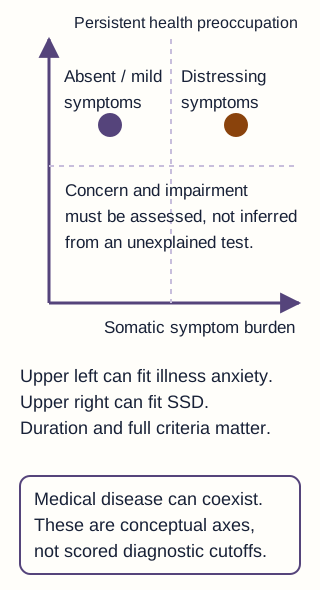
Two questions before a diagnostic label. The axes separate symptom burden from health preoccupation. A full assessment, duration and impairment are needed; the figure supplies no diagnostic cutoff. Source relationship. Enlarge this diagram
A normal test is information about the question that test addressed, not a psychiatric diagnosis. Start by asking what the person feels, how much it disrupts daily life, and what they think or do in response. Assess medical explanations alongside psychological and behavioral patterns. Neither distress nor repeated attendance establishes that a concern is disproportionate; access barriers, prior missed diagnoses, cultural context and the actual illness matter.
Somatic symptom disorder (SSD) requires one or more distressing somatic symptoms or symptoms that disrupt daily life, with disproportionate persistent thoughts about seriousness, persistently high symptom-related anxiety, or excessive time and energy devoted to symptoms or health concerns. The symptomatic state is persistent, typically longer than six months; the particular symptom can change. One disabling pain symptom can qualify, but chronic pain alone does not. Symptoms need not be medically unexplained, and a serious medical disease does not exclude a positive assessment of SSD. APA: positive SSD assessmentPersistence and medical reassessment
Illness anxiety disorder centers on preoccupation with having or acquiring serious illness for at least six months, with absent or only mild somatic symptoms, high health anxiety, and excessive checking or maladaptive avoidance. The feared disease can change without restarting the duration clock. Where medical disease or high risk is present, the preoccupation must be clearly excessive or disproportionate; realistic surveillance is not a disorder. This coexistence clause appears in criterion B of the DSM-5 comparison table reproduced by SAMHSA. Do not automatically relabel a person when one new symptom appears. Reassess burden, duration, context and competing explanations. Illness anxiety overviewSAMHSA table 3.32, criterion B
Imagine a plane with symptom burden on one axis and excessive preoccupation on the other. Severe arthritis pain with proportionate concern differs from equally severe pain plus a persistent disabling pattern of excessive checking. The laboratory result is not either axis. This comparison organizes assessment; it is not a diagnostic scoring tool.
Two people have the same arthritis pain. One follows agreed care; the other has a year of disabling checking that displaces safe activity. What additional dimension changes the assessment?
Which feature differs despite equal pain? The persistent response to symptoms differs.
Does confirmed arthritis exclude a concurrent SSD assessment? Medical disease does not exclude SSD.
Transfer: Would severe pain with proportionate concern alone establish SSD?
Worked example: No. Equal pain does not imply equal psychological assessment. SSD requires the excessive symptom-related response as well as distressing or disruptive symptoms.
Apply this idea to a patient
Case 1
Show answer and explanations for case 1
A. Somatic symptom disorder; target checking alongside ongoing arthritis care (Best answer)
Which feature weighs against that formulation here?
Pain itself substantially disrupts sleep and daily life.
Which dimensions must remain separate?
Distinguish somatic burden from the severity of disease fear.
Read this explanation together
Disease-focused checking resembles illness anxiety. Pain itself substantially disrupts sleep and daily life. Distinguish somatic burden from the severity of disease fear.
C. Somatic symptom disorder; prioritize increased immunosuppression before behavioral work (Why this does not fit)
Which part of this choice fits the presentation?
The persistent pain and disabling checking support an SSD assessment.
What fails to support immunosuppression escalation?
Serial findings do not support increased inflammatory activity.
What should determine disease-treatment escalation?
Base disease-treatment escalation on disease evidence rather than checking intensity.
Read this explanation together
The persistent pain and disabling checking support an SSD assessment. Serial findings do not support increased inflammatory activity. Base disease-treatment escalation on disease evidence rather than checking intensity.
D. Inflammatory disease activity; prioritize increased immunosuppression before behavioral work (Why this does not fit)
Why does arthritis remain clinically relevant?
Arthritis can produce genuine persistent pain.
What does inflammation alone leave unexplained?
Improved inflammatory findings do not explain the escalating restriction of safe activity.
How should the three clinical dimensions be assessed?
Assess pain and excessive responses separately from inflammatory activity.
Read this explanation together
Arthritis can produce genuine persistent pain. Improved inflammatory findings do not explain the escalating restriction of safe activity. Assess pain and excessive responses separately from inflammatory activity.
Takeaway: Confirmed disease does not exclude SSD, and excessive checking is not a measure of inflammatory activity.
Why checking can give relief without resolving worry
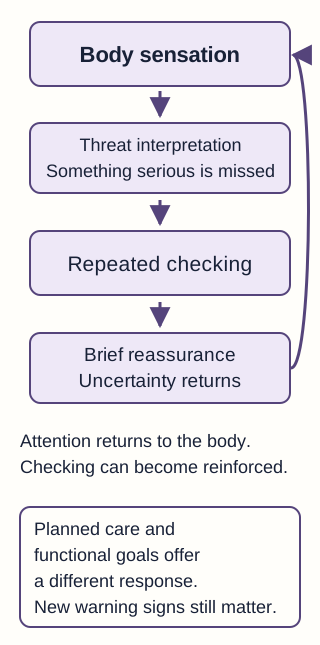
Why reassurance may not last. The return arrow represents renewed attention and uncertainty after brief relief. Planned care includes reassessment when symptoms or objective findings change. Source relationship. Enlarge this diagram
A possible health-anxiety pattern begins with a sensation, followed by a threatening interpretation. Attention narrows toward the body. Checking or seeking reassurance briefly reduces distress, making that response more likely next time. When uncertainty returns, the person checks again. The short relief is real, but it can reinforce a behavior that keeps attention fixed on threat. This is a working psychological model, not proof of a specific brain lesion or an explanation for every patient's symptoms.
Separate appropriate medical review from repeated low-value reassurance rituals. A recommended blood pressure check is not pathological because it involves checking. Ask what triggers the behavior, whether it is agreed clinical monitoring, how long relief lasts, and what valued activity is displaced. Avoidance can also maintain worry: not opening a routine appointment letter reduces immediate anxiety while preventing useful care.
Cognitive behavioral therapy (CBT) can help patients test feared predictions, reconsider catastrophic interpretations and gradually reduce unhelpful safety behaviors. A collaborative plan might replace repeated unscheduled body checks with an agreed monitoring plan and a gradual return to an activity judged safe. Graded practice should begin with an achievable task and address the actual avoided situation, such as approaching a clinic, rather than require anxiety to disappear first. The goal is not to ignore bodily information. New objective findings still enter ordinary medical assessment. APA treatment overviewCHAMP trial
Worked comparison: a person gets ten minutes of relief after each internet search, then starts another search and misses dinner with family. The model predicts repeated searching will be reinforced by that short relief. A planned experiment can examine whether tolerating uncertainty permits dinner participation. It cannot promise that anxiety immediately falls, or prove that an underlying disease is absent.
A search calms fear for ten minutes, then the person searches again. What consequence may make the second search more likely?
What immediately follows the search? Fear briefly decreases.
How can brief relief affect future checking? Relief can reinforce the checking response.
Transfer: Should an agreed disease-monitoring test be treated as the same behavior?
Worked example: No. Clinical purpose distinguishes indicated monitoring from repetitive reassurance rituals. A planned activity experiment can reduce ritual checking without canceling needed care.
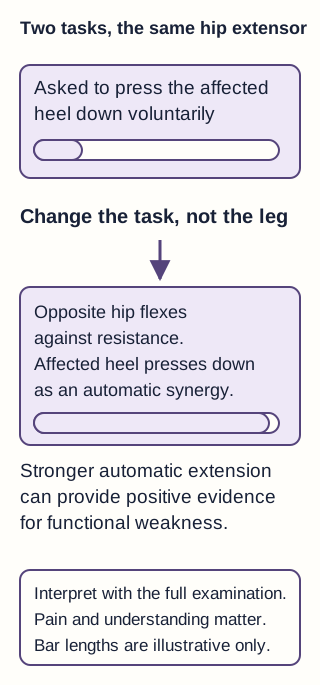
Compare voluntary and automatic activation. Hoover testing compares two tasks involving the same hip extension. The pattern supports clinical assessment; it does not prove intent or exclude coexisting disease. Source relationship. Enlarge this diagram
Functional neurologic disorder (FND), also called functional neurological symptom disorder or conversion disorder, involves genuinely experienced neurologic symptoms. Symptoms are not intentionally produced. Diagnosis rests on appropriate positive clinical features interpreted in the neurologic context, not simply normal imaging, an unusual story, emotional calmness or a recent stressor. A psychosocial stressor is not required. FND can coexist with neurologic disease. NINDS overviewSpecialty diagnostic review
For functional leg weakness, a clinician may compare impaired voluntary hip extension with preserved automatic extension during resisted flexion of the opposite hip. This is the pattern assessed by Hoover's sign. It supports functional weakness when technically appropriate and consistent with the wider examination. It does not prove deception, locate a damaged brain region, or exclude every other disorder. Pain, difficulty understanding instructions and attention can confound testing; give-way weakness alone is nonspecific. A repeat after those confounders are addressed can be informative. Seek expert assessment when interpretation is uncertain. Prospective Hoover-sign study
For tremor, entrainment means that the tremor changes toward the rhythm of a voluntary task performed with another limb. Reproducible frequency changes and other compatible examination findings can support functional tremor. A tremor merely getting worse with stress is not enough. The hip-extension comparison is a motor activation model; it is not the mechanism of tremor or a test for functional seizures.
Functional seizures require assessment of the events themselves: history, witness accounts, available videos and compatible semiology. Video electroencephalography (video EEG) of typical events is useful where indicated and feasible, especially when diagnostic ambiguity remains. A normal routine EEG between attacks does not establish FND. Retained awareness alone is nonspecific, and some epileptic events lack a clear scalp EEG correlate. If two event types occur, evaluating one does not classify the other. Brief postural collapse can require a syncope assessment, even if jerking occurs; when classification is uncertain, blood pressure and cardiac rhythm during events can help distinguish physiologic causes. Event differentialAAN functional seizure guidance
Direct left hip extension is weak, but extension becomes strong during resisted right hip flexion. What activation contrast is being examined?
Which activation context restores left extension in this example? The opposite-hip task accesses automatic extension.
What can this support in an otherwise compatible specialist examination? It can support functional weakness.
How would substantial pain alter interpretation? Pain can make the comparison unreliable.
Transfer: Can that hip test classify an unrecorded seizure-like event?
Worked example: No. The schematic concerns leg activation, not seizure mechanisms. Seizure-like episodes need their own compatible event evaluation. This is an educational model, not a diagnostic tool.
Apply this idea to a patient
Case 11
Show answer and explanations for case 11
A. Classify both types as functional; begin tapering after explaining the daytime recording (Why this does not fit)
What does the daytime recording establish?
The daytime recording supports a functional diagnosis for that phenotype.
What is outside the scope of that recording?
The distinct nocturnal events were not assessed by that recording.
What must precede the medication-indication decision?
Confirm the relevant event types before withdrawing treatment intended for possible epilepsy.
Read this explanation together
The daytime recording supports a functional diagnosis for that phenotype. The distinct nocturnal events were not assessed by that recording. Confirm the relevant event types before withdrawing treatment intended for possible epilepsy.
B. Classify both types as epileptic; retain medication because the nocturnal pattern is stereotyped (Why this does not fit)
Why does epilepsy remain under consideration?
The nocturnal phenotype warrants epilepsy assessment.
Does that concern negate the daytime findings?
It does not overturn the compatible positive evaluation of the daytime attacks.
How should different phenotypes be classified?
Distinct event types may require different classifications.
Read this explanation together
The nocturnal phenotype warrants epilepsy assessment. It does not overturn the compatible positive evaluation of the daytime attacks. Distinct event types may require different classifications.
C. Classify the daytime type as functional; assess nocturnal events before deciding the epilepsy indication (Best answer)
Which classification is currently supported?
The daytime findings support a functional event classification.
Which separate diagnostic question remains open?
The unrecorded nocturnal phenotype leaves a separate epilepsy question unresolved.
How should antiseizure treatment be reviewed?
Review antiseizure treatment against each established indication.
Read this explanation together
The daytime findings support a functional event classification. The unrecorded nocturnal phenotype leaves a separate epilepsy question unresolved. Review antiseizure treatment against each established indication.
D. Leave both types unclassified; defer the daytime explanation until nocturnal recording is complete (Why this does not fit)
Which part of the assessment remains uncertain?
The nocturnal classification remains uncertain.
What can already be explained to the patient?
The daytime evaluation already supports a specific explanation.
How should the differing certainty be communicated?
Communicate established findings while separating the unresolved event type.
Read this explanation together
The nocturnal classification remains uncertain. The daytime evaluation already supports a specific explanation. Communicate established findings while separating the unresolved event type.
Takeaway: One classified event phenotype does not classify a second phenotype or settle every medication indication.
Depression can cause fatigue, poor sleep and pain without SSD. A sustained cluster of depressed mood or loss of pleasure with sleep, concentration, guilt or other associated symptoms and impairment deserves its own assessment. Consider medical explanations, medicines and bipolar history rather than attributing every new symptom to longstanding pain. Generalized anxiety can involve several life domains. Panic attacks produce abrupt surges of fear and bodily symptoms; illness anxiety can persist between events. NIMH: depression assessment
Obsessive-compulsive disorder can have health-related obsessions even when no other theme is present. Assess the form of the intrusive thoughts and rituals rather than assuming that every health worry is illness anxiety. A ritual may be silent, such as mentally repeating a protective phrase. Exposure and response prevention addresses the neutralizing response as well as the trigger; replacing spoken repetition with silent repetition preserves the compulsion. These conditions can coexist, so document the positive findings supporting each formulation. NIMH: obsessions, mental compulsions and treatment
Neurologic and general medical differentials remain active. Acute focal deficits need appropriate urgent evaluation. Functional visual or sensory symptoms require specialist interpretation of compatible positive patterns, not a normal scan or the patient's emotional response. On tangent-screen testing, a fixed angular field should occupy a larger physical diameter when testing distance increases. Reproducible failure to expand can support a functional visual component when technique is adequate. It does not establish intention or exclude coexisting disease. A new reproducible central scotoma warrants retinal or optic-nerve assessment even after a positive functional examination. A retrospective neuro-ophthalmology series supports this caution; its referral population does not supply a universal prevalence estimate. Positive visual examinationCoexisting neuro-ophthalmologic disease
Disability, compensation claims, inconsistent accounts, medical knowledge and surgical scars are not evidence of intentional falsification. Fluctuation or improved automatic function can occur without deception. Compare an observation with the actual claim: five minutes of walking does not contradict a stated ten-minute tolerance, and it does not measure capacity for an eight-hour shift. Diagnostic pitfalls
Factitious disorder requires identified intentional falsification or induction of illness with deceptive presentation, even in the absence of obvious external rewards. A clinician does not need to prove a wish for attention. Motivation may remain unclear. Malingering is intentional falsification for an external gain, such as financial compensation; an incentive alone does not establish it. Do not infer either category from unexplained symptoms. When one document is demonstrably false, identify exactly which claim it invalidates. Independently authenticated disease remains a separate source of evidence. Use respectful, nonpunitive harm reduction and coordinated psychiatric input rather than making care depend on a confession or a precise motive. Factitious assessment and management
When verified falsification involves another person, protect that person's safety and involve the appropriate safeguarding team. The factitious diagnosis, if supported, pertains to the person falsifying, not the person harmed. Genuine disease can coexist in the affected person; safeguarding and necessary medical treatment may both be required. Record observed evidence without moral judgments and coordinate care. A past documented deception does not make every future complaint false. New illness still deserves proportionate assessment. Factitious disorder imposed on another
A patient seeking compensation has variable symptoms, but no falsification is identified. What can be concluded about intention?
What does the compensation request establish? An external incentive is present.
What evidence is still needed before a malingering conclusion? Intentional falsification must be established.
Transfer: Would medical expertise or surgical scars supply that evidence?
Worked example: No. Neither medical knowledge nor scars establish deception. Document actual observations; when falsification is verified, distinguish absent obvious reward from a demonstrated external-gain purpose.
Keep independent neurologic evidence separate. Brief pauses accompanied by generalized 3-Hz spike-wave during a typical recorded event support absence seizures, even if a caregiver has fabricated a different event type. Hyperventilation may bring out this pattern. For absence seizures without another seizure type, ethosuximide has an established treatment role. Identified fabrication does not erase that electroclinical evidence. ILAE absence EEGNICE absence treatment
Explain the finding and build a shared plan
Begin with the patient's experience: symptoms are real, distress is understandable, and treatment does not require pretending nothing is wrong. Explain the positive basis of the working diagnosis and any remaining uncertainty. For functional weakness, a clinician can demonstrate the observed difference between voluntary and automatic activation as evidence of potentially accessible function, not as a test the patient failed. Ask what the explanation means to the patient before proceeding to treatment. Communicating FND
Agree on planned follow-up with a coordinating clinician, alongside necessary specialty care. Review symptoms, examine as clinically indicated, track function and discuss when to seek earlier care. Set goals such as returning to a short walk, attending school, or reducing time lost to checking. Avoid an agreement that forbids all future tests. Equally, do not use repeated broad imaging as the default response to an unchanged presentation after an appropriate assessment. Continuity and monitoring
Match treatment to the problem. CBT can address health anxiety and unhelpful coping patterns. Motor FND may benefit from physiotherapy or occupational therapy oriented toward functional retraining and daily activities. When attention to a destination supports better walking than close monitoring of each muscle, task-based practice can use that demonstrated access to function. Bedside strength need not normalize before useful walking practice begins. Pain and other comorbidity may require different priorities. These are individualized rehabilitation principles, not a promise of recovery. Motor rehabilitation consensus
Functional seizures call for an individualized explanation, safety plan and appropriate psychological treatment, not simply the motor exercises used for leg weakness. With consent, involve family in supporting participation rather than constant checking. Treat comorbid depression, anxiety, pain and other medical conditions on their own merits. An antidepressant may be appropriate for depression; that is not a promise to cure SSD or FND. Antiseizure drugs do not treat functional seizures, but may still be needed for coexisting epilepsy or another indication. Review every habitual event type and the medication's actual indication. Changes require supervised review, not abrupt self-discontinuation. Avoid sedative or opioid escalation merely to silence unexplained symptoms; legitimate medication indications still require individualized care. Multidisciplinary careFunctional seizure treatment and medication review
Stable symptoms lead to a request for a fourth nonindicated scan because the patient fears abandonment. What can replace the scan without ending care?
What aspect of care can be made reliable without more imaging? Agree on planned clinical follow-up.
What outcome can be targeted alongside distress? Choose a meaningful daily-function goal.
Transfer: Does this plan prohibit tests if the symptoms change?
Worked example: No. A coordinated plan limits low-value repetition today while preserving reassessment tomorrow. Psychological care and appropriate rehabilitation supplement ordinary medical care.
Review the indication, not just the drug class. A person with functional seizures may still need lamotrigine for bipolar I maintenance. Derive that indication from the mood history: a sustained elated, highly activated episode with markedly reduced sleep need and serious impairment differs from brief distress around an attack. Lamotrigine can be used for maintenance after acute stabilization; this is not evidence that it treats functional seizures or acute mania. AAN medication guidanceOfficial lamotrigine indicationNIMH mood-course assessment
Apply this idea to a patient
Case 20
Show answer and explanations for case 20
A. Arrange one further reassurance scan and offer return visits whenever uncertainty rises (Why this does not fit)
What short-term benefit makes another scan tempting?
A scan may briefly lower fear.
What has that strategy not restored?
The prior pattern shows that this relief has not restored durable participation.
What is insufficient reason to repeat the strategy?
Do not repeat a reassurance strategy solely because it briefly reduces distress.
Read this explanation together
A scan may briefly lower fear. The prior pattern shows that this relief has not restored durable participation. Do not repeat a reassurance strategy solely because it briefly reduces distress.
B. Schedule coordinated reviews with a meal-participation goal and criteria for earlier medical reassessment (Best answer)
What has repeated imaging accomplished in this case?
Repeated imaging has supplied brief relief without changing the attendance pattern.
What addresses her stated concern about losing care?
Reliable scheduled contact directly addresses her fear of losing care.
What should replace the low-value repetition?
Replace low-value repetition with continuity and a specific functional goal.
Read this explanation together
Repeated imaging has supplied brief relief without changing the attendance pattern. Reliable scheduled contact directly addresses her fear of losing care. Replace low-value repetition with continuity and a specific functional goal.
C. Refer for CBT with primary-care review only after the course is completed (Why this does not fit)
What makes CBT a relevant treatment?
CBT can address health-anxiety behaviors.
What does delayed medical contact leave unanswered?
Deferring medical contact leaves her stated fear of abandonment unanswered.
How should psychological and medical care be organized?
Integrate psychological treatment with continuing clinical responsibility.
Read this explanation together
CBT can address health-anxiety behaviors. Deferring medical contact leaves her stated fear of abandonment unanswered. Integrate psychological treatment with continuing clinical responsibility.
D. Continue symptom-triggered medical appointments while postponing functional goals until discomfort resolves (Why this does not fit)
When does medical review remain appropriate?
Medical review remains available when clinically indicated.
What opportunity is lost by waiting for symptom resolution?
Waiting for symptom disappearance leaves the agreed participation goal untested.
How should symptom and function outcomes be tracked?
Track function alongside symptoms rather than making one conditional on the other.
Read this explanation together
Medical review remains available when clinically indicated. Waiting for symptom disappearance leaves the agreed participation goal untested. Track function alongside symptoms rather than making one conditional on the other.
Takeaway: Continuity can replace reassurance testing without making care conditional on symptom resolution.
Follow-up is a continuing clinical relationship, not the end of medical reasoning. New gastrointestinal bleeding, progressive objective weakness, a changed event pattern or other concerning findings warrant assessment appropriate to urgency. A previously adequate workup answers the earlier presentation; it is not lifetime clearance. New symptoms without an objective abnormality also deserve a fresh history and examination rather than automatic dismissal. Balance the risks of unnecessary testing with the risks of diagnostic overshadowing.
For stable symptoms, measure what matters to the person: activity, attendance, sleep, symptom distress and time consumed by health behaviors. Improvement in function can be meaningful even if a symptom persists. Mood improvement does not itself establish pain remission. Relapse need not mean deliberate behavior or that treatment was useless. Review obstacles, comorbidity and whether the original diagnosis still fits, then revise the plan collaboratively.
CHAMP randomized 444 medical outpatients with excessive health anxiety to adapted CBT or standard care. Its primary endpoint was health-anxiety improvement at one year. The between-group improvement was 2.98 Health Anxiety Inventory points in favor of CBT, with a 95% confidence interval of 1.64 to 4.33. Social functioning and health-related quality of life did not differ significantly. Patients under investigation for new pathology were excluded. This supports a particular treatment for a particular population, not a cure for all SSD or FND or a reason to cancel a new medical investigation. CHAMP primary report
CODES randomized 368 adults with dissociative seizures to seizure-specific CBT plus standardized medical care or standardized care alone. Monthly seizure frequency at 12 months, the primary endpoint, did not differ significantly: incidence rate ratio 0.78, 95% confidence interval 0.56 to 1.09. Several secondary outcomes, including psychosocial functioning, favored CBT, but the report did not correct these comparisons for multiplicity. One, not zero, is the no-difference value for a rate ratio. A nonsignificant primary endpoint does not establish equivalence or prove no patient can benefit; favorable secondary endpoints do not establish the primary result. CODES primary report
A trial has a nonsignificant primary seizure-frequency result but favorable secondary function outcomes. Which claim must be avoided?
What claim is unsupported when the incidence rate ratio confidence interval includes one? A proven seizure-frequency reduction must not be claimed.
What can favorable secondary function outcomes still suggest? They can suggest potential benefits in another domain, with multiple-comparison uncertainty.
Transfer: Can a positive health-anxiety trial establish benefit for every motor FND presentation?
Worked example: No. CHAMP studied health anxiety, while CODES studied dissociative seizures. Match the population and outcome before using a trial to counsel a patient. Secondary comparisons also need attention to multiplicity.
Clinical practice
These original educational cases ask for the best interpretation or next action under the stated conditions.
Case 2
Show answer and explanations for case 2
A. Somatic symptom disorder; add health-anxiety therapy while retaining scheduled surveillance (Why this does not fit)
What establishes clinically important impairment?
The health behaviors cause marked impairment.
What separates this pattern from symptom-centered SSD?
Bodily symptoms are mild rather than the central source of distress.
What should not be inferred from severe fear?
Severe preoccupation does not itself establish substantial somatic burden.
Read this explanation together
The health behaviors cause marked impairment. Bodily symptoms are mild rather than the central source of distress. Severe preoccupation does not itself establish substantial somatic burden.
B. Illness anxiety disorder; replace scheduled surveillance with symptom-triggered oncology visits (Why this does not fit)
Which part of the formulation fits?
Persistent disabling disease preoccupation supports illness anxiety in this context.
What independently supports scheduled oncology care?
Her cancer history still supplies an independent surveillance indication.
How does anxiety treatment affect that indication?
Treating excessive fear does not remove indicated medical monitoring.
Read this explanation together
Persistent disabling disease preoccupation supports illness anxiety in this context. Her cancer history still supplies an independent surveillance indication. Treating excessive fear does not remove indicated medical monitoring.
C. Illness anxiety disorder; add health-anxiety therapy while retaining scheduled surveillance (Best answer)
What supports an illness-anxiety assessment?
Nine months of disabling checking with mild symptoms supports illness anxiety.
What remains after a reassuring reassessment?
Completed reassessment does not remove her established surveillance needs.
How should the two care targets be combined?
Treat excessive preoccupation alongside indicated cancer care.
Read this explanation together
Nine months of disabling checking with mild symptoms supports illness anxiety. Completed reassessment does not remove her established surveillance needs. Treat excessive preoccupation alongside indicated cancer care.
D. Proportionate cancer concern; add reassurance visits between scheduled surveillance visits (Why this does not fit)
Why should concern not automatically be labeled pathological?
A cancer history makes some concern appropriate.
What distinguishes the observed extra visits from useful surveillance?
Repeated extra visits provide brief relief while the disabling checking continues.
What context determines whether preoccupation is excessive?
Judge excess against actual risk and function rather than the presence of disease alone.
Read this explanation together
A cancer history makes some concern appropriate. Repeated extra visits provide brief relief while the disabling checking continues. Judge excess against actual risk and function rather than the presence of disease alone.
Takeaway: Illness anxiety can coexist with real disease when preoccupation is excessive in context; surveillance remains indication-based.
A. Somatic symptom disorder without a superimposed major depressive episode (Why this does not fit)
What supports a somatic-symptom formulation before the last month?
Persistent catastrophic checking accompanied substantial pain for eight months.
Which newer findings are not explained by that formulation alone?
Four weeks of pervasive low mood and anhedonia accompany several additional depressive symptoms.
What does the distinct newer trajectory require?
Assess a superimposed depressive episode rather than absorbing it into the existing symptom response.
Read this explanation together
Persistent catastrophic checking accompanied substantial pain for eight months. Four weeks of pervasive low mood and anhedonia accompany several additional depressive symptoms. Assess a superimposed depressive episode rather than absorbing it into the existing symptom response.
B. Illness anxiety disorder without a superimposed major depressive episode (Why this does not fit)
What makes illness anxiety a tempting alternative?
The patient spends substantial time fearing paralysis.
Which bodily feature favors SSD instead?
The physical pain remains substantial and disabling.
What additional syndrome does the recent course support?
The sustained mood and anhedonia pattern supports a depressive episode.
Read this explanation together
The patient spends substantial time fearing paralysis. The physical pain remains substantial and disabling. The sustained mood and anhedonia pattern supports a depressive episode.
C. Somatic symptom disorder with a superimposed major depressive episode (Best answer)
Which longstanding pattern supports SSD?
Substantial pain is accompanied by sustained excessive checking and avoidance.
What does the newer symptom course establish separately?
Pervasive low mood and anhedonia with associated symptoms persist for four weeks with additional impairment.
Why are two formulations needed?
The earlier symptom-response disorder and the newer depressive episode explain distinct trajectories.
Read this explanation together
Substantial pain is accompanied by sustained excessive checking and avoidance. Pervasive low mood and anhedonia with associated symptoms persist for four weeks with additional impairment. The earlier symptom-response disorder and the newer depressive episode explain distinct trajectories.
D. Illness anxiety disorder with a superimposed major depressive episode (Why this does not fit)
Which part of this formulation fits the recent findings?
The four-week mood and anhedonia pattern supports a depressive episode.
What distinguishes the earlier syndrome from illness anxiety?
Distressing somatic symptoms are substantial rather than absent or mild.
Which additional formulation better fits that burden?
An excessive response to substantial somatic symptoms supports SSD.
Read this explanation together
The four-week mood and anhedonia pattern supports a depressive episode. Distressing somatic symptoms are substantial rather than absent or mild. An excessive response to substantial somatic symptoms supports SSD.
Takeaway: Separate the duration and content of each syndrome; a new depressive episode does not explain away a preceding somatic-symptom disorder.
The same disabling pattern continued when the feared disease changed.
Which duration should be counted?
Count the duration of preoccupation rather than time devoted to one disease.
Read this explanation together
Health-specific preoccupation dominates despite mild somatic symptoms. The same disabling pattern continued when the feared disease changed. Count the duration of preoccupation rather than time devoted to one disease.
B. Illness anxiety disorder remains premature; count five weeks of leukemia fear (Why this does not fit)
What does the five-week interval describe?
The current disease focus began five weeks ago.
How long has the underlying pattern lasted?
The preoccupation itself has continued for seven months.
Does a different feared illness restart the clock?
A change in feared illness does not restart the duration requirement.
Read this explanation together
The current disease focus began five weeks ago. The preoccupation itself has continued for seven months. A change in feared illness does not restart the duration requirement.
C. Generalized anxiety disorder; count the uninterrupted seven-month worry pattern (Why this does not fit)
What makes a chronic anxiety disorder worth considering?
The worry pattern is prolonged and impairing.
What limits the generalized-worry interpretation?
Worries across other life domains are brief and manageable.
What distinction should the duration not obscure?
Prolonged health preoccupation is not interchangeable with generalized worry.
Read this explanation together
The worry pattern is prolonged and impairing. Worries across other life domains are brief and manageable. Prolonged health preoccupation is not interchangeable with generalized worry.
D. Somatic symptom disorder; count seven months of bodily-sensation monitoring (Why this does not fit)
Why might monitoring be mistaken for severe symptom burden?
Body monitoring consumes substantial time.
What is actually driving the impairment?
Bodily symptoms remain mild while fear of disease dominates.
What dimensions should be classified separately?
Classify symptom burden separately from time spent monitoring it.
Read this explanation together
Body monitoring consumes substantial time. Bodily symptoms remain mild while fear of disease dominates. Classify symptom burden separately from time spent monitoring it.
Takeaway: Changing the feared disease does not reset the six-month illness-preoccupation clock.
A. Checking builds tolerance of uncertainty; lengthen each pulse-checking session before dinner (Why this does not fit)
What immediate effect do the checks have?
Checks briefly reduce fear.
What follows that short relief?
They are followed by renewed checking rather than sustained participation.
What does relief alone fail to demonstrate?
Do not equate temporary relief with improved tolerance of uncertainty.
Read this explanation together
Checks briefly reduce fear. They are followed by renewed checking rather than sustained participation. Do not equate temporary relief with improved tolerance of uncertainty.
B. Social reward explains the checking; provide company during each extra pulse check (Why this does not fit)
What potential positive reward is present in the experiment?
Dinner provides a potentially rewarding activity.
Which observed consequence is linked to the extra checks?
The observed consequence maintaining extra checks is immediate fear reduction.
How should the intervention target be selected?
Target the consequence linked to the behavior rather than an unrelated reward.
Read this explanation together
Dinner provides a potentially rewarding activity. The observed consequence maintaining extra checks is immediate fear reduction. Target the consequence linked to the behavior rather than an unrelated reward.
C. Relief reinforces checking; shorten postponement because the initial anxiety rise indicates deterioration (Why this does not fit)
What happened to distress immediately after postponement?
Anxiety rose when the extra check was postponed.
What happened to participation despite that rise?
She nevertheless sustained dinner participation despite uncertainty.
How should distress during the experiment be interpreted?
Interpret distress during practice alongside the behavior the experiment was designed to test.
Read this explanation together
Anxiety rose when the extra check was postponed. She nevertheless sustained dinner participation despite uncertainty. Interpret distress during practice alongside the behavior the experiment was designed to test.
D. Relief reinforces checking; repeat postponed extra checks while preserving indicated monitoring (Best answer)
How can brief relief maintain the extra checking?
Short-lived relief makes extra checking more likely.
What did the postponement experiment demonstrate?
Dinner participation remained possible despite initial anxiety.
What should the next experiment preserve?
Test tolerating uncertainty without canceling medically indicated monitoring.
Read this explanation together
Short-lived relief makes extra checking more likely. Dinner participation remained possible despite initial anxiety. Test tolerating uncertainty without canceling medically indicated monitoring.
Takeaway: A behavioral experiment can test participation despite uncertainty, not prove absence of disease.
A. Use repeated risk-reassurance calls, then schedule attendance once fear remains low (Why this does not fit)
What makes telephone support an available starting resource?
Telephone contact is currently tolerable.
What does risk reassurance alone leave unpracticed?
Reassurance alone does not practice the avoided act of attending.
What should support enable?
Use support to increase participation rather than make low fear a prerequisite.
Read this explanation together
Telephone contact is currently tolerable. Reassurance alone does not practice the avoided act of attending. Use support to increase participation rather than make low fear a prerequisite.
B. Agree on a graded clinic approach, leading to attendance for the indicated care agenda (Best answer)
What consequence helps maintain cancellation?
Cancellation is reinforced by brief relief.
What current ability can the initial plan use?
Her ability to discuss attendance provides a starting point for graded practice.
What endpoint should the graded plan serve?
Link anxiety treatment to completion of indicated care.
Read this explanation together
Cancellation is reinforced by brief relief. Her ability to discuss attendance provides a starting point for graded practice. Link anxiety treatment to completion of indicated care.
C. Begin exposure to bodily sensations at home, leaving appointment planning until later (Why this does not fit)
Why might exposure be considered?
Exposure can address feared experiences.
Which feared situation is causing the present care delay?
The identified avoidance concerns clinic attendance and is delaying care.
How should the exposure target be chosen?
Match the practice target to the behavior causing the current impairment.
Read this explanation together
Exposure can address feared experiences. The identified avoidance concerns clinic attendance and is delaying care. Match the practice target to the behavior causing the current impairment.
D. Arrange the full appointment immediately, using coping support only during the examination (Why this does not fit)
What part of immediate appointment scheduling is appropriate?
Completing preventive care is an appropriate goal.
What makes the proposed first task poorly matched?
She currently cannot enter the clinic and requests help reaching that step.
How should the first practice task be selected?
Choose an achievable agreed starting task rather than an inaccessible endpoint.
Read this explanation together
Completing preventive care is an appropriate goal. She currently cannot enter the clinic and requests help reaching that step. Choose an achievable agreed starting task rather than an inaccessible endpoint.
Takeaway: Graded practice should address the actual avoidance and preserve the medical purpose of attendance.
A. Progress isolated maximal contractions to rebuild a consistently unavailable motor pathway (Why this does not fit)
What finding could tempt an isolated-strength approach?
Direct contraction is impaired during examination.
What demonstrates access to force in another context?
Strong automatic extension demonstrates access to force in another task.
What conclusion does the direct test alone not justify?
Do not infer a consistently unavailable pathway from the voluntary test alone.
Read this explanation together
Direct contraction is impaired during examination. Strong automatic extension demonstrates access to force in another task. Do not infer a consistently unavailable pathway from the voluntary test alone.
B. Use pain-contingent pacing before attempting externally directed walking tasks (Why this does not fit)
When would pain-focused pacing be relevant?
Pain can limit motor testing and rehabilitation.
What limits that explanation here?
This patient has no pain during the relevant tasks.
What should determine the initial target?
Select the initial rehabilitation target from the demonstrated limitation.
Read this explanation together
Pain can limit motor testing and rehabilitation. This patient has no pain during the relevant tasks. Select the initial rehabilitation target from the demonstrated limitation.
C. Build goal-directed stepping that uses preserved automatic activation with less self-monitoring (Best answer)
What does the adequate activation comparison support?
The reproducible activation contrast supports a functional component.
Which therapy context permits better performance?
Externally directed stepping accesses better performance than isolated self-monitoring.
How should the walking goal use that finding?
Build meaningful tasks around demonstrated preserved function.
Read this explanation together
The reproducible activation contrast supports a functional component. Externally directed stepping accesses better performance than isolated self-monitoring. Build meaningful tasks around demonstrated preserved function.
D. Repeat strength measurements until direct extension normalizes before practicing walking (Why this does not fit)
What legitimate purpose can strength measurements serve?
Strength measurements can track an impairment.
What useful ability is already accessible?
Useful weight support is already available in a walking-related task.
Must direct extension normalize before walking practice?
Functional practice need not wait for normalization of every bedside strength measure.
Read this explanation together
Strength measurements can track an impairment. Useful weight support is already available in a walking-related task. Functional practice need not wait for normalization of every bedside strength measure.
Takeaway: A positive activation contrast can guide task-based retraining without implying deception or guaranteeing recovery.
A. The first is limited by confounding; the repeat provides positive functional evidence (Best answer)
Why is the first comparison limited?
Pain and misunderstanding limit the first comparison.
What does the adequate repeat demonstrate?
The technically adequate repeat demonstrates a voluntary-automatic discrepancy.
What must be assessed before interpreting the sign?
Interpret a positive sign only after assessing how it was elicited.
Read this explanation together
Pain and misunderstanding limit the first comparison. The technically adequate repeat demonstrates a voluntary-automatic discrepancy. Interpret a positive sign only after assessing how it was elicited.
B. Both provide positive functional evidence; repeated weakness is the decisive feature (Why this does not fit)
What finding was repeated across visits?
Weakness occurred at both visits.
What did the first visit fail to establish?
The first visit did not establish a reliable activation contrast.
Does repetition make the original examination reliable?
Repetition does not repair a confounded examination.
Read this explanation together
Weakness occurred at both visits. The first visit did not establish a reliable activation contrast. Repetition does not repair a confounded examination.
C. The first supports structural weakness; the repeat documents recovery from that lesion (Why this does not fit)
What was observed during the painful assessment?
Both tasks were weak when pain was severe.
What competing explanations remain for that result?
The first result cannot distinguish structural loss from pain-limited performance.
What does changed technique not establish?
Do not infer lesion recovery from a change in testing conditions.
Read this explanation together
Both tasks were weak when pain was severe. The first result cannot distinguish structural loss from pain-limited performance. Do not infer lesion recovery from a change in testing conditions.
D. Both remain pain-limited; continue treating the discrepancy as residual guarding (Why this does not fit)
When is guarding a plausible interpretation?
Guarding is plausible during the painful first assessment.
What undermines guarding as the repeat explanation?
The repeat discrepancy persists during painless and understood tasks.
How should the interpretation respond to that change?
Update an examination interpretation when the proposed confounder is no longer present.
Read this explanation together
Guarding is plausible during the painful first assessment. The repeat discrepancy persists during painless and understood tasks. Update an examination interpretation when the proposed confounder is no longer present.
Takeaway: An unreliable first examination does not invalidate a later technically adequate positive comparison.
A. Enhanced physiologic tremor; emphasize relaxation because stress increases amplitude (Why this does not fit)
What makes physiologic tremor a tempting comparison?
Stress can increase physiologic tremor.
Which finding is more discriminating here?
The reproducible frequency adaptation requires more weight than amplitude change alone.
What should determine the tremor formulation?
Interpret the pattern across tasks rather than one nonspecific trigger.
Read this explanation together
Stress can increase physiologic tremor. The reproducible frequency adaptation requires more weight than amplitude change alone. Interpret the pattern across tasks rather than one nonspecific trigger.
B. Functional tremor; emphasize isolated hand monitoring until its rhythm becomes stable (Why this does not fit)
Which part of this choice fits the examination?
The reproducible frequency changes support functional tremor.
What weighs against increased hand monitoring?
Watching the hand is associated with poorer task performance here.
How should the attentional strategy be selected?
Use the patient's task response to choose the attentional strategy.
Read this explanation together
The reproducible frequency changes support functional tremor. Watching the hand is associated with poorer task performance here. Use the patient's task response to choose the attentional strategy.
C. Essential tremor; emphasize strengthening before returning to keyboard tasks (Why this does not fit)
Why does essential tremor enter the differential?
A hand tremor can impair keyboard use in essential tremor.
What favors a different explanation?
Repeated entrainment and task-related pauses support a different motor pattern.
What is insufficient to classify this tremor?
Do not classify tremor from its location alone.
Read this explanation together
A hand tremor can impair keyboard use in essential tremor. Repeated entrainment and task-related pauses support a different motor pattern. Do not classify tremor from its location alone.
D. Functional tremor; emphasize meaningful typing tasks with attention directed externally (Best answer)
What positive pattern supports the formulation?
Frequency adaptation and task-related pauses support functional tremor.
Which attention target accompanies better function?
Attention to the screen accompanies better typing performance.
How should rehabilitation use that observation?
Tailor motor retraining to a demonstrated route to useful function.
Read this explanation together
Frequency adaptation and task-related pauses support functional tremor. Attention to the screen accompanies better typing performance. Tailor motor retraining to a demonstrated route to useful function.
Takeaway: Entrainment is more informative than stress sensitivity, and treatment should use the actual task response.
A. Repeat routine interictal EEG alone, using another normal result to favor functional events (Why this does not fit)
Why can an interictal EEG still be relevant?
An interictal study can contribute to epilepsy assessment.
What would another event-free study leave unresolved?
Another event-free recording would still not classify the habitual episodes.
How should the next test be selected?
Match the test to the unresolved event-level question.
Read this explanation together
An interictal study can contribute to epilepsy assessment. Another event-free recording would still not classify the habitual episodes. Match the test to the unresolved event-level question.
B. Review the video and semiology, then seek typical-event video EEG where feasible (Best answer)
What does the nocturnal motor pattern require?
Stereotyped nocturnal posturing warrants event-specific assessment for epilepsy.
What did the prior EEG fail to sample?
The normal interictal EEG did not sample the events.
How should the unresolved classification be approached?
Combine witnessed semiology with typical-event recording when ambiguity remains.
Read this explanation together
Stereotyped nocturnal posturing warrants event-specific assessment for epilepsy. The normal interictal EEG did not sample the events. Combine witnessed semiology with typical-event recording when ambiguity remains.
C. Prioritize tilt testing with rhythm monitoring because awareness sometimes persists (Why this does not fit)
When would physiologic monitoring address the main differential?
Physiologic monitoring is useful when syncope is a competing explanation.
Why does preserved awareness not select that pathway here?
Retained awareness alone does not explain stereotyped nocturnal posturing.
What should guide the monitoring choice?
Choose monitoring based on the event phenotype rather than awareness alone.
Read this explanation together
Physiologic monitoring is useful when syncope is a competing explanation. Retained awareness alone does not explain stereotyped nocturnal posturing. Choose monitoring based on the event phenotype rather than awareness alone.
D. Prioritize a stress-trigger diary before deciding whether event recording is necessary (Why this does not fit)
What role can a trigger history serve?
Context can contribute to a clinical history.
What remains unanswered by a stress diary?
The repeated nocturnal motor pattern remains unclassified regardless of reported stress.
What must psychological context not replace?
Psychological context cannot replace assessment of the actual episodes.
Read this explanation together
Context can contribute to a clinical history. The repeated nocturnal motor pattern remains unclassified regardless of reported stress. Psychological context cannot replace assessment of the actual episodes.
Takeaway: A normal interictal EEG and retained awareness do not settle the nature of an unrecorded stereotyped event.
A. The captured events support functional seizures; the prior course supports a bipolar I maintenance indication (Best answer)
What does the combined habitual event evidence support?
Positive functional semiology accompanies preserved waking activity during apparent unresponsiveness.
Which mood diagnosis is supported by the separate longitudinal history?
The sustained activated episode with hospitalization supports prior mania and bipolar I disorder.
What independent role can lamotrigine retain?
Bipolar maintenance is a separate indication even though lamotrigine does not treat functional seizures.
Read this explanation together
Positive functional semiology accompanies preserved waking activity during apparent unresponsiveness. The sustained activated episode with hospitalization supports prior mania and bipolar I disorder. Bipolar maintenance is a separate indication even though lamotrigine does not treat functional seizures.
B. The captured events support functional seizures; the prior course does not establish a bipolar I maintenance indication (Why this does not fit)
Which event conclusion fits the recordings?
The combined habitual semiology and event EEG support functional seizures.
What does eight months without an active mood episode fail to erase?
The earlier nine-day manic episode remains evidence for bipolar I disorder.
Why can a treatment indication persist during mood stability?
Maintenance aims to delay future episodes rather than require a current episode.
Read this explanation together
The combined habitual semiology and event EEG support functional seizures. The earlier nine-day manic episode remains evidence for bipolar I disorder. Maintenance aims to delay future episodes rather than require a current episode.
C. The captured events support epileptic seizures; the prior course supports a bipolar I maintenance indication (Why this does not fit)
Which part of this interpretation fits the longitudinal history?
The previous manic episode supports an independent bipolar maintenance indication.
Which evidence argues against classifying the recorded attacks as breakthrough epilepsy?
What should not be inferred from lamotrigine use alone?
A medicine with several indications does not establish that every new attack is epileptic.
Read this explanation together
The previous manic episode supports an independent bipolar maintenance indication. Positive functional semiology accompanies organized waking activity during habitual apparent unresponsiveness. A medicine with several indications does not establish that every new attack is epileptic.
D. The captured events support epileptic seizures; the prior course does not establish a bipolar I maintenance indication (Why this does not fit)
Why can persistent shaking prompt an epilepsy hypothesis?
Lamotrigine can be used to treat epileptic seizures.
Which current findings instead support a functional interpretation?
The habitual recorded episodes have positive functional semiology with preserved waking activity.
What independent historical finding still matters to the drug review?
A previous manic episode supports a bipolar maintenance indication even during current stability.
Read this explanation together
Lamotrigine can be used to treat epileptic seizures. The habitual recorded episodes have positive functional semiology with preserved waking activity. A previous manic episode supports a bipolar maintenance indication even during current stability.
Takeaway: Identify what each medicine treats: functional seizures can coexist with a separate, supported mood-maintenance indication.
A. Repeat video EEG of the established prolonged attacks before investigating the brief collapses (Why this does not fit)
What evidence already exists for the prolonged attacks?
The established attacks already have event-specific evidence.
What would repeating that recording leave unanswered?
Repeating that assessment would not answer the new collapse question.
Where should the next assessment be directed?
Direct testing toward the changed phenotype.
Read this explanation together
The established attacks already have event-specific evidence. Repeating that assessment would not answer the new collapse question. Direct testing toward the changed phenotype.
B. Begin antiseizure escalation because jerking makes epilepsy the leading new explanation (Why this does not fit)
Why might epilepsy be considered?
Jerking can raise concern for a seizure.
What supports a competing physiologic explanation?
The postural trigger and rapid recovery also support a syncope differential.
How should the observed jerks be interpreted?
Interpret the whole event rather than equating jerks with epilepsy.
Read this explanation together
Jerking can raise concern for a seizure. The postural trigger and rapid recovery also support a syncope differential. Interpret the whole event rather than equating jerks with epilepsy.
C. Extend the functional formulation to both types and focus on a shared psychological trigger (Why this does not fit)
What makes a functional explanation available?
The patient has an established functional event type.
What is not yet covered by that formulation?
The new postural phenotype has not been explained by that diagnosis.
What limit applies to the prior diagnosis?
A prior functional diagnosis does not classify a different kind of collapse.
Read this explanation together
The patient has an established functional event type. The new postural phenotype has not been explained by that diagnosis. A prior functional diagnosis does not classify a different kind of collapse.
D. Assess a syncope differential with appropriate blood pressure and rhythm monitoring (Best answer)
What differential follows from posture and recovery?
Postural collapse with rapid recovery raises a syncope differential.
Why does the earlier recording not resolve it?
The earlier functional recording concerned a different phenotype.
What assessment matches the new question?
Use physiologic assessment appropriate to the new event when classification remains uncertain.
Read this explanation together
Postural collapse with rapid recovery raises a syncope differential. The earlier functional recording concerned a different phenotype. Use physiologic assessment appropriate to the new event when classification remains uncertain.
Takeaway: Separate event phenotypes before selecting a test; brief jerking does not remove the need to assess syncope.
A. The earlier pattern supports a functional component; the new defect warrants retinal or optic-nerve assessment (Best answer)
What does the earlier field geometry support?
Failure of the field to expand supports a nonphysiologic component in that examination.
What concern follows from the changed visual finding?
A new central scotoma raises a separate retinal or optic-nerve concern.
How should the two findings coexist in the assessment?
Positive functional findings do not exclude coexisting visual disease.
Read this explanation together
Failure of the field to expand supports a nonphysiologic component in that examination. A new central scotoma raises a separate retinal or optic-nerve concern. Positive functional findings do not exclude coexisting visual disease.
B. The earlier pattern establishes retinal disease; the new defect measures progression of the same disorder (Why this does not fit)
What makes retinal pathology relevant now?
A central scotoma can accompany retinal disease.
What did the earlier geometry not establish?
The earlier nonexpanding field does not by itself establish that pathology.
What retrospective inference should be avoided?
Do not retrospectively assign every prior finding to a newly suspected disorder.
Read this explanation together
A central scotoma can accompany retinal disease. The earlier nonexpanding field does not by itself establish that pathology. Do not retrospectively assign every prior finding to a newly suspected disorder.
C. The earlier pattern supports a functional component; the new defect is best tracked during visual retraining alone (Why this does not fit)
Which part of the functional formulation is supported?
The earlier examination provides positive functional evidence.
What requires a different next assessment?
The newly reproducible central defect changes the clinical question.
What should precede attribution to the old formulation?
Reassess a new localizing visual finding before attributing it to the established formulation.
Read this explanation together
The earlier examination provides positive functional evidence. The newly reproducible central defect changes the clinical question. Reassess a new localizing visual finding before attributing it to the established formulation.
D. The new defect invalidates the earlier functional evidence; treat both field patterns as structural loss (Why this does not fit)
Why must the new defect be investigated?
The new finding warrants investigation for visual disease.
Does it erase the earlier evidence?
It does not erase the earlier positive evidence of nonphysiologic field geometry.
What combined formulation remains possible?
Functional and structural contributions can coexist.
Read this explanation together
The new finding warrants investigation for visual disease. It does not erase the earlier positive evidence of nonphysiologic field geometry. Functional and structural contributions can coexist.
Takeaway: Positive visual testing can support a functional component while a new central defect requires targeted reassessment.
A. The video contradicts the reported limitation and supports unrestricted full-shift capacity (Why this does not fit)
What function does the video actually demonstrate?
The video shows useful short-duration activity.
How does that duration compare with the patient's claim?
That activity is within the duration the patient reported.
What should precede a contradiction finding?
Compare observations with the actual claim before calling them contradictory.
Read this explanation together
The video shows useful short-duration activity. That activity is within the duration the patient reported. Compare observations with the actual claim before calling them contradictory.
B. The video confirms the reported limitation and establishes inability to complete any full shift (Why this does not fit)
Is the observed walk compatible with the report?
The observed walk is compatible with the stated short tolerance.
What work demand does the video not measure?
A brief observation does not establish endurance across a work shift.
What is the limit of compatibility?
Compatibility is not full validation of a disability claim.
Read this explanation together
The observed walk is compatible with the stated short tolerance. A brief observation does not establish endurance across a work shift. Compatibility is not full validation of a disability claim.
C. The video is compatible with the report; sustained work capacity requires further functional assessment (Best answer)
Does the five-minute observation contradict the reported tolerance?
Five minutes of walking does not contradict a ten-minute tolerance.
What requested capacity remains unmeasured?
The observation does not measure eight-hour endurance.
How should the report state its evidentiary scope?
Limit the report to demonstrated function and the capacity still unmeasured.
Read this explanation together
Five minutes of walking does not contradict a ten-minute tolerance. The observation does not measure eight-hour endurance. Limit the report to demonstrated function and the capacity still unmeasured.
D. The benefits incentive makes the discrepancy concerning enough to document probable intentional exaggeration (Why this does not fit)
What does the benefits application establish?
The application supplies an external incentive.
What does the matched timeline fail to establish?
The matched timeline does not establish the alleged discrepancy.
What can an incentive not substitute for?
An incentive cannot substitute for evidence of intentional falsification.
Read this explanation together
The application supplies an external incentive. The matched timeline does not establish the alleged discrepancy. An incentive cannot substitute for evidence of intentional falsification.
Takeaway: Match the duration and context of an observation to the actual claim, then separate credibility from unmeasured capacity.
A. Malingering; cancel the report-based procedure while continuing verified-condition care (Why this does not fit)
What evidence of intentional conduct is present?
Intentional falsification is established.
What purpose evidence is not identified?
An obvious external reward is not identified in the assessment.
What two evidentiary questions must be separated?
Distinguish the evidence of deception from the evidence about its purpose.
Read this explanation together
Intentional falsification is established. An obvious external reward is not identified in the assessment. Distinguish the evidence of deception from the evidence about its purpose.
B. Factitious disorder; withdraw the unsupported procedure while preserving verified-condition care (Best answer)
What supports the factitious formulation?
Identified falsification without an obvious external reward supports factitious disorder.
Why does the chronic condition still warrant care?
The authenticated condition has evidence independent of the altered report.
How should the team reduce harm?
Reduce procedure-related harm without canceling legitimate medical care.
Read this explanation together
Identified falsification without an obvious external reward supports factitious disorder. The authenticated condition has evidence independent of the altered report. Reduce procedure-related harm without canceling legitimate medical care.
C. Factitious disorder; defer all medical planning until the precise psychological motive is established (Why this does not fit)
What formulation does the verified conduct support?
The deceptive presentation supports factitious disorder.
Is a precise motive needed for the immediate procedure decision?
A precise underlying motive is not required to address the unsupported procedure.
What should determine the immediate care plan?
Act on verified evidence without making care conditional on a complete motive account.
Read this explanation together
The deceptive presentation supports factitious disorder. A precise underlying motive is not required to address the unsupported procedure. Act on verified evidence without making care conditional on a complete motive account.
D. Somatic symptom disorder; proceed with the requested procedure as part of a shared symptom plan (Why this does not fit)
Can distress coexist with the medical presentation?
A patient may experience distress alongside medical illness.
What undermines the requested procedure's indication?
Deliberate alteration invalidates the report supporting this procedure.
What should support an invasive procedure?
Verify a procedure's indication rather than using it to manage distress.
Read this explanation together
A patient may experience distress alongside medical illness. Deliberate alteration invalidates the report supporting this procedure. Verify a procedure's indication rather than using it to manage distress.
Takeaway: Established deception can invalidate one proposed procedure without invalidating independently documented disease.
A. Factitious illness presentation in the letter; retain the independently documented arthritis diagnosis (Why this does not fit)
What is established about the letter?
The letter contains identified deception.
What purpose distinguishes this presentation?
The patient describes a specific external legal benefit.
How should that purpose affect the formulation?
Use the established purpose to distinguish malingering from factitious presentation.
Read this explanation together
The letter contains identified deception. The patient describes a specific external legal benefit. Use the established purpose to distinguish malingering from factitious presentation.
B. Malingering explains the current record; reassess the arthritis diagnosis as probably fabricated (Why this does not fit)
What conclusion is justified about the admission claim?
The false admission claim served an external gain.
What independent evidence supports arthritis?
Authentic arthritis records are independent of that claim.
How far should the deception conclusion extend?
Restrict a deception conclusion to evidence that actually supports it.
Read this explanation together
The false admission claim served an external gain. Authentic arthritis records are independent of that claim. Restrict a deception conclusion to evidence that actually supports it.
C. Illness anxiety explains the letter; retain the independently documented arthritis diagnosis (Why this does not fit)
Why might health anxiety occur alongside arthritis?
Real illness can cause fear about health.
What actually explains the altered admission claim?
The acknowledged alteration was intended to obtain a legal postponement.
What should not replace the verified conduct formulation?
Do not substitute an anxiety formulation for identified goal-directed falsification.
Read this explanation together
Real illness can cause fear about health. The acknowledged alteration was intended to obtain a legal postponement. Do not substitute an anxiety formulation for identified goal-directed falsification.
D. Malingering in the admission claim; retain the independently documented arthritis diagnosis (Best answer)
What purpose is established for the false claim?
The false admission claim was made for an external legal gain.
What supports retaining the arthritis diagnosis?
The arthritis diagnosis has independent authenticated support.
How should the record express the conclusion?
Document the scope of falsification without extending it to every symptom.
Read this explanation together
The false admission claim was made for an external legal gain. The arthritis diagnosis has independent authenticated support. Document the scope of falsification without extending it to every symptom.
Takeaway: Intentional falsification for external gain concerns the demonstrated claim, not automatically the person's entire medical history.
A. Factitious disorder imposed on another belongs to the caregiver; the child has a separate absence-seizure indication for ethosuximide (Best answer)
Who is responsible for the identified falsification?
The caregiver, not the child, knowingly presented fabricated illness.
What do the independently captured pauses and generalized 3-Hz discharges support?
The electroclinical pattern supports genuine typical absence seizures.
Which treatment distinction follows?
Protect the child from fabricated escalation while preserving treatment for independently supported absence seizures.
Read this explanation together
The caregiver, not the child, knowingly presented fabricated illness. The electroclinical pattern supports genuine typical absence seizures. Protect the child from fabricated escalation while preserving treatment for independently supported absence seizures.
B. Factitious disorder imposed on another belongs to the child; the child has a separate absence-seizure indication for ethosuximide (Why this does not fit)
Which neurologic conclusion is supported?
The independently recorded electroclinical pauses support absence seizures.
Why does the factitious diagnosis not belong to the child?
The caregiver performed the identified falsification.
What does being the target of fabricated illness establish?
The affected person needs protection but is not thereby the person with factitious disorder.
Read this explanation together
The independently recorded electroclinical pauses support absence seizures. The caregiver performed the identified falsification. The affected person needs protection but is not thereby the person with factitious disorder.
C. Factitious disorder imposed on another belongs to the caregiver; the child has no verified seizure indication for ethosuximide (Why this does not fit)
Why should the invented convulsions be excluded from treatment decisions?
The caregiver has acknowledged fabricating those reports.
Which separate evidence prevents classifying every event as fabricated?
Supervised EEG links the habitual pauses to generalized 3-Hz spike-wave activity.
What survives rejection of the fabricated reports?
Independently demonstrated absence seizures retain their own treatment indication.
Read this explanation together
The caregiver has acknowledged fabricating those reports. Supervised EEG links the habitual pauses to generalized 3-Hz spike-wave activity. Independently demonstrated absence seizures retain their own treatment indication.
D. Malingering belongs to the caregiver; the child has a separate absence-seizure indication for ethosuximide (Why this does not fit)
What makes an intentional-symptom formulation relevant?
The caregiver acknowledged deliberate false illness reports.
Which supplied motive finding favors factitious disorder over malingering?
Assessment identifies no apparent external reward for the presentation.
What must remain distinct from the motive assessment?
The independently demonstrated childhood absence seizures still require appropriate care.
Read this explanation together
The caregiver acknowledged deliberate false illness reports. Assessment identifies no apparent external reward for the presentation. The independently demonstrated childhood absence seizures still require appropriate care.
Takeaway: Assign a falsification diagnosis to the responsible person, then assess the affected person for genuine disease using independent evidence.
A. Withhold both plans until the patient provides a consistent explanation of the previous alteration (Why this does not fit)
What does the previous alteration justify checking?
Past alteration justifies careful attention to evidence provenance.
What already supports treatment now?
Current authenticated findings already support treatment of the new illness.
What should not delay care for verified disease?
Do not make treatment of verified disease depend on resolving a past deceptive act.
Read this explanation together
Past alteration justifies careful attention to evidence provenance. Current authenticated findings already support treatment of the new illness. Do not make treatment of verified disease depend on resolving a past deceptive act.
B. Proceed with both plans because the authenticated current illness makes the outside letter credible (Why this does not fit)
What is established by the current hospital assessment?
The current illness is independently established.
What separate document does that not authenticate?
That confirmation does not authenticate a separate procedure recommendation.
How should consequential claims be verified?
Verify each consequential claim on its own evidence.
Read this explanation together
The current illness is independently established. That confirmation does not authenticate a separate procedure recommendation. Verify each consequential claim on its own evidence.
C. Treat the authenticated illness now and verify the outside recommendation before adopting the additional procedure (Best answer)
What evidence supports proceeding with current medical treatment?
Direct observations and authenticated tests support the current medical treatment.
What remains unestablished about the additional procedure?
The outside letter has not established the separate procedure's indication.
Where should verification delay apply?
Apply verification to the uncertain claim without delaying independently supported care.
Read this explanation together
Direct observations and authenticated tests support the current medical treatment. The outside letter has not established the separate procedure's indication. Apply verification to the uncertain claim without delaying independently supported care.
D. Treat the authenticated illness now and decline the added procedure on the basis of the previous alteration (Why this does not fit)
Why should the letter not yet determine the procedure?
The unverified letter is not yet a sound basis for intervention.
Does the past alteration establish that this recommendation is false?
Prior deception does not establish the status of this new recommendation.
What should determine the procedure decision?
Resolve the current indication from its own evidence.
Read this explanation together
The unverified letter is not yet a sound basis for intervention. Prior deception does not establish the status of this new recommendation. Resolve the current indication from its own evidence.
Takeaway: Evidence provenance is claim-specific: one verified illness neither authenticates nor invalidates a separate recommendation.
A. The initial cluster primarily measured pain severity; unchanged pain indicates failure of the mood treatment (Why this does not fit)
Why might the cluster be attributed to pain?
Pain can affect sleep and concentration.
What supports a distinct mood formulation?
Sustained depressed mood and loss of pleasure support a distinct depressive syndrome.
What should determine whether the treatment helped?
Judge treatment against the condition it was intended to address.
Read this explanation together
Pain can affect sleep and concentration. Sustained depressed mood and loss of pleasure support a distinct depressive syndrome. Judge treatment against the condition it was intended to address.
B. The initial cluster supported depression; improvement now establishes remission of the somatic disorder (Why this does not fit)
What improvement is established?
Mood-related symptoms and participation have improved.
What remission is not established?
The stem does not establish resolution of the pain or its associated response pattern.
What is the limit of a domain-specific improvement?
Improvement in one domain does not establish remission in another.
Read this explanation together
Mood-related symptoms and participation have improved. The stem does not establish resolution of the pain or its associated response pattern. Improvement in one domain does not establish remission in another.
C. The initial cluster primarily indicated illness anxiety; persistent pain should become the primary anxiety-treatment endpoint (Why this does not fit)
Can psychological symptoms coexist with physical illness?
Physical illness may coexist with psychological distress.
What distinguishes the new symptom cluster from illness anxiety?
The described new cluster centers on mood and pleasure rather than disease preoccupation.
How should the treatment target be derived?
Derive the treatment target from the positive symptom pattern.
Read this explanation together
Physical illness may coexist with psychological distress. The described new cluster centers on mood and pleasure rather than disease preoccupation. Derive the treatment target from the positive symptom pattern.
D. The initial cluster supported depression; track its improvement separately from continuing pain and function goals (Best answer)
What does the initial time course and symptom pattern support?
The sustained mood and anhedonia cluster supports a depressive syndrome.
How can the discordant follow-up outcomes be interpreted?
Mood-related improvement can occur while pain persists.
How should comorbid treatment outcomes be assessed?
Assess comorbid conditions with their own outcomes rather than a single global cure criterion.
Read this explanation together
The sustained mood and anhedonia cluster supports a depressive syndrome. Mood-related improvement can occur while pain persists. Assess comorbid conditions with their own outcomes rather than a single global cure criterion.
Takeaway: Recognize a comorbid depressive syndrome from its course and symptoms, then measure its response separately from pain.
A. Continue graded destination-focused tasks and track attendance as well as symptom intensity (Best answer)
What does the four-week outcome comparison demonstrate?
Participation has improved despite unchanged heaviness.
What attentional strategy supports better stepping?
Destination-focused attention supports better performance in the observed task.
How should the next rehabilitation plan use these findings?
Build on demonstrated functional gains while continuing to track symptoms.
Read this explanation together
Participation has improved despite unchanged heaviness. Destination-focused attention supports better performance in the observed task. Build on demonstrated functional gains while continuing to track symptoms.
B. Pause task progression until heaviness falls, then resume destination-focused practice (Why this does not fit)
What important symptom has persisted?
Heaviness remains distressing.
What improved without a lower heaviness rating?
Useful participation has already increased without a lower symptom rating.
What should not be a prerequisite for task progression?
Do not require symptom disappearance before recognizing or extending functional gains.
Read this explanation together
Heaviness remains distressing. Useful participation has already increased without a lower symptom rating. Do not require symptom disappearance before recognizing or extending functional gains.
C. Continue task progression but increase moment-to-moment leg ratings to guide each step (Why this does not fit)
When can symptom measurement be useful?
Tracking symptoms across visits can be useful.
What happened during moment-to-moment self-monitoring?
Moment-to-moment self-monitoring worsened stepping in this comparison.
What two uses of attention should be distinguished?
Distinguish outcome measurement from an attentional strategy that impairs the task.
Read this explanation together
Tracking symptoms across visits can be useful. Moment-to-moment self-monitoring worsened stepping in this comparison. Distinguish outcome measurement from an attentional strategy that impairs the task.
D. Replace task practice with isolated strength training because the symptom rating has not improved (Why this does not fit)
Can strength training have a legitimate rehabilitation role?
Strength training can serve an appropriate rehabilitation goal.
Which practice does this comparison favor?
The available comparison favors externally directed functional practice here.
What should determine the next task?
Choose the next task from observed performance rather than one unchanged rating.
Read this explanation together
Strength training can serve an appropriate rehabilitation goal. The available comparison favors externally directed functional practice here. Choose the next task from observed performance rather than one unchanged rating.
Takeaway: Outcome discordance and within-task response both matter when selecting the next rehabilitation step.
A. Present the result as direct evidence of functional recovery during the current diagnostic investigation (Why this does not fit)
Which benefit did CHAMP demonstrate?
The trial showed a health-anxiety benefit.
What did the social-function comparison establish?
A significant social-function benefit was not established.
Which eligibility limit affects this patient?
Patients under investigation for new pathology were excluded.
What must match before claiming direct clinical applicability?
Match both the endpoint and eligibility before claiming direct applicability.
Read this explanation together
The trial showed a health-anxiety benefit. A significant social-function benefit was not established. Patients under investigation for new pathology were excluded. Match both the endpoint and eligibility before claiming direct applicability.
B. Use the anxiety benefit to replace the current investigation with adapted CBT (Why this does not fit)
What supports discussing adapted CBT?
Adapted CBT improved the measured anxiety endpoint.
What limits transfer to the current investigation?
The trial excluded the current diagnostic circumstance.
What can the anxiety result not decide?
An anxiety-treatment result does not settle a new medical finding.
Read this explanation together
Adapted CBT improved the measured anxiety endpoint. The trial excluded the current diagnostic circumstance. An anxiety-treatment result does not settle a new medical finding.
C. Discuss evidence for anxiety reduction while continuing medical evaluation and qualifying direct applicability (Best answer)
How should the Health Anxiety Inventory interval be interpreted?
The interval supports a benefit on the health-anxiety endpoint.
What qualifies direct population matching?
Active new-pathology investigation limits direct population matching.
How should the trial inform the current conversation?
Discuss potential anxiety treatment without substituting it for indicated medical assessment.
Read this explanation together
The interval supports a benefit on the health-anxiety endpoint. Active new-pathology investigation limits direct population matching. Discuss potential anxiety treatment without substituting it for indicated medical assessment.
D. Describe the anxiety result as inconclusive because the social-function comparison was nonsignificant (Why this does not fit)
What did the functional comparison fail to demonstrate?
The functional comparison did not demonstrate a difference.
Does that change the measured anxiety result?
The health-anxiety interval nevertheless favors CBT.
How should multiple endpoints be interpreted?
Interpret each endpoint on its own evidence before considering transfer.
Read this explanation together
The functional comparison did not demonstrate a difference. The health-anxiety interval nevertheless favors CBT. Interpret each endpoint on its own evidence before considering transfer.
Takeaway: A positive endpoint is not a benefit on every outcome, and trial exclusions matter to clinical transfer.
A. Seizure frequency was equivalent; the secondary findings establish a separate work-function benefit (Why this does not fit)
What null value lies within the frequency interval?
The frequency interval includes one, the no-difference value for a rate ratio.
Does that establish equivalence?
Nonsignificance is not an equivalence finding.
What inference should not follow a failed superiority test?
Do not convert a failed superiority test into proof of equal effects.
Read this explanation together
The frequency interval includes one, the no-difference value for a rate ratio. Nonsignificance is not an equivalence finding. Do not convert a failed superiority test into proof of equal effects.
B. A frequency advantage was not established; functional signals may inform goals with multiplicity caution (Best answer)
Why is a frequency advantage not established?
The incidence rate ratio interval includes one.
What uncertainty qualifies the secondary findings?
Favorable secondary findings remain subject to multiple-comparison uncertainty.
How can the evidence inform the patient's goals?
Discuss possible goal-relevant benefits without claiming a proven primary frequency reduction.
Read this explanation together
The incidence rate ratio interval includes one. Favorable secondary findings remain subject to multiple-comparison uncertainty. Discuss possible goal-relevant benefits without claiming a proven primary frequency reduction.
C. A frequency advantage was established; the point estimate also supports the patient's work goal (Why this does not fit)
Why might the frequency point estimate appear favorable?
The point estimate favors CBT numerically.
What limits the proposed interpretation of that estimate?
Its interval includes no frequency difference and does not measure work participation.
What information must accompany a point estimate?
Use uncertainty and endpoint identity rather than the point estimate alone.
Read this explanation together
The point estimate favors CBT numerically. Its interval includes no frequency difference and does not measure work participation. Use uncertainty and endpoint identity rather than the point estimate alone.
D. Neither frequency nor function findings can inform care because the primary endpoint was nonsignificant (Why this does not fit)
What was not demonstrated by the primary endpoint?
The primary endpoint did not demonstrate a frequency advantage.
What can the secondary results still contribute?
The secondary results still provide qualified information about other domains.
What does a nonsignificant primary result not imply?
A nonsignificant primary result does not erase all goal-relevant evidence.
Read this explanation together
The primary endpoint did not demonstrate a frequency advantage. The secondary results still provide qualified information about other domains. A nonsignificant primary result does not erase all goal-relevant evidence.
Takeaway: For a rate ratio, one is the null value; secondary signals require their own endpoint and multiplicity qualifications.
A. Continue exposure while also preventing the covert phrase repetition, with an agreed tolerable pace (Best answer)
What pattern follows from the unwanted image and ritual?
The unwanted image and neutralizing ritual support an obsessive-compulsive pattern.
What is still happening during the apparent exposure?
Silent repetition preserves the compulsion during apparent exposure.
What must response prevention include?
Response prevention must address mental rituals as well as visible ones.
Read this explanation together
The unwanted image and neutralizing ritual support an obsessive-compulsive pattern. Silent repetition preserves the compulsion during apparent exposure. Response prevention must address mental rituals as well as visible ones.
B. Continue exposure while using silent phrase repetition as the main distress-tolerance strategy (Why this does not fit)
What immediate effect makes silent repetition attractive?
Silent repetition reduces distress temporarily.
What function does it share with the spoken phrase?
It performs the same neutralizing function as the spoken ritual.
Does hiding a ritual accomplish response prevention?
A concealed compulsion is not response prevention.
Read this explanation together
Silent repetition reduces distress temporarily. It performs the same neutralizing function as the spoken ritual. A concealed compulsion is not response prevention.
C. Replace exposure with repeated reassurance about the relative's medical risk before each image (Why this does not fit)
What might draw attention toward illness-risk reassurance?
The image has health-related content.
What process actually produces the impairment?
The disabling process is the ritual used to neutralize an intrusive thought.
What should determine the therapy target?
Match therapy to the thought-response pattern rather than the topic alone.
Read this explanation together
The image has health-related content. The disabling process is the ritual used to neutralize an intrusive thought. Match therapy to the thought-response pattern rather than the topic alone.
D. Practice saying the phrase fewer times first, keeping the silent completion until exposure feels safe (Why this does not fit)
Why might a graded plan be appropriate?
A graded pace can make treatment workable.
What does retaining silent completion leave intact?
Retaining silent completion preserves the neutralizing response at issue.
How should exposure be graded without retaining the ritual?
Grade the exposure without redefining ritual completion as its endpoint.
Read this explanation together
A graded pace can make treatment workable. Retaining silent completion preserves the neutralizing response at issue. Grade the exposure without redefining ritual completion as its endpoint.
Takeaway: Infer the function of a health-themed ritual, then check whether a covert version is undermining response prevention.