Connect nasal triggers, allergy testing and treatment targets while evaluating chronic cough, recognizing overlapping causes and choosing safe next steps.
A runny nose and a persistent cough may share a cause, but finding one does not explain the other automatically. Learn to connect symptoms with exposures, interpret allergy tests, choose a treatment target, and recognize when the cough needs a wider evaluation.
Can the nose account for the cough?
Upper airway cough syndrome (UACS) describes cough associated with upper airway disease, often rhinitis or rhinosinusitis. It replaced the narrower term postnasal drip syndrome. It is a frequent consideration in adult chronic cough, not a diagnosis established by a throat sensation or a universally dominant cause in every population. Several causes can coexist. [2]
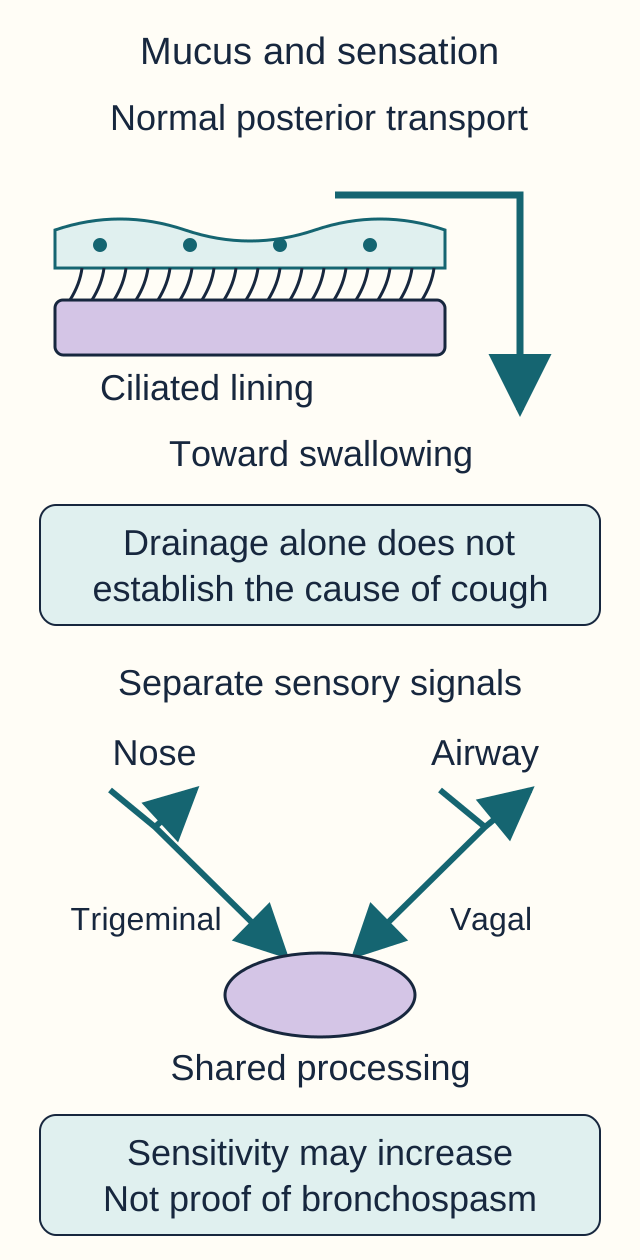
The nasal lining traps inhaled particles in mucus. Cilia carry that mucus posteriorly toward the nasopharynx, and swallowing normally clears it without coughing. Inflammation can increase secretion and alter sensation. Therefore, posterior drainage is an anatomical route, not proof that mucus has entered the lungs.
In a sensitized person, an inhaled allergen binds adjacent IgE molecules on nasal mast cells. Mediators including histamine, leukotrienes and prostaglandins act on vessels, glands and sensory endings. Early itching, sneezing and watery discharge can be followed by a later inflammatory response with eosinophils and sustained swelling. An H1 antihistamine can improve itch without fully treating the edematous lining. [1]
Cough also involves sensitivity of neural pathways. Nasal sensation travels largely through trigeminal afferents, whereas important cough-triggering afferents from the larynx and lower airways are vagal. Upper airway inflammation may influence cough hypersensitivity, and secretions may contribute to irritation in susceptible people. The older nasal-bronchial reflex explanation describes a possible neural interaction, not a proven obligatory sequence of nasal stimulation, bronchoconstriction and cough in every patient. The contribution of UACS itself and its mechanisms remain debated. [1][2][8]
Trace the mucus route and the separate sensory route in the accompanying diagram. A patient has less sneezing after an antihistamine but still has nasal blockage. Predict which part of the response has not been adequately treated.
Trace mucus toward swallowing, then trace the separate sensory routes. These simplified relationships explain why posterior drainage does not by itself establish aspiration or a cough mechanism. The neural contribution to UACS remains uncertain. [1][2][8]Compare your prediction
Persistent tissue swelling can remain after histamine-related itch improves. A change in one symptom does not establish that the entire nasal inflammatory response has stopped.
For a new patient, compare nasal symptoms and cough separately over time. Improvement in both after appropriate nasal treatment supports an upper airway contribution. Persistence of cough after the nose improves requires reassessment; it does not prove that the spray was ineffective or that more drainage must be present. Failure of dextromethorphan likewise does not locate the cause. [2]
Connect each trigger to the symptoms it produces
Allergic rhinitis requires clinically relevant IgE-mediated responses. Repeated sneezing, nasal or palatal itch, itchy eyes and clear discharge during a relevant exposure make that explanation more likely. Congestion can dominate, so lack of striking itch does not exclude allergy. Outdoor tree, grass and weed pollens often produce seasonal symptoms, with timing dependent on geography. Mites, pets, cockroach and indoor mold can produce perennial exposure. Symptom burden and sleep or work impairment matter as much as the seasonal label. [1]
Nonallergic rhinitis is a group of disorders, not simply a red-looking nose. Irritant or nonallergic rhinopathy, historically called vasomotor rhinitis, can respond to perfume, smoke, cold air, temperature or humidity changes. Gustatory rhinitis produces watery discharge with eating, often hot or spicy food, without the urticaria or systemic features of food allergy. Neural and glandular responses need not involve allergen-specific IgE. [1]
Other patterns include hormonal rhinitis during pregnancy, age-associated rhinorrhea, and atrophic disease with dryness and crusting. Ask about medicines, especially topical decongestants. Systemic medicines such as some antihypertensives can contribute. Aspirin and other cyclooxygenase-1 inhibitors may cause respiratory reactions in susceptible patients, particularly with asthma and polyps; this is not ordinary pollen allergy. Review a suspected prescription contribution with its prescriber rather than stopping cardiovascular treatment independently. [1]
Mixed rhinitis means evidence for both allergic and nonallergic components. For example, pollen exposure repeatedly causes itch and sneezing in a pollen-sensitized patient, while cold air produces watery discharge outside that season. Perennial symptoms, occasional sneezing or a partial steroid response alone do not establish the allergic component. Mixed patterns are common in referral populations, but a fixed prevalence is not a diagnostic rule. [1]
Consider two entries in one exposure diary: itchy eyes after mowing in June; watery discharge during cold-weather exercise in January. Name the feature that needs explanation beyond pollen exposure.
Compare the two episodes
Cold-weather discharge outside the pollen exposure suggests an additional nonallergic trigger. The diary supports a mixed pattern only when the allergic episode also has convincing clinical and testing support.
Apply the distinction to avoidance advice. Relevant exposure reduction can help, but eliminating an unrelated sensitization from the environment may not change symptoms. A perfume-triggered episode should not automatically prompt a larger allergen panel or a food restriction. [1]
Separate what you see from what you can conclude
Inspect the nose, eyes and throat, but use findings as supporting evidence. Pale, swollen inferior turbinates favor allergy in the right history. Erythema can occur with infection, irritation or allergy. Clear secretion, posterior pharyngeal cobblestoning and throat clearing are nonspecific. Mucosal color alone cannot separate allergic from nonallergic disease. Purulence, crusting, a focal mass or persistent unilateral obstruction deserves its own explanation. [1]
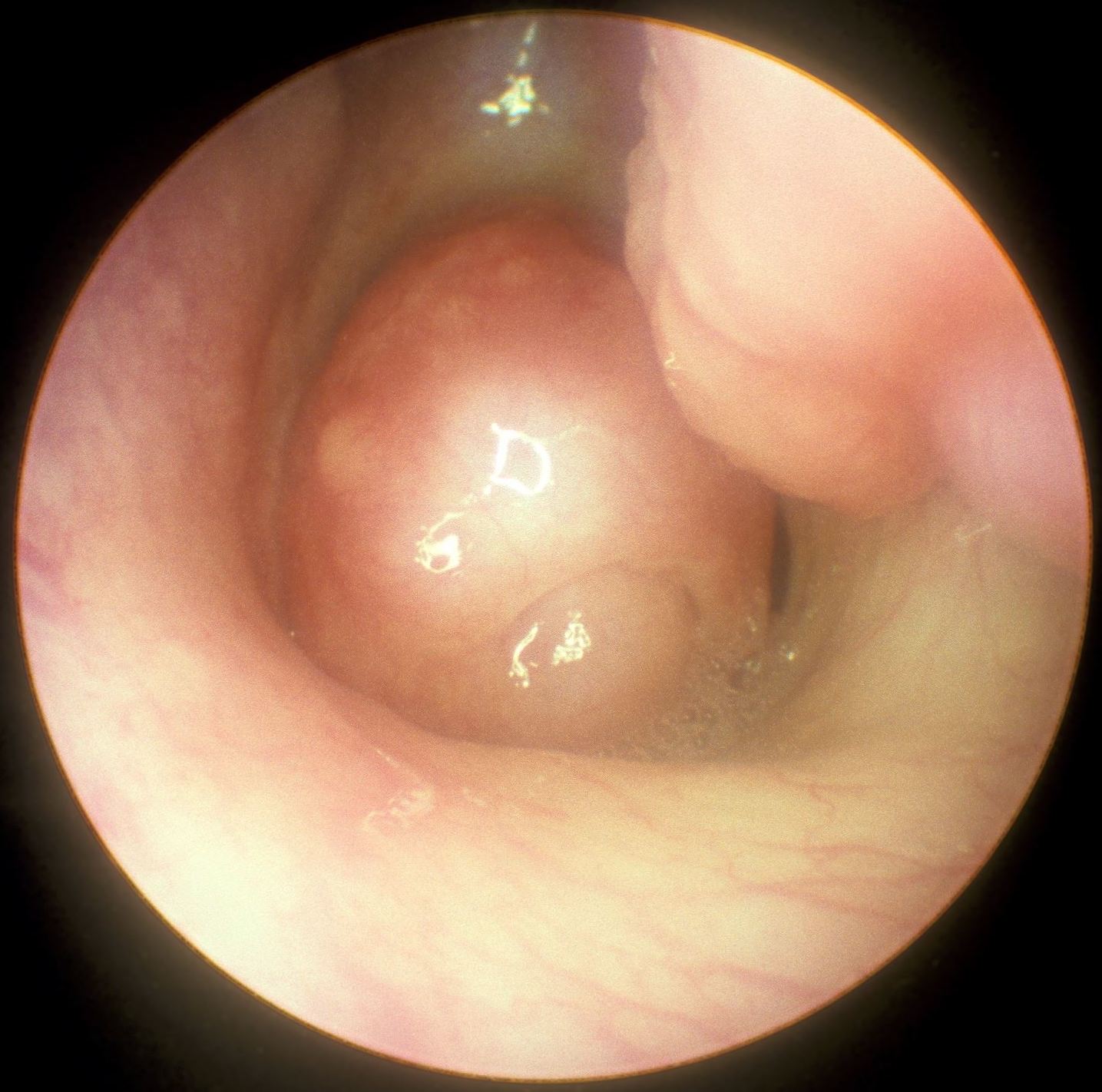
The accompanying endoscopic photograph shows a choanal polyp occupying the posterior nasal cavity, showing the polyp rather than a diagnosis of allergic rhinitis. According to its source, the view is through the left nasal cavity and the polyp originates on the opposite side. It illustrates why focal obstruction and turbinate swelling are not interchangeable. Do not infer the patient's allergy status, histology or cough mechanism from the photograph. [9]
A choanal polyp viewed through the left nasal cavity originates on the opposite side. The photograph shows focal obstruction, not a diagnostic test for allergy or proof of a cough mechanism. Image: Michael Hawke MD, CC BY 4.0. Michael Hawke MD; original source; CC BY 4.0. [9].
A positive skin-prick test or serum allergen-specific IgE test establishes sensitization. To attribute symptoms, connect that result with actual exposure and a compatible time course. Test when the diagnosis is uncertain, treatment has not worked as expected, or the result will guide exposure advice or immunotherapy. Choose inhalant allergens relevant to the history and region rather than indiscriminate panels. [1][5]
Skin testing needs valid positive and negative controls. H1 antihistamines can suppress the histamine control and allergen wheals; a negative panel with a suppressed control is not reassuring. Follow the testing service's medicine-withholding instructions. Serum specific IgE can be useful when skin testing is unsuitable or antihistamines cannot be withheld. Neither a positive panel nor a total IgE concentration substitutes for the exposure history. [1]
Nasal eosinophils identify a type of inflammation, not its cause with certainty. They may occur in allergic rhinitis or nonallergic rhinitis with eosinophilia. Negative systemic testing also does not exclude localized nasal allergic responses. Specialist nasal provocation is different from a routine blood test. Absence of eosinophils on one sample does not exclude allergy. [1]
A patient has positive cat-specific IgE but no cat exposure, and symptoms occur only with cleaning fumes. Cover the test result and identify the reproducible exposure first. Does restoring the positive result establish cat as the cause?
Interpret the result in context
No. The positive result establishes sensitization; the supplied symptom pattern does not connect cat exposure to illness. Treatment selection needs that missing clinical relationship.
Use nasal endoscopy selectively to investigate persistent obstruction, suspected polyps, sinus disease or other structural concerns. Sinus CT is not a routine test for isolated allergic rhinitis or every chronic cough. Persistent unilateral symptoms, bleeding or concerning examination findings warrant appropriate specialist assessment rather than another empirical allergy treatment. [1]
Keep the whole cough differential in view
In adults, cough lasting more than eight weeks is chronic. Begin with a careful history, examination, medication and exposure review, a recent chest radiograph and spirometry. A normal radiograph does not diagnose UACS or exclude every serious condition. Hemoptysis, unexplained weight loss, persistent fever, concerning examination findings or significant breathlessness require timely investigation. Severe respiratory distress needs immediate assessment. Children use a different pathway, commonly beginning at more than four weeks of cough. [2][8]
A tickle, globus sensation, hoarseness, throat clearing, or cough that is worse overnight or on waking can accompany upper airway disease. These patterns overlap with asthma, reflux and laryngeal hypersensitivity. Neither timing nor absence of a perceived drip identifies the cause. Review smoking, vaping, workplace exposure and ACE inhibitors even when the patient also has allergies. ACE-inhibitor cough may develop after a delay; arrange a clinician-supervised substitute when appropriate. [2][8]
Cough-variant asthma may present without wheeze. Nocturnal or exercise-related cough and variable symptoms raise suspicion. Demonstrable variable airflow limitation supports asthma, but normal spirometry between episodes does not exclude it. Depending on the history and pathway, serial airflow assessment or specialist bronchial challenge can help. A positive challenge shows airway hyperresponsiveness, not automatic proof that all cough is caused by asthma. Allergic rhinitis and asthma can coexist. [2]
Nonasthmatic eosinophilic bronchitis is another treatable possibility: cough with airway eosinophilia but without the variable obstruction or hyperresponsiveness characteristic of asthma. A well-collected induced-sputum eosinophil result, when available, refers to the lower airway and is not interchangeable with a nasal smear. Inhaled corticosteroid treatment targets lower-airway inflammation; a nasal steroid does not replace it. Exhaled nitric oxide and blood eosinophils can support assessment but are not stand-alone proof of a cough diagnosis. [2][8]
Reflux may contribute through esophageal sensory pathways or airway exposure to refluxate, but these mechanisms are not established by hoarseness alone. Heartburn, regurgitation, meal association and recumbency make reflux assessment more relevant. For symptomatic reflux, address weight when appropriate, avoid late meals, and consider head-of-bed positioning and acid-suppressive treatment. Cough may improve more slowly than heartburn. Do not automatically prescribe a prolonged proton-pump inhibitor trial for isolated cough without typical symptoms or evidence of acid reflux. Selected refractory patients need further evaluation rather than indefinite empirical treatment. [6][8]
Nasal symptoms resolve during treatment, but cough during running continues. Which observation would you investigate next: nasal color or variable lower-airway function?
Choose the more informative observation
Variable lower-airway function addresses the remaining exertional symptom. Improvement in the nose does not exclude a simultaneous lower-airway disorder.
For transfer, compare a patient with only nasal symptoms to one with hemoptysis despite a normal radiograph. The second patient needs a targeted safety evaluation, not simply a longer nasal-treatment trial. Routine chest CT is unnecessary for every uncomplicated chronic cough; specific concerns can make it appropriate. [2][8]
Choose the symptom target before adding treatment
Treat the inflamed lining when persistent obstruction or several allergic symptoms dominate. Intranasal corticosteroids such as fluticasone, mometasone, budesonide or triamcinolone are effective options. Benefit can begin early, but regular use over days to weeks and correct delivery matter. Reassess nasal symptoms and cough separately rather than promising a cough cure within a fixed interval. [1][3]
For mild intermittent itch, sneezing and rhinorrhea, a second-generation oral antihistamine such as loratadine, cetirizine, levocetirizine or fexofenadine may be useful. Oral antihistamines are less effective for obstruction. Cetirizine can still cause drowsiness. First-generation agents add sedation, impaired driving and anticholinergic effects, particularly problematic with urinary retention or frailty. Historical empirical UACS regimens containing a sedating antihistamine do not make that the safest default for everyone. [1][2]
Intranasal antihistamines such as azelastine can act relatively quickly and can help allergic or some nonallergic symptoms. For inadequately controlled allergic disease, consider a fixed intranasal antihistamine plus corticosteroid combination. ARIA's 2024-2025 revision conditionally favors this combination over corticosteroid alone, especially where severity, preference and access support it. Adding another oral antihistamine to a nasal steroid is not an equivalent evidence-based step. A spray the patient can use consistently may be more useful than an unaffordable theoretical preference. [1][3]
Check delivery before declaring resistance. Demonstrate a slightly forward head position, direct the nozzle outward away from the septum, and use a gentle sniff rather than inhaling forcefully into the throat. Follow product instructions for priming and cleaning. Ask about missed doses and inspect troublesome bleeding. Persistent epistaxis needs assessment, not simply dose escalation. [1]
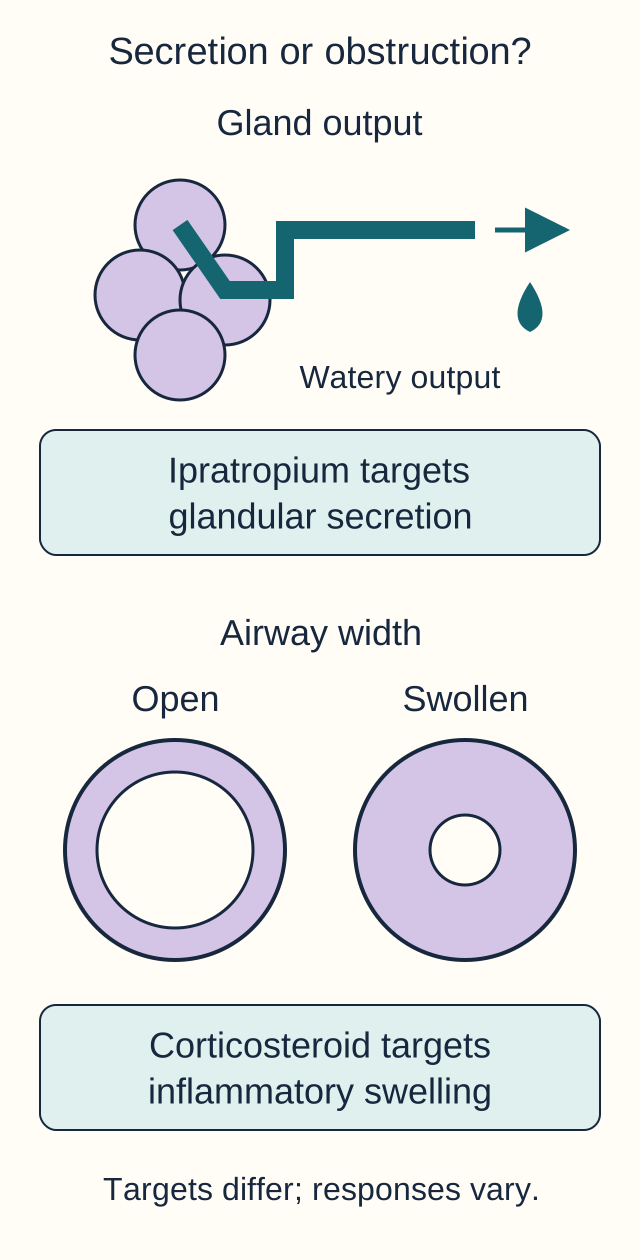
Intranasal ipratropium blocks muscarinic effects on nasal glands. It is particularly useful for troublesome anterior watery rhinorrhea, including food- or cold-triggered discharge. It does not meaningfully treat congestion or sneezing, and evidence does not support treating isolated postnasal sensation or cough as if either were the same endpoint. Dryness and epistaxis can occur. [1]
Use the gland-and-tissue diagram to make a prediction. After ipratropium, a patient's need for tissues falls but the sensation of blockage stays the same. Decide whether this pattern indicates the wrong gland target or an untreated second target.
Predict the effect of suppressing gland secretion while tissue swelling persists. Less anterior discharge with little change in blockage is a coherent response, not proof that the gland-targeted treatment failed. This schematic does not quantify drug efficacy or airflow. [1][3]Reveal the target comparison
Qualitative gland-target experiment
Observation
Before
After
ObservationAnterior secretion
BeforeProfuse
AfterReduced
ObservationResidual narrowing
BeforePresent
AfterStill present
The gland target responded. Edematous tissue can still narrow the airway. The result supports separating secretion from obstruction, not increasing ipratropium until both disappear.
Oxymetazoline and related topical decongestants produce vasoconstriction, but prolonged unsupervised use can produce rebound congestion, or rhinitis medicamentosa. Do not convert temporary relief into indefinite frequent dosing. Follow the product's short-duration label; prolonged specialist regimens are not a general self-care recommendation. Withdrawal of the overused spray, an intranasal steroid and supportive care are appropriate considerations. Oral sympathomimetics are not a harmless replacement in someone with uncontrolled hypertension. [1][3]
Saline can clear particles and secretions without changing sensitization. Use distilled, sterile, or previously boiled and cooled water for irrigation, and clean the device as instructed. Drinking-safe tap water is not automatically safe for nasal rinsing; adding a salt packet does not sterilize it. [7]
Montelukast is not an automatic next step for rhinitis. Reserve it for inadequate response or intolerance to alternatives after discussing its boxed warning for serious neuropsychiatric effects. New mood, behavior or sleep symptoms require stopping it and promptly contacting the treating clinician. Suicidal thoughts require urgent help. Coexisting asthma does not cancel the safety discussion. [4]
Distinguish immune tolerance from an anatomical solution
Allergen immunotherapy targets clinically relevant allergy. Offer specialist evaluation when appropriate avoidance and medicines are insufficient or when a patient prefers immunomodulation. Select allergens that match both testing and the exposure history. A large positive panel is not a prescription to treat every result, and a purely irritant-triggered pattern is not an indication. [5]
Repeated controlled allergen exposure can promote immune tolerance, including regulatory responses and blocking-antibody activity, and reduce symptoms and medication need. This is disease modification, not a guaranteed cure. Serum specific IgE does not have to become negative for treatment to help. Judge response by symptoms, function and medication use rather than routine repeated sensitization tests. For patients benefiting from treatment, the guideline recommends at least three years, with longer duration individualized; courses often span three to five years. [5]
Subcutaneous immunotherapy (SCIT) uses clinic injections through build-up and maintenance schedules, commonly more frequent at first and less frequent later. Sublingual immunotherapy (SLIT) uses a product-specific oral schedule, often daily. In the United States, tablet products cover particular grass, ragweed and mite allergies; aqueous sublingual drops are not FDA-approved. Route selection depends on relevant allergens, product eligibility, risk, adherence and access, not convenience alone. [5][10]
Assess asthma before initiation and before subsequent treatment. Do not initiate immunotherapy with uncontrolled asthma, during pregnancy, or when injectable epinephrine cannot be tolerated. Beta-blockers require an individualized risk discussion. A history of eosinophilic esophagitis is a contraindication to licensed SLIT tablets. SCIT requires observation for at least 30 minutes after injections; later systemic reactions can still occur. The first SLIT dose is supervised, and home use requires product-specific education, including an epinephrine plan. Wheezing, hypotension or rapidly progressive systemic symptoms after treatment require immediate anaphylaxis management, with intramuscular epinephrine first-line. [5]
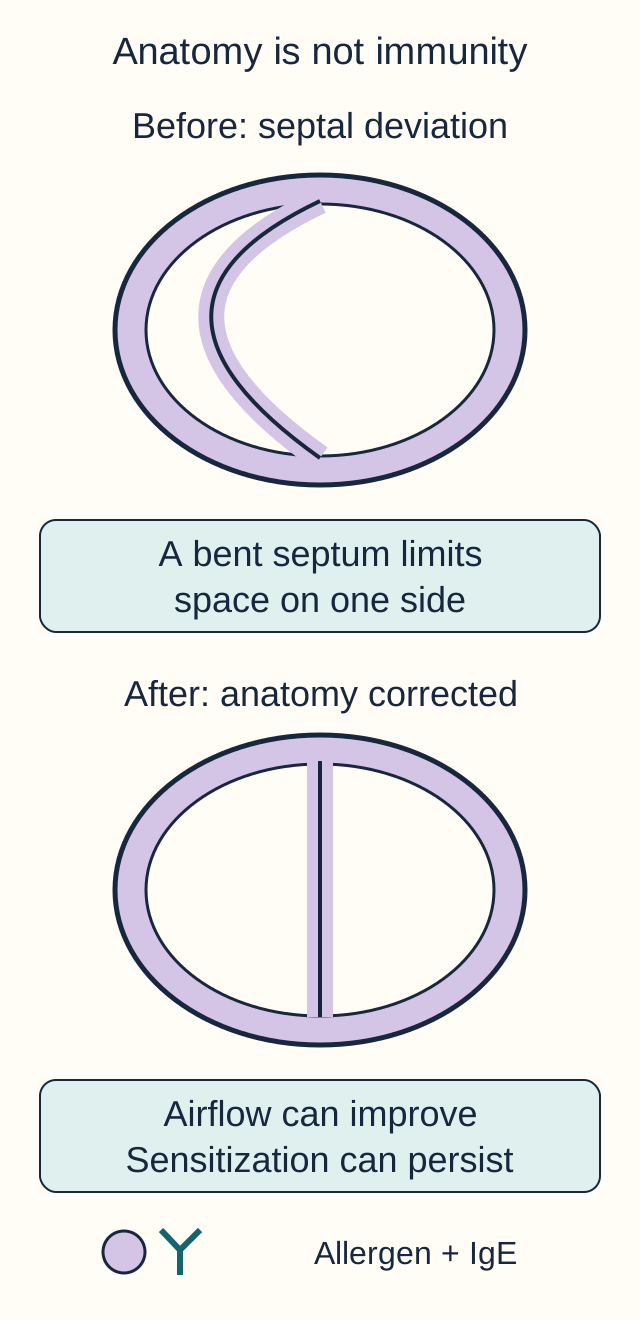
A patient asks whether surgery would make pollen-specific IgE disappear. Use the anatomical comparison diagram to predict what widening a narrowed nasal passage can and cannot change.
Compare passage space before and after correction, then predict which problem remains during the next pollen exposure. The shapes are conceptual cross-sections, not patient scans or a guarantee of surgical benefit. Nasal lining and allergic susceptibility can still require treatment. [1][5]Compare anatomy with immunity
Correcting a deviated septum or reducing enlarged turbinates may improve airflow. It does not erase sensitization or replace treatment for allergic inflammation.
Consider specialist surgical evaluation for persistent anatomical obstruction despite appropriate medical management. Septoplasty addresses a deviated septum. Turbinate reduction, using selected techniques such as radiofrequency or microdebrider-assisted approaches, addresses enlarged tissue; technique and risk depend on the individual anatomy. Neither is a primary treatment for unexplained cough. Intranasal capsaicin has been studied for selected nonallergic rhinitis through repeated TRPV1 stimulation and subsequent sensory desensitization. The 2020 practice parameter describes limited trial evidence and an unapproved intranasal use; it is not a standard first-line treatment. Do not improvise intranasal chili preparations. [1]
In the next patient, ask what is being changed: gland output, inflammatory swelling, an allergen-specific response or fixed anatomy. Then identify the symptom that should improve and the finding that would make you reconsider your explanation. Persistent cough is a reason to revisit the whole assessment, not to assume that every nasal intervention must eventually cure it.
Apply the lesson
Case 1
Show answer and explanations for case 1
A. Replace loratadine with oral diphenhydramine (Why this does not fit)
H1 blockade can reduce allergic itch and sneezing. Those symptoms already improved, while obstruction remains; added sedation does not address that mismatch well.
Reasoning steps for option A
What can diphenhydramine relieve?
H1 blockade can reduce allergic itch and sneezing.
What limits this substitution here?
Those symptoms already improved, while obstruction remains; added sedation does not address that mismatch well.
B. Add pre-exposure intranasal ipratropium (Why this does not fit)
Muscarinic blockade chiefly reduces watery glandular secretion. Obstruction, not persistent anterior rhinorrhea, is the sleep-disrupting symptom.
Obstruction, not persistent anterior rhinorrhea, is the sleep-disrupting symptom.
C. Start a daily intranasal corticosteroid (Best answer)
Inflammatory mucosal swelling can persist after histamine-related itching improves. Sleep-disrupting obstruction favors a regularly used intranasal corticosteroid; cough still needs separate follow-up.
Reasoning steps for option C
What tissue process can sustain obstruction?
Inflammatory mucosal swelling can persist after histamine-related itching improves.
Which residual symptom directs treatment here?
Sleep-disrupting obstruction favors a regularly used intranasal corticosteroid; cough still needs separate follow-up.
D. Start daily oral montelukast monotherapy (Why this does not fit)
It blocks cysteinyl-leukotriene signaling and can improve allergic symptoms. An effective intranasal alternative has not been tried, and montelukast carries important neuropsychiatric risk.
Reasoning steps for option D
What pathway does montelukast inhibit?
It blocks cysteinyl-leukotriene signaling and can improve allergic symptoms.
Why is it not the preferred next trial?
An effective intranasal alternative has not been tried, and montelukast carries important neuropsychiatric risk.
E. Use oxymetazoline as nightly maintenance (Why this does not fit)
Local vasoconstriction temporarily reduces swelling. Prolonged unsupervised dosing risks rebound congestion rather than durable control of allergic inflammation.
Reasoning steps for option E
How does oxymetazoline open the nose?
Local vasoconstriction temporarily reduces swelling.
Why does nightly maintenance pose a problem?
Prolonged unsupervised dosing risks rebound congestion rather than durable control of allergic inflammation.
Takeaway: Improvement in sneezing does not mean inflammatory obstruction is controlled.
A. Allergic and nonallergic rhinitis coexist (Best answer)
Seasonal itch and sneezing coincide with grass exposure and positive specific IgE. Immediate cold-air rhinorrhea outside that exposure supports an additional nonallergic component.
Reasoning steps for option A
What supports clinically relevant grass allergy?
Seasonal itch and sneezing coincide with grass exposure and positive specific IgE.
What does the winter diary add?
Immediate cold-air rhinorrhea outside that exposure supports an additional nonallergic component.
B. Grass allergy explains both symptom patterns (Why this does not fit)
The seasonal symptoms and sensitization agree. Winter symptoms are linked to cold air rather than grass exposure and lack the associated itching.
Reasoning steps for option B
What supports grass allergy in part of the history?
The seasonal symptoms and sensitization agree.
What finding weakens it as the sole explanation?
Winter symptoms are linked to cold air rather than grass exposure and lack the associated itching.
C. Nonallergic rhinopathy explains both patterns (Why this does not fit)
Cold-air-induced watery discharge fits a nonallergic trigger. Seasonal grass exposure repeatedly produces itching in a grass-sensitized patient.
Reasoning steps for option C
Which episodes resemble nonallergic rhinopathy?
Cold-air-induced watery discharge fits a nonallergic trigger.
Which independent evidence does this miss?
Seasonal grass exposure repeatedly produces itching in a grass-sensitized patient.
D. Chronic bacterial sinusitis explains both patterns (Why this does not fit)
Nasal obstruction or discharge can accompany chronic rhinosinusitis. The reproducible exposure-linked episodes do not provide the persistent sinus features or objective evidence needed for that attribution.
Reasoning steps for option D
What symptoms might sinus disease produce?
Nasal obstruction or discharge can accompany chronic rhinosinusitis.
Does this history establish bacterial sinus disease?
The reproducible exposure-linked episodes do not provide the persistent sinus features or objective evidence needed for that attribution.
E. Rhinitis medicamentosa explains both patterns (Why this does not fit)
Repeated topical decongestant use can sustain nasal blockage. No topical decongestant use is reported, and episodic watery discharge is not evidence of rebound congestion.
Reasoning steps for option E
What exposure would support rebound congestion?
Repeated topical decongestant use can sustain nasal blockage.
Is that exposure or dominant symptom supplied?
No topical decongestant use is reported, and episodic watery discharge is not evidence of rebound congestion.
Takeaway: Mixed rhinitis needs evidence for both components, not merely a partial treatment response.
A. IgE cross-linking on nasal mast cells (Why this does not fit)
Reproducible exposure with itching or other compatible allergic findings would favor mast-cell activation. Multiple nonallergen triggers, absent itch and valid negative inhalant testing favor a nonallergic glandular response.
Reasoning steps for option A
What would support an immediate allergic reaction?
Reproducible exposure with itching or other compatible allergic findings would favor mast-cell activation.
What makes that less explanatory here?
Multiple nonallergen triggers, absent itch and valid negative inhalant testing favor a nonallergic glandular response.
B. Persistent bacterial infection of the sinuses (Why this does not fit)
Persistent sinus symptoms and appropriate objective findings may support infection or inflammatory sinus disease. It occurs immediately with food or cold air rather than as a sustained infectious syndrome.
Reasoning steps for option B
What time course supports an infectious sinus process?
Persistent sinus symptoms and appropriate objective findings may support infection or inflammatory sinus disease.
How does this discharge behave instead?
It occurs immediately with food or cold air rather than as a sustained infectious syndrome.
C. Rebound dilation after topical alpha stimulation (Why this does not fit)
Prolonged topical decongestant exposure can produce persistent blockage. There is no decongestant exposure, and obstruction is minimal rather than the dominant symptom.
Reasoning steps for option C
What medication history supports rebound congestion?
Prolonged topical decongestant exposure can produce persistent blockage.
Which required feature is missing?
There is no decongestant exposure, and obstruction is minimal rather than the dominant symptom.
D. Fixed narrowing from septal cartilage deviation (Why this does not fit)
A structural narrowing primarily impairs airflow. A fixed deviation does not account well for immediate watery secretion after two distinct stimuli.
Reasoning steps for option D
What symptom follows fixed septal narrowing?
A structural narrowing primarily impairs airflow.
Does it explain these brief wet episodes?
A fixed deviation does not account well for immediate watery secretion after two distinct stimuli.
E. Muscarinic stimulation of nasal glands (Best answer)
A reflex secretory response can produce watery rhinorrhea without allergen-specific sensitization. Muscarinic gland signaling matches anterior discharge and explains why intranasal ipratropium can help.
Reasoning steps for option E
What can hot food or cold air provoke?
A reflex secretory response can produce watery rhinorrhea without allergen-specific sensitization.
Which target matches the dominant symptom?
Muscarinic gland signaling matches anterior discharge and explains why intranasal ipratropium can help.
Takeaway: Watery food-triggered rhinorrhea and food allergy require different evidence and treatment.
A. Accept the panel as excluding cat allergy (Why this does not fit)
An interpretable positive control is necessary to trust a negative allergen wheal. No; the absent histamine control makes this negative panel unreliable.
Reasoning steps for option A
What would a valid negative panel require?
An interpretable positive control is necessary to trust a negative allergen wheal.
Was that condition met here?
No; the absent histamine control makes this negative panel unreliable.
B. Obtain cat-specific serum IgE testing (Best answer)
The skin test is not a valid demonstration of absent immediate reactivity after an H1 antihistamine. Targeted serum specific IgE can assess sensitization without relying on a skin histamine response; the result still needs clinical correlation.
Reasoning steps for option B
What does the absent histamine control imply?
The skin test is not a valid demonstration of absent immediate reactivity after an H1 antihistamine.
Which test avoids that suppression?
Targeted serum specific IgE can assess sensitization without relying on a skin histamine response; the result still needs clinical correlation.
C. Measure total serum IgE as confirmation (Why this does not fit)
It measures overall circulating IgE rather than sensitization to one exposure. A total concentration cannot establish or exclude clinically relevant cat sensitization.
Reasoning steps for option C
What does total IgE measure?
It measures overall circulating IgE rather than sensitization to one exposure.
Would it answer the cat question?
A total concentration cannot establish or exclude clinically relevant cat sensitization.
D. Repeat skin testing immediately without changes (Why this does not fit)
Cetirizine can suppress both histamine and allergen skin responses. Repeating the same test under the same suppressive medication exposure would not resolve its interpretive limitation.
Reasoning steps for option D
What caused concern about this testing session?
Cetirizine can suppress both histamine and allergen skin responses.
Would immediate repetition correct the condition?
Repeating the same test under the same suppressive medication exposure would not resolve its interpretive limitation.
E. Begin cat immunotherapy from history alone (Why this does not fit)
A clinically relevant history and confirmed sensitization are both needed. The invalid skin test has not yet confirmed cat sensitization, so immunotherapy is premature.
Reasoning steps for option E
What must support allergen selection for immunotherapy?
A clinically relevant history and confirmed sensitization are both needed.
What remains unestablished here?
The invalid skin test has not yet confirmed cat sensitization, so immunotherapy is premature.
Takeaway: Interpret a negative skin test only after verifying that its controls worked.
A. Cat allergen immunotherapy is the preferred first step (Why this does not fit)
It must be clinically relevant and confirmed by testing. The positive test has no matching exposure history explaining these episodes.
Reasoning steps for option A
What makes an allergen appropriate for immunotherapy?
It must be clinically relevant and confirmed by testing.
Which half of that requirement is missing?
The positive test has no matching exposure history explaining these episodes.
B. A larger cat IgE value would establish causation (Why this does not fit)
It can alter the probability of sensitization being meaningful in a compatible clinical setting. Even a stronger result would not by itself show that cat exposure produces the current workplace episodes.
Reasoning steps for option B
What can the magnitude of specific IgE contribute?
It can alter the probability of sensitization being meaningful in a compatible clinical setting.
Can magnitude replace exposure correlation?
Even a stronger result would not by itself show that cat exposure produces the current workplace episodes.
C. Negative results for other allergens exclude rhinitis (Why this does not fit)
Nonallergic rhinitis can cause substantial nasal symptoms. The fragrance-linked symptoms remain real and unexplained by a requirement for positive allergen testing.
Reasoning steps for option C
What type of disorder can have negative systemic allergy testing?
Nonallergic rhinitis can cause substantial nasal symptoms.
Why does the proposed conclusion fail here?
The fragrance-linked symptoms remain real and unexplained by a requirement for positive allergen testing.
D. Cat sensitization does not establish the current cause (Best answer)
It establishes sensitization to cat allergen. No matching cat exposure or cat-related symptom pattern is supplied, whereas symptoms track fragrances.
Reasoning steps for option D
What does the positive specific-IgE result establish?
It establishes sensitization to cat allergen.
What prevents attribution of the current episodes to cats?
No matching cat exposure or cat-related symptom pattern is supplied, whereas symptoms track fragrances.
E. The work pattern proves occupational allergic rhinitis (Why this does not fit)
It supports a relationship to the workplace. Work-related timing alone cannot distinguish an irritant effect from occupational sensitization.
Reasoning steps for option E
What can improvement away from work establish?
It supports a relationship to the workplace.
Does it establish an IgE-mediated process?
Work-related timing alone cannot distinguish an irritant effect from occupational sensitization.
Takeaway: A positive specific-IgE result needs a clinically relevant exposure before it directs immunotherapy.
A. Systemic IgE-mediated allergy is confirmed by cytology (Why this does not fit)
A valid allergen-specific skin or serum result can establish sensitization. No; eosinophils can occur without positive systemic allergy testing.
Reasoning steps for option A
What evidence establishes systemic sensitization?
A valid allergen-specific skin or serum result can establish sensitization.
Does eosinophil cytology supply that evidence?
No; eosinophils can occur without positive systemic allergy testing.
B. Eosinophilic rhinitis without proven systemic sensitization (Best answer)
Eosinophils are participating in nasal inflammation. The smear alone cannot separate nonallergic eosinophilic rhinitis from localized allergic responses or other eosinophilic nasal disease.
Reasoning steps for option B
What does the smear establish?
Eosinophils are participating in nasal inflammation.
What does it not distinguish here?
The smear alone cannot separate nonallergic eosinophilic rhinitis from localized allergic responses or other eosinophilic nasal disease.
C. All localized allergic responses have been excluded (Why this does not fit)
The skin and serum tests evaluate systemic sensitization. Localized nasal allergic responses may require specialist evaluation and are not excluded by these tests alone.
Reasoning steps for option C
What compartment do the supplied tests primarily assess?
The skin and serum tests evaluate systemic sensitization.
What possibility can remain despite their negativity?
Localized nasal allergic responses may require specialist evaluation and are not excluded by these tests alone.
D. A bacterial sinus infection is established by cytology (Why this does not fit)
An eosinophil is an inflammatory cell, not an organism. No microbiologic or clinical evidence of bacterial sinus infection is supplied.
Reasoning steps for option D
What cellular finding would directly identify bacteria?
An eosinophil is an inflammatory cell, not an organism.
Does this sample establish bacterial infection?
No microbiologic or clinical evidence of bacterial sinus infection is supplied.
E. Lower-airway eosinophilic bronchitis is confirmed (Why this does not fit)
The sample came from the nose. A nasal smear is not an induced-sputum or other lower-airway sample and cannot confirm eosinophilic bronchitis.
Reasoning steps for option E
Which specimen was collected?
The sample came from the nose.
Can it establish lower-airway eosinophilia?
A nasal smear is not an induced-sputum or other lower-airway sample and cannot confirm eosinophilic bronchitis.
Takeaway: Nasal eosinophilia is not synonymous with systemic allergen sensitization.
A. Repeat regional inhalant skin testing (Why this does not fit)
It identifies sensitization when interpreted with relevant exposures. The nasal symptoms have responded, while the persistent exertional cough raises a lower-airway question.
Reasoning steps for option A
What question does allergen testing address?
It identifies sensitization when interpreted with relevant exposures.
Why is that not the main unresolved question?
The nasal symptoms have responded, while the persistent exertional cough raises a lower-airway question.
B. Computed tomography of the paranasal sinuses (Why this does not fit)
It can define selected structural or inflammatory sinus disease. There are no persistent nasal or sinus symptoms to justify making sinus anatomy the next focus.
Reasoning steps for option B
What might sinus CT clarify?
It can define selected structural or inflammatory sinus disease.
What weakens its priority here?
There are no persistent nasal or sinus symptoms to justify making sinus anatomy the next focus.
C. Ambulatory esophageal pH monitoring (Why this does not fit)
It can assess acid reflux in selected patients. The cough is exertional and nocturnal without typical reflux symptoms, and possible asthma has not been adequately assessed.
Reasoning steps for option C
What can esophageal pH monitoring assess?
It can assess acid reflux in selected patients.
Why is it less targeted than airway testing here?
The cough is exertional and nocturnal without typical reflux symptoms, and possible asthma has not been adequately assessed.
D. Repeat flexible nasal endoscopy (Why this does not fit)
It inspects nasal and selected upper-airway structures. The original nasal symptoms resolved; repeated nasal inspection does not test the persistent exercise-related lower-airway pattern.
Reasoning steps for option D
What does endoscopy inspect?
It inspects nasal and selected upper-airway structures.
What supplied change reduces its immediate value?
The original nasal symptoms resolved; repeated nasal inspection does not test the persistent exercise-related lower-airway pattern.
E. Specialist bronchial challenge testing (Best answer)
Cough-variant asthma can occur without wheeze or abnormal spirometry between episodes. It evaluates airway hyperresponsiveness relevant to this pattern; results still require interpretation with symptoms and treatment response.
Reasoning steps for option E
What disorder remains compatible with exertional and nocturnal cough?
Cough-variant asthma can occur without wheeze or abnormal spirometry between episodes.
What does a bronchial challenge evaluate?
It evaluates airway hyperresponsiveness relevant to this pattern; results still require interpretation with symptoms and treatment response.
Takeaway: Normal resting spirometry does not exclude episodic asthma-related cough.
A. An exclusively nasal process explains the airflow change (Why this does not fit)
It can account for rhinorrhea and may contribute to cough. The measured reversible expiratory obstruction is not explained by nasal secretion alone.
Reasoning steps for option A
What could nasal inflammation explain?
It can account for rhinorrhea and may contribute to cough.
What requires a lower-airway explanation here?
The measured reversible expiratory obstruction is not explained by nasal secretion alone.
B. Nonasthmatic eosinophilic bronchitis explains the airflow change (Why this does not fit)
It involves airway eosinophilia without the variable obstruction characteristic of asthma. Marked bronchodilator-responsive obstruction favors asthma in this symptomatic patient.
Reasoning steps for option B
What distinguishes nonasthmatic eosinophilic bronchitis?
It involves airway eosinophilia without the variable obstruction characteristic of asthma.
Which supplied result points away from it?
Marked bronchodilator-responsive obstruction favors asthma in this symptomatic patient.
C. A coexisting asthma process needs lower-airway treatment (Best answer)
The low ratio and substantial bronchodilator improvement demonstrate variable expiratory airflow obstruction. Improved rhinitis with persistent chest symptoms supports coexisting asthma rather than an exclusively nasal explanation.
Reasoning steps for option C
What do the airflow measurements show?
The low ratio and substantial bronchodilator improvement demonstrate variable expiratory airflow obstruction.
How does that fit the response to nasal therapy?
Improved rhinitis with persistent chest symptoms supports coexisting asthma rather than an exclusively nasal explanation.
D. A normal radiograph excludes clinically important airway disease (Why this does not fit)
It depicts structural and parenchymal abnormalities visible on a radiograph. No; asthma may have a normal radiograph despite abnormal airway physiology.
Reasoning steps for option D
What does chest radiography primarily depict?
It depicts structural and parenchymal abnormalities visible on a radiograph.
Does a normal image negate spirometric obstruction?
No; asthma may have a normal radiograph despite abnormal airway physiology.
E. Fixed bronchial narrowing explains the entire presentation (Why this does not fit)
It implies that obstruction does not substantially reverse with bronchodilation. The 0.60 L increase and episodic symptoms instead support variable obstruction.
Reasoning steps for option E
What does fixed narrowing imply about reversibility?
It implies that obstruction does not substantially reverse with bronchodilation.
Does that fit the paired FEV1 values?
The 0.60 L increase and episodic symptoms instead support variable obstruction.
Takeaway: Rhinitis can coexist with asthma; a nasal treatment response does not explain reversible bronchial obstruction.
A. Nonasthmatic eosinophilic bronchitis (Best answer)
It identifies eosinophilic inflammation in the lower airway. Normal spirometry and a valid negative challenge support nonasthmatic eosinophilic bronchitis rather than demonstrated asthma.
Reasoning steps for option A
What does the sputum result identify?
It identifies eosinophilic inflammation in the lower airway.
How do the physiological tests narrow the diagnosis?
Normal spirometry and a valid negative challenge support nonasthmatic eosinophilic bronchitis rather than demonstrated asthma.
B. Cough-variant bronchial asthma (Why this does not fit)
Asthma can present with cough and eosinophilic inflammation. Repeatedly normal spirometry and a valid negative bronchial challenge do not demonstrate the variable obstruction or hyperresponsiveness expected.
Reasoning steps for option B
What could make asthma plausible?
Asthma can present with cough and eosinophilic inflammation.
Which results weaken that diagnosis here?
Repeatedly normal spirometry and a valid negative bronchial challenge do not demonstrate the variable obstruction or hyperresponsiveness expected.
C. Eosinophilic nonallergic nasal rhinitis (Why this does not fit)
It describes eosinophilic inflammation of the nose. The supplied eosinophils came from induced sputum, and the nasal assessment is unremarkable.
Reasoning steps for option C
Where would that diagnosis be localized?
It describes eosinophilic inflammation of the nose.
What makes that localization unsupported?
The supplied eosinophils came from induced sputum, and the nasal assessment is unremarkable.
D. Acid reflux-associated chronic cough (Why this does not fit)
Typical reflux symptoms or appropriate objective evidence would strengthen that attribution. The case supplies lower-airway eosinophilia rather than evidence linking reflux to the cough.
Reasoning steps for option D
What evidence would support a reflux contribution?
Typical reflux symptoms or appropriate objective evidence would strengthen that attribution.
What more direct abnormality is provided?
The case supplies lower-airway eosinophilia rather than evidence linking reflux to the cough.
E. Fixed obstructive chronic bronchitis (Why this does not fit)
Chronic sputum production and persistent airflow obstruction would be more compatible. The cough is dry and repeated spirometry is normal, while eosinophilic inflammation is documented.
Reasoning steps for option E
Which findings would favor that phenotype?
Chronic sputum production and persistent airflow obstruction would be more compatible.
Do those features appear here?
The cough is dry and repeated spirometry is normal, while eosinophilic inflammation is documented.
Takeaway: Airway eosinophilia can produce a corticosteroid-responsive cough without asthma physiology.
A. Increase the nasal corticosteroid dose (Why this does not fit)
Persistent nasal symptoms could justify checking adherence, technique and treatment intensity. The rhinitis is controlled, so nasal escalation does not address the new medication-related possibility.
Reasoning steps for option A
What would support inadequate nasal treatment?
Persistent nasal symptoms could justify checking adherence, technique and treatment intensity.
Does the current course show that problem?
The rhinitis is controlled, so nasal escalation does not address the new medication-related possibility.
B. Begin prolonged empirical proton-pump inhibition (Why this does not fit)
Typical reflux symptoms or evidence of acid reflux support its use. The medication timeline provides a more direct reversible contributor, while typical reflux symptoms are absent.
Reasoning steps for option B
When is acid suppression more justified?
Typical reflux symptoms or evidence of acid reflux support its use.
What evidence is stronger in this case?
The medication timeline provides a more direct reversible contributor, while typical reflux symptoms are absent.
C. Add scheduled intranasal ipratropium (Why this does not fit)
Ipratropium reduces anterior watery rhinorrhea. The nasal symptoms are controlled; persistent dry cough is not the same treatment target.
Reasoning steps for option C
Which symptom is its main target?
Ipratropium reduces anterior watery rhinorrhea.
Is that the unresolved complaint?
The nasal symptoms are controlled; persistent dry cough is not the same treatment target.
D. Arrange a supervised substitute for lisinopril (Best answer)
ACE inhibitors can produce a dry cough, sometimes after a delay. A prescriber-supervised substitution, often with an appropriate alternative such as an angiotensin receptor blocker, addresses the exposure while maintaining blood-pressure care.
Reasoning steps for option D
What medication class is relevant to this cough?
ACE inhibitors can produce a dry cough, sometimes after a delay.
Which action tests that explanation safely?
A prescriber-supervised substitution, often with an appropriate alternative such as an angiotensin receptor blocker, addresses the exposure while maintaining blood-pressure care.
E. Start oral montelukast without further assessment (Why this does not fit)
Selected allergic or asthma-related symptoms may respond after other appropriate choices are considered. It overlooks the ACE-inhibitor exposure and adds neuropsychiatric risk without a demonstrated need.
Reasoning steps for option E
What disease features could support leukotriene-directed treatment?
Selected allergic or asthma-related symptoms may respond after other appropriate choices are considered.
Why is automatic addition poorly matched here?
It overlooks the ACE-inhibitor exposure and adds neuropsychiatric risk without a demonstrated need.
Takeaway: A medication-related cough can coexist with successfully treated rhinitis.
A. Increase nasal corticosteroid treatment and repeat nasal examination (Why this does not fit)
They could justify reassessing nasal therapy and anatomy. The nasal symptoms are controlled, while a distinct symptomatic reflux pattern is supplied.
Reasoning steps for option A
What could persistent nasal symptoms justify?
They could justify reassessing nasal therapy and anatomy.
What makes that less relevant now?
The nasal symptoms are controlled, while a distinct symptomatic reflux pattern is supplied.
B. Start cough suppression without addressing the meal pattern (Why this does not fit)
It may reduce cough symptoms in selected settings. Frequent heartburn and regurgitation with a clear meal relationship warrant their own management.
Reasoning steps for option B
What can cough suppression accomplish?
It may reduce cough symptoms in selected settings.
What treatable syndrome would it leave unaddressed?
Frequent heartburn and regurgitation with a clear meal relationship warrant their own management.
C. Arrange antireflux surgery before a medical treatment trial (Why this does not fit)
Selected patients with objectively supported reflux and appropriate evaluation may be surgical candidates. She has not had initial lifestyle and medical treatment or the evaluation needed before an invasive intervention.
Reasoning steps for option C
When might surgery be considered?
Selected patients with objectively supported reflux and appropriate evaluation may be surgical candidates.
Why is that premature here?
She has not had initial lifestyle and medical treatment or the evaluation needed before an invasive intervention.
D. Start an oral antibiotic course for presumed sinus infection (Why this does not fit)
An appropriate persistent, severe or worsening sinus syndrome would raise that question. No; the nasal symptoms are controlled, and the active pattern is reflux-related.
Reasoning steps for option D
What would support bacterial sinus disease?
An appropriate persistent, severe or worsening sinus syndrome would raise that question.
Is it established by cough and heartburn?
No; the nasal symptoms are controlled, and the active pattern is reflux-related.
E. Begin reflux-directed lifestyle measures and acid suppression (Best answer)
Typical heartburn and regurgitation accompany late meals and recumbency. Appropriate acid suppression plus avoiding late meals, weight management and suitable sleep positioning targets the reflux syndrome; reassess the cough separately.
Reasoning steps for option E
What supports treating reflux in this patient?
Typical heartburn and regurgitation accompany late meals and recumbency.
What plan addresses both symptoms and contributing behavior?
Appropriate acid suppression plus avoiding late meals, weight management and suitable sleep positioning targets the reflux syndrome; reassess the cough separately.
Takeaway: Treat symptomatic reflux on its own evidence; a cough response is not guaranteed.
A. Expedite targeted chest evaluation, including CT (Best answer)
Hemoptysis and unexplained weight loss in a high-risk smoker are concerning features. No; targeted urgent investigation, including appropriate CT and referral, is needed rather than another routine empirical nasal trial.
Reasoning steps for option A
What changes the urgency of this cough assessment?
Hemoptysis and unexplained weight loss in a high-risk smoker are concerning features.
Does the normal radiograph end evaluation?
No; targeted urgent investigation, including appropriate CT and referral, is needed rather than another routine empirical nasal trial.
B. Continue nasal treatment alone for another eight weeks (Why this does not fit)
An uncomplicated cough with active rhinitis and no concerning features may receive targeted nasal treatment and follow-up. Recurrent hemoptysis and weight loss require investigation despite improved nasal congestion.
Reasoning steps for option B
When might a nasal trial be reasonable?
An uncomplicated cough with active rhinitis and no concerning features may receive targeted nasal treatment and follow-up.
What makes delay inappropriate here?
Recurrent hemoptysis and weight loss require investigation despite improved nasal congestion.
C. Begin empirical acid suppression and postpone chest testing (Why this does not fit)
Typical reflux symptoms or objective reflux evidence would make it relevant. No supplied reflux evidence explains away the hemoptysis and weight loss.
Reasoning steps for option C
What could support reflux-directed treatment?
Typical reflux symptoms or objective reflux evidence would make it relevant.
Can that replace the present safety assessment?
No supplied reflux evidence explains away the hemoptysis and weight loss.
D. Attribute the cough to smoking and give reassurance (Why this does not fit)
Smoking can contribute to chronic airway symptoms. It is also a risk factor for serious chest disease, and the new warning symptoms require evaluation.
Reasoning steps for option D
Why is smoking relevant to cough?
Smoking can contribute to chronic airway symptoms.
Why is reassurance alone unsafe?
It is also a risk factor for serious chest disease, and the new warning symptoms require evaluation.
E. Order a larger allergen panel before further evaluation (Why this does not fit)
It investigates sensitization, not an occult chest lesion. No; it would not adequately investigate hemoptysis and weight loss.
Reasoning steps for option E
What does an allergy panel investigate?
It investigates sensitization, not an occult chest lesion.
Would its result resolve these warning symptoms?
No; it would not adequately investigate hemoptysis and weight loss.
Takeaway: A normal radiograph cannot neutralize persistent hemoptysis or other concerning features.
A. Double the dose and maintain the same technique (Why this does not fit)
It would assume adequate delivery but insufficient drug effect. No; the observed direction and forceful sniffing are correctable problems that escalation would leave unchanged.
Reasoning steps for option A
What assumption would dose escalation make?
It would assume adequate delivery but insufficient drug effect.
Is adequate delivery demonstrated?
No; the observed direction and forceful sniffing are correctable problems that escalation would leave unchanged.
B. Replace the spray with daily topical oxymetazoline (Why this does not fit)
A decongestant can produce rapid perceived airflow improvement. It does not resolve the underlying treatment technique and prolonged use can produce rebound congestion.
Reasoning steps for option B
Why might this seem attractive?
A decongestant can produce rapid perceived airflow improvement.
What limitation makes it a poor maintenance substitute?
It does not resolve the underlying treatment technique and prolonged use can produce rebound congestion.
C. Change to intranasal ipratropium as sole treatment (Why this does not fit)
It chiefly reduces watery anterior rhinorrhea. Obstruction and sneezing require a different target; ipratropium is not a broad replacement for anti-inflammatory treatment.
Reasoning steps for option C
Which symptom does ipratropium target best?
It chiefly reduces watery anterior rhinorrhea.
Does it match her main untreated symptoms?
Obstruction and sneezing require a different target; ipratropium is not a broad replacement for anti-inflammatory treatment.
D. Aim outward and use a gentle sniff (Best answer)
Toward the septum, where local deposition can contribute to irritation. Direct it away from the septum with a slightly forward head and a gentle sniff, then reassess benefit and any persistent bleeding.
Reasoning steps for option D
Where is the current spray being directed?
Toward the septum, where local deposition can contribute to irritation.
How should delivery be corrected?
Direct it away from the septum with a slightly forward head and a gentle sniff, then reassess benefit and any persistent bleeding.
E. Proceed directly to turbinate reduction surgery (Why this does not fit)
Persistent anatomical obstruction despite appropriate management may justify specialist surgical assessment. A three-day trial with demonstrated technique errors has not established refractory anatomical obstruction.
A. Add a second oral H1 antihistamine to fluticasone (Why this does not fit)
Antihistamines can improve sneezing and itching. Adding oral antihistamine therapy to a nasal steroid is not as well supported for added nasal benefit as an intranasal combination.
Reasoning steps for option A
Why might additional H1 blockade seem useful?
Antihistamines can improve sneezing and itching.
Why is this not the equivalent preferred escalation?
Adding oral antihistamine therapy to a nasal steroid is not as well supported for added nasal benefit as an intranasal combination.
B. Replace fluticasone with intranasal ipratropium alone (Why this does not fit)
It reduces watery glandular secretion. Sneezing and obstruction, not predominant watery rhinorrhea, remain troublesome.
Reasoning steps for option B
What does ipratropium mainly reduce?
It reduces watery glandular secretion.
What symptom pattern makes it insufficient here?
Sneezing and obstruction, not predominant watery rhinorrhea, remain troublesome.
C. Use an intranasal antihistamine-corticosteroid combination (Best answer)
Several allergic nasal symptoms remain burdensome despite partial response. A fixed intranasal antihistamine plus corticosteroid is conditionally favored over corticosteroid alone in current ARIA guidance, with individual cost and preference considerations.
Reasoning steps for option C
What remains after the adequate monotherapy trial?
Several allergic nasal symptoms remain burdensome despite partial response.
Which complementary combination is supported?
A fixed intranasal antihistamine plus corticosteroid is conditionally favored over corticosteroid alone in current ARIA guidance, with individual cost and preference considerations.
D. Add a prolonged nightly topical decongestant schedule (Why this does not fit)
Vasoconstriction can reduce perceived obstruction. It risks rebound congestion and is not a preferred long-term solution for the broad allergic symptom pattern.
Reasoning steps for option D
What can a topical decongestant temporarily improve?
Vasoconstriction can reduce perceived obstruction.
Why is prolonged scheduled use problematic?
It risks rebound congestion and is not a preferred long-term solution for the broad allergic symptom pattern.
E. Add oral antibiotics while continuing the nasal steroid (Why this does not fit)
A compatible bacterial infection would be needed. The exposure-linked allergic pattern lacks fever, purulence or another supplied bacterial syndrome.
Reasoning steps for option E
What would make antibiotics relevant?
A compatible bacterial infection would be needed.
What evidence argues against that target?
The exposure-linked allergic pattern lacks fever, purulence or another supplied bacterial syndrome.
Takeaway: After checking use and technique, intranasal antihistamine plus corticosteroid is a rational combination for inadequate allergic symptom control.
A. Nasal tissue edema resolved while glandular output persisted (Why this does not fit)
Improved obstruction or airflow would support reduced narrowing. Secretion improved while obstruction did not, the reverse of the proposed explanation.
Reasoning steps for option A
What result would support reduced tissue edema?
Improved obstruction or airflow would support reduced narrowing.
Which part contradicts the observed pattern?
Secretion improved while obstruction did not, the reverse of the proposed explanation.
B. Glandular secretion fell without substantial relief of obstruction (Best answer)
Nasal muscarinic blockade reduces glandular secretion. The medicine does not substantially treat the swollen or structurally narrowed tissue responsible for obstruction.
The medicine does not substantially treat the swollen or structurally narrowed tissue responsible for obstruction.
C. Allergen sensitization disappeared while structural narrowing persisted (Why this does not fit)
Immunotherapy can modify allergen-specific clinical responsiveness. Its symptomatic antimuscarinic action does not establish disappearance of sensitization.
Reasoning steps for option C
What treatment would alter allergen-specific tolerance?
Immunotherapy can modify allergen-specific clinical responsiveness.
Does ipratropium demonstrate that effect?
Its symptomatic antimuscarinic action does not establish disappearance of sensitization.
D. Bronchial smooth muscle relaxed while nasal glands remained active (Why this does not fit)
The administered medicine and observed response were intranasal. The clear response was reduced nasal discharge, not a documented bronchial airflow response.
Reasoning steps for option D
Which compartment was treated and measured?
The administered medicine and observed response were intranasal.
What evidence contradicts the proposed localization?
The clear response was reduced nasal discharge, not a documented bronchial airflow response.
E. Rebound vasodilation resolved after withdrawal of alpha stimulation (Why this does not fit)
It requires relevant topical decongestant overuse followed by withdrawal. No; ipratropium was added to target secretion, without a supplied decongestant withdrawal.
Reasoning steps for option E
What history supports recovery from rebound congestion?
It requires relevant topical decongestant overuse followed by withdrawal.
Is that the intervention described?
No; ipratropium was added to target secretion, without a supplied decongestant withdrawal.
Takeaway: A secretion response with little airflow change is compatible with ipratropium acting at the intended target.
A. Increase oxymetazoline frequency to sustain vasoconstriction (Why this does not fit)
Each dose can still provide temporary vasoconstriction. It continues the overexposure underlying rebound congestion instead of addressing it.
Reasoning steps for option A
Why might more frequent dosing seem helpful?
Each dose can still provide temporary vasoconstriction.
What problem would that perpetuate?
It continues the overexposure underlying rebound congestion instead of addressing it.
B. Replace oxymetazoline with scheduled oral pseudoephedrine (Why this does not fit)
Systemic sympathomimetic effects can temporarily reduce congestion. His uncontrolled hypertension makes routine systemic sympathomimetic substitution undesirable.
Reasoning steps for option B
What symptom can pseudoephedrine reduce?
Systemic sympathomimetic effects can temporarily reduce congestion.
What comorbidity makes this a poor default?
His uncontrolled hypertension makes routine systemic sympathomimetic substitution undesirable.
C. Withdraw oxymetazoline with nasal steroid and saline support (Best answer)
Short-lived relief followed by recurrent congestion after prolonged frequent use supports rhinitis medicamentosa. Clinician-guided withdrawal with appropriate nasal treatment addresses the cause without adding a routine oral sympathomimetic in uncontrolled hypertension.
Reasoning steps for option C
What pattern links the spray to the persistent blockage?
Short-lived relief followed by recurrent congestion after prolonged frequent use supports rhinitis medicamentosa.
Which plan addresses both exposure and risk?
Clinician-guided withdrawal with appropriate nasal treatment addresses the cause without adding a routine oral sympathomimetic in uncontrolled hypertension.
D. Continue oxymetazoline and add an oral antibiotic course (Why this does not fit)
A compatible bacterial infection would need to be established. No; the temporal relationship to decongestant use is more persuasive than an unsupported infection.
Reasoning steps for option D
What would justify an antibiotic?
A compatible bacterial infection would need to be established.
Does the supplied course establish that?
No; the temporal relationship to decongestant use is more persuasive than an unsupported infection.
E. Replace oxymetazoline with ipratropium as sole maintenance (Why this does not fit)
It primarily reduces watery anterior rhinorrhea. Persistent obstruction is the main complaint, so ipratropium alone is not an adequate target-matched replacement.
Reasoning steps for option E
Which symptom is ipratropium best suited to treat?
It primarily reduces watery anterior rhinorrhea.
Does that cover this predominant complaint?
Persistent obstruction is the main complaint, so ipratropium alone is not an adequate target-matched replacement.
Takeaway: Treat decongestant-associated rebound rather than perpetuating it or substituting an unsafe sympathomimetic.
A. Continue montelukast and wait for seasonal exposure to end (Why this does not fit)
It may be providing some allergic symptom control. New neuropsychiatric symptoms require action rather than assuming they will disappear while exposure continues.
Reasoning steps for option A
Why might continued therapy seem useful?
It may be providing some allergic symptom control.
What outweighs simply waiting here?
New neuropsychiatric symptoms require action rather than assuming they will disappear while exposure continues.
B. Double montelukast because poor sleep indicates undertreatment (Why this does not fit)
Persistent allergy-related sleep disruption can prompt review of rhinitis management. Vivid nightmares and new behavioral changes soon after starting the medicine suggest an adverse effect rather than a reason to increase it.
Reasoning steps for option B
What symptom would justify reassessing allergic control?
Persistent allergy-related sleep disruption can prompt review of rhinitis management.
Why does this presentation not justify dose escalation?
Vivid nightmares and new behavioral changes soon after starting the medicine suggest an adverse effect rather than a reason to increase it.
C. Add a sedating antihistamine and keep montelukast unchanged (Why this does not fit)
Sedation might alter perceived sleep without addressing the source of the new symptoms. It can obscure or compound problems while leaving a potentially causative medicine in place.
Reasoning steps for option C
What might the added antihistamine change?
Sedation might alter perceived sleep without addressing the source of the new symptoms.
Why is that not a suitable response?
It can obscure or compound problems while leaving a potentially causative medicine in place.
D. Stop montelukast and contact the prescriber promptly (Best answer)
Neuropsychiatric effects including disturbing dreams and mood changes are covered by the montelukast boxed warning. Stop the medicine and promptly contact the treating clinician; urgent assessment is needed for suicidal thoughts or immediate safety concerns.
Reasoning steps for option D
What makes the symptom timeline important?
Neuropsychiatric effects including disturbing dreams and mood changes are covered by the montelukast boxed warning.
What action follows that concern?
Stop the medicine and promptly contact the treating clinician; urgent assessment is needed for suicidal thoughts or immediate safety concerns.
E. Switch montelukast to morning dosing without further review (Why this does not fit)
It might change when a medicine is taken, not eliminate systemic exposure. The boxed-warning response is to stop and seek clinical advice for these new symptoms, not simply reschedule dosing.
Reasoning steps for option E
What might changing administration time affect?
It might change when a medicine is taken, not eliminate systemic exposure.
Why is timing alone insufficient here?
The boxed-warning response is to stop and seek clinical advice for these new symptoms, not simply reschedule dosing.
Takeaway: New mood, behavior or sleep changes during montelukast warrant stopping it and prompt clinical contact.
A. Replace diphenhydramine with hydroxyzine (Why this does not fit)
It is also a sedating first-generation H1 antihistamine with anticholinergic effects. It would retain the properties causing concern for driving and urinary symptoms.
Reasoning steps for option A
What effects does hydroxyzine share?
It is also a sedating first-generation H1 antihistamine with anticholinergic effects.
Would that address the demonstrated problem?
It would retain the properties causing concern for driving and urinary symptoms.
B. Replace diphenhydramine with fexofenadine (Best answer)
Sedation and anticholinergic effects can impair driving and worsen urinary hesitancy. It provides second-generation H1 blockade with substantially less sedation and anticholinergic burden; he should not drive while impaired.
Reasoning steps for option B
What adverse properties of diphenhydramine matter here?
Sedation and anticholinergic effects can impair driving and worsen urinary hesitancy.
Why does fexofenadine fit the requested role?
It provides second-generation H1 blockade with substantially less sedation and anticholinergic burden; he should not drive while impaired.
C. Increase diphenhydramine at bedtime (Why this does not fit)
It places the dose near sleep. No; he already has next-morning drowsiness, and increasing exposure may worsen both adverse effects.
Reasoning steps for option C
Why might bedtime dosing appear convenient?
It places the dose near sleep.
Does that eliminate next-day impairment?
No; he already has next-morning drowsiness, and increasing exposure may worsen both adverse effects.
D. Replace diphenhydramine with oral pseudoephedrine (Why this does not fit)
It chiefly targets congestion through sympathomimetic effects. Congestion is minimal, while itch and sneezing need H1 treatment; urinary effects are another concern.
Reasoning steps for option D
What symptom does pseudoephedrine chiefly target?
It chiefly targets congestion through sympathomimetic effects.
Why is it poorly matched here?
Congestion is minimal, while itch and sneezing need H1 treatment; urinary effects are another concern.
E. Replace diphenhydramine with routine montelukast (Why this does not fit)
It is reserved for inadequate response or intolerance to appropriate alternatives. A second-generation antihistamine has not been tried, making routine montelukast an unnecessary risk escalation.
Reasoning steps for option E
What role can montelukast have in rhinitis?
It is reserved for inadequate response or intolerance to appropriate alternatives.
What safer target-matched alternative remains available?
A second-generation antihistamine has not been tried, making routine montelukast an unnecessary risk escalation.
Takeaway: Do not trade allergic symptom relief for impaired driving or urinary retention.
A. Prescribe a grass SLIT tablet for cross-protection (Why this does not fit)
It targets its labeled grass allergens. No clinically relevant grass allergy is supplied, and grass tablets are not a substitute for cat-directed treatment.
Reasoning steps for option A
What allergen does a grass tablet address?
It targets its labeled grass allergens.
Does cat allergy justify that tablet?
No clinically relevant grass allergy is supplied, and grass tablets are not a substitute for cat-directed treatment.
B. Prescribe mite SLIT because symptoms occur indoors (Why this does not fit)
It identifies a setting, not a specific allergen. There is no matching mite allergy history or testing; the demonstrated exposure is cat.
Reasoning steps for option B
What does indoor exposure establish?
It identifies a setting, not a specific allergen.
What missing evidence prevents mite-directed selection?
There is no matching mite allergy history or testing; the demonstrated exposure is cat.
C. Use sublingual cat drops as an FDA-approved tablet equivalent (Why this does not fit)
Aqueous sublingual allergen drops are not FDA-approved as a class of labeled tablet products. Cat drops should not be represented as an approved cat tablet with the same evidence and product instructions.
Reasoning steps for option C
What is the U.S. regulatory distinction?
Aqueous sublingual allergen drops are not FDA-approved as a class of labeled tablet products.
Why is the proposed equivalence misleading?
Cat drops should not be represented as an approved cat tablet with the same evidence and product instructions.
D. Offer turbinate surgery to abolish cat sensitization (Why this does not fit)
It can address selected anatomical obstruction. It does not abolish allergen sensitization or constitute disease-modifying treatment for cat allergy.
Reasoning steps for option D
What can turbinate surgery change?
It can address selected anatomical obstruction.
Can it replace cat-directed immunomodulation?
It does not abolish allergen sensitization or constitute disease-modifying treatment for cat allergy.
E. Discuss cat-directed subcutaneous immunotherapy (Best answer)
Both the exposure history and specific-IgE result support clinically relevant cat allergy. Specialist cat-directed SCIT is a reasonable discussion; currently available U.S. SLIT tablets do not provide cat-allergen treatment.
Reasoning steps for option E
What makes cat an appropriate treatment candidate?
Both the exposure history and specific-IgE result support clinically relevant cat allergy.
Which available route matches that allergen?
Specialist cat-directed SCIT is a reasonable discussion; currently available U.S. SLIT tablets do not provide cat-allergen treatment.
Takeaway: Immunotherapy selection follows the clinically relevant allergen, not the route that sounds most convenient.
A. Defer initiation and promptly assess asthma control (Best answer)
Frequent night symptoms, repeated reliever use and reduced FEV1 indicate poor current asthma control. Do not initiate immunotherapy now; assess and treat the deterioration and reconsider after control is restored.
Reasoning steps for option A
What do the symptoms and FEV1 change indicate?
Frequent night symptoms, repeated reliever use and reduced FEV1 indicate poor current asthma control.
How does that change the immunotherapy plan?
Do not initiate immunotherapy now; assess and treat the deterioration and reconsider after control is restored.
B. Give the planned injection with a shorter observation period (Why this does not fit)
Patients are observed after dosing because systemic reactions may occur. No; it does not eliminate the increased risk, and shortening observation would add another safety problem.
Reasoning steps for option B
What safety procedure normally follows SCIT?
Patients are observed after dosing because systemic reactions may occur.
Does changing observation solve uncontrolled asthma?
No; it does not eliminate the increased risk, and shortening observation would add another safety problem.
C. Give a reduced first injection without addressing the wheeze (Why this does not fit)
It changes allergen exposure but does not treat active asthma deterioration. Current uncontrolled asthma still makes initiation inappropriate until it is assessed and controlled.
Reasoning steps for option C
What might a lower starting dose change?
It changes allergen exposure but does not treat active asthma deterioration.
What prerequisite remains unmet?
Current uncontrolled asthma still makes initiation inappropriate until it is assessed and controlled.
D. Switch immediately to unsupervised sublingual treatment (Why this does not fit)
Asthma control and product eligibility must be assessed, and the first dose is supervised. No; uncontrolled asthma is not made safe by choosing unsupervised sublingual initiation.
Reasoning steps for option D
What safety assessment is still required for SLIT?
Asthma control and product eligibility must be assessed, and the first dose is supervised.
Does switching route bypass the current concern?
No; uncontrolled asthma is not made safe by choosing unsupervised sublingual initiation.
E. Proceed because mite-specific IgE confirms the indication (Why this does not fit)
It helps confirm sensitization when matched to the exposure history. It does not demonstrate that current asthma control is adequate for safe treatment initiation.
Reasoning steps for option E
What does positive mite-specific IgE contribute?
It helps confirm sensitization when matched to the exposure history.
What separate requirement does it not establish?
It does not demonstrate that current asthma control is adequate for safe treatment initiation.
Takeaway: Check present asthma control before starting or giving subsequent allergen immunotherapy.
A. Avoid SLIT and discuss SCIT eligibility with a specialist (Best answer)
Eosinophilic esophagitis is an important contraindication or exclusion in sublingual tablet product selection. SCIT can be considered through specialist risk assessment rather than assuming all immunotherapy is prohibited.
Reasoning steps for option A
Which comorbidity matters specifically for SLIT?
Eosinophilic esophagitis is an important contraindication or exclusion in sublingual tablet product selection.
What alternative discussion remains possible?
SCIT can be considered through specialist risk assessment rather than assuming all immunotherapy is prohibited.
B. Start SLIT because normal spirometry resolves the risk (Why this does not fit)
It contributes to lower-airway assessment. It does not resolve active eosinophilic esophagitis or the concern about sublingual allergen therapy.
Reasoning steps for option B
What does normal spirometry help assess?
It contributes to lower-airway assessment.
Which separate safety concern remains?
It does not resolve active eosinophilic esophagitis or the concern about sublingual allergen therapy.
C. Replace the tablet with swallowed allergen drops (Why this does not fit)
Aqueous oral allergen exposure does not remove the underlying esophageal concern. It also should not be represented as a validated FDA-approved equivalent to the tablet in this setting.
Reasoning steps for option C
Would changing the formulation erase esophageal exposure?
Aqueous oral allergen exposure does not remove the underlying esophageal concern.
Why is this not a sound workaround?
It also should not be represented as a validated FDA-approved equivalent to the tablet in this setting.
D. Begin SLIT after adding a routine antihistamine (Why this does not fit)
It may reduce selected histamine-related symptoms. No; premedication does not eliminate this route-specific contraindication.
Reasoning steps for option D
What symptoms can an antihistamine modify?
It may reduce selected histamine-related symptoms.
Does that establish SLIT safety in eosinophilic esophagitis?
No; premedication does not eliminate this route-specific contraindication.
E. Reject every immunotherapy route because of dysphagia (Why this does not fit)
It reinforces the need to address active esophageal disease before considering sublingual treatment. The specific concern does not by itself establish that injection immunotherapy is contraindicated.
Reasoning steps for option E
Why is dysphagia relevant?
It reinforces the need to address active esophageal disease before considering sublingual treatment.
Why is an automatic ban on all routes too broad?
The specific concern does not by itself establish that injection immunotherapy is contraindicated.
Takeaway: A problem with sublingual therapy does not automatically rule out every form of allergen immunotherapy.
A. Inhaled albuterol as the sole initial treatment (Why this does not fit)
It can help bronchospasm as an adjunct. It does not replace epinephrine for systemic anaphylaxis with hypotension.
Reasoning steps for option A
What part of the reaction can albuterol improve?
It can help bronchospasm as an adjunct.
What dangerous feature would it not adequately treat?
It does not replace epinephrine for systemic anaphylaxis with hypotension.
B. Oral cetirizine while observing the blood pressure (Why this does not fit)
It may reduce selected cutaneous allergic symptoms. It acts too narrowly for the acute respiratory and circulatory compromise described.
Reasoning steps for option B
What can an oral antihistamine treat?
It may reduce selected cutaneous allergic symptoms.
Why is it not sufficient first-line therapy?
It acts too narrowly for the acute respiratory and circulatory compromise described.
C. Intravenous corticosteroid before giving other treatment (Why this does not fit)
They may be used as adjuncts in selected clinical situations. They do not promptly reverse the life-threatening features for which epinephrine is required.
Reasoning steps for option C
Why are corticosteroids sometimes considered?
They may be used as adjuncts in selected clinical situations.
Why must they not delay the first treatment?
They do not promptly reverse the life-threatening features for which epinephrine is required.
D. Supine observation alone for a vasovagal reaction (Why this does not fit)
Procedures can produce transient faintness and hypotension, often with bradycardia. Tachycardia with wheezing and repetitive cough after allergen exposure supports anaphylaxis rather than isolated vasovagal syncope.
Reasoning steps for option D
What would make a vasovagal episode plausible?
Procedures can produce transient faintness and hypotension, often with bradycardia.
Which findings point elsewhere?
Tachycardia with wheezing and repetitive cough after allergen exposure supports anaphylaxis rather than isolated vasovagal syncope.
E. Intramuscular epinephrine in the lateral thigh (Best answer)
Acute wheezing and hypotension shortly after allergen injection indicate severe systemic involvement even without hives. Intramuscular epinephrine in the anterolateral thigh is first-line, alongside emergency support and appropriate positioning and monitoring.
Reasoning steps for option E
What establishes concern for anaphylaxis here?
Acute wheezing and hypotension shortly after allergen injection indicate severe systemic involvement even without hives.
Which treatment has priority?
Intramuscular epinephrine in the anterolateral thigh is first-line, alongside emergency support and appropriate positioning and monitoring.
Takeaway: Anaphylaxis can occur without skin findings; respiratory compromise plus hypotension requires immediate epinephrine.
A. Less itching with persistent fixed septal narrowing (Why this does not fit)
Histamine-directed symptom treatment can reduce itching without correcting septal position. The remaining problem is fixed obstruction, which is the anatomical target of septoplasty.
Reasoning steps for option A
Which treatment target would chiefly reduce itching?
Histamine-directed symptom treatment can reduce itching without correcting septal position.
Why does that not describe the intended surgical effect?
The remaining problem is fixed obstruction, which is the anatomical target of septoplasty.
B. Improved airflow with persistent pollen susceptibility (Best answer)
Fixed septal narrowing remains despite control of the itching and sneezing. Airflow can improve without eliminating pollen sensitization or the need for future allergic symptom treatment.
Reasoning steps for option B
Which component remains after medical treatment?
Fixed septal narrowing remains despite control of the itching and sneezing.
What can correcting that narrowing achieve?
Airflow can improve without eliminating pollen sensitization or the need for future allergic symptom treatment.
C. Lower glandular output with unchanged septal position (Why this does not fit)
Nasal muscarinic blockade can reduce glandular output. Septoplasty addresses septal geometry, not primarily glandular secretion.
Reasoning steps for option C
Which treatment target chiefly reduces watery secretion?
Nasal muscarinic blockade can reduce glandular output.
Why is the expected surgical effect different?
Septoplasty addresses septal geometry, not primarily glandular secretion.
D. Less inflammatory edema with unchanged septal position (Why this does not fit)
An intranasal corticosteroid treats inflammatory swelling. The persisting deviation is a structural problem rather than simply inadequately treated mucosal edema.
Reasoning steps for option D
Which treatment primarily reduces mucosal inflammation?
An intranasal corticosteroid treats inflammatory swelling.
What distinguishes the proposed operation?
The persisting deviation is a structural problem rather than simply inadequately treated mucosal edema.
E. Greater pollen tolerance with unchanged fixed narrowing (Why this does not fit)
Allergen immunotherapy can produce clinical tolerance. Septoplasty changes anatomy and does not act as a pollen immunotherapy course.
Reasoning steps for option E
Which intervention targets allergen-specific responsiveness?
Allergen immunotherapy can produce clinical tolerance.
Why is this not the operation being discussed?
Septoplasty changes anatomy and does not act as a pollen immunotherapy course.
Takeaway: An anatomical intervention can improve airflow without eliminating allergic inflammation or sensitization.
A. Continue the current water source but double the salt quantity (Why this does not fit)
It prepares an appropriate saline mixture rather than a sterilizing solution. No; changing the salt concentration is not a substitute for an appropriate irrigation water source.
Reasoning steps for option A
What is the usual purpose of the measured salt packet?
It prepares an appropriate saline mixture rather than a sterilizing solution.
Would additional salt reliably eliminate the hazard?
No; changing the salt concentration is not a substitute for an appropriate irrigation water source.
B. Refrigerate the mixed solution before putting it in the bottle (Why this does not fit)
It changes temperature and may slow some microbial growth. No; cooling alone is not the required water-treatment step.
Reasoning steps for option B
What does refrigeration do?
It changes temperature and may slow some microbial growth.
Does it make unboiled tap water appropriate for nasal irrigation?
No; cooling alone is not the required water-treatment step.
C. Use warm tap water to improve flow through the device (Why this does not fit)
It may change comfort and flow characteristics. No; it is not equivalent to properly boiled and cooled water.
Reasoning steps for option C
What might warmth change?
It may change comfort and flow characteristics.
Does ordinary warm tap water solve the safety problem?
No; it is not equivalent to properly boiled and cooled water.
D. Use distilled, sterile, or previously boiled and cooled water (Best answer)
Organisms tolerated through ordinary drinking exposure can pose a hazard when water is introduced into the nose. Use distilled or sterile water, or boil and cool water according to public-health instructions; the salt packet does not sterilize it.
Reasoning steps for option D
Why does drinking-water approval not settle this question?
Organisms tolerated through ordinary drinking exposure can pose a hazard when water is introduced into the nose.
Which preparation change addresses that risk?
Use distilled or sterile water, or boil and cool water according to public-health instructions; the salt packet does not sterilize it.
E. Keep using tap water because regular bottle cleaning is sufficient (Why this does not fit)
It helps limit contamination of the device. Water entering the bottle must also be appropriate for nasal use; device cleaning does not sterilize newly added tap water.
Reasoning steps for option E
Why is bottle cleaning still useful?
It helps limit contamination of the device.
What separate source of exposure remains?
Water entering the bottle must also be appropriate for nasal use; device cleaning does not sterilize newly added tap water.
Takeaway: Use distilled, sterile, or previously boiled and cooled water for nasal irrigation.
A. Cholinergic gland output accounts for isolated watery secretion (Why this does not fit)
It chiefly produces watery glandular secretion. Persistent airflow limitation with increased eosinophils supports inflammatory swelling rather than an isolated secretory episode.
Reasoning steps for option A
What does a predominantly cholinergic response produce?
It chiefly produces watery glandular secretion.
What finding instead needs a tissue-inflammatory explanation?
Persistent airflow limitation with increased eosinophils supports inflammatory swelling rather than an isolated secretory episode.
B. Alpha-agonist withdrawal produces rebound vasodilation (Why this does not fit)
Repeated topical alpha-agonist use followed by waning effect or withdrawal would support it. The described intervention is an H1 antihistamine after pollen challenge, not prolonged topical decongestant use.
Reasoning steps for option B
What exposure would make rebound congestion plausible?
Repeated topical alpha-agonist use followed by waning effect or withdrawal would support it.
Is that exposure supplied here?
The described intervention is an H1 antihistamine after pollen challenge, not prolonged topical decongestant use.
C. Inflammatory-cell recruitment sustains tissue edema (Best answer)
It supports an inflammatory response extending beyond the initial histamine-sensitive symptoms. It can improve itching and sneezing without adequately suppressing the broader tissue swelling responsible for later obstruction.
Reasoning steps for option C
What does the later eosinophilic sample add?
It supports an inflammatory response extending beyond the initial histamine-sensitive symptoms.
Why can H1 blockade leave reduced airflow?
It can improve itching and sneezing without adequately suppressing the broader tissue swelling responsible for later obstruction.
D. H1-receptor activation alone explains the entire late response (Why this does not fit)
It reduces the initial itch and sneezing in the supplied experiment. Later eosinophilic inflammation and persistent swelling can continue through mediators and cells not adequately addressed by H1 blockade.
Reasoning steps for option D
What does H1 blockade successfully change?
It reduces the initial itch and sneezing in the supplied experiment.
Why is histamine alone an incomplete account?
Later eosinophilic inflammation and persistent swelling can continue through mediators and cells not adequately addressed by H1 blockade.
E. A fixed anatomical lesion accounts for the evolving airflow limitation (Why this does not fit)
A persistent anatomical narrowing could account for reduced nasal airflow. There is no fixed lesion, and the obstruction evolves after allergen exposure alongside eosinophilic inflammation.
Reasoning steps for option E
What would support a fixed obstruction?
A persistent anatomical narrowing could account for reduced nasal airflow.
What points instead to a dynamic inflammatory process?
There is no fixed lesion, and the obstruction evolves after allergen exposure alongside eosinophilic inflammation.
Takeaway: Early symptom improvement after H1 blockade does not establish control of the later inflammatory response.
A. A bronchoconstrictive contribution with an unconfirmed nasal trigger (Why this does not fit)
A demonstrated change in lower-airway caliber or relevant physiology would be needed. No obstruction was shown before or after treatment, so the response cannot establish reflex bronchoconstriction.
Reasoning steps for option A
What observation would document bronchoconstriction?
A demonstrated change in lower-airway caliber or relevant physiology would be needed.
Was that change measured here?
No obstruction was shown before or after treatment, so the response cannot establish reflex bronchoconstriction.
B. An upper-airway contribution with an unconfirmed specific pathway (Best answer)
It supports an upper-airway contribution to the cough in the clinical context. It does not prove a unique pathway, exclude coexisting causes, or establish bronchoconstriction or aspiration.
Reasoning steps for option B
What does improvement in both symptom groups support?
It supports an upper-airway contribution to the cough in the clinical context.
What does it leave uncertain?
It does not prove a unique pathway, exclude coexisting causes, or establish bronchoconstriction or aspiration.
C. An aspiration contribution with an unconfirmed secretion volume (Why this does not fit)
Evidence of aspiration or the relevant airway exposure would be needed. No; posterior drainage and improvement after nasal treatment do not demonstrate that mucus entered the trachea.
Reasoning steps for option C
What would support that anatomical claim?
Evidence of aspiration or the relevant airway exposure would be needed.
Does parallel symptom improvement establish aspiration?
No; posterior drainage and improvement after nasal treatment do not demonstrate that mucus entered the trachea.
D. An isolated asthma contribution with an unconfirmed allergen trigger (Why this does not fit)
It can be episodic and coexist with allergic rhinitis. No; asthma remains possible but is not established as the sole cause by normal interval spirometry and a nasal treatment response.
Reasoning steps for option D
Why might asthma remain a separate consideration?
It can be episodic and coexist with allergic rhinitis.
Does normal interval spirometry establish asthma as the sole cause?
No; asthma remains possible but is not established as the sole cause by normal interval spirometry and a nasal treatment response.
E. An exclusive reflux contribution with an unconfirmed reflux pattern (Why this does not fit)
Typical reflux symptoms or appropriate objective evidence would make that contribution more plausible. No; normal radiography and improvement during nasal treatment do not establish a reflux syndrome or show that reflux is the sole cause.
Reasoning steps for option E
What evidence would strengthen a reflux attribution?
Typical reflux symptoms or appropriate objective evidence would make that contribution more plausible.
Does the supplied course demonstrate an exclusive reflux cause?
No; normal radiography and improvement during nasal treatment do not establish a reflux syndrome or show that reflux is the sole cause.
Takeaway: A useful treatment response can support a contribution without proving one exclusive cough mechanism.