A normal pH can conceal two dangerous disorders. Read the gas as a description of what the lungs and kidneys are doing, then ask whether those responses are appropriate for this patient. Naming acidosis is the beginning of the diagnosis, not a treatment order.
Read the ratio before naming the disorder
The blood-gas bench
Bicarbonate is a base. CO2 forms acid. Hold one steady; change the other. Predict the pH first.
Adjust each value
Bicarbonate 24 mmol/L; PaCO2 40 mmHg. Calculated pH 7.40. The point sits within the reference pH band.
Worked example, always available
At 24 and 40, dissolved CO2 = 0.03 × 40 = 1.2. The ratio is 24 ÷ 1.2 = 20, and pH = 6.1 + log10(20) ≈ 7.40. At 12 and 40 the ratio halves, giving pH ≈ 7.10. At 12 and 26 it rises to about 15.4, giving pH ≈ 7.29. The constants 6.1 and 0.03 approximate buffer chemistry and CO2 solubility at physiological conditions. Use the stated equation inputs to compare acid–base changes; clinical compensation requires measured values.[2][14]
Reading the symbols: PaCO2 is the pressure of carbon dioxide in arterial blood. HCO3 means bicarbonate, the base component of the buffer. A numerator is the top of a fraction; the denominator is the bottom. A base buffers added acid. The pH model below changes one part at a time.
Acidemia means arterial pH below 7.35. Alkalemia means pH above 7.45. Acidosis and alkalosis name processes that lower or raise pH, so both can coexist even when the final pH is between those limits. Typical arterial reference values are PaCO2 35 to 45 mmHg and bicarbonate 22 to 26 mmol/L. Use the laboratory's ranges and the patient's previous results.
The bicarbonate buffer links respiratory and metabolic physiology. In the Henderson-Hasselbalch relationship, pH = 6.1 + log10[HCO3 / (0.03 × PaCO2)]. Bicarbonate is the numerator and dissolved carbon dioxide is the denominator. At a fixed denominator, losing bicarbonate lowers pH. At a fixed numerator, retaining CO2 lowers pH. Rapid buffering starts immediately; sustained renal adaptation to a respiratory disturbance takes days. [2][14]
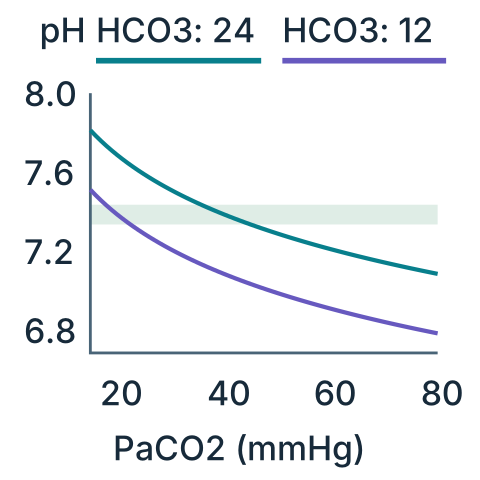
Two bicarbonate levels, two curves. Compare the curves at CO2 40: bicarbonate 24 gives pH about 7.40, while bicarbonate 12 gives about 7.10. Shading marks pH 7.35–7.45. Bicarbonate is in mmol/L. [2][14]Enlarge diagram
Follow one change, not two
Predict each answer, then open its question. Keep earlier steps open as you connect the reasoning.
1 Bicarbonate falls while carbon dioxide stays fixed. Does the numerator become smaller?
Yes. The bicarbonate amount is the numerator of the ratio.
2 What happens to a fraction when only its numerator decreases?
The fraction decreases.
3 The logarithm increases when its input increases. Does a smaller ratio raise or lower pH?
It lowers pH. This is the acidifying direction of a bicarbonate loss.
One rule to keep
Hold one variable steady to understand the other variable's effect.
Respiratory alkalosis PaCO2 falls. Buffering and then renal bicarbonate loss lower bicarbonate.
Read each pair as a primary change followed by an expected response. Direction alone cannot distinguish compensation from a second disease.
A blood gas measures pH and PaCO2 and calculates bicarbonate. A chemistry panel measures total CO2, mostly bicarbonate. Large discrepancies require checking sampling time, labeling and handling rather than forcing a diagnosis. A reported pH of 7.40, PaCO2 of 60 and bicarbonate of 12 cannot describe one internally consistent sample. Venous gases can assist selected acid-base assessments, but venous PO2 does not measure arterial oxygenation.
Check the numbers before naming a disorder
Predict each answer, then open its question. Keep earlier steps open as you connect the reasoning.
1 At bicarbonate 12 and PaCO2 60, what is dissolved CO2?
0.03 times 60 is 1.8 mmol/L.
2 What is the bicarbonate-to-dissolved-CO2 ratio?
12 divided by 1.8 is approximately 6.7.
3 Does 6.1 + log10(6.7), approximately 6.92, fit a reported pH of 7.40?
No. Verify sample timing and reported values before interpreting this combination.
One rule to keep
An internally inconsistent gas needs verification, not a clever diagnosis.
Start with illness severity and the pH, identify the variable producing that direction, calculate its expected compensation, and then inspect the anion gap. Revisit the diagnosis if the numbers and the bedside story disagree. A patient who is tiring cannot necessarily sustain the ventilation that a formula predicts.
Use compensation as a test of your explanation
Compensation is the other physiological system partly opposing a disturbance. Acute means newly developed; chronic means sustained over time. The numerical rules here estimate a response; they do not diagnose timing without the history.
Compensation reduces the pH disturbance. It does not deliberately overshoot into the opposite disorder. A near-normal pH is still possible in a chronic or mixed condition; it is not a license to stop calculating. The following are approximate physiological expectations, not hard diagnostic boundaries for a value one unit outside a range.
Expected response, starting from PaCO2 40 and bicarbonate 24
Primary disturbance
Expected response
Primary disturbanceMetabolic acidosis
Expected responseWinter's formula gives PaCO2 = 1.5 × bicarbonate + 8, within about 2 mmHg.
Primary disturbanceMetabolic alkalosis
Expected responsePaCO2 rises approximately 0.6 to 0.7 mmHg per 1 mmol/L bicarbonate increase. Use 40 + 0.7 × (bicarbonate − 24), allowing roughly 5 mmHg of biological variation.
Primary disturbanceRespiratory acidosis
Expected responseFor each 10 mmHg PaCO2 increase, bicarbonate rises about 1 mmol/L acutely and 3.5 to 4 mmol/L after chronic adaptation.
Primary disturbanceRespiratory alkalosis
Expected responseFor each 10 mmHg PaCO2 decrease, bicarbonate falls about 2 mmol/L acutely and about 4 to 5 mmol/L after sustained adaptation.
Place the measured gas
Could a “normal” CO2 be too high? In this example of primary metabolic acidosis, bicarbonate is fixed at 12 mmol/L. Winter’s estimate is 1.5 × 12 + 8 = 26, with an expected interval of 24–28 mmHg. The shaded interval stays fixed; choose a measured CO2 and see where its marker lands.
Measured PaCO2 26 mmHg is inside the expected 24–28 interval: an appropriate respiratory response.
Worked example, always available
A measured CO2 of 26 lies inside 24–28: it fits the expected respiratory response. A measured 40 lies above it: CO2 has not fallen enough, supporting an added respiratory acidosis. A measured 18 lies below it: the extra CO2 reduction supports an added respiratory alkalosis. These are approximate expectations for primary metabolic acidosis, not universal targets or a substitute for clinical assessment. [2][14]
Build the expected range
Predict each answer, then open its question. Keep earlier steps open as you connect the reasoning.
1 In primary metabolic acidosis, bicarbonate is 12. What is 1.5 times 12?
18.
2 Add the formula's intercept, 8. What PaCO2 does that predict?
26 mmHg.
3 The estimate allows 2 mmHg on either side. Is measured PaCO2 40 within 24–28?
No. It is above the expected response, supporting an additional respiratory acidosis.
One rule to keep
Compare CO2 with the needed compensation, not only its healthy reference range.
With bicarbonate 12, expected PaCO2 is 26 ± 2. A measured value of 26 supports an appropriate respiratory response. A value of 40 means additional respiratory acidosis, even though 40 is normal in a healthy person. A value of 18 means additional respiratory alkalosis. Neither abnormal response is explained by calling the metabolic acidosis more severe.
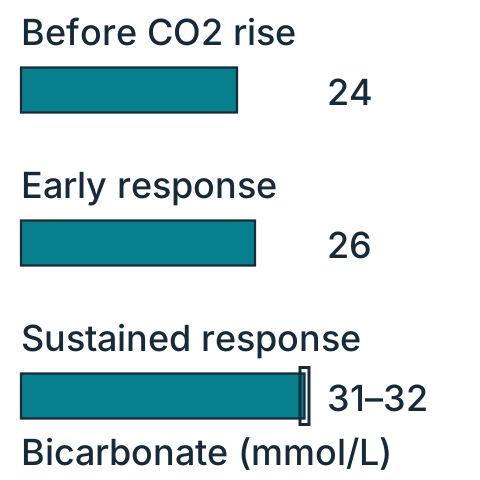
For chronic CO2 retention, use a documented baseline whenever available. PaCO2 60 with bicarbonate 31 to 32 can fit chronic respiratory acidosis. If bicarbonate is 40, consider another alkalinizing process such as vomiting or diuresis. If PaCO2 abruptly rises from 60 to 80 while bicarbonate rises only from 32 to 34, the new deterioration is acute on chronic. Do not infer duration solely from a COPD label.
Give the kidney time. Starting from CO2 40 and bicarbonate 24, a rise to CO2 60 has a smaller acute bicarbonate response than a sustained response. These are approximate comparisons, not a timed prediction of one patient. [2][14]Enlarge diagram
Why does the baseline matter?
Predict each answer, then open its question. Keep earlier steps open as you connect the reasoning.
1 PaCO2 has risen from 40 to 60. How many 10-mmHg increments is that?
Two increments.
2 An acute response adds about 1 bicarbonate per increment. Starting at 24, where does that lead?
Approximately 26 mmol/L.
3 A sustained response adds about 3.5–4 per increment. Where does that lead?
Approximately 31–32 mmol/L; the timing and kidney function must fit.
One rule to keep
A COPD label does not establish the duration of a CO2 rise.
After ventilation rapidly corrects chronic hypercapnia, the kidneys may take time to excrete retained bicarbonate. The resulting posthypercapnic metabolic alkalosis is distinct from an appropriate acute compensation. Chloride depletion, hypokalemia and ongoing diuretics can sustain it. [3]
Two organs, different response times
Predict each answer, then open its question. Keep earlier steps open as you connect the reasoning.
1 Ventilation rapidly lowers a chronically high CO2. Has previously retained bicarbonate necessarily disappeared?
No. Renal bicarbonate excretion can lag behind the change in ventilation.
2 CO2 falls while bicarbonate stays high. Which way does their ratio move?
Upward, so pH rises and posthypercapnic alkalemia can appear.
One rule to keep
A normal CO2 can coexist with an abnormal bicarbonate adaptation.
Find the acids that the chemistry panel does not name
Anions carry negative charge. The anion gap is a calculated difference, not lost electrical charge. Delta means change from a baseline. A ketone is a fuel molecule produced from fat; some ketones contribute to acidosis.
The anion gap estimates unmeasured anions. Use AG = sodium − (chloride + bicarbonate), in mmol/L, unless the laboratory explicitly includes potassium. Normal depends on the assay; the worked examples use 12 as the reference. Albumin carries negative charge, so low albumin lowers the expected gap. A useful correction is AG + 2.5 × (4 − albumin in g/dL). A measured gap of 11 with albumin 2 corrects to 16. [1]
Where did the bicarbonate go?
Same low bicarbonate. Same cause? Sodium stays at 140 mmol/L. AG = sodium − chloride − bicarbonate. Compare acid accumulation with chloride-associated bicarbonate loss. Both reduce bicarbonate to 12, but predict whether the gap will grow.
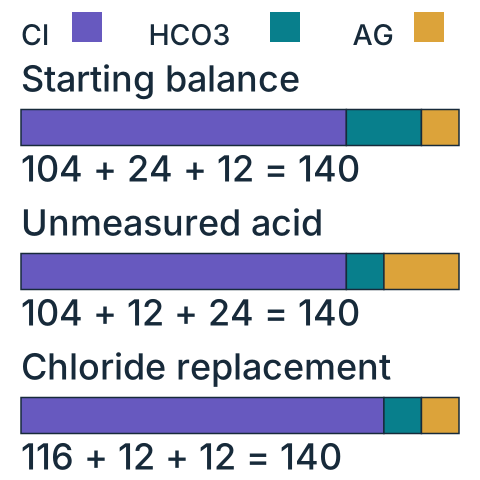
Chloride 104; bicarbonate 24; anion gap 12 mmol/L. The baseline example balances 104 + 24 + 12 against sodium 140.
Worked example, always available
Starting example: 140 − 104 − 24 = 12. Acid accumulation example: 140 − 104 − 12 = 24. Chloride replacement example: 140 − 116 − 12 = 12. The anion gap is the net unmeasured-ion balance in this sodium-based accounting, not missing electrical charge. Real blood remains electrically neutral. Reference intervals vary by laboratory. [1]
A hidden gap under low albumin
Predict each answer, then open its question. Keep earlier steps open as you connect the reasoning.
1 Albumin is 2 g/dL rather than the example reference of 4. How large is that difference?
2 g/dL.
2 The estimated gap correction is 2.5 per missing gram. How much should be added?
5 mmol/L.
3 An observed gap of 11 plus that correction gives what result?
16 mmol/L. Interpret it against the laboratory's own reference interval.
One rule to keep
Low albumin lowers the observed gap; it does not rule out acid accumulation.
Calculate a gap even when pH is normal or alkaline if the illness suggests metabolic acidosis. Lactate, beta-hydroxybutyrate and renal function identify common causes directly. High-gap causes include ketoacidosis, lactic acidosis, advanced kidney failure, methanol, ethylene glycol, salicylates and selected medication or toxin exposures. Propylene glycol in some intravenous drug solvents can contribute; iron or isoniazid poisoning can cause severe lactic acidosis. Exposure history matters more than reciting a mnemonic. [1][2]
Account for the same low bicarbonate. Each row totals the sodium reference of 140 mmol/L. The first colored segment is chloride, the middle is bicarbonate, and the last is the anion gap. This is net-ion accounting; blood remains electrically neutral. [1]Enlarge diagram
Compare the gap increase with the bicarbonate decrease. Using normal AG 12 and bicarbonate 24, the delta ratio is (AG − 12) / (24 − bicarbonate). A ratio around 1 to 2 is compatible with an isolated high-gap process. A clearly lower ratio suggests additional normal-gap acidosis; a clearly higher ratio suggests metabolic alkalosis or a pre-existing high bicarbonate. Timing, renal handling of organic anions, albumin and the patient's baseline affect this comparison. A ratio of 0.88 during DKA does not by itself prove a second disease. [1][14]
Use the delta ratio as a question
Predict each answer, then open its question. Keep earlier steps open as you connect the reasoning.
1 With gap 21 and bicarbonate 19, how far has the gap risen above an example baseline of 12?
9 mmol/L.
2 How far has bicarbonate fallen below 24?
5 mmol/L.
3 What is 9 divided by 5, and does it prove an extra disorder?
1.8. It is compatible with a high-gap acidosis, but a ratio alone does not prove or exclude another process.
One rule to keep
Check the baseline and mechanism before turning a rough ratio into a diagnosis.
AG 24. The 12-unit gap increase matches the 12-unit bicarbonate decrease. Seek lactate, ketones or another unmeasured anion.
Bicarbonate loss
Na 140, Cl 118, bicarbonate 12
AG 10. Chloride accounts for the lost bicarbonate charge. Seek gastrointestinal loss, renal tubular disease or chloride loading.
The gap separates two different biochemical routes to the same low bicarbonate. It does not measure the severity of acidemia.
The osmolal gap is measured osmolality minus calculated osmolarity. A common calculation is 2 × sodium + glucose/18 + BUN/2.8 when glucose and BUN are in mg/dL. Account for ethanol with the laboratory's validated method. A high gap can reflect alcohols but is not specific for a toxic ingestion. Early methanol or ethylene glycol exposure may have a large osmolal gap before acidosis; later metabolism may leave severe high-gap acidosis with a small osmolal gap. A normal gap does not exclude late poisoning. [7][8]
Follow what changes with time
Predict each answer, then open its question. Keep earlier steps open as you connect the reasoning.
1 A parent toxic alcohol is converted into acidic metabolites. Must the parent alcohol concentration stay high?
No. It can decrease as metabolites accumulate.
2 Can the osmolal gap therefore fall while acid-related injury continues?
Yes. A small late osmolal gap does not exclude toxic alcohol poisoning.
One rule to keep
One gap at one time does not identify or exclude a specific toxin.
Localize bicarbonate loss and persistent alkalosis
Ammonium is a form in which the kidneys excrete acid. RTA means renal tubular acidosis: a kidney-tubule problem that permits acid to accumulate or bicarbonate to be lost. Proximal means early in the nephron; distal means farther along. Fanconi syndrome involves loss of several substances normally recovered in the proximal tubule.
Diarrhea loses bicarbonate and often potassium. The kidneys should respond by increasing ammonium excretion. When direct urine ammonium is unavailable, urine sodium + potassium − chloride gives the urine anion gap. A negative value can support appropriate ammonium chloride excretion and a gastrointestinal cause. A positive value can support impaired renal acid excretion, but low distal sodium delivery, bicarbonaturia and ammonium paired with ketoanions can invalidate that inference. Reserve this surrogate for an otherwise unexplained normal-gap acidosis. [1]
Ask whether the kidney is responding
Predict each answer, then open its question. Keep earlier steps open as you connect the reasoning.
1 During diarrheal bicarbonate loss, should a functioning kidney excrete more acid as ammonium?
Yes. Increased ammonium excretion is an appropriate response to the acidosis.
2 When much ammonium leaves with chloride, can measured urine chloride exceed sodium plus potassium?
Yes. The urine anion gap can become negative.
3 Does a negative urine anion gap directly measure the ammonium concentration?
No. It is a conditional surrogate, with the limitations described above.
One rule to keep
Use a urine surrogate only when its physiological assumptions fit.
Renal tubular patterns that change the differential
Pattern
What is failing
Useful distinction
PatternDistal RTA, type 1
What is failingDistal acid secretion
Useful distinctionOften low potassium, urine pH above 5.5 despite systemic acidosis, and calcium phosphate stones or nephrocalcinosis.
PatternProximal RTA, type 2
What is failingProximal bicarbonate reclamation
Useful distinctionOften low potassium and other Fanconi losses. Urine can become acidic once plasma bicarbonate falls below the reduced reabsorptive threshold.
PatternHyperkalemic RTA, type 4
What is failingInsufficient aldosterone effect and reduced ammonium excretion
Useful distinctionHigh potassium, often diabetic kidney disease or a relevant medication. Urine pH can be below 5.5 despite inadequate total acid excretion.
Same blood acidosis, different renal failure
Predict each answer, then open its question. Keep earlier steps open as you connect the reasoning.
1 The proximal tubule normally recovers filtered bicarbonate. What is lost when that recovery fails?
Bicarbonate is lost in urine.
2 Must the distal tubule also have lost its ability to acidify urine?
No. In proximal RTA, urine can become acidic once blood bicarbonate falls below the reduced reabsorptive threshold.
3 Can urine pH below 5.5 therefore exclude every type of RTA?
No. Proximal RTA and type 4 RTA may have acidic urine despite systemic acidosis.
One rule to keep
Urine pH is not the same thing as total renal acid excretion.
Carbonic anhydrase inhibitors cause renal bicarbonate loss. Topiramate-associated persistent acidosis calls for assessment of dose reduction or tapered discontinuation, with alkali considered if treatment continues. Adding acetazolamide would intensify the same problem. ACE inhibitors, potassium-sparing diuretics and adrenal insufficiency can contribute to hyperkalemic acidosis. Substantial chloride-rich fluid or a chloride-heavy parenteral prescription can also lower bicarbonate; nutrition itself is not a universal cause of acidosis. [6][4][15]
Metabolic alkalosis requires both generation and impaired bicarbonate excretion. Vomiting or nasogastric suction loses gastric acid. Diuretics promote chloride and potassium loss. Volume and chloride depletion encourage renal bicarbonate retention. Hypokalemia further increases renal acid secretion and ammonium generation; it does not block hydrogen secretion. Calcium-alkali ingestion and metabolized citrate after transfusion supply alkali through different routes. [3]
Why can potassium depletion maintain alkalosis?
Predict each answer, then open its question. Keep earlier steps open as you connect the reasoning.
1 Does potassium depletion simply switch renal hydrogen secretion off?
Urine chloride below 20 mmol/L supports chloride depletion, often from vomiting or remote diuretic exposure. Chloride-containing fluid and potassium chloride can correct the maintaining defects when the patient is volume depleted. Urine chloride at or above 20 prompts assessment of current diuretic effect, blood pressure, renal salt wasting and mineralocorticoid excess. A high value during active diuresis does not prove permanent saline resistance. Hypertension with hypokalemic alkalosis raises concern for mineralocorticoid activity; normotensive salt wasting suggests a different pathway. [3]
Check what the urine chloride can tell you
Predict each answer, then open its question. Keep earlier steps open as you connect the reasoning.
1 A vomiting patient has urine chloride 8 mmol/L. Is that below the example cutoff of 20?
Yes. It supports chloride depletion in this setting.
2 A patient is actively receiving a loop diuretic. Must high urine chloride mean that chloride replacement can never help?
No. Active diuresis can increase urine chloride, so timing and volume status still matter.
One rule to keep
Urine chloride is a contextual clue, not a permanent treatment label.
Treat the cause and the immediate physiological threat
DKA means diabetic ketoacidosis. Dextrose is glucose supplied as treatment. NIV means noninvasive ventilation: breathing support through a mask. Hemodialysis removes selected substances from blood across a dialysis membrane.
In DKA, insulin deficiency produces ketones and osmotic diuresis depletes water and electrolytes. Blood beta-hydroxybutyrate is more useful than a urine dipstick that primarily detects acetoacetate. SGLT2-associated DKA may occur without marked hyperglycemia. Give appropriate fluids, insulin and electrolyte replacement with repeated assessment, but if potassium is below 3.5 mmol/L, replace potassium and delay insulin until it exceeds 3.5. A normal or high initial serum potassium does not mean total stores are adequate. During recovery, chloride-associated acidosis can persist after ketones clear, so the gap alone should not define resolution. [5]
Before insulin: follow potassium
Predict each answer, then open its question. Keep earlier steps open as you connect the reasoning.
1 Insulin moves potassium from blood into cells. Will this raise or lower blood potassium?
It lowers the blood potassium concentration.
2 In adult DKA with potassium 3.1 mmol/L, is that above the 3.5 threshold taught here?
No. Potassium replacement comes before insulin initiation.
3 Can a normal or high presenting blood potassium prove that total-body potassium stores are adequate?
No. Urinary losses can deplete total-body stores even when blood potassium initially looks normal or high.
One rule to keep
In adult DKA, potassium below 3.5 requires correction before insulin; reassess until it exceeds 3.5 mmol/L.
Alcohol-associated or starvation ketoacidosis needs carbohydrate and fluid restoration with attention to thiamine, potassium, magnesium and phosphate. Dextrose suppresses ketogenesis in alcoholic ketoacidosis; insulin is not routinely necessary unless there is another indication. Give thiamine promptly in a person at risk, while treating dangerous hypoglycemia without delay. Ketosis and lactic acidosis can coexist. In severe malnutrition, start nutrition through a monitored refeeding plan and replace depleted electrolytes; urgent rhythm abnormalities require immediate stabilization. [17][16]
Connect the fuel supply to ketones
Predict each answer, then open its question. Keep earlier steps open as you connect the reasoning.
1 During prolonged low carbohydrate availability, can the liver increase ketone production?
Lactic acidosis directs attention to perfusion, oxygen delivery, seizures, drugs and hepatic clearance. Treat shock or the provoking cause. Bicarbonate is not a universal cure for a low pH and generates CO2 that must be ventilated. Selected severe cases need alkali or renal replacement therapy according to cause, kidney function and clinical condition. Suspected severe metformin poisoning with pH at or below 7.0 or lactate above 20 mmol/L warrants extracorporeal treatment under EXTRIP guidance; shock and kidney impairment lower the threshold. Hemodialysis addresses drug burden and acidosis. Routine venovenous ECMO is not treatment for this poisoning. [1][10]
Treat the process, not just its pH
Predict each answer, then open its question. Keep earlier steps open as you connect the reasoning.
1 Severe metformin poisoning combines acid accumulation with a drug-clearance problem. Does merely supporting oxygen transfer remove the drug?
No. Oxygenation support alone does not provide the needed drug clearance.
2 Which extracorporeal treatment can remove metformin and help correct the acidosis?
Hemodialysis, when indicated under the EXTRIP recommendations described above.
One rule to keep
Match organ support to the process it actually corrects.
Suspected methanol or ethylene glycol poisoning requires urgent toxicology input, alcohol dehydrogenase inhibition with fomepizole and assessment for dialysis without waiting for every confirmatory test. Visual symptoms favor methanol; oxalate crystals and acute kidney injury support ethylene glycol but their absence does not exclude it. Salicylates can cause both respiratory alkalosis and high-gap acidosis. Alkalinization and potassium management require close supervision, and severe neurological or pulmonary toxicity can require hemodialysis even when a concentration alone seems less alarming. [7][8][9]
Respiratory acidosis means inadequate alveolar ventilation relative to CO2 production. Think obstruction, opioids or other central depression, neuromuscular weakness, obesity hypoventilation and ventilator problems. Support ventilation and correct the trigger. Bilevel NIV benefits appropriately monitored COPD exacerbations with acute respiratory acidosis; immediate deterioration, inability to protect the airway or failure of the trial requires escalation. In a struggling asthmatic, a rising or unexpectedly normal PaCO2 can signal exhaustion. [12][2]
Respiratory alkalosis occurs with pulmonary embolism, sepsis, hypoxemia at altitude, pregnancy, liver disease, pain and anxiety. Low CO2 increases calcium binding to albumin, which can produce paresthesias or carpopedal spasm despite normal total calcium. Do not diagnose anxiety from tingling alone. Paper bag rebreathing can worsen unrecognized hypoxemia and should not be used. [2][13]
Normal total calcium, real symptoms
Predict each answer, then open its question. Keep earlier steps open as you connect the reasoning.
1 During alkalemia, more calcium binds to albumin. Which calcium fraction becomes smaller?
The free, ionized calcium fraction.
2 Must total calcium fall before tingling or hand spasm can occur?
No. Symptoms can reflect the lower ionized fraction despite a normal total calcium.
One rule to keep
A concentration can change compartments without changing its total amount.
A. Isolated metabolic acidosis with appropriate compensation (Why this does not fit)
Connect the finding to the explanation
Predict each answer, then open its question. Keep earlier steps open as you connect the reasoning.
1 At bicarbonate 9, Winter's estimate is 1.5 × 9 + 8. What interval follows?
21.5 ± 2 mmHg, or about 19.5–23.5.
2 An appropriate response would place CO2 in about 19.5–23.5. Does measured CO2 30 fit?
No. It is higher than the expected respiratory response.
One rule to keep
A numerically normal-looking CO2 can be dangerously high for a patient with severe metabolic acidosis.
Complete explanation
Expected CO2 is 21.5 ± 2, substantially below 30.
B. Metabolic acidosis with additional respiratory acidosis (Best answer)
Connect the finding to the explanation
Predict each answer, then open its question. Keep earlier steps open as you connect the reasoning.
1 At bicarbonate 9, Winter's estimate is 1.5 × 9 + 8. What interval follows?
21.5 ± 2 mmHg, or about 19.5–23.5.
2 CO2 is 30, above the expected upper limit 23.5. Has enough CO2 been removed?
No. The additional CO2 retention supports respiratory acidosis alongside the metabolic acidosis.
3 Can a tiring patient necessarily sustain the ventilation that the formula predicts?
No. A rising CO2 during metabolic acidosis can reveal failing ventilatory compensation.
One rule to keep
A numerically normal-looking CO2 can be dangerously high for a patient with severe metabolic acidosis.
Complete explanation
The actual CO2 exceeds Winter's range, suggesting inadequate ventilation as the patient tires.
C. Metabolic acidosis with additional respiratory alkalosis (Why this does not fit)
Connect the finding to the explanation
Predict each answer, then open its question. Keep earlier steps open as you connect the reasoning.
1 At bicarbonate 9, Winter's estimate is 1.5 × 9 + 8. What interval follows?
21.5 ± 2 mmHg, or about 19.5–23.5.
2 Additional respiratory alkalosis would lower CO2 below the expected response. Is that what 30 shows?
No. It is above the interval, not below it.
One rule to keep
A numerically normal-looking CO2 can be dangerously high for a patient with severe metabolic acidosis.
Complete explanation
A respiratory alkalosis would require CO2 below the expected range, not above it.
D. Chronic respiratory alkalosis (Why this does not fit)
Connect the finding to the explanation
Predict each answer, then open its question. Keep earlier steps open as you connect the reasoning.
1 At bicarbonate 9, Winter's estimate is 1.5 × 9 + 8. What interval follows?
21.5 ± 2 mmHg, or about 19.5–23.5.
2 Chronic respiratory alkalosis requires a sustained primary low-CO2 history. Does acute DKA with fatigue and CO2 above its expected response establish that?
No. The supplied context instead supports metabolic acidosis with additional ventilatory failure.
One rule to keep
A numerically normal-looking CO2 can be dangerously high for a patient with severe metabolic acidosis.
Complete explanation
The severe bicarbonate deficit and ketotic illness indicate metabolic acidosis; ventilation is insufficient for that deficit.
Takeaway: A numerically normal-looking CO2 can be dangerously high for a patient with severe metabolic acidosis.
A. The negative urine anion gap supports appropriate renal ammonium excretion. (Best answer)
Connect the finding to the explanation
Predict each answer, then open its question. Keep earlier steps open as you connect the reasoning.
1 Urine sodium 35 plus potassium 20 minus chloride 90 gives what urine anion gap?
−35 mmol/L, a negative value.
2 During diarrheal bicarbonate loss, increased ammonium chloride excretion can make urine chloride exceed sodium plus potassium. Does the negative result fit that response?
Yes. In this context it supports appropriate renal ammonium excretion.
3 Would this surrogate remain dependable if much ammonium were leaving with an anion other than chloride?
Not necessarily. The accompanying anion and other urinary conditions affect the inference.
One rule to keep
Use the urine anion gap only when its physiological assumptions fit.
Complete explanation
35 + 20 − 90 = −35. In this setting, substantial urinary chloride can accompany ammonium excretion in response to gastrointestinal bicarbonate loss.
B. The urine proves distal renal tubular acidosis. (Why this does not fit)
Connect the finding to the explanation
Predict each answer, then open its question. Keep earlier steps open as you connect the reasoning.
1 Urine sodium 35 plus potassium 20 minus chloride 90 gives what urine anion gap?
−35 mmol/L, a negative value.
2 Distal RTA impairs acid excretion. Does this negative urine gap by itself prove that defect?
No. In the stated diarrheal setting, it instead supports an appropriate renal response.
One rule to keep
Use the urine anion gap only when its physiological assumptions fit.
Complete explanation
Impaired ammonium excretion would usually make this surrogate less negative; the diarrheal history and negative value support a renal response.
C. The patient has metabolic alkalosis from chloride loss. (Why this does not fit)
Connect the finding to the explanation
Predict each answer, then open its question. Keep earlier steps open as you connect the reasoning.
1 Urine sodium 35 plus potassium 20 minus chloride 90 gives what urine anion gap?
−35 mmol/L, a negative value.
2 Gastric acid loss can cause alkalosis. Is diarrhea-associated bicarbonate loss the same physiological loss?
No. Losing bicarbonate is acidifying; it does not establish metabolic alkalosis.
One rule to keep
Use the urine anion gap only when its physiological assumptions fit.
Complete explanation
The low serum bicarbonate and diarrheal loss describe metabolic acidosis, not gastric acid loss.
D. Urine chloride alone quantifies ammonium exactly. (Why this does not fit)
Connect the finding to the explanation
Predict each answer, then open its question. Keep earlier steps open as you connect the reasoning.
1 Urine sodium 35 plus potassium 20 minus chloride 90 gives what urine anion gap?
−35 mmol/L, a negative value.
2 Urine chloride is measured directly. Does chloride alone reveal exactly how much ammonium is present?
No. Other urinary ions contribute, so the urine gap is only a conditional surrogate.
One rule to keep
Use the urine anion gap only when its physiological assumptions fit.
Complete explanation
Chloride has several counterions. This is a conditional surrogate, not a direct ammonium measurement.
Takeaway: Use the urine anion gap only when its physiological assumptions fit.
A. Proximal RTA after bicarbonate has reached its lower steady state (Why this does not fit)
Connect the finding to the explanation
Predict each answer, then open its question. Keep earlier steps open as you connect the reasoning.
1 Blood is acidemic, but urine pH remains 6.3. Is the urine becoming strongly acidic in response?
No. In this setting, that raises concern about distal acid secretion.
2 In proximal RTA, urine can acidify after bicarbonate falls below its reduced threshold. Does persistent urine pH 6.3 with stones best fit that steady-state pattern?
No. Persistent inappropriate urine alkalinity and stones favor a distal acidification defect here.
One rule to keep
Interpret urine pH in the presence of systemic acidosis and exclude confounders such as infection.
Complete explanation
Proximal RTA can acidify urine after the plasma bicarbonate falls; persistent inability to acidify with stones favors a distal defect.
B. Type 4 RTA (Why this does not fit)
Connect the finding to the explanation
Predict each answer, then open its question. Keep earlier steps open as you connect the reasoning.
1 Blood is acidemic, but urine pH remains 6.3. Is the urine becoming strongly acidic in response?
No. In this setting, that raises concern about distal acid secretion.
2 Type 4 RTA commonly has high potassium. Does the potassium of 3.0 match that distinguishing pattern?
No. The low potassium and stone-associated urine findings favor a different tubular disorder.
One rule to keep
Interpret urine pH in the presence of systemic acidosis and exclude confounders such as infection.
Complete explanation
Type 4 usually has hyperkalemia, unlike this potassium of 3.0.
C. Distal RTA, type 1 (Best answer)
Connect the finding to the explanation
Predict each answer, then open its question. Keep earlier steps open as you connect the reasoning.
1 Blood is acidemic, but urine pH remains 6.3. Is the urine becoming strongly acidic in response?
No. In this setting, that raises concern about distal acid secretion.
2 Distal acidification failure can coexist with low potassium and calcium phosphate stones. Does this patient's combination fit?
Yes. Systemic acidosis, persistently alkaline urine and stones support distal RTA, type 1.
3 Could a urease-producing urinary infection confound an alkaline urine pH?
Yes. The negative culture in this case helps remove that competing explanation.
One rule to keep
Interpret urine pH in the presence of systemic acidosis and exclude confounders such as infection.
Complete explanation
Autoimmune disease, hypokalemia, calcium phosphate stones and persistently high urine pH during acidosis form a coherent distal acidification pattern.
D. Vomiting-associated metabolic alkalosis (Why this does not fit)
Connect the finding to the explanation
Predict each answer, then open its question. Keep earlier steps open as you connect the reasoning.
1 Blood is acidemic, but urine pH remains 6.3. Is the urine becoming strongly acidic in response?
No. In this setting, that raises concern about distal acid secretion.
2 Vomiting removes gastric acid and tends to alkalinize blood. Does it explain systemic metabolic acidosis here?
No. It has the wrong primary acid–base direction.
One rule to keep
Interpret urine pH in the presence of systemic acidosis and exclude confounders such as infection.
Complete explanation
Vomiting does not explain systemic normal-gap acidosis or the impaired acidification pattern.
Takeaway: Interpret urine pH in the presence of systemic acidosis and exclude confounders such as infection.
A. Hypokalemia blocks renal hydrogen secretion; add an NSAID. (Why this does not fit)
Connect the finding to the explanation
Predict each answer, then open its question. Keep earlier steps open as you connect the reasoning.
1 Potassium is 2.6, magnesium 1.2 and ectopy is present. Which immediate problem needs stabilization?
The depleted electrolytes are creating an urgent rhythm risk.
2 Potassium depletion can sustain alkalosis. Does it do so by blocking renal hydrogen secretion?
No. It promotes renal acid secretion and bicarbonate retention; the proposed mechanism and NSAID response are wrong.
One rule to keep
Electrolyte-associated arrhythmias take priority over merely naming the alkalosis.
Complete explanation
Hypokalemia promotes renal acid secretion and bicarbonate retention. An NSAID is not appropriate treatment for this electrolyte-associated arrhythmia.
B. Diuretic-associated chloride and potassium loss can sustain alkalosis; urgently correct potassium and magnesium and reassess diuresis. (Best answer)
Connect the finding to the explanation
Predict each answer, then open its question. Keep earlier steps open as you connect the reasoning.
1 Potassium is 2.6, magnesium 1.2 and ectopy is present. Which immediate problem needs stabilization?
The depleted electrolytes are creating an urgent rhythm risk.
2 Loop diuresis loses chloride and potassium. Can those losses maintain a high bicarbonate?
Yes. Correct the urgent potassium and magnesium deficits and reassess the diuretic and volume plan.
3 Can magnesium depletion make potassium correction difficult?
Yes. Magnesium needs attention alongside potassium rather than being postponed until potassium normalizes.
One rule to keep
Electrolyte-associated arrhythmias take priority over merely naming the alkalosis.
Complete explanation
The medication exposure, depleted electrolytes and ectopy require prompt monitored correction and evaluation of volume status.
C. The alkalosis proves the patient needs more loop diuretic. (Why this does not fit)
Connect the finding to the explanation
Predict each answer, then open its question. Keep earlier steps open as you connect the reasoning.
1 Potassium is 2.6, magnesium 1.2 and ectopy is present. Which immediate problem needs stabilization?
The depleted electrolytes are creating an urgent rhythm risk.
2 Diuretics may be needed for congestion. Does alkalosis alone prove that the dose should increase?
No. It can instead be a consequence of the treatment's chloride and potassium losses.
One rule to keep
Electrolyte-associated arrhythmias take priority over merely naming the alkalosis.
Complete explanation
Alkalosis alone is not evidence of persistent congestion and may reflect excessive depletion.
D. Correct magnesium only after potassium has normalized. (Why this does not fit)
Connect the finding to the explanation
Predict each answer, then open its question. Keep earlier steps open as you connect the reasoning.
1 Potassium is 2.6, magnesium 1.2 and ectopy is present. Which immediate problem needs stabilization?
The depleted electrolytes are creating an urgent rhythm risk.
2 Magnesium loss can sustain potassium wasting. Is waiting for normal potassium before replacing magnesium a helpful sequence?
No. Both deficits require coordinated correction.
One rule to keep
Electrolyte-associated arrhythmias take priority over merely naming the alkalosis.
Complete explanation
Magnesium depletion can perpetuate potassium wasting and should be addressed alongside potassium.
Takeaway: Electrolyte-associated arrhythmias take priority over merely naming the alkalosis.
A. An aldosterone or other mineralocorticoid-mediated process (Best answer)
Connect the finding to the explanation
Predict each answer, then open its question. Keep earlier steps open as you connect the reasoning.
1 Hypertension, low potassium and metabolic alkalosis occur without stated vomiting or diuretic use. What additional context matters?
The high blood pressure makes a mineralocorticoid-related mechanism important to evaluate.
2 Mineralocorticoid activity promotes sodium retention with potassium and acid loss. Does that fit the combined blood pressure and electrolyte pattern?
Yes. It provides a coherent mechanism for hypertension with hypokalemic alkalosis.
3 Does this pattern identify a single cause of mineralocorticoid activity without further testing?
No. Renin, aldosterone, medications and the clinical context help distinguish the causes.
One rule to keep
In alkalosis with high urine chloride, blood pressure helps separate salt wasting from mineralocorticoid activity.
Complete explanation
Hypertension, renal chloride excretion and hypokalemic alkalosis suggest mineralocorticoid activity; renin and aldosterone testing must account for medications and potassium status.
B. Uncomplicated gastric chloride depletion (Why this does not fit)
Connect the finding to the explanation
Predict each answer, then open its question. Keep earlier steps open as you connect the reasoning.
1 Hypertension, low potassium and metabolic alkalosis occur without stated vomiting or diuretic use. What additional context matters?
The high blood pressure makes a mineralocorticoid-related mechanism important to evaluate.
2 Uncomplicated gastric chloride depletion often produces a low urine chloride. Does urine chloride 46 with hypertension and no vomiting fit best?
No. Those findings favor a different maintaining mechanism.
One rule to keep
In alkalosis with high urine chloride, blood pressure helps separate salt wasting from mineralocorticoid activity.
Complete explanation
Absent vomiting and the high urine chloride make simple gastric depletion less likely.
C. Type 4 RTA (Why this does not fit)
Connect the finding to the explanation
Predict each answer, then open its question. Keep earlier steps open as you connect the reasoning.
1 Hypertension, low potassium and metabolic alkalosis occur without stated vomiting or diuretic use. What additional context matters?
The high blood pressure makes a mineralocorticoid-related mechanism important to evaluate.
2 Type 4 RTA usually produces hyperkalemic acidosis. Does that match hypokalemic alkalosis?
No. Both potassium and acid–base directions are reversed.
One rule to keep
In alkalosis with high urine chloride, blood pressure helps separate salt wasting from mineralocorticoid activity.
Complete explanation
Type 4 produces hyperkalemic acidosis, the opposite potassium and bicarbonate pattern.
D. A primary respiratory acidosis solely because bicarbonate is high (Why this does not fit)
Connect the finding to the explanation
Predict each answer, then open its question. Keep earlier steps open as you connect the reasoning.
1 Hypertension, low potassium and metabolic alkalosis occur without stated vomiting or diuretic use. What additional context matters?
The high blood pressure makes a mineralocorticoid-related mechanism important to evaluate.
2 Respiratory acidosis can raise bicarbonate secondarily. Does high bicarbonate alone establish CO2 retention?
No. A CO2 value and the expected response are required before making that respiratory diagnosis.
One rule to keep
In alkalosis with high urine chloride, blood pressure helps separate salt wasting from mineralocorticoid activity.
Complete explanation
Bicarbonate alone cannot establish a respiratory disorder; the blood pressure and potassium pattern support an endocrine evaluation.
Takeaway: In alkalosis with high urine chloride, blood pressure helps separate salt wasting from mineralocorticoid activity.
A. Euglycemic DKA requiring a DKA protocol with glucose support as needed (Best answer)
Connect the finding to the explanation
Predict each answer, then open its question. Keep earlier steps open as you connect the reasoning.
1 The patient has diabetes, beta-hydroxybutyrate 5.4 and bicarbonate 11 with pH 7.27. Are ketones and acidosis present?
Yes. The diabetes history supplies the diagnostic context even though glucose is only 168 mg/dL.
2 SGLT2-associated DKA may occur without marked hyperglycemia. Does glucose 168 exclude the ketone-associated acidosis in this patient with diabetes?
No. The stated combination supports euglycemic DKA.
3 Why may glucose support be needed while insulin treats euglycemic DKA?
Insulin must suppress ketogenesis even when the glucose is not markedly elevated, so the protocol may require dextrose support.
One rule to keep
Check ketones in an ill patient taking an SGLT2 inhibitor even when glucose is modest.
Complete explanation
SGLT2 exposure, diabetes, substantial ketonemia and acidosis meet the clinical pattern despite glucose below 200. Insulin treatment requires accompanying dextrose when glucose is not high.
B. DKA is excluded because glucose is below 250 mg/dL. (Why this does not fit)
Connect the finding to the explanation
Predict each answer, then open its question. Keep earlier steps open as you connect the reasoning.
1 The patient has diabetes, beta-hydroxybutyrate 5.4 and bicarbonate 11 with pH 7.27. Are ketones and acidosis present?
Yes. The diabetes history supplies the diagnostic context even though glucose is only 168 mg/dL.
2 Older teaching emphasized a glucose cutoff of 250. Does the current diabetes-history criterion require that glucose level in every DKA case?
No. Known diabetes with significant ketosis and acidosis can establish DKA below that glucose level.
One rule to keep
Check ketones in an ill patient taking an SGLT2 inhibitor even when glucose is modest.
Complete explanation
Marked hyperglycemia is not required for SGLT2-associated DKA.
C. Isolated respiratory alkalosis (Why this does not fit)
Connect the finding to the explanation
Predict each answer, then open its question. Keep earlier steps open as you connect the reasoning.
1 The patient has diabetes, beta-hydroxybutyrate 5.4 and bicarbonate 11 with pH 7.27. Are ketones and acidosis present?
Yes. The diabetes history supplies the diagnostic context even though glucose is only 168 mg/dL.
2 Respiratory alkalosis lowers CO2. Can an isolated respiratory process account for the substantial ketonemia with metabolic acidosis?
No. It would not explain this ketone-producing metabolic process.
One rule to keep
Check ketones in an ill patient taking an SGLT2 inhibitor even when glucose is modest.
Complete explanation
Respiratory alkalosis cannot explain the ketonemia and large bicarbonate deficit.
D. A normal urine ketone result would exclude ketoacidosis. (Why this does not fit)
Connect the finding to the explanation
Predict each answer, then open its question. Keep earlier steps open as you connect the reasoning.
1 The patient has diabetes, beta-hydroxybutyrate 5.4 and bicarbonate 11 with pH 7.27. Are ketones and acidosis present?
Yes. The diabetes history supplies the diagnostic context even though glucose is only 168 mg/dL.
2 A standard urine dipstick mainly detects acetoacetate. Does it directly measure the beta-hydroxybutyrate that is elevated here?
No. A reassuring urine result cannot overrule the measured blood ketone and acid–base findings.
One rule to keep
Check ketones in an ill patient taking an SGLT2 inhibitor even when glucose is modest.
Complete explanation
Urine testing may underrepresent beta-hydroxybutyrate, so blood ketone measurement is more useful here.
Takeaway: Check ketones in an ill patient taking an SGLT2 inhibitor even when glucose is modest.
A. Routine insulin infusion without glucose (Why this does not fit)
Connect the finding to the explanation
Predict each answer, then open its question. Keep earlier steps open as you connect the reasoning.
1 After alcohol-associated poor intake, glucose is 64 and ketones are elevated. Is the glucose supply already abundant?
No. The patient has low glucose in a carbohydrate-depleted setting.
2 Insulin lowers blood glucose. Would routine insulin without glucose address this already low glucose safely?
No. Alcohol-associated ketoacidosis usually calls for carbohydrate restoration rather than routine insulin alone.
One rule to keep
Alcoholic ketoacidosis can occur without high lactate or detectable ethanol.
Complete explanation
The glucose is already low; insulin alone could worsen hypoglycemia and is not routine treatment for alcoholic ketoacidosis.
B. Fomepizole solely because lactate is not markedly increased (Why this does not fit)
Connect the finding to the explanation
Predict each answer, then open its question. Keep earlier steps open as you connect the reasoning.
1 After alcohol-associated poor intake, glucose is 64 and ketones are elevated. Is the glucose supply already abundant?
No. The patient has low glucose in a carbohydrate-depleted setting.
2 Fomepizole targets toxic alcohol metabolism. Does a modest lactate concentration by itself establish a toxic alcohol exposure?
No. The low lactate alone does not justify that diagnosis or treatment.
One rule to keep
Alcoholic ketoacidosis can occur without high lactate or detectable ethanol.
Complete explanation
Normal or modest lactate does not identify a toxic alcohol, while the history and ketones support alcoholic ketoacidosis.
C. Dextrose and appropriate fluids, prompt thiamine and electrolyte monitoring (Best answer)
Connect the finding to the explanation
Predict each answer, then open its question. Keep earlier steps open as you connect the reasoning.
1 After alcohol-associated poor intake, glucose is 64 and ketones are elevated. Is the glucose supply already abundant?
No. The patient has low glucose in a carbohydrate-depleted setting.
2 Restoring carbohydrate supply reduces the drive to produce ketones. Does dextrose address that mechanism here?
Yes. Dextrose with appropriate fluids, thiamine and electrolyte assessment addresses the stated physiological deficits.
3 Should treatment of dangerous hypoglycemia wait until thiamine administration is complete?
No. Give thiamine promptly when indicated, but do not delay urgent glucose treatment.
One rule to keep
Alcoholic ketoacidosis can occur without high lactate or detectable ethanol.
Complete explanation
Carbohydrate suppresses ketogenesis and treats low glucose. Thiamine and potassium, magnesium and phosphate assessment address common accompanying deficits.
D. Bicarbonate alone until the anion gap closes (Why this does not fit)
Connect the finding to the explanation
Predict each answer, then open its question. Keep earlier steps open as you connect the reasoning.
1 After alcohol-associated poor intake, glucose is 64 and ketones are elevated. Is the glucose supply already abundant?
No. The patient has low glucose in a carbohydrate-depleted setting.
2 A bicarbonate infusion may alter the pH. Would it alone restore carbohydrate availability and suppress the ketone-producing stimulus?
No. It would leave the underlying fuel and volume problems untreated.
One rule to keep
Alcoholic ketoacidosis can occur without high lactate or detectable ethanol.
Complete explanation
The gap is 25, and alkali alone does not address starvation physiology, hypoglycemia or dehydration.
Takeaway: Alcoholic ketoacidosis can occur without high lactate or detectable ethanol.
A. The small osmolal gap excludes ethylene glycol. (Why this does not fit)
Connect the finding to the explanation
Predict each answer, then open its question. Keep earlier steps open as you connect the reasoning.
1 A possible garage-fluid exposure is followed by high-gap acidosis, acute kidney injury and oxalate crystals. Does the pattern raise concern for ethylene glycol?
Yes. The exposure context and findings make urgent toxic alcohol assessment important.
2 Parent alcohol contributes to the osmolal gap. Can that gap shrink as the alcohol becomes acidic metabolites?
Yes. A small late gap cannot exclude ongoing metabolite-related injury.
One rule to keep
A small osmolal gap late in toxic alcohol poisoning is not reassuring.
Complete explanation
A late presentation can have metabolized parent alcohol and accumulated acidic products, leaving a small osmolal gap.
B. Ethylene glycol remains likely; obtain urgent toxicology input, start antidotal treatment and assess dialysis indications. (Best answer)
Connect the finding to the explanation
Predict each answer, then open its question. Keep earlier steps open as you connect the reasoning.
1 A possible garage-fluid exposure is followed by high-gap acidosis, acute kidney injury and oxalate crystals. Does the pattern raise concern for ethylene glycol?
Yes. The exposure context and findings make urgent toxic alcohol assessment important.
2 Would waiting for every confirmatory result remove the ongoing risk from toxic alcohol metabolism?
No. The concerning pattern warrants urgent toxicology input, antidotal treatment and assessment for dialysis.
3 Can ethylene glycol poisoning occur without visible urine oxalate crystals?
Yes. Their absence does not safely exclude the poisoning.
One rule to keep
A small osmolal gap late in toxic alcohol poisoning is not reassuring.
Complete explanation
Exposure, renal injury and oxalate support the diagnosis. Severe poisoning requires action while confirmatory testing is pursued.
C. Oxalate crystals prove the diagnosis without further assessment. (Why this does not fit)
Connect the finding to the explanation
Predict each answer, then open its question. Keep earlier steps open as you connect the reasoning.
1 A possible garage-fluid exposure is followed by high-gap acidosis, acute kidney injury and oxalate crystals. Does the pattern raise concern for ethylene glycol?
Yes. The exposure context and findings make urgent toxic alcohol assessment important.
2 Oxalate crystals can support the diagnosis. Do crystals alone establish the exposure with certainty?
No. They must be interpreted with the exposure history, biochemical findings and further assessment.
One rule to keep
A small osmolal gap late in toxic alcohol poisoning is not reassuring.
Complete explanation
Crystals are supportive, not perfectly sensitive or specific; exposure history and the full clinical picture still matter.
D. Give dextrose alone for presumed alcoholic ketoacidosis. (Why this does not fit)
Connect the finding to the explanation
Predict each answer, then open its question. Keep earlier steps open as you connect the reasoning.
1 A possible garage-fluid exposure is followed by high-gap acidosis, acute kidney injury and oxalate crystals. Does the pattern raise concern for ethylene glycol?
Yes. The exposure context and findings make urgent toxic alcohol assessment important.
2 Dextrose treats the carbohydrate deficit in alcoholic ketoacidosis. Does it inhibit ethylene glycol metabolism?
No. It would not replace the indicated toxic alcohol evaluation and antidotal treatment.
One rule to keep
A small osmolal gap late in toxic alcohol poisoning is not reassuring.
Complete explanation
The garage-fluid exposure and kidney injury require evaluation and treatment for toxic alcohol poisoning.
Takeaway: A small osmolal gap late in toxic alcohol poisoning is not reassuring.
A. Routine venovenous ECMO to clear metformin (Why this does not fit)
Connect the finding to the explanation
Predict each answer, then open its question. Keep earlier steps open as you connect the reasoning.
1 In suspected severe metformin poisoning, lactate is 23 and pH is 6.92. Do these cross the EXTRIP thresholds described in the lesson?
Yes. Lactate exceeds 20 mmol/L and pH is below 7.0; shock and kidney impairment add concern.
2 Venovenous ECMO provides gas-exchange support. Is routine ECMO the extracorporeal method used to clear metformin in this recommendation?
No. Hemodialysis provides the relevant drug clearance and acid–base correction.
One rule to keep
Severe metformin-associated lactic acidosis can require urgent dialysis.
Complete explanation
VV ECMO supports gas exchange and does not provide the required drug clearance and metabolic correction.
B. Urgent extracorporeal treatment, preferably intermittent hemodialysis when feasible (Best answer)
Connect the finding to the explanation
Predict each answer, then open its question. Keep earlier steps open as you connect the reasoning.
1 In suspected severe metformin poisoning, lactate is 23 and pH is 6.92. Do these cross the EXTRIP thresholds described in the lesson?
Yes. Lactate exceeds 20 mmol/L and pH is below 7.0; shock and kidney impairment add concern.
2 The patient has severe poisoning with major acidosis and impaired clearance. Which extracorporeal process addresses both drug burden and acidosis?
Urgent dialysis; intermittent hemodialysis is preferred when feasible under the cited guidance.
3 Does improvement after dialysis eliminate the need to reassess lactate, pH and clinical condition?
No. Continued assessment is needed because the poisoning and metabolic disturbance can recur or persist.
One rule to keep
Severe metformin-associated lactic acidosis can require urgent dialysis.
Complete explanation
The profound acidemia and lactate exceed EXTRIP thresholds. Dialysis removes metformin and corrects acidosis; modality depends on clinical feasibility.
C. Observation until the metformin concentration returns (Why this does not fit)
Connect the finding to the explanation
Predict each answer, then open its question. Keep earlier steps open as you connect the reasoning.
1 In suspected severe metformin poisoning, lactate is 23 and pH is 6.92. Do these cross the EXTRIP thresholds described in the lesson?
Yes. Lactate exceeds 20 mmol/L and pH is below 7.0; shock and kidney impairment add concern.
2 A metformin level can add information. Must the severe clinical indications wait until that result is available?
No. The supplied pH, lactate, shock and kidney injury already warrant urgent action.
One rule to keep
Severe metformin-associated lactic acidosis can require urgent dialysis.
Complete explanation
Severe acidemia, shock and kidney injury justify treatment without waiting for a delayed drug level.
D. Acetazolamide to increase renal acid elimination (Why this does not fit)
Connect the finding to the explanation
Predict each answer, then open its question. Keep earlier steps open as you connect the reasoning.
1 In suspected severe metformin poisoning, lactate is 23 and pH is 6.92. Do these cross the EXTRIP thresholds described in the lesson?
Yes. Lactate exceeds 20 mmol/L and pH is below 7.0; shock and kidney impairment add concern.
2 Acetazolamide promotes bicarbonate loss. Would that restore bicarbonate or clear the severe metformin burden?
No. It can worsen the acidifying bicarbonate deficit and does not provide the needed drug clearance.
One rule to keep
Severe metformin-associated lactic acidosis can require urgent dialysis.
Complete explanation
Acetazolamide wastes bicarbonate and does not solve metformin accumulation in kidney failure.
Takeaway: Severe metformin-associated lactic acidosis can require urgent dialysis.
A. Immediately stabilize the rhythm risk, replace electrolytes and arrange monitored, gradual nutrition with thiamine. (Best answer)
Connect the finding to the explanation
Predict each answer, then open its question. Keep earlier steps open as you connect the reasoning.
1 Severe malnutrition is accompanied by potassium 2.0, magnesium 1.1 and ectopy. Is this only a future nutrition problem?
No. There is an immediate electrolyte-associated rhythm risk.
2 Can nutrition planning replace stabilization of the current rhythm risk?
No. Stabilize the immediate problem, replace electrolytes and arrange monitored, gradual nutrition with thiamine.
3 Why are thiamine and repeated electrolyte measurements part of the feeding plan?
Nutrition changes cellular fuel use and electrolyte distribution, so depleted stores and refeeding complications need active management.
One rule to keep
Refeeding safety depends on coordinated nutrition and electrolyte management.
Complete explanation
Severe deficits and ectopy require urgent treatment. Nutrition should follow an individualized refeeding plan with continued electrolyte and fluid monitoring.
B. Start full caloric feeding immediately without monitoring. (Why this does not fit)
Connect the finding to the explanation
Predict each answer, then open its question. Keep earlier steps open as you connect the reasoning.
1 Severe malnutrition is accompanied by potassium 2.0, magnesium 1.1 and ectopy. Is this only a future nutrition problem?
No. There is an immediate electrolyte-associated rhythm risk.
2 Refeeding can drive depleted electrolytes into cells. Would immediate full feeding without monitoring protect this patient?
No. It can worsen dangerous deficiencies and misses the need for a controlled, monitored plan.
One rule to keep
Refeeding safety depends on coordinated nutrition and electrolyte management.
Complete explanation
Insulin responses to feeding can worsen potassium, magnesium and phosphate depletion.
C. Delay all nutrition indefinitely until every laboratory value is normal. (Why this does not fit)
Connect the finding to the explanation
Predict each answer, then open its question. Keep earlier steps open as you connect the reasoning.
1 Severe malnutrition is accompanied by potassium 2.0, magnesium 1.1 and ectopy. Is this only a future nutrition problem?
No. There is an immediate electrolyte-associated rhythm risk.
2 Electrolyte correction is essential. Does that imply all nutrition should be withheld indefinitely?
No. Correction and a carefully monitored nutrition plan must be coordinated rather than indefinitely postponed.
One rule to keep
Refeeding safety depends on coordinated nutrition and electrolyte management.
Complete explanation
Refeeding requires a supervised plan, not indefinite starvation; immediate instability and deficits are treated while nutrition is safely organized.
D. Treat only the bicarbonate concentration. (Why this does not fit)
Connect the finding to the explanation
Predict each answer, then open its question. Keep earlier steps open as you connect the reasoning.
1 Severe malnutrition is accompanied by potassium 2.0, magnesium 1.1 and ectopy. Is this only a future nutrition problem?
No. There is an immediate electrolyte-associated rhythm risk.
2 A bicarbonate value describes one part of physiology. Would treating it alone address potassium, magnesium and malnutrition?
No. It would miss the immediate rhythm threat and the underlying nutritional deficits.
One rule to keep
Refeeding safety depends on coordinated nutrition and electrolyte management.
Complete explanation
The immediate danger is electrolyte-associated arrhythmia, and refeeding can intensify those deficits.
Takeaway: Refeeding safety depends on coordinated nutrition and electrolyte management.
A. A sudden increase in ionized calcium (Why this does not fit)
Connect the finding to the explanation
Predict each answer, then open its question. Keep earlier steps open as you connect the reasoning.
1 The pH is 7.52 with low CO2 and a normal total calcium. Is the blood alkalemic?
Yes. The elevated pH can alter how calcium is distributed between bound and free forms.
2 Alkalemia increases calcium binding to albumin. Does that increase the unbound ionized fraction?
No. More binding reduces the free ionized fraction.
One rule to keep
The biologically active calcium fraction can change without a change in total calcium.
Complete explanation
Alkalemia increases albumin binding of calcium, decreasing the ionized fraction rather than increasing it.
B. Potassium excess caused by respiratory acidosis (Why this does not fit)
Connect the finding to the explanation
Predict each answer, then open its question. Keep earlier steps open as you connect the reasoning.
1 The pH is 7.52 with low CO2 and a normal total calcium. Is the blood alkalemic?
Yes. The elevated pH can alter how calcium is distributed between bound and free forms.
2 Respiratory acidosis raises CO2. Does the measured low CO2 support that proposed mechanism?
No. This gas is alkalemic with low CO2, not a respiratory acidosis.
One rule to keep
The biologically active calcium fraction can change without a change in total calcium.
Complete explanation
This gas shows respiratory alkalosis, and the stem does not describe hyperkalemia.
C. Irreversible loss of total-body calcium within minutes (Why this does not fit)
Connect the finding to the explanation
Predict each answer, then open its question. Keep earlier steps open as you connect the reasoning.
1 The pH is 7.52 with low CO2 and a normal total calcium. Is the blood alkalemic?
Yes. The elevated pH can alter how calcium is distributed between bound and free forms.
2 Calcium can shift from free to bound forms rapidly. Does that require irreversible total-body calcium loss within minutes?
No. The total amount can remain unchanged while the biologically active free fraction falls.
One rule to keep
The biologically active calcium fraction can change without a change in total calcium.
Complete explanation
The rapid onset with normal total calcium is better explained by altered binding than by loss of body calcium.
D. Reduced ionized calcium from increased albumin binding during alkalemia (Best answer)
Connect the finding to the explanation
Predict each answer, then open its question. Keep earlier steps open as you connect the reasoning.
1 The pH is 7.52 with low CO2 and a normal total calcium. Is the blood alkalemic?
Yes. The elevated pH can alter how calcium is distributed between bound and free forms.
2 When more calcium binds albumin during alkalemia, which fraction becomes less available?
Ionized calcium decreases, which can explain paresthesias or hand spasm despite normal total calcium.
3 Does tingling with low CO2 establish anxiety as the cause of hyperventilation?
No. The underlying cause still needs assessment; several serious conditions can produce respiratory alkalosis.
One rule to keep
The biologically active calcium fraction can change without a change in total calcium.
Complete explanation
This can produce paresthesias and carpopedal spasm despite normal total calcium. Calm breathing guidance is appropriate after assessment; paper bag rebreathing is unsafe.
Takeaway: The biologically active calcium fraction can change without a change in total calcium.
A. Immediate complete renal compensation for the new CO2 (Why this does not fit)
Connect the finding to the explanation
Predict each answer, then open its question. Keep earlier steps open as you connect the reasoning.
1 Ventilation reduced CO2 from 70 to 40, but bicarbonate remains 34. Did both components return to the example baseline?
No. CO2 fell rapidly while the previously elevated bicarbonate remained high.
2 Renal adaptation takes time. Does persistent bicarbonate 34 show immediate complete adjustment to CO2 40?
No. It shows retained bicarbonate after the faster respiratory change.
One rule to keep
Correcting ventilation can uncover a persistent renal bicarbonate adaptation.
Complete explanation
The kidneys have not yet excreted the previously retained bicarbonate; renal adaptation is slower than ventilator-mediated CO2 correction.
B. New isolated respiratory acidosis (Why this does not fit)
Connect the finding to the explanation
Predict each answer, then open its question. Keep earlier steps open as you connect the reasoning.
1 Ventilation reduced CO2 from 70 to 40, but bicarbonate remains 34. Did both components return to the example baseline?
No. CO2 fell rapidly while the previously elevated bicarbonate remained high.
2 Respiratory acidosis raises CO2. Did CO2 rise from the patient's previous 70?
No. It fell substantially, so new isolated CO2 retention does not explain this alkalemic gas.
One rule to keep
Correcting ventilation can uncover a persistent renal bicarbonate adaptation.
Complete explanation
CO2 has fallen to 40, and the pH is alkaline.
C. Posthypercapnic metabolic alkalosis (Best answer)
Connect the finding to the explanation
Predict each answer, then open its question. Keep earlier steps open as you connect the reasoning.
1 Ventilation reduced CO2 from 70 to 40, but bicarbonate remains 34. Did both components return to the example baseline?
No. CO2 fell rapidly while the previously elevated bicarbonate remained high.
2 Has ventilation corrected the chronic CO2 retention faster than the kidneys have cleared retained bicarbonate?
Yes. That mismatch explains posthypercapnic metabolic alkalosis.
3 If CO2 falls while bicarbonate stays high, which way does the bicarbonate-to-CO2 ratio move?
Upward. The increased ratio raises pH and can produce posthypercapnic alkalemia.
One rule to keep
Correcting ventilation can uncover a persistent renal bicarbonate adaptation.
Complete explanation
Rapid CO2 correction exposes persistent bicarbonate retention from the prior chronic hypercapnia. Assess chloride, potassium and the ventilation strategy.
D. Normal acid-base status because CO2 is now 40 (Why this does not fit)
Connect the finding to the explanation
Predict each answer, then open its question. Keep earlier steps open as you connect the reasoning.
1 Ventilation reduced CO2 from 70 to 40, but bicarbonate remains 34. Did both components return to the example baseline?
No. CO2 fell rapidly while the previously elevated bicarbonate remained high.
2 CO2 is now 40. Does that alone make pH 7.55 and bicarbonate 34 normal?
No. The persistent bicarbonate elevation still makes the gas alkalemic.
One rule to keep
Correcting ventilation can uncover a persistent renal bicarbonate adaptation.
Complete explanation
Bicarbonate 34 and pH 7.55 remain abnormal despite a normal CO2 value.
Takeaway: Correcting ventilation can uncover a persistent renal bicarbonate adaptation.
A. High-gap metabolic acidosis with appropriate respiratory compensation (Why this does not fit)
Connect the finding to the explanation
Predict each answer, then open its question. Keep earlier steps open as you connect the reasoning.
1 How did the measured gap change from baseline?
It rose from 6 to 13 mmol/L.
2 Would appropriate compensation alone predict PaCO2 23?
No. The estimate is about 29 mmHg.
One rule to keep
Correct for low albumin before allowing a near-normal gap or pH to reassure you.
Complete explanation
The corrected gap supports this metabolic component, but PaCO2 is substantially lower than Winter's estimate. Normal pH reflects opposing processes.
B. Normal-gap metabolic acidosis with appropriate respiratory compensation (Why this does not fit)
Connect the finding to the explanation
Predict each answer, then open its question. Keep earlier steps open as you connect the reasoning.
1 How did the measured gap change from baseline?
It rose from 6 to 13 mmol/L.
2 What happens to the gap of 13 after correcting for albumin 1.6?
It becomes 19 mmol/L.
One rule to keep
Correct for low albumin before allowing a near-normal gap or pH to reassure you.
Complete explanation
The measured gap is 13, but correction for albumin gives 19. PaCO2 23 is also well below the expected 27 to 31.
C. High-gap metabolic acidosis with respiratory alkalosis (Best answer)
Connect the finding to the explanation
Predict each answer, then open its question. Keep earlier steps open as you connect the reasoning.
1 How did the measured gap change from baseline?
It rose from 6 to 13 mmol/L.
2 Does PaCO2 23 fit the expected 27 to 31 at bicarbonate 14?
No. It supports an additional respiratory alkalosis.
3 If albumin later rises without new acid production, could the measured gap rise?
Yes. Albumin itself contributes unmeasured negative charge.
One rule to keep
Correct for low albumin before allowing a near-normal gap or pH to reassure you.
Complete explanation
The corrected gap is 19, supporting acid accumulation despite the uncorrected result. At bicarbonate 14, expected PaCO2 is 29 plus or minus 2; 23 identifies an additional respiratory alkalosis. These two processes are established; the approximate delta comparison does not exclude a smaller normal-gap contribution.
D. Chronic respiratory alkalosis with renal adaptation (Why this does not fit)
Connect the finding to the explanation
Predict each answer, then open its question. Keep earlier steps open as you connect the reasoning.
1 How did the measured gap change from baseline?
It rose from 6 to 13 mmol/L.
2 Can renal adaptation to low CO2 explain the newly increased corrected gap?
No. An added metabolic acid source is present.
One rule to keep
Correct for low albumin before allowing a near-normal gap or pH to reassure you.
Complete explanation
Liver disease can sustain low CO2, but it does not explain the newly increased gap and lactate. The previous bicarbonate was 24.
Takeaway: Correct for low albumin before allowing a near-normal gap or pH to reassure you.
A. High-gap acidosis offset by metabolic alkalosis (Best answer)
Connect the finding to the explanation
Predict each answer, then open its question. Keep earlier steps open as you connect the reasoning.
1 What is the anion gap before any fluids?
28 mmol/L.
2 What does a 16-unit gap rise without a bicarbonate fall suggest?
An opposing metabolic alkalosis.
3 Why is a delta ratio unhelpful when bicarbonate is exactly 24?
Its denominator is zero; compare the absolute changes instead.
One rule to keep
An unchanged bicarbonate can conceal acid accumulation when gastric acid loss opposes it.
Complete explanation
The gap rose by 16 without a bicarbonate decrease. Gastric acid and chloride loss provide an opposing metabolic alkalosis, concealing the acidifying effect of ketones.
B. High-gap acidosis offset by respiratory alkalosis (Why this does not fit)
Connect the finding to the explanation
Predict each answer, then open its question. Keep earlier steps open as you connect the reasoning.
1 What is the anion gap before any fluids?
28 mmol/L.
2 Can respiratory alkalosis explain PaCO2 40 with bicarbonate 24?
No. CO2 has not decreased.
One rule to keep
An unchanged bicarbonate can conceal acid accumulation when gastric acid loss opposes it.
Complete explanation
PaCO2 is 40, so excess ventilation does not explain the preserved bicarbonate. The delta comparison identifies a metabolic alkalinizing component.
C. Ketone accumulation is too small to alter acid-base balance (Why this does not fit)
Connect the finding to the explanation
Predict each answer, then open its question. Keep earlier steps open as you connect the reasoning.
1 What is the anion gap before any fluids?
28 mmol/L.
2 Does a gap increase of 16 fit negligible acid accumulation?
No. The unmeasured anion burden is substantial.
One rule to keep
An unchanged bicarbonate can conceal acid accumulation when gastric acid loss opposes it.
Complete explanation
Substantial ketonemia accompanies a gap of 28, a 16-unit increase above baseline. A bicarbonate of 24 does not make that acid burden insignificant.
D. Renal adaptation to chronic carbon dioxide retention (Why this does not fit)
Connect the finding to the explanation
Predict each answer, then open its question. Keep earlier steps open as you connect the reasoning.
1 What is the anion gap before any fluids?
28 mmol/L.
2 Is PaCO2 40 evidence of chronic CO2 retention here?
No. The history supplies no chronic respiratory baseline.
One rule to keep
An unchanged bicarbonate can conceal acid accumulation when gastric acid loss opposes it.
Complete explanation
There is neither baseline hypercapnia nor current CO2 retention. Vomiting supplies a direct explanation for the excess bicarbonate relative to the gap.
Takeaway: An unchanged bicarbonate can conceal acid accumulation when gastric acid loss opposes it.
A. Acute respiratory acidosis superimposed on chronic respiratory acidosis (Why this does not fit)
Connect the finding to the explanation
Predict each answer, then open its question. Keep earlier steps open as you connect the reasoning.
1 What bicarbonate would acute buffering roughly predict from the prior 32?
About 33 to 34 mmol/L.
2 Would acute buffering of the CO2 rise lower bicarbonate from 32 to 25?
No. It should raise bicarbonate slightly.
One rule to keep
Use the patient's prior bicarbonate before deciding whether a current value is appropriate.
Complete explanation
An acute CO2 rise of 15 should modestly increase bicarbonate above 32. Its fall to 25 requires an additional metabolic explanation.
B. Chronic respiratory acidosis with isolated metabolic acidosis (Why this does not fit)
Connect the finding to the explanation
Predict each answer, then open its question. Keep earlier steps open as you connect the reasoning.
1 What bicarbonate would acute buffering roughly predict from the prior 32?
About 33 to 34 mmol/L.
2 Has the respiratory component remained at its chronic baseline?
No. PaCO2 has risen by 15 mmHg.
One rule to keep
Use the patient's prior bicarbonate before deciding whether a current value is appropriate.
Complete explanation
Diarrhea explains the bicarbonate loss, but PaCO2 has also risen abruptly from 60 to 75 after sedation.
C. Acute respiratory acidosis with metabolic alkalosis (Why this does not fit)
Connect the finding to the explanation
Predict each answer, then open its question. Keep earlier steps open as you connect the reasoning.
1 What bicarbonate would acute buffering roughly predict from the prior 32?
About 33 to 34 mmol/L.
2 Relative to the personal baseline, is bicarbonate 25 an excess?
No. It represents a 7 mmol/L deficit.
One rule to keep
Use the patient's prior bicarbonate before deciding whether a current value is appropriate.
Complete explanation
A bicarbonate of 25 is not an alkalinizing excess when the established chronic baseline is 32. The metabolic change is acidifying.
D. Acute respiratory acidosis plus normal-gap acidosis on chronic hypercapnia (Best answer)
Connect the finding to the explanation
Predict each answer, then open its question. Keep earlier steps open as you connect the reasoning.
1 What bicarbonate would acute buffering roughly predict from the prior 32?
About 33 to 34 mmol/L.
2 Which new process explains bicarbonate falling despite rising CO2?
An added metabolic acidosis.
3 Would bicarbonate 25 exclude metabolic acidosis in a chronic CO2 retainer?
No. It can be markedly below that patient's adapted baseline.
One rule to keep
Use the patient's prior bicarbonate before deciding whether a current value is appropriate.
Complete explanation
The abrupt CO2 rise adds respiratory acidosis. Bicarbonate fell rather than rising with acute buffering, and a gap of 12 with diarrhea supports added normal-gap metabolic acidosis.
Takeaway: Use the patient's prior bicarbonate before deciding whether a current value is appropriate.
A. New mineralocorticoid excess causing renal chloride wasting (Why this does not fit)
Connect the finding to the explanation
Predict each answer, then open its question. Keep earlier steps open as you connect the reasoning.
1 Which gas component changed much more over six hours?
PaCO2 fell by 24 mmHg while bicarbonate fell by only 2 mmol/L.
2 Does urine chloride 7 support ongoing renal chloride wasting?
No. The kidney is conserving chloride.
One rule to keep
Respiratory correction and renal bicarbonate adjustment occur on different time scales.
Complete explanation
That mechanism can produce hypokalemic alkalosis, but the temporal gas change and very low urine chloride favor retained bicarbonate with chloride depletion.
B. Retained renal bicarbonate sustained by chloride and potassium depletion (Best answer)
Connect the finding to the explanation
Predict each answer, then open its question. Keep earlier steps open as you connect the reasoning.
1 Which gas component changed much more over six hours?
PaCO2 fell by 24 mmHg while bicarbonate fell by only 2 mmol/L.
2 What does urine chloride 7 suggest about bicarbonate persistence?
Chloride depletion can limit bicarbonate excretion.
3 Would correcting chloride depletion necessarily normalize bicarbonate instantly?
No. Renal adjustment still takes time.
One rule to keep
Respiratory correction and renal bicarbonate adjustment occur on different time scales.
Complete explanation
CO2 fell much sooner than the adapted bicarbonate. Low urine chloride and hypokalemia identify factors that can sustain posthypercapnic metabolic alkalosis.
C. New respiratory alkalosis followed by complete renal compensation (Why this does not fit)
Connect the finding to the explanation
Predict each answer, then open its question. Keep earlier steps open as you connect the reasoning.
1 Which gas component changed much more over six hours?
PaCO2 fell by 24 mmHg while bicarbonate fell by only 2 mmol/L.
2 Does bicarbonate 34 indicate complete adaptation to low CO2?
No. It remains an alkalinizing metabolic excess.
One rule to keep
Respiratory correction and renal bicarbonate adjustment occur on different time scales.
Complete explanation
The ventilator has reduced CO2 faster than retained bicarbonate can be excreted. High bicarbonate is inconsistent with complete renal adaptation to a new respiratory alkalosis; a normal-range CO2 alone does not establish an appropriate response to the current bicarbonate.
D. Ongoing chronic respiratory acidosis with an appropriate bicarbonate (Why this does not fit)
Connect the finding to the explanation
Predict each answer, then open its question. Keep earlier steps open as you connect the reasoning.
1 Which gas component changed much more over six hours?
PaCO2 fell by 24 mmHg while bicarbonate fell by only 2 mmol/L.
2 Can the old CO2 baseline justify bicarbonate 34 after ventilation changes?
No. The current ratio determines the current pH.
One rule to keep
Respiratory correction and renal bicarbonate adjustment occur on different time scales.
Complete explanation
The prior bicarbonate suited chronic PaCO2 66. It is no longer appropriate after CO2 falls to 42, producing alkalemia.
Takeaway: Respiratory correction and renal bicarbonate adjustment occur on different time scales.
A. Renal acidification failure is established by persistent low bicarbonate (Why this does not fit)
Connect the finding to the explanation
Predict each answer, then open its question. Keep earlier steps open as you connect the reasoning.
1 How did the anion gap change during treatment?
It fell from 30 to 10 mmol/L.
2 Does a bicarbonate of 16 after saline establish a tubular defect?
No. Treatment-related chloride accumulation can produce this pattern.
One rule to keep
During DKA recovery, interpret blood ketones and pH alongside chloride rather than chasing bicarbonate or urine ketones alone.
Complete explanation
The abrupt chloride increase during treatment supplies an explanation without establishing RTA. Persistent low bicarbonate alone cannot localize the defect.
B. Chloride-associated acidosis persists after ketone clearance (Best answer)
Connect the finding to the explanation
Predict each answer, then open its question. Keep earlier steps open as you connect the reasoning.
1 How did the anion gap change during treatment?
It fell from 30 to 10 mmol/L.
2 What accounts for the low bicarbonate after the gap closes and blood ketones clear?
The new hyperchloremia supports residual normal-gap acidosis.
3 Can a positive urine ketone test alone justify continuing treatment for active ketogenesis?
No. Urine acetoacetate can remain positive during recovery.
One rule to keep
During DKA recovery, interpret blood ketones and pH alongside chloride rather than chasing bicarbonate or urine ketones alone.
Complete explanation
The gap is now 10, ketones have cleared, and pH exceeds 7.3. Hyperchloremia explains residual acidosis; urine acetoacetate can remain positive during recovery. Transition still requires a complete protocol and insulin overlap.
C. Inadequate ventilation is the main explanation for residual acidemia (Why this does not fit)
Connect the finding to the explanation
Predict each answer, then open its question. Keep earlier steps open as you connect the reasoning.
1 How did the anion gap change during treatment?
It fell from 30 to 10 mmol/L.
2 Is PaCO2 32 excessive for bicarbonate 16?
No. It matches the expected respiratory response.
One rule to keep
During DKA recovery, interpret blood ketones and pH alongside chloride rather than chasing bicarbonate or urine ketones alone.
Complete explanation
At bicarbonate 16, expected PaCO2 is 32 plus or minus 2. The measured 32 is appropriate.
D. Ongoing ketogenesis is the main explanation for the bicarbonate deficit (Why this does not fit)
Connect the finding to the explanation
Predict each answer, then open its question. Keep earlier steps open as you connect the reasoning.
1 How did the anion gap change during treatment?
It fell from 30 to 10 mmol/L.
2 Which directly measured result argues against substantial ongoing ketogenesis?
Beta-hydroxybutyrate is 0.4 mmol/L.
One rule to keep
During DKA recovery, interpret blood ketones and pH alongside chloride rather than chasing bicarbonate or urine ketones alone.
Complete explanation
Blood beta-hydroxybutyrate has fallen to 0.4, whereas chloride has risen to 114. The residual deficit is better explained by nongap acidosis.
Takeaway: During DKA recovery, interpret blood ketones and pH alongside chloride rather than chasing bicarbonate or urine ketones alone.
A. Volume depletion limits localization using the urine anion gap (Best answer)
Connect the finding to the explanation
Predict each answer, then open its question. Keep earlier steps open as you connect the reasoning.
1 What is the urine anion gap?
6 + 22 - 15 = +13 mmol/L.
2 Why defer a renal tubular diagnosis from the gap of +13?
The specimen was collected during marked sodium avidity.
3 What urine measurement would avoid dependence on ammonium's counterion?
Direct urine ammonium.
One rule to keep
Check whether a urinary surrogate is valid before allowing its sign to decide the diagnosis.
Complete explanation
The urine gap is +13, but very low urine sodium makes it an unreliable basis for diagnosing RTA. Correct the perfusion deficit and reassess, using direct ammonium when available.
B. The positive urine gap favors an intrinsic distal defect over gastrointestinal loss (Why this does not fit)
Connect the finding to the explanation
Predict each answer, then open its question. Keep earlier steps open as you connect the reasoning.
1 What is the urine anion gap?
6 + 22 - 15 = +13 mmol/L.
2 What does urine sodium 6 tell you about the setting of this surrogate?
Distal sodium delivery may be too low for reliable interpretation.
One rule to keep
Check whether a urinary surrogate is valid before allowing its sign to decide the diagnosis.
Complete explanation
The gap is positive, but urine sodium 6 indicates very low distal sodium delivery, which limits interpretation during volume depletion. Urine pH is also appropriately acidic.
C. The acidic urine favors adequate total ammonium excretion (Why this does not fit)
Connect the finding to the explanation
Predict each answer, then open its question. Keep earlier steps open as you connect the reasoning.
1 What is the urine anion gap?
6 + 22 - 15 = +13 mmol/L.
2 Does urine pH quantify total ammonium excretion?
No. It measures acidity rather than the amount of acid excreted.
One rule to keep
Check whether a urinary surrogate is valid before allowing its sign to decide the diagnosis.
Complete explanation
Urine pH measures free hydrogen ion concentration, not total ammonium output. Acidic urine does not establish an adequate quantity of acid excretion.
D. The acidic urine favors proximal bicarbonate loss over gastrointestinal loss (Why this does not fit)
Connect the finding to the explanation
Predict each answer, then open its question. Keep earlier steps open as you connect the reasoning.
1 What is the urine anion gap?
6 + 22 - 15 = +13 mmol/L.
2 Does urine pH alone separate proximal bicarbonate loss from an appropriate response to diarrhea?
No. Both can produce acidic urine at low plasma bicarbonate.
One rule to keep
Check whether a urinary surrogate is valid before allowing its sign to decide the diagnosis.
Complete explanation
Acidic urine can occur with both appropriate renal response to diarrhea and a proximal defect at its low bicarbonate steady state. It does not establish a proximal cause; severe sodium avidity also limits the urine-gap inference.
Takeaway: Check whether a urinary surrogate is valid before allowing its sign to decide the diagnosis.
A. Urinary bicarbonate provides the main unmeasured counterion (Why this does not fit)
Connect the finding to the explanation
Predict each answer, then open its question. Keep earlier steps open as you connect the reasoning.
1 What is the urine anion gap despite measured ammonium?
48 + 32 - 35 = +45 mmol/L.
2 Would bicarbonate-rich urine be expected to remain strongly acidic?
No. The current acidic, ketotic setting favors ketoanions as the relevant unmeasured counterions.
One rule to keep
The urine anion gap tracks ammonium chloride imperfectly, not all ammonium salts.
Complete explanation
Bicarbonate-rich urine would tend to be alkaline. This acidic urine during substantial untreated ketonemia instead favors ammonium paired with ketoanions. The absence of Fanconi findings would not by itself exclude an isolated proximal defect.
B. Severe sodium avidity is limiting distal acid secretion (Why this does not fit)
Connect the finding to the explanation
Predict each answer, then open its question. Keep earlier steps open as you connect the reasoning.
1 What is the urine anion gap despite measured ammonium?
48 + 32 - 35 = +45 mmol/L.
2 Does urine sodium 48 indicate the very low delivery seen in the prior limitation?
No. The decisive limitation here is the counterion.
One rule to keep
The urine anion gap tracks ammonium chloride imperfectly, not all ammonium salts.
Complete explanation
Urine sodium is 48, unlike a markedly sodium-avid specimen. The organic anion burden provides the more specific explanation.
C. The positive gap proves that the direct ammonium assay is erroneous (Why this does not fit)
Connect the finding to the explanation
Predict each answer, then open its question. Keep earlier steps open as you connect the reasoning.
1 What is the urine anion gap despite measured ammonium?
48 + 32 - 35 = +45 mmol/L.
2 Which test relies on an assumption about ammonium's counterion?
The urine anion gap.
One rule to keep
The urine anion gap tracks ammonium chloride imperfectly, not all ammonium salts.
Complete explanation
The gap assumes ammonium is mainly paired with chloride. That assumption fails with abundant ketoanions; a discordant surrogate does not invalidate a direct measurement.
D. Ammonium is being excreted with unmeasured organic anions (Best answer)
Connect the finding to the explanation
Predict each answer, then open its question. Keep earlier steps open as you connect the reasoning.
1 What is the urine anion gap despite measured ammonium?
48 + 32 - 35 = +45 mmol/L.
2 Which missing negative ions can accompany ammonium in this setting?
Urinary ketoanions.
3 Does a positive urine gap measure every ammonium salt equally well?
No. The identity of the accompanying anion matters.
One rule to keep
The urine anion gap tracks ammonium chloride imperfectly, not all ammonium salts.
Complete explanation
During ketoacidosis, ammonium can accompany ketoanions rather than chloride. A positive urine gap therefore can coexist with substantial measured ammonium excretion.
Takeaway: The urine anion gap tracks ammonium chloride imperfectly, not all ammonium salts.
A. Urine pH decreases and bicarbonate loss decreases (Best answer)
Connect the finding to the explanation
Predict each answer, then open its question. Keep earlier steps open as you connect the reasoning.
1 What does urine pH 5.0 before infusion establish?
The kidney can produce acidic urine at the lower plasma bicarbonate.
2 Why should less bicarbonate escape when the plasma level falls back to 14?
The filtered bicarbonate load again lies below the reduced reclamation threshold.
3 Does normal glucose and phosphate handling exclude an isolated proximal bicarbonate defect?
No. A proximal bicarbonate defect need not involve every proximal solute.
One rule to keep
Interpret urine pH in relation to the plasma bicarbonate level and the demonstrated ability to acidify.
Complete explanation
The initial acidic urine shows that distal acidification is possible. When plasma bicarbonate again falls below the reduced reclamation threshold, less bicarbonate reaches the urine and pH can decrease.
B. Urine pH remains high and bicarbonate loss decreases (Why this does not fit)
Connect the finding to the explanation
Predict each answer, then open its question. Keep earlier steps open as you connect the reasoning.
1 What does urine pH 5.0 before infusion establish?
The kidney can produce acidic urine at the lower plasma bicarbonate.
2 Would the earlier urine pH of 5.0 support a complete inability to acidify?
No. Acidification was demonstrably preserved.
One rule to keep
Interpret urine pH in relation to the plasma bicarbonate level and the demonstrated ability to acidify.
Complete explanation
Bicarbonate loss should diminish, but persistently high urine pH would require another limitation on acidification. The pretreatment pH of 5.0 shows preserved acidification at the lower plasma bicarbonate.
C. Urine pH decreases and bicarbonate loss remains high (Why this does not fit)
Connect the finding to the explanation
Predict each answer, then open its question. Keep earlier steps open as you connect the reasoning.
1 What does urine pH 5.0 before infusion establish?
The kidney can produce acidic urine at the lower plasma bicarbonate.
2 Would lowering the filtered bicarbonate load keep bicarbonate delivery unchanged?
No. Less bicarbonate should escape reclamation.
One rule to keep
Interpret urine pH in relation to the plasma bicarbonate level and the demonstrated ability to acidify.
Complete explanation
A lower plasma bicarbonate reduces the filtered load reaching the impaired reclamation threshold. Persistent large bicarbonate losses would not fit the demonstrated threshold-dependent behavior.
D. Urine pH remains high and bicarbonate loss remains high (Why this does not fit)
Connect the finding to the explanation
Predict each answer, then open its question. Keep earlier steps open as you connect the reasoning.
1 What does urine pH 5.0 before infusion establish?
The kidney can produce acidic urine at the lower plasma bicarbonate.
2 Was the alkaline urine independent of the bicarbonate infusion?
No. It appeared when the plasma bicarbonate rose above the reduced threshold.
One rule to keep
Interpret urine pH in relation to the plasma bicarbonate level and the demonstrated ability to acidify.
Complete explanation
The alkaline, bicarbonate-rich urine occurred during replacement above the reduced threshold. It need not persist after plasma bicarbonate returns to the lower steady state.
Takeaway: Interpret urine pH in relation to the plasma bicarbonate level and the demonstrated ability to acidify.
A. Gastrointestinal bicarbonate loss with appropriate renal compensation (Why this does not fit)
Connect the finding to the explanation
Predict each answer, then open its question. Keep earlier steps open as you connect the reasoning.
1 What is the serum anion gap?
10 mmol/L, supporting a normal-gap pattern.
2 What should ammonium excretion do during sustained gastrointestinal bicarbonate loss?
It should increase if renal compensation is adequate.
One rule to keep
Low urine pH does not guarantee adequate net acid excretion.
Complete explanation
No gastrointestinal losses are reported and directly measured ammonium is inadequate. The renal response therefore is not appropriate for an extrarenal acid load.
B. Preserved ammonium excretion despite impaired distal hydrogen secretion (Why this does not fit)
Connect the finding to the explanation
Predict each answer, then open its question. Keep earlier steps open as you connect the reasoning.
1 What is the serum anion gap?
10 mmol/L, supporting a normal-gap pattern.
2 Which measured result contradicts preserved ammonium excretion?
Direct urinary ammonium excretion is low.
One rule to keep
Low urine pH does not guarantee adequate net acid excretion.
Complete explanation
Measured ammonium is low, and the urine can reach an acidic pH. The pattern is the reverse of this explanation.
C. Excess filtered bicarbonate overwhelming proximal reclamation (Why this does not fit)
Connect the finding to the explanation
Predict each answer, then open its question. Keep earlier steps open as you connect the reasoning.
1 What is the serum anion gap?
10 mmol/L, supporting a normal-gap pattern.
2 Would excess bicarbonate in urine explain its pH of 5.1?
No. Bicarbonaturia tends to make urine alkaline.
One rule to keep
Low urine pH does not guarantee adequate net acid excretion.
Complete explanation
There is no bicarbonate load or proximal solute-loss pattern. Hyperkalemia with low ammonium after reduced aldosterone effect is more coherent.
D. Reduced ammonia availability despite a maintained hydrogen gradient (Best answer)
Connect the finding to the explanation
Predict each answer, then open its question. Keep earlier steps open as you connect the reasoning.
1 What is the serum anion gap?
10 mmol/L, supporting a normal-gap pattern.
2 Can little ammonia buffer coexist with a low urine pH?
Yes. An acidic urine can contain too little excreted ammonium.
3 Why can correcting hyperkalemia improve acid excretion?
Hyperkalemia can suppress renal ammonia production.
One rule to keep
Low urine pH does not guarantee adequate net acid excretion.
Complete explanation
Reduced aldosterone effect and hyperkalemia can limit ammonium excretion. Urine may still become acidic because pH reflects free hydrogen concentration, not the total acid carried as ammonium.
Takeaway: Low urine pH does not guarantee adequate net acid excretion.
A. Both positive urine gaps are equally reliable evidence of a distal defect (Why this does not fit)
Connect the finding to the explanation
Predict each answer, then open its question. Keep earlier steps open as you connect the reasoning.
1 How did urine sodium change after volume restoration?
It rose from 6 to 45 mmol/L.
2 Was the first positive gap obtained under the same delivery conditions as the second?
No. The initial low urine sodium limited its interpretation.
One rule to keep
A urinary surrogate becomes more informative when its limiting conditions are removed.
Complete explanation
The first specimen was obtained during marked sodium avidity. Its positive gap alone cannot reliably establish a primary defect, even though the later evidence supports one.
B. The later positive gap chiefly reflects continued inadequate sodium delivery (Why this does not fit)
Connect the finding to the explanation
Predict each answer, then open its question. Keep earlier steps open as you connect the reasoning.
1 How did urine sodium change after volume restoration?
It rose from 6 to 45 mmol/L.
2 Does urine sodium 45 support the same severe sodium-avidity limitation as 6?
No. The later sample has a different delivery context.
One rule to keep
A urinary surrogate becomes more informative when its limiting conditions are removed.
Complete explanation
After volume restoration, urine sodium is 45 rather than 6. The prior low-delivery limitation no longer adequately explains persistent inappropriate urinary findings.
C. The later alkaline urine chiefly reflects bicarbonate replacement above a proximal threshold (Why this does not fit)
Connect the finding to the explanation
Predict each answer, then open its question. Keep earlier steps open as you connect the reasoning.
1 How did urine sodium change after volume restoration?
It rose from 6 to 45 mmol/L.
2 Was bicarbonate loading supplied to explain persistent bicarbonaturia?
No. Plasma bicarbonate remained low without alkali administration.
One rule to keep
A urinary surrogate becomes more informative when its limiting conditions are removed.
Complete explanation
No alkali was given and plasma bicarbonate remains low. Unlike a loading experiment, this persistent alkaline urine does not follow replacement above a proximal bicarbonate threshold.
D. The first gap has a delivery limitation; the later pattern supports a persistent distal acidification defect (Best answer)
Connect the finding to the explanation
Predict each answer, then open its question. Keep earlier steps open as you connect the reasoning.
1 How did urine sodium change after volume restoration?
It rose from 6 to 45 mmol/L.
2 What remains abnormal after delivery improves?
Urine remains inappropriately alkaline during systemic acidosis.
3 Would direct urine ammonium help distinguish a weak surrogate from genuinely impaired ammonium excretion?
Yes. It measures ammonium without depending on its accompanying anion.
One rule to keep
A urinary surrogate becomes more informative when its limiting conditions are removed.
Complete explanation
The initial urine sodium of 6 limits interpretation. After restoration of delivery, a positive gap with persistently alkaline fresh urine during systemic acidosis supports an ongoing distal acidification problem. Direct ammonium measurement would strengthen the assessment.
Takeaway: A urinary surrogate becomes more informative when its limiting conditions are removed.
A. The bicarbonate rise is appropriate adaptation to respiratory acidosis (Why this does not fit)
Connect the finding to the explanation
Predict each answer, then open its question. Keep earlier steps open as you connect the reasoning.
1 At bicarbonate 38, what PaCO2 does the approximate alkalosis formula predict?
About 50 mmHg, close to the measured 49.
2 Does the alkalemic pH favor isolated respiratory acidosis?
No. Excess bicarbonate is producing alkalemia.
One rule to keep
Interpret urine chloride in relation to the time of the last diuretic dose.
Complete explanation
Bicarbonate 38 is the primary alkalinizing change, with PaCO2 49 near the expected response. There is no documented chronic hypercapnic baseline.
B. Persistent renal salt wasting is established independent of medication (Why this does not fit)
Connect the finding to the explanation
Predict each answer, then open its question. Keep earlier steps open as you connect the reasoning.
1 At bicarbonate 38, what PaCO2 does the approximate alkalosis formula predict?
About 50 mmHg, close to the measured 49.
2 Can this specimen distinguish inherited salt wasting from active loop action?
No. The medication confounds that distinction.
One rule to keep
Interpret urine chloride in relation to the time of the last diuretic dose.
Complete explanation
A renal salt-wasting disorder cannot be established during active pharmacologic salt loss. Reassessment after the drug effect is more informative.
C. Active diuresis can mask chloride depletion in the spot urine (Best answer)
Connect the finding to the explanation
Predict each answer, then open its question. Keep earlier steps open as you connect the reasoning.
1 At bicarbonate 38, what PaCO2 does the approximate alkalosis formula predict?
About 50 mmHg, close to the measured 49.
2 Why can urine chloride remain high despite this patient's orthostasis?
The recent loop dose is still promoting urinary chloride loss.
3 What later urine change would support depletion after loop activity subsides?
A fall in urine chloride as the kidney conserves chloride.
One rule to keep
Interpret urine chloride in relation to the time of the last diuretic dose.
Complete explanation
Recent loop effect can keep urine chloride high despite depleted extracellular volume. Orthostasis, weight loss and hypokalemia support holding further depletion and supervised chloride/potassium repletion.
D. High urine chloride establishes mineralocorticoid-driven alkalosis (Why this does not fit)
Connect the finding to the explanation
Predict each answer, then open its question. Keep earlier steps open as you connect the reasoning.
1 At bicarbonate 38, what PaCO2 does the approximate alkalosis formula predict?
About 50 mmHg, close to the measured 49.
2 What supplied timing makes mineralocorticoid excess a premature conclusion?
The urine was collected shortly after furosemide.
One rule to keep
Interpret urine chloride in relation to the time of the last diuretic dose.
Complete explanation
The sample was taken during active loop action. There is no hypertension, and substantial weight loss with orthostasis favors depletion.
Takeaway: Interpret urine chloride in relation to the time of the last diuretic dose.
A. Autonomous aldosterone secretion causing distal sodium retention (Why this does not fit)
Connect the finding to the explanation
Predict each answer, then open its question. Keep earlier steps open as you connect the reasoning.
1 Does the repeat high urine chloride still depend on the recent loop dose?
The repeated measurements were obtained after the supervised medication withdrawal.
2 After potassium correction, is suppressed aldosterone the expected pattern of autonomous aldosterone secretion?
No. Aldosterone would be inappropriately elevated rather than suppressed.
One rule to keep
Localize the sodium-retaining phenotype, then use renin and aldosterone to avoid assuming aldosterone overproduction.
Complete explanation
Autonomous aldosterone secretion should leave aldosterone inappropriately elevated relative to suppressed renin. Suppression after potassium correction argues for another sodium-retaining mechanism.
B. Aldosterone-independent distal sodium reabsorption with potassium and hydrogen loss (Best answer)
Connect the finding to the explanation
Predict each answer, then open its question. Keep earlier steps open as you connect the reasoning.
1 Does the repeat high urine chloride still depend on the recent loop dose?
The repeated measurements were obtained after the supervised medication withdrawal.
2 What does suppression of both renin and aldosterone add to the sodium-retaining phenotype?
It favors a pathway that does not require aldosterone overproduction.
3 Does this pattern distinguish direct epithelial sodium-channel activation from every mineralocorticoid-receptor cause?
No. It narrows the pathway without identifying a single cause.
One rule to keep
Localize the sodium-retaining phenotype, then use renin and aldosterone to avoid assuming aldosterone overproduction.
Complete explanation
Persistent hypertension and hypokalemic alkalosis indicate distal sodium retention coupled to potassium and hydrogen loss. Suppressed renin and aldosterone after the stated preparation support an aldosterone-independent mineralocorticoid-receptor or epithelial sodium-channel pathway rather than aldosterone overproduction.
C. Persistent renal salt wasting with secondary renin-aldosterone activation (Why this does not fit)
Connect the finding to the explanation
Predict each answer, then open its question. Keep earlier steps open as you connect the reasoning.
1 Does the repeat high urine chloride still depend on the recent loop dose?
The repeated measurements were obtained after the supervised medication withdrawal.
2 Would ongoing salt loss generally suppress renin in this hypertensive patient?
No. The hormone and blood-pressure pattern oppose a salt-wasting explanation.
One rule to keep
Localize the sodium-retaining phenotype, then use renin and aldosterone to avoid assuming aldosterone overproduction.
Complete explanation
Ongoing salt wasting usually stimulates renin and aldosterone and does not fit sustained marked hypertension with both hormones suppressed. The repeat urine findings outlast the stated diuretic effect.
D. Gastric chloride depletion with compensatory renal sodium retention (Why this does not fit)
Connect the finding to the explanation
Predict each answer, then open its question. Keep earlier steps open as you connect the reasoning.
1 Does the repeat high urine chloride still depend on the recent loop dose?
The repeated measurements were obtained after the supervised medication withdrawal.
2 Would gastric chloride depletion usually maintain high urine chloride after the confounding drug is withdrawn?
No. Renal chloride conservation would tend to lower it.
One rule to keep
Localize the sodium-retaining phenotype, then use renin and aldosterone to avoid assuming aldosterone overproduction.
Complete explanation
Gastric chloride loss would favor renal chloride conservation. Persistent high urine chloride without vomiting, together with the blood-pressure and hormone findings, does not fit that depleted pattern.
Takeaway: Localize the sodium-retaining phenotype, then use renin and aldosterone to avoid assuming aldosterone overproduction.
A. Replace potassium first, then use insulin with dextrose support (Best answer)
Connect the finding to the explanation
Predict each answer, then open its question. Keep earlier steps open as you connect the reasoning.
1 What is the anion gap in this low-glucose presentation?
25 mmol/L.
2 What must change before insulin is started in this sequence?
Potassium must exceed 3.5 mmol/L.
3 Why may dextrose be needed while ketones remain high?
It permits insulin to suppress ketogenesis without causing hypoglycemia.
One rule to keep
Modest glucose does not eliminate DKA; low potassium still determines the initial treatment sequence.
Complete explanation
Potassium 3.2 requires replacement with insulin delayed until potassium exceeds 3.5 mmol/L. The ketotic acidosis still needs insulin; dextrose support prevents hypoglycemia during ongoing ketone treatment. Empagliflozin is held. Fluids, potassium and glucose support proceed as indicated while insulin waits for potassium above 3.5.
B. Give bicarbonate first, then reassess whether insulin is necessary (Why this does not fit)
Connect the finding to the explanation
Predict each answer, then open its question. Keep earlier steps open as you connect the reasoning.
1 What is the anion gap in this low-glucose presentation?
25 mmol/L.
2 Would bicarbonate stop the ketone-producing mechanism?
No. It does not replace insulin.
One rule to keep
Modest glucose does not eliminate DKA; low potassium still determines the initial treatment sequence.
Complete explanation
At pH 7.27, bicarbonate does not address the insulin-deficient ketone production or the potassium-first requirement. Normalizing pH is not the initial therapeutic target.
C. Begin insulin with dextrose, replacing potassium only if it falls further (Why this does not fit)
Connect the finding to the explanation
Predict each answer, then open its question. Keep earlier steps open as you connect the reasoning.
1 What is the anion gap in this low-glucose presentation?
25 mmol/L.
2 What immediate effect of insulin threatens a patient with potassium 3.2?
It shifts potassium into cells.
One rule to keep
Modest glucose does not eliminate DKA; low potassium still determines the initial treatment sequence.
Complete explanation
Dextrose would permit continued insulin despite modest glucose, but potassium is already below the 3.5 mmol/L threshold. Insulin could aggravate the deficit.
D. Give dextrose without insulin until the ketones normalize (Why this does not fit)
Connect the finding to the explanation
Predict each answer, then open its question. Keep earlier steps open as you connect the reasoning.
1 What is the anion gap in this low-glucose presentation?
25 mmol/L.
2 Does glucose 178 exclude an insulin-requiring ketotic crisis?
No. SGLT2-associated DKA can be euglycemic.
One rule to keep
Modest glucose does not eliminate DKA; low potassium still determines the initial treatment sequence.
Complete explanation
This patient has diabetes, SGLT2 exposure and substantial ketotic acidosis. Carbohydrate alone does not replace the insulin required to suppress this process once potassium is safe.
Takeaway: Modest glucose does not eliminate DKA; low potassium still determines the initial treatment sequence.
A. Give basal insulin and stop intravenous insulin immediately because the gap is normal (Why this does not fit)
Connect the finding to the explanation
Predict each answer, then open its question. Keep earlier steps open as you connect the reasoning.
1 Has potassium crossed the minimum threshold for resuming insulin?
Yes. It is now above 3.5 mmol/L.
2 Does beta-hydroxybutyrate 2.4 establish resolution despite the closed gap?
No. Significant ketonemia remains.
One rule to keep
Reassess potassium safety, blood ketone clearance and glucose support separately before changing DKA treatment.
Complete explanation
The blood ketone concentration remains above the resolution criterion. A closed gap alone does not justify ending intravenous treatment, and transition requires an appropriate subcutaneous overlap rather than immediate discontinuation.
B. Resume intravenous insulin with dextrose support and continued potassium monitoring (Best answer)
Connect the finding to the explanation
Predict each answer, then open its question. Keep earlier steps open as you connect the reasoning.
1 Has potassium crossed the minimum threshold for resuming insulin?
Yes. It is now above 3.5 mmol/L.
2 Why is insulin still needed when the calculated gap is normal?
The directly measured blood ketones have not cleared.
3 Would the gap alone distinguish residual ketones from treatment-related chloride changes?
No. Direct blood ketones and the acid-base course are needed.
One rule to keep
Reassess potassium safety, blood ketone clearance and glucose support separately before changing DKA treatment.
Complete explanation
Potassium is now above the threshold for resuming insulin, but significant ketonemia persists despite the normal gap. Insulin with dextrose support treats the remaining ketotic process without allowing glucose to fall excessively; potassium replacement and monitoring continue.
C. Continue withholding insulin until potassium reaches the upper end of its target range (Why this does not fit)
Connect the finding to the explanation
Predict each answer, then open its question. Keep earlier steps open as you connect the reasoning.
1 Has potassium crossed the minimum threshold for resuming insulin?
Yes. It is now above 3.5 mmol/L.
2 Is the upper potassium treatment target the same as the insulin restart threshold?
No. Replacement can continue while insulin resumes above the safety threshold.
One rule to keep
Reassess potassium safety, blood ketone clearance and glucose support separately before changing DKA treatment.
Complete explanation
The usual potassium target is not the same as the minimum safety threshold for insulin. Potassium 3.8 permits insulin to resume with ongoing replacement and monitoring rather than leaving ketogenesis untreated.
D. Resume intravenous insulin without dextrose until glucose falls below 100 mg/dL (Why this does not fit)
Connect the finding to the explanation
Predict each answer, then open its question. Keep earlier steps open as you connect the reasoning.
1 Has potassium crossed the minimum threshold for resuming insulin?
Yes. It is now above 3.5 mmol/L.
2 Why add dextrose at glucose 170 while insulin continues?
It supports ongoing insulin treatment without excessive glucose reduction.
One rule to keep
Reassess potassium safety, blood ketone clearance and glucose support separately before changing DKA treatment.
Complete explanation
Glucose is already below the range at which dextrose is added during continued DKA insulin treatment. Delaying carbohydrate support until glucose is very low risks hypoglycemia without improving ketone clearance.
Takeaway: Reassess potassium safety, blood ketone clearance and glucose support separately before changing DKA treatment.
A. Defer extracorporeal treatment because the arterial pH is in range (Why this does not fit)
Connect the finding to the explanation
Predict each answer, then open its question. Keep earlier steps open as you connect the reasoning.
1 What acidifying process is present despite pH 7.39?
High-gap metabolic acidosis, with an anion gap of 22.
2 What does PaCO2 24 imply relative to the expected 27 to 31?
There is additional respiratory alkalosis.
One rule to keep
Severe salicylate toxicity is a clinical assessment, not a pH or concentration cutoff alone.
Complete explanation
The gap is 22 and PaCO2 is lower than expected for bicarbonate 14. Opposing disturbances explain the pH without eliminating toxicity.
B. Repeat the drug concentration after hydration before seeking specialist input (Why this does not fit)
Connect the finding to the explanation
Predict each answer, then open its question. Keep earlier steps open as you connect the reasoning.
1 What acidifying process is present despite pH 7.39?
High-gap metabolic acidosis, with an anion gap of 22.
2 Can another concentration safely precede specialist assessment in this presentation?
No. Organ toxicity already warrants urgent escalation.
One rule to keep
Severe salicylate toxicity is a clinical assessment, not a pH or concentration cutoff alone.
Complete explanation
Serial levels matter, but hydration and another level should not delay toxicology and dialysis assessment in a confused, hypoxemic patient.
C. Arrange urgent hemodialysis without waiting for a higher level (Best answer)
Connect the finding to the explanation
Predict each answer, then open its question. Keep earlier steps open as you connect the reasoning.
1 What acidifying process is present despite pH 7.39?
High-gap metabolic acidosis, with an anion gap of 22.
2 Which clinical feature makes the concentration alone an unsafe severity guide?
New confusion indicates significant neurologic toxicity.
3 Would a falling serum concentration guarantee improving tissue toxicity?
No. Clinical condition and acid-base status still require reassessment.
One rule to keep
Severe salicylate toxicity is a clinical assessment, not a pH or concentration cutoff alone.
Complete explanation
New neurologic dysfunction, oxygen-requiring lung injury and impaired renal clearance support urgent extracorporeal treatment. Near-normal pH conceals high-gap acidosis plus excess ventilation; concentration alone understates the risk.
D. Continue ward observation until the concentration exceeds an acute-overdose cutoff (Why this does not fit)
Connect the finding to the explanation
Predict each answer, then open its question. Keep earlier steps open as you connect the reasoning.
1 What acidifying process is present despite pH 7.39?
High-gap metabolic acidosis, with an anion gap of 22.
2 Do acute-ingestion concentration thresholds override current organ toxicity?
No. Clinical severity can justify dialysis at a lower concentration.
One rule to keep
Severe salicylate toxicity is a clinical assessment, not a pH or concentration cutoff alone.
Complete explanation
Repeated exposure with kidney injury, confusion and pulmonary toxicity is already severe. Waiting for a larger number would ignore the clinical indications.
Takeaway: Severe salicylate toxicity is a clinical assessment, not a pH or concentration cutoff alone.
Predict each answer, then open its question. Keep earlier steps open as you connect the reasoning.
1 What is dissolved CO2 when PaCO2 becomes 40?
0.03 × 40 = 1.2 mmol/L.
2 Would a ratio of 8.33 give a logarithm of only 0.82?
No. Its base-10 logarithm is about 0.92.
One rule to keep
A healthy-reference CO2 target can remove a critical alkalinizing respiratory effect when bicarbonate is very low.
Complete explanation
A pH of 6.92 would require a ratio near 6.6. The stated values produce 10 divided by 1.2, or about 8.33.
B. 7.02 (Best answer)
Connect the finding to the explanation
Predict each answer, then open its question. Keep earlier steps open as you connect the reasoning.
1 What is dissolved CO2 when PaCO2 becomes 40?
0.03 × 40 = 1.2 mmol/L.
2 What ratio follows from 10 / (0.03 × 40)?
Approximately 8.33.
3 After adding the calculated logarithm 0.92 to 6.1, what pH follows?
Approximately 7.02.
One rule to keep
A healthy-reference CO2 target can remove a critical alkalinizing respiratory effect when bicarbonate is very low.
Complete explanation
Dissolved CO2 becomes 0.03 × 40 = 1.2. The ratio is 10 / 1.2 = 8.33, so 6.1 + log10(8.33) is approximately 7.02. Losing the preceding low CO2 is profoundly acidifying.
C. 7.10 (Why this does not fit)
Connect the finding to the explanation
Predict each answer, then open its question. Keep earlier steps open as you connect the reasoning.
1 What is dissolved CO2 when PaCO2 becomes 40?
0.03 × 40 = 1.2 mmol/L.
2 Is the ratio 10 when the numerator is 10 and denominator is 1.2?
No. It is approximately 8.33.
One rule to keep
A healthy-reference CO2 target can remove a critical alkalinizing respiratory effect when bicarbonate is very low.
Complete explanation
A pH of 7.10 corresponds to a ratio of 10. The ratio here is smaller, about 8.33, because dissolved CO2 is 1.2 rather than 1.0.
D. 7.28 (Why this does not fit)
Connect the finding to the explanation
Predict each answer, then open its question. Keep earlier steps open as you connect the reasoning.
1 What is dissolved CO2 when PaCO2 becomes 40?
0.03 × 40 = 1.2 mmol/L.
2 Has bicarbonate increased enough to support a ratio near 15?
No. It remains fixed at 10 for this calculation.
One rule to keep
A healthy-reference CO2 target can remove a critical alkalinizing respiratory effect when bicarbonate is very low.
Complete explanation
A pH of 7.28 would require a ratio near 15.1, much greater than the stated 8.33. No immediate bicarbonate rise has been supplied to support it.
Takeaway: A healthy-reference CO2 target can remove a critical alkalinizing respiratory effect when bicarbonate is very low.
A. Osmolal gap 34; parent alcohol may be present before a large acid-metabolite burden (Best answer)
Connect the finding to the explanation
Predict each answer, then open its question. Keep earlier steps open as you connect the reasoning.
1 What do the sodium, glucose and urea terms contribute to calculated osmolarity?
280 + 5 + 5 = 290.
2 What is measured osmolality 324 minus the calculated value 290?
An osmolal gap of approximately 34.
3 Can the gap be treated as a direct methanol concentration?
No. Other unmeasured osmoles and individual baseline differences affect it.
One rule to keep
Calculate measured minus expected osmoles, then interpret the result with the timing and acid-base pattern.
Complete explanation
Calculated osmolarity is 280 + 5 + 5 = 290; measured minus calculated is 34. The early exposure, normal bicarbonate and normal anion gap are compatible with parent alcohol accumulation before a large acid-metabolite burden. The gap does not identify or directly measure a specific alcohol.
B. Osmolal gap 34; the chemistry indicates that the parent alcohol has largely become acidic metabolites (Why this does not fit)
Connect the finding to the explanation
Predict each answer, then open its question. Keep earlier steps open as you connect the reasoning.
1 What do the sodium, glucose and urea terms contribute to calculated osmolarity?
280 + 5 + 5 = 290.
2 Does a normal bicarbonate with a normal anion gap establish a large acid-metabolite burden?
No. It fits an earlier phase before substantial acid accumulation.
One rule to keep
Calculate measured minus expected osmoles, then interpret the result with the timing and acid-base pattern.
Complete explanation
The gap calculation is correct, but the normal bicarbonate and anion gap do not show a large accumulated acidic-metabolite burden. The early timing makes parent alcohol a more coherent explanation.
C. Osmolal gap 290; parent alcohol may be present before a large acid-metabolite burden (Why this does not fit)
Connect the finding to the explanation
Predict each answer, then open its question. Keep earlier steps open as you connect the reasoning.
1 What do the sodium, glucose and urea terms contribute to calculated osmolarity?
280 + 5 + 5 = 290.
2 Is the calculated baseline of 290 itself a difference between two measurements?
No. It must be subtracted from the measured osmolality.
One rule to keep
Calculate measured minus expected osmoles, then interpret the result with the timing and acid-base pattern.
Complete explanation
The phase interpretation is plausible, but 290 is the calculated baseline osmolarity rather than the difference between measured and calculated values.
D. Osmolal gap 290; the chemistry indicates that the parent alcohol has largely become acidic metabolites (Why this does not fit)
Connect the finding to the explanation
Predict each answer, then open its question. Keep earlier steps open as you connect the reasoning.
1 What do the sodium, glucose and urea terms contribute to calculated osmolarity?
280 + 5 + 5 = 290.
2 Does the elevated total osmolality alone establish an acid-metabolite phase?
No. The acid-base measurements and timing are needed.
One rule to keep
Calculate measured minus expected osmoles, then interpret the result with the timing and acid-base pattern.
Complete explanation
This uses calculated osmolarity as though it were the gap and assigns an acid-metabolite phase not supported by the normal bicarbonate and anion gap.
Takeaway: Calculate measured minus expected osmoles, then interpret the result with the timing and acid-base pattern.
A. Wait for methanol confirmation before arranging extracorporeal treatment (Why this does not fit)
Connect the finding to the explanation
Predict each answer, then open its question. Keep earlier steps open as you connect the reasoning.
1 What are the anion and osmolal gaps?
They are 27 mmol/L and approximately 4 mOsm/kg.
2 Which supplied manifestation already supports urgent extracorporeal treatment?
New visual impairment in suspected methanol poisoning.
One rule to keep
A small late osmolal gap does not erase severe metabolite toxicity.
Complete explanation
Visual deficits and severe unexplained gap acidosis already warrant urgent toxicology treatment and dialysis. The delay would leave ongoing toxicity untreated.
B. Use fomepizole alone until the osmolal gap exceeds 20 (Why this does not fit)
Connect the finding to the explanation
Predict each answer, then open its question. Keep earlier steps open as you connect the reasoning.
1 What are the anion and osmolal gaps?
They are 27 mmol/L and approximately 4 mOsm/kg.
2 Does a low late osmolal gap measure the existing acid-metabolite burden?
No. Parent alcohol may already have been metabolized.
One rule to keep
A small late osmolal gap does not erase severe metabolite toxicity.
Complete explanation
Antidote prevents further metabolism but does not make existing metabolite injury harmless. A low late osmolal gap cannot exclude a dialysis indication.
C. Start antidotal treatment and arrange urgent hemodialysis (Best answer)
Connect the finding to the explanation
Predict each answer, then open its question. Keep earlier steps open as you connect the reasoning.
1 What are the anion and osmolal gaps?
They are 27 mmol/L and approximately 4 mOsm/kg.
2 Why can a gap of 4 coexist with severe methanol toxicity?
Toxic acidic metabolites can remain after parent methanol declines.
3 Should antidotal therapy stop merely because dialysis has begun?
No. Antidote continuation must follow the toxicology and dialysis plan.
One rule to keep
A small late osmolal gap does not erase severe metabolite toxicity.
Complete explanation
The osmolal gap is only 4, but late metabolism can explain that. Severe high-gap acidosis with new visual toxicity supports immediate fomepizole, toxicology input and urgent dialysis without waiting for the assay.
D. Treat as starvation ketosis because the osmolal gap is small (Why this does not fit)
Connect the finding to the explanation
Predict each answer, then open its question. Keep earlier steps open as you connect the reasoning.
1 What are the anion and osmolal gaps?
They are 27 mmol/L and approximately 4 mOsm/kg.
2 Does beta-hydroxybutyrate below 2 explain this severe gap acidosis well?
No. Another acid source is needed.
One rule to keep
A small late osmolal gap does not erase severe metabolite toxicity.
Complete explanation
The small ketone burden does not explain the gap of 27. New visual dysfunction after the exposure supports toxic metabolite injury despite a small osmolal gap.
Takeaway: A small late osmolal gap does not erase severe metabolite toxicity.
A. Appropriate respiratory compensation permits observation until the toxin level returns (Why this does not fit)
Connect the finding to the explanation
Predict each answer, then open its question. Keep earlier steps open as you connect the reasoning.
1 What is the current serum anion gap?
31 mmol/L.
2 Does matching Winter's formula establish that the underlying illness is safe?
No. It only describes the respiratory response.
One rule to keep
Neither absent crystals nor a small osmolal gap can safely exclude late ethylene glycol poisoning.
Complete explanation
PaCO2 20 fits the expected response, but compensation does not treat the toxin or prevent renal injury. It does not reduce the urgency.
B. Treat late ethylene glycol toxicity with antidote and urgent dialysis (Best answer)
Connect the finding to the explanation
Predict each answer, then open its question. Keep earlier steps open as you connect the reasoning.
1 What is the current serum anion gap?
31 mmol/L.
2 What does the absent crystal finding exclude?
It does not reliably exclude ethylene glycol poisoning.
3 Would a high osmolal gap alone identify ethylene glycol?
No. The gap is nonspecific without exposure and clinical evidence.
One rule to keep
Neither absent crystals nor a small osmolal gap can safely exclude late ethylene glycol poisoning.
Complete explanation
The gap is 31 and acute kidney injury follows a credible exposure. A small osmolal gap and absent crystals do not exclude late toxicity; urgent fomepizole and extracorporeal treatment are indicated.
C. Absent crystals reduce the probability enough to defer antidotal treatment (Why this does not fit)
Connect the finding to the explanation
Predict each answer, then open its question. Keep earlier steps open as you connect the reasoning.
1 What is the current serum anion gap?
31 mmol/L.
2 Which evidence outweighs the negative microscopy?
The exposure-associated high-gap acidosis with acute kidney injury.
One rule to keep
Neither absent crystals nor a small osmolal gap can safely exclude late ethylene glycol poisoning.
Complete explanation
Crystals are supportive when present but are not sufficiently sensitive to overrule the exposure, severe gap acidosis and kidney injury.
D. A near-normal osmolal gap identifies kidney failure as the sole acid source (Why this does not fit)
Connect the finding to the explanation
Predict each answer, then open its question. Keep earlier steps open as you connect the reasoning.
1 What is the current serum anion gap?
31 mmol/L.
2 Could the kidney injury be a consequence rather than an alternative explanation?
Yes. Ethylene glycol metabolites can injure the kidneys.
One rule to keep
Neither absent crystals nor a small osmolal gap can safely exclude late ethylene glycol poisoning.
Complete explanation
The gap is approximately 4, but parent alcohol may already have been converted to acids. Kidney injury may itself be a manifestation of poisoning.
Takeaway: Neither absent crystals nor a small osmolal gap can safely exclude late ethylene glycol poisoning.
A. The gas represents appropriate compensation for isolated high-gap acidosis (Why this does not fit)
Connect the finding to the explanation
Predict each answer, then open its question. Keep earlier steps open as you connect the reasoning.
1 How much did bicarbonate fall from the actual baseline?
12 mmol/L.
2 How far is PaCO2 60 from the expected response?
It is about 22 mmHg above the estimate.
One rule to keep
Delta comparisons must respect a pre-existing bicarbonate abnormality.
Complete explanation
At bicarbonate 20, expected PaCO2 is 38 plus or minus 2. A measured 60 adds substantial respiratory acidosis.
B. A new respiratory alkalosis accounts for the bicarbonate decrease (Why this does not fit)
Connect the finding to the explanation
Predict each answer, then open its question. Keep earlier steps open as you connect the reasoning.
1 How much did bicarbonate fall from the actual baseline?
12 mmol/L.
2 Did the respiratory variable change in the alkalinizing direction?
No. PaCO2 remains 60.
One rule to keep
Delta comparisons must respect a pre-existing bicarbonate abnormality.
Complete explanation
PaCO2 has not fallen. The gap increase and lactate identify a metabolic process rather than renal adaptation to newly increased ventilation.
C. The delta ratio establishes an additional metabolic alkalosis (Why this does not fit)
Connect the finding to the explanation
Predict each answer, then open its question. Keep earlier steps open as you connect the reasoning.
1 How much did bicarbonate fall from the actual baseline?
12 mmol/L.
2 What bicarbonate decrease is hidden by using 24 instead of 32?
The actual decrease is 12 rather than 4 mmol/L.
One rule to keep
Delta comparisons must respect a pre-existing bicarbonate abnormality.
Complete explanation
Using 24 ignores the established bicarbonate of 32. From the personal baseline, the gap rise of 8 accompanies a bicarbonate fall of 12, so the ratio does not establish alkalosis.
D. New high-gap acidosis is superimposed on chronic respiratory acidosis (Best answer)
Connect the finding to the explanation
Predict each answer, then open its question. Keep earlier steps open as you connect the reasoning.
1 How much did bicarbonate fall from the actual baseline?
12 mmol/L.
2 Does unchanged PaCO2 60 provide adequate compensation for bicarbonate 20?
No. Winter's estimate is about 38 mmHg.
3 Would the baseline-adjusted comparison prove there is no smaller nongap component?
No. Delta comparisons are approximate, not complete inventories of every process.
One rule to keep
Delta comparisons must respect a pre-existing bicarbonate abnormality.
Complete explanation
The new gap and lactate identify metabolic acid accumulation. PaCO2 remains at the chronic high baseline rather than falling appropriately, and the prior bicarbonate explains why a default delta ratio can mislead.
Takeaway: Delta comparisons must respect a pre-existing bicarbonate abnormality.
A. Excess respiratory compensation for the remaining metabolic acidosis (Why this does not fit)
Connect the finding to the explanation
Predict each answer, then open its question. Keep earlier steps open as you connect the reasoning.
1 What PaCO2 is expected at the current bicarbonate of 16?
About 32 mmHg, with an approximate range of 30 to 34.
2 Would excessive compensation raise PaCO2 to 44?
No. It would lower PaCO2.
One rule to keep
An improving lactate does not protect against a new respiratory contribution to acidemia.
Complete explanation
Excess ventilation would lower CO2. Here CO2 rose to 44, above the expected 30 to 34.
B. New respiratory acidosis superimposed on improving metabolic acidosis (Best answer)
Connect the finding to the explanation
Predict each answer, then open its question. Keep earlier steps open as you connect the reasoning.
1 What PaCO2 is expected at the current bicarbonate of 16?
About 32 mmHg, with an approximate range of 30 to 34.
2 Which variable now opposes the metabolic improvement?
PaCO2 has risen well above the expected response.
3 Why is a PaCO2 inside the healthy reference interval concerning here?
The metabolic acidosis requires a lower PaCO2 than a healthy baseline.
One rule to keep
An improving lactate does not protect against a new respiratory contribution to acidemia.
Complete explanation
Expected PaCO2 is about 32 at bicarbonate 16; measured 44 and new shallow breathing support an added respiratory acidosis. Falling lactate and better perfusion support improvement of the metabolic driver. Bicarbonate alone is not independent proof, because acute CO2 retention can increase it through buffering.
C. Delayed renal compensation for a primary respiratory alkalosis (Why this does not fit)
Connect the finding to the explanation
Predict each answer, then open its question. Keep earlier steps open as you connect the reasoning.
1 What PaCO2 is expected at the current bicarbonate of 16?
About 32 mmHg, with an approximate range of 30 to 34.
2 Can delayed renal adaptation explain the abrupt shallow breathing with CO2 44?
No. The immediate change is ventilatory failure.
One rule to keep
An improving lactate does not protect against a new respiratory contribution to acidemia.
Complete explanation
The initial low CO2 accompanied a substantial metabolic deficit. The new abrupt CO2 retention and somnolence are not explained by delayed renal adaptation.
D. Accelerating metabolic acid production despite lactate clearance (Why this does not fit)
Connect the finding to the explanation
Predict each answer, then open its question. Keep earlier steps open as you connect the reasoning.
1 What PaCO2 is expected at the current bicarbonate of 16?
About 32 mmHg, with an approximate range of 30 to 34.
2 Which trend most directly supports improvement in the measured acid-producing driver?
Lactate has fallen from 8 to 3 mmol/L as perfusion improves.
One rule to keep
An improving lactate does not protect against a new respiratory contribution to acidemia.
Complete explanation
The falling lactate and improving perfusion argue against accelerating lactate production as the main explanation. The new CO2 rise explains the worsening pH; bicarbonate trends must also account for respiratory buffering.
Takeaway: An improving lactate does not protect against a new respiratory contribution to acidemia.
A. Anion gap 27 mmol/L with concurrent metabolic alkalosis (Best answer)
Connect the finding to the explanation
Predict each answer, then open its question. Keep earlier steps open as you connect the reasoning.
1 What is sodium 140 minus chloride 93 and bicarbonate 20?
An anion gap of 27 mmol/L.
2 How does the 15-unit gap increase compare with the 4-unit bicarbonate decrease?
The bicarbonate is relatively preserved, supporting an opposing alkalinizing process.
3 Does the near-normal pH remove the need to recognize the two metabolic effects?
No. Opposing processes can partly conceal one another.
One rule to keep
Calculate the gap first, then compare its increase with the bicarbonate decrease rather than using the net pH alone.
Complete explanation
The gap is 140 − 93 − 20 = 27. Its 15-unit increase is much larger than the 4-unit bicarbonate decrease; gastric acid loss explains an opposing metabolic alkalosis.
B. Anion gap 27 mmol/L with concurrent normal-gap metabolic acidosis (Why this does not fit)
Connect the finding to the explanation
Predict each answer, then open its question. Keep earlier steps open as you connect the reasoning.
1 What is sodium 140 minus chloride 93 and bicarbonate 20?
An anion gap of 27 mmol/L.
2 Would another bicarbonate-losing process make the bicarbonate decrease smaller?
No. It would tend to make the decrease larger.
One rule to keep
Calculate the gap first, then compare its increase with the bicarbonate decrease rather than using the net pH alone.
Complete explanation
The gap calculation is correct, but an additional normal-gap acidosis would make the bicarbonate deficit larger relative to the gap increase. The bicarbonate is relatively preserved instead.
C. Anion gap 15 mmol/L with concurrent metabolic alkalosis (Why this does not fit)
Connect the finding to the explanation
Predict each answer, then open its question. Keep earlier steps open as you connect the reasoning.
1 What is sodium 140 minus chloride 93 and bicarbonate 20?
An anion gap of 27 mmol/L.
2 What does 27 minus the reference gap 12 represent?
The gap increase, not the measured gap.
One rule to keep
Calculate the gap first, then compare its increase with the bicarbonate decrease rather than using the net pH alone.
Complete explanation
Fifteen is the increase above the reference gap, not the actual gap. The metabolic alkalosis interpretation is supported, but the paired calculation is wrong.
D. Anion gap 15 mmol/L with concurrent normal-gap metabolic acidosis (Why this does not fit)
Connect the finding to the explanation
Predict each answer, then open its question. Keep earlier steps open as you connect the reasoning.
1 What is sodium 140 minus chloride 93 and bicarbonate 20?
An anion gap of 27 mmol/L.
2 Is a small bicarbonate decrease relative to the gap rise the expected signature of an extra nongap acidosis?
No. It instead supports an opposing alkalinizing process here.
One rule to keep
Calculate the gap first, then compare its increase with the bicarbonate decrease rather than using the net pH alone.
Complete explanation
This confuses the gap increase with the actual gap and reverses the interpretation of the disproportionately small bicarbonate decrease.
Takeaway: Calculate the gap first, then compare its increase with the bicarbonate decrease rather than using the net pH alone.
A. Support ventilation, but defer extracorporeal treatment until lactate exceeds 20 or pH reaches 7.0 (Why this does not fit)
Connect the finding to the explanation
Predict each answer, then open its question. Keep earlier steps open as you connect the reasoning.
1 What PaCO2 range does bicarbonate 10 predict?
About 21–25 mmHg by Winter’s formula.
2 Must the strongest isolated pH or lactate cutoff be crossed when shock and kidney impairment are present?
No. Those conditions lower the treatment threshold.
One rule to keep
Compare CO2 with the metabolic requirement, and interpret poisoning thresholds in the patient’s organ-failure context.
Complete explanation
PaCO2 is excessive for bicarbonate 10, so ventilation needs attention. However, EXTRIP thresholds are not rigid prerequisites in a patient with shock and impaired kidney clearance; lactate 18 also lies in its suggested-treatment range.
B. Arrange extracorporeal treatment without addressing ventilation because PaCO2 is below 40 (Why this does not fit)
Connect the finding to the explanation
Predict each answer, then open its question. Keep earlier steps open as you connect the reasoning.
1 What PaCO2 range does bicarbonate 10 predict?
About 21–25 mmHg by Winter’s formula.
2 Is measured PaCO2 31 low enough for the expected 21–25 response?
No. It represents additional respiratory acidosis.
One rule to keep
Compare CO2 with the metabolic requirement, and interpret poisoning thresholds in the patient’s organ-failure context.
Complete explanation
The poisoning warrants urgent extracorporeal treatment, but a PaCO2 below the healthy reference does not establish adequate compensation. Winter’s expected range is 21–25, substantially below 31.
C. Assess and support ventilation while arranging urgent extracorporeal treatment (Best answer)
Connect the finding to the explanation
Predict each answer, then open its question. Keep earlier steps open as you connect the reasoning.
1 What PaCO2 range does bicarbonate 10 predict?
About 21–25 mmHg by Winter’s formula.
2 Why can extracorporeal treatment be warranted below the strongest isolated cutoffs?
Shock and impaired kidney clearance increase the urgency in suspected poisoning.
3 Does selecting extracorporeal treatment prove metformin is the only source of lactate?
No. Shock and other causes still require parallel evaluation.
One rule to keep
Compare CO2 with the metabolic requirement, and interpret poisoning thresholds in the patient’s organ-failure context.
Complete explanation
Winter’s expected PaCO2 is 23 ± 2, so measured 31 adds respiratory acidosis. Shock and severe kidney impairment lower the threshold for extracorporeal treatment in suspected metformin poisoning even though the strongest isolated lactate and pH cutoffs are not crossed. Modality and ventilatory support require bedside assessment.
D. Use alkali with resuscitation while deferring both decisions until metformin is measured (Why this does not fit)
Connect the finding to the explanation
Predict each answer, then open its question. Keep earlier steps open as you connect the reasoning.
1 What PaCO2 range does bicarbonate 10 predict?
About 21–25 mmHg by Winter’s formula.
2 Does a delayed metformin concentration remove the current physiological indications?
No. The existing findings require action while the broader evaluation continues.
One rule to keep
Compare CO2 with the metabolic requirement, and interpret poisoning thresholds in the patient’s organ-failure context.
Complete explanation
Alkali does not replace drug clearance or adequate CO2 removal. A delayed drug concentration should not postpone decisions supported by the current respiratory mismatch, shock and renal impairment.
Takeaway: Compare CO2 with the metabolic requirement, and interpret poisoning thresholds in the patient’s organ-failure context.
A. Ventilation and the metabolic acidosis are both improving (Why this does not fit)
Connect the finding to the explanation
Predict each answer, then open its question. Keep earlier steps open as you connect the reasoning.
1 At bicarbonate 16, what respiratory response is expected?
PaCO2 about 32 mmHg.
2 Does less wheezing establish better airflow when chest excursion is falling?
No. Airflow may be too limited to generate prominent wheezing.
One rule to keep
Judge ventilation against the metabolic requirement and examination, not oxygen saturation or the healthy PaCO2 range.
Complete explanation
Quieter breath sounds with less chest excursion and drowsiness can indicate reduced airflow. CO2 42 is excessive for bicarbonate 16, regardless of its healthy reference range.
B. Ventilatory failure accompanies metabolic acid accumulation (Best answer)
Connect the finding to the explanation
Predict each answer, then open its question. Keep earlier steps open as you connect the reasoning.
1 At bicarbonate 16, what respiratory response is expected?
PaCO2 about 32 mmHg.
2 What does CO2 42 show relative to expected compensation near 32?
Ventilation is inadequate for the metabolic acid load.
3 Does the lactate concentration alone establish its precise cause here?
No. Perfusion, work of breathing and treatment effects require assessment.
One rule to keep
Judge ventilation against the metabolic requirement and examination, not oxygen saturation or the healthy PaCO2 range.
Complete explanation
The gap is 18 and lactate is increased. Expected PaCO2 is about 32, so 42 adds respiratory acidosis. Drowsiness and reduced excursion support urgent airway and ventilatory reassessment despite preserved saturation.
C. Isolated lactic acidosis explains the entire gas and examination (Why this does not fit)
Connect the finding to the explanation
Predict each answer, then open its question. Keep earlier steps open as you connect the reasoning.
1 At bicarbonate 16, what respiratory response is expected?
PaCO2 about 32 mmHg.
2 Even if treatment contributes to lactate, what remains unexplained?
PaCO2 is too high for the bicarbonate deficit.
One rule to keep
Judge ventilation against the metabolic requirement and examination, not oxygen saturation or the healthy PaCO2 range.
Complete explanation
Lactate explains a metabolic component, but isolated metabolic acidosis should lower CO2 into the expected range. It does not explain the added CO2 retention or declining alertness.
D. Metabolic acidosis has an appropriate respiratory response (Why this does not fit)
Connect the finding to the explanation
Predict each answer, then open its question. Keep earlier steps open as you connect the reasoning.
1 At bicarbonate 16, what respiratory response is expected?
PaCO2 about 32 mmHg.
2 Does saturation 96% measure adequacy of CO2 clearance?
No. Oxygenation and ventilation are different measurements.
One rule to keep
Judge ventilation against the metabolic requirement and examination, not oxygen saturation or the healthy PaCO2 range.
Complete explanation
At bicarbonate 16, expected PaCO2 is about 32 rather than 42. Supplemental oxygen can preserve saturation while CO2 clearance deteriorates, so oxygenation does not establish appropriate compensation.
Takeaway: Judge ventilation against the metabolic requirement and examination, not oxygen saturation or the healthy PaCO2 range.