Colonic Parasympathetic Supply and Viscerosomatic Reflexes
Trace colonic parasympathetic pathways, interpret nonspecific somatic findings, and prioritize abdominal safety before considering adjunctive treatment.
Does a tender lumbar region tell you which parasympathetic nerve supplies the painful colon? No. The route carrying commands to bowel, the route returning visceral sensation, and the somatic response are different parts of the problem. By the end, you should be able to trace each route, explain a possible viscerosomatic response, and decide when abdominal evaluation takes priority over structural care.
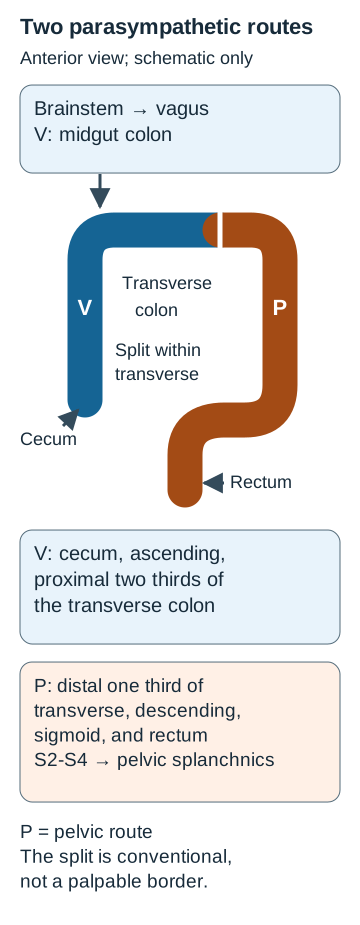
The standard transition is within the transverse colon, not at the rectum. The vagus nerve carries parasympathetic efferents from the brainstem to foregut and midgut derivatives. In the large bowel this includes the cecum, ascending colon, and proximal two thirds of the transverse colon. Pelvic splanchnic nerves from S2 through S4 supply hindgut derivatives: distal one third of the transverse colon, descending colon, sigmoid colon, and rectum. This is the conventional anatomical division, not a sharp boundary detectable by palpation. [1][7]
An efferent carries an outgoing command. Parasympathetic preganglionic fibers communicate with neurons near or within the bowel wall, influencing enteric circuits that regulate motility and secretion. The intrinsic enteric nervous system also coordinates local activity. Losing an extrinsic input therefore does not mean that every contraction ceases. Nor does constipation alone identify damage to one nerve. Drugs, stool characteristics, transit, pelvic-floor coordination, and structural disease can all matter. [1][2][8]
Trace the same bowel in two directions
Use the territory diagram to trace from cecum to rectum. At the transverse colon, assign the proximal two thirds to the vagal route and the distal third to the pelvic route. Then reverse direction from sigmoid colon back to its parasympathetic origin. Say the origin before checking below. This tests the connection between a territory and its outgoing supply, not a diagnosis.
Trace cecum to rectum, then trace the sigmoid territory back to S2-S4. The transition is conventional, not a palpable border. [1][7]Check the sigmoid route
Sigmoid colon is hindgut, so its parasympathetic preganglionic route originates at S2 through S4 and travels in pelvic splanchnic nerves. Choosing vagus would extend the midgut route too far distally. Identify the bowel territory before naming its parasympathetic origin.
The visible result is a split map: proximal colon has a cranial route, while distal colon has a sacral route. To apply it, compare two operative fields. A procedure beside the ascending colon and one deep in the pelvis do not threaten identical extrinsic parasympathetic pathways. Pelvic autonomic injury can affect bowel and bladder function together; an isolated bowel symptom still requires investigation rather than an anatomical assumption. [1]
How can bowel irritation be felt in body-wall tissues?
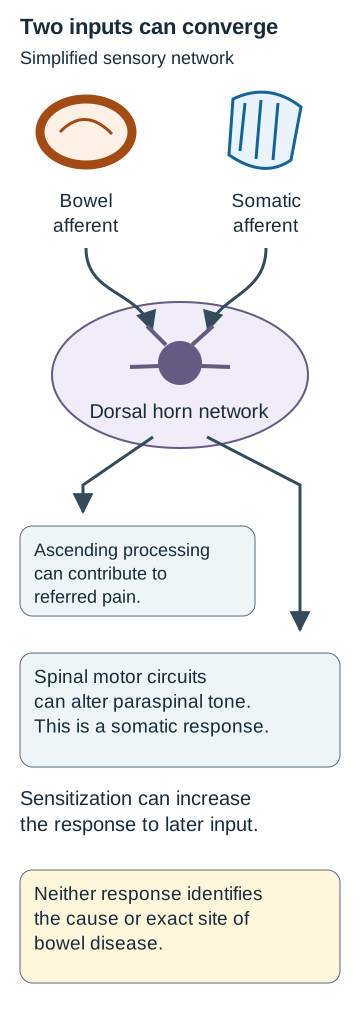
The misconception is that a tight paraspinal muscle must be the original source of abdominal discomfort. An afferent carries incoming sensory information. Distention, inflammation, ischemia, and chemical irritation can activate or sensitize visceral afferents. In the spinal cord, visceral and somatic inputs can converge on shared neurons. This provides a basis for referred pain and altered sensitivity in somatic tissues. Local spinal circuits can also influence muscle activity and autonomic output. [2]
Keep two consequences distinct. Referred pain is pain perceived away from its visceral origin. A viscerosomatic reflex is a somatic response to visceral input. Increased paraspinal tone, tenderness, tissue-texture differences, and restricted motion can accompany that response, but none is required or disease-specific. The osteopathic term segmental facilitation describes increased responsiveness of a spinal segment to input. It is an explanatory model, not a measurement of colonic inflammation obtained through the hands. [9]
The convergence diagram has two incoming routes and separate outgoing consequences. First trace the bowel input into the dorsal horn. Then trace the somatic input to the shared network. Finally distinguish the ascending sensory pathway from the motor response to paraspinal tissues. Experimental recordings in rat spinal cord demonstrate convergence of somatic and visceral C-fiber inputs onto individual lamina I neurons. That supports a physiological substrate; it does not establish diagnostic accuracy for a human palpatory test. [10]
Trace the incoming sensory paths before the two outgoing consequences. The schematic is not a one-synapse visceral-to-muscle connection or a diagnostic test. [2][9][10]
Predict the effect of persistent input
A patient with active colitis reports that ordinary pressure over nearby back muscles has become uncomfortable. Predict what increased spinal excitability would do to the response to the same somatic stimulus.
Check the sensitivity prediction
The same somatic stimulus may evoke a stronger response after sensitization. Unchanged muscle pressure does not guarantee unchanged perceived pain. Increased sensitivity can reflect altered processing, not a new muscle injury.
The resulting tenderness can coexist with the bowel disorder without identifying its cause. Now apply the model to a patient who strained the back while lifting and also has chronic constipation. Somatic input can produce similar regional findings. History, examination, and the bowel evaluation are needed to decide what is actually occurring; the reflex diagram alone cannot assign causation. [2]
Which map answers the question being asked?
S2 through S4 answers where distal-colon parasympathetic outflow originates. It does not require every associated palpatory finding to appear over the sacrum. Many spinal visceral afferents accompany sympathetic pathways to thoracolumbar segments. Pelvic afferents also reach the lumbosacral cord, and vagal afferents reach the brainstem. Traveling alongside autonomic efferents does not turn a sensory fiber into an outgoing autonomic motor fiber. [1][2]
Relevant answerPelvic splanchnic nerves from S2 through S4
QuestionWhere are colonic sympathetic associations commonly taught?
Relevant answerMidgut around T10 through T11; hindgut around T12 through L2, with overlap
The combined T10 through L2 range is a useful regional teaching summary, not an exact map of every afferent, a vertebral lesion, or a disease distribution. These are spinal segment associations. A palpable vertebral level and a spinal cord segment are not interchangeable anatomical locations. Use the range to organize reasoning, never to identify which few centimeters of bowel are diseased. [9]
Compare two reports: one documents a pelvic nerve injury during rectal surgery; another documents tender paraspinal tissues at L1 during abdominal pain. Classify each as direct evidence of a pathway injury or a nonspecific examination finding.
Check the classification
The surgical report identifies an injured pathway. The L1 finding identifies tender somatic tissues, not a damaged pelvic splanchnic nerve. Shared regional physiology does not make these observations equivalent. Keep pathway localization separate from palpatory description.
As a transfer, suppose lower thoracic tenderness is absent in a patient with bloody diarrhea. The absence does not exclude inflammation, infection, or ischemia. Conversely, its presence cannot separate ulcerative colitis from infectious colitis, identify malignancy, or measure perfusion. Those questions require disease-directed history, laboratory and stool testing, imaging, endoscopy, or surgery as appropriate. [2][3]
When must the abdominal problem take priority?
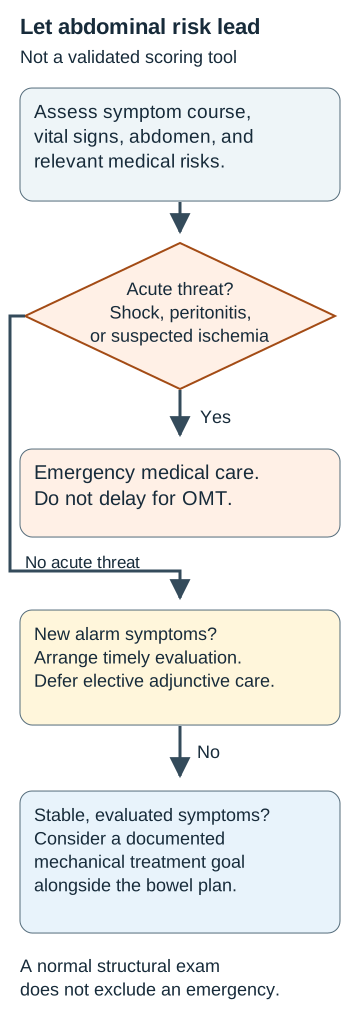
A soft abdomen or a normal structural examination does not make a dangerous intestinal process safe. Separate the immediate risk assessment from the structural examination. New persistent or focal pain, fever, blood in stool, unintended weight loss, anemia, persistent vomiting, inability to pass stool and gas, progressive distention, peritoneal signs, or unstable vital signs demand medical evaluation with urgency determined by the whole presentation. A prior reassuring evaluation does not explain a new alarm feature. [8][11]
The priority diagram separates three situations: stable chronic symptoms after appropriate evaluation, new concerning symptoms needing timely investigation, and an acute threat needing emergency care. These are decisions, not a numerical risk score. Shock, a rigid abdomen, or severe pain with vascular risk belongs in the emergency pathway. OMT must not delay resuscitation, antibiotics when indicated, imaging, decompression, specialist assessment, or operative source control. Anticoagulation and revascularization decisions in suspected vascular disease belong to that medical pathway. [3]
Classify the abdominal presentation first. A normal structural examination does not lower a clinically urgent presentation into the elective-care pathway. [3][8][11]
Change one observation, keep the risk in view
A 74-year-old with atrial fibrillation develops abrupt severe abdominal pain, but only mild tenderness. Now imagine that the initial lactate is within the laboratory reference range. Does that new result justify waiting for a repeat structural examination before imaging?
Check the effect of a normal lactate
No. No laboratory marker reliably excludes early acute mesenteric ischemia. A normal early lactate does not erase abrupt severe pain plus embolic risk. Suspected acute mesenteric ischemia needs CT angiography without delay.[3]
In the worked comparison, the decision stays urgent despite the changed lactate. A rising lactate increases concern in context but is not specific for ischemic bowel; dehydration and other causes of impaired perfusion can also contribute. With overt peritonitis, urgent surgical assessment and resuscitation take priority, and testing must not postpone necessary intervention. [3]
Apply this beyond ischemia: vomiting, obstipation, and increasing distention raise concern for obstruction even if back discomfort improves with positioning. Fever and bloody diarrhea need assessment for inflammatory or infectious disease. Chronic constipation accompanied by new weight loss or anemia requires renewed investigation for structural disease, including malignancy. None of these patterns becomes benign because a tender segment seems anatomically familiar. [8][11]
What can adjunctive structural treatment reasonably target?
The question is not whether the colon has autonomic innervation. It does. The question is whether treating an identified somatic dysfunction adds value for this patient without substituting for the bowel plan. For a stable patient after appropriate evaluation, OMT may be considered for documented mechanical pain, restricted motion, or related functional discomfort. Lumbar, pelvic, rib, or diaphragmatic findings should be examined individually rather than treated as a fixed recipe for constipation. A plausible neural relationship is not proof of bowel efficacy. [4][9]
For example, a patient with chronic idiopathic constipation has reproducible lumbar mechanical pain, no alarm features, and an active medical follow-up plan. A reasonable adjunctive goal is better comfortable trunk motion. Continue individualized dietary fiber, adequate fluid intake, physical activity, and indicated medication. The joint AGA/ACG guideline recommends polyethylene glycol for adults with chronic idiopathic constipation and suggests fiber supplementation; these recommendations are not replaced by a somatic examination. [6][8]
Persistent difficult evacuation despite treatment needs another look at the cause, not simply more treatment of the sacrum. Current AGA advice emphasizes secondary causes, including medications and neurological disease, and anorectal manometry with balloon expulsion testing before labeling most patients refractory. Pelvic-floor biofeedback is appropriate when a defecatory disorder is identified. Pelvic-floor coordination and pelvic parasympathetic outflow are related to bowel function but are not the same diagnosis. [5]
Choose the outcome that matches the intervention
Before an adjunctive session, record comfortable lumbar rotation and the patient's mechanical pain. Bowel symptoms are recorded separately. Afterward rotation is easier, but straining is unchanged. Decide which treatment goal has evidence of benefit.
Check the outcome interpretation
The mechanical goal improved; the bowel symptom did not. This does not establish correction of a pelvic autonomic lesion or failure of the entire medical plan. Match the conclusion to the outcome actually measured.
Apply that distinction when symptoms improve together. Simultaneous improvement in back discomfort and stool passage does not prove that OMT caused the bowel change. Medication, diet, natural variation, and contextual effects remain possible contributors. Maintain follow-up and reassess the diagnosis if symptoms persist or change. OMT is not a cure for inflammatory bowel disease, infection, obstruction, ischemia, or cancer. [3][5][6]
What makes a proposed technique unsafe or uninformative?
Medical stability is necessary but not sufficient for a direct technique. Muscle energy is an active method requiring comprehension and cooperation: the clinician positions a diagnosed restriction toward its barrier, the patient supplies a controlled contraction against resistance, and the clinician reassesses after relaxation. It is not force applied through pain and is not a way to test whether a bowel disorder is dangerous. Technique selection requires appropriate training and consent. [4]
Recent local surgery, acute fracture or dislocation, instability, severe osteoporosis, local infection or malignancy, acute cord or cauda equina compression, and inability to follow instructions can preclude lumbar muscle energy or require a different plan. Severe pain with positioning is a reason to stop and reassess. A modified position is not automatically safe when the underlying tissue is vulnerable or the diagnosis remains unsettled. Unstable vital signs direct attention to stabilization, not a gentler version of the same elective treatment. [4]
Consider a patient whose abdominal evaluation is reassuring but whose back pain began after a fall. Imaging identifies an acute lumbar compression fracture. Predict whether the reassuring bowel evaluation makes direct lumbar muscle energy reasonable today.
Check the tissue-safety decision
No. The bowel assessment and local tissue-safety assessment answer different questions. An acute fracture remains a contraindication to direct lumbar muscle energy. A reassuring abdomen does not clear an injured spine for treatment.
After appropriate adjunctive care, reassess pain, motion, comfortable breathing when relevant, and function against the agreed goal. Track bowel symptoms separately and maintain the medical diagnosis and follow-up plan. If discomfort worsens, stop and reassess. If treatment does not help, reconsider the working explanation rather than increasing force. New bleeding, vomiting, fever, weight loss, or persistent abdominal pain starts a fresh medical assessment even when previous treatment was helpful. [4][8]
For a final transfer, explain a patient with sigmoid symptoms and lumbar tenderness in one sentence: pelvic splanchnic nerves supply the distal bowel, shared sensory processing can contribute to nonspecific somatic findings, and the bowel diagnosis must still be established independently. That sentence keeps anatomy, physiology, and clinical decisions connected without treating them as interchangeable.
Apply the distinctions to clinical cases
Case 1
Show answer and explanations for case 1
A. Reduced sigmoid input with preserved ascending-colon input (Why this does not fit)
This reversal would fit sacral pelvic injury rather than upper abdominal vagal traction.
Reasoning steps for option A
Which case finding most directly tests the choice "Reduced sigmoid input with preserved ascending-colon input"?
The abdominal vagal trunks follow the esophagus. The operation did not involve the separate pelvic splanchnic route. Applied to "Reduced sigmoid input with preserved ascending-colon input", this reasoning shows why the choice does not fit the case.
Would a pelvic-pattern loss fit an operation confined near the esophagus?
This reversal would fit sacral pelvic injury rather than upper abdominal vagal traction.
B. Reduced ascending-colon input with preserved sigmoid input (Best answer)
Vagal injury can affect the midgut ascending colon while pelvic fibers to sigmoid remain intact.
Reasoning steps for option B
What mechanism in this case supports or contradicts the choice "Reduced ascending-colon input with preserved sigmoid input"?
The abdominal vagal trunks follow the esophagus. The operation did not involve the separate pelvic splanchnic route. Applied to "Reduced ascending-colon input with preserved sigmoid input", this reasoning shows why the choice fits the case.
Which colonic territories are affected and spared by the operative localization?
Vagal injury can affect the midgut ascending colon while pelvic fibers to sigmoid remain intact.
C. Reduced input to both ascending and sigmoid colon (Why this does not fit)
Both territories would require additional distal pathway injury not described.
Reasoning steps for option C
Which discriminator in the stem is decisive for the choice "Reduced input to both ascending and sigmoid colon"?
The abdominal vagal trunks follow the esophagus. The operation did not involve the separate pelvic splanchnic route. Applied to "Reduced input to both ascending and sigmoid colon", this reasoning shows why the choice does not fit the case.
What additional pathway involvement would be needed to reduce both territories?
Both territories would require additional distal pathway injury not described.
D. Preserved input to both ascending and sigmoid colon (Why this does not fit)
Preserved supply to both ignores the documented vagal operative risk.
Reasoning steps for option D
What specific finding separates the choice "Preserved input to both ascending and sigmoid colon" from the other options?
The abdominal vagal trunks follow the esophagus. The operation did not involve the separate pelvic splanchnic route. Applied to "Preserved input to both ascending and sigmoid colon", this reasoning shows why the choice does not fit the case.
Does continuing bowel activity prove that extrinsic vagal input was preserved?
Preserved supply to both ignores the documented vagal operative risk.
Takeaway: Localize operative field to vagal trunk, then predict ascending loss and sacral sigmoid sparing.
A. Pudendal motor injury; reduced voluntary external anal sphincter contraction (Why this does not fit)
Pudendal motor injury could weaken voluntary anal squeeze, but it does not adequately explain the weak detrusor contraction. The combined visceral pattern favors pelvic autonomic involvement.
Reasoning steps for option A
Which case finding most directly tests the choice "Pudendal motor injury; reduced voluntary external anal sphincter contraction"?
Weak detrusor contraction without obstruction and new evacuation difficulty involve two pelvic visceral functions. Perineal sensation alone does not establish pudendal motor integrity. Applied to "Pudendal motor injury; reduced voluntary external anal sphincter contraction", this reasoning shows why the choice does not fit the case.
Would isolated pudendal motor injury explain weak detrusor contraction?
Pudendal motor injury could weaken voluntary anal squeeze, but it does not adequately explain the weak detrusor contraction. The combined visceral pattern favors pelvic autonomic involvement.
B. Pelvic visceral efferent injury; reduced extrinsic facilitation of rectal contraction (Best answer)
Postoperative bowel and bladder motor dysfunction favors a pelvic visceral pathway over an isolated somatic sphincter nerve. That localization predicts reduced extrinsic facilitation of distal-bowel contraction without requiring complete loss of enteric activity.
Reasoning steps for option B
What mechanism in this case supports or contradicts the choice "Pelvic visceral efferent injury; reduced extrinsic facilitation of rectal contraction"?
Weak detrusor contraction without obstruction and new evacuation difficulty involve two pelvic visceral functions. Perineal sensation alone does not establish pudendal motor integrity. Applied to "Pelvic visceral efferent injury; reduced extrinsic facilitation of rectal contraction", this reasoning shows why the choice fits the case.
What additional visceral motor change follows from the pelvic pathway localization?
Postoperative bowel and bladder motor dysfunction favors a pelvic visceral pathway over an isolated somatic sphincter nerve. That localization predicts reduced extrinsic facilitation of distal-bowel contraction without requiring complete loss of enteric activity.
C. Pelvic visceral efferent injury; reduced voluntary external anal sphincter contraction (Why this does not fit)
The localization fits the visceral pattern, but the predicted deficit belongs to somatic external-sphincter motor supply. Pelvic parasympathetic efferents do not directly drive voluntary external anal squeeze.
Reasoning steps for option C
Which discriminator in the stem is decisive for the choice "Pelvic visceral efferent injury; reduced voluntary external anal sphincter contraction"?
Weak detrusor contraction without obstruction and new evacuation difficulty involve two pelvic visceral functions. Perineal sensation alone does not establish pudendal motor integrity. Applied to "Pelvic visceral efferent injury; reduced voluntary external anal sphincter contraction", this reasoning shows why the choice does not fit the case.
Does pelvic visceral outflow directly drive voluntary external anal squeeze?
The localization fits the visceral pattern, but the predicted deficit belongs to somatic external-sphincter motor supply. Pelvic parasympathetic efferents do not directly drive voluntary external anal squeeze.
D. Pudendal motor injury; reduced extrinsic facilitation of rectal contraction (Why this does not fit)
This pairs a somatic motor lesion with loss of a visceral parasympathetic contribution. Pudendal injury does not directly interrupt the pelvic splanchnic route or explain detrusor weakness.
Reasoning steps for option D
What specific finding separates the choice "Pudendal motor injury; reduced extrinsic facilitation of rectal contraction" from the other options?
Weak detrusor contraction without obstruction and new evacuation difficulty involve two pelvic visceral functions. Perineal sensation alone does not establish pudendal motor integrity. Applied to "Pudendal motor injury; reduced extrinsic facilitation of rectal contraction", this reasoning shows why the choice does not fit the case.
Does the pudendal route provide extrinsic parasympathetic facilitation of the rectum?
This pairs a somatic motor lesion with loss of a visceral parasympathetic contribution. Pudendal injury does not directly interrupt the pelvic splanchnic route or explain detrusor weakness.
Takeaway: Use combined bowel and bladder motor findings to localize the pathway, then distinguish its visceral effects from somatic sphincter function.
Ascending colon is vagal midgut territory and its route is spared.
Reasoning steps for option A
Which case finding most directly tests the choice "Ascending colon"?
The S2-S4 visceral efferents are compressed, while the abdominal vagal trunks are preserved. Applied to "Ascending colon", this reasoning shows why the choice fits the case.
Which listed colon segment retains the spared dominant vagal route?
Ascending colon is vagal midgut territory and its route is spared.
B. Distal transverse colon (Why this does not fit)
Distal transverse colon lies on the pelvic-splanchnic side of the transition.
Reasoning steps for option B
What mechanism in this case supports or contradicts the choice "Distal transverse colon"?
The S2-S4 visceral efferents are compressed, while the abdominal vagal trunks are preserved. Applied to "Distal transverse colon", this reasoning shows why the choice does not fit the case.
Is the distal transverse colon on the preserved vagal side of the conventional map?
Distal transverse colon lies on the pelvic-splanchnic side of the transition.
C. Sigmoid colon (Why this does not fit)
Sigmoid colon is hindgut and loses its sacral route.
Reasoning steps for option C
Which discriminator in the stem is decisive for the choice "Sigmoid colon"?
The S2-S4 visceral efferents are compressed, while the abdominal vagal trunks are preserved. Applied to "Sigmoid colon", this reasoning shows why the choice does not fit the case.
Which parasympathetic route supplies the sigmoid colon?
Sigmoid colon is hindgut and loses its sacral route.
D. Descending colon (Why this does not fit)
Descending colon depends on pelvic splanchnic supply that is threatened.
Reasoning steps for option D
What specific finding separates the choice "Descending colon" from the other options?
The S2-S4 visceral efferents are compressed, while the abdominal vagal trunks are preserved. Applied to "Descending colon", this reasoning shows why the choice does not fit the case.
Does the descending colon use the spared vagal route?
Descending colon depends on pelvic splanchnic supply that is threatened.
Takeaway: Map bilateral S2-S4 injury to hindgut, then select a segment served by spared vagal trunks.
A. Local cecal activity can persist; sigmoid pelvic input remains intact (Best answer)
Cecum is in vagal midgut territory, whereas sigmoid uses pelvic splanchnic input. Intrinsic enteric circuits can sustain local activity despite loss of extrinsic modulation.
Reasoning steps for option A
Which case finding most directly tests the choice "Local cecal activity can persist; sigmoid pelvic input remains intact"?
No. Enteric circuits can sustain local activity even when their extrinsic parasympathetic modulation is reduced. Applied to "Local cecal activity can persist; sigmoid pelvic input remains intact", this reasoning shows why the choice fits the case.
How do intrinsic cecal coordination and preserved sigmoid input combine?
Cecum is in vagal midgut territory, whereas sigmoid uses pelvic splanchnic input. Intrinsic enteric circuits can sustain local activity despite loss of extrinsic modulation.
B. Local cecal activity must cease; sigmoid pelvic input is also interrupted (Why this does not fit)
Neither prediction follows. Extrinsic vagal injury does not abolish all enteric activity or sever intact pelvic splanchnic nerves.
Reasoning steps for option B
What mechanism in this case supports or contradicts the choice "Local cecal activity must cease; sigmoid pelvic input is also interrupted"?
No. Enteric circuits can sustain local activity even when their extrinsic parasympathetic modulation is reduced. Applied to "Local cecal activity must cease; sigmoid pelvic input is also interrupted", this reasoning shows why the choice does not fit the case.
Does vagal interruption abolish both enteric activity and intact pelvic input?
Neither prediction follows. Extrinsic vagal injury does not abolish all enteric activity or sever intact pelvic splanchnic nerves.
C. Local cecal activity can persist; sigmoid pelvic input is also interrupted (Why this does not fit)
This recognizes intrinsic enteric activity but extends the injury into an intact sacral pathway. Sigmoid input is not directly interrupted by abdominal vagal injury.
Reasoning steps for option C
Which discriminator in the stem is decisive for the choice "Local cecal activity can persist; sigmoid pelvic input is also interrupted"?
No. Enteric circuits can sustain local activity even when their extrinsic parasympathetic modulation is reduced. Applied to "Local cecal activity can persist; sigmoid pelvic input is also interrupted", this reasoning shows why the choice does not fit the case.
Would recognition of enteric autonomy justify extending the injury to sigmoid input?
This recognizes intrinsic enteric activity but extends the injury into an intact sacral pathway. Sigmoid input is not directly interrupted by abdominal vagal injury.
D. Local cecal activity must cease; sigmoid pelvic input remains intact (Why this does not fit)
This correctly preserves the sigmoid pathway but treats vagal input as the only source of cecal motor coordination. The enteric system can function locally.
Reasoning steps for option D
What specific finding separates the choice "Local cecal activity must cease; sigmoid pelvic input remains intact" from the other options?
No. Enteric circuits can sustain local activity even when their extrinsic parasympathetic modulation is reduced. Applied to "Local cecal activity must cease; sigmoid pelvic input remains intact", this reasoning shows why the choice does not fit the case.
Does intact sigmoid input require cecal enteric activity to cease?
This correctly preserves the sigmoid pathway but treats vagal input as the only source of cecal motor coordination. The enteric system can function locally.
Takeaway: Distinguish loss of extrinsic modulation from loss of intrinsic enteric function, and assess spared territories separately.
A. Both margins pelvic splanchnic (Why this does not fit)
The proximal margin lies before the usual sacral boundary.
Reasoning steps for option A
Which case finding most directly tests the choice "Both margins pelvic splanchnic"?
It lies between the proximal two thirds and distal one third. The stated resection spans that transition. Applied to "Both margins pelvic splanchnic", this reasoning shows why the choice does not fit the case.
Would both resection margins fall in pelvic territory when the lesion spans the transition?
The proximal margin lies before the usual sacral boundary.
B. Proximal vagal; distal pelvic splanchnic (Best answer)
The junction crosses from vagal midgut to pelvic hindgut supply.
Reasoning steps for option B
What mechanism in this case supports or contradicts the choice "Proximal vagal; distal pelvic splanchnic"?
It lies between the proximal two thirds and distal one third. The stated resection spans that transition. Applied to "Proximal vagal; distal pelvic splanchnic", this reasoning shows why the choice fits the case.
Which route belongs to each margin under the conventional map?
The junction crosses from vagal midgut to pelvic hindgut supply.
C. Both margins vagal (Why this does not fit)
The distal margin lies beyond the usual vagal boundary.
Reasoning steps for option C
Which discriminator in the stem is decisive for the choice "Both margins vagal"?
It lies between the proximal two thirds and distal one third. The stated resection spans that transition. Applied to "Both margins vagal", this reasoning shows why the choice does not fit the case.
Would the distal margin remain vagal beyond the conventional transition?
The distal margin lies beyond the usual vagal boundary.
D. Proximal pelvic splanchnic; distal vagal (Why this does not fit)
This pairing reverses the actual proximal-to-distal handoff.
Reasoning steps for option D
What specific finding separates the choice "Proximal pelvic splanchnic; distal vagal" from the other options?
It lies between the proximal two thirds and distal one third. The stated resection spans that transition. Applied to "Proximal pelvic splanchnic; distal vagal", this reasoning shows why the choice does not fit the case.
Which margin is proximal and which route belongs to that side?
This pairing reverses the actual proximal-to-distal handoff.
Takeaway: Locate junction near proximal two thirds/distal third transition, then assign distinct pathways to surviving margins.
A. Insufficient stool softening is the dominant problem; increase polyethylene glycol (Why this does not fit)
Stool is already soft on the prescribed osmotic treatment. More softening does not directly address the measured paradoxical outlet contraction.
Reasoning steps for option A
Which case finding most directly tests the choice "Insufficient stool softening is the dominant problem; increase polyethylene glycol"?
Propulsive effort is present, but outlet coordination is impaired. Abnormal balloon expulsion supports a defecatory disorder despite the coexisting partial sacral injury. Applied to "Insufficient stool softening is the dominant problem; increase polyethylene glycol", this reasoning shows why the choice does not fit the case.
Would increasing stool softening directly retrain paradoxical anal contraction?
Stool is already soft on the prescribed osmotic treatment. More softening does not directly address the measured paradoxical outlet contraction.
B. Primary slow transit is the dominant problem; add a stimulant before retraining (Why this does not fit)
No transit study establishes primary slow transit. Even if transit impairment coexists, the demonstrated evacuation disorder provides a specific target for retraining.
Reasoning steps for option B
What mechanism in this case supports or contradicts the choice "Primary slow transit is the dominant problem; add a stimulant before retraining"?
Propulsive effort is present, but outlet coordination is impaired. Abnormal balloon expulsion supports a defecatory disorder despite the coexisting partial sacral injury. Applied to "Primary slow transit is the dominant problem; add a stimulant before retraining", this reasoning shows why the choice does not fit the case.
Has primary slow transit been established by these anorectal measurements?
No transit study establishes primary slow transit. Even if transit impairment coexists, the demonstrated evacuation disorder provides a specific target for retraining.
C. Loss of rectal propulsive effort is the dominant problem; focus on denervation support (Why this does not fit)
The manometry demonstrates preserved rectal propulsion, so loss of propulsive effort is not the principal measured deficit. The partial sacral injury may contribute but does not erase the treatable outlet-coordination finding.
Reasoning steps for option C
Which discriminator in the stem is decisive for the choice "Loss of rectal propulsive effort is the dominant problem; focus on denervation support"?
Propulsive effort is present, but outlet coordination is impaired. Abnormal balloon expulsion supports a defecatory disorder despite the coexisting partial sacral injury. Applied to "Loss of rectal propulsive effort is the dominant problem; focus on denervation support", this reasoning shows why the choice does not fit the case.
Does the recorded propulsion support absent rectal driving effort as the dominant deficit?
The manometry demonstrates preserved rectal propulsion, so loss of propulsive effort is not the principal measured deficit. The partial sacral injury may contribute but does not erase the treatable outlet-coordination finding.
D. A defecatory coordination disorder is present; offer pelvic-floor biofeedback (Best answer)
Paradoxical anal contraction and abnormal balloon expulsion identify an evacuation disorder despite coexisting sacral pathology. Preserved propulsion and ability to participate support targeting coordination with biofeedback.
Reasoning steps for option D
What specific finding separates the choice "A defecatory coordination disorder is present; offer pelvic-floor biofeedback" from the other options?
Propulsive effort is present, but outlet coordination is impaired. Abnormal balloon expulsion supports a defecatory disorder despite the coexisting partial sacral injury. Applied to "A defecatory coordination disorder is present; offer pelvic-floor biofeedback", this reasoning shows why the choice fits the case.
Which treatment targets the measured outlet-coordination deficit?
Paradoxical anal contraction and abnormal balloon expulsion identify an evacuation disorder despite coexisting sacral pathology. Preserved propulsion and ability to participate support targeting coordination with biofeedback.
Takeaway: A neurological condition can coexist with a measured defecatory disorder; target the demonstrated coordination deficit rather than assuming a single cause.
A. Sacral parasympathetic output; visceral sensory input to thoracolumbar circuits (Best answer)
S3 contributes to S2-S4 pelvic parasympathetic outflow. Visceral afferents entering shared thoracolumbar circuits can contribute to a somatic response without converting that level into the parasympathetic origin.
Reasoning steps for option A
Which case finding most directly tests the choice "Sacral parasympathetic output; visceral sensory input to thoracolumbar circuits"?
No. S3 contributes to distal-bowel parasympathetic efferents, whereas the T12 finding is a regional somatic observation that may accompany sensory-reflex processing. Applied to "Sacral parasympathetic output; visceral sensory input to thoracolumbar circuits", this reasoning shows why the choice fits the case.
How can sacral motor origin coexist with a thoracolumbar somatic response?
S3 contributes to S2-S4 pelvic parasympathetic outflow. Visceral afferents entering shared thoracolumbar circuits can contribute to a somatic response without converting that level into the parasympathetic origin.
B. Sacral parasympathetic output; sacral efferents directly innervating T12 muscle (Why this does not fit)
The origin is correct, but pelvic parasympathetic efferents do not directly innervate thoracic paraspinal muscle. A sensory input and spinal motor circuit are separate parts of the reflex.
Reasoning steps for option B
What mechanism in this case supports or contradicts the choice "Sacral parasympathetic output; sacral efferents directly innervating T12 muscle"?
No. S3 contributes to distal-bowel parasympathetic efferents, whereas the T12 finding is a regional somatic observation that may accompany sensory-reflex processing. Applied to "Sacral parasympathetic output; sacral efferents directly innervating T12 muscle", this reasoning shows why the choice does not fit the case.
Do sacral parasympathetic efferents directly innervate thoracic paraspinal skeletal muscle?
The origin is correct, but pelvic parasympathetic efferents do not directly innervate thoracic paraspinal muscle. A sensory input and spinal motor circuit are separate parts of the reflex.
C. Thoracolumbar parasympathetic output; visceral sensory input to sacral circuits (Why this does not fit)
This substitutes the thoracolumbar sympathetic association for distal-colon parasympathetic outflow. It also fails to explain the stated thoracolumbar response through the relevant shared circuits.
Reasoning steps for option C
Which discriminator in the stem is decisive for the choice "Thoracolumbar parasympathetic output; visceral sensory input to sacral circuits"?
No. S3 contributes to distal-bowel parasympathetic efferents, whereas the T12 finding is a regional somatic observation that may accompany sensory-reflex processing. Applied to "Thoracolumbar parasympathetic output; visceral sensory input to sacral circuits", this reasoning shows why the choice does not fit the case.
Is thoracolumbar outflow the parasympathetic motor origin for distal colon?
This substitutes the thoracolumbar sympathetic association for distal-colon parasympathetic outflow. It also fails to explain the stated thoracolumbar response through the relevant shared circuits.
D. Thoracolumbar parasympathetic output; vagal efferents directly innervating T12 muscle (Why this does not fit)
Both the proposed parasympathetic origin and direct muscle connection are wrong. Vagal efferents do not supply skeletal paraspinal muscle.
Reasoning steps for option D
What specific finding separates the choice "Thoracolumbar parasympathetic output; vagal efferents directly innervating T12 muscle" from the other options?
No. S3 contributes to distal-bowel parasympathetic efferents, whereas the T12 finding is a regional somatic observation that may accompany sensory-reflex processing. Applied to "Thoracolumbar parasympathetic output; vagal efferents directly innervating T12 muscle", this reasoning shows why the choice does not fit the case.
Can a vagal efferent directly account for contraction of T12 paraspinal muscle?
Both the proposed parasympathetic origin and direct muscle connection are wrong. Vagal efferents do not supply skeletal paraspinal muscle.
Takeaway: A motor-origin map and a regional sensory-reflex map describe different pathways.
A. Somatic guarding begins first and then increases the measured visceral traffic (Why this does not fit)
This reverses the observed temporal order. Distention and incoming visceral activity precede the motor response, and sensory blockade interrupts it.
Reasoning steps for option A
Which case finding most directly tests the choice "Somatic guarding begins first and then increases the measured visceral traffic"?
Visceral afferent firing follows distention and precedes the EMG increase. Blocking incoming visceral traffic eliminates that increase while motor pathways remain available. Applied to "Somatic guarding begins first and then increases the measured visceral traffic", this reasoning shows why the choice does not fit the case.
Does the observed temporal order place guarding before the visceral signal?
This reverses the observed temporal order. Distention and incoming visceral activity precede the motor response, and sensory blockade interrupts it.
B. Distention activates a muscle stretch reflex independently of visceral sensory traffic (Why this does not fit)
A purely local stretch reflex should not require the specifically blocked visceral sensory limb. The absence of a direct muscle stimulus further weakens this explanation.
Reasoning steps for option B
What mechanism in this case supports or contradicts the choice "Distention activates a muscle stretch reflex independently of visceral sensory traffic"?
Visceral afferent firing follows distention and precedes the EMG increase. Blocking incoming visceral traffic eliminates that increase while motor pathways remain available. Applied to "Distention activates a muscle stretch reflex independently of visceral sensory traffic", this reasoning shows why the choice does not fit the case.
Would an independent local stretch reflex require the blocked visceral sensory limb?
A purely local stretch reflex should not require the specifically blocked visceral sensory limb. The absence of a direct muscle stimulus further weakens this explanation.
C. Distention alters local muscle perfusion and triggers intrinsic muscle firing (Why this does not fit)
A local muscle-perfusion explanation would need evidence of muscle ischemia and would not predict selective abolition by visceral sensory blockade. The controlled reversible pattern instead implicates a neural reflex.
Reasoning steps for option C
Which discriminator in the stem is decisive for the choice "Distention alters local muscle perfusion and triggers intrinsic muscle firing"?
Visceral afferent firing follows distention and precedes the EMG increase. Blocking incoming visceral traffic eliminates that increase while motor pathways remain available. Applied to "Distention alters local muscle perfusion and triggers intrinsic muscle firing", this reasoning shows why the choice does not fit the case.
Does the reversible response and selective sensory block establish local muscle perfusion as the cause?
A local muscle-perfusion explanation would need evidence of muscle ischemia and would not predict selective abolition by visceral sensory blockade. The controlled reversible pattern instead implicates a neural reflex.
D. Incoming visceral activity recruits spinal circuits and somatic motor output (Best answer)
Afferent firing precedes EMG, and selective interruption of the incoming limb abolishes the response. Preserved efferent stimulation and motor nerves do not bypass that requirement.
Reasoning steps for option D
What specific finding separates the choice "Incoming visceral activity recruits spinal circuits and somatic motor output" from the other options?
Visceral afferent firing follows distention and precedes the EMG increase. Blocking incoming visceral traffic eliminates that increase while motor pathways remain available. Applied to "Incoming visceral activity recruits spinal circuits and somatic motor output", this reasoning shows why the choice fits the case.
How do temporal order and sensory blockade support a visceral-to-somatic pathway?
Afferent firing precedes EMG, and selective interruption of the incoming limb abolishes the response. Preserved efferent stimulation and motor nerves do not bypass that requirement.
Takeaway: Use temporal order and selective interruption together to distinguish incoming visceral signaling from a coincident motor response.
A. Skin-evoked pain persists; bowel-evoked referred pain decreases (Why this does not fit)
This reverses the blocked and preserved inputs. The local cutaneous block affects direct skin signaling, not the explicitly preserved visceral afferents.
Reasoning steps for option A
Which case finding most directly tests the choice "Skin-evoked pain persists; bowel-evoked referred pain decreases"?
Its cutaneous receptors remain silent during the bowel stimulus, while shared dorsal horn neurons respond. This supports a central explanation for the referred location. Applied to "Skin-evoked pain persists; bowel-evoked referred pain decreases", this reasoning shows why the choice does not fit the case.
Which peripheral input is actually interrupted by the skin-only block?
This reverses the blocked and preserved inputs. The local cutaneous block affects direct skin signaling, not the explicitly preserved visceral afferents.
B. Both skin-evoked pain and bowel-evoked referred pain must disappear (Why this does not fit)
The two percepts can involve shared central neurons without sharing the same peripheral input. A block confined to skin afferents need not eliminate bowel-driven referred pain.
Reasoning steps for option B
What mechanism in this case supports or contradicts the choice "Both skin-evoked pain and bowel-evoked referred pain must disappear"?
Its cutaneous receptors remain silent during the bowel stimulus, while shared dorsal horn neurons respond. This supports a central explanation for the referred location. Applied to "Both skin-evoked pain and bowel-evoked referred pain must disappear", this reasoning shows why the choice does not fit the case.
Does shared central processing mean both percepts use the same peripheral afferent route?
The two percepts can involve shared central neurons without sharing the same peripheral input. A block confined to skin afferents need not eliminate bowel-driven referred pain.
C. Both responses increase because the peripheral block amplifies spinal input (Why this does not fit)
The specified block removes peripheral skin input; it does not supply evidence of greater spinal gain. Increased responses are not the predicted direct consequence of this selective interruption.
Reasoning steps for option C
Which discriminator in the stem is decisive for the choice "Both responses increase because the peripheral block amplifies spinal input"?
Its cutaneous receptors remain silent during the bowel stimulus, while shared dorsal horn neurons respond. This supports a central explanation for the referred location. Applied to "Both responses increase because the peripheral block amplifies spinal input", this reasoning shows why the choice does not fit the case.
Does the stated peripheral block provide evidence that both responses should increase?
The specified block removes peripheral skin input; it does not supply evidence of greater spinal gain. Increased responses are not the predicted direct consequence of this selective interruption.
D. Skin-evoked pain decreases; bowel-evoked referred pain can persist (Best answer)
Silent skin receptors during the referred percept support a central rather than local generator. Blocking the cutaneous route interrupts direct skin input but leaves the incoming bowel signal available to produce a referred percept in this model.
Reasoning steps for option D
What specific finding separates the choice "Skin-evoked pain decreases; bowel-evoked referred pain can persist" from the other options?
Its cutaneous receptors remain silent during the bowel stimulus, while shared dorsal horn neurons respond. This supports a central explanation for the referred location. Applied to "Skin-evoked pain decreases; bowel-evoked referred pain can persist", this reasoning shows why the choice fits the case.
What happens to direct skin pain and bowel-referred pain after the selective skin block?
Silent skin receptors during the referred percept support a central rather than local generator. Blocking the cutaneous route interrupts direct skin input but leaves the incoming bowel signal available to produce a referred percept in this model.
Takeaway: Infer the site of convergence, then ask whether an intervention blocks the originating input or only the territory where pain is perceived.
A. The first reported episode occurred without a new exertional event or direct trauma (Why this does not fit)
Lack of trauma lowers suspicion for some injuries but does not exclude a spontaneous or chronic mechanical disorder. The combined temporal tracking and failed local reproduction discriminate more directly.
Reasoning steps for option A
Which case finding most directly tests the choice "The first reported episode occurred without a new exertional event or direct trauma"?
The ache tracks colonic cramping, but loading and palpation between attacks do not reproduce it. That combination is more discriminating than location or tone alone. Applied to "The first reported episode occurred without a new exertional event or direct trauma", this reasoning shows why the choice does not fit the case.
Does absence of a new traumatic event exclude every mechanical pain source?
Lack of trauma lowers suspicion for some injuries but does not exclude a spontaneous or chronic mechanical disorder. The combined temporal tracking and failed local reproduction discriminate more directly.
B. The ache lies over muscle despite the initial complaint being abdominal (Why this does not fit)
Pain location alone cannot identify its generator; visceral pain can be referred into a somatic territory. Location would also be compatible with strain, so it is not discriminating.
Reasoning steps for option B
What mechanism in this case supports or contradicts the choice "The ache lies over muscle despite the initial complaint being abdominal"?
The ache tracks colonic cramping, but loading and palpation between attacks do not reproduce it. That combination is more discriminating than location or tone alone. Applied to "The ache lies over muscle despite the initial complaint being abdominal", this reasoning shows why the choice does not fit the case.
Does pain perceived over muscle establish a primary muscle generator?
Pain location alone cannot identify its generator; visceral pain can be referred into a somatic territory. Location would also be compatible with strain, so it is not discriminating.
C. The ache follows cramping but is not reproduced by local loading between attacks (Best answer)
Covariation with visceral episodes and failure of local loading or palpation to evoke the same pain jointly favor referred visceral input. This does not rule out every coincident muscle disorder; it compares the generators of the particular familiar pain.
Reasoning steps for option C
Which discriminator in the stem is decisive for the choice "The ache follows cramping but is not reproduced by local loading between attacks"?
The ache tracks colonic cramping, but loading and palpation between attacks do not reproduce it. That combination is more discriminating than location or tone alone. Applied to "The ache follows cramping but is not reproduced by local loading between attacks", this reasoning shows why the choice fits the case.
Which combined observations favor referral over a primary strain for the familiar ache?
Covariation with visceral episodes and failure of local loading or palpation to evoke the same pain jointly favor referred visceral input. This does not rule out every coincident muscle disorder; it compares the generators of the particular familiar pain.
D. Paraspinal tone increases during cramping despite no reported new trauma (Why this does not fit)
Increased tone could reflect a viscerosomatic response or guarding from local injury. Its presence alone does not determine the origin of the ache.
Reasoning steps for option D
What specific finding separates the choice "Paraspinal tone increases during cramping despite no reported new trauma" from the other options?
The ache tracks colonic cramping, but loading and palpation between attacks do not reproduce it. That combination is more discriminating than location or tone alone. Applied to "Paraspinal tone increases during cramping despite no reported new trauma", this reasoning shows why the choice does not fit the case.
Can increased paraspinal tone alone distinguish referral from local guarding?
Increased tone could reflect a viscerosomatic response or guarding from local injury. Its presence alone does not determine the origin of the ache.
Takeaway: Compare a pain pattern against selective visceral and mechanical provocations; anatomic location and reflex tone alone do not prove a local lesion.
A. The later bowel diagnosis is favored as the source at both visits (Why this does not fit)
Evidence at the later visit cannot erase dysuria and pyuria at the earlier one. The visits are separated in time and support different working sources.
Reasoning steps for option A
Which case finding most directly tests the choice "The later bowel diagnosis is favored as the source at both visits"?
Visit A has dysuria and pyuria without bowel symptoms. Visit B has normal urine testing and CT-demonstrated colonic inflammation. Applied to "The later bowel diagnosis is favored as the source at both visits", this reasoning shows why the choice does not fit the case.
Can the later bowel diagnosis erase the earlier urinary findings?
Evidence at the later visit cannot erase dysuria and pyuria at the earlier one. The visits are separated in time and support different working sources.
B. A single chronic muscular disorder is favored over both visceral presentations (Why this does not fit)
A coincident muscle disorder is possible, but the repeated level does not establish it. Different organ-specific findings at the two visits require independent interpretation.
Reasoning steps for option B
What mechanism in this case supports or contradicts the choice "A single chronic muscular disorder is favored over both visceral presentations"?
Visit A has dysuria and pyuria without bowel symptoms. Visit B has normal urine testing and CT-demonstrated colonic inflammation. Applied to "A single chronic muscular disorder is favored over both visceral presentations", this reasoning shows why the choice does not fit the case.
Does a repeated somatic examination establish a primary chronic muscle disorder?
A coincident muscle disorder is possible, but the repeated level does not establish it. Different organ-specific findings at the two visits require independent interpretation.
C. Different visceral inputs can recruit overlapping regional somatic responses (Best answer)
The paired visits show similar somatic findings alongside different organ-specific evidence. This is consistent with overlapping spinal responses rather than a unique organ-to-level code.
Reasoning steps for option C
Which discriminator in the stem is decisive for the choice "Different visceral inputs can recruit overlapping regional somatic responses"?
Visit A has dysuria and pyuria without bowel symptoms. Visit B has normal urine testing and CT-demonstrated colonic inflammation. Applied to "Different visceral inputs can recruit overlapping regional somatic responses", this reasoning shows why the choice fits the case.
What does similar tone with different organ evidence imply about localization?
The paired visits show similar somatic findings alongside different organ-specific evidence. This is consistent with overlapping spinal responses rather than a unique organ-to-level code.
D. The repeated somatic level favors a single persistent visceral generator (Why this does not fit)
The matching somatic examination lacks the specificity to establish a persistent single generator. Urinary findings at A and bowel imaging at B distinguish the presentations.
Reasoning steps for option D
What specific finding separates the choice "The repeated somatic level favors a single persistent visceral generator" from the other options?
Visit A has dysuria and pyuria without bowel symptoms. Visit B has normal urine testing and CT-demonstrated colonic inflammation. Applied to "The repeated somatic level favors a single persistent visceral generator", this reasoning shows why the choice does not fit the case.
Does the matching spinal level outweigh different organ-specific observations?
The matching somatic examination lacks the specificity to establish a persistent single generator. Urinary findings at A and bowel imaging at B distinguish the presentations.
Takeaway: Compare independent organ evidence across presentations instead of assigning one visceral cause to a repeated somatic level.
A. Hold distention constant, selectively block visceral sensory input, and test direct motor responsiveness (Best answer)
Matching distention controls the changed stimulus, while a selective sensory block tests the incoming limb. A preserved direct motor response would also show that a missing reflex EMG is not simply failure of the output apparatus.
Reasoning steps for option A
Which case finding most directly tests the choice "Hold distention constant, selectively block visceral sensory input, and test direct motor responsiveness"?
Achieved bowel distention also fell. Reduced EMG could therefore reflect a weaker visceral stimulus rather than selective loss of sensory conduction. Applied to "Hold distention constant, selectively block visceral sensory input, and test direct motor responsiveness", this reasoning shows why the choice fits the case.
Which three controls distinguish sensory interruption from weaker stimulus or failed output?
Matching distention controls the changed stimulus, while a selective sensory block tests the incoming limb. A preserved direct motor response would also show that a missing reflex EMG is not simply failure of the output apparatus.
B. Repeat the mixed block with the original stimulus and compare peak EMG alone (Why this does not fit)
Repeating the same design preserves the confounding change in distention. A smaller EMG response could still reflect a weaker visceral stimulus rather than specifically interrupted sensory conduction.
Reasoning steps for option B
What mechanism in this case supports or contradicts the choice "Repeat the mixed block with the original stimulus and compare peak EMG alone"?
Achieved bowel distention also fell. Reduced EMG could therefore reflect a weaker visceral stimulus rather than selective loss of sensory conduction. Applied to "Repeat the mixed block with the original stimulus and compare peak EMG alone", this reasoning shows why the choice does not fit the case.
Would repeating the original mixed-block experiment eliminate the reduced-distention confound?
Repeating the same design preserves the confounding change in distention. A smaller EMG response could still reflect a weaker visceral stimulus rather than specifically interrupted sensory conduction.
C. Increase stimulation of the mixed nerve and compare the resulting bowel contractions with EMG (Why this does not fit)
Stimulating a mixed nerve can alter both sensory traffic and bowel motor activity. Without matched distention and an output control, this does not isolate the claimed mechanism.
Reasoning steps for option C
Which discriminator in the stem is decisive for the choice "Increase stimulation of the mixed nerve and compare the resulting bowel contractions with EMG"?
Achieved bowel distention also fell. Reduced EMG could therefore reflect a weaker visceral stimulus rather than selective loss of sensory conduction. Applied to "Increase stimulation of the mixed nerve and compare the resulting bowel contractions with EMG", this reasoning shows why the choice does not fit the case.
Would stronger stimulation of a mixed nerve isolate only incoming sensory conduction?
Stimulating a mixed nerve can alter both sensory traffic and bowel motor activity. Without matched distention and an output control, this does not isolate the claimed mechanism.
D. Block only the somatic motor nerve and compare bowel pressure before and after the block (Why this does not fit)
A somatic motor block tests the final output pathway, not whether the original mixed block reduced EMG by weakening distention or interrupting sensory traffic. Bowel pressure alone does not resolve that ambiguity.
Reasoning steps for option D
What specific finding separates the choice "Block only the somatic motor nerve and compare bowel pressure before and after the block" from the other options?
Achieved bowel distention also fell. Reduced EMG could therefore reflect a weaker visceral stimulus rather than selective loss of sensory conduction. Applied to "Block only the somatic motor nerve and compare bowel pressure before and after the block", this reasoning shows why the choice does not fit the case.
Would a somatic motor block distinguish weaker distention from lost visceral sensory traffic?
A somatic motor block tests the final output pathway, not whether the original mixed block reduced EMG by weakening distention or interrupting sensory traffic. Bowel pressure alone does not resolve that ambiguity.
Takeaway: Control stimulus strength and verify the output apparatus before attributing a lost reflex specifically to interruption of its sensory limb.
A. Increased cutaneous stimulus intensity with unchanged spinal responsiveness (Why this does not fit)
The cutaneous test stimulus is explicitly held constant. A larger spinal response to that same input requires an explanation beyond stimulus intensity.
Reasoning steps for option A
Which case finding most directly tests the choice "Increased cutaneous stimulus intensity with unchanged spinal responsiveness"?
The cutaneous stimulus is unchanged, and direct motor-nerve stimulation produces the same contraction. The increased recorded spinal response occurs only during visceral input. Applied to "Increased cutaneous stimulus intensity with unchanged spinal responsiveness", this reasoning shows why the choice does not fit the case.
Was the cutaneous test stimulus stronger during the larger response?
The cutaneous test stimulus is explicitly held constant. A larger spinal response to that same input requires an explanation beyond stimulus intensity.
B. Persistent somatic motor-nerve injury producing greater responses (Why this does not fit)
A persistent injury does not fit the return to baseline after distention. It also fails to explain unchanged responses to direct motor stimulation.
Reasoning steps for option B
What mechanism in this case supports or contradicts the choice "Persistent somatic motor-nerve injury producing greater responses"?
The cutaneous stimulus is unchanged, and direct motor-nerve stimulation produces the same contraction. The increased recorded spinal response occurs only during visceral input. Applied to "Persistent somatic motor-nerve injury producing greater responses", this reasoning shows why the choice does not fit the case.
Does a persistent motor-nerve lesion fit a response that returns to baseline after distention?
A persistent injury does not fit the return to baseline after distention. It also fails to explain unchanged responses to direct motor stimulation.
C. Transient facilitation of shared spinal circuits during visceral input (Best answer)
Visceral input changes the response to a fixed somatic test stimulus at the spinal level. Reversibility and an unchanged direct motor response support state-dependent circuit facilitation rather than muscle or nerve damage.
Reasoning steps for option C
Which discriminator in the stem is decisive for the choice "Transient facilitation of shared spinal circuits during visceral input"?
The cutaneous stimulus is unchanged, and direct motor-nerve stimulation produces the same contraction. The increased recorded spinal response occurs only during visceral input. Applied to "Transient facilitation of shared spinal circuits during visceral input", this reasoning shows why the choice fits the case.
Which mechanism fits greater spinal responses to fixed input with unchanged direct contraction?
Visceral input changes the response to a fixed somatic test stimulus at the spinal level. Reversibility and an unchanged direct motor response support state-dependent circuit facilitation rather than muscle or nerve damage.
D. Increased muscle contractility with unchanged sensory-network responsiveness (Why this does not fit)
A muscle-only change does not explain the larger recorded spinal response. The unchanged contraction to direct motor-nerve stimulation also argues against altered contractile capacity as the principal explanation.
Reasoning steps for option D
What specific finding separates the choice "Increased muscle contractility with unchanged sensory-network responsiveness" from the other options?
The cutaneous stimulus is unchanged, and direct motor-nerve stimulation produces the same contraction. The increased recorded spinal response occurs only during visceral input. Applied to "Increased muscle contractility with unchanged sensory-network responsiveness", this reasoning shows why the choice does not fit the case.
Would a muscle-only change explain the increased recorded spinal-neuron response?
A muscle-only change does not explain the larger recorded spinal response. The unchanged contraction to direct motor-nerve stimulation also argues against altered contractile capacity as the principal explanation.
Takeaway: An increased spinal response to a fixed test input, with stable direct motor output, supports circuit facilitation rather than greater muscle force.
A. Mesenteric duplex ultrasonography to evaluate stenosis (Why this does not fit)
Duplex may assess chronic mesenteric vascular disease, but it has a limited role in acute ischemia and may be compromised by bowel gas. The time-critical acute presentation calls for CTA.
Reasoning steps for option A
Which case finding most directly tests the choice "Mesenteric duplex ultrasonography to evaluate stenosis"?
Atrial fibrillation with abrupt severe abdominal pain and deteriorating acid-base and circulatory findings raises concern for acute mesenteric ischemia despite a soft abdomen. Applied to "Mesenteric duplex ultrasonography to evaluate stenosis", this reasoning shows why the choice does not fit the case.
Is duplex the preferred time-critical study in this acute presentation?
Duplex may assess chronic mesenteric vascular disease, but it has a limited role in acute ischemia and may be compromised by bowel gas. The time-critical acute presentation calls for CTA.
B. Colonoscopy to evaluate suspected ischemic colitis (Why this does not fit)
Endoscopy can assess colonic mucosal disease in selected contexts, but this abrupt severe presentation with embolic risk requires rapid evaluation of mesenteric vessels and bowel. It should not substitute for CTA here.
Reasoning steps for option B
What mechanism in this case supports or contradicts the choice "Colonoscopy to evaluate suspected ischemic colitis"?
Atrial fibrillation with abrupt severe abdominal pain and deteriorating acid-base and circulatory findings raises concern for acute mesenteric ischemia despite a soft abdomen. Applied to "Colonoscopy to evaluate suspected ischemic colitis", this reasoning shows why the choice does not fit the case.
Does colonoscopy substitute for prompt assessment of mesenteric vessels here?
Endoscopy can assess colonic mucosal disease in selected contexts, but this abrupt severe presentation with embolic risk requires rapid evaluation of mesenteric vessels and bowel. It should not substitute for CTA here.
C. CT angiography to evaluate mesenteric perfusion (Best answer)
Atrial fibrillation suggests an embolic source, and severe pain with worsening metabolic abnormalities raises concern for acute mesenteric ischemia. CTA evaluates vascular occlusion and bowel findings without waiting for peritonitis.
Reasoning steps for option C
Which discriminator in the stem is decisive for the choice "CT angiography to evaluate mesenteric perfusion"?
Atrial fibrillation with abrupt severe abdominal pain and deteriorating acid-base and circulatory findings raises concern for acute mesenteric ischemia despite a soft abdomen. Applied to "CT angiography to evaluate mesenteric perfusion", this reasoning shows why the choice fits the case.
Which investigation directly assesses the time-critical mesenteric perfusion concern?
Atrial fibrillation suggests an embolic source, and severe pain with worsening metabolic abnormalities raises concern for acute mesenteric ischemia. CTA evaluates vascular occlusion and bowel findings without waiting for peritonitis.
D. Noncontrast CT to evaluate renal or ureteric calculi (Why this does not fit)
Urinary calculi can cause severe pain, but the diffuse presentation, atrial fibrillation, and worsening acidosis prioritize mesenteric ischemia. A noncontrast stone study does not adequately assess bowel perfusion.
Reasoning steps for option D
What specific finding separates the choice "Noncontrast CT to evaluate renal or ureteric calculi" from the other options?
Atrial fibrillation with abrupt severe abdominal pain and deteriorating acid-base and circulatory findings raises concern for acute mesenteric ischemia despite a soft abdomen. Applied to "Noncontrast CT to evaluate renal or ureteric calculi", this reasoning shows why the choice does not fit the case.
Would a noncontrast stone study adequately assess the suspected perfusion mechanism?
Urinary calculi can cause severe pain, but the diffuse presentation, atrial fibrillation, and worsening acidosis prioritize mesenteric ischemia. A noncontrast stone study does not adequately assess bowel perfusion.
Takeaway: In a vascular-risk patient, disproportionate pain and deteriorating physiology require urgent perfusion-directed evaluation.
A. Acute-care assessment for obstruction with fluid-status evaluation (Best answer)
The acute change, prior surgery, distention, vomiting, and absent flatus warrant urgent obstruction assessment. Tachycardia and inability to tolerate fluids also require assessment of volume status.
Reasoning steps for option A
Which case finding most directly tests the choice "Acute-care assessment for obstruction with fluid-status evaluation"?
New vomiting, distention, and absent stool and flatus suggest acute obstruction. Tachycardia and inability to keep down fluids also require volume-status assessment. Applied to "Acute-care assessment for obstruction with fluid-status evaluation", this reasoning shows why the choice fits the case.
Which care setting and immediate assessment fit obstruction risk and fluid intolerance?
The acute change, prior surgery, distention, vomiting, and absent flatus warrant urgent obstruction assessment. Tachycardia and inability to tolerate fluids also require assessment of volume status.
B. Outpatient care with anorectal testing for an evacuation disorder (Why this does not fit)
A defecatory disorder can explain chronic straining but does not adequately account for this acute obstructive pattern. Anorectal tests should not be the first step.
Reasoning steps for option B
What mechanism in this case supports or contradicts the choice "Outpatient care with anorectal testing for an evacuation disorder"?
New vomiting, distention, and absent stool and flatus suggest acute obstruction. Tachycardia and inability to keep down fluids also require volume-status assessment. Applied to "Outpatient care with anorectal testing for an evacuation disorder", this reasoning shows why the choice does not fit the case.
Would outpatient anorectal testing address acute vomiting and complete obstipation first?
A defecatory disorder can explain chronic straining but does not adequately account for this acute obstructive pattern. Anorectal tests should not be the first step.
C. Outpatient care with transit testing for slow-transit constipation (Why this does not fit)
Transit testing is for a stable chronic disorder, not new vomiting and complete cessation of flatus. Delay also risks worsening dehydration.
Reasoning steps for option C
Which discriminator in the stem is decisive for the choice "Outpatient care with transit testing for slow-transit constipation"?
New vomiting, distention, and absent stool and flatus suggest acute obstruction. Tachycardia and inability to keep down fluids also require volume-status assessment. Applied to "Outpatient care with transit testing for slow-transit constipation", this reasoning shows why the choice does not fit the case.
Is transit testing the immediate priority when oral fluids are not tolerated?
Transit testing is for a stable chronic disorder, not new vomiting and complete cessation of flatus. Delay also risks worsening dehydration.
D. Elective endoscopy preparation for possible colorectal narrowing (Why this does not fit)
An obstructing lesion is possible, but initiating elective bowel preparation is not the appropriate first response to suspected acute obstruction. Acute medical assessment must establish the safe investigation plan.
Reasoning steps for option D
What specific finding separates the choice "Elective endoscopy preparation for possible colorectal narrowing" from the other options?
New vomiting, distention, and absent stool and flatus suggest acute obstruction. Tachycardia and inability to keep down fluids also require volume-status assessment. Applied to "Elective endoscopy preparation for possible colorectal narrowing", this reasoning shows why the choice does not fit the case.
Should elective bowel preparation precede acute obstruction assessment?
An obstructing lesion is possible, but initiating elective bowel preparation is not the appropriate first response to suspected acute obstruction. Acute medical assessment must establish the safe investigation plan.
Takeaway: New obstructive symptoms change both the diagnostic priority and the setting of care, even without peritoneal signs.
A. Resuscitation and antibiotics now; contact surgery after serial examinations clarify the source (Why this does not fit)
Initial support and antibiotics are appropriate, but peritoneal signs with shock already justify urgent surgical assessment. Waiting for serial examinations may delay necessary source control.
Reasoning steps for option A
Which case finding most directly tests the choice "Resuscitation and antibiotics now; contact surgery after serial examinations clarify the source"?
Shock with reduced urine output needs resuscitation, while guarding and rebound raise concern for an abdominal source requiring urgent surgical assessment. Applied to "Resuscitation and antibiotics now; contact surgery after serial examinations clarify the source", this reasoning shows why the choice does not fit the case.
Should serial examination delay surgical contact when shock and rebound are already present?
Initial support and antibiotics are appropriate, but peritoneal signs with shock already justify urgent surgical assessment. Waiting for serial examinations may delay necessary source control.
B. Resuscitation and repeat lactate now; arrange surgery only if the lactate remains abnormal (Why this does not fit)
Lactate does not determine whether shock with peritoneal signs needs urgent surgical assessment. Improvement in a laboratory value would not safely exclude a source requiring intervention.
Reasoning steps for option B
What mechanism in this case supports or contradicts the choice "Resuscitation and repeat lactate now; arrange surgery only if the lactate remains abnormal"?
Shock with reduced urine output needs resuscitation, while guarding and rebound raise concern for an abdominal source requiring urgent surgical assessment. Applied to "Resuscitation and repeat lactate now; arrange surgery only if the lactate remains abnormal", this reasoning shows why the choice does not fit the case.
Can a repeat lactate decide whether this patient needs urgent source assessment?
Lactate does not determine whether shock with peritoneal signs needs urgent surgical assessment. Improvement in a laboratory value would not safely exclude a source requiring intervention.
C. Resuscitation and endoscopic assessment now; reserve surgery for an identified colonic mucosal lesion (Why this does not fit)
The presentation is not confined to a proven mucosal bleeding problem. Shock and peritoneal signs require urgent surgical assessment rather than an endoscopy-first limitation of the differential.
Reasoning steps for option C
Which discriminator in the stem is decisive for the choice "Resuscitation and endoscopic assessment now; reserve surgery for an identified colonic mucosal lesion"?
Shock with reduced urine output needs resuscitation, while guarding and rebound raise concern for an abdominal source requiring urgent surgical assessment. Applied to "Resuscitation and endoscopic assessment now; reserve surgery for an identified colonic mucosal lesion", this reasoning shows why the choice does not fit the case.
Does the presentation establish a mucosal lesion for an endoscopy-first plan?
The presentation is not confined to a proven mucosal bleeding problem. Shock and peritoneal signs require urgent surgical assessment rather than an endoscopy-first limitation of the differential.
D. Resuscitation and urgent surgical assessment now; give indicated empiric antibiotics (Best answer)
Shock requires immediate support, and peritoneal signs raise concern for an abdominal process requiring urgent source control. Resuscitation, surgical assessment, and indicated antibiotics should proceed without an elective structural intervention.
Reasoning steps for option D
What specific finding separates the choice "Resuscitation and urgent surgical assessment now; give indicated empiric antibiotics" from the other options?
Shock with reduced urine output needs resuscitation, while guarding and rebound raise concern for an abdominal source requiring urgent surgical assessment. Applied to "Resuscitation and urgent surgical assessment now; give indicated empiric antibiotics", this reasoning shows why the choice fits the case.
How should circulatory support and source assessment proceed together?
Shock requires immediate support, and peritoneal signs raise concern for an abdominal process requiring urgent source control. Resuscitation, surgical assessment, and indicated antibiotics should proceed without an elective structural intervention.
Takeaway: Treat circulatory failure while arranging urgent assessment of the abdominal source; do not await a confirmatory palpatory or laboratory finding.
A. Emergency vascular imaging as the first investigation of the symptom change (Why this does not fit)
Low hemoglobin alone does not diagnose acute mesenteric ischemia. This stable, months-long presentation calls for a directed investigation rather than an automatic emergency vascular study.
Reasoning steps for option A
Which case finding most directly tests the choice "Emergency vascular imaging as the first investigation of the symptom change"?
Blood loss, weight loss, and falling hemoglobin require directed investigation. Months of symptoms with stable physiology differ from an abrupt shock or acute ischemia presentation. Applied to "Emergency vascular imaging as the first investigation of the symptom change", this reasoning shows why the choice does not fit the case.
Do the months-long stable presentation and anemia alone require emergency vascular imaging?
Low hemoglobin alone does not diagnose acute mesenteric ischemia. This stable, months-long presentation calls for a directed investigation rather than an automatic emergency vascular study.
B. Colonic transit testing as the first investigation of the symptom change (Why this does not fit)
Chronic duration does not establish primary slow transit. Bleeding, anemia, and weight loss take priority over physiological classification of constipation.
Reasoning steps for option B
What mechanism in this case supports or contradicts the choice "Colonic transit testing as the first investigation of the symptom change"?
Blood loss, weight loss, and falling hemoglobin require directed investigation. Months of symptoms with stable physiology differ from an abrupt shock or acute ischemia presentation. Applied to "Colonic transit testing as the first investigation of the symptom change", this reasoning shows why the choice does not fit the case.
Should transit classification precede assessment of bleeding and weight loss?
Chronic duration does not establish primary slow transit. Bleeding, anemia, and weight loss take priority over physiological classification of constipation.
C. Timely diagnostic evaluation of bleeding, anemia, and possible structural bowel disease (Best answer)
New symptoms with blood loss, anemia, and weight loss require timely medical investigation, including appropriate structural evaluation. Stable physiology distinguishes this from the shock or acute ischemia pathway.
Reasoning steps for option C
Which discriminator in the stem is decisive for the choice "Timely diagnostic evaluation of bleeding, anemia, and possible structural bowel disease"?
Blood loss, weight loss, and falling hemoglobin require directed investigation. Months of symptoms with stable physiology differ from an abrupt shock or acute ischemia presentation. Applied to "Timely diagnostic evaluation of bleeding, anemia, and possible structural bowel disease", this reasoning shows why the choice fits the case.
Which investigation priority fits alarm features without treating the stable course as shock?
New symptoms with blood loss, anemia, and weight loss require timely medical investigation, including appropriate structural evaluation. Stable physiology distinguishes this from the shock or acute ischemia pathway.
D. Anorectal physiology testing as the first investigation of the symptom change (Why this does not fit)
Anorectal testing may later be relevant, but it does not explain or adequately investigate the alarm features. Pelvic restriction does not establish a defecatory disorder.
Reasoning steps for option D
What specific finding separates the choice "Anorectal physiology testing as the first investigation of the symptom change" from the other options?
Blood loss, weight loss, and falling hemoglobin require directed investigation. Months of symptoms with stable physiology differ from an abrupt shock or acute ischemia presentation. Applied to "Anorectal physiology testing as the first investigation of the symptom change", this reasoning shows why the choice does not fit the case.
Does an evacuation study account for the alarm features that need investigation?
Anorectal testing may later be relevant, but it does not explain or adequately investigate the alarm features. Pelvic restriction does not establish a defecatory disorder.
Takeaway: Alarm features warrant renewed diagnostic evaluation, but urgency and test selection still depend on the clinical trajectory.
A. Obtain urgent CT angiography while continuing resuscitation (Best answer)
The low-flow context and worsening pain and acidosis raise concern for ischemia despite a normal early lactate. Urgent CTA is indicated; renal risk should not cause a dangerous diagnostic delay.
Reasoning steps for option A
Which case finding most directly tests the choice "Obtain urgent CT angiography while continuing resuscitation"?
No. Early lactate lacks the sensitivity to exclude ischemia. Worsening pain and bicarbonate after hypotension keep the vascular concern active. Applied to "Obtain urgent CT angiography while continuing resuscitation", this reasoning shows why the choice fits the case.
How should diagnostic delay risk be weighed against contrast-related renal concern?
The low-flow context and worsening pain and acidosis raise concern for ischemia despite a normal early lactate. Urgent CTA is indicated; renal risk should not cause a dangerous diagnostic delay.
B. Defer contrast imaging until creatinine returns to baseline (Why this does not fit)
Renal injury matters, but delaying diagnosis of suspected acute mesenteric ischemia can be far more harmful. The WSES guidance supports CTA despite acute kidney injury when ischemia is suspected.
Reasoning steps for option B
What mechanism in this case supports or contradicts the choice "Defer contrast imaging until creatinine returns to baseline"?
No. Early lactate lacks the sensitivity to exclude ischemia. Worsening pain and bicarbonate after hypotension keep the vascular concern active. Applied to "Defer contrast imaging until creatinine returns to baseline", this reasoning shows why the choice does not fit the case.
Should new kidney injury delay CTA when acute mesenteric ischemia is suspected?
Renal injury matters, but delaying diagnosis of suspected acute mesenteric ischemia can be far more harmful. The WSES guidance supports CTA despite acute kidney injury when ischemia is suspected.
C. Use noncontrast CT as a definitive test of mesenteric perfusion (Why this does not fit)
Noncontrast imaging may reveal some abnormalities but cannot replace contrast vascular assessment of perfusion. A nondiagnostic result would not safely exclude ischemia.
Reasoning steps for option C
Which discriminator in the stem is decisive for the choice "Use noncontrast CT as a definitive test of mesenteric perfusion"?
No. Early lactate lacks the sensitivity to exclude ischemia. Worsening pain and bicarbonate after hypotension keep the vascular concern active. Applied to "Use noncontrast CT as a definitive test of mesenteric perfusion", this reasoning shows why the choice does not fit the case.
Can a noncontrast study replace contrast assessment of mesenteric perfusion?
Noncontrast imaging may reveal some abnormalities but cannot replace contrast vascular assessment of perfusion. A nondiagnostic result would not safely exclude ischemia.
D. Repeat lactate before deciding whether vascular imaging is needed (Why this does not fit)
Lactate lacks sufficient sensitivity to be a gatekeeper for imaging. The clinical trajectory already justifies urgent evaluation.
Reasoning steps for option D
What specific finding separates the choice "Repeat lactate before deciding whether vascular imaging is needed" from the other options?
No. Early lactate lacks the sensitivity to exclude ischemia. Worsening pain and bicarbonate after hypotension keep the vascular concern active. Applied to "Repeat lactate before deciding whether vascular imaging is needed", this reasoning shows why the choice does not fit the case.
Should another lactate measurement be a prerequisite for vascular imaging?
Lactate lacks sufficient sensitivity to be a gatekeeper for imaging. The clinical trajectory already justifies urgent evaluation.
Takeaway: A normal early lactate and acute kidney injury do not justify delaying CTA when acute mesenteric ischemia is suspected.
A. Repeat colonoscopy to reassess a possible luminal structural cause (Why this does not fit)
Medication failure alone does not imply a new structural lesion after appropriate reassuring assessment and without new alarms. The stated symptoms suggest a functional evacuation problem.
Reasoning steps for option A
Which case finding most directly tests the choice "Repeat colonoscopy to reassess a possible luminal structural cause"?
Prolonged straining, digital assistance, and incomplete emptying despite adequate softening suggest a defecatory mechanism rather than simply hard stool. Applied to "Repeat colonoscopy to reassess a possible luminal structural cause", this reasoning shows why the choice does not fit the case.
Is repeat structural endoscopy the best first response after reassuring evaluation without new alarms?
Medication failure alone does not imply a new structural lesion after appropriate reassuring assessment and without new alarms. The stated symptoms suggest a functional evacuation problem.
B. Anorectal manometry together with balloon expulsion testing (Best answer)
Soft stool with prolonged straining, digital assistance, and incomplete evacuation suggests impaired evacuation. Manometry and balloon expulsion evaluate that mechanism before a refractory label and can guide biofeedback.
Reasoning steps for option B
What mechanism in this case supports or contradicts the choice "Anorectal manometry together with balloon expulsion testing"?
Prolonged straining, digital assistance, and incomplete emptying despite adequate softening suggest a defecatory mechanism rather than simply hard stool. Applied to "Anorectal manometry together with balloon expulsion testing", this reasoning shows why the choice fits the case.
Which paired physiological tests assess the leading evacuation mechanism?
Soft stool with prolonged straining, digital assistance, and incomplete evacuation suggests impaired evacuation. Manometry and balloon expulsion evaluate that mechanism before a refractory label and can guide biofeedback.
C. Lumbar MRI to assess an occult neurological cause of constipation (Why this does not fit)
No neurological findings establish a sacral lesion here. Pelvic parasympathetic anatomy is not a reason to substitute spinal imaging for appropriate anorectal physiology testing.
Reasoning steps for option C
Which discriminator in the stem is decisive for the choice "Lumbar MRI to assess an occult neurological cause of constipation"?
Prolonged straining, digital assistance, and incomplete emptying despite adequate softening suggest a defecatory mechanism rather than simply hard stool. Applied to "Lumbar MRI to assess an occult neurological cause of constipation", this reasoning shows why the choice does not fit the case.
Do the supplied findings establish a neurological indication for lumbar MRI?
No neurological findings establish a sacral lesion here. Pelvic parasympathetic anatomy is not a reason to substitute spinal imaging for appropriate anorectal physiology testing.
D. Colonic transit study alone before assessing evacuation (Why this does not fit)
Transit assessment can be useful, but prominent evacuation symptoms first require evaluation for a defecatory disorder. Slow transit can coexist and does not exclude that mechanism.
Reasoning steps for option D
What specific finding separates the choice "Colonic transit study alone before assessing evacuation" from the other options?
Prolonged straining, digital assistance, and incomplete emptying despite adequate softening suggest a defecatory mechanism rather than simply hard stool. Applied to "Colonic transit study alone before assessing evacuation", this reasoning shows why the choice does not fit the case.
Can a transit-only assessment exclude a coexisting defecatory disorder?
Transit assessment can be useful, but prominent evacuation symptoms first require evaluation for a defecatory disorder. Slow transit can coexist and does not exclude that mechanism.
Takeaway: Persistent evacuation difficulty with soft stool should prompt assessment of defecatory function rather than automatic escalation based on presumed slow transit.
A. Order colonic transit testing now and offer lumbar care for pain; review transit and motion separately (Why this does not fit)
Transit testing may follow if symptoms persist, but already abnormal manometry and expulsion identify a more immediate coordination target.
Reasoning steps for option A
Which case finding most directly tests the choice "Order colonic transit testing now and offer lumbar care for pain; review transit and motion separately"?
Paradoxical contraction, failed relaxation, and abnormal balloon expulsion support a defecatory coordination disorder for which biofeedback is appropriate. Applied to "Order colonic transit testing now and offer lumbar care for pain; review transit and motion separately", this reasoning shows why the choice does not fit the case.
Should transit testing replace treatment of the demonstrated evacuation coordination problem?
Transit testing may follow if symptoms persist, but already abnormal manometry and expulsion identify a more immediate coordination target.
B. Add a second laxative and offer lumbar care for pain; review stool frequency and motion separately (Why this does not fit)
A medication adjustment may complement treatment, but does not address the demonstrated failure of anal relaxation during attempted evacuation.
Reasoning steps for option B
What mechanism in this case supports or contradicts the choice "Add a second laxative and offer lumbar care for pain; review stool frequency and motion separately"?
Paradoxical contraction, failed relaxation, and abnormal balloon expulsion support a defecatory coordination disorder for which biofeedback is appropriate. Applied to "Add a second laxative and offer lumbar care for pain; review stool frequency and motion separately", this reasoning shows why the choice does not fit the case.
Would adding another laxative directly correct the observed failure of anal relaxation?
A medication adjustment may complement treatment, but does not address the demonstrated failure of anal relaxation during attempted evacuation.
C. Begin pelvic-floor biofeedback and expect lumbar restriction to resolve with evacuation; review both later (Why this does not fit)
Biofeedback addresses the demonstrated evacuation deficit. The separately reproducible mechanical lumbar complaint has not been shown to result from that deficit, so bowel improvement cannot be assumed to resolve the lumbar restriction.
Reasoning steps for option C
Which discriminator in the stem is decisive for the choice "Begin pelvic-floor biofeedback and expect lumbar restriction to resolve with evacuation; review both later"?
Paradoxical contraction, failed relaxation, and abnormal balloon expulsion support a defecatory coordination disorder for which biofeedback is appropriate. Applied to "Begin pelvic-floor biofeedback and expect lumbar restriction to resolve with evacuation; review both later", this reasoning shows why the choice does not fit the case.
Has bowel dysfunction been established as the cause of the mechanical lumbar restriction?
Biofeedback addresses the demonstrated evacuation deficit. The separately reproducible mechanical lumbar complaint has not been shown to result from that deficit, so bowel improvement cannot be assumed to resolve the lumbar restriction.
D. Begin pelvic-floor biofeedback and offer lumbar care for pain; review evacuation and motion separately (Best answer)
Concordant outlet testing identifies failed relaxation, so biofeedback addresses evacuation; reproducible lumbar pain permits its own treatment and endpoint.
Reasoning steps for option D
What specific finding separates the choice "Begin pelvic-floor biofeedback and offer lumbar care for pain; review evacuation and motion separately" from the other options?
Paradoxical contraction, failed relaxation, and abnormal balloon expulsion support a defecatory coordination disorder for which biofeedback is appropriate. Applied to "Begin pelvic-floor biofeedback and offer lumbar care for pain; review evacuation and motion separately", this reasoning shows why the choice fits the case.
How should the evacuation target and mechanical lumbar complaint be managed and measured?
Concordant outlet testing identifies failed relaxation, so biofeedback addresses evacuation; reproducible lumbar pain permits its own treatment and endpoint.
Takeaway: Treat confirmed outlet dysfunction and mechanical pain through distinct targets and track each response.
A. Retry the prior contraction after treating the infection, without reassessing pelvic symptoms (Why this does not fit)
Waiting for recovery addresses unreliable cooperation, but the mechanical complaint and ability to participate must be reassessed before repeating a prior method.
Reasoning steps for option A
Which case finding most directly tests the choice "Retry the prior contraction after treating the infection, without reassessing pelvic symptoms"?
The patient cannot reliably understand or time the voluntary contraction. This specific cooperation problem does not establish incapacity for every possible decision. Applied to "Retry the prior contraction after treating the infection, without reassessing pelvic symptoms", this reasoning shows why the choice does not fit the case.
Does treating the infection alone justify automatically repeating the prior contraction later?
Waiting for recovery addresses unreliable cooperation, but the mechanical complaint and ability to participate must be reassessed before repeating a prior method.
B. Proceed during an alert interval using clinician-counted contractions; reassess after the infection resolves (Why this does not fit)
Apparent alertness does not establish reliable understanding or execution of the requested contraction. Active participation must be demonstrated, not inferred from wakefulness or the clinician counting aloud.
Reasoning steps for option B
What mechanism in this case supports or contradicts the choice "Proceed during an alert interval using clinician-counted contractions; reassess after the infection resolves"?
The patient cannot reliably understand or time the voluntary contraction. This specific cooperation problem does not establish incapacity for every possible decision. Applied to "Proceed during an alert interval using clinician-counted contractions; reassess after the infection resolves", this reasoning shows why the choice does not fit the case.
Does an alert interval establish reliable comprehension and timed active participation?
Apparent alertness does not establish reliable understanding or execution of the requested contraction. Active participation must be demonstrated, not inferred from wakefulness or the clinician counting aloud.
C. Use shorter coached contractions today and reassess motion after the infection resolves (Why this does not fit)
Shorter contractions do not make an unreliable response reliable; a post-illness measurement does not justify active treatment now.
Reasoning steps for option C
Which discriminator in the stem is decisive for the choice "Use shorter coached contractions today and reassess motion after the infection resolves"?
The patient cannot reliably understand or time the voluntary contraction. This specific cooperation problem does not establish incapacity for every possible decision. Applied to "Use shorter coached contractions today and reassess motion after the infection resolves", this reasoning shows why the choice does not fit the case.
Do shorter contractions remove the stated difficulty following the requested action?
Shorter contractions do not make an unreliable response reliable; a post-illness measurement does not justify active treatment now.
D. Defer active treatment today; address delirium, then reassess cooperation and pain (Best answer)
The stated inability to time a contraction defeats active muscle energy today; acute illness care and later reassessment are appropriate.
Reasoning steps for option D
What specific finding separates the choice "Defer active treatment today; address delirium, then reassess cooperation and pain" from the other options?
The patient cannot reliably understand or time the voluntary contraction. This specific cooperation problem does not establish incapacity for every possible decision. Applied to "Defer active treatment today; address delirium, then reassess cooperation and pain", this reasoning shows why the choice fits the case.
What should happen before active muscle energy is considered again?
The stated inability to time a contraction defeats active muscle energy today; acute illness care and later reassessment are appropriate.
Takeaway: Cooperation and consent govern active technique selection independently of a stable bowel diagnosis.
A. Continue conservative analgesia and reassess in two weeks before considering spine imaging (Why this does not fit)
Analgesia may be useful, but osteoporosis, new focal bony tenderness and severe positional pain call for fracture assessment before waiting to decide on loading.
Reasoning steps for option A
Which case finding most directly tests the choice "Continue conservative analgesia and reassess in two weeks before considering spine imaging"?
Osteoporosis, abrupt focal pain after loading, severe positional pain, and vertebral tenderness still raise concern for a compression fracture. Applied to "Continue conservative analgesia and reassess in two weeks before considering spine imaging", this reasoning shows why the choice does not fit the case.
Is routine delayed reassessment appropriate before evaluating this focal fracture-risk pattern?
Analgesia may be useful, but osteoporosis, new focal bony tenderness and severe positional pain call for fracture assessment before waiting to decide on loading.
B. Continue bowel care and assess for compression fracture before direct lumbar treatment (Best answer)
The bowel course is unchanged; lifting-related focal bony pain and osteoporosis warrant evaluating vertebral injury before direct lumbar loading.
Reasoning steps for option B
What mechanism in this case supports or contradicts the choice "Continue bowel care and assess for compression fracture before direct lumbar treatment"?
Osteoporosis, abrupt focal pain after loading, severe positional pain, and vertebral tenderness still raise concern for a compression fracture. Applied to "Continue bowel care and assess for compression fracture before direct lumbar treatment", this reasoning shows why the choice fits the case.
Which assessment should precede direct lumbar loading while separate bowel care continues?
The bowel course is unchanged; lifting-related focal bony pain and osteoporosis warrant evaluating vertebral injury before direct lumbar loading.
C. Obtain urgent neurologic consultation before assessing the focal vertebral tenderness (Why this does not fit)
Absent neurologic deficits do not make a neurologic consultation the primary assessment; the presentation chiefly raises a local fracture concern.
Reasoning steps for option C
Which discriminator in the stem is decisive for the choice "Obtain urgent neurologic consultation before assessing the focal vertebral tenderness"?
Osteoporosis, abrupt focal pain after loading, severe positional pain, and vertebral tenderness still raise concern for a compression fracture. Applied to "Obtain urgent neurologic consultation before assessing the focal vertebral tenderness", this reasoning shows why the choice does not fit the case.
Does the lack of neurological findings make urgent neurological consultation the first targeted step?
Absent neurologic deficits do not make a neurologic consultation the primary assessment; the presentation chiefly raises a local fracture concern.
D. Use supported positional care for lumbar pain and image only if symptoms worsen (Why this does not fit)
Supported positioning may relieve pain, but improvement would not establish vertebral integrity in this high-risk presentation.
Reasoning steps for option D
What specific finding separates the choice "Use supported positional care for lumbar pain and image only if symptoms worsen" from the other options?
Osteoporosis, abrupt focal pain after loading, severe positional pain, and vertebral tenderness still raise concern for a compression fracture. Applied to "Use supported positional care for lumbar pain and image only if symptoms worsen", this reasoning shows why the choice does not fit the case.
Would supported positioning exclude a compression fracture before deciding on imaging?
Supported positioning may relieve pain, but improvement would not establish vertebral integrity in this high-risk presentation.
Takeaway: Assess possible fracture when severe focal positional pain emerges; a benign bowel history does not clear the spine.
A. Use a normal neurologic examination to clear lumbar loading; keep the oncology appointment (Why this does not fit)
A neurological examination is important, but preserved neurological function does not establish the mechanical integrity of a lytic vertebra. It cannot by itself clear the involved segment for loading.
Reasoning steps for option A
Which case finding most directly tests the choice "Use a normal neurologic examination to clear lumbar loading; keep the oncology appointment"?
A new painful lytic lesion raises a separate structural-integrity concern. Pain pattern alone does not characterize the lesion or its stability. Applied to "Use a normal neurologic examination to clear lumbar loading; keep the oncology appointment", this reasoning shows why the choice does not fit the case.
Can a normal neurological examination by itself establish vertebral load-bearing integrity?
A neurological examination is important, but preserved neurological function does not establish the mechanical integrity of a lytic vertebra. It cannot by itself clear the involved segment for loading.
B. Use a pain-free supported contraction to clear lumbar loading; keep the oncology appointment (Why this does not fit)
Absence of pain during a brief contraction is not a structural-stability assessment. A symptomatic lytic lesion warrants evaluation rather than a provocation-based clearance trial.
Reasoning steps for option B
What mechanism in this case supports or contradicts the choice "Use a pain-free supported contraction to clear lumbar loading; keep the oncology appointment"?
A new painful lytic lesion raises a separate structural-integrity concern. Pain pattern alone does not characterize the lesion or its stability. Applied to "Use a pain-free supported contraction to clear lumbar loading; keep the oncology appointment", this reasoning shows why the choice does not fit the case.
Can a pain-free supported contraction clear a newly identified lytic vertebra for loading?
Absence of pain during a brief contraction is not a structural-stability assessment. A symptomatic lytic lesion warrants evaluation rather than a provocation-based clearance trial.
C. Avoid L4 loading and assess lesion stability promptly; continue the established bowel plan (Best answer)
The newly identified painful lytic lesion changes local tissue safety despite the familiar mechanical pain pattern. Clarify stability before loading the involved vertebra, while keeping the separate constipation plan in place.
Reasoning steps for option C
Which discriminator in the stem is decisive for the choice "Avoid L4 loading and assess lesion stability promptly; continue the established bowel plan"?
A new painful lytic lesion raises a separate structural-integrity concern. Pain pattern alone does not characterize the lesion or its stability. Applied to "Avoid L4 loading and assess lesion stability promptly; continue the established bowel plan", this reasoning shows why the choice fits the case.
What establishes a safer next step for the painful lytic vertebra?
The newly identified painful lytic lesion changes local tissue safety despite the familiar mechanical pain pattern. Clarify stability before loading the involved vertebra, while keeping the separate constipation plan in place.
D. Wait for complete tumor staging before assessing stability; permit pain-limited lumbar exercise (Why this does not fit)
Tumor staging may be necessary, but clarification of immediate stability should not wait for the entire staging process. Pain tolerance alone is not adequate evidence for safe loading of a weakened vertebra.
Reasoning steps for option D
What specific finding separates the choice "Wait for complete tumor staging before assessing stability; permit pain-limited lumbar exercise" from the other options?
A new painful lytic lesion raises a separate structural-integrity concern. Pain pattern alone does not characterize the lesion or its stability. Applied to "Wait for complete tumor staging before assessing stability; permit pain-limited lumbar exercise", this reasoning shows why the choice does not fit the case.
Must immediate stability assessment wait until full tumor staging is complete?
Tumor staging may be necessary, but clarification of immediate stability should not wait for the entire staging process. Pain tolerance alone is not adequate evidence for safe loading of a weakened vertebra.
Takeaway: A neurological examination and pain response do not substitute for structural-stability assessment of a newly identified painful vertebral lesion.
A. Repeat constipation medication review now and investigate bleeding if stool frequency fails to improve (Why this does not fit)
Medication review may help constipation, but frequency does not adjudicate blood mixed with stool plus weight loss.
Reasoning steps for option A
Which case finding most directly tests the choice "Repeat constipation medication review now and investigate bleeding if stool frequency fails to improve"?
No. New blood mixed with stool, weight loss, and fatigue require renewed diagnostic assessment; the stable vital signs help determine urgency. Applied to "Repeat constipation medication review now and investigate bleeding if stool frequency fails to improve", this reasoning shows why the choice does not fit the case.
Should improved stool frequency determine whether new bleeding is investigated?
Medication review may help constipation, but frequency does not adjudicate blood mixed with stool plus weight loss.
B. Arrange timely diagnostic evaluation of bleeding and weight loss; decide separately whether lumbar care is useful (Best answer)
New alarm features supersede the old benign workup and warrant timely diagnosis; stable mechanical care is a separate decision, not a blanket prohibition.
Reasoning steps for option B
What mechanism in this case supports or contradicts the choice "Arrange timely diagnostic evaluation of bleeding and weight loss; decide separately whether lumbar care is useful"?
No. New blood mixed with stool, weight loss, and fatigue require renewed diagnostic assessment; the stable vital signs help determine urgency. Applied to "Arrange timely diagnostic evaluation of bleeding and weight loss; decide separately whether lumbar care is useful", this reasoning shows why the choice fits the case.
How should the new alarms be evaluated without using the lumbar complaint as a diagnostic test?
New alarm features supersede the old benign workup and warrant timely diagnosis; stable mechanical care is a separate decision, not a blanket prohibition.
C. Treat lumbar stiffness today and arrange diagnostic evaluation if bleeding remains at the next visit (Why this does not fit)
The lumbar complaint can coexist, but delaying assessment of new bleeding until another visit relies on an unrelated mechanical response.
Reasoning steps for option C
Which discriminator in the stem is decisive for the choice "Treat lumbar stiffness today and arrange diagnostic evaluation if bleeding remains at the next visit"?
No. New blood mixed with stool, weight loss, and fatigue require renewed diagnostic assessment; the stable vital signs help determine urgency. Applied to "Treat lumbar stiffness today and arrange diagnostic evaluation if bleeding remains at the next visit", this reasoning shows why the choice does not fit the case.
Should response to lumbar treatment decide the timing of alarm-symptom assessment?
The lumbar complaint can coexist, but delaying assessment of new bleeding until another visit relies on an unrelated mechanical response.
D. Order a fecal screening test now and continue lumbar treatment while awaiting that result (Why this does not fit)
Screening is not a diagnostic substitute for symptomatic bleeding and weight loss, regardless of the earlier colonoscopy.
Reasoning steps for option D
What specific finding separates the choice "Order a fecal screening test now and continue lumbar treatment while awaiting that result" from the other options?
No. New blood mixed with stool, weight loss, and fatigue require renewed diagnostic assessment; the stable vital signs help determine urgency. Applied to "Order a fecal screening test now and continue lumbar treatment while awaiting that result", this reasoning shows why the choice does not fit the case.
Is a fecal screening test a substitute for diagnostic evaluation of symptomatic bleeding and weight loss?
Screening is not a diagnostic substitute for symptomatic bleeding and weight loss, regardless of the earlier colonoscopy.
Takeaway: A prior negative evaluation does not cover later alarm features; reassess the bowel problem on its own merits.
A. Continue the same structural series while tracking stool frequency, because bowel change preceded pain improvement (Why this does not fit)
The bowel change coincided with added medication, not documented mechanical benefit; repeating a nonresponsive series needs reconsideration.
Reasoning steps for option A
Which case finding most directly tests the choice "Continue the same structural series while tracking stool frequency, because bowel change preceded pain improvement"?
Stool frequency increased after medication was added, but stair climbing and measured hip motion did not improve. These are different treatment targets. Applied to "Continue the same structural series while tracking stool frequency, because bowel change preceded pain improvement", this reasoning shows why the choice does not fit the case.
Does a bowel improvement establish benefit for unchanged mechanical outcomes?
The bowel change coincided with added medication, not documented mechanical benefit; repeating a nonresponsive series needs reconsideration.
B. Switch to pelvic-floor training for bowel symptoms and continue the structural series for another interval (Why this does not fit)
Increased frequency alone supplies no evidence of an outlet coordination disorder, and unchanged mechanical outcomes argue against an automatic repeat series.
Reasoning steps for option B
What mechanism in this case supports or contradicts the choice "Switch to pelvic-floor training for bowel symptoms and continue the structural series for another interval"?
Stool frequency increased after medication was added, but stair climbing and measured hip motion did not improve. These are different treatment targets. Applied to "Switch to pelvic-floor training for bowel symptoms and continue the structural series for another interval", this reasoning shows why the choice does not fit the case.
Do these data identify a pelvic-floor disorder that requires training?
Increased frequency alone supplies no evidence of an outlet coordination disorder, and unchanged mechanical outcomes argue against an automatic repeat series.
C. Attribute bowel improvement chiefly to medication, but repeat structural care for the original pain target (Why this does not fit)
Medication is a plausible bowel contributor, but the unchanged pain and motion still call for mechanical reassessment rather than simply repeating care.
Reasoning steps for option C
Which discriminator in the stem is decisive for the choice "Attribute bowel improvement chiefly to medication, but repeat structural care for the original pain target"?
Stool frequency increased after medication was added, but stair climbing and measured hip motion did not improve. These are different treatment targets. Applied to "Attribute bowel improvement chiefly to medication, but repeat structural care for the original pain target", this reasoning shows why the choice does not fit the case.
Does a plausible medication explanation justify repeating unchanged mechanical care without reassessment?
Medication is a plausible bowel contributor, but the unchanged pain and motion still call for mechanical reassessment rather than simply repeating care.
D. Keep bowel therapy; reconsider the pain diagnosis and structural plan after unchanged mechanical measures (Best answer)
The medication-associated bowel gain and unchanged pain and motion are distinct; retain bowel care and reassess the nonresponsive mechanical target.
Reasoning steps for option D
What specific finding separates the choice "Keep bowel therapy; reconsider the pain diagnosis and structural plan after unchanged mechanical measures" from the other options?
Stool frequency increased after medication was added, but stair climbing and measured hip motion did not improve. These are different treatment targets. Applied to "Keep bowel therapy; reconsider the pain diagnosis and structural plan after unchanged mechanical measures", this reasoning shows why the choice fits the case.
What plan follows from mechanical nonresponse and a bowel change with a competing explanation?
The medication-associated bowel gain and unchanged pain and motion are distinct; retain bowel care and reassess the nonresponsive mechanical target.
Takeaway: Interpret outcomes by their predefined targets and reconsider ineffective mechanical treatment without claiming bowel causation.