Explain misleading oxygen readings, recognize brain and heart injury, interpret COHb over time, and choose oxygen treatment, consultation, and follow-up.
How can a patient have an oxygen saturation of 99% and still develop brain injury? Carbon monoxide can disrupt oxygen carriage, oxygen release, and cellular oxygen use at the same time. Learn to separate those failures, recognize organ injury, and act before a reassuring monitor delays treatment.
1. Oxygen must reach the cell and be usable there
Start with the mismatch: a mechanic is confused after an enclosed-space exposure, yet an arterial oxygen tension is within the usual room-air range. Think of oxygen delivery as three separate jobs: loading hemoglobin, releasing oxygen to tissue, and using oxygen to produce ATP.
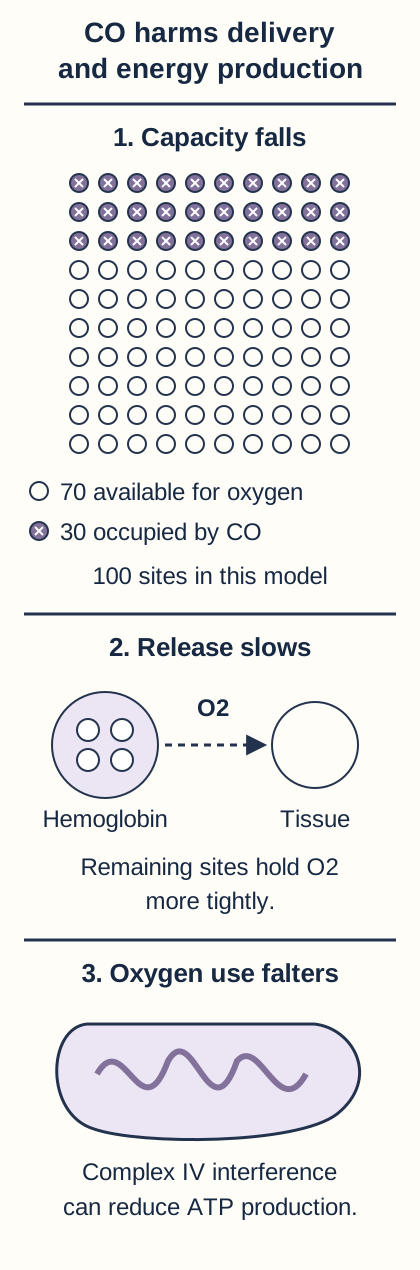
CO binds hemoglobin to form carboxyhemoglobin, abbreviated COHb. Its affinity is roughly 200 to 300 times that of oxygen, not one universal exact constant. Occupied heme sites cannot carry oxygen. CO also increases oxygen affinity at the remaining available sites, shifting the oxygen dissociation curve left and making tissue unloading harder. These are distinct problems: reduced capacity and impaired release. [2][10]
CO can also bind myoglobin in cardiac and skeletal muscle, impairing local oxygen handling, and interfere with mitochondrial cytochrome c oxidase, complex IV. Reduced oxidative ATP production, inflammation, and oxidative injury help explain why blood clearance and organ recovery are not interchangeable. This is not simply a toxin attaching directly to a neuronal surface receptor. [2]
Work with the oxygen-carriage diagram: imagine 100 heme sites. If 30 are occupied by CO, at most 70 remain available for oxygen. Those 70 sites may still hold oxygen too tightly. The diagram separates site occupancy from the final mitochondrial use of oxygen.
Count the occupied sites, then follow delivery, release, and cellular use. The site count is a simplified model, not a patient measurement. [2][13]
Try a calculation: compare two arterial samples with hemoglobin 15 g/dL and PaO2 100 mm Hg. Blood co-oximetry measures fractional oxyhemoglobin of 0.98 in sample A and 0.70 in sample B. Using oxygen content = 1.34 x hemoglobin x fractional oxyhemoglobin + 0.003 x PaO2, predict whether the equal PaO2 makes their contents equal.
Check the oxygen-content calculation
A contains about 20.0 mL O2/dL: 1.34 x 15 x 0.98 + 0.30. B contains about 14.4 mL O2/dL: 1.34 x 15 x 0.70 + 0.30. These are constructed teaching values. The small dissolved contribution is identical; the hemoglobin contribution is not. Use a measured fractional oxyhemoglobin value, not the ordinary pulse-oximeter reading, in this comparison.
Consequence: normal oxygen tension can coexist with substantially reduced carriage. Content also does not measure unloading efficiency or mitochondrial function. Apply it elsewhere: anemia can likewise reduce oxygen content despite normal PaO2, but anemia alone does not create COHb or the CO-related left shift.
2. Read the organ findings, not just the exposure number
Question: why can the same exposure produce memory loss in one survivor and gait difficulty in another? The brain and heart have high oxygen requirements and limited tolerance of disrupted energy supply. The examination asks which functions failed; it cannot be replaced by a COHb percentage. [1][2]
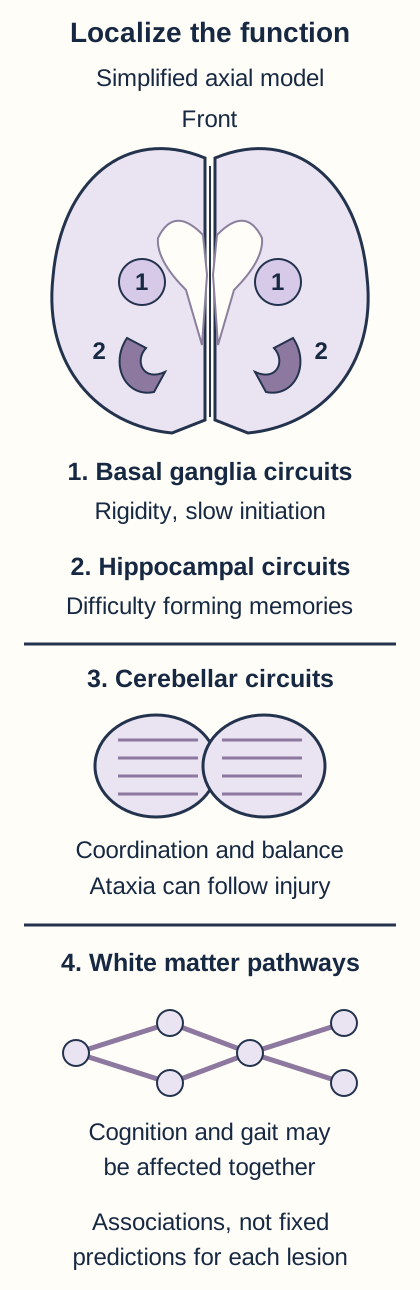
The globus pallidus is a classic site of bilateral injury. Parkinsonism, including rigidity and slowed initiation, can accompany injury to basal ganglia networks. Hippocampal injury can impair new memory formation. Cerebellar injury can contribute to ataxia, while diffuse white matter damage can affect cognition and gait together. These are useful functional associations, not one-to-one diagnostic promises. [2][8][9]
Compare two patterns: a patient who cannot retain new information despite intact strength suggests a different affected network from a patient with new rigidity and short steps. Point to the hippocampal region for the first pattern and basal ganglia region for the second in the localization diagram. Neither symptom alone proves which structure is injured.
Use the numbered regions to compare impaired initiation with impaired new-memory formation. Cerebellar and white matter models are separate insets, not additional structures in the same MRI slice. Geometry is schematic; symptoms do not guarantee one lesion. [2][9]
Consequence: bilateral deep-brain abnormalities can support toxic or hypoxic injury in an appropriate exposure history, but are not specific to CO. A normal early scan does not exclude poisoning. Avoid explaining selective pallidal vulnerability solely by a supposed watershed circulation; oxygen demand, perfusion, and cellular susceptibility all require context. Acute focal deficits still warrant urgent evaluation for stroke and other competing causes. [2][9]
Apply the same logic to the heart: chest discomfort, ischemic ECG changes, dysrhythmia, or increased troponin indicate an organ problem even when the later COHb is modest. Obtain cardiac assessment and treat the exposure in parallel. CO-associated myocardial injury can occur without obstructive coronary disease, but that possibility must not be used to dismiss acute coronary occlusion in an individual patient. [2][7]
A prospective cohort of hospitalized patients with moderate to severe poisoning found a long-term association between myocardial injury and mortality. That association supports follow-up and risk assessment; it does not prove that every biomarker abnormality has the same mechanism or that one treatment removes the later risk. [7]
3. Separate suspicion from confirmation
Question: what matters more than a normal-looking saturation display when several people feel ill? A shared environment. CO is colorless and odorless. Faulty heating, engines, fires, and other fuel-burning sources can cause headache, nausea, dizziness, and impaired concentration. Similar symptoms in cohabitants, improvement away from a building, or an environmental alarm increase concern. Fever or a meal history should not end the exposure assessment. [1][2]
Syncope, altered consciousness, chest pain, seizures, arrhythmias, severe acidosis, and respiratory failure indicate greater clinical danger. Skin color is not a useful rule-out test; the classic cherry-red appearance is unreliable. Severe poisoning can be fatal. A smoke-exposed patient can also have airway burns, pulmonary injury, trauma, or another toxin exposure. [1][2]
Sort the measurements: PaO2 measures the tension of oxygen dissolved in arterial plasma. Conventional two-wavelength SpO2 estimates saturation but cannot reliably separate COHb from oxyhemoglobin. A blood gas saturation calculated from PaO2 also does not solve that species-identification problem. Laboratory blood co-oximetry measures hemoglobin species and supplies the COHb result. Some blood gas instruments include co-oximetry; check what was actually measured. [1][11]
Try the comparison: two people leave the same workshop with headache. Their conventional SpO2 values are 98% and 99%. Name the test that directly addresses CO exposure, and decide whether oxygen should wait for it.
Check the testing and treatment decision
Obtain blood co-oximetry and begin high-concentration oxygen on clinical suspicion. Venous blood is suitable for COHb measurement; an arterial puncture is not required solely for that purpose. An arterial sample may still be needed for other questions, such as gas exchange in respiratory failure. [1][2][12]
Consequence: an apparently normal SpO2 cannot reassure you about functional oxygen carriage in CO poisoning. Do not calculate an exact oxyhemoglobin percentage by subtracting COHb from SpO2. Apply it elsewhere: persistent confusion requires glucose testing and a differential diagnosis even when CO exposure is documented. Coexisting conditions do not disappear when one toxicology result is positive. [2][11]
4. Add a clock to every COHb result
Question: does a small number several hours later mean the exposure was small? No. COHb falls after leaving the source and falls faster during oxygen treatment. Record the end of exposure, oxygen delivery, and blood-draw time before interpreting the result. [1][4]
CDC describes a COHb of 2% in a nonsmoker or above 9% in a smoker as strongly supportive of exposure. These are supporting values, not exclusions or severity grades. Tobacco use can raise baseline COHb; a smoker with new compatible symptoms still needs exposure assessment. A low value after oxygen cannot erase earlier unconsciousness or cardiac injury. [1]
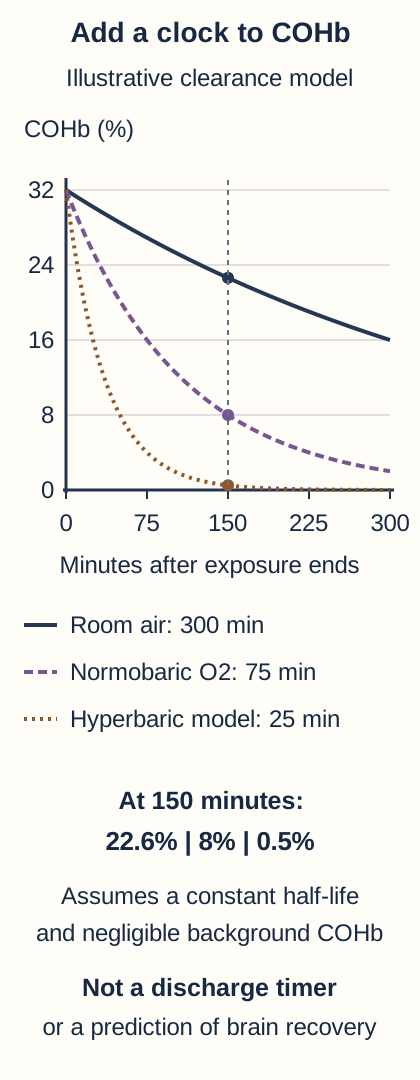
Room-air clearance takes hours, commonly summarized as roughly 4 to 6 hours per half-life. High-concentration normobaric oxygen often shortens that to about 60 to 90 minutes. One clinical series measured a mean of 74 minutes, with substantial patient-to-patient variation. Hyperbaric oxygen around 2.5 to 3 atmospheres absolute can shorten clearance further, often illustrated as about 20 to 30 minutes, although clinical measurements can be longer. These are approximate physiologic comparisons, not discharge timers or treatment protocols. [4][10][13]
Use the clearance comparison: assume constant half-lives in the equation below. Start at 32% COHb and assume constant half-lives of 300 minutes on room air, 75 minutes on normobaric oxygen, or 25 minutes under hyperbaric oxygen. Trace each curve to 150 minutes before checking the values.
Trace each line to 150 minutes. These rounded model assumptions illustrate room air, high-concentration normobaric oxygen, and a hyperbaric condition around 2.5 to 3 atmospheres absolute. They are not a patient protocol; actual clearance varies, and blood clearance does not establish tissue recovery. [4][10][13]Check the three predictions
Using COHb(t) = 32 x 2^(-t/half-life), the predictions are about 22.6%, 8%, and 0.5%. The model ignores background COHb, changes in ventilation, and tissue redistribution. It isolates why treatment before sampling changes the laboratory result. Do not use the model to delay oxygen or to reconstruct an exact peak exposure.
Consequence: the post-treatment sample describes blood at that time, not the entire injury. Transfer: two patients with COHb of 8% need not have comparable risk if one just left the source and the other received several hours of oxygen after collapsing. Intubation is selected for airway protection or ventilation needs. A tube and a reservoir mask do not guarantee identical delivered oxygen concentrations or identical clearance.
5. Start oxygen, then individualize escalation
Question: which action should not depend on a laboratory threshold? Begin the highest feasible oxygen concentration promptly when CO poisoning is suspected. Assess airway protection, breathing, circulation, glucose, and neurologic status. Use a well-fitted reservoir mask in an adequately breathing patient; provide airway protection and ventilation with 100% oxygen when needed. Do not wait for imaging, co-oximetry, or a chamber transfer to start oxygen. [1][2]
Reassess symptoms and examination during treatment. Evaluate ECG, troponin, pH, and lactate when assessing organ injury and severity. A severe fire-related presentation also requires evaluation for inhalation injury and co-toxins. If exposure was intentional, assess possible co-ingestants and arrange an appropriate mental-health safety evaluation after immediate medical stabilization. [2]
Compare the consultation decisions: one patient has improving headache and a normal examination; another is now awake but had documented loss of consciousness, persistent cognitive impairment, cardiac ischemia, or severe acidosis. The second pattern supports urgent poison-center and hyperbaric specialist discussion even when COHb has already fallen. A COHb above about 25% to 30% is another reason to consider escalation, not a universal order to use a chamber. Older age affects vulnerability but is not an isolated mandatory indication. [1][3]
Pregnancy changes the assessment: the fetus can accumulate CO and clear it more slowly than the mother. Maternal improvement or a modest maternal COHb therefore does not establish fetal safety. Continue oxygen and involve obstetric and toxicology/hyperbaric expertise urgently; CDC favors hyperbaric treatment in pregnancy even with less severe maternal poisoning. Do not wait for a nonpregnant adult threshold. [1][2]
Make the distinction: urgent consultation is a decision to obtain expertise, not a promise that every referred patient will receive HBO. The 2025 ACEP policy offers a Level C recommendation for selected symptomatic adults, incorporating severity and practical availability, including transport distance and time. Trials have reported different results under different regimens: Weaver and colleagues found fewer cognitive sequelae, whereas Scheinkestel and colleagues did not demonstrate benefit. Faster blood clearance is not itself proof of better long-term cognition. [3][5][6]
Consequence: continue oxygen and stabilize the patient while weighing benefits, transport risks, chamber capability, and timing. Seek advice promptly rather than treating a fixed 6-to-12-hour interval as a guarantee or universal exclusion. The S2k guideline targets treatment within 6 hours when HBO is chosen; that recommendation is not evidence that delaying assessment until then is safe. [2]
Apply it elsewhere: a patient with unstable ventilation needs airway management before a long transfer. A patient with ongoing ischemic ECG changes needs an appropriate cardiac evaluation while the CO exposure is treated, not an assumption that oxygen will resolve every coronary problem. [2]
6. Recovery needs a second assessment
Question: how can a patient worsen after appearing well? Delayed neurologic sequelae can emerge after a lucid interval, often within the first month. New memory or attention problems, mood or behavioral changes, gait dysfunction, parkinsonism, and ataxia merit reassessment. Persistent symptoms from the first day and new symptoms after improvement are different clinical time courses, but both need care. [2][3]
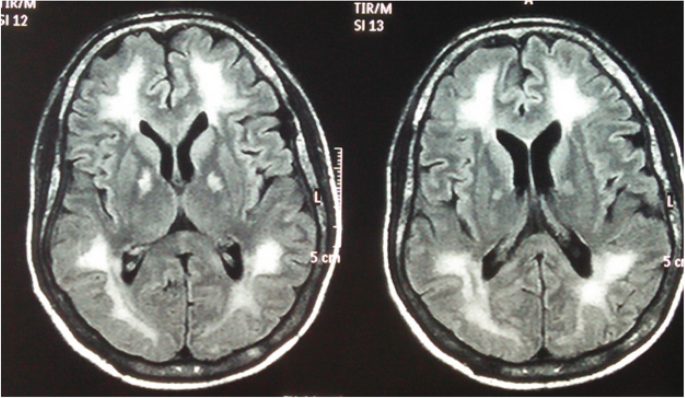
Read the clinical MRI: the published FLAIR figure shows bilateral subcortical white matter signal abnormalities and pallidal involvement in a patient with delayed deterioration. Compare the two hemispheres and the white matter distribution rather than searching for one artery's territory. This is a real published image, not an illustration of every possible presentation. The source described no significant ADC change despite bright DWI, so DWI brightness alone should not be relabeled definite restricted diffusion. [8]
Compare the bilateral white matter distribution rather than one arterial territory. Figure 3 from Kumarihamy and colleagues, BMC Pharmacology and Toxicology, 2019. The published caption also describes pallidal involvement. Image: [8] Prabhashini Kumarihamy; Senanayake Abeysinghe Mudiyanselage Kularatne; Manoji Pathirage; Wasala Mudiyanselage Sujeewa Nilanthi Gunaratne; Roshita Waduge; original source; CC BY 4.0.
Try a new timeline: one survivor becomes forgetful and slow three weeks after recovery in a different residence with no identified new exposure. Another develops headache each time they return to the original building, where a cohabitant is also symptomatic. Decide which pattern first raises concern for delayed injury and which demands renewed environmental investigation.
Check the timeline comparison
The first pattern supports delayed neurologic injury after a lucid interval. The second strongly raises concern for recurrent exposure. Neither label eliminates the need to assess other neurologic, metabolic, medication-related, or infectious causes when clinically indicated. A new deficit should not be dismissed as psychological because routine oxygen readings or COHb are normal. [1][2][8]
Consequence: arrange neurologic assessment, cognitive testing tailored to the symptoms, and rehabilitation for function and safety. MRI can help characterize injury when indicated. Neuropsychological assessment can reveal deficits missed by a brief bedside screen; no single test replaces longitudinal clinical assessment. Lesion location alone does not determine prognosis. Recovery may continue over months, but persistent disability is possible. [2][9]
No universally established drug regimen reliably reverses delayed CO brain injury. Symptom-directed care and rehabilitation remain central; experimental treatments and reports of improvement with repeated HBO do not establish a universal cure. A case report without a control group cannot separate treatment effect from natural recovery. [2][8][9]
Before discharge: confirm a safe destination and professional assessment of the exposure source; other occupants may also need evaluation. Explain return precautions for new cognitive, gait, neurologic, or cardiac symptoms. CDC recommends a repeat medical and neurologic examination in about 2 weeks; further cognitive assessment at 4 to 6 weeks and cardiac follow-up after documented injury may be appropriate. A working CO alarm and safe fuel-device use help prevent recurrence. [1][2][7]
Transfer: an asymptomatic examination today is a starting point for follow-up, not proof that later symptoms are unrelated to the exposure.
Practice with the full clinical picture
Case 1
Show answer and explanations for case 1
A. Arterial oxygen tension (Why this does not fit)
Arterial oxygen tension assesses dissolved oxygen and may identify pulmonary gas-exchange failure. It does not quantify hemoglobin occupied by CO, so a normal result would not resolve this shared-exposure presentation. Use PaO2 for gas exchange, not as a measure of COHb. [1] [11] [12]
Reasoning steps for option A
What does arterial oxygen tension measure?
Arterial oxygen tension assesses dissolved oxygen and may identify pulmonary gas-exchange failure.
How does the case detail "A 42-year-old nonsmoker and two cohabitants develop headache and nausea overnight." bear on choosing "Arterial oxygen tension"?
For "Arterial oxygen tension", it does not quantify hemoglobin occupied by CO, so a normal result would not resolve this shared-exposure presentation.
When considering "Arterial oxygen tension", which discriminator in "A 42-year-old nonsmoker and two cohabitants develop headache and nausea overnight." should control the reasoning?
For "Arterial oxygen tension", use PaO2 for gas exchange, not as a measure of COHb.
B. Calculated blood gas saturation (Why this does not fit)
A saturation calculated from PaO2 estimates hemoglobin oxygenation under standard assumptions. Those assumptions do not identify COHb; the environmental pattern remains concerning despite an apparently normal estimate. Check whether a reported blood gas saturation was measured by co-oximetry or merely calculated. [1] [11] [12]
Reasoning steps for option B
How is a calculated blood gas saturation obtained?
A saturation calculated from PaO2 estimates hemoglobin oxygenation under standard assumptions.
When considering "Calculated blood gas saturation", which discriminator in "A 42-year-old nonsmoker and two cohabitants develop headache and nausea overnight." should control the reasoning?
For "Calculated blood gas saturation", those assumptions do not identify COHb; the environmental pattern remains concerning despite an apparently normal estimate.
Why does "A 42-year-old nonsmoker and two cohabitants develop headache and nausea overnight." make the choice "Calculated blood gas saturation" fit or fail to fit this vignette?
For "Calculated blood gas saturation", check whether a reported blood gas saturation was measured by co-oximetry or merely calculated.
C. Blood carboxyhemoglobin measurement (Best answer)
Laboratory co-oximetry separates hemoglobin species and measures COHb. Shared afebrile illness around a fuel source plus impaired cognition supports testing even with SpO2 of 99%. Confirm exposure with blood COHb while treating on clinical suspicion. [1] [11] [12]
Reasoning steps for option C
Which hemoglobin species does this blood test quantify?
Laboratory co-oximetry separates hemoglobin species and measures COHb.
Why does "A 42-year-old nonsmoker and two cohabitants develop headache and nausea overnight." make the choice "Blood carboxyhemoglobin measurement" fit or fail to fit this vignette?
For "Blood carboxyhemoglobin measurement", shared afebrile illness around a fuel source plus impaired cognition supports testing even with SpO2 of 99%.
What specific link between "A 42-year-old nonsmoker and two cohabitants develop headache and nausea overnight." and "Blood carboxyhemoglobin measurement" should be checked before selecting it?
For "Blood carboxyhemoglobin measurement", confirm exposure with blood COHb while treating on clinical suspicion.
D. Serum lactate concentration (Why this does not fit)
Lactate can rise when oxygen delivery or cellular oxygen use is inadequate. An increased lactate supports physiologic stress but cannot identify CO as the cause. Use lactate to assess severity and competing causes, not as a CO-specific test. [1] [11] [12]
Reasoning steps for option D
What does an increased lactate indicate?
Lactate can rise when oxygen delivery or cellular oxygen use is inadequate.
What specific link between "A 42-year-old nonsmoker and two cohabitants develop headache and nausea overnight." and "Serum lactate concentration" should be checked before selecting it?
For "Serum lactate concentration", an increased lactate supports physiologic stress but cannot identify CO as the cause.
For the option "Serum lactate concentration", what feature matters most when the case begins with "A 42-year-old nonsmoker and two cohabitants develop headache and nausea overnight."?
For "Serum lactate concentration", use lactate to assess severity and competing causes, not as a CO-specific test.
E. Noncontrast cranial computed tomography (Why this does not fit)
Head CT can detect hemorrhage or other structural explanations for altered mental status. It does not directly measure a toxic exposure and can be normal early in CO poisoning. Select imaging for the neurologic differential without substituting it for exposure testing. [1] [11] [12]
Reasoning steps for option E
Which problems can a head CT identify?
Head CT can detect hemorrhage or other structural explanations for altered mental status.
For the option "Noncontrast cranial computed tomography", what feature matters most when the case begins with "A 42-year-old nonsmoker and two cohabitants develop headache and nausea overnight."?
For "Noncontrast cranial computed tomography", it does not directly measure a toxic exposure and can be normal early in CO poisoning.
How does the case detail "A 42-year-old nonsmoker and two cohabitants develop headache and nausea overnight." bear on choosing "Noncontrast cranial computed tomography"?
For "Noncontrast cranial computed tomography", select imaging for the neurologic differential without substituting it for exposure testing.
Takeaway: A shared exposure history can outweigh a normal conventional SpO2. [1] [11] [12]
CO occupies hemoglobin sites and impairs oxygen unloading. The normal PaO2 and clear radiograph do not exclude reduced hemoglobin-bound oxygen delivery to the brain and heart. Distinguish arterial oxygen tension from oxygen content and tissue delivery. [2] [10] [13]
Reasoning steps for option A
How does CO reduce oxygen delivery despite preserved PaO2?
CO occupies hemoglobin sites and impairs oxygen unloading.
When considering "Reduced oxygen content despite preserved dissolved oxygen tension", which discriminator in "A 57-year-old develops confusion and chest pressure after an engine runs in an enclosed work area." should control the reasoning?
For "Reduced oxygen content despite preserved dissolved oxygen tension", the normal PaO2 and clear radiograph do not exclude reduced hemoglobin-bound oxygen delivery to the brain and heart.
Why does "A 57-year-old develops confusion and chest pressure after an engine runs in an enclosed work area." make the choice "Reduced oxygen content despite preserved dissolved oxygen tension" fit or fail to fit this vignette?
For "Reduced oxygen content despite preserved dissolved oxygen tension", distinguish arterial oxygen tension from oxygen content and tissue delivery.
B. Reduced dissolved oxygen tension with preserved oxygen content (Why this does not fit)
Primary pulmonary gas-exchange failure can reduce arterial oxygen tension. The measured PaO2 is preserved, while COHb directly identifies an oxygen-carriage abnormality. A normal PaO2 argues against explaining this case solely by pulmonary oxygen transfer. [2] [10] [13]
Reasoning steps for option B
What finding would support primary pulmonary gas-exchange failure?
Primary pulmonary gas-exchange failure can reduce arterial oxygen tension.
Why does "A 57-year-old develops confusion and chest pressure after an engine runs in an enclosed work area." make the choice "Reduced dissolved oxygen tension with preserved oxygen content" fit or fail to fit this vignette?
For "Reduced dissolved oxygen tension with preserved oxygen content", the measured PaO2 is preserved, while COHb directly identifies an oxygen-carriage abnormality.
What specific link between "A 57-year-old develops confusion and chest pressure after an engine runs in an enclosed work area." and "Reduced dissolved oxygen tension with preserved oxygen content" should be checked before selecting it?
For "Reduced dissolved oxygen tension with preserved oxygen content", a normal PaO2 argues against explaining this case solely by pulmonary oxygen transfer.
C. Increased oxygen content with impaired alveolar diffusion (Why this does not fit)
High hemoglobin concentration could increase oxygen content in some settings. Hemoglobin is not increased and CO occupancy reduces available oxygen-binding capacity rather than increasing it. Oxygen content depends on usable hemoglobin, not merely a normal total hemoglobin concentration. [2] [10] [13]
Reasoning steps for option C
Would CO occupancy increase oxygen-carrying capacity?
High hemoglobin concentration could increase oxygen content in some settings.
What specific link between "A 57-year-old develops confusion and chest pressure after an engine runs in an enclosed work area." and "Increased oxygen content with impaired alveolar diffusion" should be checked before selecting it?
For "Increased oxygen content with impaired alveolar diffusion", hemoglobin is not increased and CO occupancy reduces available oxygen-binding capacity rather than increasing it.
For the option "Increased oxygen content with impaired alveolar diffusion", what feature matters most when the case begins with "A 57-year-old develops confusion and chest pressure after an engine runs in an enclosed work area."?
For "Increased oxygen content with impaired alveolar diffusion", oxygen content depends on usable hemoglobin, not merely a normal total hemoglobin concentration.
D. Preserved oxygen content with increased tissue unloading (Why this does not fit)
A right shift can favor oxygen release when tissue demand rises. CO instead reduces available binding sites and favors a left shift, making unloading harder. The CO-associated oxygen-affinity change compounds the capacity loss. [2] [10] [13]
Reasoning steps for option D
Which affinity change would favor increased unloading?
A right shift can favor oxygen release when tissue demand rises.
For the option "Preserved oxygen content with increased tissue unloading", what feature matters most when the case begins with "A 57-year-old develops confusion and chest pressure after an engine runs in an enclosed work area."?
For "Preserved oxygen content with increased tissue unloading", cO instead reduces available binding sites and favors a left shift, making unloading harder.
How does the case detail "A 57-year-old develops confusion and chest pressure after an engine runs in an enclosed work area." bear on choosing "Preserved oxygen content with increased tissue unloading"?
For "Preserved oxygen content with increased tissue unloading", the CO-associated oxygen-affinity change compounds the capacity loss.
E. Increased dissolved oxygen tension with increased cellular oxygen use (Why this does not fit)
Supplemental oxygen can raise PaO2 above room-air values. This room-air measurement is not increased, and the exposure can impair rather than accelerate mitochondrial oxygen use. Assess oxygen availability and cellular utilization as separate processes. [2] [10] [13]
Reasoning steps for option E
Does this exposure increase mitochondrial oxygen use?
Supplemental oxygen can raise PaO2 above room-air values.
How does the case detail "A 57-year-old develops confusion and chest pressure after an engine runs in an enclosed work area." bear on choosing "Increased dissolved oxygen tension with increased cellular oxygen use"?
For "Increased dissolved oxygen tension with increased cellular oxygen use", this room-air measurement is not increased, and the exposure can impair rather than accelerate mitochondrial oxygen use.
When considering "Increased dissolved oxygen tension with increased cellular oxygen use", which discriminator in "A 57-year-old develops confusion and chest pressure after an engine runs in an enclosed work area." should control the reasoning?
For "Increased dissolved oxygen tension with increased cellular oxygen use", assess oxygen availability and cellular utilization as separate processes.
Takeaway: Normal PaO2 does not establish normal oxygen delivery. [2] [10] [13]
The dissolved contribution is 0.003 x 100, or 0.3 mL O2/dL. This omits the oxygen still bound to the measured oxyhemoglobin fraction. Include both bound and dissolved oxygen when calculating content. [10] [11] [13]
Reasoning steps for option A
Which part of oxygen content equals 0.3 in this calculation?
The dissolved contribution is 0.003 x 100, or 0.3 mL O2/dL.
Why does "After a documented CO exposure, an arterial sample has hemoglobin 10 g/dL, PaO2 100 mm Hg, measured fractional oxyhemoglobin 0.70, and COHb 0.28." make the choice "0.3 mL O2/dL" fit or fail to fit this vignette?
For "0.3 mL O2/dL", this omits the oxygen still bound to the measured oxyhemoglobin fraction.
What specific link between "After a documented CO exposure, an arterial sample has hemoglobin 10 g/dL, PaO2 100 mm Hg, measured fractional oxyhemoglobin 0.70, and COHb 0.28." and "0.3 mL O2/dL" should be checked before selecting it?
For "0.3 mL O2/dL", include both bound and dissolved oxygen when calculating content.
B. 3.8 mL O2/dL (Why this does not fit)
Multiplying 1.34 x 10 x 0.28 gives approximately 3.8. The 0.28 fraction is occupied by CO, not oxygen, and cannot be counted as oxyhemoglobin. Use the measured oxygen-bearing fraction rather than the COHb fraction. [10] [11] [13]
Reasoning steps for option B
What does the fraction 0.28 represent?
Multiplying 1.34 x 10 x 0.28 gives approximately 3.8.
What specific link between "After a documented CO exposure, an arterial sample has hemoglobin 10 g/dL, PaO2 100 mm Hg, measured fractional oxyhemoglobin 0.70, and COHb 0.28." and "3.8 mL O2/dL" should be checked before selecting it?
For "3.8 mL O2/dL", the 0.28 fraction is occupied by CO, not oxygen, and cannot be counted as oxyhemoglobin.
For the option "3.8 mL O2/dL", what feature matters most when the case begins with "After a documented CO exposure, an arterial sample has hemoglobin 10 g/dL, PaO2 100 mm Hg, measured fractional oxyhemoglobin 0.70, and COHb 0.28."?
For "3.8 mL O2/dL", use the measured oxygen-bearing fraction rather than the COHb fraction.
C. 9.4 mL O2/dL (Why this does not fit)
The hemoglobin-bound contribution is 1.34 x 10 x 0.70, or 9.38. The requested total also includes 0.30 mL O2/dL dissolved in plasma. A small dissolved term still belongs in a requested total-content calculation. [10] [11] [13]
Reasoning steps for option C
Which contribution equals approximately 9.4?
The hemoglobin-bound contribution is 1.34 x 10 x 0.70, or 9.38.
For the option "9.4 mL O2/dL", what feature matters most when the case begins with "After a documented CO exposure, an arterial sample has hemoglobin 10 g/dL, PaO2 100 mm Hg, measured fractional oxyhemoglobin 0.70, and COHb 0.28."?
For "9.4 mL O2/dL", the requested total also includes 0.30 mL O2/dL dissolved in plasma.
How does the case detail "After a documented CO exposure, an arterial sample has hemoglobin 10 g/dL, PaO2 100 mm Hg, measured fractional oxyhemoglobin 0.70, and COHb 0.28." bear on choosing "9.4 mL O2/dL"?
For "9.4 mL O2/dL", a small dissolved term still belongs in a requested total-content calculation.
D. 13.6 mL O2/dL (Why this does not fit)
Substituting the pulse-oximeter value of 0.99 produces approximately 13.6. Conventional SpO2 is unreliable in this dyshemoglobinemia and overestimates the measured oxygen-bearing fraction. Use co-oximetry-derived fractional oxyhemoglobin when hemoglobin species are abnormal. [10] [11] [13]
Reasoning steps for option D
Which substituted value produces approximately 13.6?
Substituting the pulse-oximeter value of 0.99 produces approximately 13.6.
How does the case detail "After a documented CO exposure, an arterial sample has hemoglobin 10 g/dL, PaO2 100 mm Hg, measured fractional oxyhemoglobin 0.70, and COHb 0.28." bear on choosing "13.6 mL O2/dL"?
For "13.6 mL O2/dL", conventional SpO2 is unreliable in this dyshemoglobinemia and overestimates the measured oxygen-bearing fraction.
When considering "13.6 mL O2/dL", which discriminator in "After a documented CO exposure, an arterial sample has hemoglobin 10 g/dL, PaO2 100 mm Hg, measured fractional oxyhemoglobin 0.70, and COHb 0.28." should control the reasoning?
For "13.6 mL O2/dL", use co-oximetry-derived fractional oxyhemoglobin when hemoglobin species are abnormal.
E. 9.7 mL O2/dL (Best answer)
The measured fractional oxyhemoglobin gives 1.34 x 10 x 0.70 = 9.38. Adding the dissolved contribution of 0.30 gives 9.68 mL O2/dL despite a conventional SpO2 of 99%. Choose the appropriate saturation measurement before applying the oxygen-content equation. [10] [11] [13]
Reasoning steps for option E
What is the hemoglobin-bound contribution using the measured fraction?
The measured fractional oxyhemoglobin gives 1.34 x 10 x 0.70 = 9.38.
When considering "9.7 mL O2/dL", which discriminator in "After a documented CO exposure, an arterial sample has hemoglobin 10 g/dL, PaO2 100 mm Hg, measured fractional oxyhemoglobin 0.70, and COHb 0.28." should control the reasoning?
For "9.7 mL O2/dL", adding the dissolved contribution of 0.30 gives 9.68 mL O2/dL despite a conventional SpO2 of 99%.
Why does "After a documented CO exposure, an arterial sample has hemoglobin 10 g/dL, PaO2 100 mm Hg, measured fractional oxyhemoglobin 0.70, and COHb 0.28." make the choice "9.7 mL O2/dL" fit or fail to fit this vignette?
For "9.7 mL O2/dL", choose the appropriate saturation measurement before applying the oxygen-content equation.
Takeaway: A correct formula still gives a wrong answer when supplied an unreliable saturation. [10] [11] [13]
A. Lower oxygen capacity; higher P50 (Why this does not fit)
Losing usable heme sites lowers maximum oxygen capacity. The second component is reversed: CO favors greater oxygen affinity and therefore a lower P50 at remaining sites. Separate the number of usable sites from their affinity for oxygen. [2] [13]
Reasoning steps for option A
What would a higher P50 mean for affinity?
Losing usable heme sites lowers maximum oxygen capacity.
What specific link between "Two blood samples have equal total hemoglobin, pH, and temperature." and "Lower oxygen capacity; higher P50" should be checked before selecting it?
For "Lower oxygen capacity; higher P50", the second component is reversed: CO favors greater oxygen affinity and therefore a lower P50 at remaining sites.
For the option "Lower oxygen capacity; higher P50", what feature matters most when the case begins with "Two blood samples have equal total hemoglobin, pH, and temperature."?
For "Lower oxygen capacity; higher P50", separate the number of usable sites from their affinity for oxygen.
B. Lower oxygen capacity; lower P50 (Best answer)
CO occupies sites that could otherwise carry oxygen. The remaining oxygen-available sites have increased affinity, requiring a lower oxygen tension to reach half-saturation. CO decreases capacity and impairs unloading through a left shift. [2] [13]
Reasoning steps for option B
How does CO affect capacity and affinity separately?
CO occupies sites that could otherwise carry oxygen.
For the option "Lower oxygen capacity; lower P50", what feature matters most when the case begins with "Two blood samples have equal total hemoglobin, pH, and temperature."?
For "Lower oxygen capacity; lower P50", the remaining oxygen-available sites have increased affinity, requiring a lower oxygen tension to reach half-saturation.
How does the case detail "Two blood samples have equal total hemoglobin, pH, and temperature." bear on choosing "Lower oxygen capacity; lower P50"?
For "Lower oxygen capacity; lower P50", cO decreases capacity and impairs unloading through a left shift.
C. Unchanged oxygen capacity; lower P50 (Why this does not fit)
A left shift is compatible with increased oxygen affinity. Capacity cannot remain unchanged when 30% of heme sites are occupied by CO. Equal total hemoglobin does not imply equal usable oxygen-binding capacity. [2] [13]
Reasoning steps for option C
Can unchanged total hemoglobin preserve capacity when CO occupies sites?
A left shift is compatible with increased oxygen affinity.
How does the case detail "Two blood samples have equal total hemoglobin, pH, and temperature." bear on choosing "Unchanged oxygen capacity; lower P50"?
For "Unchanged oxygen capacity; lower P50", capacity cannot remain unchanged when 30% of heme sites are occupied by CO.
When considering "Unchanged oxygen capacity; lower P50", which discriminator in "Two blood samples have equal total hemoglobin, pH, and temperature." should control the reasoning?
For "Unchanged oxygen capacity; lower P50", equal total hemoglobin does not imply equal usable oxygen-binding capacity.
D. Higher oxygen capacity; lower P50 (Why this does not fit)
A lower P50 indicates tighter binding of oxygen at available sites. Tighter binding does not create additional oxygen-carrying sites, and CO has occupied some of them. Do not equate increased affinity with increased oxygen-carrying capacity. [2] [13]
Reasoning steps for option D
Does greater affinity create more available binding sites?
A lower P50 indicates tighter binding of oxygen at available sites.
When considering "Higher oxygen capacity; lower P50", which discriminator in "Two blood samples have equal total hemoglobin, pH, and temperature." should control the reasoning?
For "Higher oxygen capacity; lower P50", tighter binding does not create additional oxygen-carrying sites, and CO has occupied some of them.
Why does "Two blood samples have equal total hemoglobin, pH, and temperature." make the choice "Higher oxygen capacity; lower P50" fit or fail to fit this vignette?
For "Higher oxygen capacity; lower P50", do not equate increased affinity with increased oxygen-carrying capacity.
E. Lower oxygen capacity; unchanged P50 (Why this does not fit)
Anemia can reduce total oxygen capacity without a CO-specific affinity change. Total hemoglobin is matched here, and CO changes both usable capacity and oxygen affinity. Different causes of low oxygen content need not have the same dissociation curve. [2] [13]
Reasoning steps for option E
Which condition can reduce capacity without a CO-related affinity shift?
Anemia can reduce total oxygen capacity without a CO-specific affinity change.
Why does "Two blood samples have equal total hemoglobin, pH, and temperature." make the choice "Lower oxygen capacity; unchanged P50" fit or fail to fit this vignette?
For "Lower oxygen capacity; unchanged P50", total hemoglobin is matched here, and CO changes both usable capacity and oxygen affinity.
What specific link between "Two blood samples have equal total hemoglobin, pH, and temperature." and "Lower oxygen capacity; unchanged P50" should be checked before selecting it?
For "Lower oxygen capacity; unchanged P50", different causes of low oxygen content need not have the same dissociation curve.
Takeaway: CO leaves fewer oxygen-carrying sites and makes oxygen release harder. [2] [13]
A. Inhibition of cytosolic glucose phosphorylation (Why this does not fit)
Glucose phosphorylation supplies substrate for glycolysis in the cytosol. The preparation isolates mitochondria, and this is not the characteristic direct heme-protein effect of CO. Localize the affected process before assigning a metabolic target. [2] [13]
Reasoning steps for option A
Where does glucose phosphorylation occur?
Glucose phosphorylation supplies substrate for glycolysis in the cytosol.
For the option "Inhibition of cytosolic glucose phosphorylation", what feature matters most when the case begins with "A 39-year-old has confusion and lactic acidosis after an enclosed-space engine exposure."?
For "Inhibition of cytosolic glucose phosphorylation", the preparation isolates mitochondria, and this is not the characteristic direct heme-protein effect of CO.
How does the case detail "A 39-year-old has confusion and lactic acidosis after an enclosed-space engine exposure." bear on choosing "Inhibition of cytosolic glucose phosphorylation"?
For "Inhibition of cytosolic glucose phosphorylation", localize the affected process before assigning a metabolic target.
B. Inhibition of mitochondrial fatty acid entry (Why this does not fit)
Impaired fatty acid entry can limit oxidation of one class of fuel. CO-associated energy failure is not restricted to fatty acid use and can directly affect the terminal respiratory enzyme. Distinguish substrate delivery from the shared oxygen-using respiratory machinery. [2] [13]
Reasoning steps for option B
What role does fatty acid entry serve?
Impaired fatty acid entry can limit oxidation of one class of fuel.
How does the case detail "A 39-year-old has confusion and lactic acidosis after an enclosed-space engine exposure." bear on choosing "Inhibition of mitochondrial fatty acid entry"?
For "Inhibition of mitochondrial fatty acid entry", cO-associated energy failure is not restricted to fatty acid use and can directly affect the terminal respiratory enzyme.
When considering "Inhibition of mitochondrial fatty acid entry", which discriminator in "A 39-year-old has confusion and lactic acidosis after an enclosed-space engine exposure." should control the reasoning?
For "Inhibition of mitochondrial fatty acid entry", distinguish substrate delivery from the shared oxygen-using respiratory machinery.
C. Inhibition of matrix substrate-level phosphorylation (Why this does not fit)
Substrate-level phosphorylation produces a small amount of high-energy phosphate during the citric acid cycle. The central CO-related mitochondrial effect involves heme-dependent oxygen utilization, not this oxygen-independent phosphate transfer. A direct block of oxygen use is different from a block of substrate-level ATP generation. [2] [13]
Reasoning steps for option C
What is substrate-level phosphorylation?
Substrate-level phosphorylation produces a small amount of high-energy phosphate during the citric acid cycle.
When considering "Inhibition of matrix substrate-level phosphorylation", which discriminator in "A 39-year-old has confusion and lactic acidosis after an enclosed-space engine exposure." should control the reasoning?
For "Inhibition of matrix substrate-level phosphorylation", the central CO-related mitochondrial effect involves heme-dependent oxygen utilization, not this oxygen-independent phosphate transfer.
Why does "A 39-year-old has confusion and lactic acidosis after an enclosed-space engine exposure." make the choice "Inhibition of matrix substrate-level phosphorylation" fit or fail to fit this vignette?
For "Inhibition of matrix substrate-level phosphorylation", a direct block of oxygen use is different from a block of substrate-level ATP generation.
D. Inhibition of cytochrome c oxidase activity (Best answer)
Cytochrome c oxidase is a mitochondrial heme-containing enzyme that transfers electrons to oxygen. CO can interfere with this enzyme even in a preparation containing no hemoglobin, impairing oxidative ATP generation despite available oxygen. CO injury is not explained solely by reduced blood oxygen carriage. [2] [13]
Reasoning steps for option D
What does cytochrome c oxidase do with oxygen?
Cytochrome c oxidase is a mitochondrial heme-containing enzyme that transfers electrons to oxygen.
Why does "A 39-year-old has confusion and lactic acidosis after an enclosed-space engine exposure." make the choice "Inhibition of cytochrome c oxidase activity" fit or fail to fit this vignette?
For "Inhibition of cytochrome c oxidase activity", cO can interfere with this enzyme even in a preparation containing no hemoglobin, impairing oxidative ATP generation despite available oxygen.
What specific link between "A 39-year-old has confusion and lactic acidosis after an enclosed-space engine exposure." and "Inhibition of cytochrome c oxidase activity" should be checked before selecting it?
For "Inhibition of cytochrome c oxidase activity", cO injury is not explained solely by reduced blood oxygen carriage.
E. Inhibition of mitochondrial DNA replication (Why this does not fit)
Failure of mitochondrial DNA replication can eventually compromise respiratory proteins. An acute heme-binding effect on respiratory activity better explains this exposure model than delayed loss of protein synthesis. Use the time scale and the direct molecular target to distinguish metabolic mechanisms. [2] [13]
Reasoning steps for option E
How does loss of mitochondrial DNA replication affect respiration over time?
Failure of mitochondrial DNA replication can eventually compromise respiratory proteins.
What specific link between "A 39-year-old has confusion and lactic acidosis after an enclosed-space engine exposure." and "Inhibition of mitochondrial DNA replication" should be checked before selecting it?
For "Inhibition of mitochondrial DNA replication", an acute heme-binding effect on respiratory activity better explains this exposure model than delayed loss of protein synthesis.
For the option "Inhibition of mitochondrial DNA replication", what feature matters most when the case begins with "A 39-year-old has confusion and lactic acidosis after an enclosed-space engine exposure."?
For "Inhibition of mitochondrial DNA replication", use the time scale and the direct molecular target to distinguish metabolic mechanisms.
Takeaway: Available oxygen does not guarantee that mitochondria can use it. [2] [13]
A. Repeat arterial puncture to obtain a calculated saturation (Why this does not fit)
Arterial blood can provide useful pH and oxygen-tension measurements when needed. A calculated saturation still does not measure COHb, and no separate arterial gas-exchange question is presented. Choose the measurement needed rather than assuming that any arterial result confirms exposure. [1] [12]
Reasoning steps for option A
Does a calculated arterial saturation identify COHb?
Arterial blood can provide useful pH and oxygen-tension measurements when needed.
How does the case detail "A 46-year-old is receiving high-concentration oxygen after developing headache and confusion near a malfunctioning heater." bear on choosing "Repeat arterial puncture to obtain a calculated saturation"?
For "Repeat arterial puncture to obtain a calculated saturation", a calculated saturation still does not measure COHb, and no separate arterial gas-exchange question is presented.
When considering "Repeat arterial puncture to obtain a calculated saturation", which discriminator in "A 46-year-old is receiving high-concentration oxygen after developing headache and confusion near a malfunctioning heater." should control the reasoning?
For "Repeat arterial puncture to obtain a calculated saturation", choose the measurement needed rather than assuming that any arterial result confirms exposure.
B. Use a conventional fingertip saturation measurement (Why this does not fit)
Fingertip SpO2 is useful for routine oxygenation monitoring in many patients. Conventional two-wavelength oximetry does not reliably distinguish COHb from oxyhemoglobin. Noninvasive convenience does not overcome a measurement-specific limitation. [1] [12]
Reasoning steps for option B
Can conventional fingertip oximetry distinguish COHb?
Fingertip SpO2 is useful for routine oxygenation monitoring in many patients.
When considering "Use a conventional fingertip saturation measurement", which discriminator in "A 46-year-old is receiving high-concentration oxygen after developing headache and confusion near a malfunctioning heater." should control the reasoning?
For "Use a conventional fingertip saturation measurement", conventional two-wavelength oximetry does not reliably distinguish COHb from oxyhemoglobin.
Why does "A 46-year-old is receiving high-concentration oxygen after developing headache and confusion near a malfunctioning heater." make the choice "Use a conventional fingertip saturation measurement" fit or fail to fit this vignette?
For "Use a conventional fingertip saturation measurement", noninvasive convenience does not overcome a measurement-specific limitation.
C. Send venous lactate as the exposure confirmation test (Why this does not fit)
Venous lactate can help assess the metabolic consequences of illness. It is nonspecific and cannot quantify COHb in this symptomatic exposure. A severity marker is not necessarily an exposure marker. [1] [12]
Reasoning steps for option C
Can venous lactate identify a specific toxic exposure?
Venous lactate can help assess the metabolic consequences of illness.
Why does "A 46-year-old is receiving high-concentration oxygen after developing headache and confusion near a malfunctioning heater." make the choice "Send venous lactate as the exposure confirmation test" fit or fail to fit this vignette?
For "Send venous lactate as the exposure confirmation test", it is nonspecific and cannot quantify COHb in this symptomatic exposure.
What specific link between "A 46-year-old is receiving high-concentration oxygen after developing headache and confusion near a malfunctioning heater." and "Send venous lactate as the exposure confirmation test" should be checked before selecting it?
For "Send venous lactate as the exposure confirmation test", a severity marker is not necessarily an exposure marker.
D. Arrange arterial catheter placement before further testing (Why this does not fit)
An arterial catheter can support repeated blood gas and blood-pressure monitoring in an unstable patient. This stable patient already has access suitable for the requested COHb measurement. Do not require an invasive line solely to obtain a test validated on venous blood. [1] [12]
Reasoning steps for option D
When can an arterial catheter be useful?
An arterial catheter can support repeated blood gas and blood-pressure monitoring in an unstable patient.
What specific link between "A 46-year-old is receiving high-concentration oxygen after developing headache and confusion near a malfunctioning heater." and "Arrange arterial catheter placement before further testing" should be checked before selecting it?
For "Arrange arterial catheter placement before further testing", this stable patient already has access suitable for the requested COHb measurement.
For the option "Arrange arterial catheter placement before further testing", what feature matters most when the case begins with "A 46-year-old is receiving high-concentration oxygen after developing headache and confusion near a malfunctioning heater."?
For "Arrange arterial catheter placement before further testing", do not require an invasive line solely to obtain a test validated on venous blood.
E. Send venous blood for carboxyhemoglobin measurement (Best answer)
Blood co-oximetry can quantify COHb in venous blood. Paired-sample research supports venous sampling for this exposure question, so the existing cannula can be used while oxygen continues. An arterial sample may answer other clinical questions but is not required solely for COHb. [1] [12]
Reasoning steps for option E
Can blood COHb be measured in a venous sample?
Blood co-oximetry can quantify COHb in venous blood.
For the option "Send venous blood for carboxyhemoglobin measurement", what feature matters most when the case begins with "A 46-year-old is receiving high-concentration oxygen after developing headache and confusion near a malfunctioning heater."?
For "Send venous blood for carboxyhemoglobin measurement", paired-sample research supports venous sampling for this exposure question, so the existing cannula can be used while oxygen continues.
How does the case detail "A 46-year-old is receiving high-concentration oxygen after developing headache and confusion near a malfunctioning heater." bear on choosing "Send venous blood for carboxyhemoglobin measurement"?
For "Send venous blood for carboxyhemoglobin measurement", an arterial sample may answer other clinical questions but is not required solely for COHb.
Takeaway: Venous blood can establish the COHb result without a separate arterial puncture. [1] [12]
A. Low initial exposure consistent with a minor clinical event (Why this does not fit)
Low COHb at the time of sampling may occur after a small exposure. It can also follow hours of oxygen treatment, and the documented unconsciousness and current memory deficit are important organ findings. Interpret a laboratory value with the treatment history and examination. [1] [2] [4]
Reasoning steps for option A
When might a small COHb accompany a small exposure?
Low COHb at the time of sampling may occur after a small exposure.
When considering "Low initial exposure consistent with a minor clinical event", which discriminator in "A 61-year-old is rescued unconscious from a workshop and receives high-concentration oxygen throughout a three-hour transfer." should control the reasoning?
For "Low initial exposure consistent with a minor clinical event", it can also follow hours of oxygen treatment, and the documented unconsciousness and current memory deficit are important organ findings.
Why does "A 61-year-old is rescued unconscious from a workshop and receives high-concentration oxygen throughout a three-hour transfer." make the choice "Low initial exposure consistent with a minor clinical event" fit or fail to fit this vignette?
For "Low initial exposure consistent with a minor clinical event", interpret a laboratory value with the treatment history and examination.
B. False low COHb from unreliable sampling after oxygen (Why this does not fit)
Laboratory errors can create discordant measurements and sometimes warrant repeat testing. Oxygen-mediated elimination provides a coherent reason for a low later COHb despite earlier severe symptoms. A clinically explainable change is not proof of an analytic failure. [1] [2] [4]
Reasoning steps for option B
What would an analytic error imply?
Laboratory errors can create discordant measurements and sometimes warrant repeat testing.
Why does "A 61-year-old is rescued unconscious from a workshop and receives high-concentration oxygen throughout a three-hour transfer." make the choice "False low COHb from unreliable sampling after oxygen" fit or fail to fit this vignette?
For "False low COHb from unreliable sampling after oxygen", oxygen-mediated elimination provides a coherent reason for a low later COHb despite earlier severe symptoms.
What specific link between "A 61-year-old is rescued unconscious from a workshop and receives high-concentration oxygen throughout a three-hour transfer." and "False low COHb from unreliable sampling after oxygen" should be checked before selecting it?
For "False low COHb from unreliable sampling after oxygen", a clinically explainable change is not proof of an analytic failure.
C. Treatment-related decline despite important neurologic findings (Best answer)
COHb decreases after exposure ends and falls faster with oxygen. Three hours of treatment separates this measurement from the collapse, while impaired memory still warrants neurologic assessment. Blood clearance does not establish recovery of injured tissue. [1] [2] [4]
Reasoning steps for option C
What happens to COHb after exposure ends and oxygen starts?
COHb decreases after exposure ends and falls faster with oxygen.
What specific link between "A 61-year-old is rescued unconscious from a workshop and receives high-concentration oxygen throughout a three-hour transfer." and "Treatment-related decline despite important neurologic findings" should be checked before selecting it?
For "Treatment-related decline despite important neurologic findings", three hours of treatment separates this measurement from the collapse, while impaired memory still warrants neurologic assessment.
For the option "Treatment-related decline despite important neurologic findings", what feature matters most when the case begins with "A 61-year-old is rescued unconscious from a workshop and receives high-concentration oxygen throughout a three-hour transfer."?
For "Treatment-related decline despite important neurologic findings", blood clearance does not establish recovery of injured tissue.
D. Predictable peak COHb based on a universal clearance rate (Why this does not fit)
A decay model can illustrate how treatment affects a later result. The individual clearance rate and pretreatment exposure are unknown, so the peak cannot be recovered exactly from this sample. Use clearance models to understand direction, not to invent missing exposure measurements. [1] [2] [4]
Reasoning steps for option D
What information would an exact peak reconstruction require?
A decay model can illustrate how treatment affects a later result.
For the option "Predictable peak COHb based on a universal clearance rate", what feature matters most when the case begins with "A 61-year-old is rescued unconscious from a workshop and receives high-concentration oxygen throughout a three-hour transfer."?
For "Predictable peak COHb based on a universal clearance rate", the individual clearance rate and pretreatment exposure are unknown, so the peak cannot be recovered exactly from this sample.
How does the case detail "A 61-year-old is rescued unconscious from a workshop and receives high-concentration oxygen throughout a three-hour transfer." bear on choosing "Predictable peak COHb based on a universal clearance rate"?
For "Predictable peak COHb based on a universal clearance rate", use clearance models to understand direction, not to invent missing exposure measurements.
E. Incidental low COHb with a separate primary memory disorder (Why this does not fit)
Alternative causes of cognitive impairment remain part of the differential. A falling COHb does not exclude persistent CO-related tissue injury, particularly after documented collapse. Continue a differential diagnosis without using treated COHb to dismiss compatible organ injury. [1] [2] [4]
Reasoning steps for option E
Do alternative causes of impaired memory remain possible?
Alternative causes of cognitive impairment remain part of the differential.
How does the case detail "A 61-year-old is rescued unconscious from a workshop and receives high-concentration oxygen throughout a three-hour transfer." bear on choosing "Incidental low COHb with a separate primary memory disorder"?
For "Incidental low COHb with a separate primary memory disorder", a falling COHb does not exclude persistent CO-related tissue injury, particularly after documented collapse.
When considering "Incidental low COHb with a separate primary memory disorder", which discriminator in "A 61-year-old is rescued unconscious from a workshop and receives high-concentration oxygen throughout a three-hour transfer." should control the reasoning?
For "Incidental low COHb with a separate primary memory disorder", continue a differential diagnosis without using treated COHb to dismiss compatible organ injury.
Takeaway: A post-treatment COHb is a time-stamped measurement, not a summary of the entire illness. [1] [2] [4]
A. Environmental exposure requiring prompt treatment and assessment (Best answer)
Tobacco use can increase baseline COHb and complicate interpretation of a modest result. Symptoms in a nonsmoking coworker with improvement away from the same setting support an additional environmental exposure. Do not use a smoker-associated baseline range to dismiss a compatible acute illness. [1] [2]
Reasoning steps for option A
How can tobacco use affect baseline COHb?
Tobacco use can increase baseline COHb and complicate interpretation of a modest result.
Why does "A 52-year-old daily smoker develops headache and dizziness while working in a basement with a fuel-burning heater." make the choice "Environmental exposure requiring prompt treatment and assessment" fit or fail to fit this vignette?
For "Environmental exposure requiring prompt treatment and assessment", symptoms in a nonsmoking coworker with improvement away from the same setting support an additional environmental exposure.
What specific link between "A 52-year-old daily smoker develops headache and dizziness while working in a basement with a fuel-burning heater." and "Environmental exposure requiring prompt treatment and assessment" should be checked before selecting it?
For "Environmental exposure requiring prompt treatment and assessment", do not use a smoker-associated baseline range to dismiss a compatible acute illness.
B. Tobacco-associated COHb suitable for delayed outpatient reassessment (Why this does not fit)
Smoking can explain some COHb elevations. This value does not establish the source, and the coworker pattern argues against attributing the entire episode to tobacco. Exposure attribution requires history as well as a percentage. [1] [2]
Reasoning steps for option B
Can the measured value establish tobacco as the source?
Smoking can explain some COHb elevations.
What specific link between "A 52-year-old daily smoker develops headache and dizziness while working in a basement with a fuel-burning heater." and "Tobacco-associated COHb suitable for delayed outpatient reassessment" should be checked before selecting it?
For "Tobacco-associated COHb suitable for delayed outpatient reassessment", this value does not establish the source, and the coworker pattern argues against attributing the entire episode to tobacco.
For the option "Tobacco-associated COHb suitable for delayed outpatient reassessment", what feature matters most when the case begins with "A 52-year-old daily smoker develops headache and dizziness while working in a basement with a fuel-burning heater."?
For "Tobacco-associated COHb suitable for delayed outpatient reassessment", exposure attribution requires history as well as a percentage.
C. Severe poisoning requiring chamber treatment before clinical assessment (Why this does not fit)
A high COHb can support escalation in context. An 8% value does not alone establish severe organ injury or a mandatory chamber decision. Escalation depends on clinical severity, timing, and specialist assessment. [1] [2]
Reasoning steps for option C
What does a substantial COHb contribute to an escalation decision?
A high COHb can support escalation in context.
For the option "Severe poisoning requiring chamber treatment before clinical assessment", what feature matters most when the case begins with "A 52-year-old daily smoker develops headache and dizziness while working in a basement with a fuel-burning heater."?
For "Severe poisoning requiring chamber treatment before clinical assessment", an 8% value does not alone establish severe organ injury or a mandatory chamber decision.
How does the case detail "A 52-year-old daily smoker develops headache and dizziness while working in a basement with a fuel-burning heater." bear on choosing "Severe poisoning requiring chamber treatment before clinical assessment"?
For "Severe poisoning requiring chamber treatment before clinical assessment", escalation depends on clinical severity, timing, and specialist assessment.
D. Vasovagal presyncope requiring reassurance after symptoms improve (Why this does not fit)
Presyncope and spontaneous improvement can occur after a vasovagal event. A shared location-related illness in two people is not explained by isolated vasovagal physiology. A pattern across exposed people can be more informative than improvement in one individual. [1] [2]
Reasoning steps for option D
What can cause presyncope followed by improvement?
Presyncope and spontaneous improvement can occur after a vasovagal event.
How does the case detail "A 52-year-old daily smoker develops headache and dizziness while working in a basement with a fuel-burning heater." bear on choosing "Vasovagal presyncope requiring reassurance after symptoms improve"?
For "Vasovagal presyncope requiring reassurance after symptoms improve", a shared location-related illness in two people is not explained by isolated vasovagal physiology.
When considering "Vasovagal presyncope requiring reassurance after symptoms improve", which discriminator in "A 52-year-old daily smoker develops headache and dizziness while working in a basement with a fuel-burning heater." should control the reasoning?
For "Vasovagal presyncope requiring reassurance after symptoms improve", a pattern across exposed people can be more informative than improvement in one individual.
E. Viral illness requiring supportive care without exposure evaluation (Why this does not fit)
Viral illnesses can affect coworkers and produce headache or malaise. Rapid improvement away from a fuel-source environment and delayed sampling favor an exposure assessment rather than a cutoff-based exclusion. Compare the time course and environmental association when common symptoms have competing causes. [1] [2]
Reasoning steps for option E
Can viral illness produce headache and nausea?
Viral illnesses can affect coworkers and produce headache or malaise.
When considering "Viral illness requiring supportive care without exposure evaluation", which discriminator in "A 52-year-old daily smoker develops headache and dizziness while working in a basement with a fuel-burning heater." should control the reasoning?
For "Viral illness requiring supportive care without exposure evaluation", rapid improvement away from a fuel-source environment and delayed sampling favor an exposure assessment rather than a cutoff-based exclusion.
Why does "A 52-year-old daily smoker develops headache and dizziness while working in a basement with a fuel-burning heater." make the choice "Viral illness requiring supportive care without exposure evaluation" fit or fail to fit this vignette?
For "Viral illness requiring supportive care without exposure evaluation", compare the time course and environmental association when common symptoms have competing causes.
Takeaway: A smoking history changes interpretation of COHb but does not negate environmental evidence. [1] [2]
A. Use nasal oxygen titrated to a saturation of 94% (Why this does not fit)
Saturation-guided titration limits unnecessary oxygen in many respiratory conditions. Conventional SpO2 is not a reliable measure of functional oxygen carriage in this exposure, and oxygen also accelerates CO elimination. Do not apply routine saturation targets to untreated suspected CO poisoning. [1] [2] [11]
Reasoning steps for option A
When is saturation-guided oxygen titration useful?
Saturation-guided titration limits unnecessary oxygen in many respiratory conditions.
What specific link between "A 33-year-old is brought outside after developing headache, vomiting, and slowed responses in a room heated by a fuel-burning device." and "Use nasal oxygen titrated to a saturation of 94%" should be checked before selecting it?
For "Use nasal oxygen titrated to a saturation of 94%", conventional SpO2 is not a reliable measure of functional oxygen carriage in this exposure, and oxygen also accelerates CO elimination.
For the option "Use nasal oxygen titrated to a saturation of 94%", what feature matters most when the case begins with "A 33-year-old is brought outside after developing headache, vomiting, and slowed responses in a room heated by a fuel-burning device."?
For "Use nasal oxygen titrated to a saturation of 94%", do not apply routine saturation targets to untreated suspected CO poisoning.
B. Defer oxygen until the blood COHb result is available (Why this does not fit)
A pretreatment sample can help document exposure when readily obtainable. Waiting would delay treatment despite a compatible shared exposure and neurologic symptoms. Draw blood promptly when feasible without postponing oxygen. [1] [2] [11]
Reasoning steps for option B
Why can a pretreatment sample be informative?
A pretreatment sample can help document exposure when readily obtainable.
For the option "Defer oxygen until the blood COHb result is available", what feature matters most when the case begins with "A 33-year-old is brought outside after developing headache, vomiting, and slowed responses in a room heated by a fuel-burning device."?
For "Defer oxygen until the blood COHb result is available", waiting would delay treatment despite a compatible shared exposure and neurologic symptoms.
How does the case detail "A 33-year-old is brought outside after developing headache, vomiting, and slowed responses in a room heated by a fuel-burning device." bear on choosing "Defer oxygen until the blood COHb result is available"?
For "Defer oxygen until the blood COHb result is available", draw blood promptly when feasible without postponing oxygen.
C. Begin oxygen only if arterial oxygen tension is reduced (Why this does not fit)
Low PaO2 identifies inadequate dissolved arterial oxygen. CO can impair carriage and cellular oxygen use while PaO2 remains within the normal range. Oxygen treatment in suspected CO poisoning is not conditional on a low PaO2. [1] [2] [11]
How does the case detail "A 33-year-old is brought outside after developing headache, vomiting, and slowed responses in a room heated by a fuel-burning device." bear on choosing "Begin oxygen only if arterial oxygen tension is reduced"?
For "Begin oxygen only if arterial oxygen tension is reduced", cO can impair carriage and cellular oxygen use while PaO2 remains within the normal range.
When considering "Begin oxygen only if arterial oxygen tension is reduced", which discriminator in "A 33-year-old is brought outside after developing headache, vomiting, and slowed responses in a room heated by a fuel-burning device." should control the reasoning?
For "Begin oxygen only if arterial oxygen tension is reduced", oxygen treatment in suspected CO poisoning is not conditional on a low PaO2.
D. Begin high-concentration oxygen through a reservoir mask (Best answer)
Adequate spontaneous breathing permits immediate reservoir-mask oxygen. The exposure pattern and slowed responses justify treatment despite SpO2 of 98%, while confirmation proceeds in parallel. Start the highest feasible oxygen concentration promptly on clinical suspicion. [1] [2] [11]
Reasoning steps for option D
Which oxygen device fits adequate spontaneous breathing?
When considering "Begin high-concentration oxygen through a reservoir mask", which discriminator in "A 33-year-old is brought outside after developing headache, vomiting, and slowed responses in a room heated by a fuel-burning device." should control the reasoning?
For "Begin high-concentration oxygen through a reservoir mask", the exposure pattern and slowed responses justify treatment despite SpO2 of 98%, while confirmation proceeds in parallel.
Why does "A 33-year-old is brought outside after developing headache, vomiting, and slowed responses in a room heated by a fuel-burning device." make the choice "Begin high-concentration oxygen through a reservoir mask" fit or fail to fit this vignette?
For "Begin high-concentration oxygen through a reservoir mask", start the highest feasible oxygen concentration promptly on clinical suspicion.
E. Provide room air during transfer to the testing facility (Why this does not fit)
Leaving the source stops ongoing inhalational exposure. Room-air clearance is slower than clearance with high-concentration oxygen and does not address this avoidable treatment delay. Ending exposure and providing oxygen are complementary actions. [1] [2] [11]
Reasoning steps for option E
What does leaving the source accomplish?
Leaving the source stops ongoing inhalational exposure.
Why does "A 33-year-old is brought outside after developing headache, vomiting, and slowed responses in a room heated by a fuel-burning device." make the choice "Provide room air during transfer to the testing facility" fit or fail to fit this vignette?
For "Provide room air during transfer to the testing facility", room-air clearance is slower than clearance with high-concentration oxygen and does not address this avoidable treatment delay.
What specific link between "A 33-year-old is brought outside after developing headache, vomiting, and slowed responses in a room heated by a fuel-burning device." and "Provide room air during transfer to the testing facility" should be checked before selecting it?
For "Provide room air during transfer to the testing facility", ending exposure and providing oxygen are complementary actions.
Takeaway: A normal conventional SpO2 is not a reason to delay oxygen. [1] [2] [11]
A. Obtain brain MRI before deciding on airway management (Why this does not fit)
MRI can characterize some toxic or hypoxic brain injuries. Poor airway protection and inadequate ventilation require immediate stabilization rather than a prolonged imaging evaluation. Imaging should not precede correction of a threatened airway. [2]
Reasoning steps for option A
What can MRI add to the neurologic assessment?
MRI can characterize some toxic or hypoxic brain injuries.
For the option "Obtain brain MRI before deciding on airway management", what feature matters most when the case begins with "A 44-year-old rescued from a fire has COHb of 35%."?
For "Obtain brain MRI before deciding on airway management", poor airway protection and inadequate ventilation require immediate stabilization rather than a prolonged imaging evaluation.
How does the case detail "A 44-year-old rescued from a fire has COHb of 35%." bear on choosing "Obtain brain MRI before deciding on airway management"?
For "Obtain brain MRI before deciding on airway management", imaging should not precede correction of a threatened airway.
B. Secure the airway and ventilate with 100% oxygen (Best answer)
Intubation is appropriate when consciousness and ventilation are inadequate. Markedly depressed consciousness, slow breathing, and pooled secretions identify both airway and ventilation hazards before a long transfer. Protect the airway and maintain oxygen delivery while arranging specialist care. [2]
Reasoning steps for option B
When is a protected airway needed?
Intubation is appropriate when consciousness and ventilation are inadequate.
How does the case detail "A 44-year-old rescued from a fire has COHb of 35%." bear on choosing "Secure the airway and ventilate with 100% oxygen"?
For "Secure the airway and ventilate with 100% oxygen", markedly depressed consciousness, slow breathing, and pooled secretions identify both airway and ventilation hazards before a long transfer.
When considering "Secure the airway and ventilate with 100% oxygen", which discriminator in "A 44-year-old rescued from a fire has COHb of 35%." should control the reasoning?
For "Secure the airway and ventilate with 100% oxygen", protect the airway and maintain oxygen delivery while arranging specialist care.
C. Continue the reservoir mask throughout immediate ground transfer (Why this does not fit)
A reservoir mask can provide high-concentration oxygen to an adequately breathing patient. It does not protect against aspiration or correct the demonstrated ventilatory failure. Choose respiratory support according to airway protection and ventilation, not device convenience. [2]
Reasoning steps for option C
What can a reservoir mask provide?
A reservoir mask can provide high-concentration oxygen to an adequately breathing patient.
When considering "Continue the reservoir mask throughout immediate ground transfer", which discriminator in "A 44-year-old rescued from a fire has COHb of 35%." should control the reasoning?
For "Continue the reservoir mask throughout immediate ground transfer", it does not protect against aspiration or correct the demonstrated ventilatory failure.
Why does "A 44-year-old rescued from a fire has COHb of 35%." make the choice "Continue the reservoir mask throughout immediate ground transfer" fit or fail to fit this vignette?
For "Continue the reservoir mask throughout immediate ground transfer", choose respiratory support according to airway protection and ventilation, not device convenience.
D. Await a lower COHb before arranging respiratory support (Why this does not fit)
COHb generally falls during adequate oxygen treatment. Waiting for that laboratory change leaves the airway unprotected and does not establish adequate ventilation. A laboratory trend cannot substitute for bedside assessment of airway function. [2]
Reasoning steps for option D
What does a falling COHb document?
COHb generally falls during adequate oxygen treatment.
Why does "A 44-year-old rescued from a fire has COHb of 35%." make the choice "Await a lower COHb before arranging respiratory support" fit or fail to fit this vignette?
For "Await a lower COHb before arranging respiratory support", waiting for that laboratory change leaves the airway unprotected and does not establish adequate ventilation.
What specific link between "A 44-year-old rescued from a fire has COHb of 35%." and "Await a lower COHb before arranging respiratory support" should be checked before selecting it?
For "Await a lower COHb before arranging respiratory support", a laboratory trend cannot substitute for bedside assessment of airway function.
E. Start noninvasive ventilation during transport to the chamber (Why this does not fit)
Noninvasive support can assist selected alert patients with respiratory failure. Severely depressed consciousness and pooled secretions make airway protection the immediate concern. Noninvasive support is not a substitute for a protected airway in this presentation. [2]
Reasoning steps for option E
Which patients are suitable for noninvasive ventilation?
Noninvasive support can assist selected alert patients with respiratory failure.
What specific link between "A 44-year-old rescued from a fire has COHb of 35%." and "Start noninvasive ventilation during transport to the chamber" should be checked before selecting it?
For "Start noninvasive ventilation during transport to the chamber", severely depressed consciousness and pooled secretions make airway protection the immediate concern.
For the option "Start noninvasive ventilation during transport to the chamber", what feature matters most when the case begins with "A 44-year-old rescued from a fire has COHb of 35%."?
For "Start noninvasive ventilation during transport to the chamber", noninvasive support is not a substitute for a protected airway in this presentation.
Takeaway: A chamber referral does not replace airway stabilization. [2]
A. Stop oxygen and use serial COHb to determine discharge readiness (Why this does not fit)
Serial COHb can document blood clearance. Persistent ischemic findings identify organ injury despite a percentage below commonly cited consultation thresholds. Clinical recovery and organ assessment matter more than reaching one COHb value. [1] [2] [3] [7]
Reasoning steps for option A
What information does serial COHb supply?
Serial COHb can document blood clearance.
How does the case detail "A 59-year-old with coronary artery disease develops chest pressure and dizziness after working near a fuel-burning pump indoors." bear on choosing "Stop oxygen and use serial COHb to determine discharge readiness"?
For "Stop oxygen and use serial COHb to determine discharge readiness", persistent ischemic findings identify organ injury despite a percentage below commonly cited consultation thresholds.
When considering "Stop oxygen and use serial COHb to determine discharge readiness", which discriminator in "A 59-year-old with coronary artery disease develops chest pressure and dizziness after working near a fuel-burning pump indoors." should control the reasoning?
For "Stop oxygen and use serial COHb to determine discharge readiness", clinical recovery and organ assessment matter more than reaching one COHb value.
B. Continue oxygen and obtain urgent toxicology and cardiac assessment (Best answer)
Cardiac ischemia is a severe clinical feature of CO poisoning. New ECG changes and increased troponin justify urgent specialist assessment, including hyperbaric discussion, while evaluating coronary disease in parallel. Treat the exposure without dismissing a potentially concurrent coronary problem. [1] [2] [3] [7]
Reasoning steps for option B
Why are ischemic ECG changes and troponin important?
Cardiac ischemia is a severe clinical feature of CO poisoning.
When considering "Continue oxygen and obtain urgent toxicology and cardiac assessment", which discriminator in "A 59-year-old with coronary artery disease develops chest pressure and dizziness after working near a fuel-burning pump indoors." should control the reasoning?
For "Continue oxygen and obtain urgent toxicology and cardiac assessment", new ECG changes and increased troponin justify urgent specialist assessment, including hyperbaric discussion, while evaluating coronary disease in parallel.
Why does "A 59-year-old with coronary artery disease develops chest pressure and dizziness after working near a fuel-burning pump indoors." make the choice "Continue oxygen and obtain urgent toxicology and cardiac assessment" fit or fail to fit this vignette?
For "Continue oxygen and obtain urgent toxicology and cardiac assessment", treat the exposure without dismissing a potentially concurrent coronary problem.
C. Give oxygen and postpone consultation until COHb exceeds 25% (Why this does not fit)
A COHb above about 25% to 30% is one reason to consider hyperbaric consultation. The value has already been altered by oxygen, and myocardial injury is a separate reason for urgent discussion. A numerical consultation threshold is not an exclusion rule. [1] [2] [3] [7]
Reasoning steps for option C
What does the 25% to 30% range represent?
A COHb above about 25% to 30% is one reason to consider hyperbaric consultation.
Why does "A 59-year-old with coronary artery disease develops chest pressure and dizziness after working near a fuel-burning pump indoors." make the choice "Give oxygen and postpone consultation until COHb exceeds 25%" fit or fail to fit this vignette?
For "Give oxygen and postpone consultation until COHb exceeds 25%", the value has already been altered by oxygen, and myocardial injury is a separate reason for urgent discussion.
What specific link between "A 59-year-old with coronary artery disease develops chest pressure and dizziness after working near a fuel-burning pump indoors." and "Give oxygen and postpone consultation until COHb exceeds 25%" should be checked before selecting it?
For "Give oxygen and postpone consultation until COHb exceeds 25%", a numerical consultation threshold is not an exclusion rule.
D. Treat coronary disease alone and regard COHb as incidental (Why this does not fit)
Coronary artery disease increases vulnerability to inadequate oxygen delivery. The compatible exposure and measured COHb support active CO poisoning alongside the cardiac problem. Two clinically important processes can require concurrent assessment. [1] [2] [3] [7]
Reasoning steps for option D
How can coronary disease interact with CO exposure?
Coronary artery disease increases vulnerability to inadequate oxygen delivery.
What specific link between "A 59-year-old with coronary artery disease develops chest pressure and dizziness after working near a fuel-burning pump indoors." and "Treat coronary disease alone and regard COHb as incidental" should be checked before selecting it?
For "Treat coronary disease alone and regard COHb as incidental", the compatible exposure and measured COHb support active CO poisoning alongside the cardiac problem.
For the option "Treat coronary disease alone and regard COHb as incidental", what feature matters most when the case begins with "A 59-year-old with coronary artery disease develops chest pressure and dizziness after working near a fuel-burning pump indoors."?
For "Treat coronary disease alone and regard COHb as incidental", two clinically important processes can require concurrent assessment.
E. Transfer directly to a chamber without evaluating the ischemic findings (Why this does not fit)
Hyperbaric therapy can be considered for selected patients with cardiac involvement. That decision still requires stabilization and expert assessment, and it does not remove the need to evaluate the ischemic presentation. Hyperbaric consultation and appropriate cardiac care should proceed together. [1] [2] [3] [7]
Reasoning steps for option E
What does a hyperbaric referral assess?
Hyperbaric therapy can be considered for selected patients with cardiac involvement.
For the option "Transfer directly to a chamber without evaluating the ischemic findings", what feature matters most when the case begins with "A 59-year-old with coronary artery disease develops chest pressure and dizziness after working near a fuel-burning pump indoors."?
For "Transfer directly to a chamber without evaluating the ischemic findings", that decision still requires stabilization and expert assessment, and it does not remove the need to evaluate the ischemic presentation.
How does the case detail "A 59-year-old with coronary artery disease develops chest pressure and dizziness after working near a fuel-burning pump indoors." bear on choosing "Transfer directly to a chamber without evaluating the ischemic findings"?
For "Transfer directly to a chamber without evaluating the ischemic findings", hyperbaric consultation and appropriate cardiac care should proceed together.
Takeaway: A modest later COHb does not make ischemic organ findings mild. [1] [2] [3] [7]
A. Discharge because the present neurologic examination is normal (Why this does not fit)
Clinical improvement is an important part of reassessment. It does not erase the documented loss of consciousness and substantial exposure when considering escalation and follow-up. Use the most important events in the illness, not only the latest examination. [1] [3]
Reasoning steps for option A
What does a normal current examination establish?
Clinical improvement is an important part of reassessment.
When considering "Discharge because the present neurologic examination is normal", which discriminator in "A 37-year-old was witnessed unconscious beside an operating engine in an enclosed workspace." should control the reasoning?
For "Discharge because the present neurologic examination is normal", it does not erase the documented loss of consciousness and substantial exposure when considering escalation and follow-up.
Why does "A 37-year-old was witnessed unconscious beside an operating engine in an enclosed workspace." make the choice "Discharge because the present neurologic examination is normal" fit or fail to fit this vignette?
For "Discharge because the present neurologic examination is normal", use the most important events in the illness, not only the latest examination.
B. Continue oxygen until COHb reaches zero before seeking advice (Why this does not fit)
Oxygen accelerates clearance of COHb. A zero value is not a required consultation target, and waiting for it would delay assessment of the earlier severe features. Specialist discussion can begin while oxygen treatment continues. [1] [3]
Reasoning steps for option B
Does oxygen treatment require waiting for zero COHb?
Oxygen accelerates clearance of COHb.
Why does "A 37-year-old was witnessed unconscious beside an operating engine in an enclosed workspace." make the choice "Continue oxygen until COHb reaches zero before seeking advice" fit or fail to fit this vignette?
For "Continue oxygen until COHb reaches zero before seeking advice", a zero value is not a required consultation target, and waiting for it would delay assessment of the earlier severe features.
What specific link between "A 37-year-old was witnessed unconscious beside an operating engine in an enclosed workspace." and "Continue oxygen until COHb reaches zero before seeking advice" should be checked before selecting it?
For "Continue oxygen until COHb reaches zero before seeking advice", specialist discussion can begin while oxygen treatment continues.
C. Obtain a screening brain MRI as the prerequisite for consultation (Why this does not fit)
MRI may help evaluate persistent or new neurologic abnormalities. A normal current examination does not require MRI to validate the documented collapse as a reason for discussion. A clinical history can justify consultation without a confirmatory lesion on imaging. [1] [3]
Reasoning steps for option C
What clinical question can MRI address?
MRI may help evaluate persistent or new neurologic abnormalities.
What specific link between "A 37-year-old was witnessed unconscious beside an operating engine in an enclosed workspace." and "Obtain a screening brain MRI as the prerequisite for consultation" should be checked before selecting it?
For "Obtain a screening brain MRI as the prerequisite for consultation", a normal current examination does not require MRI to validate the documented collapse as a reason for discussion.
For the option "Obtain a screening brain MRI as the prerequisite for consultation", what feature matters most when the case begins with "A 37-year-old was witnessed unconscious beside an operating engine in an enclosed workspace."?
For "Obtain a screening brain MRI as the prerequisite for consultation", a clinical history can justify consultation without a confirmatory lesion on imaging.
D. Choose hyperbaric treatment solely from the peak percentage (Why this does not fit)
An initial COHb of 34% is a significant exposure finding. It is one part of the decision alongside loss of consciousness, timing, current condition, transport, and treatment risks. A consultation decision integrates the full course rather than applying a single mandatory number. [1] [3]
Reasoning steps for option D
How should the initial COHb contribute to the decision?
An initial COHb of 34% is a significant exposure finding.
For the option "Choose hyperbaric treatment solely from the peak percentage", what feature matters most when the case begins with "A 37-year-old was witnessed unconscious beside an operating engine in an enclosed workspace."?
For "Choose hyperbaric treatment solely from the peak percentage", it is one part of the decision alongside loss of consciousness, timing, current condition, transport, and treatment risks.
How does the case detail "A 37-year-old was witnessed unconscious beside an operating engine in an enclosed workspace." bear on choosing "Choose hyperbaric treatment solely from the peak percentage"?
For "Choose hyperbaric treatment solely from the peak percentage", a consultation decision integrates the full course rather than applying a single mandatory number.
E. Request urgent hyperbaric consultation while oxygen continues (Best answer)
Loss of consciousness and a substantial initial COHb support urgent expert discussion. Current recovery does not eliminate those severe exposure features, although treatment candidacy remains individualized. Consultation is an assessment of benefit and risk, not a guarantee that chamber treatment is required. [1] [3]
Reasoning steps for option E
Why does earlier unconsciousness still matter?
Loss of consciousness and a substantial initial COHb support urgent expert discussion.
How does the case detail "A 37-year-old was witnessed unconscious beside an operating engine in an enclosed workspace." bear on choosing "Request urgent hyperbaric consultation while oxygen continues"?
For "Request urgent hyperbaric consultation while oxygen continues", current recovery does not eliminate those severe exposure features, although treatment candidacy remains individualized.
When considering "Request urgent hyperbaric consultation while oxygen continues", which discriminator in "A 37-year-old was witnessed unconscious beside an operating engine in an enclosed workspace." should control the reasoning?
For "Request urgent hyperbaric consultation while oxygen continues", consultation is an assessment of benefit and risk, not a guarantee that chamber treatment is required.
Takeaway: An improved examination does not erase earlier loss of consciousness. [1] [3]
A. Independent fetal pulmonary elimination of inhaled CO (Why this does not fit)
Pulmonary ventilation is central to CO elimination after birth. The fetus does not independently ventilate the lungs with atmospheric oxygen; clearance depends on transfer back through the mother. Maternal respiratory treatment and placental exchange are central to fetal CO elimination. [1] [2]
Reasoning steps for option A
How is CO normally eliminated through lungs after birth?
Pulmonary ventilation is central to CO elimination after birth.
Why does "A patient at 25 weeks of pregnancy is evaluated after a shared household CO exposure." make the choice "Independent fetal pulmonary elimination of inhaled CO" fit or fail to fit this vignette?
For "Independent fetal pulmonary elimination of inhaled CO", the fetus does not independently ventilate the lungs with atmospheric oxygen; clearance depends on transfer back through the mother.
What specific link between "A patient at 25 weeks of pregnancy is evaluated after a shared household CO exposure." and "Independent fetal pulmonary elimination of inhaled CO" should be checked before selecting it?
For "Independent fetal pulmonary elimination of inhaled CO", maternal respiratory treatment and placental exchange are central to fetal CO elimination.
B. Lower fetal hemoglobin affinity for CO than maternal hemoglobin (Why this does not fit)
A lower affinity would tend to reduce fetal accumulation under comparable exposure. Fetal hemoglobin instead has high CO affinity, contributing to accumulation and slower elimination. Do not infer fetal protection from a lower current maternal COHb. [1] [2]
Reasoning steps for option B
How does fetal hemoglobin affinity affect CO accumulation?
A lower affinity would tend to reduce fetal accumulation under comparable exposure.
What specific link between "A patient at 25 weeks of pregnancy is evaluated after a shared household CO exposure." and "Lower fetal hemoglobin affinity for CO than maternal hemoglobin" should be checked before selecting it?
For "Lower fetal hemoglobin affinity for CO than maternal hemoglobin", fetal hemoglobin instead has high CO affinity, contributing to accumulation and slower elimination.
For the option "Lower fetal hemoglobin affinity for CO than maternal hemoglobin", what feature matters most when the case begins with "A patient at 25 weeks of pregnancy is evaluated after a shared household CO exposure."?
For "Lower fetal hemoglobin affinity for CO than maternal hemoglobin", do not infer fetal protection from a lower current maternal COHb.
C. Matched fetal and maternal rates of CO elimination (Why this does not fit)
Maternal and fetal circulation exchange gases across the placenta. That connection does not make equilibration and elimination instantaneous or identical between compartments. Linked compartments can have different clearance time courses. [1] [2]
Reasoning steps for option C
Does placental exchange imply identical clearance rates?
Maternal and fetal circulation exchange gases across the placenta.
For the option "Matched fetal and maternal rates of CO elimination", what feature matters most when the case begins with "A patient at 25 weeks of pregnancy is evaluated after a shared household CO exposure."?
For "Matched fetal and maternal rates of CO elimination", that connection does not make equilibration and elimination instantaneous or identical between compartments.
How does the case detail "A patient at 25 weeks of pregnancy is evaluated after a shared household CO exposure." bear on choosing "Matched fetal and maternal rates of CO elimination"?
For "Matched fetal and maternal rates of CO elimination", linked compartments can have different clearance time courses.
D. Delayed fetal CO elimination relative to maternal blood clearance (Best answer)
Fetal CO can accumulate and clear more slowly than maternal CO. A falling maternal value and symptom improvement therefore do not establish that the fetal exposure has resolved. Pregnancy requires early specialist assessment without waiting for a nonpregnant adult threshold. [1] [2]
Reasoning steps for option D
How can fetal clearance differ from maternal clearance?
Fetal CO can accumulate and clear more slowly than maternal CO.
How does the case detail "A patient at 25 weeks of pregnancy is evaluated after a shared household CO exposure." bear on choosing "Delayed fetal CO elimination relative to maternal blood clearance"?
For "Delayed fetal CO elimination relative to maternal blood clearance", a falling maternal value and symptom improvement therefore do not establish that the fetal exposure has resolved.
When considering "Delayed fetal CO elimination relative to maternal blood clearance", which discriminator in "A patient at 25 weeks of pregnancy is evaluated after a shared household CO exposure." should control the reasoning?
For "Delayed fetal CO elimination relative to maternal blood clearance", pregnancy requires early specialist assessment without waiting for a nonpregnant adult threshold.
E. Placental prevention of fetal exposure during maternal recovery (Why this does not fit)
Placental transfer supplies oxygen but also permits CO to reach the fetus. Maternal symptom improvement after treatment does not reverse that earlier fetal exposure immediately. A functioning placenta does not prevent CO toxicity. [1] [2]
Reasoning steps for option E
Does the placenta prevent CO from reaching fetal blood?
Placental transfer supplies oxygen but also permits CO to reach the fetus.
When considering "Placental prevention of fetal exposure during maternal recovery", which discriminator in "A patient at 25 weeks of pregnancy is evaluated after a shared household CO exposure." should control the reasoning?
For "Placental prevention of fetal exposure during maternal recovery", maternal symptom improvement after treatment does not reverse that earlier fetal exposure immediately.
Why does "A patient at 25 weeks of pregnancy is evaluated after a shared household CO exposure." make the choice "Placental prevention of fetal exposure during maternal recovery" fit or fail to fit this vignette?
For "Placental prevention of fetal exposure during maternal recovery", a functioning placenta does not prevent CO toxicity.
Takeaway: Maternal improvement does not establish fetal clearance of CO. [1] [2]
The risks were 19/76 = 25.0% and 35/76 = 46.1%. Subtracting the two risks gives about 21.1 percentage points, an absolute rather than relative difference. Name the effect measure and preserve the trial population and regimen when interpreting it. [5]
Reasoning steps for option A
What are the two observed event risks?
The risks were 19/76 = 25.0% and 35/76 = 46.1%.
What specific link between "A randomized trial of treatment regimens for acute CO poisoning reported cognitive sequelae at six weeks in 19 of 76 participants assigned to hyper..." and "21 percentage points" should be checked before selecting it?
For "21 percentage points", subtracting the two risks gives about 21.1 percentage points, an absolute rather than relative difference.
For the option "21 percentage points", what feature matters most when the case begins with "A randomized trial of treatment regimens for acute CO poisoning reported cognitive sequelae at six weeks in 19 of 76 participants assigned to hyper..."?
For "21 percentage points", name the effect measure and preserve the trial population and regimen when interpreting it.
B. 16 percentage points (Why this does not fit)
There were 16 fewer participants with the outcome in the hyperbaric group. A difference in counts must be divided by the group denominator of 76 to become an absolute risk difference. Counts and percentages are different units. [5]
Reasoning steps for option B
What does the difference of 16 represent?
There were 16 fewer participants with the outcome in the hyperbaric group.
For the option "16 percentage points", what feature matters most when the case begins with "A randomized trial of treatment regimens for acute CO poisoning reported cognitive sequelae at six weeks in 19 of 76 participants assigned to hyper..."?
For "16 percentage points", a difference in counts must be divided by the group denominator of 76 to become an absolute risk difference.
How does the case detail "A randomized trial of treatment regimens for acute CO poisoning reported cognitive sequelae at six weeks in 19 of 76 participants assigned to hyper..." bear on choosing "16 percentage points"?
For "16 percentage points", counts and percentages are different units.
C. 25 percentage points (Why this does not fit)
Twenty-five percent is the observed event risk in the hyperbaric group. It is one group risk, not the difference between the two groups. An absolute risk reduction requires a comparison of both outcome risks. [5]
Reasoning steps for option C
Which event risk equals 25%?
Twenty-five percent is the observed event risk in the hyperbaric group.
How does the case detail "A randomized trial of treatment regimens for acute CO poisoning reported cognitive sequelae at six weeks in 19 of 76 participants assigned to hyper..." bear on choosing "25 percentage points"?
For "25 percentage points", it is one group risk, not the difference between the two groups.
When considering "25 percentage points", which discriminator in "A randomized trial of treatment regimens for acute CO poisoning reported cognitive sequelae at six weeks in 19 of 76 participants assigned to hyper..." should control the reasoning?
For "25 percentage points", an absolute risk reduction requires a comparison of both outcome risks.
D. 46 percentage points (Why this does not fit)
The comparison group had a risk near 46%, and the relative reduction was also approximately 46% in this example. Neither value is the absolute difference of approximately 21 percentage points. Distinguish baseline risk, relative reduction, and absolute reduction. [5]
Reasoning steps for option D
What quantities are close to 46% here?
The comparison group had a risk near 46%, and the relative reduction was also approximately 46% in this example.
When considering "46 percentage points", which discriminator in "A randomized trial of treatment regimens for acute CO poisoning reported cognitive sequelae at six weeks in 19 of 76 participants assigned to hyper..." should control the reasoning?
For "46 percentage points", neither value is the absolute difference of approximately 21 percentage points.
Why does "A randomized trial of treatment regimens for acute CO poisoning reported cognitive sequelae at six weeks in 19 of 76 participants assigned to hyper..." make the choice "46 percentage points" fit or fail to fit this vignette?
For "46 percentage points", distinguish baseline risk, relative reduction, and absolute reduction.
E. 54 percentage points (Why this does not fit)
The ratio of the two event risks is approximately 0.54. A risk ratio is dimensionless and is not an absolute reduction expressed in percentage points. Keep ratios separate from differences when describing treatment effects. [5]
Reasoning steps for option E
What does the ratio near 0.54 represent?
The ratio of the two event risks is approximately 0.54.
Why does "A randomized trial of treatment regimens for acute CO poisoning reported cognitive sequelae at six weeks in 19 of 76 participants assigned to hyper..." make the choice "54 percentage points" fit or fail to fit this vignette?
For "54 percentage points", a risk ratio is dimensionless and is not an absolute reduction expressed in percentage points.
What specific link between "A randomized trial of treatment regimens for acute CO poisoning reported cognitive sequelae at six weeks in 19 of 76 participants assigned to hyper..." and "54 percentage points" should be checked before selecting it?
For "54 percentage points", keep ratios separate from differences when describing treatment effects.
Takeaway: An absolute risk difference is not the relative risk reduction. [5]
Twenty-five minutes is sometimes used as a hyperbaric half-life. The measured trajectory in this exercise implies 75 minutes per half-life, so a different treatment example should not replace the supplied data. Infer the model parameter from the stated observations. [4] [13]
Reasoning steps for option A
Which condition might use a 25-minute half-life?
Twenty-five minutes is sometimes used as a hyperbaric half-life.
For the option "25 minutes", what feature matters most when the case begins with "For a simplified clearance exercise, an adult has COHb of 32% when high-concentration oxygen begins and 8% after 150 minutes."?
For "25 minutes", the measured trajectory in this exercise implies 75 minutes per half-life, so a different treatment example should not replace the supplied data.
How does the case detail "For a simplified clearance exercise, an adult has COHb of 32% when high-concentration oxygen begins and 8% after 150 minutes." bear on choosing "25 minutes"?
For "25 minutes", infer the model parameter from the stated observations.
B. 50 minutes (Why this does not fit)
Dividing 150 minutes into three equal intervals gives 50 minutes. A decrease from 32% to 8% contains two halvings, not three. Count proportional halvings rather than the number of listed concentrations. [4] [13]
Reasoning steps for option B
How many halvings occur from 32% to 8%?
Dividing 150 minutes into three equal intervals gives 50 minutes.
How does the case detail "For a simplified clearance exercise, an adult has COHb of 32% when high-concentration oxygen begins and 8% after 150 minutes." bear on choosing "50 minutes"?
For "50 minutes", a decrease from 32% to 8% contains two halvings, not three.
When considering "50 minutes", which discriminator in "For a simplified clearance exercise, an adult has COHb of 32% when high-concentration oxygen begins and 8% after 150 minutes." should control the reasoning?
For "50 minutes", count proportional halvings rather than the number of listed concentrations.
C. 75 minutes (Best answer)
The change from 32% to 16% to 8% represents two half-lives in 150 minutes. The next halving from 8% to 4% therefore requires 75 additional minutes in this stated model. An idealized clearance calculation is not a discharge rule or a guarantee of tissue recovery. [4] [13]
Reasoning steps for option C
What half-life follows from two halvings in 150 minutes?
The change from 32% to 16% to 8% represents two half-lives in 150 minutes.
When considering "75 minutes", which discriminator in "For a simplified clearance exercise, an adult has COHb of 32% when high-concentration oxygen begins and 8% after 150 minutes." should control the reasoning?
For "75 minutes", the next halving from 8% to 4% therefore requires 75 additional minutes in this stated model.
Why does "For a simplified clearance exercise, an adult has COHb of 32% when high-concentration oxygen begins and 8% after 150 minutes." make the choice "75 minutes" fit or fail to fit this vignette?
For "75 minutes", an idealized clearance calculation is not a discharge rule or a guarantee of tissue recovery.
D. 150 minutes (Why this does not fit)
One hundred fifty minutes produced a fourfold reduction in the supplied data. Reducing 8% to 4% is only a twofold reduction, so it requires half as much time under the constant-half-life assumption. The same fraction is cleared per half-life, not the same number of percentage points. [4] [13]
Reasoning steps for option D
What proportional reduction occurred over 150 minutes?
One hundred fifty minutes produced a fourfold reduction in the supplied data.
Why does "For a simplified clearance exercise, an adult has COHb of 32% when high-concentration oxygen begins and 8% after 150 minutes." make the choice "150 minutes" fit or fail to fit this vignette?
For "150 minutes", reducing 8% to 4% is only a twofold reduction, so it requires half as much time under the constant-half-life assumption.
What specific link between "For a simplified clearance exercise, an adult has COHb of 32% when high-concentration oxygen begins and 8% after 150 minutes." and "150 minutes" should be checked before selecting it?
For "150 minutes", the same fraction is cleared per half-life, not the same number of percentage points.
E. 300 minutes (Why this does not fit)
Three hundred minutes is a room-air half-life used in some comparisons. This exercise specifies an observed oxygen-treatment trajectory rather than a room-air estimate. Use the treatment conditions and measurements supplied by the case. [4] [13]
Reasoning steps for option E
Which condition might use a 300-minute half-life?
Three hundred minutes is a room-air half-life used in some comparisons.
What specific link between "For a simplified clearance exercise, an adult has COHb of 32% when high-concentration oxygen begins and 8% after 150 minutes." and "300 minutes" should be checked before selecting it?
For "300 minutes", this exercise specifies an observed oxygen-treatment trajectory rather than a room-air estimate.
For the option "300 minutes", what feature matters most when the case begins with "For a simplified clearance exercise, an adult has COHb of 32% when high-concentration oxygen begins and 8% after 150 minutes."?
For "300 minutes", use the treatment conditions and measurements supplied by the case.
A. Give oral glucose gel and reassess swallowing afterward (Why this does not fit)
Oral carbohydrate can treat hypoglycemia in an alert person who can swallow safely. This patient is too drowsy to protect swallowing, so an intravenous route is available and safer. Match glucose replacement to consciousness and airway safety. [2] [14]
Reasoning steps for option A
When can oral carbohydrate be used safely?
Oral carbohydrate can treat hypoglycemia in an alert person who can swallow safely.
How does the case detail "A 64-year-old with insulin-treated diabetes remains confused during treatment for a documented CO exposure." bear on choosing "Give oral glucose gel and reassess swallowing afterward"?
For "Give oral glucose gel and reassess swallowing afterward", this patient is too drowsy to protect swallowing, so an intravenous route is available and safer.
When considering "Give oral glucose gel and reassess swallowing afterward", which discriminator in "A 64-year-old with insulin-treated diabetes remains confused during treatment for a documented CO exposure." should control the reasoning?
For "Give oral glucose gel and reassess swallowing afterward", match glucose replacement to consciousness and airway safety.
B. Give intramuscular glucagon before using the intravenous line (Why this does not fit)
Glucagon can provide lifesaving rescue when prompt intravenous glucose is not available. This medical setting already has intravenous access, allowing direct glucose replacement without relying on a glucagon-mediated response. Use intravenous glucose promptly when severe hypoglycemia and available access make it appropriate. [2] [14]
Reasoning steps for option B
When can glucagon provide rescue for severe hypoglycemia?
Glucagon can provide lifesaving rescue when prompt intravenous glucose is not available.
When considering "Give intramuscular glucagon before using the intravenous line", which discriminator in "A 64-year-old with insulin-treated diabetes remains confused during treatment for a documented CO exposure." should control the reasoning?
For "Give intramuscular glucagon before using the intravenous line", this medical setting already has intravenous access, allowing direct glucose replacement without relying on a glucagon-mediated response.
Why does "A 64-year-old with insulin-treated diabetes remains confused during treatment for a documented CO exposure." make the choice "Give intramuscular glucagon before using the intravenous line" fit or fail to fit this vignette?
For "Give intramuscular glucagon before using the intravenous line", use intravenous glucose promptly when severe hypoglycemia and available access make it appropriate.
C. Stop oxygen and reassess cognition on room air (Why this does not fit)
A low post-treatment COHb can accompany substantial blood clearance. It does not correct the newly demonstrated hypoglycemia or justify abandoning exposure treatment during persistent symptoms. Two simultaneous problems may need concurrent treatment. [2] [14]
Reasoning steps for option C
Does falling COHb treat hypoglycemia?
A low post-treatment COHb can accompany substantial blood clearance.
Why does "A 64-year-old with insulin-treated diabetes remains confused during treatment for a documented CO exposure." make the choice "Stop oxygen and reassess cognition on room air" fit or fail to fit this vignette?
For "Stop oxygen and reassess cognition on room air", it does not correct the newly demonstrated hypoglycemia or justify abandoning exposure treatment during persistent symptoms.
What specific link between "A 64-year-old with insulin-treated diabetes remains confused during treatment for a documented CO exposure." and "Stop oxygen and reassess cognition on room air" should be checked before selecting it?
For "Stop oxygen and reassess cognition on room air", two simultaneous problems may need concurrent treatment.
D. Give intravenous dextrose while continuing exposure treatment (Best answer)
Severe hypoglycemia can independently produce altered consciousness. Unsafe swallowing and available intravenous access favor prompt intravenous glucose while CO care continues. Do not attribute every symptom to a positive toxicology result. [2] [14]
Reasoning steps for option D
How can severe hypoglycemia affect consciousness?
Severe hypoglycemia can independently produce altered consciousness.
What specific link between "A 64-year-old with insulin-treated diabetes remains confused during treatment for a documented CO exposure." and "Give intravenous dextrose while continuing exposure treatment" should be checked before selecting it?
For "Give intravenous dextrose while continuing exposure treatment", unsafe swallowing and available intravenous access favor prompt intravenous glucose while CO care continues.
For the option "Give intravenous dextrose while continuing exposure treatment", what feature matters most when the case begins with "A 64-year-old with insulin-treated diabetes remains confused during treatment for a documented CO exposure."?
For "Give intravenous dextrose while continuing exposure treatment", do not attribute every symptom to a positive toxicology result.
E. Obtain brain MRI before treating the persistent confusion (Why this does not fit)
MRI may help assess persistent neurologic deficits after stabilization. A rapidly treatable low glucose requires correction before delaying for structural imaging. Correct immediate metabolic threats while keeping the broader differential open. [2] [14]
Reasoning steps for option E
When can MRI help persistent neurologic symptoms?
MRI may help assess persistent neurologic deficits after stabilization.
For the option "Obtain brain MRI before treating the persistent confusion", what feature matters most when the case begins with "A 64-year-old with insulin-treated diabetes remains confused during treatment for a documented CO exposure."?
For "Obtain brain MRI before treating the persistent confusion", a rapidly treatable low glucose requires correction before delaying for structural imaging.
How does the case detail "A 64-year-old with insulin-treated diabetes remains confused during treatment for a documented CO exposure." bear on choosing "Obtain brain MRI before treating the persistent confusion"?
For "Obtain brain MRI before treating the persistent confusion", correct immediate metabolic threats while keeping the broader differential open.
Takeaway: A confirmed exposure does not exclude another urgent cause of confusion. [2] [14]
Hippocampal injury can impair formation of new memories after toxic or hypoxic injury. The lesions are in the medial lentiform nuclei, and the dominant syndrome is impaired motor initiation with rigidity. Combine the anatomic description with the affected function. [2] [9]
Reasoning steps for option A
Which function is associated with hippocampal injury?
Hippocampal injury can impair formation of new memories after toxic or hypoxic injury.
When considering "Hippocampal formation", which discriminator in "Three weeks after recovery from CO exposure, a 48-year-old develops symmetric rigidity, reduced facial expression, and difficulty initiating short..." should control the reasoning?
For "Hippocampal formation", the lesions are in the medial lentiform nuclei, and the dominant syndrome is impaired motor initiation with rigidity.
Why does "Three weeks after recovery from CO exposure, a 48-year-old develops symmetric rigidity, reduced facial expression, and difficulty initiating short..." make the choice "Hippocampal formation" fit or fail to fit this vignette?
For "Hippocampal formation", combine the anatomic description with the affected function.
B. Globus pallidus (Best answer)
The globus pallidus forms the medial portion of the lentiform nucleus. Paired pallidal injury is a classic CO-associated pattern and fits dysfunction of basal ganglia motor networks. A compatible localization supports the diagnosis but is not specific to CO. [2] [9]
Reasoning steps for option B
Which structure forms the medial lentiform nucleus?
The globus pallidus forms the medial portion of the lentiform nucleus.
Why does "Three weeks after recovery from CO exposure, a 48-year-old develops symmetric rigidity, reduced facial expression, and difficulty initiating short..." make the choice "Globus pallidus" fit or fail to fit this vignette?
For "Globus pallidus", paired pallidal injury is a classic CO-associated pattern and fits dysfunction of basal ganglia motor networks.
What specific link between "Three weeks after recovery from CO exposure, a 48-year-old develops symmetric rigidity, reduced facial expression, and difficulty initiating short..." and "Globus pallidus" should be checked before selecting it?
For "Globus pallidus", a compatible localization supports the diagnosis but is not specific to CO.
C. Cerebellar hemispheres (Why this does not fit)
Cerebellar injury can cause dysmetria and limb incoordination. The described deep cerebral location and rigid, short-stepped syndrome are not the expected cerebellar pattern. Different gait abnormalities can reflect different neural networks. [2] [9]
Reasoning steps for option C
Which deficits suggest cerebellar dysfunction?
Cerebellar injury can cause dysmetria and limb incoordination.
What specific link between "Three weeks after recovery from CO exposure, a 48-year-old develops symmetric rigidity, reduced facial expression, and difficulty initiating short..." and "Cerebellar hemispheres" should be checked before selecting it?
For "Cerebellar hemispheres", the described deep cerebral location and rigid, short-stepped syndrome are not the expected cerebellar pattern.
For the option "Cerebellar hemispheres", what feature matters most when the case begins with "Three weeks after recovery from CO exposure, a 48-year-old develops symmetric rigidity, reduced facial expression, and difficulty initiating short..."?
For "Cerebellar hemispheres", different gait abnormalities can reflect different neural networks.
D. Primary motor cortex (Why this does not fit)
A cortical motor lesion can cause weakness and upper motor neuron findings. Strength is preserved, and the lesions lie within the lentiform nuclei rather than cortex. Use both lesion location and the type of motor deficit. [2] [9]
Reasoning steps for option D
What motor findings can cortical injury produce?
A cortical motor lesion can cause weakness and upper motor neuron findings.
For the option "Primary motor cortex", what feature matters most when the case begins with "Three weeks after recovery from CO exposure, a 48-year-old develops symmetric rigidity, reduced facial expression, and difficulty initiating short..."?
For "Primary motor cortex", strength is preserved, and the lesions lie within the lentiform nuclei rather than cortex.
How does the case detail "Three weeks after recovery from CO exposure, a 48-year-old develops symmetric rigidity, reduced facial expression, and difficulty initiating short..." bear on choosing "Primary motor cortex"?
For "Primary motor cortex", use both lesion location and the type of motor deficit.
E. Substantia nigra (Why this does not fit)
Substantia nigra dopaminergic neurons influence basal ganglia motor circuits. Rigidity can fit dopaminergic dysfunction, but the supplied medial lentiform location is cerebral rather than midbrain. Localize the lesion rather than assuming that every parkinsonian syndrome begins in the substantia nigra. [2] [9]
Reasoning steps for option E
How does the substantia nigra contribute to motor function?
Substantia nigra dopaminergic neurons influence basal ganglia motor circuits.
How does the case detail "Three weeks after recovery from CO exposure, a 48-year-old develops symmetric rigidity, reduced facial expression, and difficulty initiating short..." bear on choosing "Substantia nigra"?
For "Substantia nigra", rigidity can fit dopaminergic dysfunction, but the supplied medial lentiform location is cerebral rather than midbrain.
When considering "Substantia nigra", which discriminator in "Three weeks after recovery from CO exposure, a 48-year-old develops symmetric rigidity, reduced facial expression, and difficulty initiating short..." should control the reasoning?
For "Substantia nigra", localize the lesion rather than assuming that every parkinsonian syndrome begins in the substantia nigra.
Takeaway: Paired pallidal injury is characteristic in context, not a CO-specific diagnostic signature. [2] [9]
The vermis contributes to axial coordination and balance. The supplied deficit concerns retaining new information, while a cerebellar gait syndrome is not described. Distinguish memory encoding from coordination. [9]
Reasoning steps for option A
What function involves the cerebellar vermis?
The vermis contributes to axial coordination and balance.
Why does "A 43-year-old regains alertness after treatment for severe CO exposure." make the choice "Cerebellar vermis" fit or fail to fit this vignette?
For "Cerebellar vermis", the supplied deficit concerns retaining new information, while a cerebellar gait syndrome is not described.
What specific link between "A 43-year-old regains alertness after treatment for severe CO exposure." and "Cerebellar vermis" should be checked before selecting it?
For "Cerebellar vermis", distinguish memory encoding from coordination.
B. Primary auditory cortex (Why this does not fit)
Auditory cortical injury can impair processing of sound. Accurate repetition and command following show that hearing and immediate comprehension are not the dominant problem. An inability to retain heard information is not necessarily a hearing deficit. [9]
Reasoning steps for option B
What problem can auditory cortical injury cause?
Auditory cortical injury can impair processing of sound.
What specific link between "A 43-year-old regains alertness after treatment for severe CO exposure." and "Primary auditory cortex" should be checked before selecting it?
For "Primary auditory cortex", accurate repetition and command following show that hearing and immediate comprehension are not the dominant problem.
For the option "Primary auditory cortex", what feature matters most when the case begins with "A 43-year-old regains alertness after treatment for severe CO exposure."?
For "Primary auditory cortex", an inability to retain heard information is not necessarily a hearing deficit.
C. Hippocampal formation (Best answer)
The hippocampal formation is important for creating new declarative memories. Failure of delayed retention despite immediate repetition and comprehension fits bilateral medial temporal injury. Assess the stage of memory processing rather than labeling every cognitive deficit as global confusion. [9]
Reasoning steps for option C
What is a key function of the hippocampal formation?
The hippocampal formation is important for creating new declarative memories.
For the option "Hippocampal formation", what feature matters most when the case begins with "A 43-year-old regains alertness after treatment for severe CO exposure."?
For "Hippocampal formation", failure of delayed retention despite immediate repetition and comprehension fits bilateral medial temporal injury.
How does the case detail "A 43-year-old regains alertness after treatment for severe CO exposure." bear on choosing "Hippocampal formation"?
For "Hippocampal formation", assess the stage of memory processing rather than labeling every cognitive deficit as global confusion.
D. Globus pallidus (Why this does not fit)
Pallidal injury can impair basal ganglia motor-network function. The dominant findings are anterograde memory difficulty and medial temporal lesions, not rigidity or impaired motor initiation. A classic lesion for an exposure need not explain every presentation. [9]
Reasoning steps for option D
What function can pallidal injury impair?
Pallidal injury can impair basal ganglia motor-network function.
How does the case detail "A 43-year-old regains alertness after treatment for severe CO exposure." bear on choosing "Globus pallidus"?
For "Globus pallidus", the dominant findings are anterograde memory difficulty and medial temporal lesions, not rigidity or impaired motor initiation.
When considering "Globus pallidus", which discriminator in "A 43-year-old regains alertness after treatment for severe CO exposure." should control the reasoning?
For "Globus pallidus", a classic lesion for an exposure need not explain every presentation.
E. Mammillary bodies (Why this does not fit)
Mammillary bodies participate in memory circuits and their injury can impair memory. The supplied abnormalities are medial temporal, whereas the mammillary bodies are diencephalic structures. Memory impairment can arise at several sites, so use the anatomic distribution to refine localization. [9]
Reasoning steps for option E
Which function involves the mammillary bodies?
Mammillary bodies participate in memory circuits and their injury can impair memory.
When considering "Mammillary bodies", which discriminator in "A 43-year-old regains alertness after treatment for severe CO exposure." should control the reasoning?
For "Mammillary bodies", the supplied abnormalities are medial temporal, whereas the mammillary bodies are diencephalic structures.
Why does "A 43-year-old regains alertness after treatment for severe CO exposure." make the choice "Mammillary bodies" fit or fail to fit this vignette?
For "Mammillary bodies", memory impairment can arise at several sites, so use the anatomic distribution to refine localization.
Takeaway: CO-related injury can involve memory networks even when strength and basic comprehension recover. [9]
A. Continued high COHb from unchanged intravascular binding (Why this does not fit)
Persistent blood CO could sustain acute toxicity if exposure or clearance problems continued. The lucid interval followed by delayed deterioration after the exposure ended favors evolving tissue injury rather than unchanged initial blood occupancy. Blood clearance and the later evolution of tissue injury have different time courses. [2] [8] [13]
Reasoning steps for option A
What would persistent high blood CO require?
Persistent blood CO could sustain acute toxicity if exposure or clearance problems continued.
What specific link between "A 56-year-old resumes normal activities after treatment for CO poisoning." and "Continued high COHb from unchanged intravascular binding" should be checked before selecting it?
For "Continued high COHb from unchanged intravascular binding", the lucid interval followed by delayed deterioration after the exposure ended favors evolving tissue injury rather than unchanged initial blood occupancy.
For the option "Continued high COHb from unchanged intravascular binding", what feature matters most when the case begins with "A 56-year-old resumes normal activities after treatment for CO poisoning."?
For "Continued high COHb from unchanged intravascular binding", blood clearance and the later evolution of tissue injury have different time courses.
B. Acute embolic occlusion of one cerebral artery (Why this does not fit)
An embolus can cause an abrupt neurologic deficit in a vascular territory. The delayed progressive cognitive and gait syndrome with bilateral confluent white matter abnormalities does not fit one arterial territory. Use distribution and time course to distinguish vascular from diffuse toxic injury. [2] [8] [13]
Reasoning steps for option B
What course and distribution can one embolus produce?
An embolus can cause an abrupt neurologic deficit in a vascular territory.
For the option "Acute embolic occlusion of one cerebral artery", what feature matters most when the case begins with "A 56-year-old resumes normal activities after treatment for CO poisoning."?
For "Acute embolic occlusion of one cerebral artery", the delayed progressive cognitive and gait syndrome with bilateral confluent white matter abnormalities does not fit one arterial territory.
How does the case detail "A 56-year-old resumes normal activities after treatment for CO poisoning." bear on choosing "Acute embolic occlusion of one cerebral artery"?
For "Acute embolic occlusion of one cerebral artery", use distribution and time course to distinguish vascular from diffuse toxic injury.
C. Primary degeneration of dopaminergic neurons over years (Why this does not fit)
Neurodegenerative parkinsonism can produce a short-stepped gait and cognitive symptoms. A new subacute syndrome after a lucid interval and widespread white matter abnormalities favor a postexposure process. Do not ignore a distinctive exposure-related time course. [2] [8] [13]
Reasoning steps for option C
What time course characterizes primary neurodegeneration?
Neurodegenerative parkinsonism can produce a short-stepped gait and cognitive symptoms.
How does the case detail "A 56-year-old resumes normal activities after treatment for CO poisoning." bear on choosing "Primary degeneration of dopaminergic neurons over years"?
For "Primary degeneration of dopaminergic neurons over years", a new subacute syndrome after a lucid interval and widespread white matter abnormalities favor a postexposure process.
When considering "Primary degeneration of dopaminergic neurons over years", which discriminator in "A 56-year-old resumes normal activities after treatment for CO poisoning." should control the reasoning?
For "Primary degeneration of dopaminergic neurons over years", do not ignore a distinctive exposure-related time course.
D. Selective destruction of peripheral motor axons (Why this does not fit)
Peripheral motor axon injury can cause weakness and reduced reflexes. It does not explain cognitive decline or cerebral white matter abnormalities. Combine the cognitive and motor findings before deciding whether the lesion is central or peripheral. [2] [8] [13]
Reasoning steps for option D
What deficits can peripheral motor axon injury produce?
Peripheral motor axon injury can cause weakness and reduced reflexes.
When considering "Selective destruction of peripheral motor axons", which discriminator in "A 56-year-old resumes normal activities after treatment for CO poisoning." should control the reasoning?
For "Selective destruction of peripheral motor axons", it does not explain cognitive decline or cerebral white matter abnormalities.
Why does "A 56-year-old resumes normal activities after treatment for CO poisoning." make the choice "Selective destruction of peripheral motor axons" fit or fail to fit this vignette?
For "Selective destruction of peripheral motor axons", combine the cognitive and motor findings before deciding whether the lesion is central or peripheral.
E. Delayed white matter injury with demyelinating inflammation (Best answer)
CO-related hypoxic and inflammatory injury can evolve after initial clinical recovery. The lucid interval followed by combined cognitive and gait dysfunction with bilateral white matter abnormalities fits delayed neurologic sequelae. Evaluate delayed symptoms even when acute blood CO has already cleared. [2] [8] [13]
Reasoning steps for option E
How can tissue injury evolve after apparent CO recovery?
CO-related hypoxic and inflammatory injury can evolve after initial clinical recovery.
Why does "A 56-year-old resumes normal activities after treatment for CO poisoning." make the choice "Delayed white matter injury with demyelinating inflammation" fit or fail to fit this vignette?
For "Delayed white matter injury with demyelinating inflammation", the lucid interval followed by combined cognitive and gait dysfunction with bilateral white matter abnormalities fits delayed neurologic sequelae.
What specific link between "A 56-year-old resumes normal activities after treatment for CO poisoning." and "Delayed white matter injury with demyelinating inflammation" should be checked before selecting it?
For "Delayed white matter injury with demyelinating inflammation", evaluate delayed symptoms even when acute blood CO has already cleared.
Takeaway: Delayed brain injury can become apparent after blood CO and early symptoms have resolved. [2] [8] [13]
A. Bright DWI signal without confirmed current restriction (Best answer)
DWI signal can be bright from T2-related signal as well as restricted water motion. Without a corresponding ADC decrease, this examination does not establish restricted diffusion solely from DWI brightness. Interpret DWI with ADC and timing; this result does not exclude prior or evolving tissue injury. [8]
Reasoning steps for option A
What can contribute to bright DWI signal besides restriction?
DWI signal can be bright from T2-related signal as well as restricted water motion.
For the option "Bright DWI signal without confirmed current restriction", what feature matters most when the case begins with "A patient develops cognitive slowing after a lucid interval following CO poisoning."?
For "Bright DWI signal without confirmed current restriction", without a corresponding ADC decrease, this examination does not establish restricted diffusion solely from DWI brightness.
How does the case detail "A patient develops cognitive slowing after a lucid interval following CO poisoning." bear on choosing "Bright DWI signal without confirmed current restriction"?
For "Bright DWI signal without confirmed current restriction", interpret DWI with ADC and timing; this result does not exclude prior or evolving tissue injury.
B. Normal ADC indicating that no earlier injury occurred (Why this does not fit)
ADC is useful for characterizing diffusion at the time of an examination. A normal value does not erase earlier injury or exclude white matter disease, especially with abnormal FLAIR and a compatible course. A normal diffusion measurement is not a universal test of prior tissue health. [8]
Reasoning steps for option B
Does ADC measure all past tissue injury?
ADC is useful for characterizing diffusion at the time of an examination.
How does the case detail "A patient develops cognitive slowing after a lucid interval following CO poisoning." bear on choosing "Normal ADC indicating that no earlier injury occurred"?
For "Normal ADC indicating that no earlier injury occurred", a normal value does not erase earlier injury or exclude white matter disease, especially with abnormal FLAIR and a compatible course.
When considering "Normal ADC indicating that no earlier injury occurred", which discriminator in "A patient develops cognitive slowing after a lucid interval following CO poisoning." should control the reasoning?
For "Normal ADC indicating that no earlier injury occurred", a normal diffusion measurement is not a universal test of prior tissue health.
C. An acute single-artery infarct causing restricted diffusion (Why this does not fit)
Acute infarction can produce DWI hyperintensity with reduced ADC. No ADC reduction is present, and the described abnormalities are bilateral white matter changes rather than one supplied arterial territory. Do not equate DWI brightness with a specific vascular cause. [8]
Reasoning steps for option C
What diffusion pattern can accompany acute infarction?
Acute infarction can produce DWI hyperintensity with reduced ADC.
When considering "An acute single-artery infarct causing restricted diffusion", which discriminator in "A patient develops cognitive slowing after a lucid interval following CO poisoning." should control the reasoning?
For "An acute single-artery infarct causing restricted diffusion", no ADC reduction is present, and the described abnormalities are bilateral white matter changes rather than one supplied arterial territory.
Why does "A patient develops cognitive slowing after a lucid interval following CO poisoning." make the choice "An acute single-artery infarct causing restricted diffusion" fit or fail to fit this vignette?
For "An acute single-artery infarct causing restricted diffusion", do not equate DWI brightness with a specific vascular cause.
D. Ongoing cytotoxic edema established by the FLAIR signal (Why this does not fit)
FLAIR highlights increased tissue water in many disease processes. FLAIR alone cannot establish restricted diffusion or uniquely identify cytotoxic rather than other forms of tissue injury. Different MRI sequences answer related but distinct tissue questions. [8]
Reasoning steps for option D
What type of tissue property does FLAIR highlight?
FLAIR highlights increased tissue water in many disease processes.
Why does "A patient develops cognitive slowing after a lucid interval following CO poisoning." make the choice "Ongoing cytotoxic edema established by the FLAIR signal" fit or fail to fit this vignette?
For "Ongoing cytotoxic edema established by the FLAIR signal", fLAIR alone cannot establish restricted diffusion or uniquely identify cytotoxic rather than other forms of tissue injury.
What specific link between "A patient develops cognitive slowing after a lucid interval following CO poisoning." and "Ongoing cytotoxic edema established by the FLAIR signal" should be checked before selecting it?
For "Ongoing cytotoxic edema established by the FLAIR signal", different MRI sequences answer related but distinct tissue questions.
E. Complete structural recovery demonstrated by the ADC value (Why this does not fit)
Normal ADC can occur without current measurable restriction. Abnormal FLAIR and persistent cognitive slowing show that a normal ADC does not establish complete recovery. Interpret imaging together with other sequences and clinical function. [8]
Reasoning steps for option E
Does normal ADC establish structural and functional recovery?
Normal ADC can occur without current measurable restriction.
What specific link between "A patient develops cognitive slowing after a lucid interval following CO poisoning." and "Complete structural recovery demonstrated by the ADC value" should be checked before selecting it?
For "Complete structural recovery demonstrated by the ADC value", abnormal FLAIR and persistent cognitive slowing show that a normal ADC does not establish complete recovery.
For the option "Complete structural recovery demonstrated by the ADC value", what feature matters most when the case begins with "A patient develops cognitive slowing after a lucid interval following CO poisoning."?
For "Complete structural recovery demonstrated by the ADC value", interpret imaging together with other sequences and clinical function.
Takeaway: DWI brightness must be interpreted with ADC and the clinical time course. [8]
A. Arrange safe evacuation and emergency assessment of the apartment (Best answer)
Recurrent setting-related illness affecting another occupant suggests an ongoing environmental source. The family member may still be exposed, so prompt evacuation and professional assessment are needed while the patient receives clinical care. Do not assume every symptom after recovery represents delayed injury. [1] [2] [8]
Reasoning steps for option A
What does recurrent location-related illness suggest?
Recurrent setting-related illness affecting another occupant suggests an ongoing environmental source.
How does the case detail "Three weeks after treatment for CO poisoning, a 45-year-old returns with intermittent headache." bear on choosing "Arrange safe evacuation and emergency assessment of the apartment"?
For "Arrange safe evacuation and emergency assessment of the apartment", the family member may still be exposed, so prompt evacuation and professional assessment are needed while the patient receives clinical care.
When considering "Arrange safe evacuation and emergency assessment of the apartment", which discriminator in "Three weeks after treatment for CO poisoning, a 45-year-old returns with intermittent headache." should control the reasoning?
For "Arrange safe evacuation and emergency assessment of the apartment", do not assume every symptom after recovery represents delayed injury.
B. Arrange elective MRI for presumed delayed white matter injury (Why this does not fit)
Delayed neurologic sequelae can arise weeks after CO poisoning. Rapid recurrence in one location and illness in a cohabitant favor renewed exposure as the immediate preventable hazard. Use the setting-related time course to distinguish recurrent exposure from delayed tissue effects. [1] [2] [8]
Reasoning steps for option B
When can delayed neurologic sequelae emerge?
Delayed neurologic sequelae can arise weeks after CO poisoning.
When considering "Arrange elective MRI for presumed delayed white matter injury", which discriminator in "Three weeks after treatment for CO poisoning, a 45-year-old returns with intermittent headache." should control the reasoning?
For "Arrange elective MRI for presumed delayed white matter injury", rapid recurrence in one location and illness in a cohabitant favor renewed exposure as the immediate preventable hazard.
Why does "Three weeks after treatment for CO poisoning, a 45-year-old returns with intermittent headache." make the choice "Arrange elective MRI for presumed delayed white matter injury" fit or fail to fit this vignette?
For "Arrange elective MRI for presumed delayed white matter injury", use the setting-related time course to distinguish recurrent exposure from delayed tissue effects.
C. Schedule neuropsychological testing before addressing the residence (Why this does not fit)
Cognitive testing can help investigate persistent functional difficulties after exposure. This patient lacks a persistent cognitive syndrome, while another occupant remains in a potentially hazardous setting. Assessment of later deficits should not delay protection from a current source. [1] [2] [8]
Reasoning steps for option C
What can formal cognitive testing assess?
Cognitive testing can help investigate persistent functional difficulties after exposure.
Why does "Three weeks after treatment for CO poisoning, a 45-year-old returns with intermittent headache." make the choice "Schedule neuropsychological testing before addressing the residence" fit or fail to fit this vignette?
For "Schedule neuropsychological testing before addressing the residence", this patient lacks a persistent cognitive syndrome, while another occupant remains in a potentially hazardous setting.
What specific link between "Three weeks after treatment for CO poisoning, a 45-year-old returns with intermittent headache." and "Schedule neuropsychological testing before addressing the residence" should be checked before selecting it?
For "Schedule neuropsychological testing before addressing the residence", assessment of later deficits should not delay protection from a current source.
D. Begin outpatient migraine treatment and reassess after several weeks (Why this does not fit)
Migraine can cause episodic headache and nausea. A parallel illness in a cohabitant and reproducible location dependence warrant environmental investigation before attributing symptoms to primary headache. A familiar symptom pattern does not negate a shared exposure pattern. [1] [2] [8]
Reasoning steps for option D
Which symptoms can migraine cause?
Migraine can cause episodic headache and nausea.
What specific link between "Three weeks after treatment for CO poisoning, a 45-year-old returns with intermittent headache." and "Begin outpatient migraine treatment and reassess after several weeks" should be checked before selecting it?
For "Begin outpatient migraine treatment and reassess after several weeks", a parallel illness in a cohabitant and reproducible location dependence warrant environmental investigation before attributing symptoms to primary headache.
For the option "Begin outpatient migraine treatment and reassess after several weeks", what feature matters most when the case begins with "Three weeks after treatment for CO poisoning, a 45-year-old returns with intermittent headache."?
For "Begin outpatient migraine treatment and reassess after several weeks", a familiar symptom pattern does not negate a shared exposure pattern.
E. Use the prior treatment record to clear the apartment for return (Why this does not fit)
Successful medical treatment documents improvement of the treated patient. It does not show that the original fuel source or ventilation problem has been corrected. Medical recovery and environmental safety require separate confirmation. [1] [2] [8]
Reasoning steps for option E
What does successful medical treatment establish about the residence?
Successful medical treatment documents improvement of the treated patient.
For the option "Use the prior treatment record to clear the apartment for return", what feature matters most when the case begins with "Three weeks after treatment for CO poisoning, a 45-year-old returns with intermittent headache."?
For "Use the prior treatment record to clear the apartment for return", it does not show that the original fuel source or ventilation problem has been corrected.
How does the case detail "Three weeks after treatment for CO poisoning, a 45-year-old returns with intermittent headache." bear on choosing "Use the prior treatment record to clear the apartment for return"?
For "Use the prior treatment record to clear the apartment for return", medical recovery and environmental safety require separate confirmation.
Takeaway: A treated patient can be exposed again if the source remains unsafe. [1] [2] [8]
A. Serial blood COHb measurements over the next several weeks (Why this does not fit)
COHb measurements can identify current or recent blood exposure in an appropriate setting. They do not characterize attention, memory, or executive-function deficits after the acute exposure has ended. A clearance marker does not quantify the functional effects of brain injury. [2] [9] [13]
Reasoning steps for option A
What does repeated COHb testing measure?
COHb measurements can identify current or recent blood exposure in an appropriate setting.
When considering "Serial blood COHb measurements over the next several weeks", which discriminator in "Two weeks after treatment for CO poisoning, a 36-year-old has resumed work but repeatedly loses track of multistep tasks and misses appointments." should control the reasoning?
For "Serial blood COHb measurements over the next several weeks", they do not characterize attention, memory, or executive-function deficits after the acute exposure has ended.
Why does "Two weeks after treatment for CO poisoning, a 36-year-old has resumed work but repeatedly loses track of multistep tasks and misses appointments." make the choice "Serial blood COHb measurements over the next several weeks" fit or fail to fit this vignette?
For "Serial blood COHb measurements over the next several weeks", a clearance marker does not quantify the functional effects of brain injury.
B. Prolonged EEG monitoring for unrecognized seizure activity (Why this does not fit)
EEG can help evaluate episodic altered awareness or suspected seizures. The complaint is persistent task and memory difficulty without episodes of unresponsiveness, making targeted cognitive assessment more directly relevant. Match the diagnostic tool to the time course and type of symptom. [2] [9] [13]
Reasoning steps for option B
Which symptoms would support an EEG investigation?
EEG can help evaluate episodic altered awareness or suspected seizures.
Why does "Two weeks after treatment for CO poisoning, a 36-year-old has resumed work but repeatedly loses track of multistep tasks and misses appointments." make the choice "Prolonged EEG monitoring for unrecognized seizure activity" fit or fail to fit this vignette?
For "Prolonged EEG monitoring for unrecognized seizure activity", the complaint is persistent task and memory difficulty without episodes of unresponsiveness, making targeted cognitive assessment more directly relevant.
What specific link between "Two weeks after treatment for CO poisoning, a 36-year-old has resumed work but repeatedly loses track of multistep tasks and misses appointments." and "Prolonged EEG monitoring for unrecognized seizure activity" should be checked before selecting it?
For "Prolonged EEG monitoring for unrecognized seizure activity", match the diagnostic tool to the time course and type of symptom.
C. Lumbar puncture to establish an infectious cause of cognitive change (Why this does not fit)
Cerebrospinal fluid analysis can help assess infection or inflammation when the presentation supports it. No infectious syndrome is supplied, whereas a postexposure cognitive complaint remains despite a brief screen. Do not replace functional characterization with an invasive test lacking a case-specific indication. [2] [9] [13]
Reasoning steps for option C
When can cerebrospinal fluid testing be helpful?
Cerebrospinal fluid analysis can help assess infection or inflammation when the presentation supports it.
What specific link between "Two weeks after treatment for CO poisoning, a 36-year-old has resumed work but repeatedly loses track of multistep tasks and misses appointments." and "Lumbar puncture to establish an infectious cause of cognitive change" should be checked before selecting it?
For "Lumbar puncture to establish an infectious cause of cognitive change", no infectious syndrome is supplied, whereas a postexposure cognitive complaint remains despite a brief screen.
For the option "Lumbar puncture to establish an infectious cause of cognitive change", what feature matters most when the case begins with "Two weeks after treatment for CO poisoning, a 36-year-old has resumed work but repeatedly loses track of multistep tasks and misses appointments."?
For "Lumbar puncture to establish an infectious cause of cognitive change", do not replace functional characterization with an invasive test lacking a case-specific indication.
D. Formal neuropsychological assessment with functional follow-up (Best answer)
Detailed testing can assess domains that a brief screening instrument may miss. Persistent work-related difficulty despite a normal brief screen warrants targeted characterization and follow-up planning. A normal screen is not proof that cognition has returned to baseline. [2] [9] [13]
Reasoning steps for option D
What does detailed cognitive testing add to a brief screen?
Detailed testing can assess domains that a brief screening instrument may miss.
For the option "Formal neuropsychological assessment with functional follow-up", what feature matters most when the case begins with "Two weeks after treatment for CO poisoning, a 36-year-old has resumed work but repeatedly loses track of multistep tasks and misses appointments."?
For "Formal neuropsychological assessment with functional follow-up", persistent work-related difficulty despite a normal brief screen warrants targeted characterization and follow-up planning.
How does the case detail "Two weeks after treatment for CO poisoning, a 36-year-old has resumed work but repeatedly loses track of multistep tasks and misses appointments." bear on choosing "Formal neuropsychological assessment with functional follow-up"?
For "Formal neuropsychological assessment with functional follow-up", a normal screen is not proof that cognition has returned to baseline.
E. Repeat arterial oxygen tension as the primary cognitive assessment (Why this does not fit)
PaO2 assesses dissolved arterial oxygen at the moment of sampling. It cannot characterize continuing memory or executive dysfunction after exposure treatment. Choose a test of the affected function rather than repeating a normal acute physiology measurement. [2] [9] [13]
Reasoning steps for option E
What does repeated arterial oxygen tension measure?
PaO2 assesses dissolved arterial oxygen at the moment of sampling.
How does the case detail "Two weeks after treatment for CO poisoning, a 36-year-old has resumed work but repeatedly loses track of multistep tasks and misses appointments." bear on choosing "Repeat arterial oxygen tension as the primary cognitive assessment"?
For "Repeat arterial oxygen tension as the primary cognitive assessment", it cannot characterize continuing memory or executive dysfunction after exposure treatment.
When considering "Repeat arterial oxygen tension as the primary cognitive assessment", which discriminator in "Two weeks after treatment for CO poisoning, a 36-year-old has resumed work but repeatedly loses track of multistep tasks and misses appointments." should control the reasoning?
For "Repeat arterial oxygen tension as the primary cognitive assessment", choose a test of the affected function rather than repeating a normal acute physiology measurement.
Takeaway: Persistent functional difficulty warrants assessment even when a brief cognitive screen is normal. [2] [9] [13]
A. Hyperbaric treatment caused the excess mortality among patients with cardiac injury (Why this does not fit)
A treatment effect requires a suitable comparison of treatment strategies. Everyone in this cohort received hyperbaric treatment, so this association cannot establish that the treatment caused the mortality difference. Identify which exposure varies before making a causal treatment claim. [7]
Reasoning steps for option A
What comparison is needed to infer a treatment effect?
A treatment effect requires a suitable comparison of treatment strategies.
Why does "A patient who had troponin elevation during moderate to severe CO poisoning asks about follow-up after chest symptoms resolve." make the choice "Hyperbaric treatment caused the excess mortality among patients with cardiac injury" fit or fail to fit this vignette?
For "Hyperbaric treatment caused the excess mortality among patients with cardiac injury", everyone in this cohort received hyperbaric treatment, so this association cannot establish that the treatment caused the mortality difference.
What specific link between "A patient who had troponin elevation during moderate to severe CO poisoning asks about follow-up after chest symptoms resolve." and "Hyperbaric treatment caused the excess mortality among patients with cardiac injury" should be checked before selecting it?
For "Hyperbaric treatment caused the excess mortality among patients with cardiac injury", identify which exposure varies before making a causal treatment claim.
B. Myocardial injury identifies a group warranting continued cardiac risk assessment (Best answer)
An association between myocardial injury and later mortality provides prognostic information. The finding supports continued assessment after symptoms resolve without proving a specific mechanism for every later death. Use observational prognosis to guide vigilance without converting it into proof of causation. [7]
Reasoning steps for option B
What does a prognostic association provide?
An association between myocardial injury and later mortality provides prognostic information.
What specific link between "A patient who had troponin elevation during moderate to severe CO poisoning asks about follow-up after chest symptoms resolve." and "Myocardial injury identifies a group warranting continued cardiac risk assessment" should be checked before selecting it?
For "Myocardial injury identifies a group warranting continued cardiac risk assessment", the finding supports continued assessment after symptoms resolve without proving a specific mechanism for every later death.
For the option "Myocardial injury identifies a group warranting continued cardiac risk assessment", what feature matters most when the case begins with "A patient who had troponin elevation during moderate to severe CO poisoning asks about follow-up after chest symptoms resolve."?
For "Myocardial injury identifies a group warranting continued cardiac risk assessment", use observational prognosis to guide vigilance without converting it into proof of causation.
C. Resolution of chest discomfort eliminates the longer-term risk association (Why this does not fit)
Improvement in symptoms can indicate recovery from an acute episode. The cohort association concerns a history of myocardial injury and does not show that symptom resolution eliminates later risk. Current comfort and prior organ injury provide different kinds of information. [7]
Reasoning steps for option C
What can resolution of symptoms establish?
Improvement in symptoms can indicate recovery from an acute episode.
For the option "Resolution of chest discomfort eliminates the longer-term risk association", what feature matters most when the case begins with "A patient who had troponin elevation during moderate to severe CO poisoning asks about follow-up after chest symptoms resolve."?
For "Resolution of chest discomfort eliminates the longer-term risk association", the cohort association concerns a history of myocardial injury and does not show that symptom resolution eliminates later risk.
How does the case detail "A patient who had troponin elevation during moderate to severe CO poisoning asks about follow-up after chest symptoms resolve." bear on choosing "Resolution of chest discomfort eliminates the longer-term risk association"?
For "Resolution of chest discomfort eliminates the longer-term risk association", current comfort and prior organ injury provide different kinds of information.
D. The cohort proves that repeated chamber treatment prevents later cardiac deaths (Why this does not fit)
A preventive treatment effect requires a relevant controlled comparison. This study did not compare repeated chamber therapy with an alternative strategy for long-term prevention. Do not turn a prognostic association into an untested treatment recommendation. [7]
Reasoning steps for option D
What evidence would support a preventive treatment claim?
A preventive treatment effect requires a relevant controlled comparison.
How does the case detail "A patient who had troponin elevation during moderate to severe CO poisoning asks about follow-up after chest symptoms resolve." bear on choosing "The cohort proves that repeated chamber treatment prevents later cardiac deaths"?
For "The cohort proves that repeated chamber treatment prevents later cardiac deaths", this study did not compare repeated chamber therapy with an alternative strategy for long-term prevention.
When considering "The cohort proves that repeated chamber treatment prevents later cardiac deaths", which discriminator in "A patient who had troponin elevation during moderate to severe CO poisoning asks about follow-up after chest symptoms resolve." should control the reasoning?
For "The cohort proves that repeated chamber treatment prevents later cardiac deaths", do not turn a prognostic association into an untested treatment recommendation.
E. The observed mortality rate applies directly to every mildly exposed outpatient (Why this does not fit)
A hospital cohort can provide information about similar hospitalized patients. Selection for moderate to severe poisoning limits direct application of its absolute risk to mild outpatient exposures. Match the population before transferring an absolute risk estimate. [7]
Reasoning steps for option E
To whom is a hospital cohort most directly applicable?
A hospital cohort can provide information about similar hospitalized patients.
When considering "The observed mortality rate applies directly to every mildly exposed outpatient", which discriminator in "A patient who had troponin elevation during moderate to severe CO poisoning asks about follow-up after chest symptoms resolve." should control the reasoning?
For "The observed mortality rate applies directly to every mildly exposed outpatient", selection for moderate to severe poisoning limits direct application of its absolute risk to mild outpatient exposures.
Why does "A patient who had troponin elevation during moderate to severe CO poisoning asks about follow-up after chest symptoms resolve." make the choice "The observed mortality rate applies directly to every mildly exposed outpatient" fit or fail to fit this vignette?
For "The observed mortality rate applies directly to every mildly exposed outpatient", match the population before transferring an absolute risk estimate.
Takeaway: A prognostic association supports follow-up but does not establish a preventive treatment effect. [7]
A. Wait for COHb normalization before investigating the new deficit (Why this does not fit)
COHb can fall with ongoing oxygen treatment. An abrupt focal neurologic deficit may reflect a time-sensitive vascular event and should not await laboratory clearance. A positive exposure history does not justify delaying evaluation of a new focal syndrome. [2]
Reasoning steps for option A
What can continued oxygen change in the blood?
COHb can fall with ongoing oxygen treatment.
What specific link between "A 70-year-old with atrial fibrillation is treated with high-concentration oxygen after a documented household CO exposure." and "Wait for COHb normalization before investigating the new deficit" should be checked before selecting it?
For "Wait for COHb normalization before investigating the new deficit", an abrupt focal neurologic deficit may reflect a time-sensitive vascular event and should not await laboratory clearance.
For the option "Wait for COHb normalization before investigating the new deficit", what feature matters most when the case begins with "A 70-year-old with atrial fibrillation is treated with high-concentration oxygen after a documented household CO exposure."?
For "Wait for COHb normalization before investigating the new deficit", a positive exposure history does not justify delaying evaluation of a new focal syndrome.
B. Assume delayed sequelae and arrange outpatient cognitive follow-up (Why this does not fit)
Delayed neurologic sequelae can occur after a period of recovery. Sudden witnessed aphasia and unilateral weakness during the acute assessment differ from a later diffuse cognitive course. Distinguish new focal onset from delayed or persistent global dysfunction. [2]
Reasoning steps for option B
What time course is typical of delayed sequelae?
Delayed neurologic sequelae can occur after a period of recovery.
For the option "Assume delayed sequelae and arrange outpatient cognitive follow-up", what feature matters most when the case begins with "A 70-year-old with atrial fibrillation is treated with high-concentration oxygen after a documented household CO exposure."?
For "Assume delayed sequelae and arrange outpatient cognitive follow-up", sudden witnessed aphasia and unilateral weakness during the acute assessment differ from a later diffuse cognitive course.
How does the case detail "A 70-year-old with atrial fibrillation is treated with high-concentration oxygen after a documented household CO exposure." bear on choosing "Assume delayed sequelae and arrange outpatient cognitive follow-up"?
For "Assume delayed sequelae and arrange outpatient cognitive follow-up", distinguish new focal onset from delayed or persistent global dysfunction.
C. Activate urgent stroke assessment while continuing oxygen (Best answer)
Aphasia and contralateral face and arm weakness localize to a focal cerebral process. Abrupt onset and atrial fibrillation warrant urgent stroke evaluation in parallel with treatment of the documented exposure. Treat coexisting time-sensitive diagnoses rather than forcing all findings into one cause. [2]
Reasoning steps for option C
What do aphasia and contralateral weakness localize?
Aphasia and contralateral face and arm weakness localize to a focal cerebral process.
How does the case detail "A 70-year-old with atrial fibrillation is treated with high-concentration oxygen after a documented household CO exposure." bear on choosing "Activate urgent stroke assessment while continuing oxygen"?
For "Activate urgent stroke assessment while continuing oxygen", abrupt onset and atrial fibrillation warrant urgent stroke evaluation in parallel with treatment of the documented exposure.
When considering "Activate urgent stroke assessment while continuing oxygen", which discriminator in "A 70-year-old with atrial fibrillation is treated with high-concentration oxygen after a documented household CO exposure." should control the reasoning?
For "Activate urgent stroke assessment while continuing oxygen", treat coexisting time-sensitive diagnoses rather than forcing all findings into one cause.
D. Transfer for chamber treatment before obtaining focal neurologic assessment (Why this does not fit)
Neurologic involvement can support hyperbaric consultation. A new focal syndrome needs immediate diagnostic assessment, and chamber transfer should not displace a time-sensitive stroke pathway. Specialist toxicology care and neurologic emergency evaluation have complementary roles. [2]
Reasoning steps for option D
Why can neurologic findings justify toxicology consultation?
Neurologic involvement can support hyperbaric consultation.
When considering "Transfer for chamber treatment before obtaining focal neurologic assessment", which discriminator in "A 70-year-old with atrial fibrillation is treated with high-concentration oxygen after a documented household CO exposure." should control the reasoning?
For "Transfer for chamber treatment before obtaining focal neurologic assessment", a new focal syndrome needs immediate diagnostic assessment, and chamber transfer should not displace a time-sensitive stroke pathway.
Why does "A 70-year-old with atrial fibrillation is treated with high-concentration oxygen after a documented household CO exposure." make the choice "Transfer for chamber treatment before obtaining focal neurologic assessment" fit or fail to fit this vignette?
For "Transfer for chamber treatment before obtaining focal neurologic assessment", specialist toxicology care and neurologic emergency evaluation have complementary roles.
E. Treat the focal deficit as hypoglycemia despite the normal measurement (Why this does not fit)
Hypoglycemia can mimic some neurologic emergencies. Glucose is normal, and the witnessed focal syndrome supplies a different urgent diagnostic concern. Use the actual measured reversible causes while pursuing the remaining emergency differential. [2]
Reasoning steps for option E
How can hypoglycemia resemble a neurologic emergency?
Hypoglycemia can mimic some neurologic emergencies.
Why does "A 70-year-old with atrial fibrillation is treated with high-concentration oxygen after a documented household CO exposure." make the choice "Treat the focal deficit as hypoglycemia despite the normal measurement" fit or fail to fit this vignette?
For "Treat the focal deficit as hypoglycemia despite the normal measurement", glucose is normal, and the witnessed focal syndrome supplies a different urgent diagnostic concern.
What specific link between "A 70-year-old with atrial fibrillation is treated with high-concentration oxygen after a documented household CO exposure." and "Treat the focal deficit as hypoglycemia despite the normal measurement" should be checked before selecting it?
For "Treat the focal deficit as hypoglycemia despite the normal measurement", use the actual measured reversible causes while pursuing the remaining emergency differential.
Takeaway: Documented CO exposure does not exclude a concurrent stroke. [2]
A. Discharge after documenting normalized physiologic measurements (Why this does not fit)
A low COHb documents blood clearance at the time sampled. It does not assess the circumstances and continuing safety concerns of an intentional exposure. Medical recovery and safe disposition require different assessments. [2]
Reasoning steps for option A
What does normalized COHb establish?
A low COHb documents blood clearance at the time sampled.
For the option "Discharge after documenting normalized physiologic measurements", what feature matters most when the case begins with "An adult is medically stabilized after an intentional CO exposure."?
For "Discharge after documenting normalized physiologic measurements", it does not assess the circumstances and continuing safety concerns of an intentional exposure.
How does the case detail "An adult is medically stabilized after an intentional CO exposure." bear on choosing "Discharge after documenting normalized physiologic measurements"?
For "Discharge after documenting normalized physiologic measurements", medical recovery and safe disposition require different assessments.
B. Obtain screening MRI to establish disposition readiness (Why this does not fit)
MRI may be useful when a neurologic indication exists. A normal scan would not assess the stated intent or establish that leaving alone is safe. A structural test cannot substitute for a safety evaluation. [2]
Reasoning steps for option B
What can a brain MRI evaluate?
MRI may be useful when a neurologic indication exists.
How does the case detail "An adult is medically stabilized after an intentional CO exposure." bear on choosing "Obtain screening MRI to establish disposition readiness"?
For "Obtain screening MRI to establish disposition readiness", a normal scan would not assess the stated intent or establish that leaving alone is safe.
When considering "Obtain screening MRI to establish disposition readiness", which discriminator in "An adult is medically stabilized after an intentional CO exposure." should control the reasoning?
For "Obtain screening MRI to establish disposition readiness", a structural test cannot substitute for a safety evaluation.
C. Begin antidepressant medication before an assessment of current safety (Why this does not fit)
Medication may be appropriate after a broader mental-health evaluation. Starting a drug does not replace assessment of current risk, support, and a safe care plan after this exposure. An immediate disposition decision requires assessment rather than a medication shortcut. [2]
Reasoning steps for option C
When might medication become part of mental-health care?
Medication may be appropriate after a broader mental-health evaluation.
When considering "Begin antidepressant medication before an assessment of current safety", which discriminator in "An adult is medically stabilized after an intentional CO exposure." should control the reasoning?
For "Begin antidepressant medication before an assessment of current safety", starting a drug does not replace assessment of current risk, support, and a safe care plan after this exposure.
Why does "An adult is medically stabilized after an intentional CO exposure." make the choice "Begin antidepressant medication before an assessment of current safety" fit or fail to fit this vignette?
For "Begin antidepressant medication before an assessment of current safety", an immediate disposition decision requires assessment rather than a medication shortcut.
D. Arrange outpatient follow-up after discharge from the emergency department (Why this does not fit)
Follow-up is important after both medical and mental-health crises. A future appointment alone does not address the current concerns explicitly disclosed during discharge planning. Assess present safety before relying on later care. [2]
Reasoning steps for option D
What is the role of outpatient follow-up?
Follow-up is important after both medical and mental-health crises.
Why does "An adult is medically stabilized after an intentional CO exposure." make the choice "Arrange outpatient follow-up after discharge from the emergency department" fit or fail to fit this vignette?
For "Arrange outpatient follow-up after discharge from the emergency department", a future appointment alone does not address the current concerns explicitly disclosed during discharge planning.
What specific link between "An adult is medically stabilized after an intentional CO exposure." and "Arrange outpatient follow-up after discharge from the emergency department" should be checked before selecting it?
For "Arrange outpatient follow-up after discharge from the emergency department", assess present safety before relying on later care.
E. Complete a mental-health safety assessment after medical stabilization (Best answer)
Intentional exposure requires assessment of ongoing risk and appropriate supports. Resolution of CO-related physiology does not answer whether an unaccompanied discharge is safe. Integrate medical stability with an individualized mental-health and disposition assessment. [2]
Reasoning steps for option E
What additional information is needed after intentional exposure?
Intentional exposure requires assessment of ongoing risk and appropriate supports.
What specific link between "An adult is medically stabilized after an intentional CO exposure." and "Complete a mental-health safety assessment after medical stabilization" should be checked before selecting it?
For "Complete a mental-health safety assessment after medical stabilization", resolution of CO-related physiology does not answer whether an unaccompanied discharge is safe.
For the option "Complete a mental-health safety assessment after medical stabilization", what feature matters most when the case begins with "An adult is medically stabilized after an intentional CO exposure."?
For "Complete a mental-health safety assessment after medical stabilization", integrate medical stability with an individualized mental-health and disposition assessment.
Takeaway: Medical stabilization does not replace a safety assessment after intentional poisoning. [2]