Follow APC, mismatch repair and serrated pathways, interpret tumor testing, separate inherited risk, and apply biomarkers to colorectal cancer care.
Two patients have colorectal cancers with the same abnormal DNA-repair test. One has an inherited cancer predisposition; the other has a change confined to the tumor. Why can identical tumor results lead to different advice for their families, yet support the same treatment class in advanced disease?
Use three questions: What failed inside the cell? Is the cause inherited? Does the result change care in this clinical setting? By the end, predict the effects of APC or mismatch-repair loss, distinguish methylation from microsatellite instability, interpret protein-loss patterns, and connect a biomarker to an appropriate treatment decision.
Ask what the test actually measures
Colorectal cancer is not one molecular process. A driver alteration gives a cell a growth or survival advantage. A tumor-suppressor gene normally restrains growth or protects the genome; loss of function can remove that protection. An activating oncogene alteration can sustain a growth signal. A germline alteration is constitutional and can be transmitted to children, whereas a somatic alteration arises in a subset of cells. Finding a variant in a tumor does not establish which origin it has. [1][3]
Mismatch repair, abbreviated MMR, corrects mismatched bases and small insertion or deletion errors left after DNA replication. Immunohistochemistry, or IHC, asks whether repair proteins are detectable in tumor-cell nuclei. The usual panel contains MLH1, PMS2, MSH2 and MSH6. A meaningful absent stain requires adequate internal positive controls, such as adjacent non-neoplastic cells that stain normally. If those controls also fail, technical failure must be considered before interpreting tumor loss. [1]
Microsatellites are short repeated DNA sequences. An MSI assay measures instability of repeat lengths, usually against a reference or matched normal sample using a validated laboratory method. dMMR describes deficient repair; MSI-H describes a high-instability DNA phenotype. They are closely related but are not identical tests. Rare discordant results need laboratory and pathology review, not an automatic assumption that one result is correct. Retained protein staining can occasionally accompany a protein that is present but not functional. [1]
New colorectal cancers undergo tumor screening with an appropriate MMR IHC or MSI approach because results can inform both inherited-risk assessment and treatment. Age, absence of a family history, or a normal carcinoembryonic antigen concentration does not replace that molecular assessment. CEA can contribute to cancer follow-up, but it does not measure mismatch repair or identify a germline variant. [1][2]
Try a concrete comparison: a report says that tumor nuclei lack MLH1 and PMS2, while nearby lymphocytes stain. Name the observation before naming a syndrome: two repair proteins are not detected in the tumor with functioning controls.
Would a positive tumor MSI test establish inherited risk?
No. It would add evidence of the tumor's repair phenotype, not identify a constitutional cause. The next distinction is between inherited predisposition and tumor-restricted inactivation. Measure the tumor first; establish inheritance separately.[1]
Transfer this distinction to a new report: finding a pathogenic MMR variant in an appropriate germline sample answers a different question from finding repeat-length changes in a cancer sample. Keep those two columns separate as you read the pathways below.
Growth can persist after the external signal ends
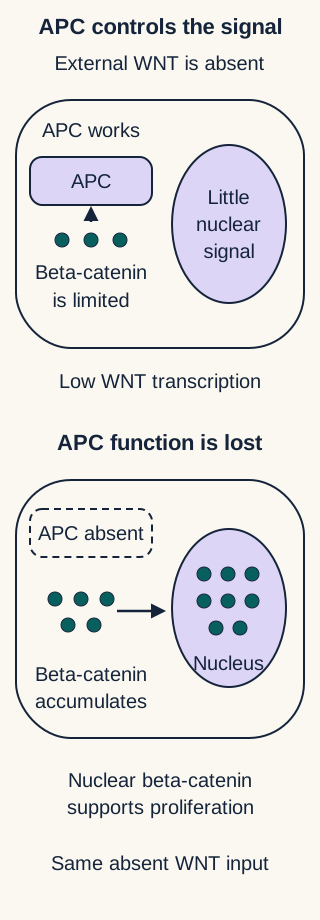
How can a conventional adenoma keep proliferating without the usual external instruction? APC participates in the complex that restrains beta-catenin when canonical WNT signaling is inactive. After loss of effective APC function, beta-catenin can accumulate and enter the nucleus, where it promotes a proliferative transcriptional program. This makes APC loss an early event in many conventional adenomas. It is not a DNA mismatch-repair defect. [1][3]
Original cell model. Dots represent beta-catenin, not measured protein counts. Compare the nuclear compartment in the two cells. Open the figure for a larger view. [1][3]
Predict before reading on: stopping extracellular WNT should have less effect when the relevant downstream restraint has already failed. In a simplified model with APC loss as the sustaining defect, restoring effective APC function would reduce nuclear beta-catenin and WNT-dependent transcription. That prediction assumes no second downstream alteration makes beta-catenin independently resistant to regulation.
As a conventional adenoma progresses, an activating KRAS alteration can sustain mitogen signaling and favor expansion. Loss of additional suppressors, including components of growth-inhibitory TGF-beta signaling such as SMAD4, can further reduce restraint. TP53 loss can impair responses to damaged DNA and is associated with later progression. APC, KRAS and TP53 describe a useful teaching sequence, not an obligatory calendar for every cancer. A single tumor's mutation list cannot prove exactly when each alteration occurred. [1][3]
Chromosomal instability, or CIN, involves ongoing errors affecting chromosome number or structure and often produces extensive copy-number gains, losses and loss of heterozygosity. Loss of heterozygosity means that a tumor no longer retains the two different alleles seen in the normal sample; it can expose a damaging allele. These chromosome-scale changes differ from the short repeat-length changes measured by MSI assays. The categories can overlap biologically, so neither assay should be treated as a universal substitute for the other. [1][3]
A copy-number profile is very abnormal but repeat lengths are stable. What is supported?
The measured abnormalities support a chromosome-scale instability pattern rather than MSI-H. They do not prove an inherited APC syndrome. Name the type of genomic change before assigning its origin.
Small transfer task: an APC-deficient adenoma also acquires an activating KRAS variant. Predict what might happen to MAPK signaling if an antibody blocks the upstream EGFR receptor. A downstream activating signal can persist even when receptor input is reduced; section 5 applies that distinction to treatment.
Repeat errors and methylation are different events
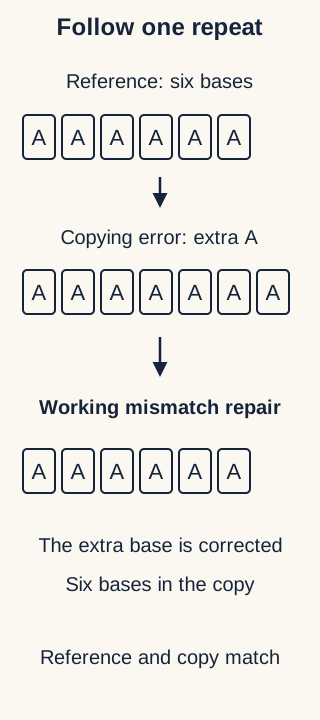
What happens to a replication error when the repair system is unavailable? Slippage within a repeated sequence can produce an insertion or deletion. With functional MMR, many such errors are corrected. Without effective repair, altered repeat lengths can persist through later cell divisions. A one-base insertion or deletion inside a protein-coding region changes the reading frame; not every microsatellite is coding, and not every repeat error creates a useful tumor antigen. [1]
Trace the repeat length before and after repair. Each tile is one base, and repeat count alone is not an MSI diagnostic cutoff. The biological event is a small insertion, not an extra chromosome. [1]
Now distinguish an epigenetic change from a sequence change. A promoter helps regulate gene expression. Promoter methylation can silence a gene without changing its coding DNA sequence. The CpG island methylator phenotype, or CIMP, describes a pattern of extensive methylation across selected CpG-rich regions. It is not another name for MSI. A CIMP-associated tumor can retain functional MMR and remain microsatellite stable if the relevant repair genes are not silenced. [4]
The serrated route often involves activating BRAF, including V600E, and a methylation-rich phenotype. If MLH1 expression is subsequently silenced, that tumor can become dMMR and MSI-H. Other serrated tumors do not take that additional step. Thus, BRAF activation, CIMP and MSI are related findings that answer different questions. BRAF activation alone is not a mismatch-repair test. [1][4]
Change one condition: silence MLH1
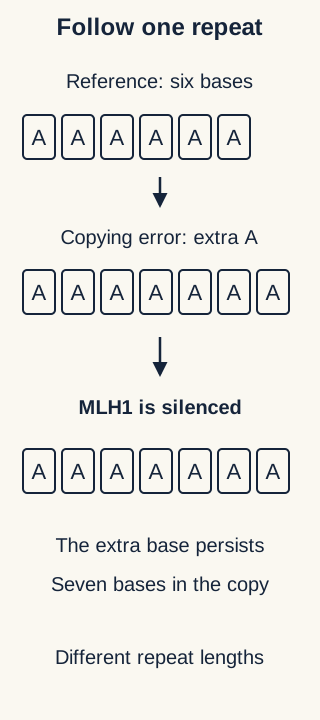
Start with the six-base reference model above. Assume the same one-base replication error occurs, but effective MLH1 expression is now lost. Predict whether correction or persistence is more likely, then open the result. This is an optional causal comparison, not a diagnostic simulator.
Show the model after MLH1 silencing
The seventh tile persists instead of being corrected. The diagram changes the repair condition while keeping the starting sequence and initial copying error the same.
Loss of effective repair permits the insertion to persist. The altered repair state changes error correction, not the chromosome count.[1]
Place that one-base insertion in a coding region. What changes next?
The reading frame shifts downstream, potentially changing the protein sequence. That provides one route to new tumor antigens; it does not guarantee immune recognition or treatment response. [1]
The complete reference remains available here: functioning repair can correct the insertion; deficient repair permits persistence; a coding insertion not divisible by three shifts the reading frame. Close the disclosures to reset the comparison. No timing, score or stored progress is required.
Transfer: a BRAF V600E-positive serrated lesion retains all four MMR proteins and has stable repeat lengths on a validated assay. Does the BRAF result make it MSI-H? No. Its measured repair phenotype is still proficient/stable; the activating driver does not substitute for the repair result.
Let tissue and location guide, not decide
Can appearance establish the molecular route? Conventional adenomas and sessile serrated lesions are different precursor patterns. Sessile serrated lesions often occur proximally and can be flat or subtle, making adequate preparation and careful mucosal inspection important. Lynch-associated cancers also commonly occur in the proximal colon. Proximal location cannot distinguish these mechanisms by itself. The endoscopic impression, histologic diagnosis and molecular results provide different evidence. [1]
Find the narrowed, irregular colon segment and compare its gross appearance with the adjacent bowel. Determine repair status and depth using molecular testing and histology, not the gross photograph. Image: Netha Hussain, 2012; source; CC BY-SA 3.0.
Point to the narrowed region, then ask what this photograph cannot show. It cannot distinguish APC loss from MLH1 silencing. It also cannot establish submucosal invasion from surface appearance alone. In colorectal pathology, extension through the muscularis mucosae into the submucosa establishes at least T1 invasion and introduces clinically important access to lymphovascular routes. Histology must assess depth and other risk features; a TP53 variant or large polyp size is not a substitute for that examination. [2]
Both samples have APC loss, but only one extends into submucosa. Which finding establishes invasion?
The demonstrated submucosal extension establishes invasive disease in that sample. APC loss can occur in a noninvasive precursor. A molecular driver explains biology; tissue depth establishes local invasion.[2]
Transfer the same logic to multiple polyps. Hundreds of conventional adenomas in a young adult suggest an adenomatous polyposis syndrome, particularly APC-associated familial adenomatous polyposis. That is different from a single proximal serrated lesion. Polyp burden directs genetic assessment but does not replace testing; attenuated APC disease and other polyposis syndromes can present with fewer polyps. [1]
Match the biomarker to the treatment setting
A biomarker can describe prognosis, predict a treatment effect, or suggest inherited risk. Those uses must not be exchanged. First identify stage, resectability, prior therapy and the patient's ability to tolerate treatment. The adjuvant examples here concern resected colon cancer; rectal cancer has additional local-treatment considerations. Molecular similarity does not erase these clinical differences. [2][9]
Resected stage II is not metastatic disease
In stage II colon cancer, dMMR/MSI-H generally indicates a more favorable prognosis, and routine fluoropyrimidine-only adjuvant treatment is not recommended. A completely resected pT3N0 tumor with adequate node assessment and no high-risk features can be observed with appropriate surveillance. T4 disease and other high-risk findings require a separate discussion. Under the ASCO stage II guideline, when high-risk dMMR disease leads to a decision to give chemotherapy, an oxaliplatin-containing regimen is recommended rather than fluoropyrimidine alone. This does not mean that dMMR makes all chemotherapy ineffective in every stage. [5]
Change only one fact: the stage II tumor is T4. What must be reconsidered?
The recurrence-risk assessment and adjuvant discussion must be reconsidered. The favorable association of dMMR does not cancel anatomic high risk. Keep prognosis and treatment context together.[5]
Advanced disease can use the repair phenotype
dMMR can generate numerous mutations, including coding frameshifts that yield new antigens. This helps explain sensitivity to immune checkpoint blockade, although no biomarker guarantees response. Pembrolizumab is an established first-line option for unresectable or metastatic MSI-H/dMMR colorectal cancer. Nivolumab with ipilimumab is another approved combination; the combination and single-agent nivolumab do not have identical prior-treatment indications. Selection still considers contraindications, comorbidity and treatment goals. [6][7]
Try separating tumor from family again: a metastatic MSI-H cancer caused by acquired MLH1 methylation can still be considered for the relevant checkpoint treatment. Germline Lynch syndrome is not required for that indication. Conversely, a person with a hereditary predisposition does not receive metastatic treatment merely because the inherited variant is present. [6]
Locate a drug target relative to the active signal
For conventional EGFR-antibody selection, activating KRAS or NRAS predicts lack of benefit from blocking EGFR alone or adding the antibody to an otherwise conventional chemotherapy regimen. Signaling can continue downstream of the blocked receptor. RAS wild-type status permits consideration, not a promise of response; primary side and other tumor features matter. There is a specific modern exception: a KRAS G12C inhibitor can be combined with an EGFR antibody. Sotorasib plus panitumumab is approved after prior fluoropyrimidine-, oxaliplatin- and irinotecan-based chemotherapy in the specified metastatic population. This is combined pathway targeting, not evidence that a KRAS-mutant cancer becomes sensitive to EGFR antibody alone. [9][10]
BRAF V600E requires another distinction. Experimental studies showed that BRAF inhibition in colorectal cancer can trigger EGFR feedback, helping sustain signaling. That supports combined targeting rather than importing single-drug expectations from another cancer type. In February 2026, the FDA granted traditional approval to encorafenib with cetuximab and fluorouracil-based chemotherapy for adult metastatic BRAF V600E colorectal cancer. A treatment plan must use the indicated combination and setting, not encorafenib alone on the basis of a mutation label. [12][8]
A planned reduction in intensity is not progression
Induction describes the initial treatment period aimed at disease control. Maintenance is a planned less-intensive approach after control, often reducing cumulative toxicity. For example, CAIRO3 studied capecitabine plus bevacizumab after disease was stable or better on induction CAPOX plus bevacizumab. New lesions on imaging would instead require reassessment for progression. This example does not mandate one maintenance regimen for every molecular subtype. [11]
Transfer task: compare a patient whose metastases remain smaller but neuropathy is accumulating with one whose scan shows new metastases. Explain why reducing oxaliplatin exposure after control and selecting treatment after progression are different decisions, even when the original mutation report is unchanged.
Return from the tumor to the family
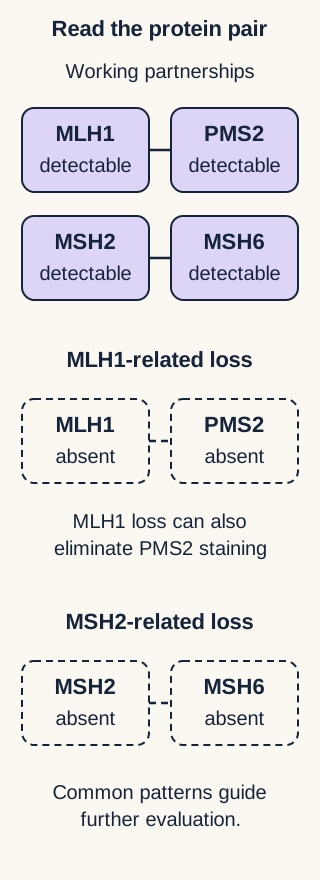
Which absent protein pattern points to which workup? MLH1 and PMS2 operate as a pair, as do MSH2 and MSH6. Loss of MLH1 commonly also eliminates detectable PMS2, and loss of MSH2 commonly also eliminates MSH6. Isolated PMS2 or isolated MSH6 loss directs attention differently. These patterns guide investigation; they are not perfectly specific genetic diagnoses. In particular, isolated PMS2 loss can sometimes arise from an MLH1 abnormality. [1]
Original partnership model, not an IHC slide. Dashed outlines and the word absent identify loss without depending on color. The model shows common patterns, not an infallible gene lookup. [1]
With MLH1/PMS2 loss, tumor MLH1 promoter-methylation testing and, in colorectal cancer, BRAF V600E testing help evaluate a sporadic origin. BRAF V600E together with tumor MLH1 methylation strongly supports that explanation. A negative BRAF result does not establish Lynch syndrome: some sporadic methylated tumors lack BRAF V600E. Rare constitutional MLH1 epimutations and unusual hereditary presentations also mean that a young age or concerning personal or family history deserves specialist assessment despite apparently sporadic tumor findings. [1]
MSH2/MSH6 loss instead directs attention to MSH2 and EPCAM-related mechanisms rather than the usual MLH1 methylation branch. Certain EPCAM deletions can cause silencing of nearby MSH2. Isolated MSH6 or PMS2 loss prompts the appropriate germline evaluation after technical and clinical review. Unexplained dMMR with unrevealing germline testing can result from two somatic inactivating events; paired tumor and normal analysis can help distinguish this from an inherited cause. A variant of uncertain significance is not equivalent to a pathogenic germline result. [1]
Lynch predisposition is usually autosomal dominant, involving a pathogenic germline MMR variant or the relevant EPCAM deletion. A later tumor-specific event can disable the remaining functional repair copy. The predisposition can therefore be dominant in a family while the individual tumor cell requires loss of effective repair. Colorectal and endometrial cancers are important manifestations, with other organ risks varying by gene. Confirmed inherited risk leads to gene-appropriate surveillance, counseling and targeted testing of relatives. [1]
A blood sample and a tumor both contain a pathogenic MSH2 variant. What additional observation explains tumor-specific repair loss?
A second inactivating event affecting the remaining functional copy in the tumor explains why that tumor loses effective repair. The constitutional variant identifies susceptibility; the second event explains the local phenotype. Family inheritance and cell-level inactivation are different levels of explanation.[1]
APC-associated familial adenomatous polyposis is also usually autosomal dominant but produces a different precursor burden: numerous conventional adenomas, often beginning early in life. Untreated classic disease carries a very high colorectal cancer risk, approaching certainty, so specialist prevention can include prophylactic surgery as well as surveillance. Preserved MMR staining does not dismiss this syndrome or other inherited risks. A striking pedigree or polyposis phenotype still warrants evaluation. [1]
Final transfer: tumor phenotype guides tumor questions; germline evidence guides family questions; stage and treatment history determine how a biomarker is used. A useful report interpretation states all three rather than replacing them with one pathway name.
Apply the lesson
Case 1
Show answer and explanations for case 1
A. More nuclear beta-catenin and higher WNT-target transcription (Why this does not fit)
Persistent WNT activation promotes beta-catenin accumulation. Functional APC was restored rather than disabled. Restoring a restraining mechanism should reduce its downstream signal.
Reasoning steps for option A
For crc-path-01, why could the option 'More nuclear beta-catenin and higher WNT-target transcription' seem plausible before using the case-specific discriminator?
In crc-path-01, which supplied finding argues against 'More nuclear beta-catenin and higher WNT-target transcription' as the best answer?
Functional APC was restored rather than disabled.
After evaluating 'More nuclear beta-catenin and higher WNT-target transcription' in crc-path-01, what specific reasoning rule should transfer to a similar colorectal case?
Restoring a restraining mechanism should reduce its downstream signal.
B. Less nuclear beta-catenin and lower WNT-target gene transcription (Best answer)
APC loss sustained beta-catenin activity downstream of extracellular WNT. It restores regulation of beta-catenin availability. Nuclear beta-catenin and its target transcription should decrease. A downstream defect can sustain signaling after the external input ends.
Reasoning steps for option B
Why did WNT withdrawal fail initially?
APC loss sustained beta-catenin activity downstream of extracellular WNT.
What does functional APC restore?
It restores regulation of beta-catenin availability.
Which nuclear response follows in this model?
Nuclear beta-catenin and its target transcription should decrease.
After resolving crc-path-01 with 'Less nuclear beta-catenin and lower WNT-target gene transcription', what case-specific lesson should carry forward?
A downstream defect can sustain signaling after the external input ends.
C. Less nuclear beta-catenin and higher WNT-target transcription (Why this does not fit)
Beta-catenin abundance and transcription are distinct measurements. In this model, beta-catenin drives the WNT transcriptional program. Predict the downstream response from the direction of the regulator change.
Reasoning steps for option C
For crc-path-01, why could the option 'Less nuclear beta-catenin and higher WNT-target transcription' seem plausible before using the case-specific discriminator?
Beta-catenin abundance and transcription are distinct measurements.
In crc-path-01, which supplied finding argues against 'Less nuclear beta-catenin and higher WNT-target transcription' as the best answer?
In this model, beta-catenin drives the WNT transcriptional program.
After evaluating 'Less nuclear beta-catenin and higher WNT-target transcription' in crc-path-01, what specific reasoning rule should transfer to a similar colorectal case?
Predict the downstream response from the direction of the regulator change.
D. More nuclear beta-catenin and lower WNT-target transcription (Why this does not fit)
Another transcriptional inhibitor could reduce gene expression despite abundant beta-catenin. No such inhibitor is introduced; the intervention restores APC. Use the actual perturbation rather than an unstated mechanism.
Reasoning steps for option D
For crc-path-01, why could the option 'More nuclear beta-catenin and lower WNT-target transcription' seem plausible before using the case-specific discriminator?
Another transcriptional inhibitor could reduce gene expression despite abundant beta-catenin.
In crc-path-01, which supplied finding argues against 'More nuclear beta-catenin and lower WNT-target transcription' as the best answer?
No such inhibitor is introduced; the intervention restores APC.
After evaluating 'More nuclear beta-catenin and lower WNT-target transcription' in crc-path-01, what specific reasoning rule should transfer to a similar colorectal case?
Use the actual perturbation rather than an unstated mechanism.
Takeaway: A downstream defect can sustain signaling after the external input ends.
A. Biallelic MLH1 inactivation (Why this does not fit)
MLH1 loss can accelerate accumulation of replication errors. The measured phenotype is proficient repair with persistent MAPK output despite receptor blockade. Distinguish failed repair from constitutive mitogen signaling.
Reasoning steps for option A
For crc-path-02, why could the option 'Biallelic MLH1 inactivation' seem plausible before using the case-specific discriminator?
MLH1 loss can accelerate accumulation of replication errors.
In crc-path-02, which supplied finding argues against 'Biallelic MLH1 inactivation' as the best answer?
The measured phenotype is proficient repair with persistent MAPK output despite receptor blockade.
After evaluating 'Biallelic MLH1 inactivation' in crc-path-02, what specific reasoning rule should transfer to a similar colorectal case?
Distinguish failed repair from constitutive mitogen signaling.
B. Loss of functional APC (Why this does not fit)
APC loss can sustain beta-catenin-dependent transcription. The intervention and readout localize this problem to EGFR-to-ERK signaling. Match the candidate driver to the measured signaling route.
Reasoning steps for option B
For crc-path-02, why could the option 'Loss of functional APC' seem plausible before using the case-specific discriminator?
APC loss can sustain beta-catenin-dependent transcription.
In crc-path-02, which supplied finding argues against 'Loss of functional APC' as the best answer?
The intervention and readout localize this problem to EGFR-to-ERK signaling.
After evaluating 'Loss of functional APC' in crc-path-02, what specific reasoning rule should transfer to a similar colorectal case?
Match the candidate driver to the measured signaling route.
C. Loss of functional TP53 (Why this does not fit)
TP53 loss can impair damage-induced growth arrest. It does not directly explain receptor-independent activation of the measured MAPK pathway. Checkpoint failure and persistent kinase signaling are different defects.
Reasoning steps for option C
For crc-path-02, why could the option 'Loss of functional TP53' seem plausible before using the case-specific discriminator?
TP53 loss can impair damage-induced growth arrest.
In crc-path-02, which supplied finding argues against 'Loss of functional TP53' as the best answer?
It does not directly explain receptor-independent activation of the measured MAPK pathway.
After evaluating 'Loss of functional TP53' in crc-path-02, what specific reasoning rule should transfer to a similar colorectal case?
Checkpoint failure and persistent kinase signaling are different defects.
D. An activating KRAS variant (Best answer)
Reduced EGFR phosphorylation supports an effect on the receptor. An activating downstream KRAS alteration can maintain MAPK output. They do not support an MMR defect as the measured explanation. Receptor inhibition can leave an activating downstream signal intact.
Reasoning steps for option D
Did the antibody engage the receptor?
Reduced EGFR phosphorylation supports an effect on the receptor.
Where can the sustained signal arise?
An activating downstream KRAS alteration can maintain MAPK output.
Why are the repair results relevant?
They do not support an MMR defect as the measured explanation.
After resolving crc-path-02 with 'An activating KRAS variant', what case-specific lesson should carry forward?
Receptor inhibition can leave an activating downstream signal intact.
E. Biallelic SMAD4 inactivation (Why this does not fit)
SMAD4 loss impairs a growth-inhibitory signaling pathway. The demonstrated output is persistent ERK phosphorylation after EGFR inhibition. A cancer driver must explain the specific experimental readout.
Reasoning steps for option E
For crc-path-02, why could the option 'Biallelic SMAD4 inactivation' seem plausible before using the case-specific discriminator?
SMAD4 loss impairs a growth-inhibitory signaling pathway.
In crc-path-02, which supplied finding argues against 'Biallelic SMAD4 inactivation' as the best answer?
The demonstrated output is persistent ERK phosphorylation after EGFR inhibition.
After evaluating 'Biallelic SMAD4 inactivation' in crc-path-02, what specific reasoning rule should transfer to a similar colorectal case?
A cancer driver must explain the specific experimental readout.
Takeaway: Receptor inhibition can leave an activating downstream signal intact.
A. Chromosome-scale instability during conventional adenoma progression (Best answer)
Whole chromosome-arm copy numbers are altered. The repeat-length assay is microsatellite stable. A conventional adenoma-associated CIN pattern accommodates APC loss and later additional alterations. A mutation inventory supports a model but does not prove an obligatory temporal order.
Reasoning steps for option A
What genomic scale is abnormal?
Whole chromosome-arm copy numbers are altered.
Which assay argues against the proposed MSI-high alternatives?
The repeat-length assay is microsatellite stable.
Which precursor model accommodates this combination?
A conventional adenoma-associated CIN pattern accommodates APC loss and later additional alterations.
After resolving crc-path-03 with 'Chromosome-scale instability during conventional adenoma progression', what case-specific lesson should carry forward?
A mutation inventory supports a model but does not prove an obligatory temporal order.
B. Inherited mismatch-repair deficiency during Lynch-associated progression (Why this does not fit)
Lynch tumors often accumulate repeat-length errors after repair loss. The dominant measured changes are chromosome-arm alterations with stable microsatellites. Choose the instability category from the assay results, not cancer alone.
Reasoning steps for option B
For crc-path-03, why could the option 'Inherited mismatch-repair deficiency during Lynch-associated progression' seem plausible before using the case-specific discriminator?
Lynch tumors often accumulate repeat-length errors after repair loss.
In crc-path-03, which supplied finding argues against 'Inherited mismatch-repair deficiency during Lynch-associated progression' as the best answer?
The dominant measured changes are chromosome-arm alterations with stable microsatellites.
After evaluating 'Inherited mismatch-repair deficiency during Lynch-associated progression' in crc-path-03, what specific reasoning rule should transfer to a similar colorectal case?
Choose the instability category from the assay results, not cancer alone.
C. MLH1 promoter silencing during a sporadic MSI-high pathway (Why this does not fit)
Acquired MLH1 silencing can produce MSI-H colorectal carcinoma. The supplied repeat assay is stable and the precursor is conventional. Do not substitute a familiar methylation pathway for contrary molecular data.
Reasoning steps for option C
For crc-path-03, why could the option 'MLH1 promoter silencing during a sporadic MSI-high pathway' seem plausible before using the case-specific discriminator?
Acquired MLH1 silencing can produce MSI-H colorectal carcinoma.
In crc-path-03, which supplied finding argues against 'MLH1 promoter silencing during a sporadic MSI-high pathway' as the best answer?
The supplied repeat assay is stable and the precursor is conventional.
After evaluating 'MLH1 promoter silencing during a sporadic MSI-high pathway' in crc-path-03, what specific reasoning rule should transfer to a similar colorectal case?
Do not substitute a familiar methylation pathway for contrary molecular data.
D. Constitutional EPCAM deletion with secondary MSH2 silencing (Why this does not fit)
EPCAM-associated susceptibility can lead to MSH2-deficient tumors. Neither the repair phenotype nor germline evidence supporting that mechanism is supplied. A chromosome alteration in a tumor does not establish a constitutional deletion.
Reasoning steps for option D
For crc-path-03, why could the option 'Constitutional EPCAM deletion with secondary MSH2 silencing' seem plausible before using the case-specific discriminator?
EPCAM-associated susceptibility can lead to MSH2-deficient tumors.
In crc-path-03, which supplied finding argues against 'Constitutional EPCAM deletion with secondary MSH2 silencing' as the best answer?
Neither the repair phenotype nor germline evidence supporting that mechanism is supplied.
After evaluating 'Constitutional EPCAM deletion with secondary MSH2 silencing' in crc-path-03, what specific reasoning rule should transfer to a similar colorectal case?
A chromosome alteration in a tumor does not establish a constitutional deletion.
Takeaway: A mutation inventory supports a model but does not prove an obligatory temporal order.
A. Reduced correction of short-repeat replication errors (Why this does not fit)
Mismatch repair corrects small replication errors. The distinguishing alteration is TP53 loss rather than a change in MMR. Separate DNA-damage responses from mismatch repair.
Reasoning steps for option A
For crc-path-04, why could the option 'Reduced correction of short-repeat replication errors' seem plausible before using the case-specific discriminator?
Mismatch repair corrects small replication errors.
In crc-path-04, which supplied finding argues against 'Reduced correction of short-repeat replication errors' as the best answer?
The distinguishing alteration is TP53 loss rather than a change in MMR.
After evaluating 'Reduced correction of short-repeat replication errors' in crc-path-04, what specific reasoning rule should transfer to a similar colorectal case?
Separate DNA-damage responses from mismatch repair.
B. Increased destruction of nuclear beta-catenin (Why this does not fit)
APC-dependent regulation can restrain beta-catenin. Both cultures share APC loss, whereas the response differs after TP53 inactivation. Use the variable that differs between the compared samples.
Reasoning steps for option B
For crc-path-04, why could the option 'Increased destruction of nuclear beta-catenin' seem plausible before using the case-specific discriminator?
APC-dependent regulation can restrain beta-catenin.
In crc-path-04, which supplied finding argues against 'Increased destruction of nuclear beta-catenin' as the best answer?
Both cultures share APC loss, whereas the response differs after TP53 inactivation.
After evaluating 'Increased destruction of nuclear beta-catenin' in crc-path-04, what specific reasoning rule should transfer to a similar colorectal case?
Use the variable that differs between the compared samples.
C. Reduced damage-triggered cell-cycle arrest and apoptosis (Best answer)
The second culture lacks remaining functional TP53. It failed to arrest or eliminate severely damaged cells after injury. A tumor can lose damage checkpoints without becoming mismatch-repair deficient.
Reasoning steps for option C
Which finding distinguishes the two cultures?
The second culture lacks remaining functional TP53.
Which response did that culture lose?
It failed to arrest or eliminate severely damaged cells after injury.
After resolving crc-path-04 with 'Reduced damage-triggered cell-cycle arrest and apoptosis', what case-specific lesson should carry forward?
A tumor can lose damage checkpoints without becoming mismatch-repair deficient.
D. Increased dependence on extracellular EGFR ligands (Why this does not fit)
EGFR ligand dependence can alter proliferation. The experiment distinguishes a response to DNA damage, not receptor stimulation. Connect the measured response to the altered protective function.
Reasoning steps for option D
For crc-path-04, why could the option 'Increased dependence on extracellular EGFR ligands' seem plausible before using the case-specific discriminator?
EGFR ligand dependence can alter proliferation.
In crc-path-04, which supplied finding argues against 'Increased dependence on extracellular EGFR ligands' as the best answer?
The experiment distinguishes a response to DNA damage, not receptor stimulation.
After evaluating 'Increased dependence on extracellular EGFR ligands' in crc-path-04, what specific reasoning rule should transfer to a similar colorectal case?
Connect the measured response to the altered protective function.
Takeaway: A tumor can lose damage checkpoints without becoming mismatch-repair deficient.
A. Inherited APC-associated cancer predisposition (Why this does not fit)
A constitutional APC alteration can predispose to multiple adenomas. Depth of invasion does not determine whether the shared variant is germline. Use a constitutional sample to address inherited origin.
Reasoning steps for option A
For crc-path-05, why could the option 'Inherited APC-associated cancer predisposition' seem plausible before using the case-specific discriminator?
A constitutional APC alteration can predispose to multiple adenomas.
In crc-path-05, which supplied finding argues against 'Inherited APC-associated cancer predisposition' as the best answer?
Depth of invasion does not determine whether the shared variant is germline.
After evaluating 'Inherited APC-associated cancer predisposition' in crc-path-05, what specific reasoning rule should transfer to a similar colorectal case?
Use a constitutional sample to address inherited origin.
B. Deficient mismatch-repair function (Why this does not fit)
dMMR can influence prognosis and therapy. Both tumors retain MMR staining, and anatomic extension does not measure repair. Do not infer a biomarker from invasion depth.
Reasoning steps for option B
For crc-path-05, why could the option 'Deficient mismatch-repair function' seem plausible before using the case-specific discriminator?
dMMR can influence prognosis and therapy.
In crc-path-05, which supplied finding argues against 'Deficient mismatch-repair function' as the best answer?
Both tumors retain MMR staining, and anatomic extension does not measure repair.
After evaluating 'Deficient mismatch-repair function' in crc-path-05, what specific reasoning rule should transfer to a similar colorectal case?
Do not infer a biomarker from invasion depth.
C. An activating BRAF alteration (Why this does not fit)
BRAF activation occurs in a subset of colorectal tumors. No BRAF result is supplied, and submucosal extension is not genotype-specific. Histologic depth and driver identity answer separate questions.
Reasoning steps for option C
For crc-path-05, why could the option 'An activating BRAF alteration' seem plausible before using the case-specific discriminator?
BRAF activation occurs in a subset of colorectal tumors.
In crc-path-05, which supplied finding argues against 'An activating BRAF alteration' as the best answer?
No BRAF result is supplied, and submucosal extension is not genotype-specific.
After evaluating 'An activating BRAF alteration' in crc-path-05, what specific reasoning rule should transfer to a similar colorectal case?
Histologic depth and driver identity answer separate questions.
D. Established distant hematogenous metastasis (Why this does not fit)
Invasive cancers can disseminate through blood vessels. Submucosal invasion establishes local invasion, not the presence of distant deposits. Risk of spread is not evidence that distant spread has occurred.
Reasoning steps for option D
For crc-path-05, why could the option 'Established distant hematogenous metastasis' seem plausible before using the case-specific discriminator?
Invasive cancers can disseminate through blood vessels.
In crc-path-05, which supplied finding argues against 'Established distant hematogenous metastasis' as the best answer?
Submucosal invasion establishes local invasion, not the presence of distant deposits.
After evaluating 'Established distant hematogenous metastasis' in crc-path-05, what specific reasoning rule should transfer to a similar colorectal case?
Risk of spread is not evidence that distant spread has occurred.
E. Access to submucosal lymphovascular routes (Best answer)
Only specimen B extends through muscularis mucosae into submucosa. Submucosal extension brings access to lymphovascular routes relevant to metastatic risk. Depth establishes invasion; a shared molecular driver does not.
Reasoning steps for option E
Which boundary differs between the specimens?
Only specimen B extends through muscularis mucosae into submucosa.
What clinically important access follows?
Submucosal extension brings access to lymphovascular routes relevant to metastatic risk.
After resolving crc-path-05 with 'Access to submucosal lymphovascular routes', what case-specific lesson should carry forward?
Depth establishes invasion; a shared molecular driver does not.
Takeaway: Depth establishes invasion; a shared molecular driver does not.
A. Accumulation of whole-chromosome segregation errors (Why this does not fit)
Chromosome-segregation errors can generate aneuploid tumors. The abnormal assay measures short repeat lengths rather than chromosome dosage. Match the scale of genomic change to the assay.
Reasoning steps for option A
For crc-path-06, why could the option 'Accumulation of whole-chromosome segregation errors' seem plausible before using the case-specific discriminator?
Chromosome-segregation errors can generate aneuploid tumors.
In crc-path-06, which supplied finding argues against 'Accumulation of whole-chromosome segregation errors' as the best answer?
The abnormal assay measures short repeat lengths rather than chromosome dosage.
After evaluating 'Accumulation of whole-chromosome segregation errors' in crc-path-06, what specific reasoning rule should transfer to a similar colorectal case?
Match the scale of genomic change to the assay.
B. Expansion of telomeric repeats through telomerase activation (Why this does not fit)
Telomere maintenance can support prolonged tumor-cell survival. The reported loci are microsatellite markers with new allele lengths after repair loss. Telomere maintenance is distinct from microsatellite instability.
Reasoning steps for option B
For crc-path-06, why could the option 'Expansion of telomeric repeats through telomerase activation' seem plausible before using the case-specific discriminator?
Telomere maintenance can support prolonged tumor-cell survival.
In crc-path-06, which supplied finding argues against 'Expansion of telomeric repeats through telomerase activation' as the best answer?
The reported loci are microsatellite markers with new allele lengths after repair loss.
After evaluating 'Expansion of telomeric repeats through telomerase activation' in crc-path-06, what specific reasoning rule should transfer to a similar colorectal case?
Telomere maintenance is distinct from microsatellite instability.
C. Accumulation of short-repeat insertion and deletion errors (Best answer)
The tumor lacks detectable components of a repair-protein pair. Repeat lengths differ between tumor and normal tissue. Uncorrected insertion or deletion errors can accumulate within repeats after repair failure. Microsatellite instability is a repeat-length phenotype, not another term for aneuploidy.
Reasoning steps for option C
What do the valid IHC results indicate?
The tumor lacks detectable components of a repair-protein pair.
What does the paired DNA assay measure?
Repeat lengths differ between tumor and normal tissue.
Which event connects those findings?
Uncorrected insertion or deletion errors can accumulate within repeats after repair failure.
After resolving crc-path-06 with 'Accumulation of short-repeat insertion and deletion errors', what case-specific lesson should carry forward?
Microsatellite instability is a repeat-length phenotype, not another term for aneuploidy.
D. Amplification of growth-receptor gene copies (Why this does not fit)
Gene amplification can increase growth signaling. The described copy-number profile is relatively preserved while repeat lengths differ. A sequence-length result should not be recast as gene amplification.
Reasoning steps for option D
For crc-path-06, why could the option 'Amplification of growth-receptor gene copies' seem plausible before using the case-specific discriminator?
Gene amplification can increase growth signaling.
In crc-path-06, which supplied finding argues against 'Amplification of growth-receptor gene copies' as the best answer?
The described copy-number profile is relatively preserved while repeat lengths differ.
After evaluating 'Amplification of growth-receptor gene copies' in crc-path-06, what specific reasoning rule should transfer to a similar colorectal case?
A sequence-length result should not be recast as gene amplification.
Takeaway: Microsatellite instability is a repeat-length phenotype, not another term for aneuploidy.
No; its repeat assay was stable and repair proteins were retained. MLH1 promoter silencing can reduce effective MMR. Persistent repeat errors can produce an MSI-H phenotype. A serrated tumor can acquire repair deficiency later; BRAF and CIMP do not make MSI inevitable.
Reasoning steps for option A
Was the original lesion demonstrated to be MSI-H?
No; its repeat assay was stable and repair proteins were retained.
Which later event can disable its repair?
MLH1 promoter silencing can reduce effective MMR.
What DNA consequence can follow?
Persistent repeat errors can produce an MSI-H phenotype.
After resolving crc-path-07 with 'Silencing of the MLH1 promoter', what case-specific lesson should carry forward?
A serrated tumor can acquire repair deficiency later; BRAF and CIMP do not make MSI inevitable.
B. Deletion of the remaining TP53 allele (Why this does not fit)
TP53 loss can impair responses to damaged DNA. It does not directly disable the mismatch-repair apparatus. Checkpoint failure does not by itself establish MSI-H.
Reasoning steps for option B
For crc-path-07, why could the option 'Deletion of the remaining TP53 allele' seem plausible before using the case-specific discriminator?
TP53 loss can impair responses to damaged DNA.
In crc-path-07, which supplied finding argues against 'Deletion of the remaining TP53 allele' as the best answer?
It does not directly disable the mismatch-repair apparatus.
After evaluating 'Deletion of the remaining TP53 allele' in crc-path-07, what specific reasoning rule should transfer to a similar colorectal case?
Checkpoint failure does not by itself establish MSI-H.
C. Inactivation of both APC alleles (Why this does not fit)
APC loss can promote a proliferative WNT program. This affects growth restraint rather than the repair function that changed. Separate an initiating growth defect from a new repair defect.
Reasoning steps for option C
For crc-path-07, why could the option 'Inactivation of both APC alleles' seem plausible before using the case-specific discriminator?
APC loss can promote a proliferative WNT program.
In crc-path-07, which supplied finding argues against 'Inactivation of both APC alleles' as the best answer?
This affects growth restraint rather than the repair function that changed.
After evaluating 'Inactivation of both APC alleles' in crc-path-07, what specific reasoning rule should transfer to a similar colorectal case?
Separate an initiating growth defect from a new repair defect.
D. Activation of a KRAS allele (Why this does not fit)
KRAS activation can sustain MAPK signaling. Persistent mitogen signaling does not directly explain the new repeat-length phenotype. The altered assay result identifies the function that needs explaining.
Reasoning steps for option D
For crc-path-07, why could the option 'Activation of a KRAS allele' seem plausible before using the case-specific discriminator?
KRAS activation can sustain MAPK signaling.
In crc-path-07, which supplied finding argues against 'Activation of a KRAS allele' as the best answer?
Persistent mitogen signaling does not directly explain the new repeat-length phenotype.
After evaluating 'Activation of a KRAS allele' in crc-path-07, what specific reasoning rule should transfer to a similar colorectal case?
The altered assay result identifies the function that needs explaining.
E. Inactivation of both SMAD4 alleles (Why this does not fit)
SMAD4 loss can reduce growth-inhibitory signaling. It does not specifically account for acquisition of deficient mismatch repair. Different tumor suppressors protect different cellular functions.
Reasoning steps for option E
For crc-path-07, why could the option 'Inactivation of both SMAD4 alleles' seem plausible before using the case-specific discriminator?
SMAD4 loss can reduce growth-inhibitory signaling.
In crc-path-07, which supplied finding argues against 'Inactivation of both SMAD4 alleles' as the best answer?
It does not specifically account for acquisition of deficient mismatch repair.
After evaluating 'Inactivation of both SMAD4 alleles' in crc-path-07, what specific reasoning rule should transfer to a similar colorectal case?
Different tumor suppressors protect different cellular functions.
Takeaway: A serrated tumor can acquire repair deficiency later; BRAF and CIMP do not make MSI inevitable.
A. A frameshift within the MLH1 coding region (Why this does not fit)
A coding frameshift can disrupt a repair protein. The coding sequence is intact, and expression changes after promoter demethylation. Promoter regulation can suppress expression without changing coding sequence.
Reasoning steps for option A
For crc-path-08, why could the option 'A frameshift within the MLH1 coding region' seem plausible before using the case-specific discriminator?
A coding frameshift can disrupt a repair protein.
In crc-path-08, which supplied finding argues against 'A frameshift within the MLH1 coding region' as the best answer?
The coding sequence is intact, and expression changes after promoter demethylation.
After evaluating 'A frameshift within the MLH1 coding region' in crc-path-08, what specific reasoning rule should transfer to a similar colorectal case?
Promoter regulation can suppress expression without changing coding sequence.
B. Deletion of the remaining MLH1 gene copy (Why this does not fit)
Allelic deletion can eliminate tumor-suppressor function. The supplied sequence and reversible transcriptional result support promoter regulation. Distinguish loss of a gene from loss of its expression.
Reasoning steps for option B
For crc-path-08, why could the option 'Deletion of the remaining MLH1 gene copy' seem plausible before using the case-specific discriminator?
Allelic deletion can eliminate tumor-suppressor function.
In crc-path-08, which supplied finding argues against 'Deletion of the remaining MLH1 gene copy' as the best answer?
The supplied sequence and reversible transcriptional result support promoter regulation.
After evaluating 'Deletion of the remaining MLH1 gene copy' in crc-path-08, what specific reasoning rule should transfer to a similar colorectal case?
Distinguish loss of a gene from loss of its expression.
C. A missense alteration that disables MLH1 catalysis (Why this does not fit)
An altered but present protein can be nonfunctional. The central findings are scarce transcript and recovery after changing promoter methylation. Use transcript and regulatory data to distinguish expression from protein-function defects.
Reasoning steps for option C
For crc-path-08, why could the option 'A missense alteration that disables MLH1 catalysis' seem plausible before using the case-specific discriminator?
An altered but present protein can be nonfunctional.
In crc-path-08, which supplied finding argues against 'A missense alteration that disables MLH1 catalysis' as the best answer?
The central findings are scarce transcript and recovery after changing promoter methylation.
After evaluating 'A missense alteration that disables MLH1 catalysis' in crc-path-08, what specific reasoning rule should transfer to a similar colorectal case?
Use transcript and regulatory data to distinguish expression from protein-function defects.
D. Epigenetic repression of MLH1 transcription (Best answer)
No; the supplied coding sequence remains intact. Reducing promoter methylation restores the transcript. Reversible epigenetic transcriptional repression fits the promoter and transcript findings. Gene silencing can change repair function without a new coding mutation.
Reasoning steps for option D
Is a coding alteration required by these data?
No; the supplied coding sequence remains intact.
Which intervention changes expression?
Reducing promoter methylation restores the transcript.
Which mechanism fits both observations?
Reversible epigenetic transcriptional repression fits the promoter and transcript findings.
After resolving crc-path-08 with 'Epigenetic repression of MLH1 transcription', what case-specific lesson should carry forward?
Gene silencing can change repair function without a new coding mutation.
E. Amplification of the MLH1 gene locus (Why this does not fit)
Copy-number alterations are frequent in some cancers. Increased gene dosage does not explain the promoter-linked repression and restoration observed here. A regulatory experiment can distinguish methylation effects from dosage changes.
Reasoning steps for option E
For crc-path-08, why could the option 'Amplification of the MLH1 gene locus' seem plausible before using the case-specific discriminator?
Copy-number alterations are frequent in some cancers.
In crc-path-08, which supplied finding argues against 'Amplification of the MLH1 gene locus' as the best answer?
Increased gene dosage does not explain the promoter-linked repression and restoration observed here.
After evaluating 'Amplification of the MLH1 gene locus' in crc-path-08, what specific reasoning rule should transfer to a similar colorectal case?
A regulatory experiment can distinguish methylation effects from dosage changes.
Takeaway: Gene silencing can change repair function without a new coding mutation.
A. A constitutional MLH1 coding defect with a second tumor event (Why this does not fit)
An inherited MLH1 defect can produce the same repair-protein loss. BRAF V600E with tumor MLH1 methylation strongly favors acquired silencing in this setting. A repair phenotype can have a sporadic or inherited origin.
Reasoning steps for option A
For crc-path-09, why could the option 'A constitutional MLH1 coding defect with a second tumor event' seem plausible before using the case-specific discriminator?
An inherited MLH1 defect can produce the same repair-protein loss.
In crc-path-09, which supplied finding argues against 'A constitutional MLH1 coding defect with a second tumor event' as the best answer?
BRAF V600E with tumor MLH1 methylation strongly favors acquired silencing in this setting.
After evaluating 'A constitutional MLH1 coding defect with a second tumor event' in crc-path-09, what specific reasoning rule should transfer to a similar colorectal case?
A repair phenotype can have a sporadic or inherited origin.
B. Acquired MLH1 silencing in a serrated-pathway tumor (Best answer)
MLH1 dysfunction commonly leads to loss of both MLH1 and PMS2. BRAF V600E and MLH1 promoter methylation favor acquired MLH1 silencing. This is the best-supported origin, not an absolute exclusion of every rare constitutional mechanism. Sporadic MLH1 silencing can produce the same MSI-H phenotype as an inherited MMR defect.
Reasoning steps for option B
Which repair component is implicated by the absent pair?
MLH1 dysfunction commonly leads to loss of both MLH1 and PMS2.
Which tumor findings identify a likely cause?
BRAF V600E and MLH1 promoter methylation favor acquired MLH1 silencing.
What level of certainty is justified?
This is the best-supported origin, not an absolute exclusion of every rare constitutional mechanism.
After resolving crc-path-09 with 'Acquired MLH1 silencing in a serrated-pathway tumor', what case-specific lesson should carry forward?
Sporadic MLH1 silencing can produce the same MSI-H phenotype as an inherited MMR defect.
C. A constitutional EPCAM deletion with adjacent MSH2 silencing (Why this does not fit)
Some EPCAM deletions predispose to MSH2-deficient tumors. The absent pair is MLH1/PMS2 rather than MSH2/MSH6. Use the affected pair when choosing the relevant inherited mechanism.
Reasoning steps for option C
For crc-path-09, why could the option 'A constitutional EPCAM deletion with adjacent MSH2 silencing' seem plausible before using the case-specific discriminator?
Some EPCAM deletions predispose to MSH2-deficient tumors.
In crc-path-09, which supplied finding argues against 'A constitutional EPCAM deletion with adjacent MSH2 silencing' as the best answer?
The absent pair is MLH1/PMS2 rather than MSH2/MSH6.
After evaluating 'A constitutional EPCAM deletion with adjacent MSH2 silencing' in crc-path-09, what specific reasoning rule should transfer to a similar colorectal case?
Use the affected pair when choosing the relevant inherited mechanism.
D. A constitutional APC defect with conventional adenoma progression (Why this does not fit)
APC predisposition can lead to colorectal carcinoma. The serrated precursor and methylation-associated repair loss fit a different molecular explanation. Do not infer APC-associated polyposis from carcinoma alone.
Reasoning steps for option D
For crc-path-09, why could the option 'A constitutional APC defect with conventional adenoma progression' seem plausible before using the case-specific discriminator?
APC predisposition can lead to colorectal carcinoma.
In crc-path-09, which supplied finding argues against 'A constitutional APC defect with conventional adenoma progression' as the best answer?
The serrated precursor and methylation-associated repair loss fit a different molecular explanation.
After evaluating 'A constitutional APC defect with conventional adenoma progression' in crc-path-09, what specific reasoning rule should transfer to a similar colorectal case?
Do not infer APC-associated polyposis from carcinoma alone.
E. Biallelic constitutional MUTYH defects with base-excision failure (Why this does not fit)
MUTYH-associated polyposis is an inherited colorectal cancer predisposition. The provided MLH1 methylation and protein-loss pattern directly support a different repair mechanism. Different DNA-repair syndromes require different supporting evidence.
Reasoning steps for option E
For crc-path-09, why could the option 'Biallelic constitutional MUTYH defects with base-excision failure' seem plausible before using the case-specific discriminator?
MUTYH-associated polyposis is an inherited colorectal cancer predisposition.
In crc-path-09, which supplied finding argues against 'Biallelic constitutional MUTYH defects with base-excision failure' as the best answer?
The provided MLH1 methylation and protein-loss pattern directly support a different repair mechanism.
After evaluating 'Biallelic constitutional MUTYH defects with base-excision failure' in crc-path-09, what specific reasoning rule should transfer to a similar colorectal case?
Different DNA-repair syndromes require different supporting evidence.
Takeaway: Sporadic MLH1 silencing can produce the same MSI-H phenotype as an inherited MMR defect.
A. A pathogenic MLH1 variant confined to the tumor sample (Why this does not fit)
Tumor-restricted MLH1 variants can cause dMMR. A tumor-only result does not establish that the variant is constitutional. Predictive family testing requires an established inherited target.
Reasoning steps for option A
For crc-path-10, why could the option 'A pathogenic MLH1 variant confined to the tumor sample' seem plausible before using the case-specific discriminator?
Tumor-restricted MLH1 variants can cause dMMR.
In crc-path-10, which supplied finding argues against 'A pathogenic MLH1 variant confined to the tumor sample' as the best answer?
A tumor-only result does not establish that the variant is constitutional.
After evaluating 'A pathogenic MLH1 variant confined to the tumor sample' in crc-path-10, what specific reasoning rule should transfer to a similar colorectal case?
Predictive family testing requires an established inherited target.
B. An MLH1 variant of uncertain significance in the patient's blood (Why this does not fit)
A constitutional variant may be detected during evaluation. Uncertain significance is not equivalent to established pathogenicity. Do not use a VUS as a proven explanation of familial disease.
Reasoning steps for option B
For crc-path-10, why could the option 'An MLH1 variant of uncertain significance in the patient's blood' seem plausible before using the case-specific discriminator?
A constitutional variant may be detected during evaluation.
In crc-path-10, which supplied finding argues against 'An MLH1 variant of uncertain significance in the patient's blood' as the best answer?
Uncertain significance is not equivalent to established pathogenicity.
After evaluating 'An MLH1 variant of uncertain significance in the patient's blood' in crc-path-10, what specific reasoning rule should transfer to a similar colorectal case?
Do not use a VUS as a proven explanation of familial disease.
C. A high-instability repeat profile confirmed in the tumor sample (Why this does not fit)
MSI-H supports a deficient-repair tumor phenotype. Repeat instability does not identify a transmissible pathogenic variant. Tumor phenotype and inherited testing targets are different results.
Reasoning steps for option C
For crc-path-10, why could the option 'A high-instability repeat profile confirmed in the tumor sample' seem plausible before using the case-specific discriminator?
MSI-H supports a deficient-repair tumor phenotype.
In crc-path-10, which supplied finding argues against 'A high-instability repeat profile confirmed in the tumor sample' as the best answer?
Repeat instability does not identify a transmissible pathogenic variant.
After evaluating 'A high-instability repeat profile confirmed in the tumor sample' in crc-path-10, what specific reasoning rule should transfer to a similar colorectal case?
Tumor phenotype and inherited testing targets are different results.
D. A second tumor assay confirming absent MLH1/PMS2 staining (Why this does not fit)
Concordant IHC can increase confidence in the protein-loss result. It still does not identify a constitutional pathogenic variant. Additional tumor-phenotype confirmation is not germline confirmation.
Reasoning steps for option D
For crc-path-10, why could the option 'A second tumor assay confirming absent MLH1/PMS2 staining' seem plausible before using the case-specific discriminator?
Concordant IHC can increase confidence in the protein-loss result.
In crc-path-10, which supplied finding argues against 'A second tumor assay confirming absent MLH1/PMS2 staining' as the best answer?
It still does not identify a constitutional pathogenic variant.
After evaluating 'A second tumor assay confirming absent MLH1/PMS2 staining' in crc-path-10, what specific reasoning rule should transfer to a similar colorectal case?
Additional tumor-phenotype confirmation is not germline confirmation.
E. A pathogenic MLH1 variant confirmed in the patient's blood (Best answer)
They justify a hereditary evaluation rather than assuming sporadic methylation. The variant must be constitutional and clinically pathogenic. The pathogenic MLH1 variant confirmed in blood meets both conditions. A pathogenic germline result can guide targeted testing of relatives; MSI or a VUS cannot substitute.
Reasoning steps for option E
What does the unmethylated tumor and pedigree justify?
They justify a hereditary evaluation rather than assuming sporadic methylation.
What must a predictive family-testing target establish?
The variant must be constitutional and clinically pathogenic.
Which listed result meets both conditions?
The pathogenic MLH1 variant confirmed in blood meets both conditions.
After resolving crc-path-10 with 'A pathogenic MLH1 variant confirmed in the patient's blood', what case-specific lesson should carry forward?
A pathogenic germline result can guide targeted testing of relatives; MSI or a VUS cannot substitute.
Takeaway: A pathogenic germline result can guide targeted testing of relatives; MSI or a VUS cannot substitute.
A. Repeat tumor testing restricted to BRAF and MLH1 methylation (Why this does not fit)
Those tumor tests help investigate MLH1/PMS2 loss. This tumor instead loses the MSH2/MSH6 pair. Choose a reflex pathway that corresponds to the proteins affected.
Reasoning steps for option A
For crc-path-11, why could the option 'Repeat tumor testing restricted to BRAF and MLH1 methylation' seem plausible before using the case-specific discriminator?
Those tumor tests help investigate MLH1/PMS2 loss.
In crc-path-11, which supplied finding argues against 'Repeat tumor testing restricted to BRAF and MLH1 methylation' as the best answer?
This tumor instead loses the MSH2/MSH6 pair.
After evaluating 'Repeat tumor testing restricted to BRAF and MLH1 methylation' in crc-path-11, what specific reasoning rule should transfer to a similar colorectal case?
Choose a reflex pathway that corresponds to the proteins affected.
B. Germline assessment restricted to APC and MUTYH (Why this does not fit)
APC and MUTYH are relevant to adenomatous polyposis. The repair-protein pattern and endometrial family history support an MMR-focused evaluation. Select inherited-risk testing from the phenotype rather than colorectal cancer alone.
Reasoning steps for option B
For crc-path-11, why could the option 'Germline assessment restricted to APC and MUTYH' seem plausible before using the case-specific discriminator?
APC and MUTYH are relevant to adenomatous polyposis.
In crc-path-11, which supplied finding argues against 'Germline assessment restricted to APC and MUTYH' as the best answer?
The repair-protein pattern and endometrial family history support an MMR-focused evaluation.
After evaluating 'Germline assessment restricted to APC and MUTYH' in crc-path-11, what specific reasoning rule should transfer to a similar colorectal case?
Select inherited-risk testing from the phenotype rather than colorectal cancer alone.
C. Germline assessment that includes MSH2 and EPCAM (Best answer)
MSH2 and MSH6 are absent with valid controls. MSH2 defects and relevant EPCAM deletions can impair MSH2 expression. A young close relative with endometrial cancer strengthens the need for hereditary assessment. The MLH1 methylation branch is not a universal reflex for every abnormal IHC pattern.
Reasoning steps for option C
Which pair is affected?
MSH2 and MSH6 are absent with valid controls.
Which mechanisms can produce this pattern?
MSH2 defects and relevant EPCAM deletions can impair MSH2 expression.
What does the family history add?
A young close relative with endometrial cancer strengthens the need for hereditary assessment.
After resolving crc-path-11 with 'Germline assessment that includes MSH2 and EPCAM', what case-specific lesson should carry forward?
The MLH1 methylation branch is not a universal reflex for every abnormal IHC pattern.
D. Serum CEA assessment followed by an interval reassessment (Why this does not fit)
CEA can contribute to follow-up of colorectal cancer. It cannot explain paired MMR-protein loss or establish inherited susceptibility. A surveillance marker does not replace a hereditary evaluation.
Reasoning steps for option D
For crc-path-11, why could the option 'Serum CEA assessment followed by an interval reassessment' seem plausible before using the case-specific discriminator?
CEA can contribute to follow-up of colorectal cancer.
In crc-path-11, which supplied finding argues against 'Serum CEA assessment followed by an interval reassessment' as the best answer?
It cannot explain paired MMR-protein loss or establish inherited susceptibility.
After evaluating 'Serum CEA assessment followed by an interval reassessment' in crc-path-11, what specific reasoning rule should transfer to a similar colorectal case?
A surveillance marker does not replace a hereditary evaluation.
Takeaway: The MLH1 methylation branch is not a universal reflex for every abnormal IHC pattern.
A. MSH2 transcription is silenced and its MSH6 partner becomes unstable (Best answer)
It can lead to silencing of adjacent MSH2. MSH6 depends on a functioning partnership with MSH2 for the usual detectable complex. A pathogenic deletion outside an MMR coding sequence can still silence an MMR gene.
Reasoning steps for option A
What does the inherited EPCAM deletion affect in this setting?
It can lead to silencing of adjacent MSH2.
Why can MSH6 also disappear?
MSH6 depends on a functioning partnership with MSH2 for the usual detectable complex.
After resolving crc-path-12 with 'MSH2 transcription is silenced and its MSH6 partner becomes unstable', what case-specific lesson should carry forward?
A pathogenic deletion outside an MMR coding sequence can still silence an MMR gene.
B. MLH1 transcription is silenced and its PMS2 partner becomes unstable (Why this does not fit)
MLH1 silencing commonly produces paired MLH1/PMS2 loss. The observed pair and promoter finding instead implicate MSH2. Match the promoter and partner to the actual absent proteins.
Reasoning steps for option B
For crc-path-12, why could the option 'MLH1 transcription is silenced and its PMS2 partner becomes unstable' seem plausible before using the case-specific discriminator?
In crc-path-12, which supplied finding argues against 'MLH1 transcription is silenced and its PMS2 partner becomes unstable' as the best answer?
The observed pair and promoter finding instead implicate MSH2.
After evaluating 'MLH1 transcription is silenced and its PMS2 partner becomes unstable' in crc-path-12, what specific reasoning rule should transfer to a similar colorectal case?
Match the promoter and partner to the actual absent proteins.
C. APC function is lost and beta-catenin-dependent transcription increases (Why this does not fit)
APC loss can initiate a proliferative adenoma pathway. It does not explain the EPCAM-associated MSH2 promoter finding. A growth-signaling alteration does not explain a specific repair-protein pair.
Reasoning steps for option C
For crc-path-12, why could the option 'APC function is lost and beta-catenin-dependent transcription increases' seem plausible before using the case-specific discriminator?
APC loss can initiate a proliferative adenoma pathway.
In crc-path-12, which supplied finding argues against 'APC function is lost and beta-catenin-dependent transcription increases' as the best answer?
It does not explain the EPCAM-associated MSH2 promoter finding.
After evaluating 'APC function is lost and beta-catenin-dependent transcription increases' in crc-path-12, what specific reasoning rule should transfer to a similar colorectal case?
A growth-signaling alteration does not explain a specific repair-protein pair.
D. PMS2 transcription is silenced and its MLH1 partner becomes unstable (Why this does not fit)
PMS2 dysfunction can impair mismatch repair. The proteins absent are MSH2 and MSH6 rather than PMS2 and MLH1. Paired staining patterns constrain the relevant regulatory mechanism.
Reasoning steps for option D
For crc-path-12, why could the option 'PMS2 transcription is silenced and its MLH1 partner becomes unstable' seem plausible before using the case-specific discriminator?
PMS2 dysfunction can impair mismatch repair.
In crc-path-12, which supplied finding argues against 'PMS2 transcription is silenced and its MLH1 partner becomes unstable' as the best answer?
The proteins absent are MSH2 and MSH6 rather than PMS2 and MLH1.
After evaluating 'PMS2 transcription is silenced and its MLH1 partner becomes unstable' in crc-path-12, what specific reasoning rule should transfer to a similar colorectal case?
Paired staining patterns constrain the relevant regulatory mechanism.
E. MSH6 transcription is silenced and its MSH2 partner becomes unstable (Why this does not fit)
MSH6 dysfunction can cause repair deficiency. The demonstrated promoter methylation is at MSH2 rather than MSH6. Loss of MSH2 commonly affects MSH6, but isolated MSH6 loss need not eliminate MSH2.
Reasoning steps for option E
For crc-path-12, why could the option 'MSH6 transcription is silenced and its MSH2 partner becomes unstable' seem plausible before using the case-specific discriminator?
MSH6 dysfunction can cause repair deficiency.
In crc-path-12, which supplied finding argues against 'MSH6 transcription is silenced and its MSH2 partner becomes unstable' as the best answer?
The demonstrated promoter methylation is at MSH2 rather than MSH6.
After evaluating 'MSH6 transcription is silenced and its MSH2 partner becomes unstable' in crc-path-12, what specific reasoning rule should transfer to a similar colorectal case?
Loss of MSH2 commonly affects MSH6, but isolated MSH6 loss need not eliminate MSH2.
Takeaway: A pathogenic deletion outside an MMR coding sequence can still silence an MMR gene.
A. Detectable MLH1 establishes intact mismatch-repair function (Why this does not fit)
Protein staining demonstrates that an antibody recognizes an antigen. The supplied variant retains the antigen but disrupts function. Protein presence and protein function are different measurements.
Reasoning steps for option A
For crc-path-13, why could the option 'Detectable MLH1 establishes intact mismatch-repair function' seem plausible before using the case-specific discriminator?
Protein staining demonstrates that an antibody recognizes an antigen.
In crc-path-13, which supplied finding argues against 'Detectable MLH1 establishes intact mismatch-repair function' as the best answer?
The supplied variant retains the antigen but disrupts function.
After evaluating 'Detectable MLH1 establishes intact mismatch-repair function' in crc-path-13, what specific reasoning rule should transfer to a similar colorectal case?
Protein presence and protein function are different measurements.
B. PMS2 is the causal gene despite the MLH1 result (Why this does not fit)
Isolated loss often directs attention first to PMS2. The supplied pathogenic MLH1 variant provides a recognized alternative mechanism. A useful IHC pattern is not an infallible single-gene diagnosis.
Reasoning steps for option B
For crc-path-13, why could the option 'PMS2 is the causal gene despite the MLH1 result' seem plausible before using the case-specific discriminator?
Isolated loss often directs attention first to PMS2.
In crc-path-13, which supplied finding argues against 'PMS2 is the causal gene despite the MLH1 result' as the best answer?
The supplied pathogenic MLH1 variant provides a recognized alternative mechanism.
After evaluating 'PMS2 is the causal gene despite the MLH1 result' in crc-path-13, what specific reasoning rule should transfer to a similar colorectal case?
A useful IHC pattern is not an infallible single-gene diagnosis.
C. The MSI result implies a separate chromosome-segregation defect (Why this does not fit)
Multiple forms of genomic instability can occur in cancer. The observed antigen-function mismatch already explains a deficient-repair phenotype. MSI measures repeat instability rather than chromosome segregation.
Reasoning steps for option C
For crc-path-13, why could the option 'The MSI result implies a separate chromosome-segregation defect' seem plausible before using the case-specific discriminator?
Multiple forms of genomic instability can occur in cancer.
In crc-path-13, which supplied finding argues against 'The MSI result implies a separate chromosome-segregation defect' as the best answer?
The observed antigen-function mismatch already explains a deficient-repair phenotype.
After evaluating 'The MSI result implies a separate chromosome-segregation defect' in crc-path-13, what specific reasoning rule should transfer to a similar colorectal case?
MSI measures repeat instability rather than chromosome segregation.
D. Detectable MLH1 is dysfunctional and fails to support PMS2 (Best answer)
It establishes detectable antigen, not normal protein function. The variant disrupts the functional partnership needed to support PMS2. It supports the downstream deficient-repair phenotype despite retained MLH1 staining. Discordance between a protein stain and function needs reconciliation rather than a rigid gene lookup.
Reasoning steps for option D
What does retained MLH1 staining establish here?
It establishes detectable antigen, not normal protein function.
Why does the MLH1 result still explain PMS2 loss?
The variant disrupts the functional partnership needed to support PMS2.
What does the MSI assay add?
It supports the downstream deficient-repair phenotype despite retained MLH1 staining.
After resolving crc-path-13 with 'Detectable MLH1 is dysfunctional and fails to support PMS2', what case-specific lesson should carry forward?
Discordance between a protein stain and function needs reconciliation rather than a rigid gene lookup.
Takeaway: Discordance between a protein stain and function needs reconciliation rather than a rigid gene lookup.
A. Reflex directly to tumor MLH1 promoter methylation testing (Why this does not fit)
MLH1 methylation testing can follow valid MLH1/PMS2 loss. The absent internal controls make the initial protein-loss pattern uninterpretable. Validate the assay before selecting a pattern-specific reflex pathway.
Reasoning steps for option A
For crc-path-14, why could the option 'Reflex directly to tumor MLH1 promoter methylation testing' seem plausible before using the case-specific discriminator?
MLH1 methylation testing can follow valid MLH1/PMS2 loss.
In crc-path-14, which supplied finding argues against 'Reflex directly to tumor MLH1 promoter methylation testing' as the best answer?
The absent internal controls make the initial protein-loss pattern uninterpretable.
After evaluating 'Reflex directly to tumor MLH1 promoter methylation testing' in crc-path-14, what specific reasoning rule should transfer to a similar colorectal case?
Validate the assay before selecting a pattern-specific reflex pathway.
B. Repeat MMR IHC using tissue and internal controls with reliable staining (Best answer)
No; benign crypts and lymphocytes also failed to stain. It prevents reliable interpretation of the apparent tumor-protein loss. Repeating the assay with reliable tissue and controls addresses technical validity. An absent tumor stain is interpretable only in a technically valid assay.
Reasoning steps for option B
Did the slide demonstrate functional internal positive controls?
No; benign crypts and lymphocytes also failed to stain.
What does that prevent?
It prevents reliable interpretation of the apparent tumor-protein loss.
What directly addresses the problem?
Repeating the assay with reliable tissue and controls addresses technical validity.
After resolving crc-path-14 with 'Repeat MMR IHC using tissue and internal controls with reliable staining', what case-specific lesson should carry forward?
An absent tumor stain is interpretable only in a technically valid assay.
C. Assign Lynch syndrome and begin family-specific variant testing (Why this does not fit)
Confirmed Lynch susceptibility can guide relatives' testing. No valid loss pattern or pathogenic inherited variant has been established. Neither a failed stain nor a family-testing request establishes a genetic target.
Reasoning steps for option C
For crc-path-14, why could the option 'Assign Lynch syndrome and begin family-specific variant testing' seem plausible before using the case-specific discriminator?
Confirmed Lynch susceptibility can guide relatives' testing.
In crc-path-14, which supplied finding argues against 'Assign Lynch syndrome and begin family-specific variant testing' as the best answer?
No valid loss pattern or pathogenic inherited variant has been established.
After evaluating 'Assign Lynch syndrome and begin family-specific variant testing' in crc-path-14, what specific reasoning rule should transfer to a similar colorectal case?
Neither a failed stain nor a family-testing request establishes a genetic target.
D. Use a normal serum CEA to classify repair as proficient (Why this does not fit)
CEA may remain normal in a patient with colorectal cancer. CEA does not measure MMR and cannot correct the failed internal controls. Use a repair assay with valid controls to assess repair status.
Reasoning steps for option D
For crc-path-14, why could the option 'Use a normal serum CEA to classify repair as proficient' seem plausible before using the case-specific discriminator?
CEA may remain normal in a patient with colorectal cancer.
In crc-path-14, which supplied finding argues against 'Use a normal serum CEA to classify repair as proficient' as the best answer?
CEA does not measure MMR and cannot correct the failed internal controls.
After evaluating 'Use a normal serum CEA to classify repair as proficient' in crc-path-14, what specific reasoning rule should transfer to a similar colorectal case?
Use a repair assay with valid controls to assess repair status.
Takeaway: An absent tumor stain is interpretable only in a technically valid assay.
A. Constitutional MSH2 inactivation transmitted through the family (Why this does not fit)
Inherited MSH2 susceptibility can lead to MSH2/MSH6 loss. The demonstrated inactivating events are confined to the tumor sample. Do not assign a constitutional cause to proven tumor-restricted events.
Reasoning steps for option A
For crc-path-15, why could the option 'Constitutional MSH2 inactivation transmitted through the family' seem plausible before using the case-specific discriminator?
Inherited MSH2 susceptibility can lead to MSH2/MSH6 loss.
In crc-path-15, which supplied finding argues against 'Constitutional MSH2 inactivation transmitted through the family' as the best answer?
The demonstrated inactivating events are confined to the tumor sample.
After evaluating 'Constitutional MSH2 inactivation transmitted through the family' in crc-path-15, what specific reasoning rule should transfer to a similar colorectal case?
Do not assign a constitutional cause to proven tumor-restricted events.
B. Constitutional EPCAM deletion with secondary MSH2 silencing (Why this does not fit)
A relevant EPCAM deletion can silence adjacent MSH2. Germline assessment is unrevealing and two different tumor-specific events already account for repair loss. Use paired tumor-normal evidence to distinguish acquired and inherited causes.
Reasoning steps for option B
For crc-path-15, why could the option 'Constitutional EPCAM deletion with secondary MSH2 silencing' seem plausible before using the case-specific discriminator?
A relevant EPCAM deletion can silence adjacent MSH2.
In crc-path-15, which supplied finding argues against 'Constitutional EPCAM deletion with secondary MSH2 silencing' as the best answer?
Germline assessment is unrevealing and two different tumor-specific events already account for repair loss.
After evaluating 'Constitutional EPCAM deletion with secondary MSH2 silencing' in crc-path-15, what specific reasoning rule should transfer to a similar colorectal case?
Use paired tumor-normal evidence to distinguish acquired and inherited causes.
C. Tumor-restricted biallelic MSH2 inactivation (Best answer)
Both were confined to the tumor. Yes; the pathogenic allele plus loss of the other functional allele account for biallelic inactivation. An acquired two-event MSH2 mechanism is supported by the paired analysis. Unexplained dMMR can arise from two somatic events; residual familial risk still uses the full clinical assessment.
Reasoning steps for option C
Where were the two inactivating events demonstrated?
Both were confined to the tumor.
Do they affect the remaining repair function?
Yes; the pathogenic allele plus loss of the other functional allele account for biallelic inactivation.
What origin is supported for this tumor?
An acquired two-event MSH2 mechanism is supported by the paired analysis.
After resolving crc-path-15 with 'Tumor-restricted biallelic MSH2 inactivation', what case-specific lesson should carry forward?
Unexplained dMMR can arise from two somatic events; residual familial risk still uses the full clinical assessment.
D. Tumor MLH1 methylation causing secondary PMS2 loss (Why this does not fit)
Sporadic MLH1 silencing is a common cause of dMMR. The absent pair and demonstrated lesions involve MSH2 rather than MLH1. Sporadic repair loss is not limited to one gene or epigenetic mechanism.
Reasoning steps for option D
For crc-path-15, why could the option 'Tumor MLH1 methylation causing secondary PMS2 loss' seem plausible before using the case-specific discriminator?
Sporadic MLH1 silencing is a common cause of dMMR.
In crc-path-15, which supplied finding argues against 'Tumor MLH1 methylation causing secondary PMS2 loss' as the best answer?
The absent pair and demonstrated lesions involve MSH2 rather than MLH1.
After evaluating 'Tumor MLH1 methylation causing secondary PMS2 loss' in crc-path-15, what specific reasoning rule should transfer to a similar colorectal case?
Sporadic repair loss is not limited to one gene or epigenetic mechanism.
Takeaway: Unexplained dMMR can arise from two somatic events; residual familial risk still uses the full clinical assessment.
A. Base risk assessment on the pedigree while pursuing variant clarification (Best answer)
The significance of the constitutional variant and the tumor's repair-defect origin remain unresolved. The young-onset cancers in the family still inform risk assessment. The VUS should not be treated as a proven familial pathogenic variant. An uncertain variant is neither a confirmed explanation nor permission to disregard the pedigree.
Reasoning steps for option A
What remains unresolved?
The significance of the constitutional variant and the tumor's repair-defect origin remain unresolved.
What evidence still matters for the brother?
The young-onset cancers in the family still inform risk assessment.
What should not be treated as established?
The VUS should not be treated as a proven familial pathogenic variant.
After resolving crc-path-16 with 'Base risk assessment on the pedigree while pursuing variant clarification', what case-specific lesson should carry forward?
An uncertain variant is neither a confirmed explanation nor permission to disregard the pedigree.
B. Use the uncertain variant as the familial pathogenic testing target (Why this does not fit)
A proven familial pathogenic variant can guide targeted testing. The current variant has not been established as pathogenic. A VUS should not function as a confirmed inherited diagnosis.
Reasoning steps for option B
For crc-path-16, why could the option 'Use the uncertain variant as the familial pathogenic testing target' seem plausible before using the case-specific discriminator?
A proven familial pathogenic variant can guide targeted testing.
In crc-path-16, which supplied finding argues against 'Use the uncertain variant as the familial pathogenic testing target' as the best answer?
The current variant has not been established as pathogenic.
After evaluating 'Use the uncertain variant as the familial pathogenic testing target' in crc-path-16, what specific reasoning rule should transfer to a similar colorectal case?
A VUS should not function as a confirmed inherited diagnosis.
C. Return the family to average-risk care because the result is uncertain (Why this does not fit)
A negative hereditary evaluation can sometimes lower concern. An uncertain result does not erase the young cancers in this pedigree. Unresolved molecular testing does not negate clinical family risk.
Reasoning steps for option C
For crc-path-16, why could the option 'Return the family to average-risk care because the result is uncertain' seem plausible before using the case-specific discriminator?
A negative hereditary evaluation can sometimes lower concern.
In crc-path-16, which supplied finding argues against 'Return the family to average-risk care because the result is uncertain' as the best answer?
An uncertain result does not erase the young cancers in this pedigree.
After evaluating 'Return the family to average-risk care because the result is uncertain' in crc-path-16, what specific reasoning rule should transfer to a similar colorectal case?
Unresolved molecular testing does not negate clinical family risk.
D. Treat the tumor MSI result as a constitutional diagnosis in relatives (Why this does not fit)
MSI-H supports a repair-deficient tumor phenotype. It does not establish which constitutional cause, if any, relatives could inherit. Tumor phenotype cannot replace a defined inherited testing target.
Reasoning steps for option D
For crc-path-16, why could the option 'Treat the tumor MSI result as a constitutional diagnosis in relatives' seem plausible before using the case-specific discriminator?
MSI-H supports a repair-deficient tumor phenotype.
In crc-path-16, which supplied finding argues against 'Treat the tumor MSI result as a constitutional diagnosis in relatives' as the best answer?
It does not establish which constitutional cause, if any, relatives could inherit.
After evaluating 'Treat the tumor MSI result as a constitutional diagnosis in relatives' in crc-path-16, what specific reasoning rule should transfer to a similar colorectal case?
Tumor phenotype cannot replace a defined inherited testing target.
Takeaway: An uncertain variant is neither a confirmed explanation nor permission to disregard the pedigree.
A. Observation with scheduled cancer surveillance (Best answer)
The adequately staged pT3N0 tumor lacks the supplied high-risk features. It argues against routine fluoropyrimidine-only adjuvant treatment. Observation with appropriate surveillance fits low-risk resected stage II dMMR disease. Low-risk stage II dMMR disease is not treated as metastatic MSI-H disease.
Reasoning steps for option A
What recurrence-risk setting is described?
The adequately staged pT3N0 tumor lacks the supplied high-risk features.
What does dMMR change in this setting?
It argues against routine fluoropyrimidine-only adjuvant treatment.
Which listed plan fits both?
Observation with appropriate surveillance fits low-risk resected stage II dMMR disease.
After resolving crc-path-17 with 'Observation with scheduled cancer surveillance', what case-specific lesson should carry forward?
Low-risk stage II dMMR disease is not treated as metastatic MSI-H disease.
B. Adjuvant fluorouracil and leucovorin monotherapy (Why this does not fit)
Fluoropyrimidines are active components of several colon cancer regimens. Routine fluoropyrimidine-only treatment is not recommended for low-risk stage II dMMR disease. Apply drug benefit evidence to stage and repair status together.
Reasoning steps for option B
For crc-path-17, why could the option 'Adjuvant fluorouracil and leucovorin monotherapy' seem plausible before using the case-specific discriminator?
Fluoropyrimidines are active components of several colon cancer regimens.
In crc-path-17, which supplied finding argues against 'Adjuvant fluorouracil and leucovorin monotherapy' as the best answer?
Routine fluoropyrimidine-only treatment is not recommended for low-risk stage II dMMR disease.
After evaluating 'Adjuvant fluorouracil and leucovorin monotherapy' in crc-path-17, what specific reasoning rule should transfer to a similar colorectal case?
Apply drug benefit evidence to stage and repair status together.
C. Adjuvant capecitabine monotherapy for six months (Why this does not fit)
Oral capecitabine is a fluoropyrimidine used in colorectal cancer. Changing the route does not resolve the lack of routine benefit in this low-risk dMMR setting. An oral formulation is not a different biological treatment class.
Reasoning steps for option C
For crc-path-17, why could the option 'Adjuvant capecitabine monotherapy for six months' seem plausible before using the case-specific discriminator?
Oral capecitabine is a fluoropyrimidine used in colorectal cancer.
In crc-path-17, which supplied finding argues against 'Adjuvant capecitabine monotherapy for six months' as the best answer?
Changing the route does not resolve the lack of routine benefit in this low-risk dMMR setting.
After evaluating 'Adjuvant capecitabine monotherapy for six months' in crc-path-17, what specific reasoning rule should transfer to a similar colorectal case?
An oral formulation is not a different biological treatment class.
D. Adjuvant pembrolizumab based on MSI status (Why this does not fit)
MSI-H predicts benefit from checkpoint therapy in the established advanced-disease setting. This patient has low-risk resected stage II disease rather than unresectable or metastatic cancer. A metastatic indication must not be imported solely on the basis of the same biomarker.
Reasoning steps for option D
For crc-path-17, why could the option 'Adjuvant pembrolizumab based on MSI status' seem plausible before using the case-specific discriminator?
MSI-H predicts benefit from checkpoint therapy in the established advanced-disease setting.
In crc-path-17, which supplied finding argues against 'Adjuvant pembrolizumab based on MSI status' as the best answer?
This patient has low-risk resected stage II disease rather than unresectable or metastatic cancer.
After evaluating 'Adjuvant pembrolizumab based on MSI status' in crc-path-17, what specific reasoning rule should transfer to a similar colorectal case?
A metastatic indication must not be imported solely on the basis of the same biomarker.
E. Adjuvant cetuximab based on proximal location (Why this does not fit)
EGFR antibodies are used in selected metastatic colorectal cancers. Proximal location does not establish an adjuvant indication or appropriate molecular selection. Tumor side does not replace stage-specific evidence.
Reasoning steps for option E
For crc-path-17, why could the option 'Adjuvant cetuximab based on proximal location' seem plausible before using the case-specific discriminator?
EGFR antibodies are used in selected metastatic colorectal cancers.
In crc-path-17, which supplied finding argues against 'Adjuvant cetuximab based on proximal location' as the best answer?
Proximal location does not establish an adjuvant indication or appropriate molecular selection.
After evaluating 'Adjuvant cetuximab based on proximal location' in crc-path-17, what specific reasoning rule should transfer to a similar colorectal case?
Tumor side does not replace stage-specific evidence.
Takeaway: Low-risk stage II dMMR disease is not treated as metastatic MSI-H disease.
A. Fluorouracil and leucovorin without oxaliplatin (Why this does not fit)
Fluorouracil-based therapy is commonly used in colon cancer. When high-risk dMMR disease leads to chemotherapy under the cited recommendation, an oxaliplatin-containing regimen is preferred. Do not extend a fluoropyrimidine-only strategy to this selected high-risk dMMR decision.
Reasoning steps for option A
For crc-path-18, why could the option 'Fluorouracil and leucovorin without oxaliplatin' seem plausible before using the case-specific discriminator?
Fluorouracil-based therapy is commonly used in colon cancer.
In crc-path-18, which supplied finding argues against 'Fluorouracil and leucovorin without oxaliplatin' as the best answer?
When high-risk dMMR disease leads to chemotherapy under the cited recommendation, an oxaliplatin-containing regimen is preferred.
After evaluating 'Fluorouracil and leucovorin without oxaliplatin' in crc-path-18, what specific reasoning rule should transfer to a similar colorectal case?
Do not extend a fluoropyrimidine-only strategy to this selected high-risk dMMR decision.
B. Capecitabine without an additional cytotoxic agent (Why this does not fit)
Capecitabine is an active oral fluoropyrimidine. It remains fluoropyrimidine monotherapy rather than the recommended oxaliplatin-containing approach. Oral dosing does not change the underlying treatment class.
Reasoning steps for option B
For crc-path-18, why could the option 'Capecitabine without an additional cytotoxic agent' seem plausible before using the case-specific discriminator?
Capecitabine is an active oral fluoropyrimidine.
In crc-path-18, which supplied finding argues against 'Capecitabine without an additional cytotoxic agent' as the best answer?
It remains fluoropyrimidine monotherapy rather than the recommended oxaliplatin-containing approach.
After evaluating 'Capecitabine without an additional cytotoxic agent' in crc-path-18, what specific reasoning rule should transfer to a similar colorectal case?
Oral dosing does not change the underlying treatment class.
C. Fluorouracil, leucovorin and cetuximab (Why this does not fit)
Cetuximab can accompany chemotherapy in selected metastatic disease. It is not the recommended substitute for oxaliplatin in this adjuvant stage II scenario. A targeted metastatic regimen is not automatically an adjuvant regimen.
Reasoning steps for option C
For crc-path-18, why could the option 'Fluorouracil, leucovorin and cetuximab' seem plausible before using the case-specific discriminator?
Cetuximab can accompany chemotherapy in selected metastatic disease.
In crc-path-18, which supplied finding argues against 'Fluorouracil, leucovorin and cetuximab' as the best answer?
It is not the recommended substitute for oxaliplatin in this adjuvant stage II scenario.
After evaluating 'Fluorouracil, leucovorin and cetuximab' in crc-path-18, what specific reasoning rule should transfer to a similar colorectal case?
A targeted metastatic regimen is not automatically an adjuvant regimen.
D. Fluorouracil, leucovorin and oxaliplatin (Best answer)
T4 disease and perforation make the recurrence-risk discussion different. The patient and team have selected adjuvant chemotherapy after discussing risks and benefits. The cited guideline favors an oxaliplatin-containing regimen when chemotherapy is chosen for high-risk dMMR disease. dMMR does not cancel anatomic high risk or prohibit all cytotoxic combinations.
Reasoning steps for option D
Why is the low-risk observation example insufficient here?
T4 disease and perforation make the recurrence-risk discussion different.
What decision has already been made?
The patient and team have selected adjuvant chemotherapy after discussing risks and benefits.
Which feature of the recommended regimen matters?
The cited guideline favors an oxaliplatin-containing regimen when chemotherapy is chosen for high-risk dMMR disease.
After resolving crc-path-18 with 'Fluorouracil, leucovorin and oxaliplatin', what case-specific lesson should carry forward?
dMMR does not cancel anatomic high risk or prohibit all cytotoxic combinations.
Takeaway: dMMR does not cancel anatomic high risk or prohibit all cytotoxic combinations.
A. An EGFR-antibody-only treatment strategy (Why this does not fit)
RAS wild-type disease may permit EGFR-directed treatment in selected metastatic settings. MSI-H/dMMR provides the direct first-line predictive result here, and antibody alone is not the corresponding checkpoint approach. Prioritize the biomarker linked to the specific treatment setting.
Reasoning steps for option A
For crc-path-19, why could the option 'An EGFR-antibody-only treatment strategy' seem plausible before using the case-specific discriminator?
RAS wild-type disease may permit EGFR-directed treatment in selected metastatic settings.
In crc-path-19, which supplied finding argues against 'An EGFR-antibody-only treatment strategy' as the best answer?
MSI-H/dMMR provides the direct first-line predictive result here, and antibody alone is not the corresponding checkpoint approach.
After evaluating 'An EGFR-antibody-only treatment strategy' in crc-path-19, what specific reasoning rule should transfer to a similar colorectal case?
Prioritize the biomarker linked to the specific treatment setting.
B. An immune checkpoint inhibitor strategy (Best answer)
The disease is unresectable metastatic colorectal cancer without prior systemic therapy. MSI-H/dMMR supports a checkpoint-inhibitor strategy. They do not provide the BRAF V600E or HER2 targets named in the competing options. Advanced MSI-H/dMMR colorectal cancer can use checkpoint therapy without requiring a Lynch diagnosis.
Reasoning steps for option B
What clinical setting makes the approval relevant?
The disease is unresectable metastatic colorectal cancer without prior systemic therapy.
Which result predicts the corresponding treatment class?
MSI-H/dMMR supports a checkpoint-inhibitor strategy.
What do the other results prevent?
They do not provide the BRAF V600E or HER2 targets named in the competing options.
After resolving crc-path-19 with 'An immune checkpoint inhibitor strategy', what case-specific lesson should carry forward?
Advanced MSI-H/dMMR colorectal cancer can use checkpoint therapy without requiring a Lynch diagnosis.
C. A BRAF V600E-targeted treatment strategy (Why this does not fit)
BRAF V600E can identify patients for a targeted combination. This tumor is BRAF wild type. A named targeted regimen requires its matching alteration.
Reasoning steps for option C
For crc-path-19, why could the option 'A BRAF V600E-targeted treatment strategy' seem plausible before using the case-specific discriminator?
BRAF V600E can identify patients for a targeted combination.
In crc-path-19, which supplied finding argues against 'A BRAF V600E-targeted treatment strategy' as the best answer?
This tumor is BRAF wild type.
After evaluating 'A BRAF V600E-targeted treatment strategy' in crc-path-19, what specific reasoning rule should transfer to a similar colorectal case?
A named targeted regimen requires its matching alteration.
D. A HER2-amplification-targeted treatment strategy (Why this does not fit)
HER2 amplification can inform targeted treatment selection. HER2 amplification is not present in the supplied profile. Use the measured target rather than a possible target from another colorectal subtype.
Reasoning steps for option D
For crc-path-19, why could the option 'A HER2-amplification-targeted treatment strategy' seem plausible before using the case-specific discriminator?
HER2 amplification can inform targeted treatment selection.
In crc-path-19, which supplied finding argues against 'A HER2-amplification-targeted treatment strategy' as the best answer?
HER2 amplification is not present in the supplied profile.
After evaluating 'A HER2-amplification-targeted treatment strategy' in crc-path-19, what specific reasoning rule should transfer to a similar colorectal case?
Use the measured target rather than a possible target from another colorectal subtype.
Takeaway: Advanced MSI-H/dMMR colorectal cancer can use checkpoint therapy without requiring a Lynch diagnosis.
A. Only A has a checkpoint-relevant tumor phenotype; both have established inherited MMR susceptibility (Why this does not fit)
Inherited MMR defects can generate checkpoint-responsive tumor biology. Patient B also has MSI-H, but tumor-restricted methylation does not establish inherited MMR susceptibility. Separate the treatment phenotype from the constitutional explanation.
Reasoning steps for option A
For crc-path-20, why could the option 'Only A has a checkpoint-relevant tumor phenotype; both have established inherited MMR susceptibility' seem plausible before using the case-specific discriminator?
Inherited MMR defects can generate checkpoint-responsive tumor biology.
In crc-path-20, which supplied finding argues against 'Only A has a checkpoint-relevant tumor phenotype; both have established inherited MMR susceptibility' as the best answer?
Patient B also has MSI-H, but tumor-restricted methylation does not establish inherited MMR susceptibility.
After evaluating 'Only A has a checkpoint-relevant tumor phenotype; both have established inherited MMR susceptibility' in crc-path-20, what specific reasoning rule should transfer to a similar colorectal case?
Separate the treatment phenotype from the constitutional explanation.
B. Only B has a checkpoint-relevant tumor phenotype; only A has established inherited MMR susceptibility (Why this does not fit)
Patient B has an acquired mechanism with a measured MSI-H phenotype. An inherited origin does not eliminate the predictive significance of Patient A's MSI-H tumor. The origin of repair loss does not by itself negate the relevant tumor phenotype.
Reasoning steps for option B
For crc-path-20, why could the option 'Only B has a checkpoint-relevant tumor phenotype; only A has established inherited MMR susceptibility' seem plausible before using the case-specific discriminator?
Patient B has an acquired mechanism with a measured MSI-H phenotype.
In crc-path-20, which supplied finding argues against 'Only B has a checkpoint-relevant tumor phenotype; only A has established inherited MMR susceptibility' as the best answer?
An inherited origin does not eliminate the predictive significance of Patient A's MSI-H tumor.
After evaluating 'Only B has a checkpoint-relevant tumor phenotype; only A has established inherited MMR susceptibility' in crc-path-20, what specific reasoning rule should transfer to a similar colorectal case?
The origin of repair loss does not by itself negate the relevant tumor phenotype.
C. Both have a checkpoint-relevant tumor phenotype; only A has established inherited MMR susceptibility (Best answer)
Both cancers are MSI-H. Patient A has a confirmed pathogenic germline MSH2 variant. No; the documented MSI-H/dMMR phenotype remains relevant to advanced-disease treatment selection. The same tumor phenotype can support treatment while its origin changes counseling for relatives.
Reasoning steps for option C
Which tumor feature do both patients share?
Both cancers are MSI-H.
Which patient has established inherited MMR susceptibility?
Patient A has a confirmed pathogenic germline MSH2 variant.
Does acquired repair loss invalidate Patient B's phenotype?
No; the documented MSI-H/dMMR phenotype remains relevant to advanced-disease treatment selection.
After resolving crc-path-20 with 'Both have a checkpoint-relevant tumor phenotype; only A has established inherited MMR susceptibility', what case-specific lesson should carry forward?
The same tumor phenotype can support treatment while its origin changes counseling for relatives.
D. Both have a checkpoint-relevant tumor phenotype; both have established inherited MMR susceptibility (Why this does not fit)
Both tumors share MSI-H, which can affect treatment selection. Patient B's acquired MLH1 silencing is not evidence of a constitutional MMR defect. Shared tumor behavior does not imply shared family inheritance.
Reasoning steps for option D
For crc-path-20, why could the option 'Both have a checkpoint-relevant tumor phenotype; both have established inherited MMR susceptibility' seem plausible before using the case-specific discriminator?
Both tumors share MSI-H, which can affect treatment selection.
In crc-path-20, which supplied finding argues against 'Both have a checkpoint-relevant tumor phenotype; both have established inherited MMR susceptibility' as the best answer?
Patient B's acquired MLH1 silencing is not evidence of a constitutional MMR defect.
After evaluating 'Both have a checkpoint-relevant tumor phenotype; both have established inherited MMR susceptibility' in crc-path-20, what specific reasoning rule should transfer to a similar colorectal case?
Shared tumor behavior does not imply shared family inheritance.
Takeaway: The same tumor phenotype can support treatment while its origin changes counseling for relatives.
A. Doublet chemotherapy with an anti-VEGF agent as first-line therapy (Best answer)
Activating KRAS G12D argues against the conventional anti-EGFR strategy. The MSS and BRAF-wild-type results do not supply their respective predictive targets. Doublet chemotherapy with an anti-VEGF agent fits a fit patient without a stated contraindication. Strong receptor staining does not override a downstream activating driver.
Reasoning steps for option A
What does the KRAS result imply despite EGFR staining?
Activating KRAS G12D argues against the conventional anti-EGFR strategy.
Do the other reported biomarkers support the competing targeted plans?
The MSS and BRAF-wild-type results do not supply their respective predictive targets.
Which listed option fits the supplied first-line context?
Doublet chemotherapy with an anti-VEGF agent as first-line therapy fits a fit patient without a stated contraindication.
After resolving crc-path-21 with 'Doublet chemotherapy with an anti-VEGF agent as first-line therapy', what case-specific lesson should carry forward?
Strong receptor staining does not override a downstream activating driver.
B. Doublet chemotherapy with an EGFR antibody (Why this does not fit)
Left-sided RAS wild-type cancers can benefit from an EGFR antibody with chemotherapy. This tumor has activating KRAS G12D despite strong EGFR staining. Receptor expression does not override an activating downstream RAS result.
Reasoning steps for option B
For crc-path-21, why could the option 'Doublet chemotherapy with an EGFR antibody' seem plausible before using the case-specific discriminator?
Left-sided RAS wild-type cancers can benefit from an EGFR antibody with chemotherapy.
In crc-path-21, which supplied finding argues against 'Doublet chemotherapy with an EGFR antibody' as the best answer?
This tumor has activating KRAS G12D despite strong EGFR staining.
After evaluating 'Doublet chemotherapy with an EGFR antibody' in crc-path-21, what specific reasoning rule should transfer to a similar colorectal case?
Receptor expression does not override an activating downstream RAS result.
C. Pembrolizumab without cytotoxic chemotherapy (Why this does not fit)
Checkpoint therapy can be used first line in unresectable MSI-H/dMMR colorectal cancer. This tumor is microsatellite stable without another supplied checkpoint indication. Apply a biomarker-directed strategy to its measured predictive phenotype.
Reasoning steps for option C
For crc-path-21, why could the option 'Pembrolizumab without cytotoxic chemotherapy' seem plausible before using the case-specific discriminator?
Checkpoint therapy can be used first line in unresectable MSI-H/dMMR colorectal cancer.
In crc-path-21, which supplied finding argues against 'Pembrolizumab without cytotoxic chemotherapy' as the best answer?
This tumor is microsatellite stable without another supplied checkpoint indication.
After evaluating 'Pembrolizumab without cytotoxic chemotherapy' in crc-path-21, what specific reasoning rule should transfer to a similar colorectal case?
Apply a biomarker-directed strategy to its measured predictive phenotype.
D. Encorafenib with cetuximab and chemotherapy (Why this does not fit)
This combination targets BRAF V600E metastatic colorectal cancer. The tumor is BRAF wild type, with a KRAS rather than BRAF driver. A downstream signaling alteration must match the exact targeted drug.
Reasoning steps for option D
For crc-path-21, why could the option 'Encorafenib with cetuximab and chemotherapy' seem plausible before using the case-specific discriminator?
This combination targets BRAF V600E metastatic colorectal cancer.
In crc-path-21, which supplied finding argues against 'Encorafenib with cetuximab and chemotherapy' as the best answer?
The tumor is BRAF wild type, with a KRAS rather than BRAF driver.
After evaluating 'Encorafenib with cetuximab and chemotherapy' in crc-path-21, what specific reasoning rule should transfer to a similar colorectal case?
A downstream signaling alteration must match the exact targeted drug.
E. Sotorasib with panitumumab without chemotherapy (Why this does not fit)
Sotorasib with panitumumab is a defined KRAS G12C combination after specified prior chemotherapy. The tumor has G12D and is previously untreated. Both variant identity and prior-treatment context matter for a targeted combination.
Reasoning steps for option E
For crc-path-21, why could the option 'Sotorasib with panitumumab without chemotherapy' seem plausible before using the case-specific discriminator?
Sotorasib with panitumumab is a defined KRAS G12C combination after specified prior chemotherapy.
In crc-path-21, which supplied finding argues against 'Sotorasib with panitumumab without chemotherapy' as the best answer?
The tumor has G12D and is previously untreated.
After evaluating 'Sotorasib with panitumumab without chemotherapy' in crc-path-21, what specific reasoning rule should transfer to a similar colorectal case?
Both variant identity and prior-treatment context matter for a targeted combination.
Takeaway: Strong receptor staining does not override a downstream activating driver.
A. Panitumumab given as targeted monotherapy (Why this does not fit)
Panitumumab blocks EGFR and is used in selected colorectal cancers. KRAS G12C does not make EGFR antibody alone the mutation-specific regimen. The approved exception requires the KRAS inhibitor plus its EGFR partner.
Reasoning steps for option A
For crc-path-22, why could the option 'Panitumumab given as targeted monotherapy' seem plausible before using the case-specific discriminator?
Panitumumab blocks EGFR and is used in selected colorectal cancers.
In crc-path-22, which supplied finding argues against 'Panitumumab given as targeted monotherapy' as the best answer?
KRAS G12C does not make EGFR antibody alone the mutation-specific regimen.
After evaluating 'Panitumumab given as targeted monotherapy' in crc-path-22, what specific reasoning rule should transfer to a similar colorectal case?
The approved exception requires the KRAS inhibitor plus its EGFR partner.
B. Encorafenib combined with cetuximab (Why this does not fit)
This combination targets BRAF V600E colorectal cancer in an appropriate setting. The supplied driver is KRAS G12C, and BRAF is wild type. Match the exact activating variant rather than any MAPK-pathway mutation.
Reasoning steps for option B
For crc-path-22, why could the option 'Encorafenib combined with cetuximab' seem plausible before using the case-specific discriminator?
This combination targets BRAF V600E colorectal cancer in an appropriate setting.
In crc-path-22, which supplied finding argues against 'Encorafenib combined with cetuximab' as the best answer?
The supplied driver is KRAS G12C, and BRAF is wild type.
After evaluating 'Encorafenib combined with cetuximab' in crc-path-22, what specific reasoning rule should transfer to a similar colorectal case?
Match the exact activating variant rather than any MAPK-pathway mutation.
C. Pembrolizumab given as targeted monotherapy (Why this does not fit)
Checkpoint inhibition is an established option for advanced MSI-H/dMMR disease. The stated tumor is microsatellite stable without another supplied checkpoint indication. Use the measured predictive biomarker and relevant treatment history.
Reasoning steps for option C
For crc-path-22, why could the option 'Pembrolizumab given as targeted monotherapy' seem plausible before using the case-specific discriminator?
Checkpoint inhibition is an established option for advanced MSI-H/dMMR disease.
In crc-path-22, which supplied finding argues against 'Pembrolizumab given as targeted monotherapy' as the best answer?
The stated tumor is microsatellite stable without another supplied checkpoint indication.
After evaluating 'Pembrolizumab given as targeted monotherapy' in crc-path-22, what specific reasoning rule should transfer to a similar colorectal case?
Use the measured predictive biomarker and relevant treatment history.
D. Sotorasib combined with panitumumab (Best answer)
KRAS G12C is confirmed. The patient has received fluoropyrimidine-, oxaliplatin- and irinotecan-based chemotherapy. Sotorasib with panitumumab matches the cited mutation-specific option. A KRAS G12C plus EGFR combination is distinct from EGFR antibody alone in RAS-mutant disease.
Reasoning steps for option D
Which exact target is present?
KRAS G12C is confirmed.
Which prior therapies make the cited indication applicable?
The patient has received fluoropyrimidine-, oxaliplatin- and irinotecan-based chemotherapy.
What combination is required among these choices?
Sotorasib with panitumumab matches the cited mutation-specific option.
After resolving crc-path-22 with 'Sotorasib combined with panitumumab', what case-specific lesson should carry forward?
A KRAS G12C plus EGFR combination is distinct from EGFR antibody alone in RAS-mutant disease.
Takeaway: A KRAS G12C plus EGFR combination is distinct from EGFR antibody alone in RAS-mutant disease.
A. Encorafenib plus cetuximab and fluorouracil-based chemotherapy (Best answer)
BRAF V600E selects the encorafenib-containing backbone. This is a previously untreated metastatic setting, not the older post-treatment doublet scenario. Cetuximab and fluorouracil-based chemotherapy complete the specified combination. A biomarker-directed plan must retain the specific partners and treatment setting supported by its evidence.
Reasoning steps for option A
Which activating driver selects the targeted backbone?
BRAF V600E selects the encorafenib-containing backbone.
Why does prior-treatment context matter?
This is a previously untreated metastatic setting, not the older post-treatment doublet scenario.
What completes the cited regimen?
Cetuximab and fluorouracil-based chemotherapy complete the specified combination.
After resolving crc-path-23 with 'Encorafenib plus cetuximab and fluorouracil-based chemotherapy', what case-specific lesson should carry forward?
A biomarker-directed plan must retain the specific partners and treatment setting supported by its evidence.
B. Encorafenib plus panitumumab and irinotecan-only chemotherapy (Why this does not fit)
BRAF and EGFR cotargeting has a mechanistic rationale. The cited indication specifies cetuximab with fluorouracil-based chemotherapy. A plausible mechanism does not make altered regimen components interchangeable with the studied indication.
Reasoning steps for option B
For crc-path-23, why could the option 'Encorafenib plus panitumumab and irinotecan-only chemotherapy' seem plausible before using the case-specific discriminator?
BRAF and EGFR cotargeting has a mechanistic rationale.
In crc-path-23, which supplied finding argues against 'Encorafenib plus panitumumab and irinotecan-only chemotherapy' as the best answer?
The cited indication specifies cetuximab with fluorouracil-based chemotherapy.
After evaluating 'Encorafenib plus panitumumab and irinotecan-only chemotherapy' in crc-path-23, what specific reasoning rule should transfer to a similar colorectal case?
A plausible mechanism does not make altered regimen components interchangeable with the studied indication.
C. Sotorasib plus panitumumab and fluorouracil-based chemotherapy (Why this does not fit)
Sotorasib with panitumumab targets a defined colorectal cancer subgroup. Its target is KRAS G12C, not this patient's BRAF V600E. Use the driver-specific combination rather than a different MAPK-targeted regimen.
Reasoning steps for option C
For crc-path-23, why could the option 'Sotorasib plus panitumumab and fluorouracil-based chemotherapy' seem plausible before using the case-specific discriminator?
Sotorasib with panitumumab targets a defined colorectal cancer subgroup.
In crc-path-23, which supplied finding argues against 'Sotorasib plus panitumumab and fluorouracil-based chemotherapy' as the best answer?
Its target is KRAS G12C, not this patient's BRAF V600E.
After evaluating 'Sotorasib plus panitumumab and fluorouracil-based chemotherapy' in crc-path-23, what specific reasoning rule should transfer to a similar colorectal case?
Use the driver-specific combination rather than a different MAPK-targeted regimen.
D. Encorafenib plus cetuximab without fluorouracil-based chemotherapy (Why this does not fit)
Encorafenib with cetuximab has an established role after prior treatment. The specified February 2026 first-line regimen includes fluorouracil-based chemotherapy. Preserve line of treatment and the complete indicated combination.
Reasoning steps for option D
For crc-path-23, why could the option 'Encorafenib plus cetuximab without fluorouracil-based chemotherapy' seem plausible before using the case-specific discriminator?
Encorafenib with cetuximab has an established role after prior treatment.
In crc-path-23, which supplied finding argues against 'Encorafenib plus cetuximab without fluorouracil-based chemotherapy' as the best answer?
The specified February 2026 first-line regimen includes fluorouracil-based chemotherapy.
After evaluating 'Encorafenib plus cetuximab without fluorouracil-based chemotherapy' in crc-path-23, what specific reasoning rule should transfer to a similar colorectal case?
Preserve line of treatment and the complete indicated combination.
Takeaway: A biomarker-directed plan must retain the specific partners and treatment setting supported by its evidence.
A. Second-line treatment for documented radiographic progression (Why this does not fit)
New progression often requires a different treatment strategy. The scan shows disease control without new sites. A planned reduction in intensity is not evidence of progression.
Reasoning steps for option A
For crc-path-24, why could the option 'Second-line treatment for documented radiographic progression' seem plausible before using the case-specific discriminator?
New progression often requires a different treatment strategy.
In crc-path-24, which supplied finding argues against 'Second-line treatment for documented radiographic progression' as the best answer?
The scan shows disease control without new sites.
After evaluating 'Second-line treatment for documented radiographic progression' in crc-path-24, what specific reasoning rule should transfer to a similar colorectal case?
A planned reduction in intensity is not evidence of progression.
B. Maintenance after induction to reduce cumulative toxicity (Best answer)
It shows control rather than progression. Accumulating neuropathy motivates reducing oxaliplatin exposure. A planned maintenance phase follows while disease control is monitored. Induction, maintenance and treatment after progression describe different clinical situations.
A planned maintenance phase follows while disease control is monitored.
After resolving crc-path-24 with 'Maintenance after induction to reduce cumulative toxicity', what case-specific lesson should carry forward?
Induction, maintenance and treatment after progression describe different clinical situations.
C. Adjuvant treatment after definitive eradication of disease (Why this does not fit)
Adjuvant therapy follows treatment intended to eliminate all known disease. The patient still has unresectable metastases under systemic control. Control of metastatic lesions is not the same as complete resection.
Reasoning steps for option C
For crc-path-24, why could the option 'Adjuvant treatment after definitive eradication of disease' seem plausible before using the case-specific discriminator?
Adjuvant therapy follows treatment intended to eliminate all known disease.
In crc-path-24, which supplied finding argues against 'Adjuvant treatment after definitive eradication of disease' as the best answer?
The patient still has unresectable metastases under systemic control.
After evaluating 'Adjuvant treatment after definitive eradication of disease' in crc-path-24, what specific reasoning rule should transfer to a similar colorectal case?
Control of metastatic lesions is not the same as complete resection.
D. Neoadjuvant treatment before an already planned operation (Why this does not fit)
Systemic therapy can precede a planned curative procedure. The supplied plan is ongoing management of unresectable disease rather than preparation for a scheduled operation. Identify treatment intent from the actual multidisciplinary plan.
Reasoning steps for option D
For crc-path-24, why could the option 'Neoadjuvant treatment before an already planned operation' seem plausible before using the case-specific discriminator?
Systemic therapy can precede a planned curative procedure.
In crc-path-24, which supplied finding argues against 'Neoadjuvant treatment before an already planned operation' as the best answer?
The supplied plan is ongoing management of unresectable disease rather than preparation for a scheduled operation.
After evaluating 'Neoadjuvant treatment before an already planned operation' in crc-path-24, what specific reasoning rule should transfer to a similar colorectal case?
Identify treatment intent from the actual multidisciplinary plan.
Takeaway: Induction, maintenance and treatment after progression describe different clinical situations.
A. Dominant MMR susceptibility with secondary MSI in the adenoma (Why this does not fit)
Lynch susceptibility is often dominant and can cause colorectal neoplasia. The demonstrated inherited and second tumor events involve APC, with numerous conventional adenomas. Do not equate all dominant colorectal predispositions with Lynch syndrome.
Reasoning steps for option A
For crc-path-25, why could the option 'Dominant MMR susceptibility with secondary MSI in the adenoma' seem plausible before using the case-specific discriminator?
Lynch susceptibility is often dominant and can cause colorectal neoplasia.
In crc-path-25, which supplied finding argues against 'Dominant MMR susceptibility with secondary MSI in the adenoma' as the best answer?
The demonstrated inherited and second tumor events involve APC, with numerous conventional adenomas.
After evaluating 'Dominant MMR susceptibility with secondary MSI in the adenoma' in crc-path-25, what specific reasoning rule should transfer to a similar colorectal case?
Do not equate all dominant colorectal predispositions with Lynch syndrome.
B. Recessive MUTYH susceptibility with two inherited affected alleles (Why this does not fit)
Biallelic MUTYH variants can cause adenomatous polyposis. The confirmed variant and tumor event involve APC in a vertical family pattern. Distinguish an alternative polyposis syndrome from the demonstrated molecular cause.
Reasoning steps for option B
For crc-path-25, why could the option 'Recessive MUTYH susceptibility with two inherited affected alleles' seem plausible before using the case-specific discriminator?
Biallelic MUTYH variants can cause adenomatous polyposis.
In crc-path-25, which supplied finding argues against 'Recessive MUTYH susceptibility with two inherited affected alleles' as the best answer?
The confirmed variant and tumor event involve APC in a vertical family pattern.
After evaluating 'Recessive MUTYH susceptibility with two inherited affected alleles' in crc-path-25, what specific reasoning rule should transfer to a similar colorectal case?
Distinguish an alternative polyposis syndrome from the demonstrated molecular cause.
C. Dominant APC susceptibility with a second inactivating event in the adenoma (Best answer)
The blood sample contains a pathogenic heterozygous APC variant. It has also lost the remaining functional APC allele. Inheriting one susceptible allele predisposes to later tumor-specific loss of remaining function. Dominant inheritance of susceptibility can coexist with two-event inactivation inside an individual tumor.
Reasoning steps for option C
Which inherited mechanism is directly demonstrated?
The blood sample contains a pathogenic heterozygous APC variant.
What explains the affected adenoma cell?
It has also lost the remaining functional APC allele.
How can the family trait still be dominant?
Inheriting one susceptible allele predisposes to later tumor-specific loss of remaining function.
After resolving crc-path-25 with 'Dominant APC susceptibility with a second inactivating event in the adenoma', what case-specific lesson should carry forward?
Dominant inheritance of susceptibility can coexist with two-event inactivation inside an individual tumor.
D. Sporadic BRAF activation with acquired MLH1 silencing in the adenoma (Why this does not fit)
BRAF-associated serrated pathways can lead to acquired repair loss. The inherited APC result, conventional polyp burden and retained repair proteins support a different route. A serrated somatic mechanism does not explain demonstrated constitutional APC susceptibility.
Reasoning steps for option D
For crc-path-25, why could the option 'Sporadic BRAF activation with acquired MLH1 silencing in the adenoma' seem plausible before using the case-specific discriminator?
BRAF-associated serrated pathways can lead to acquired repair loss.
In crc-path-25, which supplied finding argues against 'Sporadic BRAF activation with acquired MLH1 silencing in the adenoma' as the best answer?
The inherited APC result, conventional polyp burden and retained repair proteins support a different route.
After evaluating 'Sporadic BRAF activation with acquired MLH1 silencing in the adenoma' in crc-path-25, what specific reasoning rule should transfer to a similar colorectal case?
A serrated somatic mechanism does not explain demonstrated constitutional APC susceptibility.
E. Dominant EPCAM susceptibility with secondary MSH2 silencing in the adenoma (Why this does not fit)
Relevant EPCAM deletions can produce inherited MMR susceptibility. The specified genetic events are in APC, and the lesions retain MMR proteins. Match the inherited mechanism to the measured gene and precursor phenotype.
Reasoning steps for option E
For crc-path-25, why could the option 'Dominant EPCAM susceptibility with secondary MSH2 silencing in the adenoma' seem plausible before using the case-specific discriminator?
Relevant EPCAM deletions can produce inherited MMR susceptibility.
In crc-path-25, which supplied finding argues against 'Dominant EPCAM susceptibility with secondary MSH2 silencing in the adenoma' as the best answer?
The specified genetic events are in APC, and the lesions retain MMR proteins.
After evaluating 'Dominant EPCAM susceptibility with secondary MSH2 silencing in the adenoma' in crc-path-25, what specific reasoning rule should transfer to a similar colorectal case?
Match the inherited mechanism to the measured gene and precursor phenotype.
Takeaway: Dominant inheritance of susceptibility can coexist with two-event inactivation inside an individual tumor.
A. Receptor feedback restores downstream MAPK output (Best answer)
It supports an initial pathway effect of BRAF inhibition. EGFR activity rises as ERK output returns. EGFR inhibition prevents the rebound, supporting feedback through the receptor. A second intervention can distinguish adaptive feedback from inadequate drug exposure or an unobserved new mutation.
Reasoning steps for option A
What does the early ERK decrease support?
It supports an initial pathway effect of BRAF inhibition.
What identifies a bypass during recovery?
EGFR activity rises as ERK output returns.
Which second intervention tests that explanation?
EGFR inhibition prevents the rebound, supporting feedback through the receptor.
After resolving crc-path-26 with 'Receptor feedback restores downstream MAPK output', what case-specific lesson should carry forward?
A second intervention can distinguish adaptive feedback from inadequate drug exposure or an unobserved new mutation.
B. A newly selected KRAS-mutant population restores MAPK output (Why this does not fit)
Acquired RAS alterations can cause resistance to pathway-directed treatment. The rapid EGFR-associated rebound and its prevention by EGFR blockade favor feedback over the unobserved new KRAS population. Use timing, sequencing and the second intervention to distinguish adaptive signaling from a new genetic driver.
Reasoning steps for option B
For crc-path-26, why could the option 'A newly selected KRAS-mutant population restores MAPK output' seem plausible before using the case-specific discriminator?
Acquired RAS alterations can cause resistance to pathway-directed treatment.
In crc-path-26, which supplied finding argues against 'A newly selected KRAS-mutant population restores MAPK output' as the best answer?
The rapid EGFR-associated rebound and its prevention by EGFR blockade favor feedback over the unobserved new KRAS population.
After evaluating 'A newly selected KRAS-mutant population restores MAPK output' in crc-path-26, what specific reasoning rule should transfer to a similar colorectal case?
Use timing, sequencing and the second intervention to distinguish adaptive signaling from a new genetic driver.
C. Accelerated drug inactivation prevents adequate BRAF exposure (Why this does not fit)
Inadequate active-drug exposure can cause loss of an initial drug effect. Intracellular drug levels remain stable and EGFR blockade prevents rebound. Separate target-pathway adaptation from insufficient drug exposure.
Reasoning steps for option C
For crc-path-26, why could the option 'Accelerated drug inactivation prevents adequate BRAF exposure' seem plausible before using the case-specific discriminator?
Inadequate active-drug exposure can cause loss of an initial drug effect.
In crc-path-26, which supplied finding argues against 'Accelerated drug inactivation prevents adequate BRAF exposure' as the best answer?
Intracellular drug levels remain stable and EGFR blockade prevents rebound.
After evaluating 'Accelerated drug inactivation prevents adequate BRAF exposure' in crc-path-26, what specific reasoning rule should transfer to a similar colorectal case?
Separate target-pathway adaptation from insufficient drug exposure.
D. Failure of the drug to inhibit BRAF explains the initial ERK response (Why this does not fit)
Failure of target engagement can explain a lack of therapeutic effect. ERK initially falls before an EGFR-linked recovery occurs. An initial response followed by a specific reversible rebound needs a time-dependent explanation.
Reasoning steps for option D
For crc-path-26, why could the option 'Failure of the drug to inhibit BRAF explains the initial ERK response' seem plausible before using the case-specific discriminator?
Failure of target engagement can explain a lack of therapeutic effect.
In crc-path-26, which supplied finding argues against 'Failure of the drug to inhibit BRAF explains the initial ERK response' as the best answer?
ERK initially falls before an EGFR-linked recovery occurs.
After evaluating 'Failure of the drug to inhibit BRAF explains the initial ERK response' in crc-path-26, what specific reasoning rule should transfer to a similar colorectal case?
An initial response followed by a specific reversible rebound needs a time-dependent explanation.
Takeaway: A second intervention can distinguish adaptive feedback from inadequate drug exposure or an unobserved new mutation.