
Choose an answer, then open any option to work its reasoning.
MSK · Pain Syndromes
Fibromyalgia and CRPS Discriminator: Widespread Pain Versus the Post-Traumatic Fire
Two pain syndromes, one reflex: where is the pain, and what else is wrong with the body? Fibromyalgia hurts everywhere with a normal exam and normal labs, wrapped in fatigue, unrefreshing sleep, and brain fog. Complex regional pain syndrome burns in one limb after an injury, with swelling, color change, sweating, and trophic change out of all proportion to the fracture. The discriminator is a reflex: widespread plus sleep plus normal labs is fibromyalgia; focal plus post-traumatic plus autonomic and trophic change is CRPS.
What this page makes you able to do
- Apply the widespread-versus-focal reflex to any chronic pain stem
- Score the 2010 ACR criteria: the widespread pain index (WPI) and symptom severity score (SSS), with the old 11 of 18 tender point count in context
- Apply the Budapest criteria: pain out of proportion, symptoms in 3+ categories, signs in 2+ categories
- Sequence both treatment ladders and name the never-answers: opioids for fibromyalgia, disuse for CRPS
- Dr. Fatima Ali, DOPsychiatry residentPrimary reviewer
Last reviewed
The pearl
Widespread pain plus fatigue plus a normal exam and normal labs is fibromyalgia, a clinical diagnosis treated with graded exercise, CBT, and sleep hygiene before any pill. Focal post-traumatic pain with allodynia and autonomic and trophic change is CRPS, scored with the Budapest criteria and treated with PT and OT first. The two ladders share one rule: never an opioid for fibromyalgia, and never disuse for CRPS.
Prove it
Opening question
Answer before you read anything, then keep the widespread-versus-focal reflex in mind through every section.
A 34-year-old woman comes to the office because of 5 months of widespread pain in her arms, legs, back, and neck. She sleeps 8 hours a night but wakes feeling unrefreshed, and she describes trouble concentrating at work. She denies joint swelling, rash, fever, and weakness. Temperature is 36.9 C. Examination shows no joint swelling, full strength, normal sensation, and multiple tender points over the neck, shoulders, and hips. Serum ESR is 8 mm/hr, CRP is 2 mg/L, TSH is normal, and creatine kinase is normal.Which of the following is the most likely diagnosis?
- Why this is rightWidespread pain for more than 3 months, bilateral above and below the waist plus axial, unrefreshing sleep, cognitive fog, and a completely normal exam and normal inflammatory markers is the fibromyalgia fingerprint. The diagnosis is clinical; the workup exists only to exclude the mimics. Rule: widespread pain plus fatigue plus normal labs is fibromyalgia, and the diagnosis is clinical.
- Why this failsPMR strikes patients over 50 with shoulder and hip girdle stiffness and an ESR usually above 50, and it melts with steroids. She is 34, the pain is widespread rather than girdle-bound, and the ESR is 8. Rule: PMR is old, stiff, and inflamed; this stem is young, widespread, and normal.
- Why this failsRA is a symmetric inflammatory arthritis with joint swelling, morning stiffness, and elevated inflammatory markers. This patient has no joint swelling at all, and the ESR and CRP are normal. Rule: no swollen joints, no inflammation: RA is not in this picture.
- Why this failsHypothyroidism brings fatigue, cold intolerance, weight gain, and diffuse aches with a high TSH. The TSH here is normal, which removes the endocrine mimic in one lab draw. Rule: one TSH draw excludes hypothyroidism from the differential.
- Why this failsCRPS is focal and post-traumatic, with burning pain out of proportion plus allodynia and autonomic and trophic change in one limb. Nothing here is focal, post-traumatic, or autonomic. Rule: widespread plus sleep plus normal labs is fibromyalgia; CRPS is a focal limb fire.
Work the reasoning
Fibromyalgia is the pain syndrome with nothing to see: no swelling, no weakness, no neurologic deficit, just tenderness. That normal exam is what the boards plant.
They exclude hypothyroidism, PMR, RA, SLE, and myositis, the mimics that all carry a lab fingerprint fibromyalgia lacks. The workup is a hunt for mimics, and it comes back normal by definition.
Diagnose clinically and start graded aerobic exercise with CBT and sleep hygiene; add duloxetine, pregabalin, or low-dose amitriptyline if needed, and never an opioid.
The answer is A: fibromyalgia. Widespread pain plus fatigue plus normal labs is fibromyalgia, and the diagnosis is clinical.
THE REFLEX
The Widespread Versus Focal Reflex: Geography First
One reflex separates the two pain syndromes the boards pair together: where is the pain, and what travels with it? Geography first, then company, then the exam and the labs.
Run the reflex in order. Geography: fibromyalgia is widespread, bilateral above and below the waist plus the axial skeleton, for at least 3 months. CRPS is focal: one limb or one region, almost always after trauma, fracture, or surgery, classically the wrist or the ankle. Company: fibromyalgia travels with fatigue, nonrestorative sleep, and fibro fog, and it collects first-degree companions (IBS, interstitial cystitis, TMJ disorder, tension headache, depression). CRPS travels with allodynia (the sleeve hurts), vasomotor change (temperature and color asymmetry), sudomotor change (sweating and edema), and trophic change (skin, hair, and nails). Exam and labs: fibromyalgia leaves the exam normal except for tenderness, and every lab is normal, because it is not inflammation. CRPS is written on the limb: you observe the signs in the categories the patient reports.
The board trap is stopping at the word "pain." Both syndromes hurt; the discriminator is what else is wrong. Widespread plus sleep plus normal labs is fibromyalgia. Focal plus post-traumatic plus autonomic and trophic change is CRPS. A focal mechanical pain that worsens with activity and improves with rest, with no autonomic change, is neither: it is the mechanical back or joint problem, and it gets a different workup entirely.
Flip between the two syndromes and hold the reflex.
FIBROMYALGIA
Fibromyalgia: The Widespread Pain That Leaves the Exam Normal
Chronic widespread pain for at least 3 months, bilateral above and below the waist plus the axial skeleton, with fatigue, nonrestorative sleep, and fibro fog. The exam is normal except for tenderness, and the labs are normal by definition: the workup exists to exclude hypothyroidism, SLE, RA, polymyalgia rheumatica, and myositis.
Fibromyalgia is defined by its geography and its company. The pain is chronic widespread pain for at least 3 months: bilateral, above and below the waist, plus the axial skeleton (neck, back, chest). It is accompanied by fatigue, waking unrefreshed, and cognitive symptoms (fibro fog), and it collects somatic companions: IBS, interstitial cystitis, TMJ disorder, tension headache, and depression. The exam is normal except for diffuse tenderness, and every lab is normal, because fibromyalgia is not inflammation and not autoimmunity. That normal panel is not a failure of the workup; it is the point.
The criteria have a history the boards test. The 1990 ACR criteria required chronic widespread pain plus tenderness at 11 of 18 defined tender points. The 2010 ACR criteria replaced the count with two scores: the widespread pain index (WPI), counting how many of 19 body regions hurt in the past week, and the symptom severity score (SSS), rating fatigue, waking unrefreshed, and cognitive symptoms 0 to 3 each plus a somatic symptom burden 0 to 3 (total 0 to 12). The 2010 threshold is WPI at least 7 with SSS at least 5, or WPI 3 to 6 with SSS at least 9; the 2011 modified criteria use WPI 4 to 6 in the second arm. The diagnosis remains clinical: the criteria support what the history and exam already say, and no test confirms it.
Hold the 2010 ACR numbers.
A 31-year-old woman comes to the office because of 6 months of widespread pain. In the past week she reports pain in the shoulders, both arms, both thighs, the chest, the abdomen, the upper back, and the lower back, and she rates her fatigue 2 of 3, waking unrefreshed 2 of 3, and cognitive symptoms 1 of 3, with headaches, bloating, and pelvic pain. Which of the following best describes her diagnostic criteria status?
A. WPI 9 with SSS 7 meets the criteria. Nine painful regions (shoulders, arms, thighs, chest, abdomen, upper back, lower back) give a WPI of 9; severity 2 + 2 + 1 plus a somatic burden of 2 (three symptom groups map to a score of 2) gives an SSS of 7. WPI at least 7 with SSS at least 5 clears the 2010 threshold. B. WPI 14. No such threshold exists; it is a distractor number. C. Tender points still required. The 1990 criteria used 11 of 18 tender points; the 2010 criteria dropped the count for WPI and SSS. D. ANA required. ANA is a lupus screening test drawn when lupus is suspected; fibromyalgia is defined by the absence of autoimmune findings. Rule: WPI at least 7 with SSS at least 5 is the 2010 arm; WPI 3 to 6 needs SSS 9 or higher.
THE CRITERIA LAB
The Tender-Point Map and Criteria Lab: 18 Points, 19 Regions, and an SSS
The old criteria lived on the body: 18 tender points in 9 bilateral pairs. The new criteria live in the count: 19 painful regions for the WPI, then a symptom severity score. Tap the map, then run the numbers the way the case works.
The 18 classic tender points are 9 bilateral pairs: occiput, low cervical, trapezius, supraspinatus, second rib, lateral epicondyle, gluteal, greater trochanter, and knee. Tenderness at 11 of 18 supported the 1990 criteria, but the points were criticized as subjective, and the 2010 ACR criteria moved the exam out of the diagnosis entirely: now you count 19 regions for the WPI (jaw, shoulder girdle, upper arm, lower arm, hip, upper leg, lower leg, chest, abdomen, upper back, lower back, and neck, with the limbs bilateral) and score the SSS: fatigue, waking unrefreshed, and cognitive symptoms each 0 to 3, plus a somatic symptom burden 0 to 3, for a total of 0 to 12. The tender points still appear in stems as the historical clue and as exam findings, but the modern answer grades WPI and SSS.
Run the lab on Maya, 34: 5 months of widespread pain, unrefreshing sleep, and brain fog. She reports pain in both arms, both legs, the upper and lower back, the neck, and the shoulders: that is a WPI of 8. She rates fatigue 2, waking unrefreshed 2, and cognitive symptoms 1, with headaches, IBS symptoms, and pelvic pain: that is an SSS of 6. WPI 8 with SSS 6 meets the 2010 ACR criteria (WPI at least 7 with SSS at least 5), and the 14 of 18 tender points you would find would also have met the old 1990 count. The exam is otherwise normal and the labs are normal: the diagnosis is clinical, and the workup exists to exclude the mimics.
Tap the tender point pairs, then read the count.
Tap a tender point pair.
WORKUP AND TREATMENT
The Fibromyalgia Workup and Treatment: Normal Labs, Multimodal Fix
The workup is a hunt for mimics: hypothyroidism (TSH), polymyalgia rheumatica and inflammatory disease (ESR and CRP), anemia and organ damage (CBC and CMP), and lupus or myositis (ANA and CK when suspected). Every result comes back normal, because fibromyalgia is not inflammation. The treatment is a ladder, not a pill.
The labs exist to catch the treatable mimics, and each has a fingerprint fibromyalgia lacks. TSH excludes hypothyroidism (fatigue, cold intolerance, diffuse aches, high TSH). ESR and CRP are normal in fibromyalgia; an elevated ESR redirects to polymyalgia rheumatica, RA, lupus, or infection. CBC and CMP screen for anemia, chronic disease, and organ involvement. ANA and CK are drawn only when suspicion warrants: ANA for lupus, CK for myositis, and a sky-high CK is a myopathy, not fibromyalgia. Order the panel, watch it come back normal, and stop testing: more imaging and more labs after a normal workup is the wrong move, because the diagnosis is clinical.
The treatment is a ladder with a fixed order. The foundation is graded aerobic and strength exercise, cognitive behavioral therapy, and sleep hygiene, and it is the highest-yield intervention and the one the boards grade first. When the foundation is not enough, add an FDA-indicated agent: an SNRI (duloxetine or milnacipran), a gabapentinoid (pregabalin, which binds the alpha-2-delta subunit of voltage-gated calcium channels; gabapentin is the older cousin), or low-dose amitriptyline 10 to 25 mg at bedtime, which improves sleep and pain at a fraction of the antidepressant dose. Three answers are always traps: opioids show no benefit and carry harm (taper them, never start them), NSAIDs are ineffective as primary therapy, and steroids have no inflammatory target. The stem will hand you the ibuprofen failure and the opioid request; the correct answer is still the ladder.
Put the fibromyalgia treatment ladder in order.
CRPS
Complex Regional Pain Syndrome: The Post-Traumatic Fire
After a fracture, a surgery, or even a minor injury, one limb starts to burn out of proportion to the damage: light touch hurts, the skin swells and changes color, the sweat changes, and over time the skin thins and the hair and nails change.
CRPS splits on the nerve question. Type I (reflex sympathetic dystrophy) has no definable nerve injury: it follows trauma, fracture (distal radius, ankle), surgery, or even a minor sprain, and it is the classic post-cast wrist pain that will not settle. Type II (causalgia) is the same clinical picture driven by a definable peripheral nerve injury, a laceration, crush, or transection, and the burning follows the injured nerve territory. The boards hand you the fracture or the nerve repair in the first sentence; the nerve is the whole question.
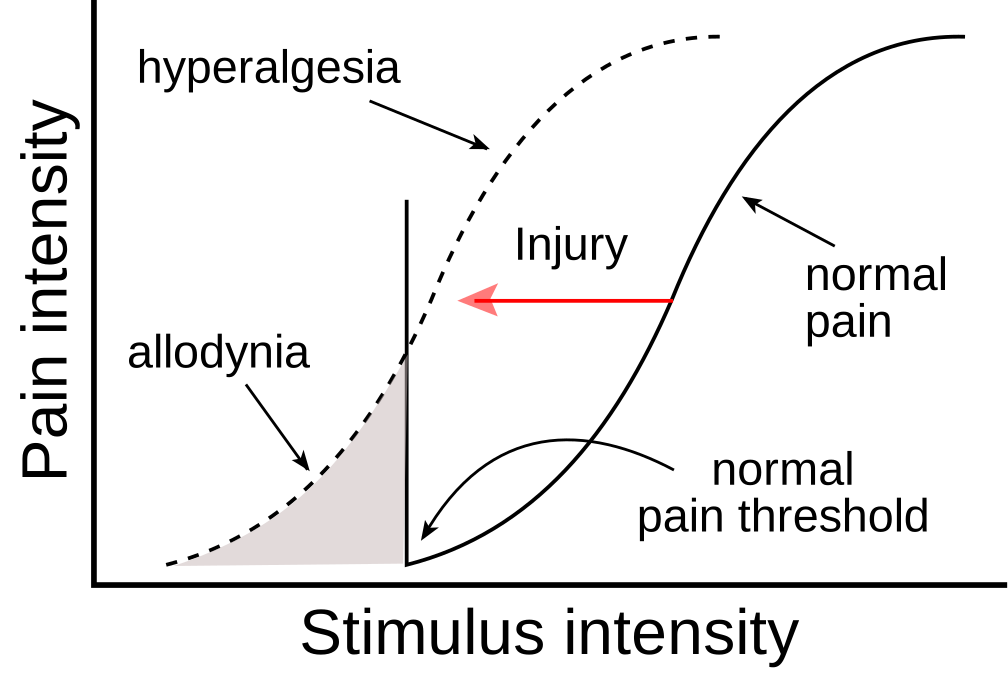
The pain is the entry ticket: burning pain out of proportion to the inciting event, worse than the fracture ever was. Around it the four Budapest families stack up. Sensory: allodynia (the shirtsleeve hurts) and hyperalgesia. Vasomotor: temperature asymmetry and skin color change. Sudomotor and edema: swelling and sweating change. Motor and trophic: decreased range of motion, weakness, tremor, then shiny atrophic skin, abnormal hair, and ridged brittle nails. The diagnosis is clinical: pain disproportionate to the event, plus at least one symptom in 3 or more categories, plus at least one sign in 2 or more categories at evaluation, with no better explanation. The three-phase bone scan and MRI are supportive only, and a normal scan never rules CRPS out.
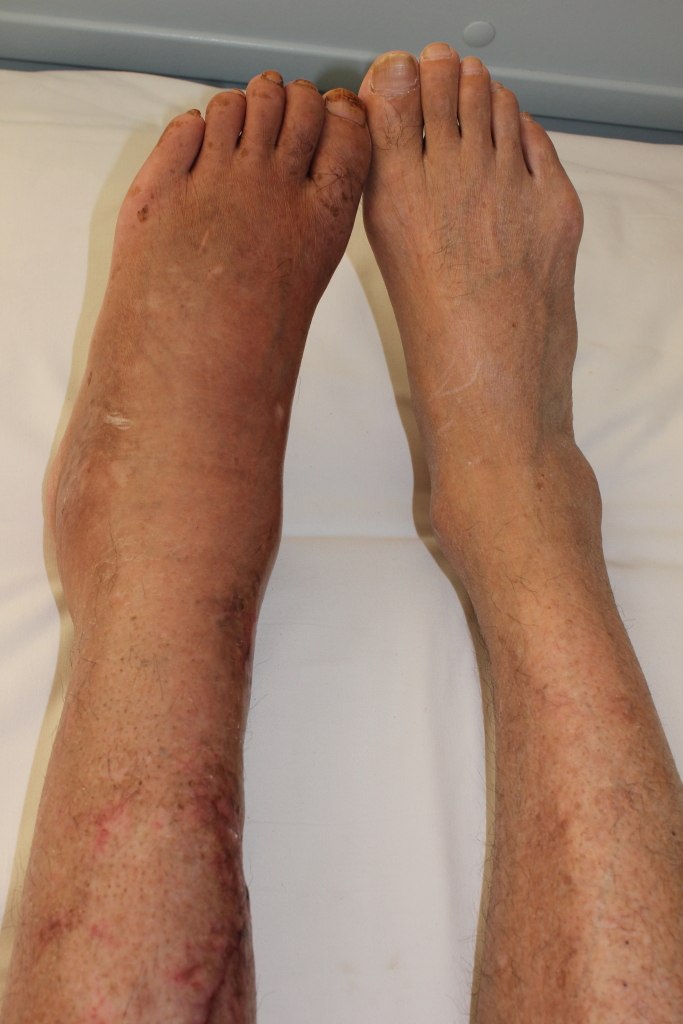
Run the Budapest scorer on Mr. Okonkwo: tick the symptom categories he reports, then the sign categories you observe.
Checked 0
DIAGNOSIS AND TREATMENT
CRPS Diagnosis and Treatment: Clinical, Then Therapy First
The diagnosis is clinical: the Budapest criteria, not the bone scan, make the call. The three-phase bone scan and MRI are supportive only, and a normal scan never rules CRPS out. Treatment starts with motion, not with a needle and never with a stimulator.
Imaging supports, the criteria diagnose. The three-phase bone scan may show increased periarticular uptake in the affected limb on the delayed phase, and MRI may show skin thickening, soft tissue edema, and muscle change; radiographs over weeks can show the patchy osteopenia of Sudeck atrophy. None of them confirms CRPS, and a normal scan never excludes it: the boards plant the bone scan as the red herring after a stem that already meets Budapest. Before labeling CRPS, exclude the acute limb mimics: infection (fever, wound, elevated WBC), DVT (Doppler shows a non-compressible vein), and fracture complications.
The treatment is a ladder that starts with physical and occupational therapy: desensitization (graded tactile exposure), range of motion, graded motor imagery, and mirror therapy, started early, because this is the intervention with the best evidence. The drugs are adjuncts: gabapentinoids and TCAs for the neuropathic component, bisphosphonates and a short early course of corticosteroids for the inflammatory phase. Sympathetic blocks (stellate ganglion for the arm, lumbar sympathetic for the leg) come next for resistant pain, and spinal cord stimulation is reserved for refractory severe disease after conservative therapy fails. Disuse feeds the syndrome: the patient who keeps the weight off the foot is doing exactly the wrong thing. Most patients improve substantially over 6 to 12 months, and the earlier the therapy starts, the better the outcome.
Run the pain workup decision tool: geography first, then the labs, then the limb.
A patient comes in with chronic pain. Which door fits which presentation?
THE DISCRIMINATOR
The One-Screen Discriminator: Fibromyalgia Versus CRPS
Two pain syndromes, one reflex: widespread pain with fatigue and a normal exam is fibromyalgia; focal post-traumatic pain with autonomic and trophic change is CRPS. Hold the six rows, then lock the numbers with the mnemonics.
Run the rows in order. Pain geography: fibromyalgia is widespread (bilateral above and below the waist plus axial, 3+ months); CRPS is focal in one limb after trauma, surgery, or fracture. Pain quality: fibromyalgia is deep aching or burning anywhere with no dominant site; CRPS burns out of proportion to the event with allodynia and hyperalgesia. Companions: fibromyalgia brings fatigue, nonrestorative sleep, fibro fog, IBS, interstitial cystitis, TMJ, tension headache, and depression; CRPS brings vasomotor, sudomotor, and trophic change in the limb. Exam and labs: fibromyalgia is normal except tenderness, with normal ESR, CRP, TSH, CBC, and CMP; CRPS shows observed signs in the limb, and the bone scan is supportive only. Criteria: 2010 ACR WPI and SSS versus Budapest. Treatment reflex: exercise, CBT, sleep hygiene, then an SNRI, gabapentinoid, or low-dose amitriptyline, never an opioid; versus PT and OT with desensitization and mirror therapy first, then drugs, blocks, and stimulation, never disuse.
Tap each letter to reveal the hook it holds.
3-2-1 SVSM TPRSM
3Symptoms in 3 or more of the 4 Budapest categories
2Signs in 2 or more categories at evaluation
1One continuing pain disproportionate to the event, plus no better explanation
SSensory: allodynia, hyperalgesia
VVasomotor: temperature and color asymmetry
SSudomotor and edema: sweating change, swelling
MMotor and trophic: decreased range of motion, skin, hair, nail change
TThyroid: hypothyroidism, high TSH
PRPolymyalgia rheumatica: over 50, girdle stiffness, ESR above 50
SSystemic lupus erythematosus: rash, arthritis, positive ANA
MMyositis and rheumatoid arthritis: CK, anti-CCP, swollen joints
Open each rung of the CRPS ladder, then the one-screen discriminator.
Physical and occupational therapy with desensitization, range of motion, graded motor imagery, and mirror therapy, started early. This is the backbone of CRPS treatment and the intervention with the best evidence; the boards grade it as the first step in every treatment stem.
Gabapentin or pregabalin and tricyclic antidepressants (amitriptyline) for the neuropathic pain component. They treat the nerve-fire; they do not replace the therapy.
Bisphosphonates for bone turnover and pain, and a short early course of corticosteroids for the inflammatory phase. Both are time-limited adjuncts, not first-line.
Stellate ganglion block for the arm, lumbar sympathetic block for the leg, offered when the pain resists the first rungs. Response varies, and a block is never the first move.
Spinal cord stimulation for refractory severe disease after conservative treatment fails. The stem that offers a stimulator first is testing whether you know the ladder order.
Fibromyalgia: widespread pain, fatigue and unrefreshing sleep, normal exam and labs, WPI plus SSS, exercise and CBT then an SNRI, gabapentinoid, or low-dose TCA, never an opioid. CRPS: focal post-traumatic burning, allodynia plus autonomic and trophic change, Budapest criteria, PT and OT first then drugs, blocks, stimulation, never disuse. Mimics: PMR (over 50, girdle stiffness, ESR above 50, steroids), hypothyroidism (TSH), RA and lupus (swollen joints, rash, autoantibodies), myositis (CK).
Prove it
Walkthrough: fibromyalgia and CRPS in seven cases
Original practice scenarios, one at a time. Choose an answer, then open any option to work its reasoning.
Clinical walkthrough
Reviewed by

Dr. Fatima Ali, DO
Psychiatry resident, PGY-1 · University Hospitals, Columbia
Resident physician whose osteopathic training feeds a whole-system, mechanism-first approach to the subjects students struggle most to reason through alone. Co-founder of Bone Wizardry. Reviews the psychiatry, osteopathic medicine and OMM, clinical-reasoning, and licensing-readiness material, and verifies each page for clinical accuracy.
Published
Content updated
Medically reviewed
Bone Wizardry is a study resource for medical students. It is not medical advice, and nothing here substitutes for the judgement of a licensed clinician or for the guidelines your program follows.