Upper and Lower Extremity Findings: Anatomy, Autonomics and Manual Medicine
Localize limb findings, predict joint and autonomic responses, and distinguish useful osteopathic examination models from unsupported diagnostic claims.
A weak wrist, a painful shoulder and a tender thoracic point do not carry the same kind of diagnostic information. The central mistake is treating a named test or map as a diagnosis. This lesson instead connects observed function to anatomy, predicts what should be impaired or spared, and distinguishes established physiology from traditional osteopathic claims.
By the end, you should be able to localize limb findings across joint, tendon, nerve and root; predict the direction a ligament or receptor resists or produces; and judge when palpatory findings can inform an examination without replacing clinical evidence. Use the diagrams to make a prediction before reading the comparison, then test the same reasoning in a new patient.
First decide what the shoulder cannot do
Does a painful arm indicate a tendon tear, a stiff joint, or a nerve lesion? Compare active motion with passive motion before choosing a special test. If the examiner can take the arm farther than the patient can, pain inhibition, tendon failure, or weakness is more likely than a fixed capsular restriction. Loss of both active and passive motion, especially external rotation, supports adhesive capsulitis or joint disease. Frozen shoulder may follow immobilization, but can also arise without it and is associated with diabetes. [1][2]
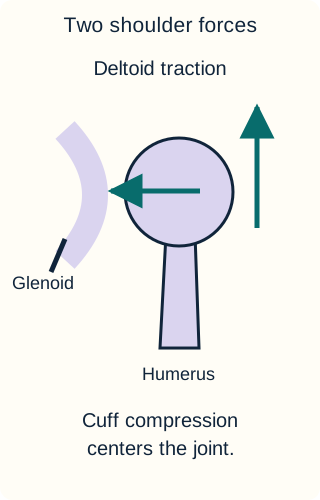
The cuff stabilizes the humeral head against the shallow glenoid while larger muscles generate torque. Supraspinatus contributes to abduction, prominently at initiation; the familiar first 15 degrees is a teaching approximation, not an exclusive operating interval. Infraspinatus and teres minor externally rotate; subscapularis internally rotates. The first three attach to the greater tubercle and subscapularis to the lesser tubercle. Supraspinatus tendon disease is common, but tears are multifactorial rather than inevitable pinching with every arm raise. [1][29]
Two forces, one centered joint. The arrows represent functions, not measured force magnitudes. Select the image for the full-size view.
Anterior deltoid helps flex the shoulder; middle deltoid abducts; posterior deltoid, teres major, and latissimus dorsi extend it. Pectoralis major and latissimus dorsi are powerful adductors, supplied by the medial/lateral pectoral nerves and thoracodorsal nerve, respectively. Full arm abduction can approach 180 degrees through combined glenohumeral and scapulothoracic motion, not the glenohumeral joint alone. [29][1]
Tests load a structure; they do not prove a diagnosis
Interpret the response, not just the test name
Test
Position and useful finding
TestNeer
Position and useful findingStabilize the scapula and passively flex the internally rotated arm. Pain supports subacromial pain, not a proven isolated tear.
TestHawkins
Position and useful findingFlex shoulder and elbow to about 90 degrees, then internally rotate the shoulder. Pain also supports subacromial involvement.
TestEmpty can and drop arm
Position and useful findingResisted abduction in the scapular plane with thumbs down stresses supraspinatus. Loss of controlled lowering raises concern for a significant cuff tear; pain-limited effort must be distinguished from true weakness.
TestSpeed and Yergason
Position and useful findingAnterior groove pain with resisted shoulder flexion in supination, or resisted forearm supination with the elbow at 90 degrees, supports biceps tendon involvement. Speed positioning varies by described protocol.
TestAnterior/posterior apprehension
Position and useful findingFear of anterior instability during abduction/external rotation differs from pain alone. Posterior instability is assessed with flexion, adduction and internal rotation under controlled posterior loading, not during an unreduced acute injury.
A painful arc, often during midrange abduction, describes a finding rather than a synonym for supraspinatus tendinitis. Neer, Hawkins, and biceps tests are not sufficiently specific to name one damaged structure in isolation. Persistent traumatic weakness or loss of controlled lowering warrants appropriate imaging and specialist assessment; ultrasound or MRI may characterize a cuff tear. [1][2]
Try the comparison: Patient A has passive external rotation of 70 degrees but active abduction of only 50 degrees. Patient B has both active and passive external rotation limited to 10 degrees. Decide whose limitation suggests capsular stiffness.
Compare the two patterns
Patient B has restriction even when another person supplies the force. Patient A needs an assessment of pain, tendon integrity and motor supply. A painful test cannot substitute for this comparison.
Apply it elsewhere: A patient with diabetes and gradually restricted passive rotation should not be labeled as having a cuff tear solely because overhead reaching hurts.
Instability and compression require different reasoning
Most glenohumeral dislocations are anterior, often after abduction and external rotation. The shallow socket and capsulolabral injury permit escape; a claim that weak posterior tissues cause anterior displacement is not a useful explanation. Check axillary nerve function and distal perfusion before and after reduction. Seizure or electrical injury with a fixed internally rotated arm suggests posterior dislocation.
An AP film may show a rounded humeral head, but an appropriate orthogonal view is important. A modified axillary/Velpeau view can help when pain prevents standard positioning; do not force abduction. CT may be needed for unresolved alignment or associated fracture. [41][42] Subluxation retains some joint contact; dislocation loses congruent contact; an acromioclavicular separation injures a different articulation. [1][3]
The brachial plexus and subclavian artery pass between anterior and middle scalenes; the vein passes anterior to anterior scalene. Potential thoracic outlet compression also occurs between clavicle and first rib and beneath pectoralis minor. Adson turns the head toward the tested side with inspiration; reverse Adson turns away. The costoclavicular posture retracts and depresses shoulders; Wright uses hyperabduction; Roos/EAST holds the shoulders abducted and elbows flexed at about 90 degrees during repeated hand opening, commonly for up to three minutes.
These tests overlap anatomically and have false positives. There is no universal 25% false-positive rate and no single image that confirms every neurogenic presentation. Paresthesia, weakness, swelling, cyanosis or ischemic signs determine which neurological or vascular assessment is needed. A swollen blue arm needs timely assessment for venous obstruction, not a sequence of provocative maneuvers. [6][32]
Use what is spared to locate the lesion
Can a numb thumb distinguish a root from a wrist lesion? Not alone. A dermatome describes a spinal sensory contribution; a named peripheral nerve contains fibers from several roots. Compare sensation with muscles supplied by different nerves and with reflexes. Overlap and anatomical variation make these patterns guides, not sharply drawn borders. [4][3]
Upper limb root landmarks and overlapping reflex arcs
Root
Useful sensory landmark
Motor or reflex anchor
RootC4
Useful sensory landmarkTop of shoulder
Motor or reflex anchorNot a standard upper-limb tendon reflex
RootC5
Useful sensory landmarkLateral upper arm
Motor or reflex anchorDeltoid/biceps; biceps reflex C5-C6, often C5 emphasis
RootC6
Useful sensory landmarkLateral forearm and thumb
Motor or reflex anchorWrist extension/elbow flexion; brachioradialis reflex C5-C6, often C6 emphasis
RootC7
Useful sensory landmarkMiddle finger
Motor or reflex anchorTriceps and wrist flexion; triceps reflex mainly C7, with C8 contribution
RootC8
Useful sensory landmarkLittle finger and ulnar hand
Motor or reflex anchorFinger flexion; finger-flexor response often C8, not an isolated screening diagnosis
Motor or reflex anchorFinger abduction/adduction; medial upper arm also includes T2 territory
C6 radiculopathy may weaken both biceps and wrist extensors while reducing brachioradialis and sometimes biceps reflexes. A wrist-level median lesion cannot explain that cross-nerve pattern. Spurling positioning can reproduce radicular pain; relief with distraction supports but does not independently confirm it. Radiographs show alignment and bony disease, CT characterizes bone, MRI assesses soft tissues and neural compression, and electrodiagnostic testing helps when root versus peripheral localization remains uncertain. These are selected tests, not a mandatory bundle; progressive deficits, myelopathic signs or other red flags alter urgency. [4]
Follow the median nerve past the wrist branch
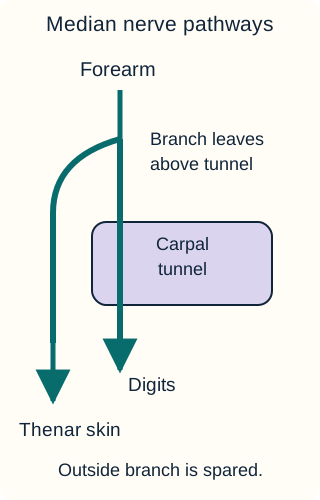
The carpal tunnel contains the median nerve and nine flexor tendons: four flexor digitorum superficialis, four flexor digitorum profundus, and one flexor pollicis longus. Its roof is the flexor retinaculum. The palmar cutaneous branch leaves the median nerve proximal to the tunnel and travels superficial to that roof. Therefore, median-digit paresthesias with preserved thenar-skin sensation fit carpal tunnel syndrome. Nocturnal wrist position can aggravate symptoms, but repetitive use is not the only cause. [5]
Trace the branch that never enters the tunnel before predicting which skin region stays normal. Select the image for the full-size view.
Trace and predict: Start at the forearm label. Follow each branch with a finger or your eyes. If compression occurs only under the retinaculum, predict whether thenar skin or fingertip sensation changes first.
Check the branch prediction
The fingertip pathway passes through the compressed space. The thenar-skin branch bypasses it. If the palm is also numb and pronation is weak, reassess a more proximal median lesion rather than stretching the tunnel diagnosis to fit.
Phalen flexes the wrists, reverse Phalen extends them, and Tinel taps over the nerve; reproduction of the patient's median-territory symptoms supports the diagnosis. No single maneuver is decisive. Advanced compression may impair thumb palmar abduction/opposition and the first two lumbricals, with thenar wasting. Flexor pollicis brevis has variable dual innervation, so do not treat every thenar muscle as exclusively median. A proximal median lesion additionally impairs forearm flexors and may produce incomplete index/middle finger flexion during an attempted fist, traditionally called a benediction posture. That active task is not the resting ulnar claw. [5][3]
Contrast four motor patterns
Ulnar injury impairs interossei, adductor pollicis and lumbricals three and four. Ring/little finger MCP hyperextension with IP flexion reflects intrinsic loss. In Froment testing, thumb IP flexion is compensation by median-innervated flexor pollicis longus for weak ulnar-innervated adductor pollicis. Radial injury proximal to the wrist-extensor branches can cause wrist drop; a posterior interosseous lesion instead primarily affects finger extension and has no cutaneous sensory deficit. [3]
Upper-trunk C5-C6 traction injury can produce the adducted, internally rotated arm, extended elbow and pronated forearm of Erb palsy, involving muscles supplied by several nerves. A newborn who does not use an arm also needs assessment for fracture and other causes. Lower-trunk C8-T1 injury preferentially compromises hand function across median and ulnar territories; severe proximal injury involving sympathetic pathways may accompany Horner syndrome. Long thoracic nerve injury weakens serratus anterior, often producing medial scapular winging during a wall push. Trapezius injury can also cause winging, but adds impaired shrug and a different pattern. [3]
New situation: Wrist drop with normal triceps after a humeral shaft injury favors a radial lesion distal to the triceps branches. Add elbow-flexion weakness and a neck-provoked dermatomal symptom, and the localization must be reconsidered.
Try it here · Checkpoint 1 of 3
Make your prediction before reading the choices. A first attempt is just a starting point.
Case 6
Show answer and explanations for case 6
A. Forearm pronation (Best answer)
The spared thenar skin and median-digit symptoms favor compression within the carpal tunnel. Pronator branches arise proximally, so pronation should be preserved in an isolated wrist-level lesion.
Reasoning steps for option A
What does normal thenar skin sensation localize despite nocturnal median-digit tingling?
The palmar cutaneous branch bypasses the carpal tunnel, so normal thenar skin alongside thumb, index and middle finger symptoms favors tunnel-level compression.
Why should forearm pronation survive this wrist-level lesion?
Motor branches to the forearm pronators leave the median nerve proximal to the tunnel; isolated tunnel compression therefore spares pronation.
B. Thumb palmar abduction (Why this does not fit)
Abductor pollicis brevis is supplied distal to the tunnel and is already weak in the stem. Its action is not expected to be reliably spared.
Reasoning steps for option B
Why is thumb palmar abduction a tempting median-nerve answer in this patient?
Abductor pollicis brevis is median-innervated, but the stem already documents weakness of this exact action.
Does the palmar-cutaneous bypass also protect abductor pollicis brevis motor fibers?
No. Thenar motor fibers pass through the tunnel before supplying abductor pollicis brevis, so preserved thenar skin does not imply preserved palmar abduction.
C. Thumb opposition (Why this does not fit)
Thenar motor fibers travel through the tunnel before supplying opponens pollicis; advanced compression can impair opposition.
Reasoning steps for option C
Why might thumb opposition appear spared when thenar skin feels normal?
Normal skin sensation over the thenar eminence reflects a cutaneous branch bypassing the tunnel, not intact motor supply to opponens pollicis.
Where do opponens pollicis motor fibers run relative to this compression?
They traverse the carpal tunnel before reaching the thenar muscles; opposition may weaken with compression rather than being anatomically protected like pronation.
D. Index-finger lumbrical function (Why this does not fit)
The first lumbrical receives median supply distal to the tunnel. It is not protected by the proximal branching that spares pronation.
Reasoning steps for option D
Why could index-lumbrical function look preserved in an incomplete tunnel lesion?
Some distal median motor functions may remain strong clinically if compression is incomplete, making a preserved index lumbrical superficially plausible.
Does the first lumbrical receive its median supply before the carpal tunnel?
No. Its motor supply is distal to the tunnel, so any retained function is not due to the proximal branching specifically requested in the stem.
Takeaway: Localize compression with a spared sensory branch, then predict spared proximal motor function.
Separate a motion preference from an injured structure
Does restricted rotation mean the radial head needs manipulation? An acute fall with lateral elbow tenderness and effusion must first raise concern for fracture, even if an initial radiograph shows no fracture line. A somatic-dysfunction label does not rule out structural injury. Neurovascular compromise, dislocation, instability or a suspected fracture changes the plan before any manual intervention. [33]
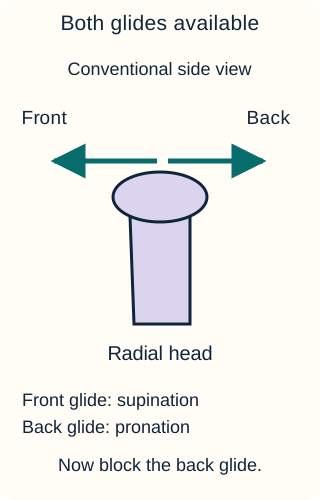
For a nontraumatic, appropriately screened examination, the conventional osteopathic model pairs supination with anterior radial-head glide and pronation with posterior glide. Name the dysfunction for the position of ease, not the missing excursion. An anterior radial head has relative supination ease and restricted pronation/posterior glide; a posterior head has relative pronation ease and restricted supination/anterior glide. This is a useful examination convention, not a claim that forearm rotation is only translation. The radius also rotates within the annular ligament and relative to the ulna. [18][19]
Baseline: both glides are available. Select the image for the full-size view.
Change one constraint: Imagine the posterior glide is blocked while anterior glide remains available. Before opening the result, name the forearm action that will become restricted.
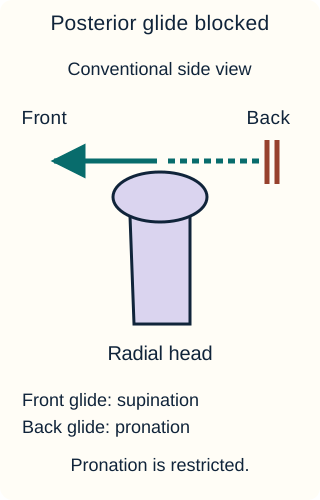
Apply a posterior-glide barrierChanged state: a barrier in the posterior direction limits pronation. Close this optional result to return to the baseline comparison. Select the image for the full-size view.
The barrier blocks the excursion needed for pronation, so the conventional name is anterior radial-head dysfunction. Naming it posterior because posterior glide is restricted reverses the convention.
Worked comparison: Restricted pronation with supination ease means anterior. Restricted supination with pronation ease means posterior. Now reverse the barrier mentally: the lost action becomes supination and the name becomes posterior. This prediction does not authorize self-manipulation.
Backward falls onto a supinated forearm and forward falls onto a pronated forearm are traditional associations with anterior and posterior patterns, respectively, not diagnostic rules. The old thrust-position recipes are replaced here by diagnosis and safety reasoning: setup depends on the technique and clinician's examination, not the remembered fall direction. Reassess motion after any appropriately selected treatment. [18][19][33]
Use the elbow as the reference point
The carrying angle is the angle between humerus and forearm with the elbow extended and forearm supinated. It varies with measurement and anatomy. Greater valgus means more lateral forearm deviation; varus means less or reversed lateral deviation. Conventional ulnar abduction describes distal ulna lateral, olecranon medial, and relative wrist adduction; ulnar adduction describes distal ulna medial, olecranon lateral, and relative wrist abduction. Wrist and ulna directions are relative to different reference segments. Do not equate a fixed angular threshold or structural deformity with a newly diagnosed somatic dysfunction. [19]
Brachialis is a major elbow flexor regardless of forearm position; biceps adds powerful supination, especially with the elbow flexed. Both are chiefly musculocutaneous, C5-C6. Supinator receives radial motor supply; triceps is radial, chiefly C7. Pronation uses median-supplied pronator teres and anterior-interosseous-supplied pronator quadratus. Branch level matters: a distal median injury does not abolish both pronators. [3][29]
Lateral epicondylopathy causes focal common-extensor-origin pain with resisted wrist extension; medial epicondylopathy involves the flexor-pronator origin and pain with resisted wrist flexion/pronation. Occupation and loading matter more than whether the patient plays tennis or golf. Compare these focal tendon patterns with joint-line pain on passive forearm rotation. [7]
Read the finger joints individually
De Quervain disease involves abductor pollicis longus and extensor pollicis brevis in the first dorsal compartment near the radial styloid. Provocative thumb/wrist testing should localize pain there. The thumb-in-fist ulnar-deviation maneuver is commonly called Finkelstein, although that version is often distinguished as Eichhoff; either name must be accompanied by the actual maneuver rather than assuming a positive test is specific. [8][38]
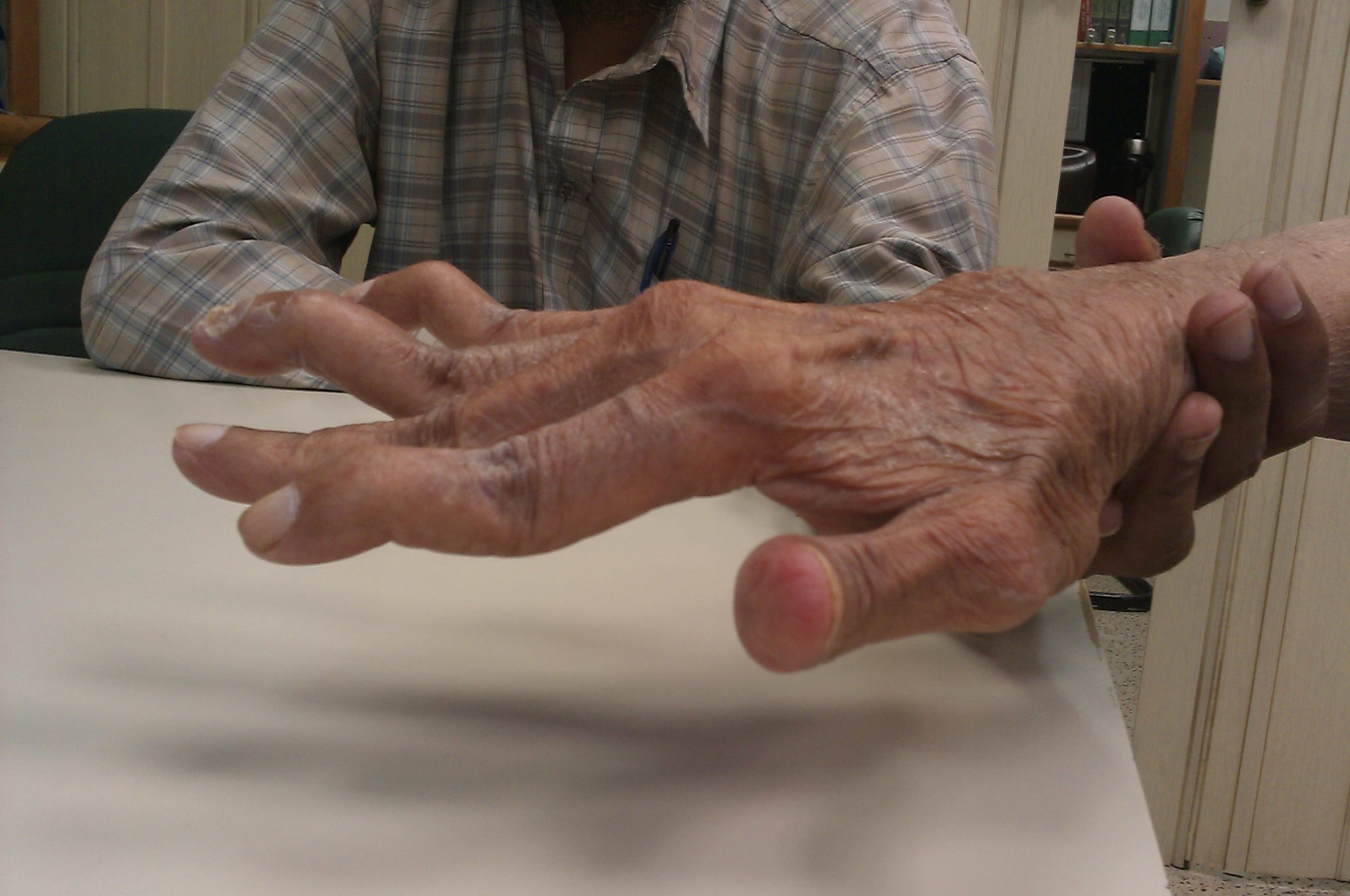
Swan-neck deformity is PIP hyperextension with DIP flexion. Boutonnière is PIP flexion with DIP hyperextension, typically involving central-slip failure and altered lateral-band mechanics. Both can occur with rheumatoid arthritis, but neither is specific to it. Swan-neck mechanisms include volar restraint laxity, intrinsic imbalance and terminal tendon disease; there is no single universal flexor-sheath explanation. Dupuytren contracture is progressive palmar fascial fibrosis, often affecting ring and little fingers, rather than a tendon or nerve palsy. [10][11][12]
Describe the PIP and DIP positions separately before naming the deformity. Image: rheumatoid arthritis, but appearance alone does not establish its cause. Image: Phoenix119, Wikimedia Commons source, CC BY-SA 3.0. No overlay or cropping. Select for full size.
Transfer: If the PIP is flexed rather than hyperextended and active PIP extension is lost after a jammed finger, investigate central-slip injury instead of labeling every bent arthritic finger swan-neck.
Identify the restrained direction before naming the knee ligament
Does an anteriorly traveling tibia always prove an ACL tear? First check where the tibia started. A PCL-deficient tibia may rest posteriorly and appear to travel far forward simply as it returns toward neutral. Record posterior sag before interpreting an anterior drawer. [9]
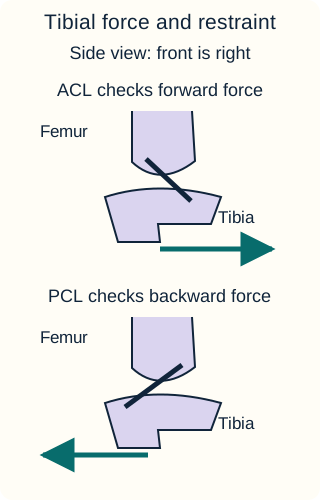
The ACL runs from anterior tibia toward the posteromedial surface of the lateral femoral condyle and primarily restrains anterior tibial translation. The PCL runs from posterior tibia toward the anterolateral surface of the medial femoral condyle and primarily restrains posterior translation. The names refer to tibial attachments, not which ligament lies farther forward everywhere. The MCL resists valgus stress and has deep connections to the medial meniscus; the LCL resists varus stress and has no direct attachment to the lateral meniscus. [9][31][36][40]
Hold the femur fixed in your reasoning. The arrow describes tibial translation, not the direction the examiner stands. Select the image for the full-size view.
Lachman assesses anterior translation at about 20-30 degrees of knee flexion; anterior drawer uses about 90 degrees. Compare translation and endpoint with the other side. Posterior drawer and posterior sag/Godfrey positioning examine posterior stability, commonly with the hip and knee flexed to 90 degrees for sag assessment. A pivot injury, early effusion and a soft Lachman endpoint support ACL injury. A dashboard blow to the proximal tibia suggests PCL injury. The traditional ACL-MCL-medial-meniscus combination is a remembered injury pattern, not proof that a particular meniscus must be torn. [9][31][36][40]
Predict the examination: In a knee with posterior sag, gently returning the tibia to neutral changes the starting position. Decide whether that correction alone proves an ACL tear.
Interpret the starting position
It does not. The apparent excursion can represent reduction of posterior sag. Assess anterior translation from an appropriate neutral reference before adding an ACL diagnosis.
Distinguish muscle action, alignment and symptoms
Biceps femoris is the lateral hamstring; semitendinosus and semimembranosus are medial. They flex the knee, with gracilis and sartorius assisting but not belonging to the hamstring group. The long head of biceps femoris and the other two hamstrings extend the hip; the short biceps head does not cross it. Quadriceps comprises rectus femoris and the three vasti: lateralis, medialis and intermedius. All extend the knee; only rectus femoris crosses and flexes the hip. [15][34]
Examine hip flexion, extension, abduction, adduction and internal/external rotation, recording position and side-to-side differences. Fixed ranges without test position can mislead. In a healthy-adult study, external rotation averaged several tens of degrees and differed between sitting and prone testing; 10-15 degrees is not a universal normal external-rotation range. Compare the painful direction and passive restriction rather than diagnosing a hip disorder from one memorized interval. [16]
The Q angle uses lines from the anterior superior iliac spine to the patellar center and from the patellar center to the tibial tuberosity. It is not the same as the weight-bearing mechanical axis. Values depend on sex, posture and technique; a larger static Q angle does not by itself establish maltracking or patellofemoral pain. Assess symptoms during loaded flexion, patellar tracking, hip strength, quadriceps function and soft-tissue flexibility. An isolated weak vastus medialis or tight iliotibial band is not a complete explanation. [13][9]
Genu varum shifts load toward the medial tibiofemoral compartment, whereas valgus favors lateral loading. The femoral neck-shaft inclination angle is a separate hip measurement: coxa vara is a relatively smaller angle, coxa valga a larger angle. Cutoffs vary. A large adult MRI study found a mean near 127 degrees and a reference interval of 114-140 degrees, illustrating why 130 degrees cannot be treated as a universal disease boundary. [17][35]
Use a neurological comparison when the joint does not explain weakness
L4 contributes to knee extension and the patellar reflex. L5 contributes to great-toe extension and sensation over the dorsum of the foot; the first web space also belongs to the deep fibular peripheral nerve territory. S1 contributes to plantarflexion, the Achilles reflex and lateral/plantar foot sensation. S2 includes posterior thigh sensation; heel sensation is overlapping and not an isolated S2 test.
Posterolateral L5-S1 disc disease commonly affects the traversing S1 root. Lateral-foot symptoms, weak repeated heel raises and a reduced Achilles reflex form a stronger localization than pain alone. Foot drop with weak eversion but preserved inversion instead suggests a common fibular lesion; L5 disease may also weaken tibialis posterior-mediated inversion. [26][28]
New perineal sensory loss, urinary retention or loss of rectal tone requires urgent assessment for caudal-root compression rather than a routine local-joint explanation. [45]
New situation: A patient has foot drop after prolonged pressure at the fibular neck but can invert the ankle strongly. Test eversion and sensory territories before attributing the deficit to an incidental lumbar MRI abnormality.
Try it here · Checkpoint 2 of 3
Make your prediction before reading the choices. A first attempt is just a starting point.
Case 15
Show answer and explanations for case 15
A. Excess anterior translation beyond neutral with a soft Lachman endpoint (Best answer)
The resting posterior displacement suggests PCL deficiency. Reduction toward neutral can mimic anterior laxity, but excessive translation beyond the appropriate reference with a soft Lachman endpoint supports an additional ACL injury.
Reasoning steps for option A
What does posterior resting displacement after the dashboard collision suggest before testing anterior laxity?
Posterior sag with the knee at 90 degrees suggests PCL deficiency, so initial forward motion may merely restore the tibia to its normal contour.
What Lachman finding would independently support a second cruciate lesion?
Excess anterior translation beyond the neutral reference with a soft endpoint supports additional ACL injury rather than simple reduction of the posterior starting position.
B. Forward excursion from the posterior resting position to the normal contour (Why this does not fit)
That excursion may simply reduce posterior sag from PCL deficiency and does not independently establish ACL failure.
Reasoning steps for option B
Why can forward movement from this patient’s posterior starting position look like ACL laxity?
The tibia begins behind its normal contour, so a visible forward excursion can seem excessive if its starting position is ignored.
What does return only to the normal anterior contour actually demonstrate?
It may merely reduce PCL-related posterior sag; anterior travel beyond neutral with a soft Lachman endpoint is needed to support a second ACL injury.
C. Greater posterior excursion during posterior drawer than on the other side (Why this does not fit)
This adds evidence of the same posterior-restraint deficit, not a second anterior-restraint injury.
Reasoning steps for option C
Why is a greater posterior drawer abnormal after the dashboard collision?
It strengthens the evidence for deficient posterior restraint already suggested by the tibia resting farther posteriorly at 90 degrees.
Does greater posterior excursion establish an additional ACL tear?
No. It further supports PCL deficiency, whereas independent ACL evidence requires abnormal anterior translation beyond neutral with a soft Lachman endpoint.
D. Posterior resting displacement that increases as the knee is supported at 90 degrees (Why this does not fit)
This further demonstrates posterior sag but does not assess the ACL from an appropriate starting position.
Reasoning steps for option D
Why does more posterior sag at 90 degrees appear compelling in this case?
The resting asymmetry is a real sign of the posterior-restraint deficit following a dashboard mechanism.
Why cannot worsening posterior sag alone prove a second cruciate injury?
It continues to assess PCL-related posterior displacement, not ACL anterior restraint after the tibia has been restored to a proper reference position.
Takeaway: A changed starting position can create an apparent abnormality in a second test.
Predict the receptor effect, not just the division's name
Why can a sympathetic nerve release acetylcholine? The effector receptor, not the word sympathetic, determines the response. Both autonomic divisions ordinarily use a preganglionic neuron, a ganglion and a postganglionic neuron. Preganglionic neurons release acetylcholine onto neuronal nicotinic receptors. Most sympathetic postganglionic terminals release norepinephrine, whereas parasympathetic postganglionic terminals release acetylcholine onto muscarinic receptors. Sympathetic sweat-gland innervation is an important cholinergic exception. The adrenal medulla is another: preganglionic cholinergic fibers directly activate nicotinic receptors on chromaffin cells, which release catecholamines into blood. [24]
Sympathetic preganglionic cell bodies lie approximately T1-L2, with some descriptions extending to L3, and synapse in paravertebral or prevertebral ganglia. Parasympathetic outflow arises with cranial nerves III, VII, IX and X and sacral segments S2-S4, with ganglia near or in their target organs. These layouts make sympathetic preganglionic axons generally shorter and parasympathetic preganglionic axons generally longer; they are patterns, not an exact length rule for every fiber. [24][25]
Follow preganglionic outflow to the target
Pathway
Route and target boundary
PathwayCranial parasympathetic
Route and target boundaryIII: pupil constriction/accommodation; VII: lacrimal, submandibular and sublingual glands; IX: parotid; X: thorax, foregut and midgut through proximal two-thirds of transverse colon.
PathwayPelvic splanchnic
Route and target boundaryS2-S4 parasympathetic fibers supply hindgut beyond the vagal boundary, bladder and erectile tissues. They are not the sympathetic sacral splanchnic nerves.
PathwayGreater thoracic splanchnic
Route and target boundaryApproximately T5-T9 to the celiac region and foregut.
PathwayLesser and least thoracic splanchnic
Route and target boundaryLesser: T10-T11, chiefly superior mesenteric/aorticorenal routes. Least: T12, chiefly renal pathways. Least is not a T12-L2 nerve serving the entire hindgut.
PathwayLumbar splanchnic
Route and target boundaryLumbar sympathetic fibers reach inferior mesenteric and hypogastric networks, including hindgut and pelvic targets.
Organ-level maps are overlapping teaching ranges, not unique diagnostic addresses. Heart and lungs receive upper-thoracic sympathetic contributions, commonly summarized around T1-T5 or T6; osteopathic lung charts may extend to T7. Foregut is often summarized T5-T9, midgut T10-T11 and hindgut T12-L2. Renal/adrenal and ureteral pathways overlap roughly T10-L1, and pelvic urinary/reproductive pathways extend into upper lumbar segments. A tender T6 paraspinal area does not identify a diseased organ. Gonadal innervation also reflects development and cannot be assigned the pelvic parasympathetic pattern simply because a gonad is near the pelvis. [24][25]
Use tissue plus receptor to forecast the effect
Selected autonomic receptor effects
Receptor
Important direct effects
ReceptorAlpha-1
Important direct effectsVascular and urinary outlet smooth-muscle contraction; iris radial dilator contraction produces mydriasis.
ReceptorAlpha-2
Important direct effectsPresynaptic reduction in norepinephrine release; also has other tissue effects, including platelet aggregation.
ReceptorBeta-1
Important direct effectsIncreased cardiac rate/conduction/contractility and renin secretion from renal juxtaglomerular cells.
ReceptorBeta-2
Important direct effectsBronchial, selected vascular-bed and uterine smooth-muscle relaxation. Circulating epinephrine and medicines are important activators in the airways.
ReceptorBeta-3
Important direct effectsDetrusor relaxation during bladder filling. Current bladder pharmacology should not be reduced to beta-2 alone.
ReceptorMuscarinic
Important direct effectsM2 slows the cardiac pacemaker. M3 supports glandular secretion, bronchial contraction, pupil constriction and detrusor contraction; tissue signaling and coordinated reflexes matter.
During storage, sympathetic detrusor relaxation and outlet contraction differ from the coordinated parasympathetic voiding response. The external urethral sphincter also has somatic pudendal innervation; it is not simply another alpha-1 effector. In the gut, parasympathetic activity generally promotes motility/secretion, while sympathetic activity generally reduces motility and promotes sphincter contraction. Both divisions can stimulate salivary secretion with different amounts and composition; dry mouth is not explained by saying that sympathetic activation always stops saliva. [24][27]
Receptor comparison: A patient taking a muscarinic antagonist develops dry mouth and reduced sweating. Decide whether reduced sweating disproves sympathetic control of sweat glands.
Account for the exception
It does not. The sweat pathway is sympathetic but its postganglionic transmitter is acetylcholine acting at muscarinic receptors. Blocking the effector receptor can impair sweating and parasympathetic salivary secretion at the same time.
Transfer: A selective beta-3 agonist can relax the detrusor without having to block muscarinic salivary receptors. A selective beta-1 blocker instead links a slower pulse with reduced renin secretion. Predict from the receptor and the tissue rather than assigning every organ an all-or-none sympathetic response.
Separate a palpatory model from evidence of disease or benefit
Can a tender point diagnose thyroid disease, or can a regional manual technique guarantee a change in vagal output? Neither conclusion follows from location alone. Visceral afferent input can contribute to segmental sensitization and associated somatic tenderness or hypertonicity. Osteopathic teaching extends that model to patterns of tissue texture and Chapman points. The existence of a palpable finding does not validate its proposed organ association. [20]
Chapman points are traditionally described as small, tender, sometimes bead-like areas in anterior or posterior tissues. Research on their mechanism, reproducibility and diagnostic value is limited. Gentle rotary pressure and reassessment belong to the traditional treatment description; a reduction in local tenderness is not proof that an organ disorder has improved. Use these maps as historical examination conventions, never as replacements for history, laboratory testing or imaging. Sources also differ on precise locations. [20][21]
Retain the map without assigning diagnostic certainty
Selected traditional anterior Chapman locations; ICS means intercostal space
Association
Described surface location
AssociationSinuses, pharynx, larynx, tonsils
Described surface locationSinus: inferior-medial clavicular region. Pharynx: medial first-rib/clavicular region. Larynx: lateral to the second sternocostal region. Tonsils: first ICS near sternum.
AssociationThyroid, bronchi, esophagus
Described surface locationSecond ICS near the sternocostal junction in commonly taught maps. Thyroid posterior description is near T2 between spinous and transverse processes, not a unique midline T2-T3 diagnostic site.
AssociationLung and heart
Described surface locationUpper lung: third ICS; lower lung: fourth ICS, near the sternum. Heart is often assigned a second-ICS location, but laterality differs between source tables and figures; no side-specific diagnostic claim is supported.
AssociationStomach
Described surface locationAcidity: left fifth ICS. Motility: left sixth ICS.
AssociationLiver/gallbladder, pancreas, spleen
Described surface locationLiver/gallbladder: right fifth/sixth ICS region. Pancreas: right seventh ICS. Spleen: left seventh ICS.
AssociationAppendix and colon
Described surface locationAppendix: tip of right twelfth rib. Colon: lateral thigh/iliotibial regions, traditionally proximal right for cecum, middle right for ascending, distal thigh regions for transverse, middle left for descending, proximal left for sigmoid.
AssociationKidneys, adrenals, bladder
Described surface locationKidneys: about 1 inch superior and lateral to umbilicus. Adrenals: about 2 inches superior and 1 inch lateral. Bladder: periumbilical region.
AssociationGonads, uterus, prostate
Described surface locationGonads are described near anterior pubic bone. One map places uterus at the medial obturator border. Do not collapse all urinary and reproductive associations onto the pubic rami; a uniform anterior prostate site is not established across the supplied references.
This table deliberately preserves recognizable course associations while marking disagreements. A tender point at the second ICS could be assigned more than one organ even within traditional maps; anatomical overlap alone defeats a one-point-one-disease inference. [20][21]
Choose the stronger evidence: A patient has fatigue, constipation, a thyroid-associated tender point, TSH 18 mIU/L (reference 0.4-4.0) and free T4 0.5 ng/dL (reference 0.8-1.8). Decide which observations establish the biochemical pattern.
Interpret the laboratory comparison
Low free T4 with increased TSH supports primary hypothyroidism: pituitary stimulation rises when thyroid hormone feedback is inadequate. The point does not add validated confirmation. Subclinical hypothyroidism has normal free T4; central hypothyroidism usually has an inappropriately low, normal or only mildly increased TSH for the low free T4.
Likewise, weight loss or palpitations do not become hyperthyroidism because of a tender point. The clinical assessment and appropriate thyroid tests determine the diagnosis. [30]
Manual care: purpose, uncertainty and limits
Rib raising and paraspinal soft-tissue techniques are traditionally discussed in relation to sympathetic function. That rationale does not establish a predictable increase or decrease in an individual's organ output. A small rib-raising pilot had 14 completers and found reduced salivary alpha-amylase, with no significant cortisol or flow-rate effect. A biomarker result is not proof of improved pneumonia, asthma or another clinical outcome.
The Still approach combines indirect positioning followed by a direct component; it should not be described simply as a proven sympathetic inhibitor. A special lower-rib 11/12 prescription for pneumonia is not established by the cited clinical evidence. [23][14][39]
OA denotes occiput-C1, while AA denotes C1-C2. The vagus arises in the brainstem and exits the jugular foramen; it does not originate in either cervical joint. Suboccipital or upper-cervical treatment is sometimes proposed to influence parasympathetic function, but that does not demonstrate reliable vagal suppression, bronchodilation, or a cranial-rhythm effect on the dorsal motor nucleus. Pharyngeal inflammation is not equivalent to vagal overactivity. [37] Sacral techniques are traditionally associated with pelvic parasympathetic regions, not proven substitutes for evaluation of retention or bowel dysfunction.
Thoracic and pedal pumps use rhythmic mechanical input and are proposed to assist fluid transport; splenic techniques have been proposed to affect immune responses. These hypotheses do not establish clinical benefit for a particular patient. In a randomized pneumonia trial, the intention-to-treat analysis found no significant group differences. A per-protocol analysis favored the multi-technique OMT group over usual care for some outcomes, but not over light touch for length of stay. This is neither proof for one isolated pump nor justification for replacing antibiotics or respiratory support. [22][14]
First obtain consent and screen for cardiopulmonary instability, acute fracture or tissue injury in the treatment region, thrombosis, bleeding risk and fluid-handling problems. Do not apply a splenic pump to an enlarged or injured spleen. Lymphatic-treatment references distinguish absolute contraindications such as deep venous thrombosis or anuria without dialysis from context-dependent precautions such as decompensated heart failure, coagulopathy and acute respiratory exacerbation. Infection is not a simple rule that every pump spreads bacteria, but suspected sepsis with hypotension or confusion demands urgent conventional care rather than elective manual treatment. [22]
Transfer: For a stable patient requesting adjunctive care, specify the intended symptom goal, uncertainty, risks and reassessment plan. For an unstable patient, stabilize and investigate first. An anatomically appealing explanation is not a clinical outcome.
Try it here · Checkpoint 3 of 3
Make your prediction before reading the choices. A first attempt is just a starting point.
Case 25
Show answer and explanations for case 25
A. Compare fully adherent OMT patients with usual-care patients in the original per-protocol set (Why this does not fit)
This repeats the selected-adherence bundle comparison. It neither isolates the pump component nor preserves the same protection from post-randomization selection.
Reasoning steps for option A
Why does the original per-protocol OMT comparison look appealing for a pump claim?
Median stay was 3.5 days with OMT versus 4.5 with usual care, with a significant per-protocol difference, which can tempt attribution to the pump.
Can comparing the same adherent bundle with usual care isolate the pump effect?
No. Other OMT techniques remain bundled with the pump, and selection by adherence after randomization weakens the causal comparison.
B. Pool OMT and light-touch groups, then compare the combined group with usual care (Why this does not fit)
This could assess a broader contact-associated difference but merges distinct interventions, preventing attribution to the pump.
Reasoning steps for option B
Why might pooling OMT with light touch appear to improve the comparison?
Combining the contact groups increases the apparent sample size when comparing them with usual care.
Would pooling distinguish the pump from light touch or other OMT components?
No. It merges different interventions, despite no significant OMT versus light-touch difference in the per-protocol results, and cannot attribute any effect to the pump.
C. Within the OMT group, compare length of stay by the number of pump sessions received (Why this does not fit)
Session count is related to adherence, illness course and time in hospital. An observational exposure comparison is more vulnerable to confounding and reverse timing than component randomization.
Reasoning steps for option C
Why might number of pump sessions seem like an informative dose comparison?
Variation in pump-session count within OMT can resemble a dose-response test of the component.
Can observed session count establish a causal pump benefit for hospital stay?
No. Adherence, illness course, and length of hospitalization affect exposure, creating confounding and reverse timing absent in component randomization.
D. Randomize pump versus matched control with other care held constant; analyze assigned groups (Best answer)
The original bundle and per-protocol comparison cannot isolate a pump effect. Randomizing the component while holding other care constant addresses attribution, and analysis by assignment protects the randomization comparison.
Reasoning steps for option D
What does the null intention-to-treat result and selected per-protocol bundle comparison leave unresolved?
Neither establishes a pump-specific benefit: the former found no significant hospitalization benefit and the latter compares entire bundles among adherent patients.
How should the follow-up isolate the pump while retaining a protected comparison?
Randomize pump versus matched control with other care constant, then analyze by assignment to estimate the added component effect without selecting patients by adherence.
Takeaway: Separate trial analysis, comparator and bundled intervention before making a treatment claim.
For each case, identify the anatomical or physiological pattern, then predict the consequence or choose the safest interpretation. Explain why the closest competing answer fails before checking the rationale.
Case 1
Show answer and explanations for case 1
A. Lesser tubercle (Why this does not fit)
Subscapularis inserts here and primarily internally rotates. It does not best explain selective abduction and controlled-lowering failure.
Reasoning steps for option A
Why does the lesser tubercle initially belong in a cuff-insertion differential?
It anchors subscapularis, a rotator-cuff tendon that ultrasound can assess after this overhead injury.
Why does preserved external rotation not make the lesser-tubercle insertion the priority for failed controlled lowering?
Subscapularis chiefly internally rotates; weak abduction and inability to lower smoothly from 90 degrees instead favor supraspinatus at the superior greater-tubercle facet.
B. Middle facet of the greater tubercle (Why this does not fit)
Infraspinatus inserts here. Preserved external rotation makes isolated infraspinatus failure less consistent than supraspinatus injury.
Reasoning steps for option B
Why could the middle facet of the greater tubercle seem relevant to this overhead injury?
It is the infraspinatus attachment, another cuff tendon near the suspected superior-facet attachment.
What examination finding argues against prioritizing the infraspinatus middle facet?
External-rotation strength is preserved, while active abduction and controlled lowering are impaired, making supraspinatus involvement more likely.
C. Superior facet of the greater tubercle (Best answer)
The pattern favors supraspinatus failure rather than capsular stiffness or axillary injury. Its tendon inserts on the superior facet of the greater tubercle. Ultrasound should still assess the entire cuff; this pattern does not prove an isolated tear.
Reasoning steps for option C
How do preserved passive range and deltoid findings narrow the source of the abduction deficit?
Full passive movement argues against capsular stiffness, while intact deltoid contraction and lateral-shoulder sensation make axillary-nerve dysfunction less likely; the failed controlled lowering points toward cuff dysfunction.
Which tendon footprint matches this selective deficit, and what remains uncertain?
Supraspinatus attaches to the superior facet of the greater tubercle and is the tendon of particular concern, but ultrasound should examine the entire cuff because these findings do not prove an isolated tear.
D. Greater tubercle at the teres minor footprint (Why this does not fit)
Teres minor inserts here and contributes to external rotation. The focal abduction deficit points to a different cuff insertion.
Reasoning steps for option D
Why is the teres minor footprint a plausible nearby ultrasound target?
Teres minor is a cuff tendon with a greater-tubercle footprint, so its insertion lies in the same broad region.
Which preserved movement makes teres minor less explanatory than supraspinatus?
Teres minor contributes to external rotation, which remains strong; the prominent abduction and lowering deficit points instead to the supraspinatus insertion.
Takeaway: Infer the failing action, then predict where the responsible tendon inserts.
The deltoid motor and lateral-shoulder sensory findings identify the axillary nerve. Teres minor receives the same nerve, so its function is also at risk. A selective distal branch lesion could spare teres minor, so this is a risk prediction rather than an inevitable deficit.
Reasoning steps for option A
Which nerve links reduced deltoid contraction and lateral-deltoid sensation after the dislocation?
Both findings localize most strongly to the axillary nerve rather than to an isolated elbow motor deficit; elbow flexion and extension remain strong.
Why predict teres minor involvement without calling it inevitable?
Teres minor shares axillary innervation with deltoid and is therefore at risk, although a selective distal branch lesion could spare it.
B. Infraspinatus (Why this does not fit)
This external rotator shares a broad action with teres minor but receives the suprascapular nerve, not the axillary nerve.
Reasoning steps for option B
Why might an external rotator such as infraspinatus be confused with teres minor here?
Both muscles externally rotate the shoulder, so similar function alone could suggest shared denervation.
Does the axillary localization from deltoid weakness and lateral sensory loss predict infraspinatus denervation?
No. Infraspinatus is supplied by the suprascapular nerve, unlike axillary-innervated teres minor.
C. Teres major (Why this does not fit)
Its similar name can be misleading: teres major receives lower subscapular innervation and is not an axillary target.
Reasoning steps for option C
Why might teres major be mistaken for the at-risk muscle after anterior dislocation?
Its name resembles teres minor and both lie around the posterior shoulder.
What innervation separates teres major from the deltoid sensory-motor pattern?
Teres major receives the lower subscapular nerve, not the axillary nerve implicated by deltoid weakness and lateral-shoulder sensory loss.
D. Supraspinatus (Why this does not fit)
Supraspinatus assists abduction but receives the suprascapular nerve. Abduction weakness is not enough to assign every abductor to the same nerve.
Reasoning steps for option D
Why might supraspinatus seem to explain the reduced shoulder movement?
It assists abduction, which can be weak when deltoid contraction is impaired.
Why does weak abduction after this dislocation not establish supraspinatus denervation?
The paired deltoid motor and lateral-shoulder sensory deficits point to the axillary nerve; supraspinatus instead receives the suprascapular nerve.
Takeaway: A motor-sensory localization predicts deficits in another muscle supplied by that nerve.
A. About 75% have the condition among test-positive people; continue the clinical differential (Why this does not fit)
Fifteen of 20 affected people test positive, so 75% is sensitivity, not the probability of disease after a positive result.
Reasoning steps for option A
How does the offered 75% arise from the elevated-arm test counts?
It divides 15 affected test-positive people by all 20 affected people, giving the test sensitivity in this dataset.
Why is 75% not the chance of neurogenic thoracic outlet syndrome after a positive result?
Among all positive results there are also 45 unaffected people, so the post-test denominator is 15 plus 45, not 20.
B. About 25% have the condition among test-positive people; continue the clinical differential (Best answer)
There are 60 positive results, of which 15 are true positives: 15/60 is 25%. A positive provocation result alone is insufficient for diagnosis; the synthetic data illustrate why history and competing diagnoses still matter.
Reasoning steps for option B
How many positive elevated-arm tests occur among the 100 patients?
Fifteen affected and 45 unaffected people test positive, for 60 positive results.
What fraction of those positive tests belongs to affected people, and how should it be used?
The positive predictive value in this sample is 15/60, or 25%; the result alone does not establish neurogenic thoracic outlet syndrome, so the clinical differential remains open.
C. About 56% have the condition among test-positive people; continue the clinical differential (Why this does not fit)
Forty-five of 80 unaffected people test positive. That 56% false-positive proportion is not the positive predictive value.
Reasoning steps for option C
Where does the approximately 56% figure come from in this sample?
Forty-five of 80 people without neurogenic thoracic outlet syndrome test positive, yielding a false-positive proportion near 56%.
Why does dividing by 80 fail to answer the question about someone with a positive test?
The 80 are all unaffected people, including those with negative results; the relevant group is all 60 test-positive people, 15 of whom are affected.
D. About 20% have the condition among test-positive people; continue the clinical differential (Why this does not fit)
Twenty percent is the starting prevalence in this sample. The relevant denominator after testing is the 60 positive results.
Reasoning steps for option D
What does 20% describe before using the elevated-arm test result?
Twenty of the 100 patients have neurogenic thoracic outlet syndrome, so 20% is the sample prevalence.
Why is the baseline 20% not the requested interpretation of a positive test?
A positive result restricts attention to 60 test-positive patients, among whom 15 have the condition, giving 25% in this synthetic dataset.
Takeaway: Separate sensitivity, prevalence and positive predictive value before interpreting a provocative test.
A. Repeat AP shoulder radiograph in internal rotation (Why this does not fit)
A repeat AP projection may again obscure posterior displacement. The immediate need is an adequate orthogonal view, not merely another AP image.
Reasoning steps for option A
Why might repeating the AP radiograph seem attractive after this convulsion?
The first AP image is equivocal, so obtaining another familiar shoulder projection may seem like a way to clarify it.
Why would another internally rotated AP view fail to address the suspected displacement?
The seizure and fixed internal rotation with blocked external rotation raise posterior-dislocation concern; repeating an AP projection can again obscure posterior alignment rather than supply an orthogonal view.
B. Ultrasound focused on rotator-cuff tendon integrity (Why this does not fit)
Cuff injury is a possible post-event shoulder problem, but tendon evaluation does not establish glenohumeral congruence in a mechanically locked shoulder.
Reasoning steps for option B
What makes rotator-cuff ultrasound a conceivable post-event shoulder study?
Shoulder pain after a convulsion could prompt assessment of tendon integrity.
Why is tendon integrity not the immediate imaging target in this fixed-rotation shoulder?
The posture and external-rotation block demand assessment of glenohumeral congruence for possible posterior dislocation, which cuff-focused ultrasound does not establish.
C. Modified axillary (Velpeau) shoulder radiograph (Best answer)
The seizure, fixed internal rotation and limited external rotation raise concern for posterior dislocation. A modified axillary projection assesses alignment without forcing painful abduction.
Reasoning steps for option C
Which finding pattern raises the concern that an equivocal AP film has missed posterior dislocation?
A convulsion followed by a shoulder held in internal rotation and inability to externally rotate supports concern for posterior glenohumeral displacement.
Why choose a modified axillary Velpeau projection rather than standard axillary positioning?
It gives an additional alignment view while avoiding the painful abduction required for a standard axillary position.
D. Bilateral acromioclavicular stress radiographs (Why this does not fit)
AC injury is a competing traumatic shoulder diagnosis, but the fixed rotation pattern suggests glenohumeral displacement rather than AC widening.
Reasoning steps for option D
Why might acromioclavicular stress views enter a traumatic shoulder differential?
Traumatic shoulder pain can reflect AC separation, which those views are intended to assess.
What feature makes AC widening a poorer immediate target than glenohumeral alignment?
Fixed internal rotation and inability to externally rotate after a seizure suggest posterior glenohumeral displacement, not primarily an AC injury.
Takeaway: Recognize the likely displacement before selecting a view that can show it.
A. Weak finger abduction through the interossei (Why this does not fit)
This adds an ulnar-innervated function, but its C8-T1 emphasis does not match the C6-weighted thumb, wrist-extension and brachioradialis pattern.
Reasoning steps for option A
Why might weak interosseous finger abduction appear to support a proximal lesion?
Finger interossei use an ulnar rather than radial peripheral nerve, so a second nerve territory could point beyond an isolated radial neuropathy.
Why is this ulnar finding a poorer match for the thumb and brachioradialis pattern?
Interosseous weakness emphasizes C8-T1, whereas thumb symptoms, wrist-extension weakness and a reduced brachioradialis reflex weight the case toward C6.
B. Weak elbow flexion through biceps (Best answer)
The pattern suggests C6 involvement. Biceps receives musculocutaneous rather than radial innervation but shares C5-C6 roots; weakness across these nerves supports a root-level lesion.
Reasoning steps for option B
Which clues point to a C6-weighted process instead of simply a radial wrist-extensor deficit?
Thumb radiation, a reduced brachioradialis reflex and neck-position provocation accompany the wrist-extension weakness.
Why would weak biceps flexion strengthen root localization over isolated radial neuropathy?
Biceps uses the musculocutaneous nerve but shares C5-C6 root contributions with the suspected pattern, so a nonradial muscle deficit supports a root-level process without uniquely proving one.
C. Reduced dorsal first-web-space sensation (Why this does not fit)
That territory can be affected by radial sensory injury. It does not demonstrate dysfunction in a different peripheral nerve.
Reasoning steps for option C
Why might dorsal first-web-space sensory loss seem relevant to the thumb symptoms?
That dorsal hand region is a radial sensory territory near the symptomatic thumb.
Why would first-web-space sensory loss not separate C6 root disease from radial neuropathy?
Radial sensory injury can itself reduce sensation there; unlike weakness in a nonradial C6-weighted muscle, it does not demonstrate another peripheral nerve territory.
D. Weak wrist extension with radial deviation (Why this does not fit)
This remains a radial motor finding and can reflect branch-level extensor involvement; it is not as useful as a nonradial muscle deficit.
Reasoning steps for option D
How does weak wrist extension with radial deviation connect to the presented examination?
The patient already has weak wrist extension, so a more detailed wrist-extensor pattern may appear to clarify the lesion.
Why does this additional wrist-extensor observation lose to biceps weakness?
It remains a radial motor finding compatible with branch-level extensor involvement, whereas biceps weakness adds a musculocutaneous-innervated muscle sharing the relevant C5-C6 roots.
Takeaway: A second muscle supplied by another nerve can distinguish a root lesion from a single-nerve lesion.
Plantarflexors mainly receive tibial supply. Their weakness would suggest more extensive sciatic, plexus or root disease.
Reasoning steps for option A
Could fibular-neck pressure and foot drop also weaken ankle plantarflexion?
Foot drop points to lost dorsiflexion after common fibular compression, whereas plantarflexion is chiefly supplied through the tibial nerve.
What distribution would plantarflexion loss imply alongside dorsal foot numbness?
It would suggest tibial involvement from a broader sciatic, plexus or root lesion, not the localized fibular-neck process favored by intact inversion and hip abduction.
B. Lesser-toe flexion (Why this does not fit)
Long toe flexors receive tibial supply rather than the compressed common fibular nerve.
Reasoning steps for option B
Why is lesser-toe flexion easily confused with the distal deficit in this foot drop?
The foot-drop deficit involves dorsiflexion and can include toe extension, but flexing the lesser toes uses a different motor distribution.
Does common fibular compression at the neck denervate the long lesser-toe flexors?
No. The long toe flexors have tibial motor supply, so their flexion is not the predicted additional weakness here.
C. Great-toe flexion (Why this does not fit)
Flexor hallucis longus receives tibial motor supply, unlike the common fibular dorsiflexor and evertor distribution implicated here.
Reasoning steps for option C
What distinction between great-toe flexion and extension matters after fibular-neck pressure?
Great-toe extension can be impaired through the deep fibular distribution, while great-toe flexion is a tibial-innervated action.
Why does lost great-toe flexion not follow from this dorsal-numbness and foot-drop pattern?
Flexor hallucis longus receives tibial supply; the common fibular lesion instead predicts deficits in dorsiflexors and superficial-branch evertors.
D. Ankle eversion (Best answer)
Preserved inversion and hip abduction favor common fibular neuropathy over a broader L5 lesion. Its superficial branch supplies the major evertors, so eversion can accompany dorsiflexion loss.
Reasoning steps for option D
What do preserved inversion and hip abduction suggest about this foot drop?
They favor a common fibular neuropathy at the pressured fibular neck over a more widespread L5 pattern, although they do not absolutely exclude one.
Which common fibular branch explains additional ankle eversion weakness?
The superficial fibular branch supplies the major evertors, so a common fibular lesion can weaken eversion together with dorsiflexion.
Takeaway: Spared nonfibular L5 actions help localize foot drop; branch anatomy predicts the accompanying deficit.
A. Scapular retraction against resistance (Why this does not fit)
Retraction is chiefly a rhomboid and middle-trapezius function. Those muscles do not share the long thoracic supply implicated by this winging pattern.
Reasoning steps for option A
Why might resisted scapular retraction seem impaired after axillary surgery?
Retraction also moves the scapula, making it sound like another consequence of the observed wall-push winging.
Which muscles primarily retract the scapula rather than causing this medial winging pattern?
Rhomboids and middle trapezius chiefly retract it; the wall-push pattern after axillary surgery points instead to serratus anterior and long thoracic supply.
B. Upward rotation of the scapula during overhead reaching (Best answer)
Medial winging with preserved shrug favors serratus anterior weakness from long thoracic injury. Serratus stabilizes and upwardly rotates the scapula during overhead reaching.
Reasoning steps for option B
Which muscle is implicated by medial winging on a wall push with a preserved shrug?
This pattern favors serratus anterior weakness after long thoracic nerve injury rather than trapezius weakness; strong external rotation also argues against a cuff explanation.
Why does the implicated muscle matter during overhead reaching?
Serratus anterior stabilizes and helps upwardly rotate the scapula, so its weakness impairs upward rotation during an overhead reach.
C. Shoulder adduction during a resisted pull-down (Why this does not fit)
Latissimus dorsi and pectoralis major are major adductors, with different nerve supplies from serratus anterior.
Reasoning steps for option C
Why could a resisted pull-down seem connected to the wall-push abnormality?
A pull-down uses the shoulder girdle and may require scapular control, but the proposed loss is glenohumeral adduction rather than serratus-dependent upward rotation.
Which muscles power shoulder adduction in a pull-down instead of serratus anterior?
Latissimus dorsi and pectoralis major are major adductors and have different nerve supplies from the long thoracic nerve implicated by medial winging.
D. Glenohumeral internal rotation with the arm at the side (Why this does not fit)
Subscapularis and other internal rotators act at the glenohumeral joint. This differs from the scapular stabilization and rotation supplied by serratus.
Reasoning steps for option D
Why does medial scapular winging not specifically predict loss of glenohumeral internal rotation?
The observed deficit concerns scapular stabilization, not rotation at the glenohumeral joint; preserved external rotation also helps distinguish the winging pattern from a cuff explanation.
Why does weak internal rotation not follow from serratus anterior injury?
Subscapularis and other glenohumeral internal rotators perform that action; serratus anterior instead stabilizes and upwardly rotates the scapula.
Takeaway: Identify the scapular stabilizer, then predict a different task requiring it.
A. Reduced triceps response with relative preservation of biceps response (Why this does not fit)
This predicts a C7-weighted rather than upper-trunk C5-C6 deficit.
Reasoning steps for option A
What root emphasis would reduced triceps with preserved biceps indicate?
Triceps reflex loss with a relatively intact biceps reflex emphasizes C7 rather than the C5-C6 distribution suggested by this patient.
How do the shoulder and sensory findings argue against that reversed reflex pattern?
Weak abduction and external rotation with lateral upper-arm and thumb sensory loss point to a shared upper plexus region involving C5-C6, where biceps is more vulnerable than triceps.
B. Reduction of both biceps and triceps responses to a similar degree (Why this does not fit)
This would favor more extensive root or plexus involvement than the proximal C5-C6 pattern with preserved distal function.
Reasoning steps for option B
Why could both elbow reflexes fall after a motorcycle traction injury?
A sufficiently extensive root or plexus injury could affect both the C5-C6 biceps and more C7-weighted triceps arcs.
What makes equal biceps and triceps reduction less likely in this patient?
The shoulder deficits and lateral arm/thumb sensory changes concentrate proximally in C5-C6, while grip and finger abduction remain strong; equal triceps loss implies broader involvement.
C. Reduced biceps response with relative preservation of triceps response (Best answer)
Deficits involving axillary and suprascapular functions plus C5-C6-weighted sensation favor the upper trunk. Biceps shares C5-C6 through musculocutaneous supply; triceps is more strongly C7-weighted.
Reasoning steps for option C
Why do weak abduction and external rotation suggest a shared plexus site rather than one terminal nerve?
They involve axillary and suprascapular functions, accompanied by lateral upper-arm and thumb sensory deficits, favoring an upper-trunk C5-C6 pattern.
Which reflex should that upper-trunk pattern reduce while relatively sparing the other?
The musculocutaneous biceps reflex shares C5-C6 supply and should decline; the more C7-weighted triceps reflex should be relatively preserved.
D. Relative preservation of both biceps and triceps responses (Why this does not fit)
A lesion confined to one distal shoulder nerve might spare both reflexes, but the combined motor and sensory findings favor a shared proximal C5-C6 region involving the biceps arc.
Reasoning steps for option D
When might both biceps and triceps reflexes remain intact despite shoulder weakness?
An injury restricted to one distal shoulder nerve could spare both elbow reflex arcs.
Why is a single distal shoulder nerve inadequate for this patient?
Combined abduction and external-rotation weakness plus lateral arm and thumb sensory changes cross terminal-nerve territories, favoring a shared proximal C5-C6 lesion that can affect biceps.
Takeaway: A plexus pattern predicts which reflex arc is impaired and which distal function is spared.
A. Active thumb IP flexion is lost, leaving a weaker uncompensated pinch (Best answer)
The first lesion impairs ulnar adductor pollicis. Flexor pollicis longus supplies the Froment compensation through the anterior interosseous nerve, so the second lesion removes it.
Reasoning steps for option A
What produces thumb IP flexion during the cyclist's original paper pinch?
Ulnar adductor pollicis weakness prompts compensation by flexor pollicis longus, which flexes the thumb IP joint.
How does the new motor-only forearm lesion change that compensation?
Loss of index DIP flexion and particularly weak pronation with unchanged median cutaneous sensation implicate the anterior interosseous branch; complete interruption also denervates FPL, eliminating active thumb IP-flexion compensation.
B. Thumb IP flexion persists, but index-finger DIP flexion is lost (Why this does not fit)
Both FPL and the index-finger deep flexor receive anterior interosseous supply. A complete second lesion should not spare the compensating FPL while denervating only the index flexor.
Reasoning steps for option B
Why might index DIP flexion disappear while thumb IP flexion appears to persist?
The new index-finger deep-flexor deficit draws attention to that one muscle, and selective involvement could seem conceivable without the stated complete-branch assumption.
What does complete interruption of the implicated branch mean for both flexors?
Both index FDP and the compensating FPL receive anterior interosseous motor supply, so complete branch interruption cannot selectively preserve active FPL thumb IP flexion.
C. Thumb IP flexion persists, but thumb IP extension is lost (Why this does not fit)
This predicts a radial/PIN extensor deficit rather than the anterior interosseous flexor deficit specified.
Reasoning steps for option C
Why is thumb IP extension loss a misleading alternative to lost pinch compensation?
The original paper-pinch compensation is thumb IP flexion, not extension; the new deficits also involve flexion of the index DIP and weak pronation.
Which nerve territory would thumb IP extension loss implicate instead?
An extensor deficit points toward radial or posterior interosseous supply, unlike the motor anterior interosseous lesion that removes FPL flexion.
D. Thumb IP flexion persists, but palmar thumb sensation is lost (Why this does not fit)
The anterior interosseous nerve is a motor branch and supplies FPL. This alternative mistakes a motor lesion for a cutaneous one.
Reasoning steps for option D
Why might a proximal median lesion raise concern for palmar thumb numbness?
A broader median injury can affect cutaneous sensation as well as motor function, but median cutaneous sensation is explicitly unchanged after this forearm injury.
Why can the second lesion remove thumb IP flexion without removing palmar thumb sensation?
The anterior interosseous nerve is a motor branch supplying FPL, not a cutaneous branch; complete interruption abolishes the active pinch compensation without predicting palmar thumb sensory loss.
Takeaway: Do not confuse the weak target muscle with the intact muscle providing compensation.
A. Supination is better preserved with the elbow extended because biceps supplies it (Why this does not fit)
Biceps is the correct nonradial contributor, but this reverses its mechanical advantage for supination with a flexed elbow.
Reasoning steps for option A
Why does naming biceps not justify better supination with this patient’s elbow extended?
Preserved elbow flexion indicates the musculocutaneous-supplied biceps remains available despite radial weakness, but its supination contribution is stronger with the elbow flexed.
Which elbow position exposes the spared biceps contribution after supinator loss?
Flexing the elbow to 90 degrees, not nearly extending it, better preserves supination through biceps.
B. Supination is similarly absent in both positions because biceps cannot supinate (Why this does not fit)
Biceps has a major supination action in addition to elbow flexion, so complete absence is not expected merely from loss of supinator.
Reasoning steps for option B
Does loss of radial-supplied supinator abolish all supination in both test positions?
No. Strong elbow flexion suggests biceps is spared and can still supinate the forearm despite radial nerve injury.
Why should the two elbow positions produce different residual performance?
The spared biceps contributes more to supination with the elbow flexed, so similarly absent movement in both positions overlooks that positional advantage.
C. Supination is better preserved with the elbow flexed because biceps supplies it (Best answer)
The radial lesion can impair supinator while sparing musculocutaneous-supplied biceps. Biceps provides a stronger supination contribution with the elbow flexed, so changing elbow position exposes the compensation.
Reasoning steps for option C
What does preserved elbow flexion imply about supination after this radial lesion?
It supports spared musculocutaneous biceps function even though wrist and finger extension weakness and first-web-space numbness suggest radial injury affecting supinator.
Why is supination better preserved at 90 degrees than near extension?
Biceps has a stronger supination contribution in flexion, exposing compensation when the radial-supplied supinator is lost.
D. Supination is better preserved with the elbow extended because pronator teres substitutes (Why this does not fit)
Pronator teres does not provide compensatory supination. This assigns the wrong action to a spared median-innervated muscle.
Reasoning steps for option D
Could a spared forearm muscle explain residual supination near full elbow extension?
A median-innervated forearm muscle may remain intact after this radial lesion, but pronator teres rotates the forearm toward pronation.
Why cannot pronator teres account for this proposed pattern?
Its action is pronation, not supination; the spared biceps instead predicts better supination with the elbow flexed.
Takeaway: Overlapping actions can remain functional when the muscles do not share a peripheral nerve.
A. Lateral epicondylopathy (Why this does not fit)
This usually follows repeated tendon loading and hurts with resisted wrist extension; an acute intra-articular effusion after a fall is less consistent.
Reasoning steps for option A
Why can lateral epicondylopathy initially resemble this adult’s elbow complaint?
It can cause lateral elbow pain without a visible fracture line, as in this fall evaluation.
What makes lateral epicondylopathy a poorer explanation for the radiographic effusion?
Epicondylopathy usually follows repeated tendon loading and pain with resisted wrist extension, whereas an acute fall with intra-articular effusion and painful rotation raises concern for occult fracture.
B. Olecranon bursitis (Why this does not fit)
Bursal swelling is posterior and extra-articular. It does not best explain lateral pain and painful rotation.
Reasoning steps for option B
Could trauma-related swelling at the elbow represent olecranon bursitis?
A fall can be followed by elbow-region swelling, but olecranon bursitis produces posterior, extra-articular swelling.
Which findings conflict with an isolated olecranon bursa lesion?
The pain is lateral, forearm rotation hurts, and the radiograph shows a joint effusion rather than a posterior bursal process.
C. Medial flexor-pronator strain (Why this does not fit)
This would favor medial origin tenderness and pain with resisted flexion/pronation, not the lateral joint findings and effusion.
Reasoning steps for option C
Why might a fall with painful pronation suggest flexor-pronator strain?
The flexor-pronator mass participates in pronation and could be strained during a fall without an obvious fracture line.
What localization argues against medial flexor-pronator strain here?
The case emphasizes lateral elbow pain and joint effusion, rather than medial origin tenderness and pain with resisted flexion or pronation.
D. Occult radial head fracture (Best answer)
Traumatic lateral elbow pain with painful forearm rotation and an effusion warrants suspicion for a radial head fracture even when the initial line is not visible.
Reasoning steps for option D
How should an elbow effusion be interpreted after this fall despite no fracture line?
Combined with acute lateral pain and painful pronation and supination, the effusion raises suspicion for an occult intra-articular radial head fracture.
Why is occult radial head fracture the working diagnosis rather than a tendon or bursal disorder?
The adult’s traumatic lateral joint pain, rotation pain, and radiographic effusion fit radial head injury even when the initial fracture line is not visible.
Takeaway: Do not convert a potentially occult fracture into a manual-treatment diagnosis.
A. PIP hyperextension with DIP flexion (Why this does not fit)
This is a swan-neck pattern. It does not follow the central-slip failure described.
Reasoning steps for option A
Why might PIP hyperextension with DIP flexion be confused with the predicted deformity?
It is another paired PIP/DIP deformity, but those directions describe swan-neck rather than the consequences of this dorsal PIP central-slip injury.
What PIP/DIP directions follow central-slip failure after forced finger flexion?
Loss of active PIP extension favors eventual PIP flexion and DIP hyperextension, the reverse of this option.
B. MCP hyperextension with PIP and DIP flexion in two ulnar digits (Why this does not fit)
This describes an intrinsic-loss claw pattern, not a single traumatic central-slip lesion.
Reasoning steps for option B
Why might a claw posture seem relevant to a finger that cannot actively straighten?
Intrinsic muscle loss can produce flexed interphalangeal joints, superficially resembling this extension complaint.
Why does a two-ulnar-digit intrinsic claw not follow this injury?
The stem describes one finger with acute dorsal PIP tenderness after forced flexion and intact sensation, not an intrinsic-loss pattern across two ulnar digits.
C. Fixed MCP and PIP flexion with a palpable palmar cord (Why this does not fit)
This fits Dupuytren fascial contracture rather than an acute dorsal extensor injury.
Reasoning steps for option C
Could a palmar cord explain this patient’s failure to extend the PIP joint?
A Dupuytren cord can hold the MCP and PIP flexed, but the described injury is acute and tender dorsally at the PIP.
How does passive straightening argue against the fixed contracture in this option?
The PIP can be straightened passively despite loss of active extension, supporting extensor mechanism injury rather than a fixed palmar fascial contracture.
D. PIP flexion with DIP hyperextension (Best answer)
Central-slip failure permits volar displacement of the lateral bands relative to the PIP axis, producing boutonniere mechanics: PIP flexion with distal hyperextension.
Reasoning steps for option D
Which damaged structure is suggested by dorsal PIP tenderness and failed active extension after forced flexion?
The pattern favors central-slip injury: passive PIP straightening remains possible, but active PIP extension fails.
How does central-slip disruption lead to PIP flexion with DIP hyperextension?
Volar displacement of the lateral bands relative to the PIP axis permits a boutonniere posture with PIP flexion and distal hyperextension over time.
Takeaway: Identify the failed extensor component, then predict the secondary joint posture.
A. Posterior tibial sag at 90 degrees of flexion (Why this does not fit)
This points toward PCL deficiency, a different cruciate restraint.
Reasoning steps for option A
Why might posterior tibial sag be considered after this skier’s pivot injury?
A traumatic knee effusion can accompany cruciate injury, and posterior sag is a familiar sign of a central knee stabilizer lesion.
Which cruciate does posterior sag assess instead of the soft-endpoint Lachman lesion?
Posterior sag at 90 degrees indicates PCL deficiency, whereas increased anterior translation with a soft Lachman endpoint favors ACL disruption.
B. Medial gapping during valgus stress at 30 degrees (Why this does not fit)
This supports MCL injury. It may coexist with ACL injury but is not another test of the same primary stabilizer.
Reasoning steps for option B
Why is MCL gapping plausible after a pivoting knee injury?
Valgus-related collateral injury may coexist with ACL injury after a pivot, so the finding could occur in an injured knee.
Why does medial gapping at 30 degrees not independently confirm this same stabilizer?
Valgus gapping primarily tests the MCL; it does not demonstrate the ACL rotational deficit predicted by the soft Lachman endpoint.
C. Rotational giving way with a positive pivot-shift test (Best answer)
The pattern favors ACL rupture. The ACL restrains anterior translation and contributes to rotational stability, so pivot-shift instability supports the same lesion.
Reasoning steps for option C
Which ligament is implicated by rapid effusion and a soft Lachman endpoint after a pivot?
The mechanism, one-hour effusion, and increased anterior tibial translation favor ACL injury.
Why seek a pivot shift later when guarding has improved?
The ACL contributes to rotational as well as anterior stability, so rotational giving way with a positive pivot-shift supports the same ACL lesion when the later examination is tolerable.
D. Lateral gapping during varus stress at 30 degrees (Why this does not fit)
This favors LCL/posterolateral injury rather than the ACL restraint demonstrated by Lachman.
Reasoning steps for option D
Why might lateral gapping be considered in a knee that gives way after a pivot?
Lateral collateral or posterolateral injury can also produce traumatic instability.
What does varus gapping at 30 degrees test instead of the suspected ACL?
It favors LCL or posterolateral injury, unlike a pivot-shift finding that supports rotational instability from the ACL lesion suggested by Lachman.
Takeaway: One ligament may constrain more than one type of tibial displacement.
A. Increased lateral tibiofemoral loading and risk of lateral degeneration (Why this does not fit)
This pattern is more consistent with valgus rather than the described medial mechanical-axis shift.
Reasoning steps for option A
Does a mechanical axis medial to the knee indicate increased lateral loading?
No. Greater lateral loading fits valgus, whereas a medial axis and medially angled distal tibia describe varus geometry.
Which compartment instead bears relatively greater load with this axis displacement?
The medial tibiofemoral compartment; persistent loading there increases medial degeneration risk.
B. Reduced medial tibiofemoral loading with relative medial protection (Why this does not fit)
That reverses the expected loading consequence of varus alignment.
Reasoning steps for option B
Would varus geometry protect the medial tibiofemoral compartment?
No. The medial weight-bearing axis concentrates load medially rather than reducing medial load.
Why does the option's reduced medial loading reverse the case's geometry?
A medially angled distal tibia and medial mechanical-axis shift predict preferential medial stress, not relative medial protection.
C. Increased medial tibiofemoral loading and risk of medial degeneration (Best answer)
The geometry is varus. A medial shift in load favors the medial tibiofemoral compartment, although alignment is not the only determinant of progression.
Reasoning steps for option C
What alignment follows from the medial mechanical axis and distal tibial direction?
They describe varus alignment of this painful knee.
What compartment change follows persistent loading in varus?
Medial tibiofemoral loading and risk of medial degeneration rise, although alignment alone does not determine progression.
D. Symmetric tibiofemoral loading despite the axis displacement (Why this does not fit)
The displaced mechanical axis changes the distribution of load; equal compartment loading cannot be assumed.
Reasoning steps for option D
Can load remain symmetric when the weight-bearing axis passes medial to knee center?
Not as an assumption: displacement of the mechanical axis shifts relative tibiofemoral load.
Which compartment is preferentially loaded in this patient's alignment?
The medial compartment, rather than equal loading despite the axis displacement.
Takeaway: Infer alignment from the mechanical axis before predicting the stressed compartment.
A. Beta-2 activation with uterine smooth-muscle contraction (Why this does not fit)
The receptor identification fits the airway response, but its uterine smooth-muscle effect is relaxation rather than contraction.
Reasoning steps for option A
Does the rise in peak flow from 220 to 340 L/min favor beta-2 activation?
Yes. Bronchial relaxation with little pulse change supports relatively selective beta-2 action in this selective-agonist setting.
What direction of uterine smooth-muscle response makes this beta-2 choice wrong?
Beta-2 activation relaxes uterine smooth muscle; contraction reverses the expected direct effect.
B. Beta-2 activation with uterine smooth-muscle relaxation (Best answer)
The airflow response with relatively little cardiac effect favors beta-2 activation. The same subtype supports uterine smooth-muscle relaxation; this physiological prediction is not a treatment recommendation.
Reasoning steps for option B
Which receptor best explains marked airflow improvement with little pulse change?
Relatively selective beta-2 activation explains bronchial smooth-muscle relaxation better than a primarily cardiac beta-1 effect.
What does activation of that subtype predict in uterine smooth muscle?
The direct effect is relaxation, a physiological prediction rather than a treatment recommendation.
C. Beta-1 activation with uterine smooth-muscle relaxation (Why this does not fit)
Beta-1 preferentially explains cardiac stimulation, not the bronchodilation with minimal pulse change or the uterine response requested.
Reasoning steps for option C
Would beta-1 primarily explain improved expiratory flow without much pulse change?
No. Beta-1 preferentially mediates cardiac stimulation, while the described airway response favors beta-2.
Why is uterine relaxation not enough to rescue the beta-1 pairing?
The question asks for the same receptor subtype that explains bronchodilation; beta-2, not beta-1, links airway and uterine relaxation.
D. Alpha-1 activation with uterine smooth-muscle contraction (Why this does not fit)
Alpha-1 is associated with contraction in several smooth-muscle tissues but does not explain selective adrenergic bronchodilation.
Reasoning steps for option D
Does alpha-1 contraction account for this patient's airway improvement?
No. Alpha-1 can contract some smooth muscle, but it does not explain selective adrenergic bronchodilation.
What receptor and uterine response better link both tissues?
Beta-2 activation links the increased airflow to uterine smooth-muscle relaxation, unlike alpha-1 contraction.
Takeaway: Identify the receptor from one organ response, then transfer it to another tissue.
A. Muscarinic blockade; parasympathetic salivary and sympathetic eccrine pathways (Best answer)
The urinary and secretory effects fit an effector antimuscarinic action. Eccrine sweating is sympathetic but cholinergic, so it shares muscarinic effector receptors with parasympathetic salivary secretion.
Reasoning steps for option A
What effector blockade explains dry mouth, reduced eccrine sweating and urinary-urgency treatment?
Muscarinic blockade can inhibit salivary and eccrine secretory effectors in this selective-antagonist scenario.
Why can both parasympathetic saliva and sympathetic sweat be reduced together?
Salivary secretion uses parasympathetic muscarinic effectors, while eccrine sweating is a sympathetic cholinergic pathway with muscarinic effectors.
B. Muscarinic blockade; parasympathetic salivary and parasympathetic eccrine pathways (Why this does not fit)
The receptor fits, but the sweat pathway is sympathetic, not parasympathetic. Division and effector transmitter are different classifications.
Reasoning steps for option B
Does the muscarinic receptor designation fit both dry mouth and reduced eccrine sweating?
Yes. Both secretory pathways use muscarinic effector receptors, so blockade can impair both.
Which division is wrongly assigned to the eccrine pathway in this option?
Eccrine sweating is under sympathetic cholinergic control, not parasympathetic control; transmitter and division are separate labels.
C. Neuronal nicotinic blockade; parasympathetic salivary and sympathetic eccrine pathways (Why this does not fit)
A broad ganglionic blocker would interrupt additional sympathetic functions, including orthostatic vasoconstriction. Preserved vasoconstriction favors an effector rather than ganglionic site.
Reasoning steps for option C
Where would neuronal nicotinic blockade act compared with muscarinic effector blockade?
It would interrupt transmission at autonomic ganglia broadly, rather than selectively blocking muscarinic secretory effectors.
What preserved case finding argues against this broad ganglionic choice?
Intact orthostatic vasoconstriction argues against broad sympathetic ganglionic interruption, even though saliva and sweat fall.
D. Alpha-1 blockade; sympathetic salivary and sympathetic eccrine pathways (Why this does not fit)
Alpha-1 is not the eccrine muscarinic effector receptor. This explanation also fails to account for the bladder-treatment and dry-mouth pattern.
Reasoning steps for option D
Is alpha-1 the effector receptor for eccrine sweat secretion?
Why does alpha-1 blockade fail to unify the urinary and salivary findings?
It does not account for the selective antagonist's dry mouth and reduced sweat via shared muscarinic effectors; the salivary pathway is parasympathetic.
Takeaway: A transmitter exception explains why one drug can affect two autonomic divisions similarly.
A. Ascending colon and proximal transverse colon (Why this does not fit)
These are midgut territories predominantly served by vagal parasympathetic outflow, not pelvic splanchnic outflow.
Reasoning steps for option A
Does sacral bladder-outflow failure predict loss of proximal colonic vagal input?
No. Ascending and proximal transverse colon are midgut territories predominantly supplied by the vagus, not pelvic splanchnic nerves.
Where is the relevant boundary relative to this option?
Sacral pelvic parasympathetic supply concerns hindgut beyond the vagal boundary, so this proximal colonic pair is not the expected territory.
B. Jejunum and ileum (Why this does not fit)
These small-bowel territories receive vagal rather than sacral parasympathetic supply.
Reasoning steps for option B
Could the injured patient's absent reflex detrusor contraction identify small-bowel parasympathetic loss?
No. It implicates sacral pelvic outflow, whereas jejunum and ileum receive vagal parasympathetic supply.
Why do preserved cranial autonomic responses favor a different territory?
They fit preserved cranial/vagal function while perineal, anal-reflex and bladder deficits localize to the sacral region.
C. Descending and sigmoid colon (Best answer)
Perineal and anal-reflex findings place the lesion in the sacral region; loss of detrusor contraction implicates pelvic parasympathetic outflow. Its hindgut distribution includes descending and sigmoid colon. The anal reflex itself is somatic via pudendal pathways, not parasympathetic; it helps identify the involved region.
Reasoning steps for option C
What do impaired perineal sensation, absent anal reflex and failed detrusor contraction localize?
They point to the sacral region; the anal reflex is somatic via pudendal pathways, while detrusor contraction depends on pelvic parasympathetic outflow.
Which gut territory shares the implicated pelvic parasympathetic outflow?
The descending and sigmoid colon are hindgut territories supplied by pelvic splanchnic pathways under the question's shared-outflow condition.
D. Stomach and proximal duodenum (Why this does not fit)
These foregut territories receive vagal parasympathetic input. The neurological and bladder pattern points to a different outflow.
Reasoning steps for option D
Would the stomach and proximal duodenum share the affected sacral outflow?
No. These foregut territories receive vagal parasympathetic input rather than pelvic splanchnic input.
Which case findings distinguish sacral from this foregut-vagal alternative?
Loss of perineal and anal-reflex function with failed detrusor contraction, alongside preserved gastric responses, favors sacral involvement.
Takeaway: Use the bladder finding to identify an outflow, then apply its gastrointestinal boundary.
A. Increased renin release through renal beta-1 blockade (Why this does not fit)
This identifies the relevant receptor but reverses its direct effect. Reflex influences on measured renin are separate from the receptor action requested.
Reasoning steps for option A
Does the fall from 92 to 66/min identify a receptor also present on juxtaglomerular cells?
Yes. The cardiac slowing with little bronchospasm favors beta-1 blockade, and renal juxtaglomerular cells have beta-1 receptors.
Would blocking renal beta-1 directly increase renin secretion?
No. Beta-1 activation stimulates renin release, so blockade removes that direct stimulus; reflex effects on measured renin are a separate issue.
B. Reduced renal arteriolar constriction through alpha-1 blockade (Why this does not fit)
Alpha-1 mediates vascular constriction, but that receptor does not explain the selective cardiac pacemaker response that identifies the drug target.
Reasoning steps for option B
Could alpha-1 blockade reduce renal vascular constriction?
Yes, alpha-1 receptors mediate vascular constriction, which makes this renal vascular alternative physiologically recognizable.
Would alpha-1 blockade explain the marked sinus slowing without appreciable bronchospasm?
No. The selective cardiac pacemaker response points to beta-1 blockade, not alpha-1 blockade of renal arterioles.
C. Increased renal arteriolar constriction through beta-2 blockade (Why this does not fit)
Beta-2 effects can involve vascular smooth muscle, but this subtype does not best fit the relative cardiac versus bronchial selectivity in the stem.
Reasoning steps for option C
Could blocking beta-2 increase renal arteriolar tone?
Beta-2 signaling can affect vascular smooth muscle, so its blockade could suggest more constriction.
Does beta-2 blockade fit the heart-rate and airway pattern in this patient?
No. The slowing of resting and exercise heart rate without appreciable bronchospasm favors beta-1 over beta-2 as the blocked receptor.
D. Reduced renin release through renal beta-1 blockade (Best answer)
The relatively selective cardiac response favors beta-1 blockade. Juxtaglomerular beta-1 receptors normally stimulate renin release, so their blockade reduces this direct stimulus.
Reasoning steps for option D
Which blocked subtype explains both sinus slowing and the blunted exercise heart-rate rise?
The predominantly cardiac response with no appreciable bronchospasm favors beta-1 rather than beta-2 or alpha-1 blockade.
What direct renal effect follows loss of juxtaglomerular beta-1 stimulation?
Renin release decreases because beta-1 normally stimulates those cells; this predicts a direct receptor effect, not every possible reflex contribution to measured renin.
Takeaway: Infer receptor selectivity from the cardiac response, then predict an independent renal action.
A. Adrenal catecholamine release after splanchnic nerve stimulation (Best answer)
Loss of both autonomic ganglionic pathways with intact skeletal transmission points to neuronal nicotinic blockade. Chromaffin cells also receive preganglionic acetylcholine at neuronal nicotinic receptors.
Reasoning steps for option A
What blocked receptor class links loss of vagal restraint, impaired sympathetic vasoconstriction, and intact skeletal transmission?
Interruption of both autonomic divisions while motor end plates remain functional favors neuronal nicotinic blockade at autonomic ganglia.
Why should splanchnic nerve stimulation then release less adrenal catecholamine?
Preganglionic acetylcholine also activates neuronal nicotinic receptors on adrenal chromaffin cells, so blocking that receptor reduces the nerve-evoked adrenal response.
B. Cardiac acceleration after a directly acting beta-1 agonist (Why this does not fit)
A direct beta-1 agonist bypasses the blocked ganglionic nicotinic synapse and can still act on the myocardium.
Reasoning steps for option B
Would loss of sympathetic ganglionic transmission normally alter cardiac acceleration?
Yes. Endogenous sympathetic signaling ordinarily traverses an autonomic ganglion, so cardiac responses can seem vulnerable here.
Does a directly acting beta-1 agonist need the blocked ganglionic synapse?
No. It acts on myocardial beta-1 receptors downstream of the ganglion and can still accelerate the heart despite neuronal nicotinic blockade.
C. Sweat secretion after a directly acting muscarinic agonist (Why this does not fit)
A direct muscarinic agonist bypasses the ganglion and acts on the glandular effector receptor.
Reasoning steps for option C
Why could sweat secretion seem affected when autonomic ganglia are blocked?
Sweating is autonomic and cholinergic, so loss of ganglionic signaling could reduce nerve-mediated gland activation.
Does directly applied muscarinic stimulation of a sweat gland require ganglionic nicotinic transmission?
No. The agonist bypasses the blocked ganglion and activates the glandular muscarinic effector receptor directly.
D. Skeletal contraction after somatic motor-nerve stimulation (Why this does not fit)
Neuromuscular transmission uses muscle-type nicotinic receptors, distinct from the neuronal nicotinic receptors blocked in autonomic ganglia and the adrenal medulla.
Reasoning steps for option D
Why is preserved skeletal-muscle stimulation informative despite nicotinic receptors at motor end plates?
Somatic motor transmission also uses nicotinic receptors, but the intact response distinguishes its muscle-type receptor from blocked neuronal nicotinic receptors.
Should somatic motor-nerve stimulation lose its skeletal contraction in this case?
No. Muscle-type nicotinic receptors at the neuromuscular junction remain functional, unlike the neuronal subtype in autonomic ganglia and adrenal medulla.
Takeaway: The adrenal medulla shares a ganglionic receptor even without a typical postganglionic axon.
Does the tender thoracic point independently confirm that laboratory diagnosis?
No. Its traditional Chapman association has no validated diagnostic specificity to independently confirm thyroid failure.
B. Subclinical primary hypothyroidism; the point has no validated confirmatory role (Why this does not fit)
The evidence limit is appropriate, but low free T4 makes the biochemical pattern overt rather than subclinical.
Reasoning steps for option B
Why could TSH 18 suggest a subclinical primary thyroid disorder?
An elevated TSH can occur in subclinical primary hypothyroidism, which makes the first half of the interpretation tempting.
What does free T4 0.5 do to the subclinical interpretation?
It is below the 0.8-1.8 reference range, making this overt rather than subclinical disease; denying confirmatory status to the point remains appropriate.
C. Overt primary hypothyroidism; the point has no validated confirmatory role (Best answer)
Increased TSH with reduced free T4 favors overt primary thyroid failure. The traditional thoracic point has no validated specificity that confirms this laboratory diagnosis.
Reasoning steps for option C
How do the two hormone measurements classify thyroid function?
TSH 18 is elevated while free T4 0.5 is low, a feedback pattern favoring overt primary thyroid failure.
What evidentiary weight should the traditional thyroid-associated thoracic point carry?
It has no validated specificity for confirming this laboratory diagnosis, so the biochemical conclusion stands without treating the tender point as independent confirmation.
D. Central hypothyroidism; the point independently confirms pituitary dysfunction (Why this does not fit)
The marked TSH response favors primary thyroid failure rather than inadequate central stimulation, and the point does not independently confirm pituitary disease.
Reasoning steps for option D
Could low free T4 alone prompt consideration of a central cause?
Yes. Low free T4 can occur with inadequate central stimulation, but the accompanying TSH direction must also be assessed.
Does TSH 18 support pituitary failure or confirmation by the tender point?
No. Markedly elevated TSH favors primary thyroid failure rather than inadequate central stimulation, and the point cannot independently confirm pituitary dysfunction.
Takeaway: Use objective hormone feedback, not a traditional surface association, to classify disease.