A tiny puncture on the heel, five drops on a paper card, and 35+ silent diseases get caught before they ever announce themselves. Miss the window and the damage is invisible until it is permanent.
A healthy 36-hour-old boy is feeding well, has lost the expected 4% of birth weight, and is ready for discharge. The nurse does the routine heel stick, drops five spots on the filter card, lets it air dry, and ships it to the state lab. Five days later the pediatrician calls: phenylalanine flagged high. The mother panics on the phone. The pediatrician says the same sentence she has said a hundred times: this is exactly what we screen for. Confirmatory testing is being arranged today, and a metabolic geneticist will see the family before the end of the week.
Classic PKU caught by newborn screen
The clue: a totally well-looking baby flagged on the heel stick. PKU is silent at birth. The heel stick is the only thing standing between this child and irreversible intellectual disability.
The chain: first feeding loads the body with phenylalanine → PAH-deficient liver cannot clear it → level rises above the screening cutoff at 24 to 48 hours → tandem mass spec catches it days before any symptom → phenylalanine-restricted formula starts within the first 7 to 10 days → brain develops normally.
The outcome: normal IQ, normal growth, lifelong medical food. If the family had skipped the screen because of an out-of-hospital birth, the same baby presents at 4 to 6 months with seizures, blond hair, mousy odor, and intellectual disability that no diet can reverse.
The Window
Why 24 to 48 hours after the first feeding
The screen is a chemistry test. Chemistry needs a substrate. Until the baby has fed, none of the amino-acid disorders have anything to detect. Past 48 hours, some conditions have already started cooking the brain. The window is narrow on both ends.
Too Early
< 24h
Sweet Spot
24h
48h
Late
> 5d
⚠
Before 24 hours. The baby has not been protein-loaded yet. Phenylalanine, branched-chain amino acids, and acylcarnitines are still at cord-blood levels. Amino-acid disorders look normal. False negatives.
✔
24 to 48 hours after the first feeding. First-feed protein has hit the liver, broken pathways are now backed up, biomarkers spike. This is when the chemistry tells the truth.
⏱
Past 5 to 7 days. Several conditions have already started silent damage. Galactosemia babies can be in liver failure or septic with E. coli. MSUD babies can be in metabolic crisis. The screen still catches the disease, but the catch comes after the harm.
The Process
From heel to filter paper to mass spectrometer
Three stages, one workflow. Tap each stage to see how the blood gets from the baby to a tandem mass spec readout in five days. The same five spots screen for 35+ diseases at once.
Step 1: heel stick
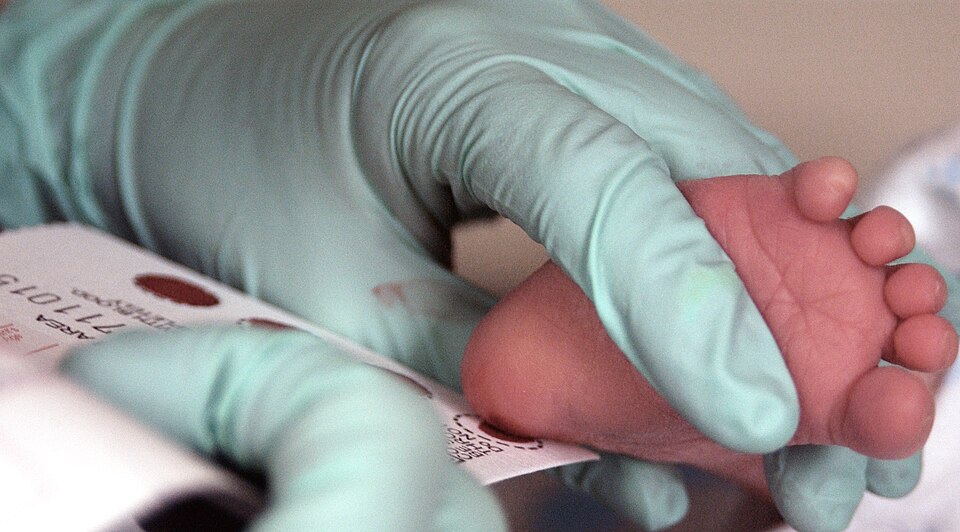
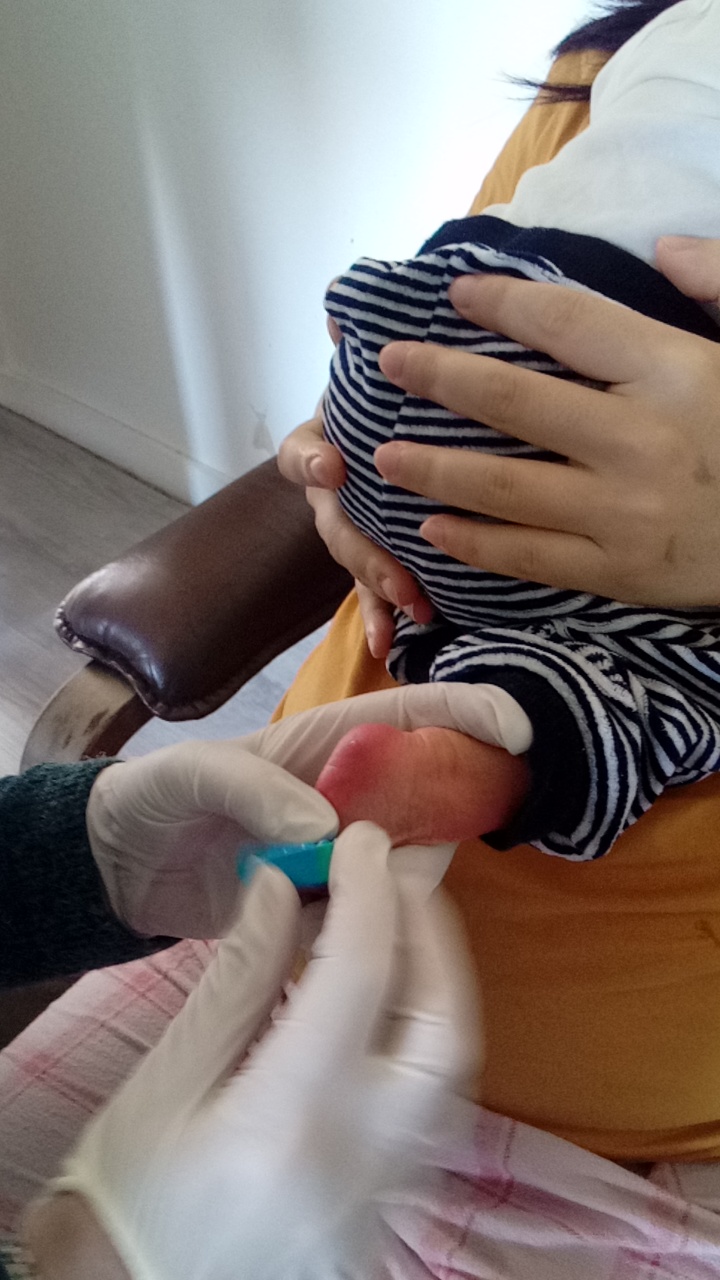
Warm the heel, clean it, and lance the lateral or medial side (never the central pad: the calcaneus is too close and a deep stick can scar the bone). Squeeze a single large drop and let it fall onto the filter card.
What Gets Caught
Six categories. Tap each to see what is on the panel.
The federal RUSP (Recommended Uniform Screening Panel) lists ~35 core conditions. States add another 0 to 30 on top. Every disease here changes outcome only if treatment starts before symptoms appear.
🧬
Amino Acid Disorders
Broken machinery for taking apart specific amino acids. The unprocessed substrate poisons the brain.
Pattern: tandem MS reads which amino acid pile is too tall.
PKU (phenylalanine high) Phe
MSUD (BCAAs and alloisoleucine) Leu/Ile/Val
Homocystinuria (methionine high) Met
Tyrosinemia (tyrosine and succinylacetone) Tyr/SUAC
Citrullinemia (urea cycle, citrulline) Cit
🔥
Fatty Acid Oxidation
The body cannot burn fat for fuel. Skipped feeding turns into hypoglycemia, coma, sudden death.
These seven get tested over and over because the chain from biomarker to intervention to outcome is short and devastating. Memorize the row, not the textbook.
PKU
Biomarker
Phenylalanine high on tandem MS
Move
Phe-restricted formula plus tyrosine within 7 to 10 days
Outcome
Normal IQ, normal growth (catch matters more than diagnosis)
MSUD
Biomarker
BCAAs + alloisoleucine on tandem MS
Move
BCAA-restricted formula immediately. Acts within DAYS to prevent neuro crisis.
Outcome
Avoids ketoacidotic coma, brain edema, death in week one
Congenital Hypothyroidism
Biomarker
TSH high (or low T4 in some state algorithms)
Move
Levothyroxine started in the first 2 weeks of life
Outcome
Normal cognitive development. THE biggest win of newborn screening (~1:3000).
Galactosemia
Biomarker
GALT enzyme low in the dried blood spot
Move
Stop lactose. Switch to soy or elemental formula immediately.
Outcome
Prevents cataracts, liver failure, and the classic E. coli sepsis of week one
CAH (21-OH deficiency)
Biomarker
17-hydroxyprogesterone (17-OHP) high immunoassay
Move
Hydrocortisone plus fludrocortisone, salt added if losing
Outcome
Prevents salt-wasting crisis around day 7 to 14 (vomiting, hyperkalemia, shock)
MCAD Deficiency
Biomarker
C8 acylcarnitine high (octanoylcarnitine)
Move
Avoid fasting. Frequent feeds. IV dextrose during illness.
Outcome
Prevents hypoglycemic coma during a viral illness, prevents some sudden infant deaths
SCID
Biomarker
TRECs absent (T-cell receptor excision circles)
Move
Protective isolation. Bone marrow transplant in the first 3 to 4 months.
Outcome
Survival jumps from near-zero to over 90% when transplanted before any infection
The biggest single win: congenital hypothyroidism. Incidence ~1 in 3000 live births, treatment is one cheap pill (levothyroxine), and started by week 2 of life it gives a totally normal IQ. Untreated, the same baby develops cretinism (severe intellectual disability, short stature, coarse features). No other screening catch produces that much preserved cognition for that little money. This single condition is the reason newborn screening is mandatory in every state.
The Two Non-Blood Screens
Hearing and the heart, before the baby leaves
Two more universal screens happen before discharge. Neither uses the heel-stick blood. Both catch silent disease that the parents could not detect on their own.
Universal Hearing Screen
OAE and AABR before discharge
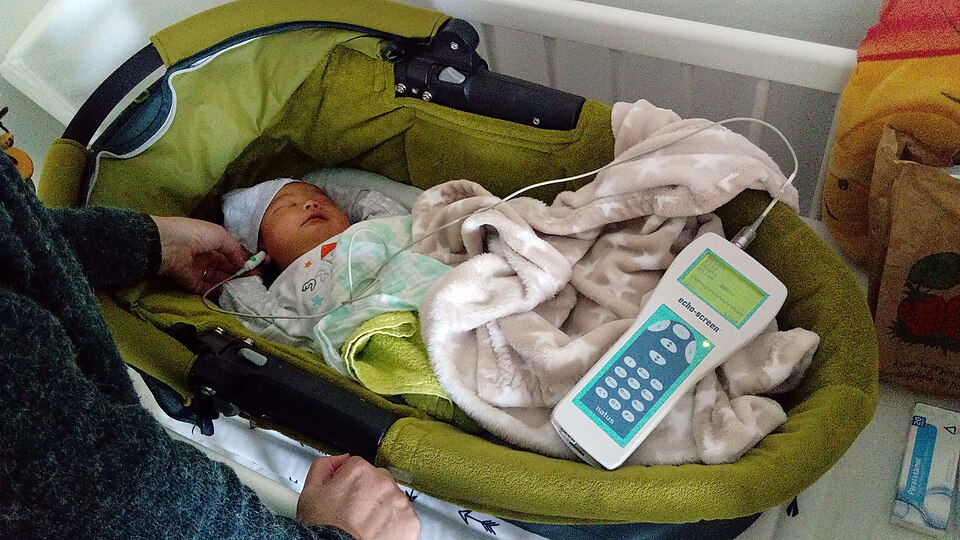
OAE / AABR probe placed gently in the sleeping newborn’s ear. Result is automatic: PASS or REFER.For contrast: the blood-spot card on the same morning. The hearing screen is separate hardware, separate workflow.
When
Before discharge from the hospital, ideally in the first 24 to 48 hours. Repeat as outpatient if first attempt fails.
How (OAE)
Otoacoustic emissions: a soft probe plays clicks into the ear and listens for the cochlea’s answering whisper. A working cochlea hums back. A damaged one is silent.
How (AABR)
Automated auditory brainstem response: scalp electrodes measure the brainstem’s electrical reply to sound. Catches retrocochlear (nerve / brainstem) lesions that an OAE would miss.
Why It Matters
Profound congenital hearing loss is invisible until the child should be talking. Catching it before 6 months and starting cochlear implants or signing preserves language development.
Critical Congenital Heart Disease
CCHD pulse oximetry: hands and feet
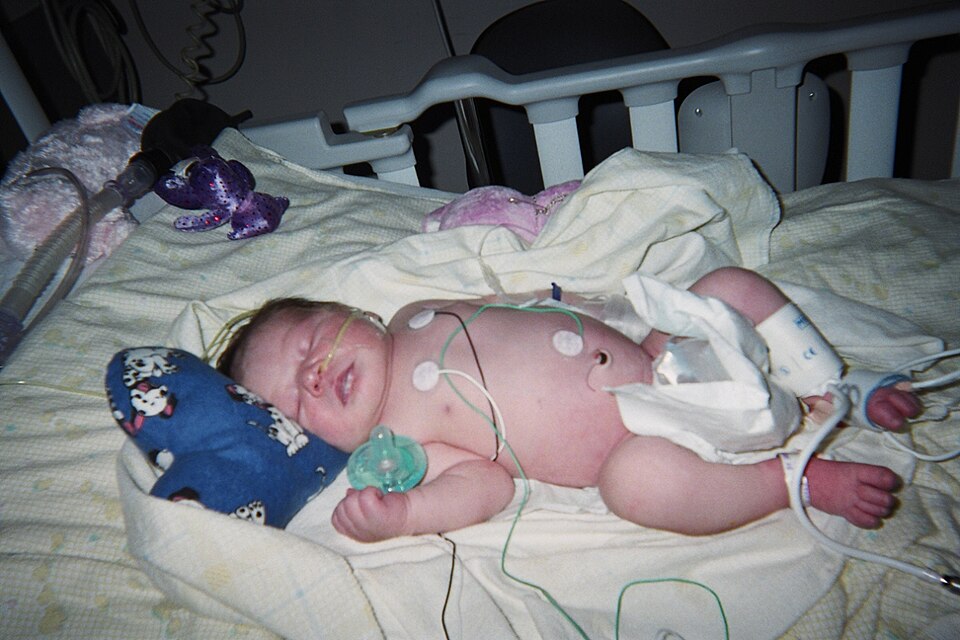
Pulse oximetry probe on a newborn. The CCHD screen compares the right hand (pre-ductal) reading to a foot (post-ductal) reading.The heel-stick card is wet and air-drying nearby. Three universal screens, one morning, no overlap in technology.
When
After 24 hours of life (before, the ductus arteriosus may still be open and confound the reading) and before discharge.
How
Pulse oximetry on the right hand (pre-ductal) and a foot (post-ductal). Pass requires both above 95% and a hand-foot difference of 3% or less.
Catches
Ductal-dependent lesions: hypoplastic left heart, transposition, tetralogy, total anomalous pulmonary venous return, truncus, tricuspid atresia, pulmonary atresia. The ductus closing turns these into shock.
Why It Matters
A failed pulse-ox triggers an echocardiogram before the baby goes home. Starting prostaglandin to reopen the ductus is the difference between a planned surgery and a circulatory collapse on day 5.
Process and Limits
Screen, not diagnosis. Catch, then confirm.
Newborn screening is a triage tool. Its job is to flag babies who deserve a closer look, not to make a final diagnosis. The follow-up is everything.
The Workflow
From heel to family in five days
Day 1
Heel stick at 24 to 48 hours after first feed. Five spots on a Guthrie card. Air dry, mail to state lab.
Days 2 to 4
Lab runs tandem mass spec for amino acids and acylcarnitines, immunoassays for TSH and 17-OHP, enzyme assays (GALT, biotinidase), DNA quant for SCID (TRECs) and SMA.
Day 5
Results back to the pediatrician. Normal results are usually silent. Abnormal results trigger a phone call and confirmatory testing.
Confirm
A positive screen is not a diagnosis. Confirm with quantitative plasma amino acids, urine organic acids, enzyme activity, gene sequencing, or hormone re-measurement. Treatment usually starts pending confirmation when the disease is time-sensitive (MSUD, galactosemia, CAH).
Repeat
Some states do a routine second screen at 1 to 2 weeks of life to catch what the first screen missed (especially congenital hypothyroidism in premature infants).
What It Cannot Do
Limits of the panel
Coverage
~35 conditions on the federal RUSP, plus state-specific additions (range about 35 to 65). Thousands of genetic diseases are NOT screened. Clinical suspicion still drives diagnosis for everything else.
Sensitivity
High but not 100%. False negatives happen, especially when the screen runs too early, when the baby received a transfusion, or in premature infants whose biomarkers are still immature.
Specificity
False positives are common. Every confirmed catch comes with a multiple of false alarms. Counsel families that a positive screen means investigate, not panic.
Premie
Preterm or sick infants have altered biomarkers. The standard protocol includes a repeat at 1 to 2 weeks (and often again at 28 days for very preterm) to catch what the first sample could not.
Symptoms First
If a baby is symptomatic and the screen is normal, do not be falsely reassured. A normal screen does not exclude the disease. Treat the baby in front of you.
Go Deeper
Sister deep-dives on the catches
Each of these conditions has its own page on Bone Wizardry with the full Chicago breakdown of biomarker, mechanism, and treatment.
Medically reviewed by Kaitlyn Cocuzzo, MD and Fatima Ali, DO
Bone Wizardry is an independent educational resource for visual learning in the medical sciences. It is not affiliated with, endorsed by, or sponsored by any licensing or examination board, contains no real or recalled examination questions, and does not guarantee any educational or examination outcome.
 Bone WizardryMEDICAL EDUCATION