Cystic Fibrosis: From Chloride Transport to Clinical Decisions
Build Step 1 CFTR mechanisms, Step 2/3 diagnosis and management, then extend Beyond to surveillance, dosing, complications, counseling and referral.
Start with the causal spine. Step 1 links biallelic CFTR dysfunction to tissue-specific chloride handling, water transport, mucus behavior and salty sweat. Then change the task. Step 2/3 uses that mechanism for diagnosis and management, while Beyond adds surveillance intervals, dosing limits, complications, counseling and referral thresholds.
A child has cough, poor growth and salty skin. Cystic fibrosis (CF) reflects dysfunction of cystic fibrosis transmembrane conductance regulator (CFTR). Which finding unifies the organs, and why does the family history point to two chromosome 7 alleles rather than an X-linked infection disorder? By the end, you should be able to connect inheritance to epithelial transport, interpret a sweat chloride result, and distinguish supportive care from genotype-directed therapy.
Two copies, one from each parent
An infant has a bowel obstruction at birth and later a salty sweat test. A male infant does not make the disorder X-linked. Cystic fibrosis transmembrane conductance regulator (CFTR) is on chromosome 7, an autosome, and cystic fibrosis requires disease-causing variants on both copies. An affected person usually inherited one variant from each parent, who can be healthy carriers. Think about the chromosome and the organ pattern before the patient's sex. [1][8]
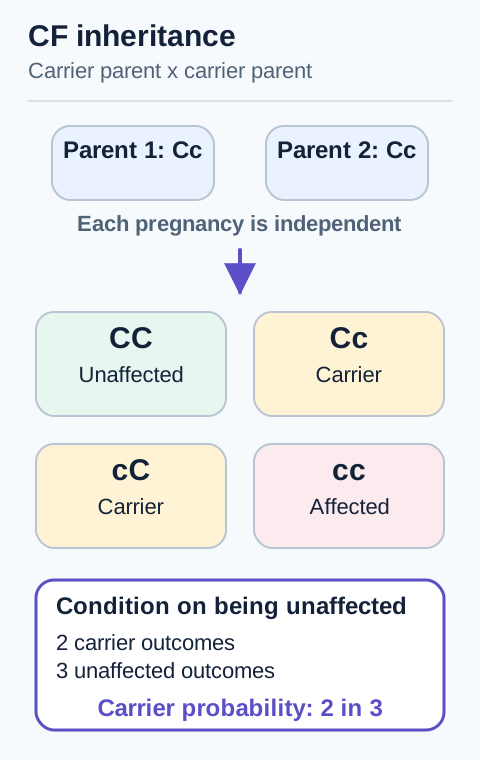
Use C for a functioning copy and c for a disease-causing copy in this simplified cross. Two carrier parents, Cc by Cc, produce CC, Cc, cC and cc with equal probability. Each new pregnancy has a 25% affected chance, a 50% carrier chance and a 25% noncarrier chance. A previous affected or unaffected child does not alter the next conception's independent risk.
A carrier by an affected partner, Cc by cc, yields half affected and half carriers; a noncarrier by an affected partner, CC by cc, yields all carriers and none affected. These numbers assume the stated genotypes, not a population carrier estimate. [1]
The denominator changes when information arrives. For a sibling already known not to have cystic fibrosis (CF), delete the cc outcome. The remaining CC, Cc and cC outcomes are equally likely under the simple cross. Among three unaffected outcomes, two are carriers, so the prior carrier probability is 2 in 3. That is not the 50% chance for an unselected future child. A molecular result changes the prior; do not keep using two-thirds after a definitive test. An unaffected sibling's result is separate from the next pregnancy risk faced by the carrier parents. [1]
Write both parental alleles, then remove the affected outcome before conditioning on an unaffected sibling. [1]
Family patterns help, but a pedigree alone does not establish the diagnosis. Recurrent infections in boys can suggest an X-linked immune defect, whereas intestinal obstruction, malabsorption and salty sweat favor a CFTR problem in either sex. Two affected siblings of either sex with unaffected parents are compatible with recessive inheritance. An affected person can also carry two different CF-causing variants in trans, one on each chromosome 7; the alleles need not have identical names. A report of two variants without phase or pathogenicity is not automatically the same thing as two CF-causing alleles. [4]
Use the inheritance grid as a conditional-probability tool. First write the parental alleles, then remove outcomes already excluded by the stem. An unaffected sibling of an affected child has a two-in-three carrier probability because the affected genotype is no longer in the denominator. [1]
Test the denominator before calculating
Condition on what is already known. For an unaffected sibling of two carriers, keep the unaffected noncarrier and both carrier outcomes, then ask what the partner contributes.
One channel, opposite tissue directions
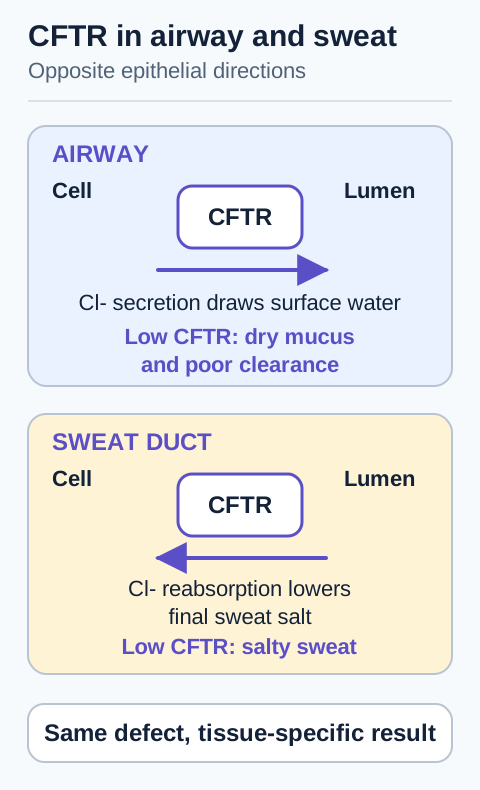
Why can the same variant cause dry airway mucus and salty skin? CFTR is an epithelial chloride channel that regulates salt and water movement. At the airway surface, functioning CFTR moves chloride toward the lumen. Water helps maintain the surface layer so cilia can sweep mucus and trapped organisms outward. When CFTR function is lost, the surface becomes dehydrated; sticky mucus stays put, encouraging obstruction and infection. A cough with repeated lower-airway infection is a consequence of failed clearance, not an isolated immune-cell respiratory-burst defect. [2]
At the sweat duct, the direction matters more than the name of the ion. The duct normally reabsorbs chloride from forming sweat, with sodium reabsorption linked to it. Defective CFTR reduces this salvage, leaving concentrated salt on the skin. Airway failure dries the surface; sweat duct failure leaves chloride in sweat. A high sweat chloride measurement probes CFTR function in a different tissue from the one causing the cough. It is not a serum sodium test, nor does salty skin alone quantify chloride. The diagnostic cutoffs belong to a properly collected quantitative sweat sample. [5]
The same CFTR defect dries airway secretions but leaves excess chloride in final sweat. [2]
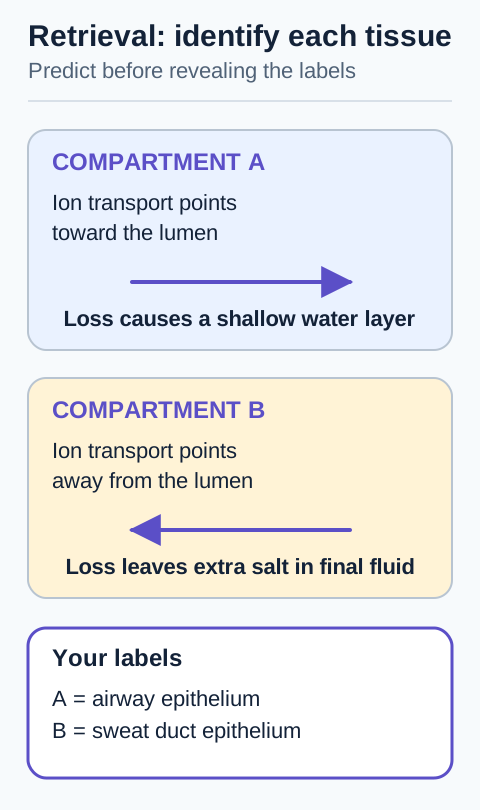
Predict each tissue from the arrow and outcome before reading the answer labels. [2]
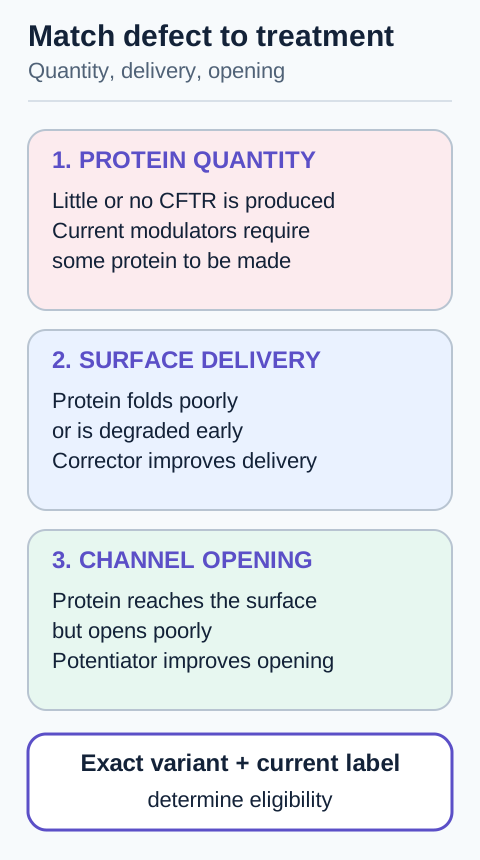
CFTR variants differ in what goes wrong. The phenylalanine 508 deletion (F508del) removes phenylalanine at amino-acid position 508. The altered protein folds poorly and is largely recognized and degraded before it reaches the surface. This is primarily a processing or trafficking defect, not proof that the gene was never transcribed. A gating variant can make surface protein that opens poorly; a premature-stop variant may produce no usable protein. A processing defect and a gating defect call for different mechanistic reasoning even though both reduce chloride transport. Correctors improve folding and delivery; potentiators increase channel opening for protein at the membrane.
The actual treatment choice still requires a confirmed genotype and current eligibility assessment. [3][7][8]
Imagine tracing a water drop. In a functioning airway, chloride reaches the lumen, water supports the airway surface and cilia clear mucus. With severe CFTR dysfunction, each later consequence follows from the missing hydrated layer. In the sweat duct, the same missing channel activity prevents reclamation instead. Avoid transferring the airway arrow to the sweat duct. The transporter is the same; the epithelial job is not. This comparison explains why one test at the skin can support a disease of lungs and pancreas. [2][5]
Salt-rich sweat can cause clinically important volume and chloride depletion, especially in infants during hot weather. The resulting low chloride, low potassium and metabolic alkalosis can resemble a renal salt-wasting disorder. A low urine chloride during depletion indicates that the kidney is conserving chloride rather than causing ongoing chloride loss. Use the respiratory, digestive and exposure history to localize an extrarenal source. This pseudo-Bartter pattern is not, by itself, a cystic fibrosis diagnosis; assessment must include appropriate confirmatory testing after stabilization. [14]
The transport defect comes first. Pseudomonas aeruginosa does not create the channel defect. Reduced CFTR function dehydrates the airway surface, slows mucociliary clearance and creates a setting in which organisms can persist. A later culture with an oxidase-positive gram-negative rod, blue-green pigment and a sweet grape-like odor identifies the organism, but infection is a consequence of the airway environment rather than the inherited cause. [11]
When the organism is tested directly, exotoxin A disables elongation factor 2 by adenosine diphosphate ribosylation. That microbiology finding identifies the organism; it does not replace the transport mechanism that explains why infection recurs. [11]
Predict both compartments before revealing the arrows. In the airway, chloride normally reaches the lumen and water supports the ciliary surface. In the sweat duct, chloride is normally reclaimed from the lumen. Loss of one channel therefore dries one surface and salts the other. [2]
Reveal the two-tissue rule
Airway secretion and sweat reabsorption point in opposite directions. Loss of CFTR lowers airway-surface hydration while leaving excess chloride in final sweat.
Try it here · Checkpoint 1 of 3
Make your prediction before reading the choices. A first attempt is just a starting point.
Case 12
Show answer and explanations for case 12
A. Particle transport increases; ciliary frequency remains similar (Best answer)
Cilia already function at normal frequency under a standardized fluid layer. Restoring the layer should improve cilia-mucus coupling and particle transport without requiring faster ciliary cycling. A hydration rescue can improve clearance without correcting the channel or ciliary motor.
Reasoning steps for option A
Does the option 'Particle transport increases; ciliary frequency remains similar' fit the finding shallow surface liquid?
In this case, cilia already function at normal frequency under a standardized fluid layer. Stem anchor: shallow surface liquid.
After adding slow fluorescent-particle transport, how should the option 'Particle transport increases; ciliary frequency remains similar' be judged?
In this case, restoring the layer should improve cilia-mucus coupling and particle transport without requiring faster ciliary cycling.. Deciding evidence: slow fluorescent-particle transport.
B. Particle transport remains similar; ciliary frequency increases (Why this does not fit)
The intervention restores fluid depth without targeting ciliary motor activity. Hydration-limited clearance predicts better particle transport, not an isolated rise in motor frequency. Separate mechanical coupling through fluid from intrinsic ciliary cycling.
Reasoning steps for option B
Does the option 'Particle transport remains similar; ciliary frequency increases' fit the finding Ciliary frequency is normal?
In this case, the intervention restores fluid depth without targeting ciliary motor activity. Stem anchor: Ciliary frequency is normal.
After adding restore surface liquid depth with isotonic fluid, how should the option 'Particle transport remains similar; ciliary frequency increases' be judged?
In this case, hydration-limited clearance predicts better particle transport, not an isolated rise in motor frequency. Deciding evidence: restore surface liquid depth with isotonic fluid.
C. Particle transport increases; ciliary frequency decreases (Why this does not fit)
A deeper surface layer can improve transport in this dehydrated culture. There is no motor-suppressing intervention or baseline hyperactivity to support a concurrent frequency decrease. Predict only effects supported by the tested limiting mechanism.
Reasoning steps for option C
Does the option 'Particle transport increases; ciliary frequency decreases' fit the finding without changing cystic fibrosis transmembrane conductance regulator (CFTR) activity?
In this case, a deeper surface layer can improve transport in this dehydrated culture. Stem anchor: without changing cystic fibrosis transmembrane conductance regulator (CFTR) activity.
After adding shallow surface liquid, how should the option 'Particle transport increases; ciliary frequency decreases' be judged?
In this case, there is no motor-suppressing intervention or baseline hyperactivity to support a concurrent frequency decrease.. Deciding evidence: shallow surface liquid.
D. Particle transport remains similar; ciliary frequency remains similar (Why this does not fit)
Unchanged ciliary frequency fits a fluid-only intervention. Unchanged particle transport would argue against hydration as the limiting defect specified in the hypothesis. Rescuing a limiting surface-fluid deficit should change the clearance readout.
Reasoning steps for option D
Does the option 'Particle transport remains similar; ciliary frequency remains similar' fit the finding slow fluorescent-particle transport?
In this case, unchanged ciliary frequency fits a fluid-only intervention. Stem anchor: slow fluorescent-particle transport.
After adding Ciliary frequency is normal, how should the option 'Particle transport remains similar; ciliary frequency remains similar' be judged?
In this case, unchanged particle transport would argue against hydration as the limiting defect specified in the hypothesis. Deciding evidence: Ciliary frequency is normal.
Takeaway: A fluid rescue tests whether poor clearance reflects surface hydration rather than a ciliary motor defect.
A newborn with failure to pass meconium and distal intestinal obstruction may have meconium ileus. Tenacious intestinal contents are one early consequence of altered fluid secretion. Later, thick pancreatic secretions can obstruct exocrine ducts, so digestive enzymes fail to reach the gut. Greasy bulky stools and poor growth despite food intake point to fat malabsorption. Fat-soluble vitamins A, D, E and K can become deficient; a prolonged prothrombin time from vitamin K depletion is one possible consequence. The duct problem is different from primary villous injury or simple lactose intolerance. [6]
Think about two separate routes for nutrition. Food can enter normally, yet pancreatic enzymes must reach the intestine to digest it. In a patient with pancreatic insufficiency, enzyme replacement with meals and snacks and nutritional monitoring address this route. Replacement treats the downstream digestive deficit rather than repairing the CFTR gene. If an infant has a positive newborn screen and poor growth, investigate CF with confirmatory testing instead of assuming all poor growth is dietary. A positive screen is a signal to evaluate, not itself a confirmed diagnosis. [6][4]
Airways accumulate dehydrated secretions that impair mucociliary clearance. Repeated infection and inflammation can damage bronchial walls and lead to bronchiectasis, persistent productive cough and clubbing. A culture result matters more than a memorized age sequence: Staphylococcus aureus may be found in younger patients, while mucoid Pseudomonas aeruginosa is important in chronic disease. Do not diagnose a species from green sputum alone. Recurrent sinusitis and nasal polyps can extend the upper-airway pattern; in a child, those findings together with poor growth should prompt CF evaluation. Airway clearance and infection-directed care address different consequences of the same underlying disorder. [2][6]
Reproductive anatomy is another route. Many males with CF have congenital bilateral absence of the vas deferens, causing obstructive azoospermia. Sperm production and testosterone need not be impaired because transport, not testicular production, is the problem. An individual with isolated bilateral absence can have a CFTR-related disorder without meeting full criteria for CF. That distinction prevents the false conclusion that every man with absent vasa has classic multisystem CF.
Genetic evaluation and partner counseling are appropriate in this setting. Thick secretions may also affect hepatobiliary ducts, and the clinical course varies by person. The useful pattern is a channel affecting multiple epithelial surfaces, not a compulsory list of every complication. [8][4][6]
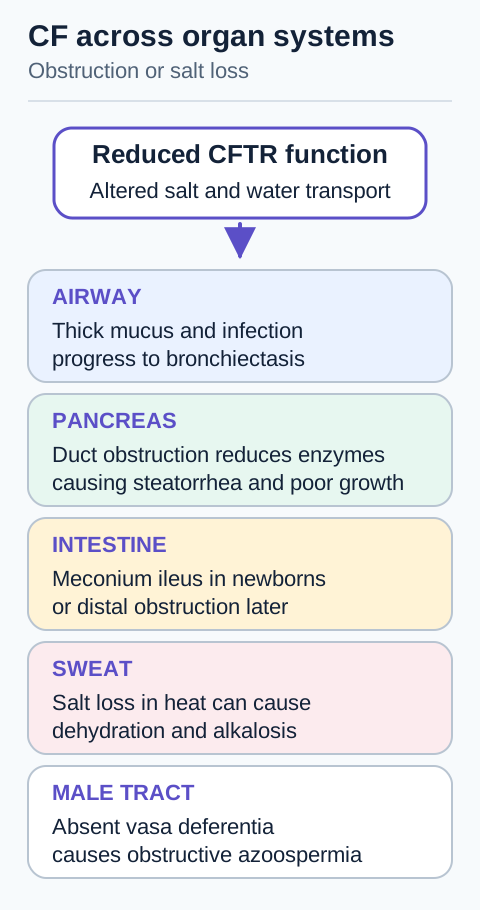
Organ findings become predictable when each is tied to obstruction or salt loss. [1][2][6][14][18]
The organ map is one transport problem expressed through different ducts. Thick secretions obstruct bronchi, pancreatic ducts, the neonatal intestine and the male reproductive tract, while defective sweat-duct reabsorption wastes salt. [6]
The salty infant pattern becomes urgent during heat or illness. Excess sodium chloride loss can produce volume depletion, hyponatremia, hypochloremia and metabolic alkalosis while the kidney appropriately conserves chloride. [14]
Connect poor growth to the blocked route
Food intake can be adequate while digestion fails. Pancreatic enzyme replacement with meals and snacks restores the missing luminal enzymes; unrestricted dietary fat and growth monitoring remain part of care. [18]
A screen starts the question
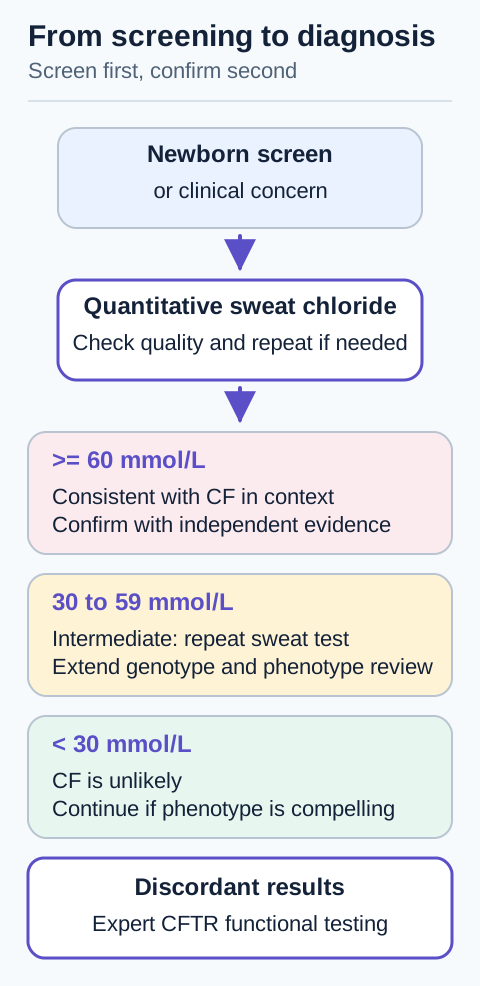
Newborn screening, often beginning with elevated immunoreactive trypsinogen, identifies infants who need diagnostic evaluation. A screen is not the final diagnosis. Quantitative pilocarpine iontophoresis measures sweat chloride using a sufficient properly collected sample. In an individual with a positive screen, compatible symptoms or family history, 60 mmol/L or greater is consistent with CF; 30 through 59 mmol/L is intermediate; under 30 mmol/L makes CF unlikely. The context still matters, especially for a symptomatic person with a low value. [4][5]
Use the sweat category and the full phenotype to select confirmation or extended testing. [4][5][16][17][20]
A positive sweat result needs confirmation on a separate date or with an independent diagnostic method. If genotype data are incomplete, obtain CFTR genetic analysis rather than equating a high sweat value with a known modulator target. Two CF-causing variants on separate alleles support diagnosis, yet the Foundation still calls for sweat confirmation. Conversely, failure to identify two variants on a limited panel does not exclude CF.
A value exactly 60 belongs in the high group; 59 remains intermediate. A value of 29 is in the unlikely group, not an absolute veto if evolving clinical features and genotyping support CF. [4][5]
For an intermediate sweat value on two occasions in a patient with symptoms, family history or a positive screen, further CFTR analysis and possibly functional testing at a validated center are considered. Repeat testing and specialist interpretation are better than forcing a binary label from one borderline number. An asymptomatic screen-positive infant with inconclusive sweat and variant findings may receive a CFTR-related metabolic syndrome/cystic fibrosis screen positive, inconclusive diagnosis (CRMS/CFSPID) designation, with follow-up rather than an unsupported claim of definite CF.
In contrast, bronchiectasis, pancreatitis or congenital bilateral absent vasa associated with CFTR dysfunction can represent a CFTR-related disorder without fulfilling CF diagnostic criteria. These names describe different clinical states, not grades of certainty to assign casually. [4]
Specimen quality is part of interpretation. Insufficient sweat must not be analyzed; conductivity or sweat sodium cannot replace quantitative sweat chloride for diagnosis. For a screen-positive newborn, collection is planned when weight and corrected gestational age support an adequate specimen, and generally after day 10 where those criteria are met. This helps prevent a misleading result from poor collection.
An elevated immunoreactive trypsinogen screen, a variant panel and a sweat value answer different questions: who needs evaluation, what alleles are found and whether CFTR function is impaired. Put them together, rather than treating any one as a complete story. [4][5]
Screening opens the evaluation; it does not diagnose cystic fibrosis. Current newborn-screening algorithms begin with immunoreactive trypsinogen and then use variant testing or another screening tier before referral for quantitative sweat chloride testing. [16]
An inconclusive screen needs scheduled reassessment rather than a premature label. Current guidance supports expanded CFTR analysis when fewer than two disease-causing variants are known, repeat sweat testing and follow-up by clinicians with relevant expertise. [17]
When sweat and genetics remain discordant, expert centers can measure CFTR function with nasal potential difference or intestinal current measurement. These are problem-solving tests for selected inconclusive cases, not population screening tests. [20]
Reveal the diagnostic order
Phenotype, sweat chloride and molecular evidence must agree. A screen raises suspicion, sweat testing measures the transport phenotype, and genotype or functional testing resolves selected uncertain cases.
Try it here · Checkpoint 2 of 3
Make your prediction before reading the choices. A first attempt is just a starting point.
Case 8
Show answer and explanations for case 8
A. Cystic fibrosis supported by compatible disease and demonstrated CFTR dysfunction despite one identified variant (Best answer)
The patient has a multisystem phenotype compatible with CF and repeated intermediate sweat chloride values. When the genotype is incomplete, validated CFTR physiologic testing can supply independent evidence of dysfunction. The normal immune evaluation also weakens a competing antibody-deficiency explanation for the bronchiectasis.
Reasoning steps for option A
Does the option 'Cystic fibrosis supported by compatible disease and demonstrated CFTR dysfunction despite one identified variant' fit the finding chronic sinusitis, bronchiectasis and poor growth?
In this case, the patient has a multisystem phenotype compatible with CF and repeated intermediate sweat chloride values. Stem anchor: chronic sinusitis, bronchiectasis and poor growth.
After adding 46 and 48 mmol/L, how should the option 'Cystic fibrosis supported by compatible disease and demonstrated CFTR dysfunction despite one identified variant' be judged?
In this case, when the genotype is incomplete, validated CFTR physiologic testing can supply independent evidence of dysfunction.. Deciding evidence: 46 and 48 mmol/L.
B. An inconclusive newborn-screen designation based only on one disease-causing allele and intermediate sweat chloride (Why this does not fit)
CRMS/CFSPID is an inconclusive newborn-screen designation rather than a universal label for every older symptomatic patient. This patient has established respiratory disease and an abnormal independent CFTR functional test. This option applies the right vocabulary to the wrong clinical setting.
Reasoning steps for option B
Does the option 'An inconclusive newborn-screen designation based only on one disease-causing allele and intermediate sweat chloride' fit the finding one cystic fibrosis (CF)-causing allele?
The inconclusive-screen designation is reserved for screen-positive infants without an established cystic fibrosis phenotype.
After adding demonstrates CFTR dysfunction, how should the option 'An inconclusive newborn-screen designation based only on one disease-causing allele and intermediate sweat chloride' be judged?
This symptomatic adolescent has intermediate sweat chloride plus independent evidence of CFTR dysfunction, so an infant screening label is insufficient.
C. Unaffected CF carrier because a second CF-causing variant was not found (Why this does not fit)
One identified variant alone can describe carrier status only when the rest of the evidence does not show disease-level CFTR dysfunction. Here the phenotype and validated physiologic result provide additional evidence. This option lets incomplete molecular detection overrule functional and clinical findings.
Reasoning steps for option C
Does the option 'Unaffected CF carrier because a second CF-causing variant was not found' fit the finding vaccine antibody responses are normal?
In this case, one identified variant alone can describe carrier status only when the rest of the evidence does. Stem anchor: vaccine antibody responses are normal.
After adding chronic sinusitis, bronchiectasis and poor growth, how should the option 'Unaffected CF carrier because a second CF-causing variant was not found' be judged?
In this case, here the phenotype and validated physiologic result provide additional evidence. Deciding evidence: chronic sinusitis, bronchiectasis and poor growth.
D. Primary antibody deficiency because recurrent respiratory disease is present despite normal vaccine responses (Why this does not fit)
Bronchiectasis can occur in antibody deficiency, but the supplied immunoglobulin and vaccine-response data do not support that mechanism. The abnormal nasal CFTR study directly supports a different physiologic defect. This option ignores the discriminating functional result.
Reasoning steps for option D
Does the option 'Primary antibody deficiency because recurrent respiratory disease is present despite normal vaccine responses' fit the finding 46 and 48 mmol/L?
In this case, bronchiectasis can occur in antibody deficiency, but the supplied immunoglobulin and vaccine-response data do not support. Stem anchor: 46 and 48 mmol/L.
After adding one cystic fibrosis (CF)-causing allele, how should the option 'Primary antibody deficiency because recurrent respiratory disease is present despite normal vaccine responses' be judged?
In this case, the abnormal nasal CFTR study directly supports a different physiologic defect. Deciding evidence: one cystic fibrosis (CF)-causing allele.
Takeaway: When genotype is incomplete, integrate phenotype, sweat testing and validated CFTR physiology rather than counting variants alone.
Supportive care and molecular therapy solve different problems. Airway clearance helps remove retained secretions; infection management follows clinical assessment and cultures. Pancreatic enzymes and nutritional support address exocrine insufficiency. None of these should be withheld merely because a CFTR modulator is being considered. Conversely, a modulator is not a replacement for all supportive care. Treatment is individualized with a CF team. The purpose here is to predict which protein defect a strategy targets, not prescribe a named regimen from a vignette alone. [6]
A corrector helps a folding or trafficking mutant protein reach and persist at the surface. That mechanism is relevant to F508del, whose protein is largely removed before membrane delivery. A potentiator improves opening of CFTR protein that reaches the surface, a particularly clear fit for a gating defect. A combination can address more than one limitation in an F508del protein.
If a variant prevents any protein production, there may be no channel for a modulator to alter. This is a mechanistic distinction, not a declaration that every person with a given broad mutation class is eligible for one specific product. [3][7]
Identify the protein defect first, then verify exact-variant eligibility in the current label. [3][7][9]
The actual variant pair, phase, current drug labeling, age, interactions and clinical circumstances matter. F508del on one allele may coexist with a second variant that behaves differently. A positive sweat chloride result says CFTR function is impaired; it does not identify a drug-responsive allele. A limited negative genetic screen is not proof that a molecular therapy cannot apply, because further analysis can clarify an allele. Obtain the exact genotype and confirm eligibility with current specialist guidance before choosing a modulator. Do not infer approval or efficacy from the word “gating” or from a single F508del result without those checks. [4][7]
Use a practical comparison. If a laboratory shows little mature protein at the cell surface after F508del expression, ask whether delivery is defective before asking how to hold the gate open. If protein is present but channel opening is poor, a trafficking-only explanation misses the defect. These two experimental observations are not interchangeable. In either case, symptom management, evaluation for pancreatic insufficiency and airway care remain part of the patient picture. The genotype refines a mechanism-based plan; it does not erase the organ consequences already present. [3][6]
There is now disease-modifying therapy for responsive genotypes. A potentiator improves channel opening at the cell surface, while a corrector improves folding, trafficking or stability. These medicines complement rather than erase airway clearance, nutrition, pancreatic enzymes, culture-guided infection care and monitoring. [7][9]
A newly detected airway isolate changes the immediate plan. Current foundation guidance recommends an eradication regimen for initial or new Pseudomonas aeruginosa growth rather than waiting for chronic infection, while routine prophylaxis is not recommended. [19]
Match the laboratory defect to the intervention
Quantity, delivery and opening are separate questions. No mature protein calls for a synthesis or replacement strategy; poor surface delivery supports a corrector; preserved surface abundance with poor opening supports a potentiator.
Make the next decision from the pattern
When repeated infection is the opening finding, ask what else travels with it. A history of meconium ileus, greasy stools and elevated sweat chloride links airway disease to epithelial salt transport. Isolated catalase-positive abscesses with an abnormal oxidative-burst assay instead redirect the reasoning to a phagocyte disorder. Both can have serious infection, but only the first set explains the pancreatic and sweat findings through CFTR. Sex alone is weak evidence. The useful distinction is a multi-organ secretory pattern plus the appropriate functional test. [2][4]
For counseling, write the parental genotypes before calculating. A future pregnancy of two carriers has a 1 in 4 affected risk regardless of prior births. A known-unaffected sibling has a 2 in 3 carrier prior. A carrier married to an affected partner has a 1 in 2 affected risk under the simplified fully penetrant cross. Do not transfer the sibling's conditional denominator to a fetus whose status is not yet known. Likewise, a negative result on a limited variant panel changes but does not necessarily erase residual carrier risk. [1][4]
For testing, first separate screening from diagnosis. A positive newborn screen calls for a sweat test under appropriate collection conditions. At 60 or above, confirm the positive finding and complete genotype evaluation; at 30 to 59, repeat and investigate; below 30, CF is unlikely yet compatible symptoms can still justify further evaluation. A symptomatic adult with bronchiectasis and a low result is not the same situation as a healthy screen-positive infant. The Foundation recognizes CFTR-related disease and inconclusive screen-positive infants as distinct from confirmed CF. [4][5]
For mechanisms, locate the failed step. Surface dehydration predicts retained airway mucus, pancreatic obstruction and often a nutritional deficit. Failed sweat-duct reclamation predicts elevated sweat chloride. F508del is primarily a processing defect; channel presence with poor opening suggests gating instead. A corrector and a potentiator therefore ask different protein questions. Keep the final decision modest: confirm the clinical diagnosis, identify the two alleles when possible, and ask a CF specialist about current genotype-specific therapy. These rules turn a scattered symptom list into a sequence of discriminating decisions without pretending that one finding or one medication fits everyone. [3][7]
Primary ciliary dyskinesia can mimic the airway history. Both disorders can cause chronic wet cough, sinus disease, bronchiectasis and infertility. Situs inversus or dextrocardia strongly favors ciliary disease, although normal organ position does not exclude it; a normal sweat chloride result also redirects the evaluation. [15]
The ciliary disorder is not a chloride-channel disorder. Primary ciliary dyskinesia results from abnormal motile-cilia structure, assembly or function. Some genotypes affect dynein arms, but not every patient has the same ultrastructural lesion, and a normal microscopy result does not exclude the disorder. [15]
Infertility separates by mechanism. In males with cystic fibrosis, the usual problem is obstructive azoospermia from congenital bilateral absence of the vas deferens, with sperm production generally preserved. In primary ciliary dyskinesia, sperm can be present but poorly motile because the flagellum shares motile-cilia machinery. [1][15]
Separate the two mucociliary disorders
Ask what else travels with the airway disease. Salty sweat, pancreatic insufficiency and meconium ileus favor CFTR dysfunction; laterality defects and flagellar immotility favor primary ciliary dyskinesia.
Try it here · Checkpoint 3 of 3
Make your prediction before reading the choices. A first attempt is just a starting point.
Case 26
Show answer and explanations for case 26
A. Epithelial chloride-channel dysfunction with pancreatic duct obstruction (Why this does not fit)
That pattern supports cystic fibrosis, but the normal sweat chloride and laterality defect redirect the diagnosis. Pancreatic or neonatal intestinal findings are not described.
Reasoning steps for option A
Does the option 'Epithelial chloride-channel dysfunction with pancreatic duct obstruction' fit the finding wet cough and upper-airway disease since infancy?
In this case, that pattern supports cystic fibrosis, but the normal sweat chloride and laterality defect redirect the diagnosis.. Stem anchor: wet cough and upper-airway disease since infancy.
After adding bronchiectasis, how should the option 'Epithelial chloride-channel dysfunction with pancreatic duct obstruction' be judged?
In this case, pancreatic or neonatal intestinal findings are not described. Deciding evidence: bronchiectasis.
B. Abnormal motile-cilia structure, assembly or function (Best answer)
Early chronic upper and lower airway disease plus situs inversus is a classic primary ciliary dyskinesia pattern. Motile-cilia dysfunction impairs mucus clearance and embryonic left-right patterning.
Reasoning steps for option B
Does the option 'Abnormal motile-cilia structure, assembly or function' fit the finding situs inversus with dextrocardia?
In this case, early chronic upper and lower airway disease plus situs inversus is a classic primary ciliary dyskinesia. Stem anchor: situs inversus with dextrocardia.
After adding sweat chloride 18 mmol/L, how should the option 'Abnormal motile-cilia structure, assembly or function' be judged?
In this case, motile-cilia dysfunction impairs mucus clearance and embryonic left-right patterning. Deciding evidence: sweat chloride 18 mmol/L.
C. Phagocyte oxidative-burst failure with catalase-positive infection (Why this does not fit)
An oxidative-burst disorder causes invasive bacterial and fungal infection rather than congenital laterality change and lifelong wet cough from failed mucociliary clearance.
Reasoning steps for option C
Does the option 'Phagocyte oxidative-burst failure with catalase-positive infection' fit the finding wet cough and upper-airway disease since infancy?
Oxidative-burst failure explains invasive abscesses, not congenital laterality change with a lifelong wet cough.
After adding bronchiectasis, how should the option 'Phagocyte oxidative-burst failure with catalase-positive infection' be judged?
The bronchiectasis follows failed mucociliary clearance rather than impaired phagocyte killing.
D. Protease-inhibitor polymerization with lower-lobe emphysema (Why this does not fit)
Alpha-1 antitrypsin deficiency can cause early emphysema and liver disease but does not explain situs inversus or chronic otitis from infancy.
Reasoning steps for option D
Does the option 'Protease-inhibitor polymerization with lower-lobe emphysema' fit the finding situs inversus with dextrocardia?
Protease-inhibitor disease can cause emphysema but does not alter embryonic left-right patterning.
After adding sweat chloride 18 mmol/L, how should the option 'Protease-inhibitor polymerization with lower-lobe emphysema' be judged?
Dextrocardia with normal sweat chloride still points to a motile-cilia disorder.
Takeaway: Situs inversus plus lifelong wet airway disease and normal sweat chloride favors primary ciliary dyskinesia.
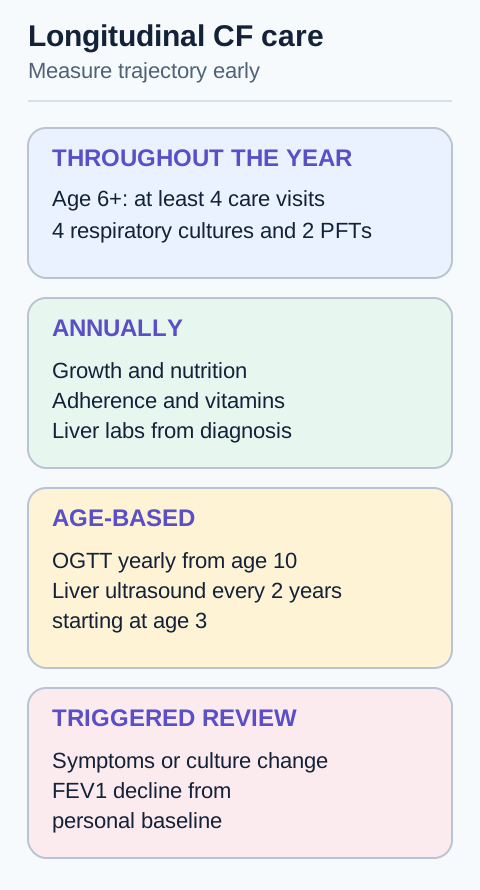
Step 3 reframes CF as longitudinal physiology. A stable visit is a chance to measure lung function, culture the airway, review nutrition, examine treatment burden and detect silent complications before organ reserve falls.
Use a repeatable cadence. For people age 6 years and older, CF Foundation care guidance calls for at least four care-center visits, four respiratory cultures and two pulmonary function tests each year. A new cough, weight change or fall from personal spirometric baseline still merits earlier review. [21]
Scheduled measurements detect trajectory changes and silent complications before symptoms become severe. [18][21][22][23]
Culture before guessing. Airway microbiology can change while symptoms remain mild, so surveillance cultures guide organism-specific decisions. Initial or new Pseudomonas growth is treated as an eradication opportunity rather than accepted as inevitable chronic colonization. [19 [19],21 [21]]
Screen for CFRD even without symptoms. Begin annual screening by age 10 with a 2-hour 75 g oral glucose tolerance test. Hemoglobin A1c alone is not recommended for screening because a value below 6.5 percent does not exclude cystic-fibrosis-related diabetes. [22]
Check the liver during clinical stability. From diagnosis, obtain annual total bilirubin, AST, ALT, alkaline phosphatase, GGT and platelet count. Perform liver and spleen ultrasound at least every two years from age 3 through late adolescence; abnormal findings prompt fibrosis assessment and specialty coordination. [23]
Reassess pancreatic status and growth. Fecal elastase is used to identify pancreatic insufficiency, and pancreatic-sufficient patients need periodic reassessment. Review weight trajectory, stool quality, enzyme timing, fat-soluble vitamins and adherence before simply escalating enzyme dose. [18]
Treat exacerbation as a change from baseline. Increased cough, sputum, dyspnea or an acute spirometric decline can signal a pulmonary exacerbation. Continue chronic lung-health therapies, intensify airway clearance and individualize antimicrobial choice from prior cultures and current susceptibility data. [25]
Do not overstate uncertain antibiotic rules. Current guidance prefers once-daily aminoglycoside dosing over three-times-daily dosing when an aminoglycoside is used, but evidence remains insufficient to prescribe one universal number of antipseudomonal classes or one optimal treatment duration. Routine synergy testing is not recommended. [25]
Plan reproductive care early. Discuss obstructive azoospermia, partner carrier testing, assisted reproduction, pregnancy goals and medication safety before a time-sensitive decision. A person with CF may still produce sperm despite absent vasa deferentia, so infertility counseling is not the same as declaring sterility. [1 [1],8 [8]]
Beyond: current thresholds, dosing and referral
Use current labels, not memory. The examples below reflect U.S. guidance reviewed through October 2, 2026. Confirm the current product label, genotype list, local formulary and patient-specific plan before prescribing.
ALYFTREK is once daily with fat-containing food. For age 6 to under 12 years and weight under 40 kg, the labeled dose is three 4/20/50 mg tablets, totaling vanzacaftor 12 mg, tezacaftor 60 mg and deutivacaftor 150 mg. At 40 kg or more, and for age 12 years or older at any weight, the dose is two 10/50/125 mg tablets, totaling 20/100/250 mg. [9]
Pair modulator selection with safety monitoring. Obtain ALT, AST, alkaline phosphatase and bilirubin before ALYFTREK, monthly for 6 months, every 3 months for the next 12 months, then at least annually. Strong or moderate CYP3A inducers are not recommended; inhibitors require labeled dose adjustment. Pediatric patients need baseline and follow-up eye examinations. [9]
PERT begins in the lower effective range. Older children and adults generally use 500 to 2,500 lipase units/kg/meal and 250 to 1,250 units/kg/snack, titrated to nutrition and malabsorption. Doses above 2,500 units/kg/meal or 4,000 units/g fat require investigation, and doses above 6,000 units/kg/meal have been associated with fibrosing colonopathy. [18]
New Pseudomonas growth has a specific eradication regimen. The CF Foundation strongly recommends inhaled tobramycin 300 mg twice daily for 28 days for initial or new airway growth. It recommends against routine antipseudomonal prophylaxis before acquisition. [19]
Airway clearance is individualized. Every person with CF should perform an airway-clearance therapy, but no single technique is superior for everyone. Aerobic exercise is an adjunct with broad health benefit, not a substitute for the selected airway-clearance method. [24]
Discuss transplant before crisis. Begin transplant discussion when FEV1 is below 50 percent predicted. For adults, refer no later than FEV1 below 50 percent with more than 20 percent relative decline in 12 months, below 40 percent with shortened-survival markers, or below 30 percent. Referral is also indicated regardless of FEV1 for a 6-minute walk under 400 m, hypoxemia, hypercarbia or pulmonary hypertension. [26]
Some thresholds accelerate referral. With FEV1 below 40 percent, referral is recommended for BMI below 18, more than two IV-treated exacerbations per year, one exacerbation requiring positive-pressure ventilation, massive hemoptysis requiring intensive care or embolization, or pneumothorax. Referral opens evaluation and barrier reduction; it does not equal immediate listing. [26]
Know the evidence gaps. Pulmonary exacerbation guidance supports continuing chronic therapies and increasing airway clearance, yet it does not establish one optimal antibiotic duration, one universal number of drug classes or routine corticosteroids. Separate a guideline recommendation from an unresolved question. [25]
Apply the pattern
Case 1
Show answer and explanations for case 1
A. 1 in 12 (Why this does not fit)
Among unaffected offspring of two carriers, two of three are carriers. A 1-in-12 risk would use a 1-in-3 carrier probability before multiplying by 1/4. Count both heterozygous outcomes in the unaffected denominator.
Reasoning steps for option A
Does the option '1 in 12' fit the finding healthy adult?
In this case, among unaffected offspring of two carriers, two of three are carriers. Stem anchor: healthy adult.
After adding both parents are confirmed carriers, how should the option '1 in 12' be judged?
In this case, a 1-in-12 risk would use a 1-in-3 carrier probability before multiplying by 1/4. Deciding evidence: both parents are confirmed carriers.
B. 1 in 4 (Why this does not fit)
Her partner is a confirmed carrier, but she has not been tested. One-quarter is the risk conditional on both partners being carriers, not the combined risk here. Weight the carrier-couple risk by her conditional carrier probability.
Reasoning steps for option B
Does the option '1 in 4' fit the finding Her partner is a confirmed carrier?
In this case, her partner is a confirmed carrier, but she has not been tested. Stem anchor: Her partner is a confirmed carrier.
After adding complete penetrance, how should the option '1 in 4' be judged?
In this case, one-quarter is the risk conditional on both partners being carriers, not the combined risk here. Deciding evidence: complete penetrance.
C. 1 in 6 (Best answer)
Excluding the affected outcome leaves two carrier outcomes among three unaffected outcomes. Multiply her 2/3 carrier probability by the 1/4 affected risk for two carriers to obtain 1/6. Condition on her unaffected status before calculating the child risk.
Reasoning steps for option C
Does the option '1 in 6' fit the finding healthy adult?
In this case, excluding the affected outcome leaves two carrier outcomes among three unaffected outcomes. Stem anchor: healthy adult.
After adding both parents are confirmed carriers, how should the option '1 in 6' be judged?
In this case, multiply her 2/3 carrier probability by the 1/4 affected risk for two carriers to obtain 1/6. Deciding evidence: both parents are confirmed carriers.
D. 1 in 8 (Why this does not fit)
The woman is already known to be unaffected under complete penetrance. Using 1/2 as her carrier probability and multiplying by 1/4 gives 1/8 but retains the wrong denominator. One-half is the unconditioned carrier probability at conception.
Reasoning steps for option D
Does the option '1 in 8' fit the finding Her partner is a confirmed carrier?
In this case, the woman is already known to be unaffected under complete penetrance. Stem anchor: Her partner is a confirmed carrier.
After adding complete penetrance, how should the option '1 in 8' be judged?
In this case, using 1/2 as her carrier probability and multiplying by 1/4 gives 1/8 but retains the wrong denominator. Deciding evidence: complete penetrance.
Takeaway: Condition on unaffected status before calculating reproductive risk.
Among negative results, missed carriers contribute 1/15 and noncarriers contribute 1/3. Dividing the missed-carrier contribution by the total negative probability yields a posterior carrier risk of 1/6; multiplying by 1/4 gives 1/24. Normalize over all negative results before applying the reproductive cross.
Reasoning steps for option A
Does the option '1 in 24' fit the finding initial 2 in 3 carrier probability?
In this case, negative results include missed carriers, (2/3)(0.10), and noncarriers, 1/3. Stem anchor: initial 2 in 3 carrier probability.
After adding identifies 90% of carriers, how should the option '1 in 24' be judged?
In this case, the posterior carrier probability is (1/15)/(1/15+1/3)=1/6; multiplying by 1/4 gives 1/24. Deciding evidence: identifies 90% of carriers.
B. 1 in 40 (Why this does not fit)
The assay misses 10% of carriers, but the prior carrier probability is 2/3. Using 0.10 as a posterior and multiplying by 1/4 gives 1/40, confusing a test likelihood with carrier probability. A false-negative rate is conditional on being a carrier, not on testing negative.
Reasoning steps for option B
Does the option '1 in 40' fit the finding no false positives?
In this case, the assay misses 10% of carriers, but the prior carrier probability is 2/3. Stem anchor: no false positives.
After adding result is negative, how should the option '1 in 40' be judged?
In this case, using 0.10 as a posterior and multiplying by 1/4 gives 1/40, confusing a test likelihood with. Deciding evidence: result is negative.
C. 1 in 60 (Why this does not fit)
The missed-carrier fraction is (2/3)(0.10)=1/15 of the initial population. Multiplying that fraction by 1/4 gives 1/60 without conditioning on the observed negative test. Divide by the total negative-test probability before calculating offspring risk.
Reasoning steps for option C
Does the option '1 in 60' fit the finding partner is a confirmed carrier?
In this case, the missed-carrier fraction is (2/3)(0.10)=1/15 of the initial population. Stem anchor: partner is a confirmed carrier.
After adding initial 2 in 3 carrier probability, how should the option '1 in 60' be judged?
In this case, multiplying that fraction by 1/4 gives 1/60 without conditioning on the observed negative test. Deciding evidence: initial 2 in 3 carrier probability.
D. 1 in 6 (Why this does not fit)
The negative test changes the maternal carrier probability to 1/6. An affected child also requires transmission of a disease-causing allele from each carrier, a 1/4 event. Do not equate a parental carrier posterior with an offspring affected risk.
Reasoning steps for option D
Does the option '1 in 6' fit the finding identifies 90% of carriers?
In this case, the negative test changes the maternal carrier probability to 1/6. Stem anchor: identifies 90% of carriers.
After adding no false positives, how should the option '1 in 6' be judged?
In this case, an affected child also requires transmission of a disease-causing allele from each carrier, a 1/4 event. Deciding evidence: no false positives.
Takeaway: A negative assay changes the carrier prior through Bayes; inheritance adds a separate probability.
A. CF remains unconfirmed because a variant of uncertain significance (VUS) cannot contribute to diagnosis even when sweat chloride is repeatedly high (Why this does not fit)
A VUS cannot be counted as a proven CF-causing allele. However, the diagnosis is not dependent on proving that VUS when compatible disease is accompanied by repeated abnormal cystic fibrosis transmembrane conductance regulator (CFTR) functional testing. This option incorrectly lets molecular uncertainty erase independent functional evidence.
Reasoning steps for option A
Does the option 'CF remains unconfirmed because a variant of uncertain significance (VUS) cannot contribute to diagnosis even when sweat chloride is repeatedly high' fit the finding recurrent pneumonia and pancreatic steatorrhea?
In this case, a VUS cannot be counted as a proven CF-causing allele. Stem anchor: recurrent pneumonia and pancreatic steatorrhea.
After adding 76 mmol/L, how should the option 'CF remains unconfirmed because a variant of uncertain significance (VUS) cannot contribute to diagnosis even when sweat chloride is repeatedly high' be judged?
In this case, however, the diagnosis is not dependent on proving that VUS when compatible disease is accompanied by. Deciding evidence: 76 mmol/L.
B. The VUS is now disease-causing because it is in trans with a CF-causing variant (Why this does not fit)
Parental testing can establish that two variants occupy opposite alleles. Phase does not establish the pathogenicity of an uncertain variant. This option correctly reads phase but overstates what phase can prove about variant consequence.
Reasoning steps for option B
Does the option 'The VUS is now disease-causing because it is in trans with a CF-causing variant' fit the finding 74 mmol/L?
In this case, parental testing can establish that two variants occupy opposite alleles. Stem anchor: 74 mmol/L.
After adding variant of uncertain significance, how should the option 'The VUS is now disease-causing because it is in trans with a CF-causing variant' be judged?
In this case, phase does not establish the pathogenicity of an uncertain variant. Deciding evidence: variant of uncertain significance.
C. The repeat sweat result should be ignored until the VUS mechanism is proven (Why this does not fit)
A second adequate sweat chloride above the diagnostic threshold is independent functional evidence. The unresolved VUS remains a separate molecular question rather than a reason to discard the repeat test. This option reverses the proper relationship between functional confirmation and variant classification.
Reasoning steps for option C
Does the option 'The repeat sweat result should be ignored until the VUS mechanism is proven' fit the finding in trans?
In this case, a second adequate sweat chloride above the diagnostic threshold is independent functional evidence. Stem anchor: in trans.
After adding recurrent pneumonia and pancreatic steatorrhea, how should the option 'The repeat sweat result should be ignored until the VUS mechanism is proven' be judged?
In this case, the unresolved VUS remains a separate molecular question rather than a reason to discard the repeat test. Deciding evidence: recurrent pneumonia and pancreatic steatorrhea.
D. Repeated functional evidence supports CF; trans phase alone does not establish VUS pathogenicity (Best answer)
The compatible respiratory and pancreatic phenotype is accompanied by two adequate sweat chloride values above 60 mmol/L. The trans result answers phase but does not reclassify the VUS as disease-causing. The two results therefore strengthen functional diagnosis while leaving the uncertain variant's pathogenicity unresolved.
Reasoning steps for option D
Does the option 'Repeated functional evidence supports CF; trans phase alone does not establish VUS pathogenicity' fit the finding 76 mmol/L?
In this case, the compatible respiratory and pancreatic phenotype is accompanied by two adequate sweat chloride values above 60. Stem anchor: 76 mmol/L.
After adding 74 mmol/L, how should the option 'Repeated functional evidence supports CF; trans phase alone does not establish VUS pathogenicity' be judged?
In this case, the trans result answers phase but does not reclassify the VUS as disease-causing. Deciding evidence: 74 mmol/L.
Takeaway: Repeated CFTR functional evidence and variant classification answer related but distinct diagnostic questions.
One-quarter is the affected risk for a carrier-by-carrier cross before any fetal result. Here one parent is affected and therefore contributes a CF-causing allele to every conception. This option uses the wrong parental cross and ignores the conditional fetal result.
Reasoning steps for option A
Does the option '25%' fit the finding genetically confirmed cystic fibrosis (CF)?
In this case, one-quarter is the affected risk for a carrier-by-carrier cross before any fetal result. Stem anchor: genetically confirmed cystic fibrosis (CF).
After adding confirmed carrier, how should the option '25%' be judged?
In this case, here one parent is affected and therefore contributes a CF-causing allele to every conception. Deciding evidence: confirmed carrier.
B. 100% (Best answer)
An affected parent contributes a CF-causing allele to every child under the stated assumptions. The fetal assay already establishes inheritance of the carrier partner's CF-causing allele. Conditioned on that result, the fetus has disease-causing alleles from both parents and is therefore affected.
Reasoning steps for option B
Does the option '100%' fit the finding affected risk for each conception is 50%?
In this case, an affected parent contributes a CF-causing allele to every child under the stated assumptions. Stem anchor: affected risk for each conception is 50%.
After adding inherited the carrier partner's CF-causing allele, how should the option '100%' be judged?
In this case, the fetal assay already establishes inheritance of the carrier partner's CF-causing allele. Deciding evidence: inherited the carrier partner's CF-causing allele.
C. 50% (Why this does not fit)
Fifty percent is the pretest affected risk for an affected-by-carrier conception. The fetal result is not neutral because it establishes that the carrier partner transmitted the disease-causing allele. This option fails to update the prior risk after new fetal information.
Reasoning steps for option C
Does the option '50%' fit the finding genetically confirmed cystic fibrosis (CF)?
In this case, fifty percent is the pretest affected risk for an affected-by-carrier conception. Stem anchor: genetically confirmed cystic fibrosis (CF).
After adding confirmed carrier, how should the option '50%' be judged?
In this case, the fetal result is not neutral because it establishes that the carrier partner transmitted the disease-causing. Deciding evidence: confirmed carrier.
D. 0% (Why this does not fit)
The fetus inherited a CF-causing allele from the carrier partner rather than the functioning allele. The affected parent necessarily contributes another CF-causing allele under the stated genotype. This option reverses the implication of the fetal result.
Reasoning steps for option D
Does the option '0%' fit the finding affected risk for each conception is 50%?
In this case, the fetus inherited a CF-causing allele from the carrier partner rather than the functioning allele. Stem anchor: affected risk for each conception is 50%.
After adding inherited the carrier partner's CF-causing allele, how should the option '0%' be judged?
In this case, the affected parent necessarily contributes another CF-causing allele under the stated genotype. Deciding evidence: inherited the carrier partner's CF-causing allele.
Takeaway: Update a Mendelian prior when fetal testing reveals which parental allele was transmitted.
A. Repeat blood immunoreactive trypsinogen; obtain fecal elastase (Why this does not fit)
Greasy stools suggest pancreatic maldigestion, for which fecal elastase is relevant. Repeating the screening marker would not confirm the high quantitative sweat result. Use a diagnostic cystic fibrosis transmembrane conductance regulator (CFTR) test rather than repeating a screening signal.
Reasoning steps for option A
Does the option 'Repeat blood immunoreactive trypsinogen; obtain fecal elastase' fit the finding poor weight gain despite adequate intake?
In this case, greasy stools suggest pancreatic maldigestion, for which fecal elastase is relevant. Stem anchor: poor weight gain despite adequate intake.
After adding bulky greasy stools, how should the option 'Repeat blood immunoreactive trypsinogen; obtain fecal elastase' be judged?
In this case, repeating the screening marker would not confirm the high quantitative sweat result. Deciding evidence: bulky greasy stools.
B. Determine parental variant phase; obtain fecal elastase (Why this does not fit)
Fecal elastase addresses the digestive phenotype. Only one allele has been detected, so parental segregation of that allele cannot establish two CF-causing variants in trans. A single-variant segregation study cannot supply independent diagnostic confirmation.
Reasoning steps for option B
Does the option 'Determine parental variant phase; obtain fecal elastase' fit the finding 72 mmol/L?
In this case, fecal elastase addresses the digestive phenotype. Stem anchor: 72 mmol/L.
After adding one cystic fibrosis (CF)-causing allele, how should the option 'Determine parental variant phase; obtain fecal elastase' be judged?
In this case, only one allele has been detected, so parental segregation of that allele cannot establish two CF-causing. Deciding evidence: one cystic fibrosis (CF)-causing allele.
C. Repeat quantitative sweat chloride; obtain stool reducing substances (Why this does not fit)
A repeat sweat test addresses confirmation. Stool reducing substances investigate carbohydrate malabsorption, whereas bulky greasy stools despite intake favor fat maldigestion. Choose the digestive assay that matches the stool phenotype.
Reasoning steps for option C
Does the option 'Repeat quantitative sweat chloride; obtain stool reducing substances' fit the finding second sweat test has not been done?
In this case, a repeat sweat test addresses confirmation. Stem anchor: second sweat test has not been done.
After adding poor weight gain despite adequate intake, how should the option 'Repeat quantitative sweat chloride; obtain stool reducing substances' be judged?
In this case, stool reducing substances investigate carbohydrate malabsorption, whereas bulky greasy stools despite intake favor fat maldigestion.. Deciding evidence: poor weight gain despite adequate intake.
D. Repeat quantitative sweat chloride; obtain fecal elastase (Best answer)
One adequate high sweat value needs confirmation, and greasy stools accompany poor growth despite intake. Repeat sweat testing confirms the functional finding while fecal elastase assesses pancreatic exocrine output. Investigate both diagnostic certainty and the organ deficit responsible for symptoms.
Reasoning steps for option D
Does the option 'Repeat quantitative sweat chloride; obtain fecal elastase' fit the finding bulky greasy stools?
In this case, one adequate high sweat value needs confirmation, and greasy stools accompany poor growth despite intake. Stem anchor: bulky greasy stools.
After adding 72 mmol/L, how should the option 'Repeat quantitative sweat chloride; obtain fecal elastase' be judged?
In this case, repeat sweat testing confirms the functional finding while fecal elastase assesses pancreatic exocrine output. Deciding evidence: 72 mmol/L.
Takeaway: Confirm a high diagnostic sweat result and evaluate the specific digestive deficit.
A. Confirmed cystic fibrosis; begin routine multisystem complication surveillance (Why this does not fit)
Intermediate sweat values and one disease-causing allele raise concern for CFTR dysfunction. They do not establish CF in this asymptomatic infant, so a confirmed-CF classification exceeds the evidence. Intermediate results require follow-up without assuming a definitive diagnosis.
Reasoning steps for option A
Does the option 'Confirmed cystic fibrosis; begin routine multisystem complication surveillance' fit the finding asymptomatic 6-week-old?
In this case, intermediate sweat values and one disease-causing allele raise concern for CFTR dysfunction. Stem anchor: asymptomatic 6-week-old.
After adding 43 and 45 mmol/L, how should the option 'Confirmed cystic fibrosis; begin routine multisystem complication surveillance' be judged?
In this case, they do not establish CF in this asymptomatic infant, so a confirmed-CF classification exceeds the evidence. Deciding evidence: 43 and 45 mmol/L.
B. Inconclusive newborn-screen result; arrange specialty review and repeat sweat testing (Best answer)
CFTR-related metabolic syndrome/cystic fibrosis screen positive, inconclusive diagnosis (CRMS/CFSPID) describes this asymptomatic screen-positive infant with intermediate sweat chloride and fewer than two CF-causing variants. Specialty follow-up and repeat sweat testing address a possible later diagnostic change without declaring confirmed cystic fibrosis. An inconclusive result requires reassessment rather than either dismissal or a premature diagnosis.
Reasoning steps for option B
Does the option 'Inconclusive newborn-screen result; arrange specialty review and repeat sweat testing' fit the finding one cystic fibrosis (CF)-causing variant?
In this case, cFTR-related metabolic syndrome/cystic fibrosis screen positive, inconclusive diagnosis (CRMS/CFSPID) describes this asymptomatic screen-positive infant with intermediate. Stem anchor: one cystic fibrosis (CF)-causing variant.
After adding Growth and fecal elastase are normal, how should the option 'Inconclusive newborn-screen result; arrange specialty review and repeat sweat testing' be judged?
In this case, specialty follow-up and repeat sweat testing address a possible later diagnostic change without declaring confirmed cystic. Deciding evidence: Growth and fecal elastase are normal.
C. Carrier without unresolved disease; continue usual pediatric growth surveillance (Why this does not fit)
One identified disease-causing allele is compatible with carrier status. Carrier-only follow-up does not address the repeated intermediate functional findings after a positive screen. A molecular carrier result does not resolve discordant functional testing.
Reasoning steps for option C
Does the option 'Carrier without unresolved disease; continue usual pediatric growth surveillance' fit the finding asymptomatic 6-week-old?
In this case, one identified disease-causing allele is compatible with carrier status. Stem anchor: asymptomatic 6-week-old.
After adding 43 and 45 mmol/L, how should the option 'Carrier without unresolved disease; continue usual pediatric growth surveillance' be judged?
In this case, carrier-only follow-up does not address the repeated intermediate functional findings after a positive screen. Deciding evidence: 43 and 45 mmol/L.
D. Single-organ CFTR-related disorder; arrange surveillance for the affected organ (Why this does not fit)
A CFTR-related disorder may involve a single affected organ without full CF. This infant has no symptomatic organ disorder and instead entered evaluation through newborn screening. Distinguish an inconclusive infant screen from a symptomatic CFTR-associated disorder.
Reasoning steps for option D
Does the option 'Single-organ CFTR-related disorder; arrange surveillance for the affected organ' fit the finding one cystic fibrosis (CF)-causing variant?
In this case, a CFTR-related disorder may involve a single affected organ without full CF. Stem anchor: one cystic fibrosis (CF)-causing variant.
After adding Growth and fecal elastase are normal, how should the option 'Single-organ CFTR-related disorder; arrange surveillance for the affected organ' be judged?
In this case, this infant has no symptomatic organ disorder and instead entered evaluation through newborn screening. Deciding evidence: Growth and fecal elastase are normal.
Takeaway: An inconclusive screen-positive infant needs longitudinal diagnostic reassessment.
A. The negative familial-deletion result excludes CF, so no further CFTR analysis is useful (Why this does not fit)
The sibling's deletion is absent in the teenager. A CF-typical functional result still supplies independent evidence of CFTR dysfunction despite the low sweat value. This option incorrectly treats absence of one familial lesion as exclusion of every possible second CFTR defect.
Reasoning steps for option A
Does the option 'The negative familial-deletion result excludes CF, so no further CFTR analysis is useful' fit the finding does not carry the familial deletion?
In this case, the sibling's deletion is absent in the teenager. Stem anchor: does not carry the familial deletion.
After adding CF-typical CFTR dysfunction, how should the option 'The negative familial-deletion result excludes CF, so no further CFTR analysis is useful' be judged?
In this case, a CF-typical functional result still supplies independent evidence of CFTR dysfunction despite the low sweat value.. Deciding evidence: CF-typical CFTR dysfunction.
B. The low sweat chloride excludes CFTR dysfunction, so the nasal result should be disregarded (Why this does not fit)
A low sweat chloride makes classic CF less likely but is not an absolute veto in a compatible phenotype. The validated nasal test is specifically provided as independent evidence of CFTR dysfunction. This option discards the result that resolves the discordance instead of integrating it.
Reasoning steps for option B
Does the option 'The low sweat chloride excludes CFTR dysfunction, so the nasal result should be disregarded' fit the finding bronchiectasis and pancreatic insufficiency?
In this case, a low sweat chloride makes classic CF less likely but is not an absolute veto in a compatible phenotype. Stem anchor: bronchiectasis and pancreatic insufficiency.
After adding 24 mmol/L, how should the option 'The low sweat chloride excludes CFTR dysfunction, so the nasal result should be disregarded' be judged?
In this case, the validated nasal test is specifically provided as independent evidence of CFTR dysfunction. Deciding evidence: 24 mmol/L.
C. The sibling's deletion is not the teenager's second allele; pursue comprehensive CFTR analysis for a different second defect (Best answer)
Targeted testing rules out the known familial deletion as the missing allele in this teenager. The compatible multisystem phenotype and abnormal nasal physiology keep CFTR dysfunction clinically relevant. Comprehensive CFTR analysis is therefore appropriate to look for a different second defect rather than repeating the hotspot panel.
Reasoning steps for option C
Does the option "The sibling's deletion is not the teenager's second allele; pursue comprehensive CFTR analysis for a different second defect" fit the finding does not carry the familial deletion?
In this case, targeted testing rules out the known familial deletion as the missing allele in this teenager. Stem anchor: does not carry the familial deletion.
After adding CF-typical CFTR dysfunction, how should the option "The sibling's deletion is not the teenager's second allele; pursue comprehensive CFTR analysis for a different second defect" be judged?
In this case, the compatible multisystem phenotype and abnormal nasal physiology keep CFTR dysfunction clinically relevant. Deciding evidence: CF-typical CFTR dysfunction.
D. Repeat the same hotspot panel because the sibling's deletion proves that the panel can detect copy-number changes (Why this does not fit)
The original hotspot panel explicitly did not establish the sibling's copy-number lesion in this teenager. A repeat of the same limited method does not address a different second variant class. This option confuses a known family lesion with the capabilities of the limited panel.
Reasoning steps for option D
Does the option "Repeat the same hotspot panel because the sibling's deletion proves that the panel can detect copy-number changes" fit the finding bronchiectasis and pancreatic insufficiency?
In this case, the original hotspot panel explicitly did not establish the sibling's copy-number lesion in this teenager. Stem anchor: bronchiectasis and pancreatic insufficiency.
After adding 24 mmol/L, how should the option "Repeat the same hotspot panel because the sibling's deletion proves that the panel can detect copy-number changes" be judged?
In this case, a repeat of the same limited method does not address a different second variant class. Deciding evidence: 24 mmol/L.
Takeaway: A negative familial-variant test narrows one mechanism; independent CFTR dysfunction can justify broader analysis for another.
A. Collect at 40 weeks corrected age; classify 58 mmol/L as diagnostic of CF (Why this does not fit)
The infant already meets the stated age, weight and corrected-gestation conditions for prompt collection. A chloride value of 58 mmol/L remains in the intermediate range rather than the diagnostic high range. This option adds an unnecessary delay and misclassifies the result.
Reasoning steps for option A
Does the option 'Collect at 40 weeks corrected age; classify 58 mmol/L as diagnostic of CF' fit the finding 12 days old?
In this case, the infant already meets the stated age, weight and corrected-gestation conditions for prompt collection. Stem anchor: 12 days old.
After adding 2.2 kg, how should the option 'Collect at 40 weeks corrected age; classify 58 mmol/L as diagnostic of CF' be judged?
In this case, a chloride value of 58 mmol/L remains in the intermediate range rather than the diagnostic high range. Deciding evidence: 2.2 kg.
B. Collect once weight reaches 3 kg; classify 58 mmol/L as making CF unlikely (Why this does not fit)
A 3-kg threshold is not required by the supplied collection criteria. A result of 58 mmol/L is intermediate, not in the less-than-30 range that makes CF unlikely. Both the timing and interpretation are incorrect.
Reasoning steps for option B
Does the option 'Collect once weight reaches 3 kg; classify 58 mmol/L as making CF unlikely' fit the finding 37 weeks corrected gestational age?
In this case, a 3-kg threshold is not required by the supplied collection criteria. Stem anchor: 37 weeks corrected gestational age.
After adding quantity-not-sufficient, how should the option 'Collect once weight reaches 3 kg; classify 58 mmol/L as making CF unlikely' be judged?
In this case, a result of 58 mmol/L is intermediate, not in the less-than-30 range that makes CF unlikely. Deciding evidence: quantity-not-sufficient.
C. Repeat blood screening before collection; classify 58 mmol/L as another positive screen (Why this does not fit)
The newborn screen already established the need for diagnostic evaluation and does not replace sweat chloride testing. Sweat chloride is a diagnostic functional measurement rather than another screening result. This option confuses the roles of screening and diagnostic testing.
Reasoning steps for option C
Does the option 'Repeat blood screening before collection; classify 58 mmol/L as another positive screen' fit the finding 58 mmol/L?
In this case, the newborn screen already established the need for diagnostic evaluation and does not replace sweat chloride. Stem anchor: 58 mmol/L.
After adding 12 days old, how should the option 'Repeat blood screening before collection; classify 58 mmol/L as another positive screen' be judged?
In this case, sweat chloride is a diagnostic functional measurement rather than another screening result. Deciding evidence: 12 days old.
D. Collect sweat promptly now; classify 58 mmol/L as intermediate and continue evaluation (Best answer)
The infant is older than 10 days, above 2 kg and at least 36 weeks corrected gestational age, so prompt recollection is appropriate after a quantity-not-sufficient attempt. An adequate value of 58 mmol/L falls in the 30 through 59 mmol/L intermediate range. The next step is continued diagnostic evaluation rather than declaring definite CF or dismissing the screen.
Reasoning steps for option D
Does the option 'Collect sweat promptly now; classify 58 mmol/L as intermediate and continue evaluation' fit the finding 2.2 kg?
In this case, the infant is older than 10 days, above 2 kg and at least 36 weeks corrected. Stem anchor: 2.2 kg.
After adding 37 weeks corrected gestational age, how should the option 'Collect sweat promptly now; classify 58 mmol/L as intermediate and continue evaluation' be judged?
In this case, an adequate value of 58 mmol/L falls in the 30 through 59 mmol/L intermediate range. Deciding evidence: 37 weeks corrected gestational age.
Takeaway: Specimen readiness and chloride interpretation are separate decisions: collect when ready, then act on the measured range.
A. Primary renal sodium-chloride loss; continued urinary chloride wasting (Why this does not fit)
The alkalosis and low potassium can occur in a renal salt-wasting disorder. Urine chloride of 4 mmol/L during volume depletion instead shows renal chloride conservation and argues against ongoing primary renal chloride wasting. Interpret the urinary response before assigning the kidney as the source of salt loss.
Reasoning steps for option A
Does the option 'Primary renal sodium-chloride loss; continued urinary chloride wasting' fit the finding recurrent cough, bulky greasy stools and poor weight gain?
In this case, the alkalosis and low potassium can occur in a renal salt-wasting disorder. Stem anchor: recurrent cough, bulky greasy stools and poor weight gain.
After adding after several hot days, how should the option 'Primary renal sodium-chloride loss; continued urinary chloride wasting' be judged?
In this case, urine chloride of 4 mmol/L during volume depletion instead shows renal chloride conservation and argues against. Deciding evidence: after several hot days.
B. Gastric hydrogen-chloride loss; appropriate renal chloride conservation (Why this does not fit)
Gastric losses can produce hypochloremic alkalosis with a low urine chloride. This infant has no vomiting and instead has a chronic respiratory and malabsorptive pattern that becomes worse during heat exposure. The acid-base pattern alone fits gastric loss, but the supplied history favors a different extrarenal route.
Reasoning steps for option B
Does the option 'Gastric hydrogen-chloride loss; appropriate renal chloride conservation' fit the finding no vomiting, diarrhea or diuretic exposure?
In this case, gastric losses can produce hypochloremic alkalosis with a low urine chloride. Stem anchor: no vomiting, diarrhea or diuretic exposure.
After adding Blood pH is 7.50, how should the option 'Gastric hydrogen-chloride loss; appropriate renal chloride conservation' be judged?
In this case, this infant has no vomiting and instead has a chronic respiratory and malabsorptive pattern that becomes. Deciding evidence: Blood pH is 7.50.
Alkalemia with increased bicarbonate and marked chloride depletion identifies a hypochloremic metabolic alkalosis. Low urinary chloride shows that the kidney is conserving chloride; heat exposure plus respiratory and malabsorptive features favors excessive sweat salt loss from epithelial channel dysfunction. This pseudo-Bartter pattern warrants diagnostic evaluation after stabilization; it does not establish cystic fibrosis from electrolytes alone.
Reasoning steps for option C
Does the option 'Excessive sweat sodium-chloride loss; appropriate renal chloride conservation' fit the finding bicarbonate 38 mmol/L?
In this case, alkalemia with increased bicarbonate and marked chloride depletion identifies a hypochloremic metabolic alkalosis.. Stem anchor: bicarbonate 38 mmol/L.
After adding Urine chloride before fluids is 4 mmol/L, how should the option 'Excessive sweat sodium-chloride loss; appropriate renal chloride conservation' be judged?
In this case, low urinary chloride shows that the kidney is conserving chloride; heat exposure plus respiratory and malabsorptive. Deciding evidence: Urine chloride before fluids is 4 mmol/L.
D. Intestinal bicarbonate loss; compensatory renal chloride retention (Why this does not fit)
Intestinal bicarbonate loss can occur with diarrhea and produce volume depletion. The infant has no diarrhea, and bicarbonate loss would favor metabolic acidosis rather than the measured alkalosis. Match the direction of the acid-base change before attributing the disturbance to intestinal loss.
Reasoning steps for option D
Does the option 'Intestinal bicarbonate loss; compensatory renal chloride retention' fit the finding recurrent cough, bulky greasy stools and poor weight gain?
In this case, intestinal bicarbonate loss can occur with diarrhea and produce volume depletion. Stem anchor: recurrent cough, bulky greasy stools and poor weight gain.
After adding after several hot days, how should the option 'Intestinal bicarbonate loss; compensatory renal chloride retention' be judged?
In this case, the infant has no diarrhea, and bicarbonate loss would favor metabolic acidosis rather than the measured. Deciding evidence: after several hot days.
Takeaway: Use the acid-base pattern, urinary chloride and organ history together to distinguish extrarenal sweat salt loss from primary renal wasting.
A. Airway surface hydration improves; sweat chloride remains high (Best answer)
Restored airway CFTR increases luminal chloride movement and supports a better hydrated airway surface. The untreated sweat duct still cannot reabsorb chloride normally, so final sweat remains chloride-rich. Tissue-restricted rescue improves the airway phenotype without correcting the sweat-duct defect.
Reasoning steps for option A
Does the option 'Airway surface hydration improves; sweat chloride remains high' fit the finding severely reduced in both airway and sweat-duct cells?
In this case, restored airway CFTR increases luminal chloride movement and supports a better hydrated airway surface. Stem anchor: severely reduced in both airway and sweat-duct cells.
After adding restores functional CFTR only to airway epithelial cells, how should the option 'Airway surface hydration improves; sweat chloride remains high' be judged?
In this case, the untreated sweat duct still cannot reabsorb chloride normally, so final sweat remains chloride-rich. Deciding evidence: restores functional CFTR only to airway epithelial cells.
B. Airway surface hydration improves; sweat chloride falls toward normal (Why this does not fit)
The airway part is consistent with restored chloride secretion in the treated epithelium. The vector is explicitly restricted to airway cells, so sweat-duct CFTR function remains impaired. This option incorrectly treats a local rescue as systemic correction.
Reasoning steps for option B
Does the option 'Airway surface hydration improves; sweat chloride falls toward normal' fit the finding sweat-duct cells receive no vector?
In this case, the airway part is consistent with restored chloride secretion in the treated epithelium. Stem anchor: sweat-duct cells receive no vector.
After adding severely reduced in both airway and sweat-duct cells, how should the option 'Airway surface hydration improves; sweat chloride falls toward normal' be judged?
In this case, the vector is explicitly restricted to airway cells, so sweat-duct CFTR function remains impaired. Deciding evidence: severely reduced in both airway and sweat-duct cells.
C. Airway surface hydration remains low; sweat chloride falls toward normal (Why this does not fit)
Sweat chloride would not normalize because the sweat duct receives no vector. The treated airway should gain chloride-secretory function and improved surface hydration. This option assigns both effects to the wrong tissue.
Reasoning steps for option C
Does the option 'Airway surface hydration remains low; sweat chloride falls toward normal' fit the finding restores functional CFTR only to airway epithelial cells?
In this case, sweat chloride would not normalize because the sweat duct receives no vector. Stem anchor: restores functional CFTR only to airway epithelial cells.
After adding sweat-duct cells receive no vector, how should the option 'Airway surface hydration remains low; sweat chloride falls toward normal' be judged?
In this case, the treated airway should gain chloride-secretory function and improved surface hydration. Deciding evidence: sweat-duct cells receive no vector.
D. Airway surface hydration remains low; sweat chloride remains high (Why this does not fit)
Persistently high sweat chloride fits the untreated duct. However, restored airway CFTR should improve luminal chloride movement and hydration in the treated airway. This option ignores the stated airway-specific rescue.
Reasoning steps for option D
Does the option 'Airway surface hydration remains low; sweat chloride remains high' fit the finding severely reduced in both airway and sweat-duct cells?
In this case, persistently high sweat chloride fits the untreated duct. Stem anchor: severely reduced in both airway and sweat-duct cells.
After adding restores functional CFTR only to airway epithelial cells, how should the option 'Airway surface hydration remains low; sweat chloride remains high' be judged?
In this case, however, restored airway CFTR should improve luminal chloride movement and hydration in the treated airway. Deciding evidence: restores functional CFTR only to airway epithelial cells.
Takeaway: A tissue-restricted CFTR rescue changes the function of the treated epithelium, not every CFTR-dependent organ.
A. X improves delivery; Y increases single-channel conductance (Why this does not fit)
The rise in mature surface protein supports improved delivery by X. Y leaves single-channel amplitude unchanged, arguing against greater current through each open channel. At fixed channel number and amplitude, increased macroscopic current reflects more time spent open.
Reasoning steps for option A
Does the option 'X improves delivery; Y increases single-channel conductance' fit the finding immature cystic fibrosis transmembrane conductance regulator (CFTR) with little mature surface protein?
In this case, the rise in mature surface protein supports improved delivery by X. Stem anchor: immature cystic fibrosis transmembrane conductance regulator (CFTR) with little mature surface protein.
After adding increases mature membrane CFTR, how should the option 'X improves delivery; Y increases single-channel conductance' be judged?
In this case, y leaves single-channel amplitude unchanged, arguing against greater current through each open channel. Deciding evidence: increases mature membrane CFTR.
B. X increases opening; Y improves protein delivery (Why this does not fit)
X changes mature surface abundance rather than merely its activity. Y increases current rapidly without a surface abundance change, the reverse of the proposed assignment. Use protein abundance and current as separate readouts.
Reasoning steps for option B
Does the option 'X increases opening; Y improves protein delivery' fit the finding within minutes?
In this case, x changes mature surface abundance rather than merely its activity. Stem anchor: within minutes.
After adding without changing surface abundance or single-channel current amplitude, how should the option 'X increases opening; Y improves protein delivery' be judged?
In this case, y increases current rapidly without a surface abundance change, the reverse of the proposed assignment. Deciding evidence: without changing surface abundance or single-channel current amplitude.
C. X improves delivery; Y increases opening probability (Best answer)
Immature protein with low mature surface abundance identifies a processing limitation that X reduces. With surface number and single-channel amplitude unchanged, the extra current after Y is explained by increased opening probability. Distinguish channel number, unitary current and opening probability.
Reasoning steps for option C
Does the option 'X improves delivery; Y increases opening probability' fit the finding immature cystic fibrosis transmembrane conductance regulator (CFTR) with little mature surface protein?
In this case, immature protein with low mature surface abundance identifies a processing limitation that X reduces. Stem anchor: immature cystic fibrosis transmembrane conductance regulator (CFTR) with little mature surface protein.
After adding increases mature membrane CFTR, how should the option 'X improves delivery; Y increases opening probability' be judged?
In this case, with surface number and single-channel amplitude unchanged, the extra current after Y is explained by increased. Deciding evidence: increases mature membrane CFTR.
D. X increases conductance; Y improves membrane retention (Why this does not fit)
Increasing conductance does not explain X's increase in mature membrane protein. Improved retention would need an abundance or turnover effect, whereas Y acutely raises current at unchanged abundance. Match each molecular proposal to the variable actually altered.
Reasoning steps for option D
Does the option 'X increases conductance; Y improves membrane retention' fit the finding within minutes?
In this case, increasing conductance does not explain X's increase in mature membrane protein. Stem anchor: within minutes.
After adding without changing surface abundance or single-channel current amplitude, how should the option 'X increases conductance; Y improves membrane retention' be judged?
In this case, improved retention would need an abundance or turnover effect, whereas Y acutely raises current at unchanged. Deciding evidence: without changing surface abundance or single-channel current amplitude.
Takeaway: Surface abundance, single-channel amplitude and whole-cell current distinguish delivery from gating.
A. A: potentiator; B: corrector (Why this does not fit)
A has little surface protein, whereas B has abundant channels that open poorly. Potentiation does not chiefly fix A's delivery limitation, and correction does not chiefly fix B's gating limitation. Target the measured bottleneck rather than the shared low-current endpoint.
Reasoning steps for option A
Does the option 'A: potentiator; B: corrector' fit the finding same low baseline chloride current?
In this case, a has little surface protein, whereas B has abundant channels that open poorly. Stem anchor: same low baseline chloride current.
After adding A has little surface protein but normal opening, how should the option 'A: potentiator; B: corrector' be judged?
In this case, potentiation does not chiefly fix A's delivery limitation, and correction does not chiefly fix B's gating. Deciding evidence: A has little surface protein but normal opening.
B. A: corrector; B: potentiator (Best answer)
A opens normally when delivered; B is already abundant at the surface but opens poorly. Improving delivery addresses A, while increasing opening probability addresses B. Equal current can conceal different channel-number and gating defects.
Reasoning steps for option B
Does the option 'A: corrector; B: potentiator' fit the finding B has abundant surface protein with low opening probability?
In this case, a opens normally when delivered; B is already abundant at the surface but opens poorly. Stem anchor: B has abundant surface protein with low opening probability.
After adding same low baseline chloride current, how should the option 'A: corrector; B: potentiator' be judged?
In this case, improving delivery addresses A, while increasing opening probability addresses B. Deciding evidence: same low baseline chloride current.
C. A: corrector; B: corrector (Why this does not fit)
Improved processing could increase A's low surface channel population. B already has abundant membrane protein, so a trafficking-only approach does not address its measured opening defect. Surface abundance distinguishes a delivery target from a gating target.
Reasoning steps for option C
Does the option 'A: corrector; B: corrector' fit the finding A has little surface protein but normal opening?
In this case, improved processing could increase A's low surface channel population. Stem anchor: A has little surface protein but normal opening.
After adding B has abundant surface protein with low opening probability, how should the option 'A: corrector; B: corrector' be judged?
In this case, b already has abundant membrane protein, so a trafficking-only approach does not address its measured opening. Deciding evidence: B has abundant surface protein with low opening probability.
D. A: potentiator; B: potentiator (Why this does not fit)
Increasing opening probability addresses B's measured gating limitation. A already opens normally when present and chiefly lacks sufficient membrane protein. Do not apply a gating strategy to a protein-delivery bottleneck.
Reasoning steps for option D
Does the option 'A: potentiator; B: potentiator' fit the finding same low baseline chloride current?
In this case, increasing opening probability addresses B's measured gating limitation. Stem anchor: same low baseline chloride current.
After adding A has little surface protein but normal opening, how should the option 'A: potentiator; B: potentiator' be judged?
In this case, a already opens normally when present and chiefly lacks sufficient membrane protein. Deciding evidence: A has little surface protein but normal opening.
Takeaway: Choose a mechanistic target from surface abundance and opening probability, not current alone.
A. A increases; B increases (Why this does not fit)
Both lines start with low current, but only B has a demonstrated channel population. A lacks the protein substrate whose opening could be increased, so equal rescue is not predicted. A common low-current endpoint does not establish a common drug target.
Reasoning steps for option A
Does the option 'A increases; B increases' fit the finding biallelic premature-stop?
In this case, both lines start with low current, but only B has a demonstrated channel population. Stem anchor: biallelic premature-stop.
After adding no detectable CFTR protein, how should the option 'A increases; B increases' be judged?
In this case, a lacks the protein substrate whose opening could be increased, so equal rescue is not predicted. Deciding evidence: no detectable CFTR protein.
B. A increases; B remains low (Why this does not fit)
A has no detectable CFTR while B has a drug-responsive gating variant at the membrane. The proposed response assigns rescue to the line lacking a target and not to the line with the stated responsive target. Combine substrate presence with variant-specific drug responsiveness.
Reasoning steps for option B
Does the option 'A increases; B remains low' fit the finding abundant membrane CFTR that rarely opens?
In this case, a has no detectable CFTR while B has a drug-responsive gating variant at the membrane. Stem anchor: abundant membrane CFTR that rarely opens.
After adding concentration active against B, how should the option 'A increases; B remains low' be judged?
In this case, the proposed response assigns rescue to the line lacking a target and not to the line. Deciding evidence: concentration active against B.
C. A remains low; B remains low (Why this does not fit)
No protein in A explains why acute potentiation cannot rescue that line. B has a membrane channel with low opening and stated sensitivity to the tested concentration, so a response is expected there. Absent protein in one line does not negate a responsive gating target in the other.
Reasoning steps for option C
Does the option 'A remains low; B remains low' fit the finding biallelic premature-stop?
In this case, no protein in A explains why acute potentiation cannot rescue that line. Stem anchor: biallelic premature-stop.
After adding no detectable CFTR protein, how should the option 'A remains low; B remains low' be judged?
In this case, b has a membrane channel with low opening and stated sensitivity to the tested concentration, so. Deciding evidence: no detectable CFTR protein.
D. A remains low; B increases (Best answer)
A lacks detectable protein, whereas B has membrane channels with low opening probability. A potentiator can increase B's channel activity but cannot acutely supply A's missing protein. Potentiation requires an existing responsive surface channel.
Reasoning steps for option D
Does the option 'A remains low; B increases' fit the finding abundant membrane CFTR that rarely opens?
In this case, a lacks detectable protein, whereas B has membrane channels with low opening probability. Stem anchor: abundant membrane CFTR that rarely opens.
After adding concentration active against B, how should the option 'A remains low; B increases' be judged?
In this case, a potentiator can increase B's channel activity but cannot acutely supply A's missing protein. Deciding evidence: concentration active against B.
Takeaway: Protein production and membrane gating determine whether acute potentiation has a target.
A. An inherited deficiency of coagulation factor VII (Why this does not fit)
An isolated prolonged PT that corrects with mixing can reflect factor VII deficiency. A previously normal PT and onset during pancreatic maldigestion favor an acquired nutritional deficit over a congenital deficiency. Use the time course and malabsorption context to interpret a factor-deficiency pattern.
Reasoning steps for option A
Does the option 'An inherited deficiency of coagulation factor VII' fit the finding greasy stools after several weeks without pancreatic enzymes?
In this case, an isolated prolonged PT that corrects with mixing can reflect factor VII deficiency. Stem anchor: greasy stools after several weeks without pancreatic enzymes.
After adding Prothrombin time (PT) is 22 seconds, how should the option 'An inherited deficiency of coagulation factor VII' be judged?
In this case, a previously normal PT and onset during pancreatic maldigestion favor an acquired nutritional deficit over a. Deciding evidence: Prothrombin time (PT) is 22 seconds.
B. Reduced vitamin K absorption during pancreatic insufficiency (Best answer)
Enzyme omission caused greasy stools, indicating fat maldigestion; mixing correction indicates a factor deficiency. Depletion of fat-soluble vitamin K reduces functional clotting factors and can first prolong PT while factor V remains normal. Acquire the coagulation explanation from digestive failure and the factor pattern together.
Reasoning steps for option B
Does the option 'Reduced vitamin K absorption during pancreatic insufficiency' fit the finding PT corrects in a mixing study?
In this case, enzyme omission caused greasy stools, indicating fat maldigestion; mixing correction indicates a factor deficiency.. Stem anchor: PT corrects in a mixing study.
After adding Albumin and factor V activity are normal, how should the option 'Reduced vitamin K absorption during pancreatic insufficiency' be judged?
In this case, depletion of fat-soluble vitamin K reduces functional clotting factors and can first prolong PT while factor. Deciding evidence: Albumin and factor V activity are normal.
C. Reduced clotting-factor synthesis from hepatic dysfunction (Why this does not fit)
Liver dysfunction can produce prolonged PT and bruising. Normal factor V and albumin, together with the enzyme-omission time course, favor impaired vitamin absorption over generalized synthetic failure. Vitamin K-dependent activity can decline while non-vitamin-K-dependent factor V is preserved.
Reasoning steps for option C
Does the option 'Reduced clotting-factor synthesis from hepatic dysfunction' fit the finding PT was normal six months earlier?
In this case, liver dysfunction can produce prolonged PT and bruising. Stem anchor: PT was normal six months earlier.
After adding no anticoagulants, how should the option 'Reduced clotting-factor synthesis from hepatic dysfunction' be judged?
In this case, normal factor V and albumin, together with the enzyme-omission time course, favor impaired vitamin absorption over. Deciding evidence: no anticoagulants.
D. An acquired inhibitor directed against coagulation factor VII (Why this does not fit)
A factor VII inhibitor can selectively prolong PT. Correction with normal plasma supports a deficiency rather than an inhibitor under the stated mixing result. A corrected mixing study directs attention to deficient factor activity.
Reasoning steps for option D
Does the option 'An acquired inhibitor directed against coagulation factor VII' fit the finding greasy stools after several weeks without pancreatic enzymes?
In this case, a factor VII inhibitor can selectively prolong PT. Stem anchor: greasy stools after several weeks without pancreatic enzymes.
After adding Prothrombin time (PT) is 22 seconds, how should the option 'An acquired inhibitor directed against coagulation factor VII' be judged?
In this case, correction with normal plasma supports a deficiency rather than an inhibitor under the stated mixing result. Deciding evidence: Prothrombin time (PT) is 22 seconds.
Takeaway: Pancreatic fat maldigestion can cause an acquired vitamin K-dependent coagulation defect.
A. Quantitative sweat chloride testing at an experienced center (Best answer)
Distal ileal inspissated contents with an unused microcolon and relief after evacuation support meconium ileus. That phenotype warrants CF diagnostic testing despite a negative screen, and the stable term infant is large and old enough for collection. A negative screen does not override a characteristic clinical indication for diagnostic testing.
Reasoning steps for option A
Does the option 'Quantitative sweat chloride testing at an experienced center' fit the finding microcolon?
In this case, distal ileal inspissated contents with an unused microcolon and relief after evacuation support meconium ileus.. Stem anchor: microcolon.
After adding dilated distal ileum containing firm pellets, how should the option 'Quantitative sweat chloride testing at an experienced center' be judged?
In this case, that phenotype warrants CF diagnostic testing despite a negative screen, and the stable term infant is. Deciding evidence: dilated distal ileum containing firm pellets.
B. Rectal suction biopsy to assess enteric ganglion cells (Why this does not fit)
Failure to pass meconium can suggest Hirschsprung disease. The described obstruction is centered on firm ileal contents rather than a distal colonic transition, favoring meconium ileus as the first etiologic lead. Localize neonatal obstruction before selecting a tissue biopsy.
Reasoning steps for option B
Does the option 'Rectal suction biopsy to assess enteric ganglion cells' fit the finding evacuation of these contents relieves the obstruction?
In this case, failure to pass meconium can suggest Hirschsprung disease. Stem anchor: evacuation of these contents relieves the obstruction.
After adding screening is reported as negative, how should the option 'Rectal suction biopsy to assess enteric ganglion cells' be judged?
In this case, the described obstruction is centered on firm ileal contents rather than a distal colonic transition, favoring. Deciding evidence: screening is reported as negative.
C. Upper gastrointestinal contrast study to assess intestinal rotation (Why this does not fit)
Bilious vomiting can indicate malrotation with volvulus and requires urgent evaluation in an acutely obstructed infant. Here the obstruction was localized to ileal contents and resolved with evacuation; the present task is the underlying cause at stable follow-up. Distinguish the resolved obstruction mechanism from another acute anatomic differential.
Reasoning steps for option C
Does the option 'Upper gastrointestinal contrast study to assess intestinal rotation' fit the finding day 15?
In this case, bilious vomiting can indicate malrotation with volvulus and requires urgent evaluation in an acutely obstructed infant.. Stem anchor: day 15.
After adding stable and weighs 2.8 kg, how should the option 'Upper gastrointestinal contrast study to assess intestinal rotation' be judged?
In this case, here the obstruction was localized to ileal contents and resolved with evacuation; the present task is. Deciding evidence: stable and weighs 2.8 kg.
D. Repeat contrast enema to assess a fixed ileal narrowing (Why this does not fit)
A microcolon can accompany an unused bowel distal to an anatomic obstruction. Reflux through the ileum and relief after evacuating its contents favor obstructing meconium rather than a fixed narrowing. An anatomic alternative must account for the observed response to evacuation.
Reasoning steps for option D
Does the option 'Repeat contrast enema to assess a fixed ileal narrowing' fit the finding microcolon?
In this case, a microcolon can accompany an unused bowel distal to an anatomic obstruction. Stem anchor: microcolon.
After adding dilated distal ileum containing firm pellets, how should the option 'Repeat contrast enema to assess a fixed ileal narrowing' be judged?
In this case, reflux through the ileum and relief after evacuating its contents favor obstructing meconium rather than a. Deciding evidence: dilated distal ileum containing firm pellets.
Takeaway: Meconium ileus warrants diagnostic CF testing even when newborn screening is negative.
A. Paternal Y-chromosome deletion analysis; partner CFTR carrier analysis (Why this does not fit)
Y-chromosome deletions can cause impaired sperm production, and partner CFTR testing addresses reproductive risk. Normal testicular findings with absent ducts localize this man's problem to obstruction, making extended paternal CFTR analysis more directly relevant. Do not substitute a spermatogenic-failure assay for a congenital duct phenotype.
Reasoning steps for option A
Does the option 'Paternal Y-chromosome deletion analysis; partner CFTR carrier analysis' fit the finding normal testicular volume, normal follicle-stimulating hormone (FSH) and testosterone?
In this case, y-chromosome deletions can cause impaired sperm production, and partner CFTR testing addresses reproductive risk.. Stem anchor: normal testicular volume, normal follicle-stimulating hormone (FSH) and testosterone.
After adding absence of both vasa deferentia, how should the option 'Paternal Y-chromosome deletion analysis; partner CFTR carrier analysis' be judged?
In this case, normal testicular findings with absent ducts localize this man's problem to obstruction, making extended paternal CFTR. Deciding evidence: absence of both vasa deferentia.
B. Paternal CFTR sequence/copy-number analysis; partner karyotyping (Why this does not fit)
Extended paternal CFTR testing addresses the absent vasa and intermediate sweat values. Partner karyotyping would not estimate the chance that she transmits a CFTR disease-causing allele. For recessive embryo risk, assess the partner at the relevant gene.
Reasoning steps for option B
Does the option 'Paternal CFTR sequence/copy-number analysis; partner karyotyping' fit the finding 44 and 46 mmol/L?
In this case, extended paternal CFTR testing addresses the absent vasa and intermediate sweat values. Stem anchor: 44 and 46 mmol/L.
After adding limited cystic fibrosis transmembrane conductance regulator (CFTR) panel detects one, how should the option 'Paternal CFTR sequence/copy-number analysis; partner karyotyping' be judged?
In this case, partner karyotyping would not estimate the chance that she transmits a CFTR disease-causing allele. Deciding evidence: limited cystic fibrosis transmembrane conductance regulator (CFTR) panel detects one.
Absent vasa with preserved testicular and hormonal findings support obstructive infertility, with CFTR involvement suggested by intermediate sweat and one allele. Extended paternal analysis and partner carrier testing clarify the allele pair and reproductive risk without assuming classic multisystem CF. Match genetic testing to the duct phenotype and assess both partners for the recessive risk.
Reasoning steps for option C
Does the option 'Paternal CFTR sequence/copy-number analysis; partner CFTR carrier analysis' fit the finding partner has not had carrier testing?
In this case, absent vasa with preserved testicular and hormonal findings support obstructive infertility, with CFTR involvement suggested by. Stem anchor: partner has not had carrier testing.
After adding normal testicular volume, normal follicle-stimulating hormone (FSH) and testosterone, how should the option 'Paternal CFTR sequence/copy-number analysis; partner CFTR carrier analysis' be judged?
In this case, extended paternal analysis and partner carrier testing clarify the allele pair and reproductive risk without assuming. Deciding evidence: normal testicular volume, normal follicle-stimulating hormone (FSH) and testosterone.
D. Paternal karyotyping; partner CFTR carrier analysis (Why this does not fit)
Chromosomal abnormalities can be relevant to azoospermia, and partner CFTR testing is appropriate for this reproductive question. The congenital duct absence and CFTR evidence prioritize paternal CFTR characterization over a test for chromosomal causes of testicular failure. An infertility workup should follow the demonstrated anatomic localization.
Reasoning steps for option D
Does the option 'Paternal karyotyping; partner CFTR carrier analysis' fit the finding absence of both vasa deferentia?
In this case, chromosomal abnormalities can be relevant to azoospermia, and partner CFTR testing is appropriate for this reproductive. Stem anchor: absence of both vasa deferentia.
After adding 44 and 46 mmol/L, how should the option 'Paternal karyotyping; partner CFTR carrier analysis' be judged?
In this case, the congenital duct absence and CFTR evidence prioritize paternal CFTR characterization over a test for chromosomal. Deciding evidence: 44 and 46 mmol/L.
Takeaway: Obstructive infertility can be CFTR-associated without classic CF; characterize both partners for counseling.
A. Pseudomonas aeruginosa; repeated lower-airway recovery supports persistence; normal DHR makes an oxidative-burst defect less likely (Best answer)
Pyocyanin production, oxidase positivity, and growth at 42 degrees Celsius support Pseudomonas aeruginosa. Repeated lower-airway recovery is stronger evidence of persistence than one earlier negative throat swab. A normal DHR argues against a neutrophil oxidative-burst defect without negating cystic-fibrosis airway-clearance failure.
Reasoning steps for option A
Does the option 'Pseudomonas aeruginosa; repeated lower-airway recovery supports persistence; normal DHR makes an oxidative-burst defect less likely' fit the finding three lower-airway sputum cultures?
In this case, pyocyanin production, oxidase positivity, and growth at 42 degrees Celsius support Pseudomonas aeruginosa. Stem anchor: three lower-airway sputum cultures.
After adding produces pyocyanin, how should the option 'Pseudomonas aeruginosa; repeated lower-airway recovery supports persistence; normal DHR makes an oxidative-burst defect less likely' be judged?
In this case, repeated lower-airway recovery is stronger evidence of persistence than one earlier negative throat swab. Deciding evidence: produces pyocyanin.
B. Pseudomonas aeruginosa; the earlier negative throat swab argues against persistence; normal DHR instead suggests antibody deficiency (Why this does not fit)
The organism identification fits the supplied culture traits. A single upper-airway swab does not outweigh repeated lower-airway recovery, and DHR assesses oxidative burst rather than antibody production. This option gets the organism right but misreads both specimen hierarchy and immune testing.
Reasoning steps for option B
Does the option 'Pseudomonas aeruginosa; the earlier negative throat swab argues against persistence; normal DHR instead suggests antibody deficiency' fit the finding grows at 42 degrees Celsius?
In this case, the organism identification fits the supplied culture traits. Stem anchor: grows at 42 degrees Celsius.
After adding prior throat swab was negative, how should the option 'Pseudomonas aeruginosa; the earlier negative throat swab argues against persistence; normal DHR instead suggests antibody deficiency' be judged?
In this case, a single upper-airway swab does not outweigh repeated lower-airway recovery, and DHR assesses oxidative burst rather. Deciding evidence: prior throat swab was negative.
C. Burkholderia cepacia complex; repeated lower-airway recovery supports persistence; normal DHR makes an oxidative-burst defect less likely (Why this does not fit)
Repeated lower-airway recovery and the DHR interpretation are reasonable general principles. The supplied pyocyanin production and growth characteristics point to Pseudomonas aeruginosa rather than Burkholderia cepacia complex. This option fails at organism identification despite otherwise plausible host reasoning.
Reasoning steps for option C
Does the option 'Burkholderia cepacia complex; repeated lower-airway recovery supports persistence; normal DHR makes an oxidative-burst defect less likely' fit the finding dihydrorhodamine (DHR) testing is normal?
In this case, repeated lower-airway recovery and the DHR interpretation are reasonable general principles. Stem anchor: dihydrorhodamine (DHR) testing is normal.
After adding three lower-airway sputum cultures, how should the option 'Burkholderia cepacia complex; repeated lower-airway recovery supports persistence; normal DHR makes an oxidative-burst defect less likely' be judged?
In this case, the supplied pyocyanin production and growth characteristics point to Pseudomonas aeruginosa rather than Burkholderia cepacia complex.. Deciding evidence: three lower-airway sputum cultures.
D. Stenotrophomonas maltophilia; repeated lower-airway recovery supports persistence; normal DHR makes an oxidative-burst defect less likely (Why this does not fit)
Repeated lower-airway recovery and a normal DHR can be interpreted as stated. Stenotrophomonas maltophilia does not match the pyocyanin-producing, 42-degree growth profile supplied here. This option preserves the specimen and host logic but selects the wrong gram-negative CF pathogen.
Reasoning steps for option D
Does the option 'Stenotrophomonas maltophilia; repeated lower-airway recovery supports persistence; normal DHR makes an oxidative-burst defect less likely' fit the finding produces pyocyanin?
In this case, repeated lower-airway recovery and a normal DHR can be interpreted as stated. Stem anchor: produces pyocyanin.
After adding grows at 42 degrees Celsius, how should the option 'Stenotrophomonas maltophilia; repeated lower-airway recovery supports persistence; normal DHR makes an oxidative-burst defect less likely' be judged?
In this case, stenotrophomonas maltophilia does not match the pyocyanin-producing, 42-degree growth profile supplied here. Deciding evidence: grows at 42 degrees Celsius.
Takeaway: Integrate organism traits, specimen source, and host-defense testing; none of the three can substitute for the others.
A. A: phagocyte oxidative burst; B: epithelial chloride transport (Why this does not fit)
A has normal dihydrorhodamine (DHR) testing but intestinal, pancreatic and sweat abnormalities; B has abnormal DHR with deep abscesses. The proposed assignment reverses the localization indicated by both the organ pattern and cell assay. Localize each patient independently before pairing the mechanisms.
Reasoning steps for option A
Does the option 'A: phagocyte oxidative burst; B: epithelial chloride transport' fit the finding meconium ileus history, steatorrhea?
In this case, a has normal DHR testing but intestinal, pancreatic and sweat abnormalities; B has abnormal DHR with. Stem anchor: meconium ileus history, steatorrhea.
After adding 88 mmol/L, how should the option 'A: phagocyte oxidative burst; B: epithelial chloride transport' be judged?
In this case, the proposed assignment reverses the localization indicated by both the organ pattern and cell assay. Deciding evidence: 88 mmol/L.
B. A: epithelial chloride transport; B: epithelial chloride transport (Why this does not fit)
A's meconium ileus, steatorrhea and high sweat chloride fit epithelial cystic fibrosis transmembrane conductance regulator (CFTR) dysfunction. B's abnormal DHR and deep catalase-positive abscesses instead identify impaired phagocyte function. Recurrent infection is a shared endpoint, not a shared localization.
Reasoning steps for option B
Does the option 'A: epithelial chloride transport; B: epithelial chloride transport' fit the finding dihydrorhodamine response is normal?
In this case, a's meconium ileus, steatorrhea and high sweat chloride fit epithelial CFTR dysfunction. Stem anchor: dihydrorhodamine response is normal.
After adding deep catalase-positive abscesses, how should the option 'A: epithelial chloride transport; B: epithelial chloride transport' be judged?
In this case, b's abnormal DHR and deep catalase-positive abscesses instead identify impaired phagocyte function. Deciding evidence: deep catalase-positive abscesses.
A's digestive and sweat findings localize beyond immunity, and his oxidative burst is normal. B's abnormal oxidative-burst assay and abscess phenotype localize to phagocytes. Use tissue-spanning signs and a mechanism-specific assay to distinguish similar infection histories.
Reasoning steps for option C
Does the option 'A: epithelial chloride transport; B: phagocyte oxidative burst' fit the finding abnormal dihydrorhodamine response?
In this case, a's digestive and sweat findings localize beyond immunity, and his oxidative burst is normal. Stem anchor: abnormal dihydrorhodamine response.
After adding meconium ileus history, steatorrhea, how should the option 'A: epithelial chloride transport; B: phagocyte oxidative burst' be judged?
In this case, b's abnormal oxidative-burst assay and abscess phenotype localize to phagocytes. Deciding evidence: meconium ileus history, steatorrhea.
D. A: phagocyte oxidative burst; B: phagocyte oxidative burst (Why this does not fit)
B has a functional assay consistent with a phagocyte burst defect. A has a normal DHR response and a secretory organ pattern that a primary burst defect does not explain. Do not extend one patient's positive assay to a second patient with a normal assay.
Reasoning steps for option D
Does the option 'A: phagocyte oxidative burst; B: phagocyte oxidative burst' fit the finding 88 mmol/L?
In this case, b has a functional assay consistent with a phagocyte burst defect. Stem anchor: 88 mmol/L.
After adding dihydrorhodamine response is normal, how should the option 'A: phagocyte oxidative burst; B: phagocyte oxidative burst' be judged?
In this case, a has a normal DHR response and a secretory organ pattern that a primary burst defect does not explain. Deciding evidence: dihydrorhodamine response is normal.
Takeaway: Shared infection histories can arise from epithelial clearance failure or phagocyte dysfunction.
A. Slow internalization and degradation of surface CFTR (Best answer)
The variant reaches the membrane and initially carries normal current, but its labeled surface population disappears faster. Preserving channels already delivered to the surface addresses reduced residence time rather than an opening or synthesis defect. A pulse-labeled surface cohort separates post-delivery loss from production and gating.
Reasoning steps for option A
Does the option 'Slow internalization and degradation of surface CFTR' fit the finding equal surface abundance and chloride current?
In this case, the variant reaches the membrane and initially carries normal current, but its labeled surface population disappears. Stem anchor: equal surface abundance and chloride current.
After adding 80% of labeled channels, how should the option 'Slow internalization and degradation of surface CFTR' be judged?
In this case, preserving channels already delivered to the surface addresses reduced residence time rather than an opening or. Deciding evidence: 80% of labeled channels.
B. Increase opening probability of membrane CFTR (Why this does not fit)
A gating drug could raise current through channels that remain at the surface. The measured opening probability is already the same as reference, while rapid surface loss is the demonstrated defect. An intervention that compensates for low current need not address its measured cause.
Reasoning steps for option B
Does the option 'Increase opening probability of membrane CFTR' fit the finding only 25%?
In this case, a gating drug could raise current through channels that remain at the surface. Stem anchor: only 25%.
After adding equal opening probability and single-channel amplitude, how should the option 'Increase opening probability of membrane CFTR' be judged?
In this case, the measured opening probability is already the same as reference, while rapid surface loss is the. Deciding evidence: equal opening probability and single-channel amplitude.
C. Increase endoplasmic-reticulum export of newly made CFTR (Why this does not fit)
Enhanced export could supply additional channels to the membrane. It would not directly slow disappearance of the labeled channels that already reached the surface. Trace the measured cohort to distinguish delivery from surface retention.
Reasoning steps for option C
Does the option 'Increase endoplasmic-reticulum export of newly made CFTR' fit the finding equal surface abundance and chloride current?
In this case, enhanced export could supply additional channels to the membrane. Stem anchor: equal surface abundance and chloride current.
After adding 80% of labeled channels, how should the option 'Increase endoplasmic-reticulum export of newly made CFTR' be judged?
In this case, it would not directly slow disappearance of the labeled channels that already reached the surface. Deciding evidence: 80% of labeled channels.
D. Increase chloride conductance of each open CFTR channel (Why this does not fit)
Higher unitary conductance could increase current per remaining channel. Unitary amplitude is equal between cultures, so it does not explain selective depletion of the variant surface cohort. Match treatment mechanism to the abnormal measurement, not simply total current.
Reasoning steps for option D
Does the option 'Increase chloride conductance of each open CFTR channel' fit the finding only 25%?
In this case, higher unitary conductance could increase current per remaining channel. Stem anchor: only 25%.
After adding equal opening probability and single-channel amplitude, how should the option 'Increase chloride conductance of each open CFTR channel' be judged?
In this case, unitary amplitude is equal between cultures, so it does not explain selective depletion of the variant. Deciding evidence: equal opening probability and single-channel amplitude.
Takeaway: Following a labeled membrane cohort distinguishes poor surface retention from impaired production or gating.
A. Complete second-allele characterization before starting ALYFTREK (Why this does not fit)
Further genotype characterization remains useful for counseling and disease interpretation. The current ALYFTREK indication is broader than F508del alone, and F508del itself is listed as responsive. In this child, the known responsive allele plus clinical CF and age satisfy the stated label criterion, so the pending second allele is not the immediate prescribing gap.
Reasoning steps for option A
Does the option 'Complete second-allele characterization before starting ALYFTREK' fit the finding 8-year-old with confirmed cystic fibrosis (CF)?
In this case, the child is old enough and already has a responsive F508del allele under the supplied ALYFTREK criterion. Stem anchor: 8-year-old with confirmed cystic fibrosis (CF).
After adding one F508del allele, how should the option 'Complete second-allele characterization before starting ALYFTREK' be judged?
In this case, the pending second allele remains useful for characterization but is not the unresolved initiation issue. Deciding evidence: one F508del allele.
B. Repeat fecal elastase testing before selecting the regimen (Why this does not fit)
Pancreatic function remains relevant to nutritional care. Stable enzyme dosing and weight gain do not resolve the stated drug interaction or make pancreatic reassessment the immediate prerequisite. Maintain organ support while addressing the factor that changes initiation safety.
Reasoning steps for option B
Does the option 'Repeat fecal elastase testing before selecting the regimen' fit the finding age 6 years and older?
In this case, enzyme dosing and weight gain are stable. Stem anchor: age 6 years and older.
After adding at least one responsive or protein-producing cystic fibrosis transmembrane conductance regulator (CFTR) variant, how should the option 'Repeat fecal elastase testing before selecting the regimen' be judged?
In this case, repeating pancreatic testing would not address the medication factor that can reduce modulator exposure. Deciding evidence: at least one responsive or protein-producing cystic fibrosis transmembrane conductance regulator (CFTR) variant.
C. Obtain ex-vivo drug-response testing before selecting the regimen (Why this does not fit)
Functional testing may help interpret an uncharacterized variant for some treatment questions. Here the known allele meets the supplied label criterion, whereas the concurrent inducer is an identified prescribing concern. Use functional testing for a real eligibility uncertainty, not instead of medication review.
Reasoning steps for option C
Does the option 'Obtain ex-vivo drug-response testing before selecting the regimen' fit the finding F508del is listed as responsive?
In this case, the known responsive allele already satisfies the supplied variant criterion. Stem anchor: F508del is listed as responsive.
After adding takes carbamazepine for focal seizures, how should the option 'Obtain ex-vivo drug-response testing before selecting the regimen' be judged?
In this case, ex-vivo testing of the pending allele does not replace review of a concomitant CYP3A inducer. Deciding evidence: takes carbamazepine for focal seizures.
D. Coordinate medication-interaction review before starting ALYFTREK (Best answer)
The child meets the age and current variant criterion for ALYFTREK but takes a strong CYP3A inducer, and the March 2026 label recommends against that combination because inducer exposure can reduce ALYFTREK effectiveness. The CF and prescribing teams should resolve the interaction before initiation.
Reasoning steps for option D
Does the option 'Coordinate medication-interaction review before starting ALYFTREK' fit the finding Liver tests are normal?
In this case, carbamazepine is a strong CYP3A inducer, while the ALYFTREK label advises against strong or moderate CYP3A. Stem anchor: Liver tests are normal.
After adding 8-year-old with confirmed cystic fibrosis (CF), how should the option 'Coordinate medication-interaction review before starting ALYFTREK' be judged?
In this case, the interaction can reduce ALYFTREK exposure and effectiveness, so it must be resolved before initiation. Deciding evidence: 8-year-old with confirmed cystic fibrosis (CF).
Takeaway: Assess label eligibility and medication interactions separately while continuing indicated supportive care.
A. A: pancreatic enzymes; B: increased calorie intake (Why this does not fit)
A has low intake but normal elastase; B has adequate intake with severe exocrine insufficiency. This pair targets pancreatic failure in the child without that evidence and intake alone in the child with maldigestion. Distinguish inadequate consumption from inadequate digestion.
Reasoning steps for option A
Does the option 'A: pancreatic enzymes; B: increased calorie intake' fit the finding Both have poor weight gain?
In this case, a has low intake but normal elastase; B has adequate intake with severe exocrine insufficiency. Stem anchor: Both have poor weight gain.
After adding A consumes substantially fewer calories, how should the option 'A: pancreatic enzymes; B: increased calorie intake' be judged?
In this case, this pair targets pancreatic failure in the child without that evidence and intake alone in the. Deciding evidence: A consumes substantially fewer calories.
B. A: calorie-focused support; B: pancreatic enzyme replacement (Best answer)
A's formed stools and normal elastase favor inadequate intake as the immediate nutritional deficit. B's greasy stools and very low elastase indicate pancreatic maldigestion despite meeting the intake target. Individualize nutritional treatment from intake, stool phenotype and exocrine function.
Reasoning steps for option B
Does the option 'A: calorie-focused support; B: pancreatic enzyme replacement' fit the finding formed stools?
In this case, a's formed stools and normal elastase favor inadequate intake as the immediate nutritional deficit. Stem anchor: formed stools.
After adding 410 micrograms/g, how should the option 'A: calorie-focused support; B: pancreatic enzyme replacement' be judged?
In this case, b's greasy stools and very low elastase indicate pancreatic maldigestion despite meeting the intake target. Deciding evidence: 410 micrograms/g.
C. A: pancreatic enzymes; B: pancreatic enzyme replacement (Why this does not fit)
Enzymes address B's documented exocrine insufficiency. A has normal elastase and a measured intake shortfall, so empiric enzymes do not address the demonstrated cause of poor growth. A shared CF diagnosis does not establish shared pancreatic insufficiency.
Reasoning steps for option C
Does the option 'A: pancreatic enzymes; B: pancreatic enzyme replacement' fit the finding B meets the calorie target?
In this case, enzymes address B's documented exocrine insufficiency. Stem anchor: B meets the calorie target.
After adding greasy stools, how should the option 'A: pancreatic enzymes; B: pancreatic enzyme replacement' be judged?
In this case, a has normal elastase and a measured intake shortfall, so empiric enzymes do not address the. Deciding evidence: greasy stools.
D. A: calorie-focused support; B: increased calorie intake (Why this does not fit)
Calorie-focused support addresses A's documented inadequate intake. B already meets the target and lacks adequate enzyme output, so more intake alone fails to address the digestive bottleneck. Adequate oral intake does not imply adequate nutrient absorption.
Reasoning steps for option D
Does the option 'A: calorie-focused support; B: increased calorie intake' fit the finding 65 micrograms/g?
In this case, calorie-focused support addresses A's documented inadequate intake. Stem anchor: 65 micrograms/g.
After adding Neither takes pancreatic enzymes, how should the option 'A: calorie-focused support; B: increased calorie intake' be judged?
In this case, b already meets the target and lacks adequate enzyme output, so more intake alone fails to. Deciding evidence: Neither takes pancreatic enzymes.
Takeaway: In CF, poor growth may reflect intake or digestion; assess both before selecting nutrition support.
The corrected parental genotype is A/B and the partner is A/normal, producing four equally likely combinations. A/A alone is one quarter of all conceptions, but A/B is also affected and the observed A-positive result changes the denominator. Count every affected genotype and then condition on the fetal assay result.
Reasoning steps for option A
Does the option '25%' fit the finding independently confirmed cystic fibrosis (CF)?
In this case, the corrected parental genotype is A/B and the partner is A/normal, producing four equally likely combinations.. Stem anchor: independently confirmed cystic fibrosis (CF).
After adding A and B are on opposite alleles, how should the option '25%' be judged?
In this case, a/A alone is one quarter of all conceptions, but A/B is also affected and the observed. Deciding evidence: A and B are on opposite alleles.
B. 50% (Why this does not fit)
Before fetal testing, the affected-by-carrier cross gives a 1/2 affected probability. The A-positive assay excludes the unaffected B/normal outcome, leaving a different conditional denominator. Independent confirmation preserves the baseline cross; new fetal information still updates risk.
Reasoning steps for option B
Does the option '50%' fit the finding partner carries A and has one functioning allele?
In this case, before fetal testing, the affected-by-carrier cross gives a 1/2 affected probability. Stem anchor: partner carries A and has one functioning allele.
After adding at least one copy of A, how should the option '50%' be judged?
In this case, the A-positive assay excludes the unaffected B/normal outcome, leaving a different conditional denominator. Deciding evidence: at least one copy of A.
C. 67% (Best answer)
The cross produces A/A, A/normal, B/A and B/normal with equal probability; the A-positive assay excludes B/normal. Two of the three remaining outcomes, A/A and B/A, are affected, so the conditional probability is 2/3, approximately 67%. Use corrected phase to enumerate assay-positive genotypes before calculating conditional risk.
Reasoning steps for option C
Does the option '67%' fit the finding cannot determine its dosage or parental origin?
In this case, the cross produces A/A, A/normal, B/A and B/normal with equal probability; the A-positive assay excludes B/normal.. Stem anchor: cannot determine its dosage or parental origin.
After adding does not test B, how should the option '67%' be judged?
In this case, two of the three remaining outcomes, A/A and B/A, are affected, so the conditional probability is. Deciding evidence: does not test B.
D. 75% (Why this does not fit)
Three of the four conception outcomes contain A. That 3/4 fraction is the probability of an A-positive result, not the fraction affected among A-positive fetuses. Do not exchange the probability of the observed test result with the requested posterior.
Reasoning steps for option D
Does the option '75%' fit the finding complete penetrance?
In this case, three of the four conception outcomes contain A. Stem anchor: complete penetrance.
After adding independently confirmed cystic fibrosis (CF), how should the option '75%' be judged?
In this case, that 3/4 fraction is the probability of an A-positive result, not the fraction affected among A-positive. Deciding evidence: independently confirmed cystic fibrosis (CF).
Takeaway: Independent CF confirmation preserves the baseline 50% cross; phase and fetal assay coverage determine the conditional risk.
A. P: cystic fibrosis; Q: CFTR-related disorder (Best answer)
Patient P has a compatible multisystem phenotype plus repeated sweat chloride values in the diagnostic range despite incomplete molecular detection. Patient Q has a monosymptomatic reproductive phenotype plus independently demonstrated CFTR dysfunction but does not meet the supplied evidence for multisystem cystic fibrosis. The pair therefore separates cystic fibrosis from a monosymptomatic CFTR-related disorder using functional evidence in both patients.
Reasoning steps for option A
Does the option 'P: cystic fibrosis; Q: CFTR-related disorder' fit the finding bronchiectasis, pancreatic insufficiency?
In this case, patient P has a compatible multisystem phenotype plus repeated sweat chloride values in the diagnostic range. Stem anchor: bronchiectasis, pancreatic insufficiency.
After adding 68 and 71 mmol/L, how should the option 'P: cystic fibrosis; Q: CFTR-related disorder' be judged?
In this case, patient Q has a monosymptomatic reproductive phenotype plus independently demonstrated CFTR dysfunction but does not meet. Deciding evidence: 68 and 71 mmol/L.
B. P: CF carrier only; Q: cystic fibrosis (Why this does not fit)
Patient P's repeated diagnostic-range sweat chloride and multisystem disease cannot be reduced to carrier status because sequencing is incomplete. Patient Q has isolated reproductive disease, low sweat chloride, and abnormal CFTR physiology without pulmonary or pancreatic disease. This option reverses the clinical weight of the two presentations.
Reasoning steps for option B
Does the option 'P: CF carrier only; Q: cystic fibrosis' fit the finding isolated congenital bilateral absence of the vas deferens (CBAVD)?
In this case, patient P's repeated diagnostic-range sweat chloride and multisystem disease cannot be reduced to carrier status because. Stem anchor: isolated congenital bilateral absence of the vas deferens (CBAVD).
After adding 24 mmol/L, how should the option 'P: CF carrier only; Q: cystic fibrosis' be judged?
In this case, patient Q has isolated reproductive disease, low sweat chloride, and abnormal CFTR physiology without pulmonary or. Deciding evidence: 24 mmol/L.
C. P: CRMS/CFSPID; Q: unaffected CFTR carrier (Why this does not fit)
CFTR-related metabolic syndrome/cystic fibrosis screen positive, inconclusive diagnosis (CRMS/CFSPID) is an inconclusive screen-positive infant designation, not a label for Patient P's established adolescent multisystem disease. Patient Q has a clinically relevant monosymptomatic phenotype plus independent CFTR dysfunction, so incidental carrier status is insufficient. This option under-classifies both patients.
Reasoning steps for option C
Does the option 'P: CRMS/CFSPID; Q: unaffected CFTR carrier' fit the finding abnormal CFTR-mediated chloride transport?
In this case, cFTR-related metabolic syndrome/cystic fibrosis screen positive, inconclusive diagnosis (CRMS/CFSPID) is an inconclusive screen-positive infant designation, not. Stem anchor: abnormal CFTR-mediated chloride transport.
After adding no pulmonary or pancreatic disease, how should the option 'P: CRMS/CFSPID; Q: unaffected CFTR carrier' be judged?
In this case, patient Q has a clinically relevant monosymptomatic phenotype plus independent CFTR dysfunction, so incidental carrier status. Deciding evidence: no pulmonary or pancreatic disease.
D. P: CFTR-related disorder; Q: CRMS/CFSPID (Why this does not fit)
Patient P has multisystem disease and repeated diagnostic-range sweat chloride rather than a monosymptomatic CFTR-related disorder. Patient Q is an adult with a reproductive phenotype and demonstrated CFTR dysfunction, not a screen-positive infant with an inconclusive diagnosis. The labels are assigned to the wrong clinical contexts.
Reasoning steps for option D
Does the option 'P: CFTR-related disorder; Q: CRMS/CFSPID' fit the finding bronchiectasis, pancreatic insufficiency?
In this case, patient P has multisystem disease and repeated diagnostic-range sweat chloride rather than a monosymptomatic CFTR-related disorder.. Stem anchor: bronchiectasis, pancreatic insufficiency.
After adding 68 and 71 mmol/L, how should the option 'P: CFTR-related disorder; Q: CRMS/CFSPID' be judged?
In this case, patient Q is an adult with a reproductive phenotype and demonstrated CFTR dysfunction, not a screen-positive. Deciding evidence: 68 and 71 mmol/L.
Takeaway: Distinguish cystic fibrosis from a CFTR-related disorder by combining phenotype with independent evidence of CFTR dysfunction.
A. Congenital absence of both vas deferens causing obstructive azoospermia (Why this does not fit)
This is the usual male reproductive mechanism in cystic fibrosis. It produces absent sperm in the ejaculate rather than a normal concentration with poor motility.
Reasoning steps for option A
Does the option 'Congenital absence of both vas deferens causing obstructive azoospermia' fit the finding chronic sinus disease and bronchiectasis?
In this case, this is the usual male reproductive mechanism in cystic fibrosis. Stem anchor: chronic sinus disease and bronchiectasis.
After adding situs inversus, how should the option 'Congenital absence of both vas deferens causing obstructive azoospermia' be judged?
In this case, it produces absent sperm in the ejaculate rather than a normal concentration with poor motility. Deciding evidence: situs inversus.
B. Defective sperm flagellar motion from the motile-cilia disorder (Best answer)
The sperm flagellum shares core motile-cilia machinery. A motile-cilia disorder can therefore preserve sperm number while severely reducing progressive motility.
Reasoning steps for option B
Does the option 'Defective sperm flagellar motion from the motile-cilia disorder' fit the finding normal sweat chloride?
In this case, the sperm flagellum shares core motile-cilia machinery. Stem anchor: normal sweat chloride.
After adding normal sperm concentration with poor progressive motility, how should the option 'Defective sperm flagellar motion from the motile-cilia disorder' be judged?
In this case, a motile-cilia disorder can therefore preserve sperm number while severely reducing progressive motility. Deciding evidence: normal sperm concentration with poor progressive motility.
C. Primary testicular failure causing low sperm production (Why this does not fit)
Primary testicular failure lowers sperm concentration and often alters gonadotropins. The stem instead provides preserved sperm number with a movement defect.
Reasoning steps for option C
Does the option 'Primary testicular failure causing low sperm production' fit the finding chronic sinus disease and bronchiectasis?
In this case, primary testicular failure lowers sperm concentration and often alters gonadotropins. Stem anchor: chronic sinus disease and bronchiectasis.
After adding situs inversus, how should the option 'Primary testicular failure causing low sperm production' be judged?
In this case, the stem instead provides preserved sperm number with a movement defect. Deciding evidence: situs inversus.
D. Retrograde ejaculation from autonomic neuropathy (Why this does not fit)
Retrograde ejaculation lowers semen volume or eliminates the antegrade specimen. It does not connect infertility with situs inversus and chronic sinopulmonary disease.
Reasoning steps for option D
Does the option 'Retrograde ejaculation from autonomic neuropathy' fit the finding normal sweat chloride?
In this case, retrograde ejaculation lowers semen volume or eliminates the antegrade specimen. Stem anchor: normal sweat chloride.
After adding normal sperm concentration with poor progressive motility, how should the option 'Retrograde ejaculation from autonomic neuropathy' be judged?
In this case, it does not connect infertility with situs inversus and chronic sinopulmonary disease. Deciding evidence: normal sperm concentration with poor progressive motility.
Takeaway: Cystic fibrosis usually causes obstructive azoospermia; primary ciliary dyskinesia can impair sperm motility.
A. Inherited epithelial chloride transport failure dehydrates the airway surface before infection (Best answer)
The cystic fibrosis transmembrane conductance regulator defect is present before infection. Dehydrated airway surface liquid and impaired mucociliary clearance create a setting in which Pseudomonas aeruginosa persists.
Reasoning steps for option A
Does the option 'Inherited epithelial chloride transport failure dehydrates the airway surface before infection' fit the finding known cystic fibrosis?
In this case, the cystic fibrosis transmembrane conductance regulator defect is present before infection. Stem anchor: known cystic fibrosis.
After adding oxidase-positive gram-negative rod, how should the option 'Inherited epithelial chloride transport failure dehydrates the airway surface before infection' be judged?
In this case, dehydrated airway surface liquid and impaired mucociliary clearance create a setting in which Pseudomonas aeruginosa persists.. Deciding evidence: oxidase-positive gram-negative rod.
B. Bacterial exotoxin A creates the inherited chloride-channel defect after colonization (Why this does not fit)
Exotoxin A can inhibit elongation factor 2, but it does not create an inherited channel disorder. The host transport defect precedes the bacterial infection.
Reasoning steps for option B
Does the option 'Bacterial exotoxin A creates the inherited chloride-channel defect after colonization' fit the finding blue-green pigment and grape-like odor?
In this case, exotoxin A can inhibit elongation factor 2, but it does not create an inherited channel disorder. Stem anchor: blue-green pigment and grape-like odor.
After adding repeated lower-airway growth, how should the option 'Bacterial exotoxin A creates the inherited chloride-channel defect after colonization' be judged?
In this case, the host transport defect precedes the bacterial infection. Deciding evidence: repeated lower-airway growth.
C. Blue-green pigment blocks sweat-duct sodium uptake and initiates multisystem disease (Why this does not fit)
Pyocyanin helps identify the organism, but pigment does not cause pancreatic, intestinal, reproductive and sweat findings. Those arise from inherited epithelial transport dysfunction.
Reasoning steps for option C
Does the option 'Blue-green pigment blocks sweat-duct sodium uptake and initiates multisystem disease' fit the finding known cystic fibrosis?
In this case, pyocyanin helps identify the organism, but pigment does not cause pancreatic, intestinal, reproductive and sweat findings.. Stem anchor: known cystic fibrosis.
After adding oxidase-positive gram-negative rod, how should the option 'Blue-green pigment blocks sweat-duct sodium uptake and initiates multisystem disease' be judged?
In this case, those arise from inherited epithelial transport dysfunction. Deciding evidence: oxidase-positive gram-negative rod.
D. A phagocyte oxidative-burst defect accounts for the pancreatic and sweat abnormalities (Why this does not fit)
Oxidative-burst failure can predispose to catalase-positive infection, but it does not explain salty sweat, pancreatic insufficiency or meconium ileus.
Reasoning steps for option D
Does the option 'A phagocyte oxidative-burst defect accounts for the pancreatic and sweat abnormalities' fit the finding blue-green pigment and grape-like odor?
The pigment, odor and oxidase result identify Pseudomonas aeruginosa rather than a phagocyte diagnosis.
After adding repeated lower-airway growth, how should the option 'A phagocyte oxidative-burst defect accounts for the pancreatic and sweat abnormalities' be judged?
Pancreatic and sweat findings require epithelial CFTR dysfunction, which an oxidative-burst defect cannot produce.