Hemophilic arthropathy: from joint bleed to target joint
Trace joint bleeding into synovitis and cartilage damage, distinguish factor defects from mucosal bleeding, and act on infection or threatened-limb signs.
A swollen knee in a person with hemophilia could reflect new bleeding, accumulated joint injury, or infection. Which finding changes the immediate plan? Follow the same joint from the first bleed through its laboratory workup, an acute decision and prevention of repeated damage. The figures beside these sections let you compare the relationships; the explanation remains readable without them.
Why one bleed can make the next more likely
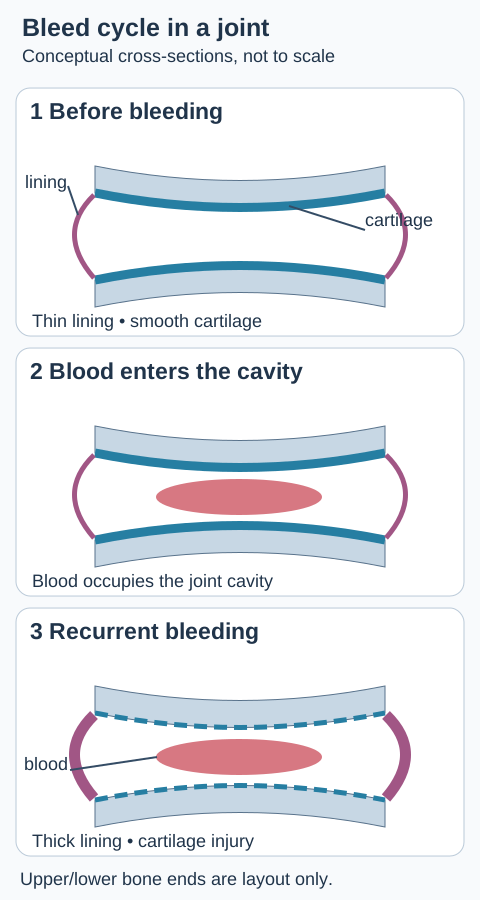
Imagine a child with factor VIII deficiency who develops ankle swelling after walking. The absent coagulation activity makes it harder to stabilize a deep-tissue clot. Blood accumulates within the joint capsule: a hemarthrosis. Knees, ankles and elbows are common sites, but the site alone cannot identify which factor is deficient. Compare the neighboring joint-progression schematic with the sequence below. [1]
Three conceptual opposing bone-end views show thin synovial lining around a cavity and cartilage on both ends, then blood in the cavity, then thickened lining and cartilage injury. Upper and lower indicate layout, not anatomical direction. [1][5]
Trace blood from the joint space into the synovial lining. Red-cell breakdown releases iron; persistent blood exposure contributes to synovial inflammation and thickening. Fragile hypertrophic synovium is more prone to further bleeding, while recurrent inflammation damages cartilage and subchondral bone. A repeatedly affected joint becomes a target joint; chronic pain, reduced range of motion and deformity reflect accumulated arthropathy, not simply blood remaining from one event. [1][5]
Predict: if the same ankle stops bleeding today but bleeds again each month, does its future risk return to baseline? The visible sequence is blood, synovitis, another bleed, cartilage loss. No: repeated synovial injury makes later bleeding and disability more likely. Apply the same sequence to a patient whose ankle is stiff between acute episodes; persistent stiffness warrants evaluation for chronic joint injury rather than labeling every symptom a fresh bleed. [1]
A painful swelling may initially lack obvious external bruising: a deep bleeding compartment is different from skin hemorrhage. A muscle hematoma can also follow factor deficiency and, in a tight space, threaten nerves or vessels. When pain is disproportionate or there are new sensory changes, weakness or compromised perfusion, an urgent alternative pathway is needed rather than an ordinary joint-rest plan. [1]
Three spontaneous episodes in the same joint within six months meet the operational target-joint definition; a fall-related episode is not interchangeable with a spontaneous one when counting toward that threshold. This classification helps track a pattern, not determine whether another diagnosis is present today. Two spontaneous episodes with one traumatic episode call for prevention review even before the formal threshold is met. [1]
Try it here · Checkpoint 1 of 3
Make your prediction before reading the choices. A first attempt is just a starting point.
Case 11
Show answer and explanations for case 11
A. Meets the target-joint definition because any three bleeds count (Why this does not fit)
The trauma-related event does not supply a third spontaneous bleed.
Reasoning steps for option A
Why is counting all three ankle events misleading?
One followed a soccer collision, whereas the usual target-joint count concerns spontaneous bleeds in the same joint over six months.
If the collision had not occurred, what would a third atraumatic bleed mean?
Three spontaneous left-ankle bleeds within six months would meet the threshold.
B. Meets it because two spontaneous bleeds suffice (Why this does not fit)
Two spontaneous events are concerning but below the usual three-in-six-month threshold.
Reasoning steps for option B
Why is two spontaneous bleeds still important even though this label is premature?
Two in five months signal recurrence and warrant preventive review, but do not equal the conventional three-in-six-month count.
Should care wait for an official target-joint designation?
No; revise prevention and monitor this ankle now rather than waiting for additional damage.
C. Not yet a target joint: only two spontaneous bleeds (Best answer)
Only two spontaneous bleeds occurred within six months; revise prevention even before formal threshold.
Reasoning steps for option C
What is the precise count for the left ankle?
There are two spontaneous events in five months; the third event is traumatic and the right ankle has none.
How can prevention and formal classification diverge?
A joint may warrant intervention before it crosses the operational target-joint threshold.
D. Cannot be assessed until magnetic resonance imaging shows cartilage loss (Why this does not fit)
Target-joint status is defined by recurrent spontaneous bleeding, not required magnetic resonance imaging damage.
Reasoning steps for option D
Why not demand magnetic resonance imaging before classifying this joint?
The operational threshold is based on recurrent spontaneous bleeds, not established cartilage injury on imaging.
What role could magnetic resonance imaging still play?
It could stage joint damage or synovitis if clinically needed, without changing how bleeds are counted.
Takeaway: A target joint is defined by three or more spontaneous bleeds into the same joint over six months; count trauma separately.
Read the bleeding surface, then the factor activity
Compare two histories: recurrent knee and muscle bleeding versus prolonged nosebleeds, heavy menstrual bleeding and dental-site oozing. Which represents a failure to form a durable deep clot? Deep joint or muscle bleeding raises suspicion for a coagulation factor problem; predominantly mucocutaneous bleeding raises a platelet or von Willebrand factor problem. von Willebrand factor supports platelet adhesion and protects factor VIII in circulation, so these patterns can overlap. Do not diagnose from the surface alone. [1]
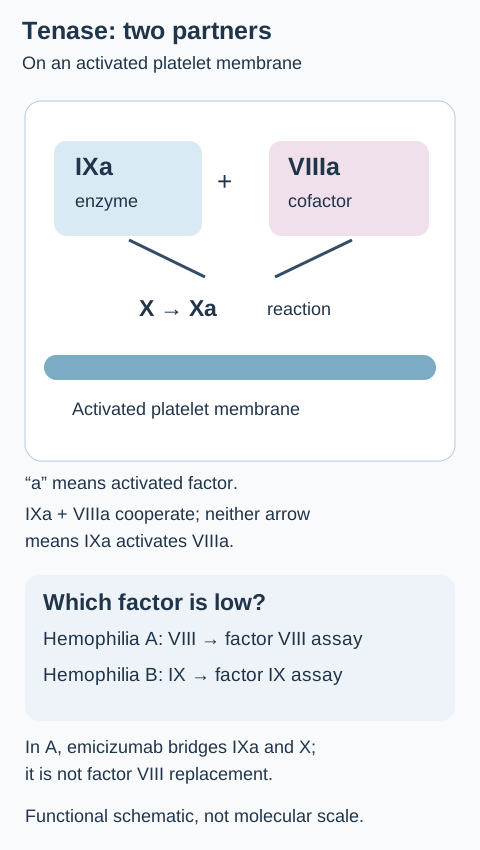
At an activated platelet membrane, IXa enzyme plus VIIIa cofactor converge on the X to Xa reaction; A lacks VIII and B lacks IX, distinguished by specific factor assays. Activated forms carry the suffix a. Not molecular scale. [1][3]
Use the adjacent laboratory comparison schematic as a sorting exercise: first identify whether platelet number is low, then whether prothrombin time (PT) or activated partial thromboplastin time (aPTT) is prolonged. An isolated prolonged aPTT with preserved PT and platelet count can fit factor VIII deficiency (hemophilia A) or factor IX deficiency (hemophilia B). The factor activity assay, not the joint involved, distinguishes the two. A normal aPTT cannot exclude mild hemophilia; investigate a convincing bleeding history with appropriate specific assays. [1]
A woman with factor VIII activity below 40% can have mild hemophilia A rather than merely an asymptomatic carrier label; an affected father makes his daughter an obligate genetic carrier regardless of her bleeding severity. [1][8]
Predict a change: a patient with repeated knee bleeds has low factor IX activity but normal factor VIII activity. The label changes from hemophilia A to hemophilia B, while the joint-risk mechanism remains. Deficiency means reduced functional activity; do not assume the antigen concentration must be normal in A or that the activity threshold automatically prescribes an identical treatment for everyone. [1]
A 1:1 mixing study combines patient plasma with normal plasma. Initial correction can support factor deficiency, whereas noncorrection, including after incubation when indicated, raises an inhibitor or another interfering substance. In a previously treated patient whose factor VIII activity remains unexpectedly low after replacement, test for a factor VIII inhibitor; poor response alone does not establish its presence. Lupus anticoagulant can prolong aPTT without producing the characteristic inherited deep-bleed phenotype. [1]
A final assay qualification matters with modern prevention: emicizumab functionally bridges activated factor IX and factor X to substitute for activated factor VIII in hemophilia A, but does not replace factor IX in B. It shortens standard aPTT and can distort activated partial thromboplastin time based factor VIII assays. If clinical assessment requires factor VIII activity or inhibitor testing during emicizumab use, arrange an appropriate bovine-reagent chromogenic assay through the specialist laboratory. A short aPTT in this setting is not proof of normal endogenous factor VIII. [1][3]
A supervised desmopressin challenge can show whether stored factor VIII rises enough, for long enough, to treat an appropriate mild or moderate hemophilia A bleed or minor procedure. It does not increase factor IX and is not a universal substitute for factor replacement. Assess the achieved activity, required duration and risks of water retention and hyponatremia; severe bleeding or prolonged coverage may instead need factor concentrate. [1]
Restore hemostasis without overlooking a dangerous joint
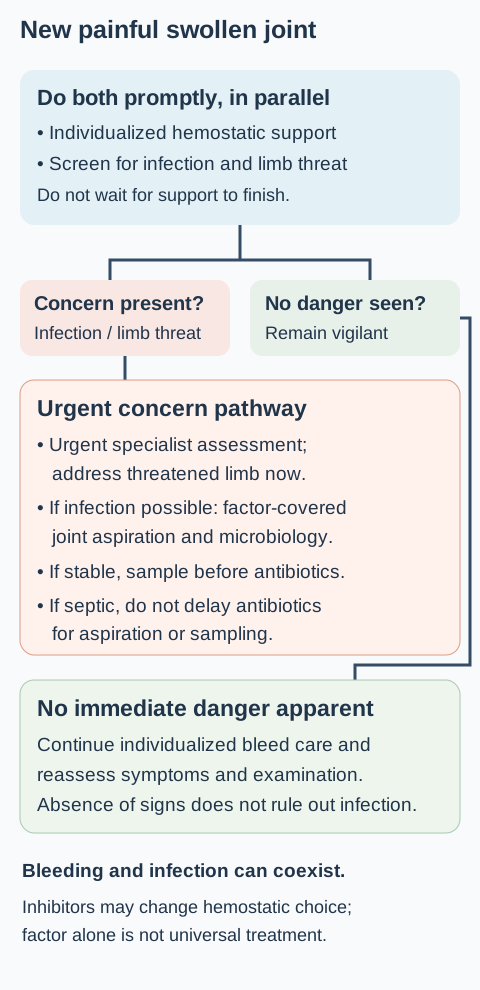
A person with known severe hemophilia develops a familiar swollen knee shortly after a minor collision; there is no fever, fracture concern, or nerve or vessel deficit. What is the first clinical priority? Follow the adjacent decision-fork diagram: promptly provide the patient-specific hemostatic treatment and protect the joint; do not delay treatment solely to obtain advanced imaging of an otherwise typical bleed. Arrange assessment and a rehabilitation plan with the hemophilia team. [1]
For a new painful swollen joint, start individualized hemostatic support while screening promptly in parallel for infection and limb threat. Infection concern warrants urgent assessment and factor-covered aspiration with microbiology; sample before antibiotics if stable, but never delay antibiotics in sepsis. If danger is not apparent, continue bleed care and reassess; infection is not excluded. Inhibitors can change hemostatic choice. [1][4]
Now change one branch: the knee is hot, the patient is febrile and cannot tolerate passive movement. Hemophilia does not prevent septic arthritis. Suspicion calls for rapid evaluation, joint-fluid sampling for microbiology and appropriate antimicrobial therapy while coordinating hemostatic coverage for the invasive procedure. In a stable patient, obtain samples before empiric antibiotics when feasible; with sepsis, do not delay antibiotics for aspiration. This is a combined infection-and-bleeding plan, not a choice between them. [1][4]
Try another change: the patient is afebrile but has a painful new effusion and a high-risk source of bacteremia. Absence of fever or a reassuring inflammatory blood test cannot reliably exclude joint infection. Likewise, crystals found in joint fluid do not rule it out. Reconsider the differential if a presumed bleed does not improve as expected, particularly with escalating pain or systemic symptoms. Aspiration is not routinely necessary to prove every typical hemarthrosis, but suspected infection warrants a protected diagnostic procedure. [1][4]
After an injury with focal bony tenderness, deformity or inability to bear weight, evaluate for fracture as well as bleeding. After marked swelling with progressive paresthesias, weakness or vascular concern, obtain immediate emergency assessment for threatened limb function. These findings alter concurrent investigation and urgency; they do not make clotting support optional in a bleeding patient. In an inhibitor patient, an ineffective usual factor dose requires a specialist alternative hemostatic strategy rather than blind repetition of the same dose. [1]
Distinguish effusion from its cause. Ultrasound readily shows joint fluid and synovial hypertrophy; magnetic resonance imaging depicts cartilage, subchondral changes and hemosiderin, while plain radiographs may remain normal early in arthropathy. Neither imaging nor a fluid level independently diagnoses uncomplicated hemophilic bleeding. After acute knee trauma, a verified intra-articular fat-fluid level raises concern for marrow fat from an intra-articular fracture; a simple fluid-fluid level may also be blood separating into layers. Seek fracture-directed imaging without postponing indicated hemostasis. [1][5][7]
An enlarging calf hematoma with severe pain on passive stretch and new sensory change can signal compartment syndrome despite palpable distal pulses. Groin pain with a flexed hip, weak knee extension and a reduced knee reflex suggests an iliopsoas bleed compressing the femoral nerve. Both scenarios need urgent specialist assessment and individualized hemostatic support, not routine rehabilitation during the acute event. [1]
When prophylaxis with emicizumab does not prevent a bleed, treatment depends on inhibitor status: factor VIII remains effective in a patient without an inhibitor, but a high-responding factor VIII inhibitor generally requires bypassing treatment. Recombinant activated factor VII is preferred over activated prothrombin complex concentrate during emicizumab prophylaxis because the combination with the latter increases thrombosis and thrombotic microangiopathy risk. Coordinate selection with the hemophilia team; an extra emicizumab dose is not an acute rescue treatment. [1]
Try it here · Checkpoint 2 of 3
Make your prediction before reading the choices. A first attempt is just a starting point.
Case 15
Show answer and explanations for case 15
A. Observe after factor replacement; aspirate only if fever appears (Why this does not fit)
Catheter-associated infection and hot painful joint demand evaluation even without fever.
Reasoning steps for option A
Why not label the hot knee a familiar hemarthrosis and observe?
An indwelling catheter and marked passive-motion pain raise septic arthritis concern even without documented fever.
What should happen while bleeding risk is controlled?
Arrange prompt diagnostic aspiration with cultures, rather than waiting for fever.
B. Begin several days of antibiotics, then obtain cultures (Why this does not fit)
Delaying sampling until after antibiotics can reduce organism recovery in this stable patient.
Reasoning steps for option B
Why is antibiotic-first sampling delay avoidable in this stable patient?
Blood cultures are already drawn, but joint fluid before antibiotics improves organism recovery when aspiration is promptly feasible.
Would the same sequencing apply during septic shock?
No; shock demands immediate antibiotics and resuscitation without waiting for transfer or aspiration.
C. Factor-covered aspiration, cultures, then antibiotics (Best answer)
Hemostatic coverage facilitates safe sampling; culture before antibiotics when feasible, then treat promptly.
Reasoning steps for option C
What does factor coverage accomplish before knee aspiration?
It reduces procedure-related bleeding in hemophilia while allowing synovial fluid culture before antibiotics in a stable patient.
After obtaining fluid, what should not be postponed?
Prompt antimicrobial treatment based on the clinical infection concern.
D. Aspirate immediately without hemostatic planning, then consider antibiotics (Why this does not fit)
Unprotected puncture needlessly adds bleeding risk; infection treatment must not be deferred.
Reasoning steps for option D
Why does unprotected needle entry create a second hazard?
Aspiration in hemophilia can itself bleed; coordinating hemostatic coverage protects the joint without abandoning infection diagnosis.
Does arranging factor mean deferring antibiotics for days?
No; plan expedited covered sampling and then prompt antibiotics, with urgency overriding sampling delay if unstable.
Takeaway: In a stable patient, obtain factor-covered joint fluid for culture before empiric antibiotics when promptly feasible; do not delay antibiotics in sepsis.
An ankle that swells every few weeks is not adequately managed by repeatedly treating episodes without revisiting prevention. Regular prophylaxis aims to prevent bleeding before it injures synovium. In a randomized study of 65 young boys with severe hemophilia A, 93% assigned regular factor VIII prophylaxis versus 55% assigned enhanced episodic therapy had normal index-joint structure on magnetic resonance imaging at age six. These figures describe that particular trial, not reversal of established arthropathy or efficacy in every other population. [1][2]
Emicizumab is a factor VIII function-mimicking prophylactic antibody for hemophilia A, not an acute replacement for every joint bleed. In a randomized comparison among eligible participants aged at least 12 years without inhibitors who previously received episodic treatment, weekly or every-two-week prophylaxis reduced treated bleeding relative to no prophylaxis. Its trial endpoint was treated bleeding, not restoration of already damaged cartilage. Individualize prophylaxis and breakthrough-bleed plans with the specialist team. [1][3]
Predict what happens if prophylaxis reduces new bleeding after years of ankle damage: the recurrent blood exposure may decrease, but existing cartilage loss does not instantly disappear. Follow serial pain, function, range of motion and joint evaluation; coordinated physical therapy and musculoskeletal care address mobility and protection. If a target joint still bleeds, reassess treatment adherence, exposure and potential inhibitors rather than treating persistent swelling as inevitable. [1]
One last three-part retrieval: ask where bleeding occurs, what the factor assays show, and whether a new danger signal changes the action. A person with nosebleeds and heavy menses needs a different initial diagnostic emphasis than one with repeated hemarthroses; an isolated prolonged aPTT does not pick VIII over IX; and a febrile joint needs infection workup even when hemophilia is already established. Use these distinctions again in the independent cases below. [1][4]
Test the boundary: a child with new hip pain may have a deep hematoma without a visible swollen joint. Reassess the time course, neurologic findings and response to the individualized hemostatic plan; escalating pain may instead require evaluation for infection, fracture or treatment resistance. Hemostasis and targeted investigation proceed together rather than replacing one another. [1]
For recurrent bleeding despite adequate prevention, distinguish ongoing synovitis from end-stage joint destruction. After optimizing prophylaxis and excluding inhibitors or other causes, persistent vascular synovium with preserved cartilage can prompt consideration of nonsurgical synoviorthesis under specialist care; it is not automatically an indication for joint replacement. End-stage deformity, lost joint space and disabling pain warrant coordinated orthopedic and rehabilitation evaluation with continued hemostatic planning. [1]
Try it here · Checkpoint 3 of 3
Make your prediction before reading the choices. A first attempt is just a starting point.
Case 22
Show answer and explanations for case 22
A. Immediate total knee arthroplasty (Why this does not fit)
Arthroplasty is generally reserved for advanced destructive arthropathy, not preserved cartilage.
Reasoning steps for option A
Why is immediate arthroplasty premature?
magnetic resonance imaging shows preserved knee cartilage and useful motion despite recurrent bleeding, so an end-stage replacement strategy sacrifices a salvageable joint.
What contrasting image would make arthroplasty more relevant?
Advanced destructive cartilage loss and disabling mechanical symptoms despite optimized conservative care.
B. Consider synoviorthesis with specialist multidisciplinary care (Best answer)
Persistent bleeding from hypertrophic synovium despite prevention may benefit from synoviorthesis.
Reasoning steps for option B
Which mechanism is synoviorthesis meant to interrupt?
A. Factor VIII deficiency without a demonstrable time-dependent inhibitor (Best answer)
Sustained correction supports deficiency; selective VIII loss explains the deep bleeding.
Reasoning steps for option A
Why does a mixing study help here but not finish the diagnosis?
Fresh normal plasma supplies the missing activity; correction persisting through incubation favors deficiency, while VIII 2% versus IX 89% identifies which factor is missing.
Would this conclusion survive loss of correction after two hours?
No. A falling incubated correction would trigger a search for a time-dependent VIII inhibitor rather than uncomplicated deficiency.
B. Factor IX deficiency without a demonstrable time-dependent inhibitor (Why this does not fit)
IX is preserved, so the same mixing pattern does not establish IX deficiency.
Reasoning steps for option B
Why might hemophilia B initially seem plausible in this elbow-bleed history?
IX deficiency also causes deep spontaneous bleeding and a prolonged activated partial thromboplastin time that corrects with mixing; the IX activity of 89% rules it out here.
What result would shift the diagnosis toward B?
Selective low IX with preserved VIII would reverse the factor-specific interpretation.
C. Time-dependent factor VIII inhibitor despite sustained mixing correction (Why this does not fit)
An incubated inhibitor commonly abolishes correction; here correction persists.
Reasoning steps for option C
What makes an acquired VIII inhibitor worth considering at first glance?
A prolonged activated partial thromboplastin time and low VIII can occur with an inhibitor, but this mixture remains corrected after two hours at 37 C.
What laboratory reversal would support this alternative?
Correction immediately followed by prolongation after incubation would suggest a time-dependent inhibitor and merit inhibitor quantification.
D. Lupus anticoagulant causing the low factor VIII activity (Why this does not fit)
An interfering anticoagulant may affect activated partial thromboplastin time but does not explain this correction and concordant severe VIII deficit.
Reasoning steps for option D
Can lupus anticoagulant explain any part of the screen?
It can prolong activated partial thromboplastin time, making it tempting, but sustained mixing correction plus a profound selective VIII deficit and recurrent deep bleeds point elsewhere.
If antiphospholipid interference were suspected despite these findings, what would matter?
Use appropriate confirmatory phospholipid-dependent studies and assess assay interference rather than attributing VIII 2% automatically to lupus anticoagulant.
Takeaway: Persistent mixing correction plus selectively low VIII favors deficiency; an incubated noncorrecting mix raises concern for inhibitor.
IX replacement does not address documented VIII deficiency.
Reasoning steps for option A
Why is IX concentrate the wrong replacement despite a bleeding-risk procedure?
His diagnosed defect is VIII, not IX; the supervised challenge already raised VIII from 12% to 58%.
When would IX replacement become relevant?
Documented IX deficiency, rather than a responsive mild A phenotype, would require IX-directed coverage.
B. Desmopressin with fluid precautions (Best answer)
Measured and sustained VIII release supports desmopressin for this brief minor procedure, alongside individualized local measures and fluid precautions.
Reasoning steps for option B
Which part of the challenge supports a minor-procedure desmopressin plan?
VIII remained 42% four hours after rising to 58%, demonstrating useful magnitude and duration for uncomplicated extraction.
What safety detail accompanies that choice even without baseline hyponatremia risk?
Limit free water and follow local sodium precautions because desmopressin can cause water retention and hyponatremia.
C. Emicizumab as a single perioperative rescue dose (Why this does not fit)
Emicizumab is prevention, not a one-time substitute for perioperative coverage.
Reasoning steps for option C
Why could emicizumab sound useful for a patient with A?
It can prevent bleeds in A, but a new loading injection tomorrow will not provide tailored immediate extraction hemostasis like his proven desmopressin response.
Would established emicizumab prophylaxis remove all procedural planning?
No; procedural hemostasis still needs an individualized plan rather than an assumed rescue dose.
D. Recombinant activated factor VII as first-line bypass (Why this does not fit)
Bypass therapy is reserved for selected inhibitor scenarios, not responsive mild A.
Reasoning steps for option D
What finding makes a bypass agent disproportionate for this extraction?
He has mild A with robust endogenous VIII release and no described inhibitor; activated factor VII bypass is not the first response to this setting.
What new complication might make bypass therapy relevant?
A clinically important inhibitor preventing effective VIII-based hemostasis would change the agent discussion.
Takeaway: In mild hemophilia A, use a documented adequate desmopressin response for suitable brief procedures with fluid precautions and local measures.
Emicizumab prevention does not preclude use of effective VIII for breakthrough bleeding without inhibitors.
Reasoning steps for option A
Does emicizumab prevent use of infused VIII for this breakthrough wrist bleed?
No; no inhibitor history and previously expected VIII recovery make VIII a matched acute treatment despite preventive antibody therapy.
What change would weaken reliance on infused VIII?
New poor factor recovery or a documented high-responding inhibitor would require an inhibitor-directed approach.
B. Activated prothrombin complex concentrate (Why this does not fit)
activated prothrombin complex concentrate is not indicated here and carries thrombotic risk with emicizumab.
Reasoning steps for option B
What special harm makes activated prothrombin complex concentrate a poor shortcut on emicizumab?
activated prothrombin complex concentrate combined with emicizumab can increase thrombosis and thrombotic microangiopathy risk, with no inhibitor-driven need here.
Could activated prothrombin complex concentrate ever be considered at all in an inhibitor patient?
Only under specialist oversight if alternatives fail, with careful risk and dose consideration; it is not preferred here.
C. Recombinant activated factor VII instead of effective VIII (Why this does not fit)
activated factor VII is useful for inhibitor bleeds but need not displace functional VIII in this patient.
Reasoning steps for option C
Why is activated factor VII not the best default simply because bleeding broke through prophylaxis?
Breakthrough does not imply VIII neutralization; this patient historically recovers well after VIII.
What specific evidence would favor activated factor VII over VIII?
A high-responding inhibitor that makes infused VIII ineffective would favor bypassing therapy.
D. An extra emicizumab dose in place of acute therapy (Why this does not fit)
A prophylactic antibody dose is not rapid matched treatment for this joint bleed.
Reasoning steps for option D
Why does another preventive injection not settle active hemarthrosis?
Emicizumab dosing maintains prophylaxis; the currently bleeding wrist needs prompt effective acute hemostasis.
What additional observation would still require reassessment after acute treatment?
Persistent swelling or pain despite effective VIII warrants checking recovery and considering other joint pathology.
Takeaway: Emicizumab prevents many bleeds but does not rescue an acute bleed; effective factor VIII remains appropriate when no inhibitor is present.
A. Factor VIII concentrate at his former home dose (Why this does not fit)
High-responding inhibitor makes conventional VIII unreliable.
Reasoning steps for option A
Why not reuse his former home VIII dose?
A documented high-responding inhibitor neutralizes VIII, so the old effective dose cannot be trusted now.
What evidence would change confidence in direct replacement?
Demonstrated adequate VIII recovery without clinically important inhibitor would allow reconsideration.
B. Recombinant activated factor VII (Best answer)
activated factor VII bypasses VIII and is preferred for inhibitor breakthrough bleeding on emicizumab.
Reasoning steps for option B
Which two constraints select activated factor VII for this knee bleed?
Recombinant activated factor VII bypasses neutralized VIII and avoids the particularly problematic activated prothrombin complex concentrate-emicizumab combination.
Does emicizumab prophylaxis eliminate the need for acute treatment?
No; the spontaneous knee bleed still needs hemostatic therapy despite prevention.
C. Activated prothrombin complex concentrate as preferred first-line (Why this does not fit)
Why is activated prothrombin complex concentrate tempting yet not preferred here?
It bypasses VIII, but pairing activated prothrombin complex concentrate with emicizumab heightens thrombosis and thrombotic microangiopathy risk.
What monitoring issue would arise if specialists had no alternative?
They would need tightly controlled exposure and surveillance for thrombosis or microangiopathy, not routine first-line activated prothrombin complex concentrate.
D. Desmopressin (Why this does not fit)
Severe VIII loss plus inhibitor is not corrected by endogenous release.
Reasoning steps for option D
Why is endogenous VIII release unlikely to solve this case?
Severe A leaves little reserve, and the released VIII would still face the documented inhibitor.
In which contrasting A patient might desmopressin help?
Someone with mild A and a proven adequate sustained VIII response, not severe inhibitor-positive A.
Takeaway: With a high-responding factor VIII inhibitor on emicizumab, recombinant activated factor VII is preferred for breakthrough bleeding.
A. One-stage activated partial thromboplastin time based factor VIII activity (Why this does not fit)
Emicizumab falsely elevates activated partial thromboplastin time based VIII estimates.
Reasoning steps for option A
Why does the surprisingly high one-stage VIII activity mislead?
Emicizumab shortens activated partial thromboplastin time based clotting tests, creating an apparent activity inconsistent with genetically severe A.
Would repeating the same one-stage method settle endogenous VIII?
No; the same drug interference persists regardless of repeated measurement.
B. Human-reagent chromogenic factor VIII activity (Why this does not fit)
Human activated factor IX/factor X reagents respond to the antibody and overestimate native VIII.
Reasoning steps for option B
Why is human chromogenic testing still vulnerable?
Emicizumab bridges human activated factor IX and factor X reagents, so a human-reagent chromogenic assay can read antibody activity as VIII-like activity.
What reagent change isolates native VIII better?
Use bovine-reagent chromogenic components that respond minimally to emicizumab.
C. Bovine-reagent chromogenic factor VIII activity (Best answer)
Bovine components do not react significantly with emicizumab and allow native VIII measurement.
Reasoning steps for option C
What property makes bovine chromogenic testing fit this precise question?
The bovine activated factor IX/factor X reagent system has little response to emicizumab and can estimate endogenous VIII rather than its mimic.
Would this same logic matter for inhibitor quantification on emicizumab?
Yes; a bovine chromogenic residual-VIII method can avoid misleading antibody-derived activity.
D. Routine activated partial thromboplastin time alone (Why this does not fit)
Clotting time alone cannot quantify native factor activity on this drug.
Reasoning steps for option D
Why is a routine activated partial thromboplastin time insufficient even if it looks normal?
Emicizumab can normalize or shorten activated partial thromboplastin time without restoring native VIII in this severe A child.
Which inference must be avoided from a normal clotting time here?
Do not infer normal endogenous VIII or absence of an anti-factor VIII inhibitor from drug-affected activated partial thromboplastin time.
Takeaway: Emicizumab invalidates routine clot-based VIII quantitation; use an appropriate bovine-reagent chromogenic VIII assay.
A. Isolated recurrent synovitis (Why this does not fit)
Synovitis can cause swelling but not traumatic lipohemarthrosis.
Reasoning steps for option A
Why can recurrent synovitis not explain the radiographic level?
The fat-fluid layer after bicycle trauma indicates marrow fat entering the joint, not simply inflamed synovium.
What physical finding strengthens the bone-injury interpretation?
Focal tibial plateau tenderness.
B. Simple hemarthrosis without bone injury (Why this does not fit)
Fat layered with blood after trauma suggests marrow communication, not just an uncomplicated bleed.
Reasoning steps for option B
Why is this more than an uncomplicated hemarthrosis?
Blood alone cannot account for an intra-articular fat layer; marrow communication suggests an occult intra-articular fracture.
Should IX hemostatic support stop while fracture workup proceeds?
No; evaluate both traumatic fracture and bleeding risk together.
C. Intra-articular fracture with marrow fat entering the joint (Best answer)
Confirmed fat layered within the joint plus focal plateau tenderness suggests intra-articular fracture; maintain factor IX coverage and arrange fracture-directed evaluation.
Reasoning steps for option C
How do the image and exam converge on fracture?
Lipohemarthrosis plus focal plateau tenderness after a fall supports an intra-articular tibial plateau injury.
If no fracture line appears on initial x-ray, what remains important?
Further targeted fracture evaluation; a fat-fluid level can reveal an occult intra-articular break.
D. Factor IX inhibitor causing atraumatic bleeding (Why this does not fit)
An inhibitor does not produce a fat-fluid level after focal injury.
Reasoning steps for option D
Why does an inhibitor not create this x-ray finding?
Neutralization might cause poor IX recovery or bleeding, but it does not introduce marrow fat after trauma.
What result would instead raise inhibitor concern?
Unexpectedly poor IX recovery after appropriate infusion or recurrent refractory bleeding.
Takeaway: After trauma, an intra-articular fat-fluid level suggests an occult articular fracture; continue factor IX and pursue fracture-directed evaluation.
A. Hip hemarthrosis irritating the sciatic nerve (Why this does not fit)
Sciatic injury typically affects posterior leg/foot rather than knee extension and patellar reflex.
Reasoning steps for option A
Why does sciatic compression misfit the neurologic pattern?
Sciatic deficits favor posterior leg or foot findings; this patient has weak knee extension, lost patellar reflex, and anterior thigh sensory loss.
What preserved movement further weakens a distal sciatic explanation?
Ankle dorsiflexion remains intact.
B. Obturator neuropathy from an adductor hematoma (Why this does not fit)
Obturator dysfunction preferentially weakens hip adduction, not quadriceps extension.
Reasoning steps for option B
Which motor deficit would better fit obturator nerve compression?
Hip adduction weakness would be expected, rather than the prominent quadriceps and patellar-reflex abnormalities here.
Does groin pain alone identify the obturator nerve?
No; the specific motor, reflex, and sensory pattern localizes better to femoral compression.
C. fourth lumbar nerve root radiculopathy from a lumbar disc lesion (Why this does not fit)
fourth lumbar nerve root root disease can overlap but flexed hip with groin pain and hemophilia favors a deep iliopsoas bleed.
Reasoning steps for option C
Why is fourth lumbar nerve root radiculopathy a plausible but less complete fit?
fourth lumbar nerve root can affect knee extension and reflex, yet flexed hip and groin pain after lifting with hemophilia suggest iliopsoas bleeding around the femoral nerve.
What additional context might redirect toward the spine?
A convincing radicular back-pain pattern or spinal lesion rather than signs of deep pelvic hematoma.
D. Iliopsoas hematoma compressing the femoral nerve (Best answer)
Femoral compression by iliopsoas blood produces quadriceps weakness, reflex loss and anterior/medial sensory changes.
Reasoning steps for option D
How does one hematoma explain all the findings?
Iliopsoas bleeding near the femoral nerve causes hip-flexed posture, quadriceps weakness, depressed patellar reflex, and anterior/medial leg sensory loss.
Why is this localization urgent rather than a routine joint bleed?
An enlarging deep hematoma can worsen nerve injury and needs prompt hemostatic and anatomic assessment.
Takeaway: Flexed hip, weak knee extension and diminished patellar reflex localize compressive iliopsoas bleeding to the femoral nerve.
A. Give acute factor VIII at every episode of weight-bearing pain (Why this does not fit)
Mechanical end-stage pain without new bleeding is not necessarily another acute hemarthrosis.
Reasoning steps for option A
Why should every weight-bearing pain episode not trigger an acute VIII dose?
Six bleed-free months on effective prophylaxis plus end-stage joint-space loss and deformity point to mechanical pain, not automatically fresh blood.
What change would still require acute bleed treatment?
New effusion or other evidence of an acute hemarthrosis.
B. Orthopedic and rehabilitation assessment with ongoing prophylaxis (Best answer)
Structural disability calls for orthopedic/rehabilitation evaluation; maintain individualized prophylaxis.
Reasoning steps for option B
Why pair orthopedic and rehabilitation assessment with continued prevention?
Marked walking pain now reflects structural ankle disability, while prophylaxis still protects against additional bleeds.
What cannot the orthopedic consultation replace?
The individualized hematologic plan for ongoing bleeding prevention and procedures.
C. Diagnose factor VIII inhibitor from the fixed deformity alone (Why this does not fit)
Fixed bony deformity does not establish impaired factor recovery.
Reasoning steps for option C
Why does fixed deformity not diagnose an inhibitor?
It documents accumulated joint damage, not neutralization of infused VIII or unexpectedly poor factor recovery.
Which measurements would raise genuine inhibitor concern?
A low postinfusion VIII peak, rapid decline, or a positive specific inhibitor assay.
D. Increase prophylactic frequency until lost cartilage regrows (Why this does not fit)
Prevention may limit new bleeds but cannot regenerate end-stage cartilage.
Reasoning steps for option D
Why will greater prophylactic frequency not restore this ankle?
Preventing new hemarthroses cannot regrow lost end-stage cartilage or reverse fixed deformity.
What outcome should now be assessed beyond bleed counts?
Pain with walking, mobility, deformity, and rehabilitation or surgical options.
Takeaway: End-stage deformity with persistent pain despite bleed prevention calls for orthopedic and rehabilitation planning, not reflexive acute factor doses.
A. Normal activated partial thromboplastin time excludes inherited factor deficiency (Why this does not fit)
Screening activated partial thromboplastin time can be normal at clinically relevant mild VIII reductions.
Reasoning steps for option A
Why is a normal activated partial thromboplastin time falsely reassuring here?
A screening clotting time can miss moderate VIII reductions; repeat VIII activity is 18% alongside real ankle hemarthroses.
What should outweigh the normal screen?
The selective VIII measurement and deep-bleeding phenotype in a daughter of an affected father.
B. Factor IX deficiency explains the ankle bleeds (Why this does not fit)
IX activity is normal and cannot account for the selective VIII deficit.
Reasoning steps for option B
Why does the family history not make this a IX deficiency?
Her father has A, VIII is reduced to 18%, and IX activity is preserved at 96%.
What laboratory pattern would support B instead?
Repeated low IX with preserved VIII, evaluated alongside pedigree.
C. Mild hemophilia A with obligate carrier status (Best answer)
Her father transmits the affected X chromosome to all daughters. Factor VIII activity 18% and recurrent deep bleeding meet criteria for mild hemophilia A in a woman, rather than merely symptomatic carrier status.
Reasoning steps for option C
How can an affected father and daughter both have clinically relevant VIII deficiency?
An affected father transmits his X chromosome to every daughter; her VIII of 18% and deep bleeds classify her as a woman with mild hemophilia A as well as an obligate carrier.
Why not dismiss the heavy menses as the only bleeding clue?
Recurrent ankle hemarthroses show clinically important deep bleeding beyond mucosal symptoms.
D. von Willebrand disease despite preserved antigen and activity (Why this does not fit)
Normal von Willebrand factor antigen and activity plus an affected father and selective low VIII favor mild hemophilia A; rare von Willebrand factor binding defects may require further evaluation if the phenotype or family study conflicts.
Reasoning steps for option D
Why is von Willebrand disease a less convincing cause of low VIII here?
von Willebrand factor carries VIII, so vWD can lower it, but both von Willebrand factor antigen and activity are normal on the reported workup.
Which converging findings favor mild hemophilia A over common von Willebrand disease?
The affected father, selective VIII reduction and preserved IX plus von Willebrand factor tests favor mild inherited A, although rare von Willebrand binding defects may warrant additional testing if other evidence conflicts.
Takeaway: A woman with VIII activity 18% and deep bleeds meets mild hemophilia A criteria; a hemophilic father also establishes obligate carrier status.