Psoas syndrome: assess the restriction, then the cause
Distinguish hip-flexor shortening from painful loading, control pelvic compensation, localize nerve findings, and recognize when urgent investigation comes first.
A flexed hip can be a response to muscle tightness, joint pain, abdominal inflammation or retroperitoneal bleeding. First identify the actual restriction, then its likely source, then whether local treatment is appropriate. Psoas syndrome is a clinical working diagnosis, not the automatic meaning of a positive hip test. [2][5][6]
Does it resist lengthening, hurt during effort, or both?
A muscle's action describes the force it can produce. Passive extensibility describes how far it can lengthen. These are different observations. A shortened hip flexor particularly resists passive hip extension, but an irritated flexor may also hurt during active hip flexion. Pain, weakness, joint disease and protective guarding can limit active performance without following a simple opposite-direction rule. [2][4]
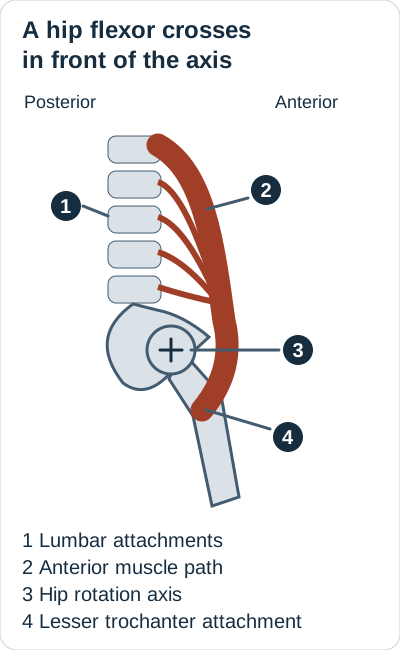
The line of pull passes anterior to the hip axis. The lesser trochanter itself is a posteromedial proximal-femoral attachment, not an anterior surface landmark.
Try the prediction: Imagine that the anterior muscle path cannot lengthen normally. Before reading on, choose which passive direction would demand more length: bringing the thigh toward the trunk or taking it behind the trunk.
Read the result: Extension demands more anterior length. Flexion reduces that demand and may be a position of comfort. Now add a load-sensitive tendon: contracting the same flexor against resistance may hurt even though passive flexion is comfortable. The two findings can coexist without contradiction.
Passive test: What range is available with the patient relaxed, neighboring joints controlled and symptoms monitored?
Active or resisted test: Can the patient generate the action, and does loading reproduce the familiar symptom?
Apply it elsewhere: Short adductors can resist abduction; a short gluteus maximus can resist flexion. Neither prediction proves which tissue is diseased. Check attachments, joint position, symptom location and competing joint or neurological findings. A painfully guarded joint may restrict several directions rather than behaving like one isolated short muscle. [4]
Why can one region produce several different patterns?
Follow the anatomy before naming a syndrome. Psoas major arises from the T12 through L5 vertebral-body and disc region and lumbar transverse processes. It joins iliacus, which arises from the iliac fossa, toward the lesser trochanter. The combined iliopsoas flexes the hip. Psoas also contributes to lumbar stabilization and posture; with the femur fixed, it can assist trunk flexion while also contributing to stabilization; the net effect depends on position and loading. Unilateral activity can contribute to same-side bending. Do not reduce these functions to one inevitable lumbar posture. [2][4]
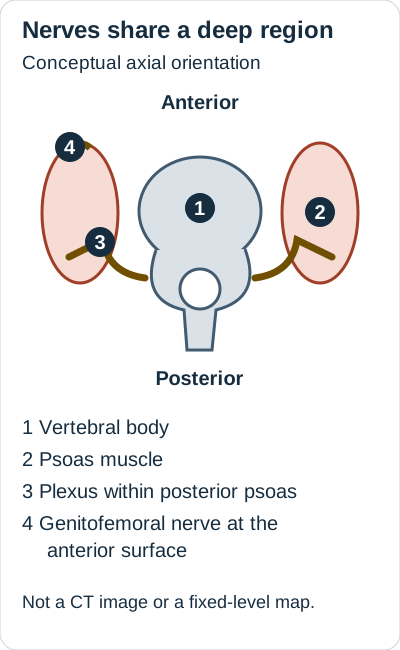
The lumbar plexus forms within the psoas region. The genitofemoral nerve emerges onto its anterior surface; the femoral nerve proceeds laterally between psoas and iliacus. Positions vary with level. This drawing is an anatomical orientation aid, not a CT slice.
Psoas commonly receives direct anterior-ramus branches from L1 through L3; iliacus receives femoral innervation. The lumbar plexus is usually described as L1 through L4, sometimes with T12 contribution, and distributes fibers into several peripheral nerves. Motor-root numbers are not a stand-alone map for diagnosing kidney, ureter or adrenal disease. Nearby organs belong in the differential when their history and examination support it. New wave-like flank pain with hematuria warrants urinary-tract assessment rather than an organ diagnosis from muscle motor roots. [15][16][2][11]
Use function as well as pain location
Pathway
Useful distinction
PathwayFemoral, usually L2 through L4
Useful distinctionKnee extension, patellar reflex and medial-leg sensation through the saphenous branch.
PathwayObturator, usually L2 through L4
Useful distinctionHip adduction, with a variable medial-thigh sensory territory.
PathwayLateral femoral cutaneous, usually L2 through L3
Useful distinctionAnterolateral-thigh sensation without a motor supply.
PathwayGenitofemoral, usually L1 through L2
Useful distinctionA small upper-anterior-thigh sensory territory and genital-branch functions, not quadriceps power.
PathwayIliohypogastric and ilioinguinal
Useful distinctionLower abdominal and groin territories; commonly T12/L1 and L1 contributions, respectively, with anatomical variation.
These are typical teaching distributions, not infallible maps. Root contributions and cutaneous territories vary and overlap. [13][14]
Try the localization: Compare isolated superficial anterolateral burning with weak knee extension, a reduced patellar reflex and medial-leg sensory loss. Which pattern requires a motor nerve explanation?
Read the result: The second pattern fits femoral-pathway involvement. If adduction is weak as well, broaden the assessment to a plexus or root process. Groin pain alone does not establish nerve compression; objective weakness, reflex loss or sensory change must not be dismissed as ordinary tightness.
Apply it to the next patient: Hip flexion can remain partly intact after a femoral lesion because psoas has a separate direct lumbar supply. Conversely, a normal hip-flexion effort cannot by itself clear every femoral function. Test the relevant actions, reflexes and sensory territories independently. [2][11]
Try it here · Checkpoint 1 of 3
Make your prediction before reading the choices. A first attempt is just a starting point.
Case 7
Show answer and explanations for case 7
A. Obturator nerve (Why this does not fit)
Weak hip adduction would support injury to its motor supply. Adduction is preserved while quadriceps function and the patellar reflex are impaired. Test adduction separately from knee extension.
Reasoning steps for option A
What deficit would particularly suggest obturator involvement?
Weak hip adduction would support injury to its motor supply.
How do the findings compare?
Adduction is preserved while quadriceps function and the patellar reflex are impaired.
What distinguishes the major lumbar-plexus branches?
Test adduction separately from knee extension.
B. Genitofemoral nerve (Why this does not fit)
It courses on the anterior psoas and supplies a small upper-thigh sensory territory through its femoral branch. It does not supply quadriceps or the medial lower leg. Verify the nerve's actual functions before attributing a deficit to a nearby branch.
Reasoning steps for option B
What makes this nerve anatomically tempting?
It courses on the anterior psoas and supplies a small upper-thigh sensory territory through its femoral branch.
Can that account for this patient's motor and distal sensory changes?
It does not supply quadriceps or the medial lower leg.
What should anatomical proximity not replace?
Verify the nerve's actual functions before attributing a deficit to a nearby branch.
C. Femoral nerve (Best answer)
The femoral nerve supplies quadriceps and gives rise to the saphenous sensory nerve. Weak knee extension, a reduced patellar reflex and medial leg sensory loss fit that nerve, while preserved adduction argues against a broad plexus lesion. Combine motor, reflex, sensory and anatomical findings rather than using pain location alone.
Reasoning steps for option C
Which nerve connects quadriceps function to medial leg sensation?
The femoral nerve supplies quadriceps and gives rise to the saphenous sensory nerve.
What does the supplied pattern add to the imaging location?
Weak knee extension, a reduced patellar reflex and medial leg sensory loss fit that nerve, while preserved adduction argues against a broad plexus lesion.
What makes localization stronger?
Combine motor, reflex, sensory and anatomical findings rather than using pain location alone.
D. Lateral femoral cutaneous nerve (Why this does not fit)
It can produce sensory symptoms over the anterolateral thigh. Quadriceps weakness, patellar reflex reduction and medial lower-leg sensory loss exceed its sensory territory. Confirm that no supplied motor or reflex deficit requires a different localization.
Reasoning steps for option D
Which symptoms can this nerve produce?
It can produce sensory symptoms over the anterolateral thigh.
Which findings cannot be explained by an isolated lesion there?
Quadriceps weakness, patellar reflex reduction and medial lower-leg sensory loss exceed its sensory territory.
How should a sensory nerve diagnosis be checked?
Confirm that no supplied motor or reflex deficit requires a different localization.
Takeaway: Combine motor, reflex, sensory and anatomical findings rather than using pain location alone.
Is the hip extending, or is the pelvis compensating?
A possible mechanical presentation includes deep anterior hip, groin or low-back aching after repeated flexion, prolonged sitting or a strain. A patient may prefer a flexed hip or bend toward the symptomatic side. These associations guide an examination, but neither posture nor a tender point proves the cause. Assess gait, active and passive hip range, the lumbar and pelvic regions, and neurological and abdominal findings when indicated. Lateral tenderness over the greater trochanter suggests a different regional problem from deep groin pain. Normal reflexes or strength do not by themselves exclude every radicular cause. [1][2]
During a Thomas-type assessment, flexing the opposite hip helps control pelvic position while the tested thigh is lowered. Watch the pelvis and lumbar curve: anterior tilt and increased lordosis can make the thigh appear lower without the same gain in femur-on-pelvis extension. A raised tested thigh supports limited extension in that setup, not a unique psoas diagnosis. The modified Thomas measurement study involved healthy participants; it did not establish a stand-alone diagnostic test for painful psoas syndrome. [3]
Compare hip angle with the pelvic reference. The hip remains 15 degrees flexed relative to the pelvic reference. Changing the reference does not stretch a real patient's muscle or provide a diagnostic score.
At 0 degrees of reference tilt, the thigh is 15 degrees above the table reference; the hip remains 15 degrees flexed.
In the same example, a 15-degree reference tilt makes the thigh parallel to the table while the hip deficit stays unchanged. Without interactive controls, compare these two stated positions and explain why table position alone is misleading. Original geometry schematic.
Try the comparison: Change only the reference tilt, or use the stated 0-degree and 15-degree examples. Predict whether the actual hip deficit will improve. Read the result: It does not. The display changes because its reference changes. In a clinical examination, standardize pelvic control and measure the actual hip before calling an apparent gain treatment success.
Next vary the tested knee while maintaining the same pelvis. Rectus femoris arises at the anterior inferior iliac spine and adjacent supra-acetabular region and crosses both hip and knee. Knee flexion increases its length demand. If allowing knee extension lets the thigh descend, a two-joint flexor contribution becomes more likely. Psoas does not cross the knee. Hip capsular restriction and pain-related guarding remain alternatives; comfortable or restricted rotation helps characterize the broader pattern. [4]
Apply it: Record side, pelvic control, knee position, range, familiar symptoms and neurological findings. Do not convert this one assessment into an anterior innominate diagnosis, a fixed L1/L2 segmental diagnosis, or proof that a piriformis on a predetermined side is involved. Regional associations need their own examination. [2][3]
Try it here · Checkpoint 2 of 3
Make your prediction before reading the choices. A first attempt is just a starting point.
Case 4
Show answer and explanations for case 4
A. The second result establishes that the first examiner found a structural contracture (Why this does not fit)
They could show whether a passive deficit persists under comparable conditions. No; pelvic position changed, so the disagreement cannot establish the tissue responsible for the first result. Do not assign a structural diagnosis from measurements made with different reference positions.
Reasoning steps for option A
What would repeated controlled measurements help establish?
They could show whether a passive deficit persists under comparable conditions.
Were those conditions comparable here?
No; pelvic position changed, so the disagreement cannot establish the tissue responsible for the first result.
What conclusion should wait?
Do not assign a structural diagnosis from measurements made with different reference positions.
B. The second result establishes rapid resolution of the muscular restriction (Why this does not fit)
More femur-on-pelvis extension under the same measurement conditions would support it. Only the thigh-to-table appearance improved while the pelvis tilted and symptoms were unchanged. Measure the joint itself rather than accepting a compensatory posture as recovery.
Reasoning steps for option B
What would support an actual increase in extension?
More femur-on-pelvis extension under the same measurement conditions would support it.
Was that change demonstrated?
Only the thigh-to-table appearance improved while the pelvis tilted and symptoms were unchanged.
What should apparent improvement be checked against?
Measure the joint itself rather than accepting a compensatory posture as recovery.
C. The first result establishes an anteriorly rotated innominate on that side (Why this does not fit)
Pelvic position influences the hip extension examination. It does not; the findings describe an extension limit and subsequent compensation, not a complete pelvic structural examination. Use an independent pelvic examination before assigning a specific pelvic dysfunction.
Reasoning steps for option C
Why might the pelvis enter the differential?
Pelvic position influences the hip extension examination.
Does a hip angle provide the landmarks needed for a named innominate diagnosis?
It does not; the findings describe an extension limit and subsequent compensation, not a complete pelvic structural examination.
What remains necessary?
Use an independent pelvic examination before assigning a specific pelvic dysfunction.
D. A changed pelvic reference can conceal the persistent hip extension deficit (Best answer)
It is the femur's position relative to the pelvis, not merely relative to the table. The pelvis tilted while symptoms and treatment status were unchanged, making the table-based appearance misleading. Repeat with the same pelvic control before concluding that extensibility improved.
Reasoning steps for option D
What defines a hip angle?
It is the femur's position relative to the pelvis, not merely relative to the table.
What changed between these observations?
The pelvis tilted while symptoms and treatment status were unchanged, making the table-based appearance misleading.
How should the assessments be compared?
Repeat with the same pelvic control before concluding that extensibility improved.
Takeaway: Repeat with the same pelvic control before concluding that extensibility improved.
When does a painful psoas region need urgent investigation?
The psoas lies in the retroperitoneum near the spine, bowel and urinary tract. Pain with passive extension, sometimes called a psoas sign, indicates irritation during that maneuver. Pain during resisted flexion also loads the region. Neither identifies the primary disease by itself. A retrocecal inflamed appendix can irritate the neighboring psoas; a comfortable flexed posture does not distinguish that process from a mechanical complaint. [2][5]
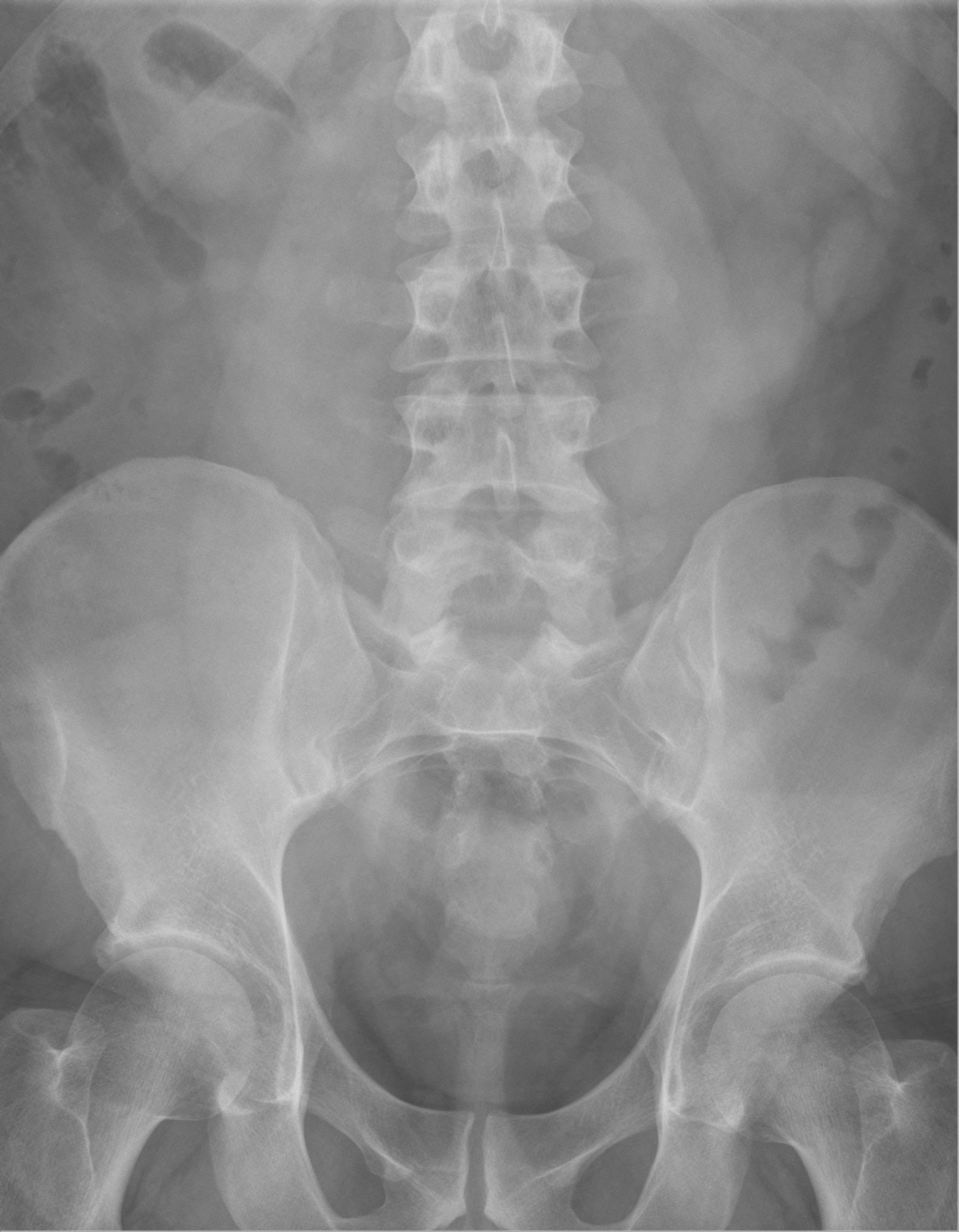
Find the soft-tissue borders beside the lumbar spine. Image: Hellerhoff, normal psoas-shadow radiograph, CC BY-SA 4.0, This is an anatomical example, not an image that excludes an abscess, hematoma or early abdominal disease. Image source and license [8].
Try the decision: A normal outline is visible on a radiograph, but the patient has progressive pain and systemic concern. Decide whether the picture answers the clinical question. Read the result: It does not. Projected anatomy is not a validated exclusion rule for a deep compartment lesion; CT or MRI may be needed according to the suspected process and clinical stability. Loss of a psoas outline is also nonspecific. [6][12]
Pause local treatment when there is significant abdominal tenderness, an evolving abdominal syndrome, inability to bear weight, systemic illness, unexplained anemia, anticoagulation with acute pain, progressive neurological deficit, or persistent night/rest pain. The urgency depends on the full presentation, not on whether every textbook feature is present.
For example, a falling hemoglobin with acute flank pain and new quadriceps weakness may reflect bleeding in the iliopsoas region with femoral compression. This is not simply a tighter muscle. An abscess may develop from bloodstream seeding or direct extension from spinal, gastrointestinal or genitourinary infection. Fever can be absent, including in patients with important underlying risk factors. Imaging-supported infection needs urgent cause-directed evaluation, including antimicrobial and source-control planning. [6][12]
With evolving right lower abdominal pain, use the whole history, examination, laboratory context and indicated imaging to assess appendicitis. An isolated positive sign does not mandate surgery, and a negative sign or normal temperature does not reliably exclude early disease. Current guidance permits nonoperative treatment for selected uncomplicated cases; that selection follows appropriate evaluation and shared decision-making, not a manual-treatment trial. [5]
Apply it to a child: Hip disease can present as knee pain. A child who cannot bear weight or has markedly painful passive hip motion needs prompt assessment even when initial radiographs are normal and fever is absent. Do not label the problem muscular simply because a bone film has no explanation. [7]
Try it here · Checkpoint 3 of 3
Make your prediction before reading the choices. A first attempt is just a starting point.
Case 20
Show answer and explanations for case 20
A. Begin counterstrain because the flexed posture identifies uncomplicated psoas spasm (Why this does not fit)
It can reduce tension in the iliopsoas region. No; these findings indicate possible bleeding and compression rather than an uncomplicated muscle restriction. A protective posture can occur around a serious underlying lesion.
Reasoning steps for option A
Why might a flexed hip reduce pain?
It can reduce tension in the iliopsoas region.
Does that position explain the hemoglobin fall and new neurological findings?
No; these findings indicate possible bleeding and compression rather than an uncomplicated muscle restriction.
What must not be mistaken for a benign diagnosis?
A protective posture can occur around a serious underlying lesion.
B. Treat as isolated lumbar radiculopathy without evaluating the hemoglobin change (Why this does not fit)
It can cause weakness and reflex changes in lumbar root distributions. The acute hemoglobin fall with anticoagulation and flank pain requires investigation for bleeding. Prefer the urgent unifying explanation while evaluating all supplied abnormalities.
Reasoning steps for option B
Why could radiculopathy enter the neurological differential?
It can cause weakness and reflex changes in lumbar root distributions.
What important finding does that explanation leave unresolved?
The acute hemoglobin fall with anticoagulation and flank pain requires investigation for bleeding.
How should competing explanations be ranked?
Prefer the urgent unifying explanation while evaluating all supplied abnormalities.
C. Obtain only a repeat hip radiograph before deciding whether urgent assessment is needed (Why this does not fit)
It can identify many bony abnormalities. No; the combination of anemia and neurological change requires urgent evaluation of deeper soft tissues and circulation. Select imaging for the suspected lesion and clinical urgency, not merely the painful joint.
Reasoning steps for option C
What does a hip radiograph evaluate well?
It can identify many bony abnormalities.
Would it adequately assess the suspected bleeding compartment and active hemorrhage?
No; the combination of anemia and neurological change requires urgent evaluation of deeper soft tissues and circulation.
What should determine imaging priority?
Select imaging for the suspected lesion and clinical urgency, not merely the painful joint.
D. Arrange emergency bleeding assessment and appropriate abdominal-pelvic CT while supporting circulation (Best answer)
Anticoagulation, an acute hemoglobin fall and flank or groin pain raise concern for retroperitoneal bleeding. A collection in the iliopsoas region can affect the nearby femoral nerve and explain quadriceps weakness and reflex loss. Urgent hemorrhage evaluation and stabilization take priority over manual treatment of the flexed posture.
Reasoning steps for option D
What combination suggests a concealed source of blood loss?
Anticoagulation, an acute hemoglobin fall and flank or groin pain raise concern for retroperitoneal bleeding.
How do the neurological findings fit?
A collection in the iliopsoas region can affect the nearby femoral nerve and explain quadriceps weakness and reflex loss.
What should take priority?
Urgent hemorrhage evaluation and stabilization take priority over manual treatment of the flexed posture.
Takeaway: Urgent hemorrhage evaluation and stabilization take priority over manual treatment of the flexed posture.
First establish a suitable musculoskeletal working diagnosis, screen for alternative disease and obtain informed consent. The following are supervised clinical principles, not instructions for forceful self-treatment or deep abdominal pressure. A recent operation, suspected fracture, unstable joint, injured healing tissue, infection, bleeding concern or inability to participate safely changes the plan. Technique labels do not remove the need to know what positions and loads are permitted. [2]
Compare two responses: Approaching hip extension causes guarding, but supported flexion reduces monitored tenderness from 6/10 to 2/10. Which response better supports an indirect comfort-position trial? The supported position does. The numerical improvement describes this patient's response; it is not proof of the diagnosis or a guarantee of lasting benefit.
Counterstrain: position for comfort
One described iliopsoas method uses supported bilateral hip flexion with external rotation, with the clinician adjusting position according to tenderness feedback. The target is a substantial reduction, commonly at least two thirds, followed by a tolerated 90-second hold, passive return and reassessment. A planned duration is not a reason to continue through new pain or withdrawn consent.
Muscle energy: controlled effort
When appropriate and tolerated, approach a comfortable hip-extension barrier with pelvic control. The patient gently attempts hip flexion against matched resistance for about 3 to 5 seconds. After full relaxation, reassess and take up available extension without forcing. A described sequence uses several repetitions, often 3 to 5, followed by reassessment.
In the second method the effort is isometric: force is produced without joint excursion during the matched resistance. The later passive positioning is a different phase. Neither method should substitute lumbar arching for true hip extension. Do not claim that a specific reflex has been proven to explain every response, or that one method is universally best for acute versus chronic symptoms. [2][3]
Tender-point descriptions vary across teaching systems. A described iliopsoas assessment includes a point just medial to the ASIS, but a memorized fraction along the ASIS-to-umbilicus line is not an independent diagnostic rule. Psoas and iliacus labels may be taught with different positioning variants. Use the identified region, gentle monitoring, the specified technique and patient feedback rather than automatically applying a fixed sidebend. Do not press deeply into an unexplained painful abdomen. [2]
Apply it after the trial: Recheck familiar pain, comparable passive range and a relevant function, such as walking upright. Discuss tolerable activity adjustments, progressive exercise and follow-up rather than promising a cure from one session. If improvement is brief, absent or accompanied by new findings, reconsider the diagnosis and plan. A published case report describes improvement with combined manual care and home stretching, but cannot establish which component caused it or prove superiority over alternatives. Lumbar thrust treatment requires its own indication and safety assessment; it is not automatically indicated by hip-flexor tightness. [1][2]
Can the same reasoning survive a different joint or symptom?
Start with attachments and the actual joint position, not a memorized slogan. Most long hamstrings cross both hip and knee: hip flexion and knee extension increase their combined length demand. The short head of biceps femoris is an important exception because it does not cross the hip. A short hamstring can therefore limit hip flexion as well as knee extension. [4]
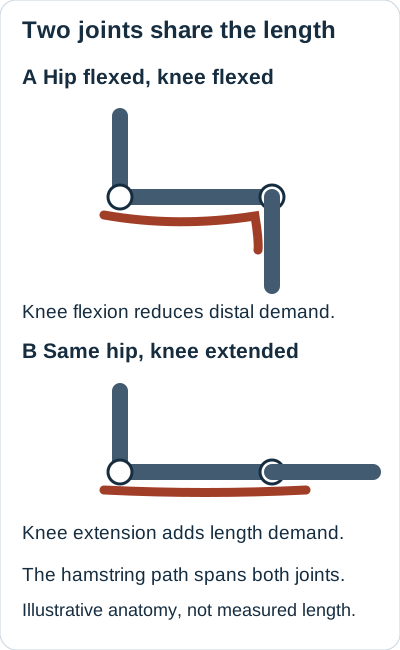
Hold the hip position constant and compare the knee. Extension adds distal length demand to the long hamstrings. Conversely, reducing hip flexion can permit more knee extension.
Try the transfer: Knee extension is limited with the hip deeply flexed, but nearly full when hip flexion is reduced. Predict whether a knee-only fixed restraint explains that large change well. Read the result: A two-joint length-sensitive structure is a better fit. Changing the neighboring joint tests the proposed explanation rather than simply renaming the stiffness.
After a stroke, test speed as a separate variable. An earlier catch with fast stretch suggests velocity-dependent resistance; a remaining deficit during slow testing describes an additional passive limitation. These components can coexist. The examination distinction is more useful than calling every post-stroke restriction a spasm or assuming every restricted joint is a fixed contracture. [9]
Piriformis is a posterior hip muscle near the sciatic nerve, unlike the psoas region's close lumbar-plexus relationships. Its rotational effect depends on hip position; near neutral it contributes to external rotation, so an opposing passive direction can challenge it. A flexion-adduction-internal-rotation provocation is not a stand-alone confirmation of a piriformis disorder. Posterior leg symptoms still require a neurological and regional differential, not automatic attribution to one muscle. [4][11]
At the shoulder, pectoralis major contributes to adduction and internal rotation; its different portions also have position-dependent flexion or extension roles. An anterior restraint may limit external rotation or horizontal abduction. Turning the palm upward may instead be forearm supination. Reaching behind the back includes internal rotation and other components, not isolated shoulder external rotation. Observe the humerus and scapula directly. [10]
Apply the limit of the rule: A same-side trunk bend with hip tension may create an apparent opposite-side curve, and the posture may lessen with support. That demonstrates a position-dependent component, not a measured bony leg-length difference or a complete segmental diagnosis. Examine lumbar, pelvic and associated hip findings independently, including both sides, rather than assuming a fixed L1/L2 pattern or predetermined piriformis compensation. [2][3]
Practice: decide what the findings actually establish
Before viewing the choices, state the clinical task and the two findings that most affect your decision. After answering, compare every option's reasoning. Keep the observed deficit, its possible cause and the next safe action separate.
Case 1
Show answer and explanations for case 1
A. Less anterior tension when the hip is supported in flexion (Best answer)
Hip flexion reduces the length demand on the iliopsoas. Extension is limited while passive flexion is preserved, so supported flexion should reduce stretch-related tension. Separate passive extensibility from pain produced by actively loading a muscle.
Reasoning steps for option A
Which position shortens the anterior hip flexors?
Hip flexion reduces the length demand on the iliopsoas.
How does that fit the passive examination?
Extension is limited while passive flexion is preserved, so supported flexion should reduce stretch-related tension.
What distinction belongs in the next examination?
Separate passive extensibility from pain produced by actively loading a muscle.
B. Less anterior tension when the hip is passively extended farther (Why this does not fit)
Tolerated extension can be part of a later stretching program. It lengthens the anterior hip flexors and may increase this patient's familiar tension rather than immediately reduce it. Do not confuse a future stretching goal with the position that presently reduces tension.
Reasoning steps for option B
Why might extension be selected in rehabilitation?
Tolerated extension can be part of a later stretching program.
Would extra extension unload the currently restricted tissue?
It lengthens the anterior hip flexors and may increase this patient's familiar tension rather than immediately reduce it.
How should loading be selected?
Do not confuse a future stretching goal with the position that presently reduces tension.
C. Loss of patellar reflex after the hip is supported in flexion (Why this does not fit)
It can accompany dysfunction in the femoral nerve or its contributing roots. The neurological examination is normal; a new reflex deficit is not an expected consequence of simply supporting the hip. Objective neurological changes require reassessment rather than attribution to ordinary muscle tightness.
Reasoning steps for option C
What can a reduced patellar reflex indicate?
It can accompany dysfunction in the femoral nerve or its contributing roots.
Does the proposed length restriction predict that change?
The neurological examination is normal; a new reflex deficit is not an expected consequence of simply supporting the hip.
How should that new result be treated?
Objective neurological changes require reassessment rather than attribution to ordinary muscle tightness.
D. Greater knee extension range solely from shortening the psoas (Why this does not fit)
The psoas spans the hip, not the knee. No knee limitation is described, and the psoas does not supply a direct two-joint explanation. Identify the joints crossed before predicting a passive range change.
Reasoning steps for option D
Which joint does the psoas directly span?
The psoas spans the hip, not the knee.
Would changing its length directly release a knee-spanning restraint?
No knee limitation is described, and the psoas does not supply a direct two-joint explanation.
What limits the opposite-direction prediction?
Identify the joints crossed before predicting a passive range change.
Takeaway: Separate passive extensibility from pain produced by actively loading a muscle.
A. Obturator activation has replaced the entire lost femoral motor supply (Why this does not fit)
Hip adduction remains intact. It does not; the patient still has quadriceps weakness, while intact psoas offers a direct explanation for hip flexion. Map each tested action to its contributing muscles and nerves.
Reasoning steps for option A
Which observed function supports preserved obturator innervation?
Hip adduction remains intact.
Does that restore femoral-innervated knee extension?
It does not; the patient still has quadriceps weakness, while intact psoas offers a direct explanation for hip flexion.
What should be localized separately?
Map each tested action to its contributing muscles and nerves.
B. Psoas activation through direct lumbar branches remains available (Best answer)
Psoas receives direct lumbar anterior-ramus branches, whereas iliacus is supplied through the femoral nerve. Intact psoas can contribute to hip flexion despite femoral-innervated weakness. Preserved hip flexion does not by itself establish an intact femoral nerve.
Reasoning steps for option B
Do psoas and iliacus have identical motor innervation?
Psoas receives direct lumbar anterior-ramus branches, whereas iliacus is supplied through the femoral nerve.
What function can therefore survive this focal lesion?
Intact psoas can contribute to hip flexion despite femoral-innervated weakness.
What should residual strength not imply?
Preserved hip flexion does not by itself establish an intact femoral nerve.
C. Quadriceps activation is preserved because the lesion is above the thigh (Why this does not fit)
They travel in the femoral nerve through the pelvis. Knee extension is markedly weak, consistent with the pelvic femoral lesion affecting those axons. Follow the affected axons to their distal muscles rather than assuming proximal location spares them.
Reasoning steps for option C
Where do motor axons to quadriceps travel before reaching the thigh?
They travel in the femoral nerve through the pelvis.
What supplied finding contradicts preserved quadriceps activation?
Knee extension is markedly weak, consistent with the pelvic femoral lesion affecting those axons.
What determines the consequence of a proximal nerve injury?
Follow the affected axons to their distal muscles rather than assuming proximal location spares them.
D. Iliacus activation is spared because all hip flexors receive direct spinal branches (Why this does not fit)
Several muscles contribute to the same joint action. Iliacus uses the femoral nerve; the intact direct supply applies to psoas rather than every hip flexor. A common joint action does not imply identical innervation.
Reasoning steps for option D
Why might hip flexion seem to implicate a shared motor supply?
Several muscles contribute to the same joint action.
Does a shared action mean shared nerve routing?
Iliacus uses the femoral nerve; the intact direct supply applies to psoas rather than every hip flexor.
What distinction prevents this error?
A common joint action does not imply identical innervation.
Takeaway: Preserved hip flexion does not by itself establish an intact femoral nerve.
A. The anterior hip capsule becomes slack when the knee extends (Why this does not fit)
Capsular stiffness can restrict hip excursion. Knee extension alone changes the limitation while hip rotation is comfortable and pelvic position is unchanged. Determine whether the restriction depends on a neighboring joint rather than the hip alone.
Reasoning steps for option A
Why consider a capsule in passive hip restriction?
Capsular stiffness can restrict hip excursion.
What makes the capsule a weaker explanation here?
Knee extension alone changes the limitation while hip rotation is comfortable and pelvic position is unchanged.
What should be identified before naming a joint disorder?
Determine whether the restriction depends on a neighboring joint rather than the hip alone.
B. Hamstring shortening prevents the thigh from descending with a bent knee (Why this does not fit)
Knee flexion shortens the hamstrings rather than increasing their knee-related length demand. The direction is opposite: knee extension would lengthen hamstrings, not selectively release them. Predict its length change at both joints before attributing the examination to it.
Reasoning steps for option B
How do hamstrings respond to knee flexion?
Knee flexion shortens the hamstrings rather than increasing their knee-related length demand.
Does that fit the observed improvement with knee extension?
The direction is opposite: knee extension would lengthen hamstrings, not selectively release them.
How should a proposed muscle be checked?
Predict its length change at both joints before attributing the examination to it.
C. Rectus femoris limits the combined hip extension and knee flexion position (Best answer)
Knee flexion lengthens this muscle, which also crosses the front of the hip. It reduces that length demand and permits more hip extension with the pelvis unchanged. A knee-dependent hip restriction supports a two-joint contribution, not isolated psoas shortening.
Reasoning steps for option C
What happens to rectus femoris during knee flexion?
Knee flexion lengthens this muscle, which also crosses the front of the hip.
What does allowing knee extension change here?
It reduces that length demand and permits more hip extension with the pelvis unchanged.
How should the finding be used?
A knee-dependent hip restriction supports a two-joint contribution, not isolated psoas shortening.
D. Psoas length changes directly as the knee extends (Why this does not fit)
Its distal attachment is on the proximal femur, so it does not cross the knee. With the pelvis controlled, the strong effect of knee position points instead toward a structure spanning both joints. Change one joint while controlling the others to identify two-joint restrictions.
Reasoning steps for option D
Does the psoas cross the knee?
Its distal attachment is on the proximal femur, so it does not cross the knee.
Can direct psoas lengthening explain the knee-dependent change?
With the pelvis controlled, the strong effect of knee position points instead toward a structure spanning both joints.
What is the useful comparison?
Change one joint while controlling the others to identify two-joint restrictions.
Takeaway: A knee-dependent hip restriction supports a two-joint contribution, not isolated psoas shortening.
A. Right hip extension is limited; the tissue and cause require further assessment (Best answer)
The right thigh is being lowered while the left hip controls pelvic position. The right hip has less passive extension in this examination, but several tissues or pain-related guarding can contribute. Name the observed side and deficit without converting a range test into a unique diagnosis.
Reasoning steps for option A
Which side is undergoing the extension assessment first?
The right thigh is being lowered while the left hip controls pelvic position.
What does the asymmetry demonstrate?
The right hip has less passive extension in this examination, but several tissues or pain-related guarding can contribute.
How should a positive result be described?
Name the observed side and deficit without converting a range test into a unique diagnosis.
B. Left iliopsoas shortening is established by holding the left knee up (Why this does not fit)
Flexing it helps control pelvic position while the other hip is tested. The right thigh, whereas the left descends during the reversed assessment. Identify the hip being extended rather than the hip being held in flexion.
Reasoning steps for option B
What role does the left hip play in the first assessment?
Flexing it helps control pelvic position while the other hip is tested.
Which thigh actually fails to descend?
The right thigh, whereas the left descends during the reversed assessment.
What prevents a side error?
Identify the hip being extended rather than the hip being held in flexion.
C. Right psoas pathology is confirmed independently of the rest of the examination (Why this does not fit)
It is an anterior hip flexor whose reduced extensibility can limit extension. No; other flexors, joint restriction and guarding can produce a similar observed deficit. Use the range finding to direct further assessment, not to confirm one muscle disorder alone.
Reasoning steps for option C
Why does psoas enter the differential?
It is an anterior hip flexor whose reduced extensibility can limit extension.
Is it the only explanation for this result?
No; other flexors, joint restriction and guarding can produce a similar observed deficit.
What is the correct diagnostic role?
Use the range finding to direct further assessment, not to confirm one muscle disorder alone.
D. Right femoral neuropathy is established by failure of the thigh to descend (Why this does not fit)
Motor, reflex and sensory findings in the femoral distribution would support it. The case supplies a passive range asymmetry, not a femoral neurological deficit. A passive hip extension test cannot establish nerve dysfunction.
Reasoning steps for option D
What evidence would support femoral neuropathy?
Motor, reflex and sensory findings in the femoral distribution would support it.
Are those findings supplied?
The case supplies a passive range asymmetry, not a femoral neurological deficit.
What should not be substituted for a neurological examination?
A passive hip extension test cannot establish nerve dysfunction.
Takeaway: Name the observed side and deficit without converting a range test into a unique diagnosis.
A. Piriformis shortening is established by the internal rotation deficit (Why this does not fit)
Near hip neutral, stretching an external rotator can resist internal rotation. The groin symptoms, loss of flexion and joint changes create a broader articular pattern, not an isolated posterior muscle finding. Use symptom location, multiple passive directions and structural findings together.
Reasoning steps for option A
Why might a shortened external rotator limit internal rotation?
Near hip neutral, stretching an external rotator can resist internal rotation.
Why is that insufficient in this case?
The groin symptoms, loss of flexion and joint changes create a broader articular pattern, not an isolated posterior muscle finding.
What matters beyond direction alone?
Use symptom location, multiple passive directions and structural findings together.
B. A hip joint process is better supported than an isolated shortened flexor (Best answer)
Loading an already painful hip can reproduce symptoms without identifying one injured muscle. Restriction in several passive directions and degenerative joint changes fit the symptoms better than isolated anterior muscle shortening. Interpret it with passive joint findings and the rest of the clinical examination.
Reasoning steps for option B
Can a joint disorder produce pain during resisted hip flexion?
Loading an already painful hip can reproduce symptoms without identifying one injured muscle.
Which findings support a joint source here?
Restriction in several passive directions and degenerative joint changes fit the symptoms better than isolated anterior muscle shortening.
How should a provocative muscle test be used?
Interpret it with passive joint findings and the rest of the clinical examination.
C. Isolated psoas shortening explains the entire examination (Why this does not fit)
It would particularly limit hip extension when pelvic compensation is controlled. No; internal rotation and flexion are restricted, and the joint itself has relevant structural changes. Do not force a broad joint restriction into a single-muscle explanation.
Reasoning steps for option C
What passive deficit would an anterior flexor restraint particularly suggest?
It would particularly limit hip extension when pelvic compensation is controlled.
Is that the dominant pattern supplied?
No; internal rotation and flexion are restricted, and the joint itself has relevant structural changes.
What prevents overlocalization?
Do not force a broad joint restriction into a single-muscle explanation.
D. Femoral nerve injury accounts for the restriction in passive rotation (Why this does not fit)
It can produce motor and sensory deficits in its distribution. Those findings point to a joint process, and no characteristic neurological deficit is supplied. Separate passive joint restriction from neurological weakness and sensory loss.
Reasoning steps for option D
How can femoral injury affect hip and leg function?
It can produce motor and sensory deficits in its distribution.
Does that explain painful passive rotation with joint-space loss?
Those findings point to a joint process, and no characteristic neurological deficit is supplied.
What examination domains should remain distinct?
Separate passive joint restriction from neurological weakness and sensory loss.
Takeaway: Interpret it with passive joint findings and the rest of the clinical examination.
A. An isolated femoral nerve lesion distal to the inguinal ligament (Why this does not fit)
Quadriceps weakness and saphenous-distribution sensory loss fit femoral dysfunction. Obturator-innervated adductor involvement is outside an isolated distal femoral lesion. Use all documented motor territories, not only the most obvious weakness.
Reasoning steps for option A
What findings could a femoral lesion explain?
Quadriceps weakness and saphenous-distribution sensory loss fit femoral dysfunction.
Which additional finding requires a broader explanation?
Obturator-innervated adductor involvement is outside an isolated distal femoral lesion.
What should not be discarded?
Use all documented motor territories, not only the most obvious weakness.
B. An isolated obturator nerve lesion in the obturator canal (Why this does not fit)
Weak adduction and medial thigh sensory change can fit obturator dysfunction. Quadriceps weakness and medial leg sensory loss involve a different major nerve. It is inadequate when another independently tested nerve distribution is also affected.
Reasoning steps for option B
What findings could an obturator lesion explain?
Weak adduction and medial thigh sensory change can fit obturator dysfunction.
Which supplied findings remain unexplained?
Quadriceps weakness and medial leg sensory loss involve a different major nerve.
When is a single-branch diagnosis inadequate?
It is inadequate when another independently tested nerve distribution is also affected.
C. An isolated lateral femoral cutaneous nerve lesion near the ASIS (Why this does not fit)
It is a sensory nerve to the anterolateral thigh. There are deficits in two motor distributions and sensory loss outside that territory. A purely sensory branch cannot unify independently demonstrated motor deficits.
Reasoning steps for option C
What type of nerve is the lateral femoral cutaneous nerve?
It is a sensory nerve to the anterolateral thigh.
How does this patient's pattern differ?
There are deficits in two motor distributions and sensory loss outside that territory.
What anatomical principle applies?
A purely sensory branch cannot unify independently demonstrated motor deficits.
D. Lumbar plexus involvement within the psoas region (Best answer)
Knee extension and medial leg sensation involve femoral pathways, while hip adduction implicates obturator pathways. The lumbar plexus forms in the psoas region and supplies both nerves. Consider a shared proximal structure rather than assigning every deficit to one distal nerve.
Reasoning steps for option D
Which two major peripheral distributions are affected?
Knee extension and medial leg sensation involve femoral pathways, while hip adduction implicates obturator pathways.
Where can the single supplied mass affect both?
The lumbar plexus forms in the psoas region and supplies both nerves.
How should multiple nerve territories guide localization?
Consider a shared proximal structure rather than assigning every deficit to one distal nerve.
Takeaway: Consider a shared proximal structure rather than assigning every deficit to one distal nerve.
A. A lateral femoral cutaneous distribution is more consistent than femoral motor dysfunction (Best answer)
The lateral femoral cutaneous nerve supplies that cutaneous territory without a motor component. Normal quadriceps function and patellar reflexes, with no medial leg deficit, make femoral motor involvement less consistent. Distinguish a sensory-only thigh pattern from a nerve lesion that should also affect strength or reflexes.
Reasoning steps for option A
Which nerve supplies sensation over the anterolateral thigh?
The lateral femoral cutaneous nerve supplies that cutaneous territory without a motor component.
How do the preserved functions refine the interpretation?
Normal quadriceps function and patellar reflexes, with no medial leg deficit, make femoral motor involvement less consistent.
What should be compared in a similar case?
Distinguish a sensory-only thigh pattern from a nerve lesion that should also affect strength or reflexes.
B. A femoral neuropathy is established by the anterior thigh symptoms (Why this does not fit)
The femoral nerve has anterior thigh sensory branches as well as motor functions. The symptoms are anterolateral and sensory only, while knee extension, reflexes and medial leg sensation remain intact. Use the precise sensory distribution together with motor and reflex testing.
Reasoning steps for option B
Why can a femoral lesion produce thigh symptoms?
The femoral nerve has anterior thigh sensory branches as well as motor functions.
What makes the alternative cutaneous localization better here?
The symptoms are anterolateral and sensory only, while knee extension, reflexes and medial leg sensation remain intact.
What prevents overdiagnosis from location alone?
Use the precise sensory distribution together with motor and reflex testing.
C. Psoas shortening is established despite normal passive extension (Why this does not fit)
It can contribute to mechanical anterior hip or groin symptoms. Comfortable controlled extension and a discrete cutaneous disturbance do not establish a psoas length deficit. Do not equate superficial burning or numbness with a demonstrated muscular restriction.
Reasoning steps for option C
Why might psoas be considered in hip-region discomfort?
It can contribute to mechanical anterior hip or groin symptoms.
Does it explain this isolated belt-associated sensory pattern?
Comfortable controlled extension and a discrete cutaneous disturbance do not establish a psoas length deficit.
How should different symptom types be separated?
Do not equate superficial burning or numbness with a demonstrated muscular restriction.
D. An obturator neuropathy is established by preserved hip adduction (Why this does not fit)
It would tend to impair hip adduction. Adduction is full and the symptoms are anterolateral rather than medial thigh. Preserved target-muscle function does not establish a lesion in its nerve.
Reasoning steps for option D
What would obturator motor involvement tend to impair?
It would tend to impair hip adduction.
Is that deficit or its characteristic medial distribution present?
Adduction is full and the symptoms are anterolateral rather than medial thigh.
How should an intact function be interpreted?
Preserved target-muscle function does not establish a lesion in its nerve.
Takeaway: Distinguish a sensory-only thigh pattern from a nerve lesion that should also affect strength or reflexes.
A. Immediate reduction of tenderness with a supported hip position (Why this does not fit)
It can reduce tissue loading and reported tenderness. It is a symptom response and supplies no urinary-tract evidence. Report the observed change without converting it into an unsupported etiological diagnosis.
Reasoning steps for option A
What can comfortable positioning change?
It can reduce tissue loading and reported tenderness.
Would that positive response establish renal disease?
It is a symptom response and supplies no urinary-tract evidence.
How should a treatment response be described?
Report the observed change without converting it into an unsupported etiological diagnosis.
B. New colicky flank pain with hematuria (Best answer)
Colicky flank pain with hematuria would directly raise concern for urinary-tract disease. It supplies organ-related clinical information; the muscle's motor supply alone does not diagnose a visceral disorder. Consider nearby organs when the history and examination support them, not from a motor-root label alone.
Reasoning steps for option B
What new evidence would independently support a urinary source?
Colicky flank pain with hematuria would directly raise concern for urinary-tract disease.
Why is that more useful than naming psoas motor roots?
It supplies organ-related clinical information; the muscle's motor supply alone does not diagnose a visceral disorder.
How should regional anatomy be used?
Consider nearby organs when the history and examination support them, not from a motor-root label alone.
C. A familiar ache only during resisted hip flexion (Why this does not fit)
It loads hip flexors and surrounding painful structures. It does not add an organ-specific symptom to the already mechanical pattern. It cannot by itself identify which internal organ, if any, is diseased.
Reasoning steps for option C
What does resisted flexion assess?
It loads hip flexors and surrounding painful structures.
Does reproduction of the same mechanical ache establish urinary disease?
It does not add an organ-specific symptom to the already mechanical pattern.
What is the limitation of a musculoskeletal provocation test?
It cannot by itself identify which internal organ, if any, is diseased.
D. The same extension limit after pelvic stabilization (Why this does not fit)
It makes the passive hip extension observation more interpretable. No; it confirms an examination finding without establishing an organ diagnosis. Measurement validity and determination of the underlying cause are separate questions.
Reasoning steps for option D
What does pelvic stabilization improve?
It makes the passive hip extension observation more interpretable.
Does persistence of that deficit identify a urinary cause?
No; it confirms an examination finding without establishing an organ diagnosis.
What remains distinct?
Measurement validity and determination of the underlying cause are separate questions.
Takeaway: Consider nearby organs when the history and examination support them, not from a motor-root label alone.
A. Apply a lumbar thrust because hip extension is limited (Why this does not fit)
It would address a separately examined and suitably selected joint dysfunction. No; the supplied finding concerns a hip-flexor restriction with a tolerable indirect position. It does not automatically justify a thrust technique or replace a separate contraindication assessment.
Reasoning steps for option A
What might a lumbar thrust target when appropriate?
It would address a separately examined and suitably selected joint dysfunction.
Has this case established that indication?
No; the supplied finding concerns a hip-flexor restriction with a tolerable indirect position.
What does a limited hip test not authorize?
It does not automatically justify a thrust technique or replace a separate contraindication assessment.
B. Stretch beyond the current pain response until the guarding subsides (Why this does not fit)
Tolerated stretching may be part of a broader rehabilitation plan. No; the chosen position should reduce symptoms, and worsening pain is a reason to adjust or stop. Patient comfort and safety take priority over achieving a predetermined range.
Reasoning steps for option B
Why might a stretching program eventually be considered?
Tolerated stretching may be part of a broader rehabilitation plan.
Does current guarding justify pushing through pain during this trial?
No; the chosen position should reduce symptoms, and worsening pain is a reason to adjust or stop.
What limits the intervention?
Patient comfort and safety take priority over achieving a predetermined range.
C. Support a comfortable position, monitor tenderness, then return passively and reassess (Best answer)
Counterstrain uses a position that reduces monitored tenderness rather than forcing the restrictive barrier. Supported flexion reduces tenderness, while approaching extension increases guarding and the patient can provide reliable feedback. Maintain comfort, return passively and reassess rather than selecting treatment solely by symptom duration.
Reasoning steps for option C
What distinguishes counterstrain from a direct barrier technique?
Counterstrain uses a position that reduces monitored tenderness rather than forcing the restrictive barrier.
Why does it fit this patient's response?
Supported flexion reduces tenderness, while approaching extension increases guarding and the patient can provide reliable feedback.
What completes the trial?
Maintain comfort, return passively and reassess rather than selecting treatment solely by symptom duration.
D. Advance to the extension barrier and require repeated isometric flexion immediately (Why this does not fit)
That describes a muscle energy approach. The extension approach is currently provoking guarding, whereas an indirect supported position clearly reduces tenderness. Use tolerance, cooperation and the observed examination rather than applying one sequence to everyone.
Reasoning steps for option D
Which technique uses isometric effort at a restrictive barrier?
That describes a muscle energy approach.
Why is it not the best match for the trial described?
The extension approach is currently provoking guarding, whereas an indirect supported position clearly reduces tenderness.
How should technique choice be individualized?
Use tolerance, cooperation and the observed examination rather than applying one sequence to everyone.
Takeaway: Maintain comfort, return passively and reassess rather than selecting treatment solely by symptom duration.
A. Complete the remaining 60 seconds because the initial reduction met the target (Why this does not fit)
It describes a planned hold when the position remains appropriate and tolerated. The patient now has a new symptom and has withdrawn consent for continuing. A scheduled hold is conditional on ongoing safety and consent.
Reasoning steps for option A
Why is a duration specified in a procedural description?
It describes a planned hold when the position remains appropriate and tolerated.
Why is completing it inappropriate here?
The patient now has a new symptom and has withdrawn consent for continuing.
How should protocols be applied?
A scheduled hold is conditional on ongoing safety and consent.
B. Increase local palpation pressure to determine whether tenderness will fall again (Why this does not fit)
It is to compare the response to positioning, not to force a lower pain rating. It could worsen discomfort and does not address the new abdominal pain or the request to stop. Stop the provoking intervention before trying to explain it with stronger provocation.
Reasoning steps for option B
What is the purpose of monitoring the tender region?
It is to compare the response to positioning, not to force a lower pain rating.
Would more pressure answer the new clinical concern safely?
It could worsen discomfort and does not address the new abdominal pain or the request to stop.
How should an unexpected symptom be handled?
Stop the provoking intervention before trying to explain it with stronger provocation.
C. Switch directly to a forceful extension technique because the indirect trial failed (Why this does not fit)
A different approach may be reasonable after reassessment when its indication and safety are established. No; the new abdominal complaint first needs evaluation, and the patient has asked to stop. Reassess the diagnosis and obtain consent rather than escalating force after an adverse response.
Reasoning steps for option C
Why might another technique sometimes be considered?
A different approach may be reasonable after reassessment when its indication and safety are established.
Is that reassessment complete here?
No; the new abdominal complaint first needs evaluation, and the patient has asked to stop.
What should precede a treatment change?
Reassess the diagnosis and obtain consent rather than escalating force after an adverse response.
D. End the trial, support a comfortable return and reassess the new symptom (Best answer)
No; patient responses can change during a procedure. A different abdominal pain and an explicit request to stop require ending the trial and reassessment. Ongoing consent, symptom monitoring and clinical judgment remain necessary throughout treatment.
Reasoning steps for option D
Does an initial reduction in tenderness guarantee continued tolerance?
No; patient responses can change during a procedure.
What new information overrides the planned duration?
A different abdominal pain and an explicit request to stop require ending the trial and reassessment.
What does a timer never replace?
Ongoing consent, symptom monitoring and clinical judgment remain necessary throughout treatment.
Takeaway: Ongoing consent, symptom monitoring and clinical judgment remain necessary throughout treatment.
A. Have the patient remain relaxed while the clinician returns the limbs, then reassess (Best answer)
The clinician passively returns the supported region from the position of comfort. It would introduce active loading before the supported return and the planned reassessment are complete. Passive return comes before checking the local response and choosing subsequent activity.
Reasoning steps for option A
What is the intended return after counterstrain?
The clinician passively returns the supported region from the position of comfort.
What would asking for a lunge do instead?
It would introduce active loading before the supported return and the planned reassessment are complete.
What sequence should be retained?
Passive return comes before checking the local response and choosing subsequent activity.
B. Ask the patient to contract maximally before the legs reach neutral (Why this does not fit)
Muscle energy includes controlled isometric effort as part of a different procedure. No; the described trial calls for passive return rather than inserting an unplanned high-effort contraction. Follow the chosen technique and reassess before adding a different intervention.
Reasoning steps for option B
Which approach deliberately includes patient contraction?
Muscle energy includes controlled isometric effort as part of a different procedure.
Is maximal contraction the missing step in this counterstrain sequence?
No; the described trial calls for passive return rather than inserting an unplanned high-effort contraction.
What avoids mixing incompatible steps?
Follow the chosen technique and reassess before adding a different intervention.
C. Hold the position until all tenderness is permanently absent (Why this does not fit)
It does not establish permanent recovery or removal of the underlying cause. No; the planned tolerated hold is complete, and function and symptoms still need evaluation after return. Assess the observed response and follow-up function rather than demanding a permanent result during one hold.
Reasoning steps for option C
Does a temporary symptom reduction prove lasting resolution?
It does not establish permanent recovery or removal of the underlying cause.
Does an indefinite hold replace reassessment?
No; the planned tolerated hold is complete, and function and symptoms still need evaluation after return.
How should treatment success be judged?
Assess the observed response and follow-up function rather than demanding a permanent result during one hold.
D. Have the patient immediately stretch into the maximum available extension (Why this does not fit)
A tolerated extension exercise may have a place in a subsequent plan. The passive return and response assessment have not occurred, and maximal loading is not a required conclusion to this procedure. Select it after reassessment and within the patient's tolerance.
Reasoning steps for option D
Why might extension be included later?
A tolerated extension exercise may have a place in a subsequent plan.
Why not insert maximal stretching now?
The passive return and response assessment have not occurred, and maximal loading is not a required conclusion to this procedure.
What governs subsequent exercise?
Select it after reassessment and within the patient's tolerance.
Takeaway: Passive return comes before checking the local response and choosing subsequent activity.
A. Greater lumbar arching confirms a larger gain at the hip (Why this does not fit)
It changes the pelvic reference used to judge hip extension. No; it can conceal a persistent hip deficit by substituting another region's motion. Maintain comparable pelvic position before attributing a range change to the hip.
Reasoning steps for option A
Why can lumbar posture affect the apparent thigh position?
It changes the pelvic reference used to judge hip extension.
Does that prove increased femur-on-pelvis excursion?
No; it can conceal a persistent hip deficit by substituting another region's motion.
What makes comparison valid?
Maintain comparable pelvic position before attributing a range change to the hip.
B. The effort was isometric; the reassessed range must still be measured relative to the pelvis (Best answer)
The patient generates force against resistance without a change in joint position. Lumbar arching and pelvic tilt can create apparent extension without the same increase at the hip. Record tolerated femur-on-pelvis range and symptoms, not only how far the thigh travels.
Reasoning steps for option B
What defines an isometric effort in this examination?
The patient generates force against resistance without a change in joint position.
Why continue controlling the pelvis after relaxation?
Lumbar arching and pelvic tilt can create apparent extension without the same increase at the hip.
What should be documented?
Record tolerated femur-on-pelvis range and symptoms, not only how far the thigh travels.
C. The effort was passive because the joint did not change position (Why this does not fit)
Yes; an isometric contraction does exactly that. No; the patient deliberately attempted hip flexion against matched resistance. Patient force generation matters even when the joint angle remains unchanged.
Reasoning steps for option C
Can a muscle generate force without visible joint excursion?
Yes; an isometric contraction does exactly that.
Was the patient inactive during the effort?
No; the patient deliberately attempted hip flexion against matched resistance.
What distinguishes active from passive treatment?
Patient force generation matters even when the joint angle remains unchanged.
D. The effort was eccentric because the clinician resisted hip flexion (Why this does not fit)
The active muscle lengthens while producing force. No joint position changed during the matched effort; additional extension occurred after relaxation. Classify the contraction during the effort, not from the later passive reassessment.
Reasoning steps for option D
What defines eccentric muscle action?
The active muscle lengthens while producing force.
Did the supplied description demonstrate active lengthening?
No joint position changed during the matched effort; additional extension occurred after relaxation.
What must be separated in time?
Classify the contraction during the effort, not from the later passive reassessment.
Takeaway: Record tolerated femur-on-pelvis range and symptoms, not only how far the thigh travels.
A. Use any indirect position because indirect techniques have no postoperative limitations (Why this does not fit)
It can avoid the painful restrictive barrier. No; an indirect position can still place a recently operated hip outside its permitted range. A gentler method still requires procedure-specific safety screening.
Reasoning steps for option A
Why might an indirect technique be better tolerated in some patients?
It can avoid the painful restrictive barrier.
Does that guarantee that every positioning choice respects the repair?
No; an indirect position can still place a recently operated hip outside its permitted range.
How should technique labels be interpreted?
A gentler method still requires procedure-specific safety screening.
B. Treat the tightness as proven muscular dysfunction because there is no fever (Why this does not fit)
It is one clinical observation, not a complete postoperative assessment. It establishes neither, so a muscular label cannot bypass the missing operative information. Integrate surgical context, examination and warning signs rather than relying on one negative finding.
Reasoning steps for option B
What does the absence of fever contribute?
It is one clinical observation, not a complete postoperative assessment.
Does it identify the cause of tightness or the allowed range?
It establishes neither, so a muscular label cannot bypass the missing operative information.
How should postoperative symptoms be assessed?
Integrate surgical context, examination and warning signs rather than relying on one negative finding.
C. Clarify operative restrictions and obtain a focused postoperative assessment (Best answer)
The operation, repaired structures and current rehabilitation precautions matter. It does not establish safety for a forceful stretch or a particular hip position. Confirm the postoperative plan and examine the complaint before applying an intervention.
Reasoning steps for option C
What determines which positions and loads are safe after surgery?
The operation, repaired structures and current rehabilitation precautions matter.
Does an uncomplicated-looking incision supply that information?
It does not establish safety for a forceful stretch or a particular hip position.
What should precede treatment?
Confirm the postoperative plan and examine the complaint before applying an intervention.
D. Use a forceful extension stretch because the patient requested it (Why this does not fit)
It informs shared planning and consent. No; the operative restrictions are still unknown. Consent and clinical suitability are both required, and neither substitutes for the other.
Reasoning steps for option D
Why is the patient's preference important?
It informs shared planning and consent.
Does a request establish mechanical safety after an unspecified operation?
No; the operative restrictions are still unknown.
What are the separate requirements?
Consent and clinical suitability are both required, and neither substitutes for the other.
Takeaway: Confirm the postoperative plan and examine the complaint before applying an intervention.
A. The manual technique is more effective than an exercise-only program (Why this does not fit)
A suitable comparison of the alternatives would be needed. No; it described combined care in one patient. An uncontrolled combined intervention cannot establish superiority over an untested alternative.
Reasoning steps for option A
What would support a comparative effectiveness claim?
A suitable comparison of the alternatives would be needed.
Did the report supply an exercise-only comparator?
No; it described combined care in one patient.
What claim exceeds a case report?
An uncontrolled combined intervention cannot establish superiority over an untested alternative.
B. Home stretching alone accounts for the observed improvement (Why this does not fit)
It was one part of the care received. No; manual treatment and other time-related influences were not separated from it. Do not assign all benefit to either component without evidence that separates them.
Reasoning steps for option B
Why might stretching have contributed?
It was one part of the care received.
Can its isolated contribution be determined here?
No; manual treatment and other time-related influences were not separated from it.
What prevents an equally unsupported opposite conclusion?
Do not assign all benefit to either component without evidence that separates them.
C. The symptom response establishes the original muscle as the only source of pain (Why this does not fit)
It can support continuing a tolerable approach with reassessment. No; a response to combined care is not a specific diagnostic test for one muscle. Track improvement while remaining willing to reassess the underlying explanation.
Reasoning steps for option C
Can symptom improvement support a useful clinical plan?
It can support continuing a tolerable approach with reassessment.
Does it uniquely identify every pain-generating structure?
No; a response to combined care is not a specific diagnostic test for one muscle.
How should response and diagnosis be related?
Track improvement while remaining willing to reassess the underlying explanation.
D. Improvement followed combined care, but the contribution of each component is uncertain (Best answer)
One patient improved after a combination of interventions. There was no comparison group and both treatments occurred together, so their separate effects and natural recovery are not resolved. Describe possible benefit without claiming that one technique is necessary or superior.
Reasoning steps for option D
What was observed directly?
One patient improved after a combination of interventions.
What prevents attributing the response to one component?
There was no comparison group and both treatments occurred together, so their separate effects and natural recovery are not resolved.
How should counseling reflect the evidence?
Describe possible benefit without claiming that one technique is necessary or superior.
Takeaway: Describe possible benefit without claiming that one technique is necessary or superior.
A. Arrange prompt abdominal evaluation with risk-appropriate imaging (Best answer)
Migrating abdominal pain, anorexia and focal tenderness warrant assessment for an intra-abdominal process. They do not reliably exclude early appendicitis, and the hip-extension response does not establish a benign muscle cause. Investigate the abdominal syndrome rather than beginning routine muscle treatment.
Reasoning steps for option A
What does the symptom progression suggest beyond a hip complaint?
Migrating abdominal pain, anorexia and focal tenderness warrant assessment for an intra-abdominal process.
Do normal temperature and a non-elevated leukocyte count remove that concern?
They do not reliably exclude early appendicitis, and the hip-extension response does not establish a benign muscle cause.
What should take priority?
Investigate the abdominal syndrome rather than beginning routine muscle treatment.
B. Begin counterstrain and investigate the abdomen only if hip extension remains painful (Why this does not fit)
It may reduce tension in the irritated psoas region. No; adjacent abdominal inflammation may also become less painful in that position. Symptom relief must not delay investigation of a concerning abdominal presentation.
Reasoning steps for option B
Why might flexed positioning reduce discomfort?
It may reduce tension in the irritated psoas region.
Would that response safely resolve the abdominal concern?
No; adjacent abdominal inflammation may also become less painful in that position.
How should comfort be distinguished from evaluation?
Symptom relief must not delay investigation of a concerning abdominal presentation.
C. Diagnose mechanical psoas syndrome because there is no fever or leukocytosis (Why this does not fit)
They are part of the overall assessment but are not definitive exclusion tests. Pain migration, anorexia and focal abdominal tenderness remain unexplained by an isolated mechanical label. Weigh the full evolving syndrome rather than allowing two normal values to determine the diagnosis.
Reasoning steps for option C
What do the normal observations contribute?
They are part of the overall assessment but are not definitive exclusion tests.
Which findings remain concerning?
Pain migration, anorexia and focal abdominal tenderness remain unexplained by an isolated mechanical label.
What prevents premature closure?
Weigh the full evolving syndrome rather than allowing two normal values to determine the diagnosis.
D. Proceed directly to appendectomy solely because extension produces abdominal pain (Why this does not fit)
The abdominal pattern warrants urgent diagnostic consideration. No; integrated evaluation and appropriate imaging guide those decisions in a stable patient. A provocative sign is not a stand-alone surgical indication.
Reasoning steps for option D
Why is appendicitis a relevant possibility?
The abdominal pattern warrants urgent diagnostic consideration.
Does an isolated psoas response establish diagnosis, severity and treatment choice?
No; integrated evaluation and appropriate imaging guide those decisions in a stable patient.
What should not determine surgery by itself?
A provocative sign is not a stand-alone surgical indication.
Takeaway: Investigate the abdominal syndrome rather than beginning routine muscle treatment.
A. The two results are incompatible because a shortened muscle cannot hurt during its own action (Why this does not fit)
It predicts limited passive excursion in a direction that lengthens the tissue. No; load-sensitive muscle or tendon pain can occur during its own active action. Passive shortening and pain during contraction are different examination dimensions.
Reasoning steps for option A
What does a pure length restriction predict?
It predicts limited passive excursion in a direction that lengthens the tissue.
Does that prohibit pain during active contraction?
No; load-sensitive muscle or tendon pain can occur during its own active action.
What should be distinguished?
Passive shortening and pain during contraction are different examination dimensions.
B. Both tests stress the same region in different ways, and neither alone identifies the cause (Best answer)
Extension increases anterior hip-flexor length demand, whereas resisted flexion loads active contraction. Muscle pathology or irritation from adjacent disease may make both painful, so the results are not two independent etiological confirmations. Use the wider history, abdominal examination and indicated testing to determine the cause.
Why do two positive results not uniquely identify the origin of disease?
Muscle pathology or irritation from adjacent disease may make both painful, so the results are not two independent etiological confirmations.
What is the next interpretive step?
Use the wider history, abdominal examination and indicated testing to determine the cause.
C. The extension response tests the quadriceps alone because the patient is passive (Why this does not fit)
No; passive positioning can load multiple muscles, capsules and adjacent tissues. It does not; extension can lengthen the anterior hip flexors regardless of who supplies the force. Use anatomy and joint position rather than equating passive examination with one muscle.
Reasoning steps for option C
Does passive testing isolate a single structure?
No; passive positioning can load multiple muscles, capsules and adjacent tissues.
Does passivity make the psoas irrelevant to hip extension?
It does not; extension can lengthen the anterior hip flexors regardless of who supplies the force.
What determines which tissues are stressed?
Use anatomy and joint position rather than equating passive examination with one muscle.
D. The resisted flexion response excludes adjacent abdominal inflammation (Why this does not fit)
It loads the iliopsoas region. Yes; a painful contraction does not exclude an adjacent visceral or retroperitoneal source. It cannot independently rule out disease in neighboring structures.
Reasoning steps for option D
Why can a flexion contraction be painful?
It loads the iliopsoas region.
Can nearby inflammation make that loaded region painful?
Yes; a painful contraction does not exclude an adjacent visceral or retroperitoneal source.
What should a loading test not be used to do?
It cannot independently rule out disease in neighboring structures.
Takeaway: Use the wider history, abdominal examination and indicated testing to determine the cause.
A. Mechanical psoas dysfunction is established because the patient is afebrile (Why this does not fit)
Yes; its presentation can be nonspecific. A rim-enhancing collection with a bowel tract and marked inflammation cannot be explained as routine shortening alone. Absence of fever does not negate imaging-supported deep infection.
Reasoning steps for option A
Can iliopsoas infection present without fever?
Yes; its presentation can be nonspecific.
What evidence overrides the normal temperature here?
A rim-enhancing collection with a bowel tract and marked inflammation cannot be explained as routine shortening alone.
Which negative finding is insufficient?
Absence of fever does not negate imaging-supported deep infection.
B. An isolated femoral nerve injury accounts for the rim-enhancing collection (Why this does not fit)
It may compress or irritate nearby neural structures. No; it could be a consequence but is not the demonstrated source process. Identify and address the causal lesion rather than only a possible downstream deficit.
Reasoning steps for option B
What might an adjacent collection do to a nerve?
It may compress or irritate nearby neural structures.
Would a nerve injury alone explain the tract and inflammatory collection?
No; it could be a consequence but is not the demonstrated source process.
What should treatment prioritize?
Identify and address the causal lesion rather than only a possible downstream deficit.
C. Secondary iliopsoas infection from contiguous bowel disease requires urgent cause-directed care (Best answer)
The supplied tract supports direct extension of infection into the iliopsoas compartment. The imaging and inflammatory findings establish a serious concern despite a normal temperature. Prioritize urgent infection and source-control assessment rather than treating guarding alone.
Reasoning steps for option C
What does a collection connected to adjacent inflamed bowel suggest?
The supplied tract supports direct extension of infection into the iliopsoas compartment.
Why does the absence of fever not make this a routine muscle syndrome?
The imaging and inflammatory findings establish a serious concern despite a normal temperature.
What follows clinically?
Prioritize urgent infection and source-control assessment rather than treating guarding alone.
D. Primary hematogenous infection is established because the psoas is highly vascular (Why this does not fit)
A distant bloodstream source can seed the compartment without a contiguous focus. The CT demonstrates a tract from adjacent inflamed bowel. Use demonstrated source anatomy rather than vascularity alone.
Reasoning steps for option D
How can a primary iliopsoas infection develop?
A distant bloodstream source can seed the compartment without a contiguous focus.
Which finding favors secondary infection here?
The CT demonstrates a tract from adjacent inflamed bowel.
How should primary and secondary forms be separated?
Use demonstrated source anatomy rather than vascularity alone.
Takeaway: Prioritize urgent infection and source-control assessment rather than treating guarding alone.
A. Normal silhouettes do not resolve the concern for deep disease; pursue appropriate cross-sectional assessment (Best answer)
It shows a projected soft-tissue boundary on that radiograph. It does not resolve persistent night symptoms, inflammation and worsening pain; the relevant compartment may require CT or MRI assessment. Match the test's capabilities to the suspected disease rather than treating a normal outline as an exclusion rule.
Reasoning steps for option A
What does the visible silhouette demonstrate?
It shows a projected soft-tissue boundary on that radiograph.
Does this anatomical observation explain or exclude the concerning clinical course?
It does not resolve persistent night symptoms, inflammation and worsening pain; the relevant compartment may require CT or MRI assessment.
How should imaging be interpreted?
Match the test's capabilities to the suspected disease rather than treating a normal outline as an exclusion rule.
B. The normal silhouettes exclude an iliopsoas collection (Why this does not fit)
It provides a recognizable anatomical boundary. No; a projected outline cannot by itself settle concern for a deep collection in this clinical context. Persisting warning signs require evaluation even when an initial radiograph appears normal.
Reasoning steps for option B
Why might a visible outline appear reassuring?
It provides a recognizable anatomical boundary.
Does that constitute a validated exclusion test for the suspected process?
No; a projected outline cannot by itself settle concern for a deep collection in this clinical context.
What should remain central?
Persisting warning signs require evaluation even when an initial radiograph appears normal.
C. The normal silhouettes establish a purely functional pain syndrome (Why this does not fit)
Yes, but that does not make every patient with normal radiography mechanical. Night symptoms, elevated inflammation and worsening pain require a broader explanation. Absence of one imaging abnormality does not prove a particular alternative diagnosis.
Reasoning steps for option C
Can normal radiography occur in a patient with a mechanical complaint?
Yes, but that does not make every patient with normal radiography mechanical.
Which supplied findings weaken that conclusion?
Night symptoms, elevated inflammation and worsening pain require a broader explanation.
What logical error should be avoided?
Absence of one imaging abnormality does not prove a particular alternative diagnosis.
D. The silhouettes establish that the lumbar plexus is functioning normally (Why this does not fit)
It is an anatomical soft-tissue outline, not a functional nerve measurement. No; those require their own assessment and may need additional testing. Anatomical visibility and neurological function are not interchangeable.
Reasoning steps for option D
What does a radiographic psoas border display?
It is an anatomical soft-tissue outline, not a functional nerve measurement.
Were motor, reflex or sensory functions established by that image?
No; those require their own assessment and may need additional testing.
Which domains should not be substituted?
Anatomical visibility and neurological function are not interchangeable.
Takeaway: Match the test's capabilities to the suspected disease rather than treating a normal outline as an exclusion rule.
A. Defer further evaluation until fever develops (Why this does not fit)
It increases suspicion for infection in an appropriate context. No; inability to bear weight and painful passive hip motion already warrant prompt evaluation. Use the whole presentation rather than waiting for a complete textbook pattern.
Reasoning steps for option A
Why can fever raise concern in a limping child?
It increases suspicion for infection in an appropriate context.
Is fever required for urgent assessment of this presentation?
No; inability to bear weight and painful passive hip motion already warrant prompt evaluation.
What should determine urgency?
Use the whole presentation rather than waiting for a complete textbook pattern.
B. Arrange urgent pediatric and orthopedic assessment of the painful hip (Best answer)
Yes; the site where pain is reported need not be the primary joint involved. Inability to bear weight and painful passive hip motion persist despite analgesia; normal radiographs and absent fever do not exclude early infection. Evaluate the concerning hip presentation and determine the cause before treating presumed muscle tightness.
Reasoning steps for option B
Can a hip disorder be experienced as knee pain?
Yes; the site where pain is reported need not be the primary joint involved.
What makes this more concerning than a routine stretching complaint?
Inability to bear weight and painful passive hip motion persist despite analgesia; normal radiographs and absent fever do not exclude early infection.
What should precede exercise advice?
Evaluate the concerning hip presentation and determine the cause before treating presumed muscle tightness.
C. Begin home stretching because normal radiographs exclude septic arthritis (Why this does not fit)
They may exclude some visible bony findings but not every important early disorder. Septic arthritis and early osteomyelitis are not excluded, and the child still cannot bear weight. Normal radiography does not make a severe persistent limp suitable for routine stretching alone.
Reasoning steps for option C
What can normal initial radiographs establish?
They may exclude some visible bony findings but not every important early disorder.
Which concern remains despite those images?
Septic arthritis and early osteomyelitis are not excluded, and the child still cannot bear weight.
What conclusion is unsafe?
Normal radiography does not make a severe persistent limp suitable for routine stretching alone.
D. Focus exclusively on the knee because that is where the child reports pain (Why this does not fit)
It is an important starting point in localization. The knee is relatively comfortable while passive hip examination reproduces marked pain. Assess neighboring joints and the wider clinical context rather than stopping at the reported site.
Reasoning steps for option D
Why examine the reported pain site?
It is an important starting point in localization.
What redirects the assessment here?
The knee is relatively comfortable while passive hip examination reproduces marked pain.
What should be examined in a limping child?
Assess neighboring joints and the wider clinical context rather than stopping at the reported site.
Takeaway: Evaluate the concerning hip presentation and determine the cause before treating presumed muscle tightness.
A. Psoas shortening directly restricts knee extension at 90 degrees of hip flexion (Why this does not fit)
It crosses the hip and attaches to the proximal femur. It does not cross the knee, and hip flexion reduces rather than increases its length demand. Match both attachments and the direction of lengthening to the observed restriction.
Reasoning steps for option A
Which joint does the psoas cross?
It crosses the hip and attaches to the proximal femur.
Why does that not explain this two-joint posterior pattern?
It does not cross the knee, and hip flexion reduces rather than increases its length demand.
What should be checked before applying a muscle rule?
Match both attachments and the direction of lengthening to the observed restriction.
B. Velocity-dependent spasticity is established by the extension deficit (Why this does not fit)
The resistance or catch changes with the speed of stretch. The response is not speed dependent and instead changes with hip position. Test speed dependence separately from passive length and joint-position dependence.
Reasoning steps for option B
What feature defines a velocity-dependent response?
The resistance or catch changes with the speed of stretch.
Was that feature demonstrated here?
The response is not speed dependent and instead changes with hip position.
How should different causes of stiffness be separated?
Test speed dependence separately from passive length and joint-position dependence.
C. A two-joint hamstring length limitation is more consistent than a fixed knee-only restriction (Best answer)
It lengthens them proximally while knee extension lengthens them distally. It reduces the combined length demand across the two joints. Compare neighboring-joint positions before attributing a range limit to the tested joint alone.
Reasoning steps for option C
How does greater hip flexion affect the long hamstrings?
It lengthens them proximally while knee extension lengthens them distally.
Why does reducing hip flexion permit more knee extension?
It reduces the combined length demand across the two joints.
What is the transferable principle?
Compare neighboring-joint positions before attributing a range limit to the tested joint alone.
D. A fixed knee capsule restriction explains the large change with hip position (Why this does not fit)
It would continue to restrict the knee despite changing a neighboring joint that it does not span. Knee extension nearly normalizes when hip flexion is reduced. Consider a structure spanning both joints rather than assuming an isolated capsule restriction.
Reasoning steps for option D
What would a knee-only restraint tend to do?
It would continue to restrict the knee despite changing a neighboring joint that it does not span.
What finding weakens that explanation?
Knee extension nearly normalizes when hip flexion is reduced.
What does strong neighboring-joint dependence suggest?
Consider a structure spanning both joints rather than assuming an isolated capsule restriction.
Takeaway: Compare neighboring-joint positions before attributing a range limit to the tested joint alone.
A. Velocity-dependent spasticity alone explains the full passive deficit (Why this does not fit)
The catch occurs earlier with rapid extension. Slow testing still leaves a 15-degree deficit, so a passive limitation also requires assessment. A speed-dependent catch and reduced slow passive excursion are different findings.
Reasoning steps for option A
What part of the examination supports spasticity?
The catch occurs earlier with rapid extension.
What additional observation remains to be explained?
Slow testing still leaves a 15-degree deficit, so a passive limitation also requires assessment.
What should not be collapsed into one label?
A speed-dependent catch and reduced slow passive excursion are different findings.
B. A fixed contracture alone explains the entire response (Why this does not fit)
A fixed soft-tissue or joint restriction could contribute. The earlier catch at faster stretch indicates an additional velocity-dependent component. Use both speed and final passive excursion rather than relying on either alone.
Reasoning steps for option B
What could contribute to a persistent slow passive deficit?
A fixed soft-tissue or joint restriction could contribute.
What does that explanation omit?
The earlier catch at faster stretch indicates an additional velocity-dependent component.
How should the two tests be integrated?
Use both speed and final passive excursion rather than relying on either alone.
C. Normal muscle extensibility is established because slow testing gives more range (Why this does not fit)
It may reduce the velocity-dependent component of resistance. No; a residual 15-degree deficit remains. Improvement relative to a rapid test is not the same as normal passive range.
Reasoning steps for option C
Why can slower testing permit more range?
It may reduce the velocity-dependent component of resistance.
Does the supplied slow range reach full extension?
No; a residual 15-degree deficit remains.
What numerical comparison matters?
Improvement relative to a rapid test is not the same as normal passive range.
D. A velocity-dependent component coexists with a persistent passive range limitation (Best answer)
It supports a velocity-dependent component of resistance. It shows a persistent passive limitation that is not explained solely by the earlier rapid-stretch catch. Document both dynamic resistance and slower passive range rather than treating all stiffness as one phenomenon.
Reasoning steps for option D
What does the earlier catch during rapid stretch suggest?
It supports a velocity-dependent component of resistance.
What does the remaining deficit during slow testing add?
It shows a persistent passive limitation that is not explained solely by the earlier rapid-stretch catch.
What should be assessed separately?
Document both dynamic resistance and slower passive range rather than treating all stiffness as one phenomenon.
Takeaway: Document both dynamic resistance and slower passive range rather than treating all stiffness as one phenomenon.
A. Knee-extension weakness with a diminished patellar reflex (Best answer)
These findings involve the femoral pathway, predominantly lumbar roots L2 through L4. The femoral pathway does not travel with the sciatic nerve through the deep-gluteal region, so isolated local sciatic irritation does not account for this new motor-reflex pattern. Broaden the neurological and regional assessment rather than letting posterior tenderness explain deficits in a different nerve pathway.
Reasoning steps for option A
Which pathway supplies the quadriceps and participates in the patellar reflex?
These findings involve the femoral pathway, predominantly lumbar roots L2 through L4.
Why do they challenge the proposed single explanation?
The femoral pathway does not travel with the sciatic nerve through the deep-gluteal region, so isolated local sciatic irritation does not account for this new motor-reflex pattern.
What should the clinician do with the additional finding?
Broaden the neurological and regional assessment rather than letting posterior tenderness explain deficits in a different nerve pathway.
B. Ankle-plantarflexion weakness with a diminished Achilles reflex (Why this does not fit)
The tibial component of the sciatic nerve supplies the major plantarflexors and participates in the Achilles reflex. No; a sufficiently proximal sciatic lesion could affect that component, although the pattern would not by itself distinguish it from a root lesion. Include it in localization without treating a compatible distribution as proof of the exact compression site.
Reasoning steps for option B
Which peripheral pathway participates in these functions?
The tibial component of the sciatic nerve supplies the major plantarflexors and participates in the Achilles reflex.
Would this pattern alone require leaving the proposed sciatic pathway?
No; a sufficiently proximal sciatic lesion could affect that component, although the pattern would not by itself distinguish it from a root lesion.
How should this finding be used?
Include it in localization without treating a compatible distribution as proof of the exact compression site.
C. Great-toe extension weakness with first-web-space sensory loss (Why this does not fit)
They are associated with the deep fibular pathway, derived from the common fibular component of the sciatic nerve. No; that component can be affected by a proximal sciatic lesion as well as by more distal or root-level disease. Determine the lesion level with the wider examination rather than inferring it from one distal branch distribution.
Reasoning steps for option C
Which pathway carries these motor and sensory functions?
They are associated with the deep fibular pathway, derived from the common fibular component of the sciatic nerve.
Does this necessarily contradict a proximal sciatic explanation?
No; that component can be affected by a proximal sciatic lesion as well as by more distal or root-level disease.
What additional distinction remains necessary?
Determine the lesion level with the wider examination rather than inferring it from one distal branch distribution.
D. Knee-flexion weakness with reduced plantar-foot sensation (Why this does not fit)
The sciatic nerve supplies most hamstrings, and its tibial component continues toward plantar-foot sensory branches. No; a proximal sciatic lesion can affect both, so these findings do not create the femoral-versus-sciatic mismatch present in the best answer. Check whether all observed deficits share the proposed pathway before deciding whether one lesion can explain them.
Reasoning steps for option D
How can these two findings relate to the sciatic nerve?
The sciatic nerve supplies most hamstrings, and its tibial component continues toward plantar-foot sensory branches.
Does that distribution necessarily extend beyond the proposed pathway?
No; a proximal sciatic lesion can affect both, so these findings do not create the femoral-versus-sciatic mismatch present in the best answer.
What is the useful comparison?
Check whether all observed deficits share the proposed pathway before deciding whether one lesion can explain them.
Takeaway: Broaden the neurological and regional assessment rather than letting posterior tenderness explain deficits in a different nerve pathway.
A. An isolated gluteus maximus shortening pattern (Why this does not fit)
Hip flexion opposes its major extension action. Those findings more directly implicate the adductor region than a posterior hip extensor. Relate the passive direction to the action of the proposed muscle group.
Reasoning steps for option A
Which hip direction tends to lengthen gluteus maximus?
Hip flexion opposes its major extension action.
Does that fit the medial adduction-loading and abduction-stretch pattern?
Those findings more directly implicate the adductor region than a posterior hip extensor.
What comparison is useful?
Relate the passive direction to the action of the proposed muscle group.
B. An adductor-related load-sensitive and length-sensitive restriction (Best answer)
Resisted adduction loads the hip adductors. Abduction lengthens that group and reproduces medial tension, while extension is not selectively limited. Match active loading, passive direction and symptom location without letting one test alone establish the diagnosis.
Reasoning steps for option B
Which action reproduces pain actively?
Resisted adduction loads the hip adductors.
Which passive finding is consistent with length sensitivity in the same region?
Abduction lengthens that group and reproduces medial tension, while extension is not selectively limited.
How should these findings be used?
Match active loading, passive direction and symptom location without letting one test alone establish the diagnosis.
C. An isolated iliopsoas shortening pattern (Why this does not fit)
A controlled hip extension deficit would support that possibility. Extension is nearly full, while adduction loading and abduction stretch reproduce medial symptoms. Use the plane of restriction and location of symptoms together.
Reasoning steps for option C
Which passive deficit would particularly support anterior hip-flexor shortening?
A controlled hip extension deficit would support that possibility.
Which supplied pattern points elsewhere?
Extension is nearly full, while adduction loading and abduction stretch reproduce medial symptoms.
What should distinguish neighboring muscle groups?
Use the plane of restriction and location of symptoms together.
D. An isolated long-hamstring shortening pattern (Why this does not fit)
Hip flexion and knee extension increase their length demand. The case instead centers on adduction and abduction, with nearly full knee extension. Choose a tissue whose attachments and action match the tested plane.
Reasoning steps for option D
Which combined positions particularly lengthen long hamstrings?
Hip flexion and knee extension increase their length demand.
Does that explain the selected active and passive findings?
The case instead centers on adduction and abduction, with nearly full knee extension.
What prevents a generic tight-muscle diagnosis?
Choose a tissue whose attachments and action match the tested plane.
Takeaway: Match active loading, passive direction and symptom location without letting one test alone establish the diagnosis.
A. Pectoralis major shortening should primarily limit forearm pronation (Why this does not fit)
Its humeral attachment gives it a role at the shoulder. No; it does not provide a direct anatomical explanation for an isolated pronation limit. Restrict the predicted effect to the joints actually spanned.
Reasoning steps for option A
Which joints does pectoralis major directly act across?
Its humeral attachment gives it a role at the shoulder.
Does it cross the forearm joints that produce pronation?
No; it does not provide a direct anatomical explanation for an isolated pronation limit.
What should a transfer prediction respect?
Restrict the predicted effect to the joints actually spanned.
B. Placing the hand behind the back would isolate humeral external rotation (Why this does not fit)
That task includes internal rotation along with other shoulder and scapular components. No; it is a composite task and is not a direct substitute for stabilized external rotation testing. Separate its joint components before using it as a test of one direction.
Reasoning steps for option B
What shoulder components are used to reach behind the back?
That task includes internal rotation along with other shoulder and scapular components.
Would it isolate the external rotation deficit described here?
No; it is a composite task and is not a direct substitute for stabilized external rotation testing.
How should a composite task be interpreted?
Separate its joint components before using it as a test of one direction.
C. A shoulder-level restraint can limit external rotation despite normal forearm supination (Best answer)
It contributes to humeral adduction and internal rotation. External rotation and horizontal abduction challenge an anterior shoulder restraint, while forearm supination occurs at different joints. Track the humerus and scapula rather than inferring shoulder rotation from palm direction alone.
Reasoning steps for option C
Which actions of pectoralis major matter here?
It contributes to humeral adduction and internal rotation.
Why can its length sensitivity fit the supplied findings?
External rotation and horizontal abduction challenge an anterior shoulder restraint, while forearm supination occurs at different joints.
What should be observed directly?
Track the humerus and scapula rather than inferring shoulder rotation from palm direction alone.
D. Full forearm supination proves that humeral external rotation is unrestricted (Why this does not fit)
It occurs through the radioulnar joints rather than being the same action as humeral rotation. Supination was full with the humerus still, while humeral external rotation remained limited. Palm orientation and shoulder-joint rotation are not the same measurement.
Reasoning steps for option D
Where does forearm supination occur?
It occurs through the radioulnar joints rather than being the same action as humeral rotation.
What did the examination measure separately?
Supination was full with the humerus still, while humeral external rotation remained limited.
What should not be treated as interchangeable?
Palm orientation and shoulder-joint rotation are not the same measurement.
Takeaway: Track the humerus and scapula rather than inferring shoulder rotation from palm direction alone.
A. A fixed bony leg-length difference is established by the original standing posture (Why this does not fit)
It can be one consideration in a complete assessment. No, and the substantial positional change does not itself establish a bony difference. Use an appropriate structural assessment before prescribing treatment for a true length discrepancy.
Reasoning steps for option A
Can unequal limb length affect posture?
It can be one consideration in a complete assessment.
Was structural length measured in this case?
No, and the substantial positional change does not itself establish a bony difference.
What evidence is still needed?
Use an appropriate structural assessment before prescribing treatment for a true length discrepancy.
B. A specific L1 vertebral dysfunction is established by the side of the trunk bend (Why this does not fit)
The psoas region and lumbar posture can interact clinically. It does not establish the vertebral level or its complete directional pattern. A regional postural association is not a named vertebral diagnosis.
Reasoning steps for option B
Why might the lumbar region merit examination?
The psoas region and lumbar posture can interact clinically.
Does a trunk bend supply the full segmental findings required?
It does not establish the vertebral level or its complete directional pattern.
What must not replace segmental assessment?
A regional postural association is not a named vertebral diagnosis.
C. An ipsilateral piriformis disorder is established by improvement in the supported position (Why this does not fit)
Regional compensation can involve additional muscles and either side. No; the observation concerns a change in posture with support, not a separate posterior-hip examination. Assess associated regions rather than assuming a fixed side or named compensatory muscle.
Reasoning steps for option C
Why might another hip muscle merit assessment?
Regional compensation can involve additional muscles and either side.
Was a specific piriformis pattern demonstrated?
No; the observation concerns a change in posture with support, not a separate posterior-hip examination.
What should be tested independently?
Assess associated regions rather than assuming a fixed side or named compensatory muscle.
D. A position-dependent component is present, but the full structural diagnosis remains unestablished (Best answer)
At least part of the observed posture is position dependent. No; those require additional examination beyond the observed postural response. Describe the reversible component without inferring a specific innominate, vertebral or bone-length diagnosis.
Reasoning steps for option D
What does a substantial change with support demonstrate?
At least part of the observed posture is position dependent.
Does that identify every structure responsible or measure true leg length?
No; those require additional examination beyond the observed postural response.
How should the finding be documented?
Describe the reversible component without inferring a specific innominate, vertebral or bone-length diagnosis.
Takeaway: Describe the reversible component without inferring a specific innominate, vertebral or bone-length diagnosis.