Nephrolithiasis: protect drainage, explain the chemistry
Protect an obstructed kidney, interpret stone chemistry and microscopy, choose appropriate imaging, and match recurrence prevention to the urine findings.
A stone question asks two different things: is this kidney safe to observe, and why did this material crystallize? First protect drainage. Then use the urine chemistry, stone analysis and clinical context to choose prevention.
Decide whether waiting is safe
A ureter is the muscular tube carrying urine from kidney to bladder. An obstructing stone stretches the upstream collecting system and provokes contractions, producing episodic flank pain that may extend toward the groin. Blood may appear after urothelial irritation. Neither pain behavior nor hematuria alone proves a stone. Dangerous vascular, abdominal and pelvic disorders remain alternatives when the presentation does not fit.
Separate uncomplicated colic from threatened renal drainage. Fever, systemic illness, pyuria, rising creatinine, a solitary functioning kidney or very low urine output changes the assessment. Sterile inflammation can cause some white cells; urine culture and the whole presentation matter. Conversely, absence of fever does not make marked obstruction safe.
Infection behind an obstruction needs antibiotics and urgent drainage, not one followed days later by the other. Obtain appropriate cultures without delaying treatment. Decompress with a ureteral stent or percutaneous nephrostomy, stabilize the patient, and defer definitive stone removal until infection is controlled. Stone size does not override this emergency [1].
A 3 mm stone is usually passable. Does hypotension plus infected hydronephrosis change that plan?
Yes. A potentially passable stone can still trap infected urine. Antibiotics treat organisms; drainage addresses the closed infected system. Definitive fragmentation is a later decision.
What single change would make a comfortable patient unsafe to send home?
New evidence of infection with obstruction, deteriorating kidney function or inability to maintain adequate symptom control requires reassessment. Pain relief is not proof of restored drainage.
Why can antibiotics improve fever without making an obstructed kidney safe?
They can reduce bacterial activity, but they do not mechanically reopen the ureter. A trapped infected collecting system still requires urgent source control.
Case 1
Show answer and explanations for case 1
A. Definitive ureteroscopy and fragmentation now (Why this does not fit)
Fragmentation treats the stone but entails manipulation during uncontrolled infection. Stabilization and drainage take priority; definitive stone treatment is ordinarily delayed.
What does fragmentation require during uncontrolled infection?
Fragmentation treats the stone but entails manipulation during uncontrolled infection.
Which treatment comes before definitive stone removal?
Stabilization and drainage take priority; definitive stone treatment is ordinarily delayed.
B. Tamsulosin and observation for spontaneous passage (Why this does not fit)
A 3 mm distal stone may pass in an otherwise stable patient. Hypotension, fever and infected obstruction remove this patient from conservative management.
When might a 3 mm distal stone pass without intervention?
A 3 mm distal stone may pass in an otherwise stable patient.
Which findings make observation unsafe here?
Hypotension, fever and infected obstruction remove this patient from conservative management.
C. Continue antibiotics alone until the urine culture is sterile (Why this does not fit)
Waiting for sterile urine leaves infected fluid behind an obstruction. Drainage is needed alongside immediate antimicrobial treatment, not only after antibiotics fail.
What remains trapped while waiting for a sterile culture?
Waiting for sterile urine leaves infected fluid behind an obstruction.
Why must drainage accompany antibiotics in this obstructed infected system?
Drainage is needed alongside immediate antimicrobial treatment, not only after antibiotics fail.
D. Urgent collecting-system drainage with a stent or nephrostomy (Best answer)
Sepsis plus hydronephrosis identifies an infected obstructed system. Antibiotics are necessary but do not restore drainage; urgent decompression is source control, even for a small stone.
What does sepsis with hydronephrosis identify?
Sepsis plus hydronephrosis identifies an infected obstructed system.
Which problem do antibiotics leave mechanically unresolved?
Antibiotics are necessary but do not restore drainage; urgent decompression is source control, even for a small stone.
Takeaway: Treat the trapped infected system with urgent drainage alongside antibiotics
Glomerular capillaries filter fluid into Bowman's space and then into renal tubules. Upstream urinary pressure opposes filtration when outflow is blocked. The initial pressure effect is followed by vascular and inflammatory changes if obstruction persists. The useful model is increased opposing pressure, not tubules simply collapsing.[13]
One obstructed ureter does not ordinarily stop urine production from a healthy opposite kidney. A sudden major fall in total urine output therefore makes you ask about bilateral obstruction, a solitary functioning kidney, additional kidney disease or another cause of acute kidney injury. Hydronephrosis describes collecting-system dilation, not by itself the duration, severity or cause of functional loss.
For the clearance comparisons here, filtered solute load is defined as GFR multiplied by filterable plasma concentration. Fractional excretion is urinary solute mass divided by filtered solute mass over the same interval. These definitions provide the calculation: a higher filterable concentration at unchanged GFR raises filtered load, but the escaping fraction still has to be calculated from urinary excretion.
The kidney needs an open outflow path and enough arterial inflow. A severe renal artery narrowing can reduce glomerular perfusion pressure, whereas a blocked ureter raises the opposing pressure downstream. Disease in the other kidney can therefore make an apparently one-sided urinary obstruction threaten total renal function [13].
Clearance is the volume of plasma from which a substance is removed per unit time. In a complete timed urine collection with a stable plasma concentration, urinary mass per minute is urine concentration times urine flow. Divide that mass rate by plasma concentration: clearance = U × V / P. Using the same concentration units makes them cancel and leaves mL/min. For example, 20 mg/dL in urine, 0.50 mg/dL in plasma and flow 1 mL/min give 40 mL/min. This is a mass-balance derivation, not a formula inferred from a concentration ratio alone.
A valid marker that is freely filtered, neither secreted nor reabsorbed, and accurately measured under the stipulated collection conditions has clearance equal to GFR. Inulin is an example used in renal physiology, but marker integrity and assay quality matter. These controlled assumptions do not make a single changing serum creatinine during acute kidney injury an equivalent measurement [24].
If pressure in Bowman's space rises while other forces are initially fixed, what happens to filtration?
The net outward filtration pressure falls. Persistent obstruction adds further changes, so this isolated pressure model is not a numerical prediction of an actual patient's GFR.
Why is anuria from one small ureteral stone especially concerning after a prior nephrectomy?
The remaining kidney has no functioning partner to preserve total urine production. A small stone may threaten the patient's entire filtration capacity.
Does collecting-system dilation alone measure the amount of remaining filtration?
No. Hydronephrosis describes dilation. Renal function, the clinical course and the cause of dilation require separate assessment.
Follow calcium and oxalate from gut to urine
Supersaturation means the fluid contains more dissolved material than can remain stably in solution under those conditions. Lower urine volume raises concentration. Crystal growth also depends on promoters, inhibitors and time. Calcium-containing stones are common, but calcium oxalate and calcium phosphate are not interchangeable diagnoses.
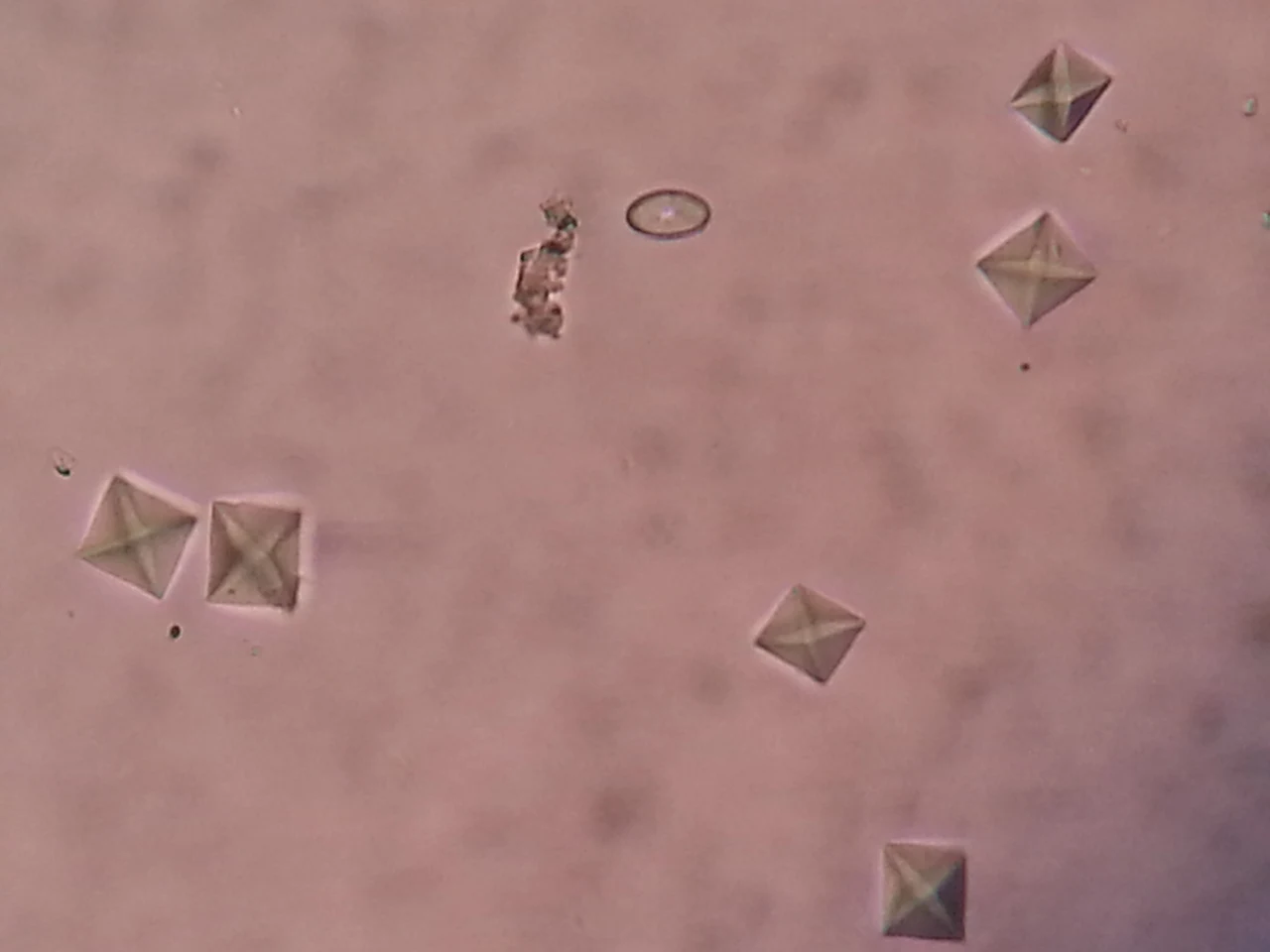
Calcium oxalate dihydrate often forms an envelope-like profile; monohydrate may appear oval or dumbbell-like. Recognizing a crystal supports a chemical hypothesis, but incidental crystals do not prove that a patient's pain comes from a stone. Analyze recovered stone material when available. [14]
Open whole micrographUrine microscopy showing multiple envelope-shaped calcium oxalate crystals with intersecting diagonal faces. Image: Ajay Kumar Chaurasiya. Original photograph. CC BY-SA 4.0. Resized where needed and prepared for web display; not cropped or annotated.
In the intestinal lumen, calcium can bind oxalate and limit its absorption. With fat malabsorption, fatty acids bind calcium instead, leaving more oxalate available for absorption, especially when the colon remains in continuity. Urinary oxalate then rises. Crohn disease with bowel resection, some bariatric procedures and pancreatic malabsorption can therefore produce calcium oxalate stones without high serum calcium. [12][16]
Original schematic. Ca means calcium; Ox means oxalate. The brown zigzag represents fatty acid. The lower row shows less luminal calcium available to bind oxalate, allowing more oxalate absorption and urinary excretion. [12][16]
Do not reflexively prescribe a low-calcium diet for calcium oxalate stones. Normal dietary calcium with meals, reduced sodium and individualized oxalate counseling generally fits better. A randomized trial supported a normal-calcium, lower-salt and lower-animal-protein pattern over calcium restriction in men with recurrent hypercalciuric stones [3], [7].
Removing or bypassing the colon changes this mechanism. Patients with steatorrhea and an ileostomy have shown much less enteric hyperoxaluria than similar patients with a retained colon. An ileostomy can still create substantial fluid and alkali losses: a functioning kidney may produce low-volume acidic urine, favoring a different stone pathway rather than eliminating all stone risk [12], [2].
Meal-associated calcium and dietary sodium act through different relationships. Calcium can bind oxalate before absorption; high sodium intake can increase urinary calcium excretion. A patient with both hyperoxaluria after calcium restriction and persistently high sodium-associated hypercalciuria may need normal calcium with meals plus sodium reduction, not a choice between them [2], [7].
An isotope tracer is a distinguishable label attached to a molecule so its origin can be followed. An oral oxalate label tracks the ingested source rather than newly made, unlabeled oxalate. Stable-isotope experiments can separate these contributions: calcium taken with an oxalate load can reduce absorption of that load without an equivalent change in internally produced oxalate. Urine results still require attention to collection and kidney handling; comparing the blood signal can help distinguish less entry from more retention. The tracer values in the practice comparison are constructed teaching observations [25].
Dietary calcium decreases but urinary oxalate increases. Where did the protective binding disappear?
In the gut, before absorption. Dietary calcium and urinary calcium act in different compartments; they should not be treated as one interchangeable quantity.
Where must calcium meet food oxalate to reduce absorption?
Inside the gut lumen, before oxalate enters blood. Meal timing helps connect the dietary intervention to that location.
Why can a person with normal serum calcium still form calcium oxalate stones after bowel surgery?
The important abnormality may be increased urinary oxalate, low urine volume or low citrate rather than elevated blood calcium.
Case 10
Show answer and explanations for case 10
A. Reduced intestinal uptake of ingested oxalate (Best answer)
Both the early blood signal and urinary recovery of orally labeled oxalate fall when calcium accompanies the same meal. Calcium can bind oxalate in the intestinal lumen and reduce its absorption. The unchanged estimated endogenous contribution favors an effect on the ingested source rather than reduced internal production; the constructed comparison does not predict an individual treatment effect size.
Which observations place the change before the ingested tracer reaches blood?
Both the early blood signal and urinary recovery of orally labeled oxalate fall when calcium accompanies the same meal.
How can meal-associated calcium change that entry step?
Calcium can bind oxalate in the intestinal lumen and reduce its absorption. The unchanged estimated endogenous contribution favors an effect on the ingested source rather than reduced internal production; the constructed comparison does not predict an individual treatment effect size.
B. Reduced hepatic synthesis of endogenous oxalate (Why this does not fit)
Oxalate can be generated internally from precursors, so bowel history alone should not be treated as proof of its source. The affected signal came from ingested labeled oxalate, while the estimate of the unlabeled endogenous contribution was comparable. A reduction in hepatic synthesis does not directly explain less oral tracer entering blood.
Why is hepatic oxalate production a credible alternative for total hyperoxaluria?
Oxalate can be generated internally from precursors, so bowel history alone should not be treated as proof of its source.
Which measurement makes reduced hepatic production insufficient here?
The affected signal came from ingested labeled oxalate, while the estimate of the unlabeled endogenous contribution was comparable. A reduction in hepatic synthesis does not directly explain less oral tracer entering blood.
C. Reduced tubular secretion of circulating oxalate (Why this does not fit)
Less tubular secretion can reduce the transfer of circulating oxalate into urine, making renal handling a relevant competing explanation for a urinary result alone. The early circulating oral-tracer signal also fell. Retaining a circulating solute through reduced renal secretion does not explain that lower entry signal as directly as reduced intestinal uptake under the matched conditions.
How could lower tubular secretion affect a urinary oxalate measurement?
Less tubular secretion can reduce the transfer of circulating oxalate into urine, making renal handling a relevant competing explanation for a urinary result alone.
Which additional observation argues against retention as the primary explanation?
The early circulating oral-tracer signal also fell. Retaining a circulating solute through reduced renal secretion does not explain that lower entry signal as directly as reduced intestinal uptake under the matched conditions.
D. Reduced glomerular filtration of circulating oxalate (Why this does not fit)
A change in GFR can change the filtered amount of circulating oxalate, so urinary recovery should not automatically be equated with intestinal absorption. Measured GFR was comparable, and the early blood signal from the oral tracer was lower rather than increased by reduced clearance. These findings support less absorbed tracer, not a fall in filtration.
Why must filtration be considered when urinary solute recovery changes?
A change in GFR can change the filtered amount of circulating oxalate, so urinary recovery should not automatically be equated with intestinal absorption.
Which supplied findings defeat reduced filtration in this comparison?
Measured GFR was comparable, and the early blood signal from the oral tracer was lower rather than increased by reduced clearance. These findings support less absorbed tracer, not a fall in filtration.
Takeaway: Use an oral tracer and its blood-versus-urine pattern to distinguish absorption from endogenous production or renal handling.
Low urine pH favors poorly soluble uric acid. Insulin resistance, acid load and gastrointestinal bicarbonate loss may contribute; marked serum hyperuricemia is not required. By contrast, alkaline urine favors calcium phosphate. Distal renal tubular acidosis combines systemic acidosis with inadequate urine acidification and can produce calcium phosphate stones.
Urease-producing organisms split urea and generate ammonia, making urine more alkaline. Proteus is a strong example. In the appropriate infected setting, magnesium, ammonium and phosphate form struvite. Do not assume all species called Pseudomonas produce urease, and do not assume every branching staghorn stone is struvite [2].
Original qualitative model of uric acid solubility. Changing pH alters chemistry; it does not guarantee that a stone will dissolve. Excess alkalinization can favor calcium phosphate.
Potassium citrate supplies alkali and increases urinary citrate, an inhibitor of calcium crystallization. For uric acid stones, urine alkalinization can support prevention or monitored dissolution. These are different goals. EAU dissolution guidance uses pH 7.0 to 7.2 with monitoring; do not turn a prevention target into a universal dissolution prescription or use alkali instead of draining a threatened kidney [1].
A medication can produce alkaline urine without infection. Topiramate inhibits carbonic anhydrase, allowing renal bicarbonate loss and systemic metabolic acidosis while increasing urine pH and reducing urinary citrate. The resulting profile can favor calcium phosphate stones. Blood acidity and urinary acidity are different measurements [9].
In distal renal tubular acidosis, alkali may be needed despite alkaline urine. Correcting the systemic acid-base disturbance can reduce tubular citrate reabsorption and restore urinary citrate. The aim is to correct the acid-base and inhibitor abnormalities, with monitoring of potassium, urine chemistry and calcium phosphate risk, not simply to push urine pH higher [2].
For a usual serum anion-gap calculation, subtract chloride and bicarbonate from sodium: anion gap = sodium - (chloride + bicarbonate). Interpret it with the laboratory range and clinical context. Gastrointestinal bicarbonate loss can cause a normal-gap acidosis with appropriately acidic urine; distal renal acidification failure can leave urine inappropriately alkaline during systemic acidosis [2].
When alkalinization is appropriate, check the safety of the alkali formulation. Potassium citrate is not suitable in hyperkalemia or significant renal impairment. Sodium bicarbonate is an alternative alkali without a potassium load, but sodium balance and urine pH still need individualized assessment [17], [2].
Two interventions can improve citrate availability without producing the same pH direction. Stopping topiramate removes its bicarbonate-wasting effect and can lower excess urinary alkalinity. Adding potassium citrate while continuing topiramate supplies alkali and can instead raise urine pH. Small observational studies support these directions and increased citrate, but do not guarantee an individual response or prove fewer stone events [18], [19].
The urine anion gap is urine sodium + urine potassium - urine chloride. During a normal-gap systemic acidosis, greater ammonium chloride excretion usually makes this gap more negative. In a suitable setting, a positive gap can suggest inadequate ammonium excretion. It is an indirect indicator, not a direct assay: low urine sodium, organic anions, advanced renal disease and other changes can make the inference unreliable. Urine pH alone does not settle the cause [20].
Citrate can form soluble complexes with calcium, reducing the free calcium available to participate in crystals without necessarily changing total calcium. That chemical interaction is distinct from dilution, which changes concentration through added volume. A controlled experiment holding volume and pH fixed can help distinguish these mechanisms [22].
Ammonia can arise through more than one reaction. Urease hydrolyzes urea; amino-acid deamination releases nitrogen from an amino-acid substrate. In a laboratory tracing exercise, the labeled nitrogen source helps distinguish these routes. A culture effect can favor reduced urea hydrolysis without proving the exact molecular binding site of an unknown compound [2].
Calcium complexation and direct crystal-surface inhibition are also different explanations. A surface inhibitor can slow crystal growth, but less free calcium at a comparable dissolved total points toward more calcium held in solution complexes. Use the free-versus-total measurement rather than treating any slower crystallization as the same mechanism [17], [22]. These actions can coexist. A surface-only explanation with unchanged dissolved calcium speciation is different from a claim that any surface action is absent. Free-ion activity should be compared under matched assay conditions, including ionic strength.
Alkaline urine and a branching stone suggest infection. What evidence would prevent you from treating that inference as confirmed?
Repeatedly negative cultures and stone analysis showing calcium phosphate would change the explanation. Branching describes shape; it does not identify mineral composition.
Which compound in struvite points toward urease activity?
Ammonium. Urease-generated ammonia supports ammonium availability and alkalinizes urine, providing the conditions for magnesium ammonium phosphate.
What new mineral concern appears when urine is made too alkaline?
Calcium phosphate can become more likely to precipitate. Alkali therefore needs a clinical goal and monitoring, not an assumption that a higher pH is always better.
Case 8
Show answer and explanations for case 8
A. Struvite in A and uric acid in B (Why this does not fit)
This pair misses both discriminators. A is better explained by a sterile renal acidification defect, while B has infection-associated alkalinization rather than a low-pH uric acid phenotype.
How do the two patients differ mechanistically?
This pair misses both discriminators. A is better explained by a sterile renal acidification defect, while B has infection-associated alkalinization rather than a low-pH uric acid phenotype.
B. Struvite in A and struvite in B (Why this does not fit)
Struvite fits B, but A has repeatedly sterile urine with systemic acidification failure. High urine pH alone is not enough to assign the same infection-associated mineral to both patients.
Why does struvite fit B better than A?
Struvite fits B, but A has repeatedly sterile urine with systemic acidification failure.
Why does alkaline urine not assign the same infection-associated mineral to both patients?
High urine pH alone is not enough to assign the same infection-associated mineral to both patients.
C. Calcium phosphate in A and uric acid in B (Why this does not fit)
Calcium phosphate fits A, but B has very alkaline urine with a urease-producing organism. That environment favors struvite rather than the acidic conditions ordinarily supporting uric acid precipitation.
Which patient's evidence contradicts the proposed uric acid stone?
Calcium phosphate fits A, but B has very alkaline urine with a urease-producing organism.
What mineral does that infected alkaline environment favor?
That environment favors struvite rather than the acidic conditions ordinarily supporting uric acid precipitation.
D. Calcium phosphate in A and struvite in B (Best answer)
A has a normal-anion-gap systemic acidosis, hypokalemia and inadequate urine acidification without a demonstrated infection, supporting a distal renal acidification defect that favors calcium phosphate. B has a separate urease-associated microbial pattern that favors magnesium ammonium phosphate, or struvite; these are supported predictions, not replacements for stone analysis.
What mineral follows from A's sterile acidification pattern?
A has a normal-anion-gap systemic acidosis, hypokalemia and inadequate urine acidification without a demonstrated infection, supporting a distal renal acidification defect that favors calcium phosphate.
What separate mineral mechanism is supported in B?
B has a separate urease-associated microbial pattern that favors magnesium ammonium phosphate, or struvite; these are supported predictions, not replacements for stone analysis.
Takeaway: Independently infer the infection-associated mineral in B from organism and pH
Recognize a transport defect without overcalling the image
Cystinuria affects proximal-tubule reabsorption of cystine and the dibasic amino acids ornithine, lysine and arginine. The familiar COLA grouping combines cystine with three dibasic amino acids; cystine itself is a disulfide-linked pair of cysteine molecules. Of this transported group, cystine is poorly soluble enough to produce typical stones.
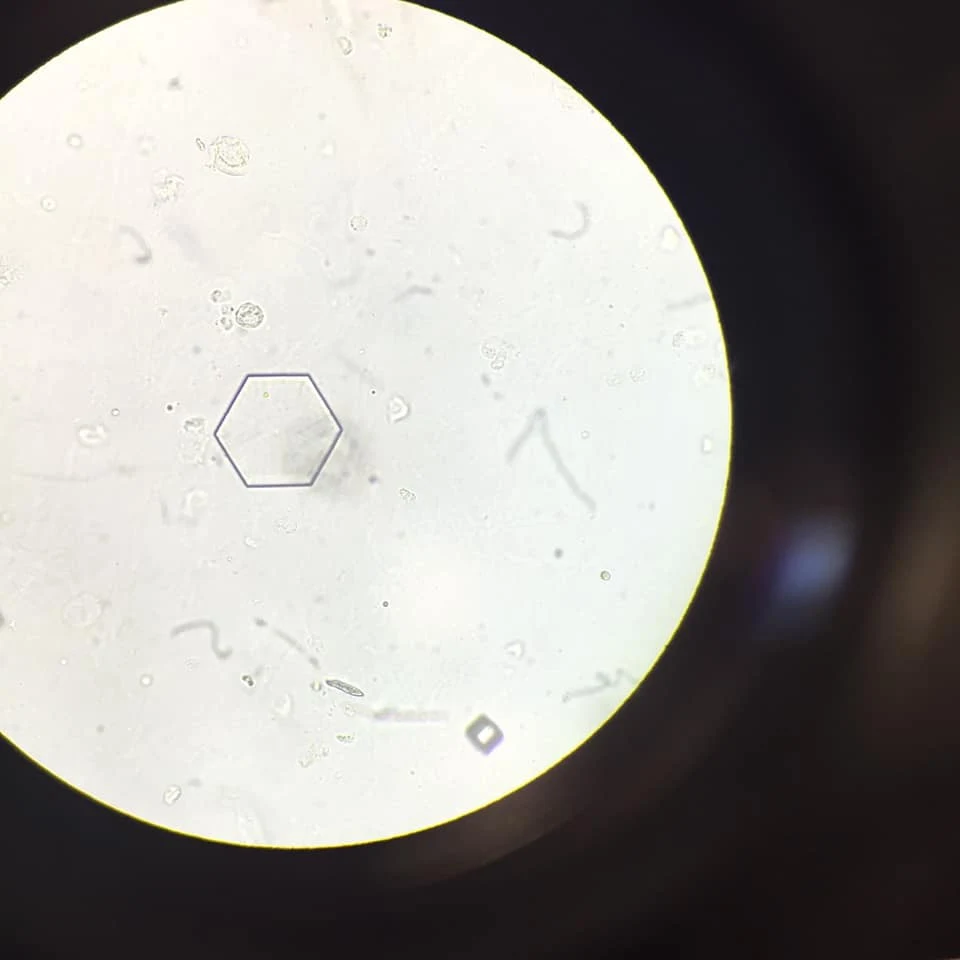
Recurrent childhood stones with hexagonal crystals should trigger this hypothesis. SLC3A1 and SLC7A9 encode transporter components. Many severe presentations are recessive, but heterozygous expression and inheritance patterns are variable; molecular confirmation and family assessment should not be replaced by a single absolute inheritance rule [5].
Open whole micrographUrine microscopy showing a flat six-sided cystine crystal within the circular microscope field. Image: J3D3. Original photograph. CC BY-SA 4.0. Resized where needed and prepared for web display; not cropped or annotated.
Cystine is poorly or faintly radiopaque, not categorically invisible on a plain film. A screening cyanide-nitroprusside reaction can support further evaluation, but it has false-positive and false-negative results. Quantitative urine testing and stone analysis provide better confirmation than shape or screening alone. [15][1]
Management emphasizes substantial urine dilution, sodium reduction, monitored alkalinization and, when needed, a cystine-binding thiol drug such as tiopronin. Thiol therapy forms more soluble drug-cysteine complexes. Monitoring, including urine protein, matters because adverse effects can limit treatment [5].
A selective transporter defect is different from generalized proximal tubular failure. Cystinuria need not produce glucose or phosphate loss. A broader proximal defect can affect several solutes together, while neutral amino-acid transport disorders affect a different substrate group. Tiopronin changes cystine solubility; it does not restore the underlying transporter, so associated amino-acid losses can persist [5].
For a bounded dilution calculation, divide the daily cystine mass by the daily urine volume. For example, 600 mg/day in 3 L/day gives 200 mg/L. A laboratory threshold at a specified pH can support a chemical comparison, but actual solubility varies with conditions and the calculation does not promise freedom from stones [2].
Alkalinization and a cystine-binding drug can both help cystinuria, but they act differently. Potassium citrate changes the urine environment; tiopronin forms more soluble drug-cysteine disulfides. Comparing free cystine at the same specimen pH and volume can help distinguish a remaining chemical-form effect from dilution or pH alone. Actual treated patients can also change total urinary cystine, so a fixed-total comparison is a stated laboratory model, not a universal treatment response [5], [23].
Why do four transported amino acids spill into urine but only one commonly forms these stones?
A shared transport defect explains the losses. Cystine's comparatively low solubility explains precipitation. Transport failure and crystal formation are separate inferences.
What is the difference between cystine and the other three members of COLA?
Cystine is a disulfide-linked pair of cysteine molecules. Ornithine, lysine and arginine are dibasic amino acids. The grouping describes shared transport, not identical chemical structure.
What does tiopronin change that drinking more fluid does not?
It changes the chemical form by producing more soluble mixed disulfides. More fluid changes concentration without itself forming those complexes.
Choose a test for the clinical question
A negative KUB radiograph does not exclude a urinary stone. Uric acid is radiolucent, cystine may be faint, and even calcium stones may be missed because of size or overlying structures. Noncontrast CT identifies most calculi and helps define size, position and obstruction. Some drug stones, including indinavir stones, are exceptions. [1]
CT is not automatically the first test for every patient. Ultrasound avoids ionizing radiation and is the first-line study in pregnancy; it is also useful in children and selected adults. A trial of ultrasound-first strategies found lower cumulative radiation without worse major short-term outcomes, while allowing further imaging when needed [6]. Persistent uncertainty or concern for complications changes the choice.
For a stable patient without infection, threatened renal function or uncontrolled symptoms, stone size and location help estimate the chance of passage. Use appropriate analgesia, avoid forced fluid loading, arrange reassessment and confirm resolution when indicated. NSAIDs are useful when not contraindicated, but kidney injury, pregnancy and other risks affect selection.
An alpha blocker is an optional, off-label aid for selected patients, with the strongest evidence for distal ureteral stones larger than 5 mm. It is not compulsory for every 3 mm stone. Persistent obstruction or refractory pain can require intervention even when a stone is small. Larger renal burdens often require percutaneous treatment, with infection evaluated and treated before definitive instrumentation [1].
In pregnancy, normal physiological dilation can resemble obstruction. When ultrasound leaves the question unresolved, magnetic resonance urography without gadolinium is a second-line option; it can clarify the level of obstruction even when a tiny calculus is not directly seen. Low-dose CT can be considered selectively when necessary, rather than treating radiation avoidance as an absolute rule [1].
An appropriate escalation decision and a safe analgesic choice are separate parts of care. Refractory colic can require urologic assessment despite a small stone. An active peptic ulcer or gastrointestinal bleed is a contraindication to ketorolac, so non-NSAID symptom support may be necessary while intervention is assessed [1], [21].
A 4 mm stone is painless today. What must follow-up establish besides symptom relief?
That the stone has passed or obstruction has resolved. Symptoms can improve while impaired drainage persists.
What does a negative plain X-ray establish about an otherwise convincing stone presentation?
Only that no stone was identified on that film. It does not exclude radiolucent, faint or small calculi and does not replace appropriate evaluation for obstruction.
Why might a 7 mm distal stone benefit more from an alpha blocker than a 3 mm stone?
The smaller stone already has a relatively high chance of spontaneous passage. The larger distal group has shown greater additional benefit, provided observation is clinically safe.
Match prevention to measured abnormalities
Every stone former deserves a basic assessment and stone analysis when material is recovered. Recurrent or high-risk patients need more detailed metabolic evaluation, commonly with 24-hour urine collections. A first episode does not make a child, a patient with bowel malabsorption or a solitary-kidney patient low risk. Age over 50 alone is not the decision rule.
Measure urine volume separately from fluid intake. Sweat, diarrhea and other losses explain why drinking 2.5 liters need not produce 2.5 liters of urine. A commonly recommended adult prevention goal is urine output above 2.5 liters daily, individualized for the person's medical condition. Cystinuria often requires still greater dilution [2].
Use the findings to formulate a specific intervention: low volume suggests dilution; low citrate supports citrate replacement; hyperoxaluria requires an intestinal or dietary explanation; high urinary calcium prompts sodium assessment and consideration of targeted therapy. Hypercalcemia warrants investigation of systemic causes, including primary hyperparathyroidism. A high PTH is inappropriate when serum calcium is already high.
Thiazides lower urinary calcium, but a biochemical effect is not a guarantee of fewer symptomatic stones. NOSTONE did not establish substantial recurrence benefit for hydrochlorothiazide over placebo and identified adverse effects. Guidelines still allow selected hypercalciuric patients to receive thiazides; use shared decisions, monitoring and reassessment rather than promising success [4].
Excess vitamin C can increase oxalate exposure. Ethylene glycol is a different, acute toxicologic problem: calcium oxalate crystalluria with high-anion-gap metabolic acidosis and acute kidney injury requires urgent toxicologic evaluation, not routine stone-prevention counseling [8]. Allopurinol is directed toward an appropriate urate phenotype; it does not correct every calcium or cystine stone [2].
Schedule the detailed metabolic collection after the acute episode has settled, while the person is free of urinary infection and on their usual diet and fluid intake. EAU guidance advises no earlier than 20 days and preferably around three months; it calls for two consecutive 24-hour collections. A high-risk first event warrants this plan without waiting for a second stone [2].
PTH must be interpreted against the calcium level, not only the printed reference interval. During hypercalcemia, an upper-normal PTH can be inappropriately nonsuppressed. Although PTH promotes renal calcium retention, its effects on calcium release from bone and absorption from the intestine can increase the filtered calcium load, so high urinary calcium can coexist with that retaining action [11].
A percentage-point difference subtracts two percentages; a relative change divides that difference by the comparison group's percentage. For a rate ratio, 1 is the no-difference value. An interval spanning 1 does not prove either benefit or equivalence. These distinctions matter when interpreting NOSTONE, which reported no dose-response relationship for its primary recurrence outcome [4].
In suspected ethylene glycol poisoning, urgent treatment aims to stop further production of toxic metabolites. Fomepizole inhibits alcohol dehydrogenase; it does not remove already formed metabolites. Stabilization, poison-center or toxicology guidance and assessment for additional treatment, including dialysis when indicated, remain important [10].
Excess urinary uric acid can contribute to calcium oxalate stones. In a recurrent calcium oxalate stone former with persistent hyperuricosuria, allopurinol may be selected to reduce uric acid formation through xanthine oxidase inhibition. This is not treatment for every calcium stone, and a calcium oxalate label alone does not identify the urine abnormality [2].
Read the units before interpreting a collection: mg/L multiplied by collected liters gives mg/day. A urine creatinine total that is unexpectedly low for the person's body size and muscle mass raises concern for an incomplete collection. Undercollection can make several daily solute totals look low together. Confirm the collection method and repeat adequate sampling rather than select a preventive drug from unreliable totals [2].
NOSTONE's primary composite, symptomatic events and secondary imaging outcomes are not interchangeable. Its primary result did not demonstrate a dose-response benefit. Secondary imaging differences should be interpreted with their statistical limitations rather than described as either proof of universal benefit or proof that every outcome was unchanged [4].
Toxin metabolism and toxin removal are also different targets. Fomepizole limits further ethylene glycol metabolite production; it does not directly clear the acidic metabolites already formed. Hemodialysis can remove parent alcohol and metabolites already in the circulation. Clinical severity, specialist assessment and monitoring determine the actual treatment, not a simplified laboratory model [10].
Urinary calcium falls on a drug but stone events continue. Are the laboratory and clinical outcomes contradictory?
No. Lowering one promoter does not correct every determinant of crystallization. Reassess volume, citrate, diet, adherence, stone composition and the treatment's clinical benefit.
Why does a daily urine volume matter more than a report of liters drunk?
Fluid can be lost through sweat, stool and other routes before becoming urine. The measured urine volume determines urinary dilution.
Which PTH response is expected when serum calcium is high?
PTH should fall. A PTH that remains elevated or inappropriately nonsuppressed suggests a PTH-dependent cause rather than an appropriate response to hypercalcemia.
Apply the decision, not just the label
These original cases ask for one best decision or explanation. Three appear beside the relevant teaching. Attempt each before opening its reasoning; all options have an explanation. This is practice, not a validated score prediction.
Case 2
Show answer and explanations for case 2
A. Discharge with observation because the stone is smaller than 5 mm (Why this does not fit)
Size predicts passage only within a suitable clinical context. This patient has no contralateral kidney to preserve filtration while waiting.
Why is stone size alone inadequate for deciding whether this patient can safely wait for passage?
Size predicts passage only within a suitable clinical context. This patient has no contralateral kidney to preserve filtration while waiting.
B. Urgent urologic assessment for decompression of the remaining kidney (Best answer)
Anuria or marked oliguria with rising creatinine in the only functioning kidney indicates threatened total renal function. Absence of infection and relief of pain do not make continued obstruction safe.
What do oliguria and rising creatinine mean in the only kidney?
Anuria or marked oliguria with rising creatinine in the only functioning kidney indicates threatened total renal function.
Why do improved pain and absence of fever not establish that continued obstruction is safe?
Absence of infection and relief of pain do not make continued obstruction safe.
C. Begin a monitored expulsion trial with repeat creatinine after 24 hours (Why this does not fit)
A monitored passage trial is reasonable for selected stable stone formers, but this patient already has substantially impaired total output and worsening function in the only kidney. Monitoring alone would leave the suspected obstructive threat unrelieved while waiting.
Why is a passage trial insufficient for this patient?
A monitored passage trial is reasonable for selected stable stone formers, but this patient already has substantially impaired total output and worsening function in the only kidney.
What would remain uncorrected during another day of monitoring?
Monitoring alone would leave the suspected obstructive threat unrelieved while waiting.
D. Arrange functional renal imaging before requesting urologic assessment (Why this does not fit)
A functional study can be useful when drainage or differential function remains uncertain. Here a solitary kidney, severe oliguria, rising creatinine and new hydronephrosis already indicate a time-sensitive renal threat, so that additional investigation must not postpone urgent urologic assessment.
When can functional imaging help?
A functional study can be useful when drainage or differential function remains uncertain.
Why must that extra study not delay urologic assessment here?
Here a solitary kidney, severe oliguria, rising creatinine and new hydronephrosis already indicate a time-sensitive renal threat, so that additional investigation must not postpone urgent urologic assessment.
Takeaway: Prioritize renal drainage over a size-based observation rule
A. Increased left Bowman-space hydrostatic pressure and increased right Bowman-space hydrostatic pressure (Why this does not fit)
Left urinary back-pressure fits the new hydronephrosis, but the right collecting system is not dilated and its documented problem is arterial inflow. The right-kidney contribution cannot be explained by assuming a second urinary outflow obstruction.
Which observations distinguish left urinary back-pressure from the right kidney problem?
Left urinary back-pressure fits the new hydronephrosis, but the right collecting system is not dilated and its documented problem is arterial inflow. The right-kidney contribution cannot be explained by assuming a second urinary outflow obstruction.
B. Increased left glomerular plasma oncotic pressure and increased right Bowman-space hydrostatic pressure (Why this does not fit)
Both named changes could oppose filtration in other circumstances, but this pair does not fit either local lesion. The left has urinary back-pressure, whereas the right has impaired arterial supply without collecting-system dilation.
Which different causes reduce filtration in the two kidneys?
Both named changes could oppose filtration in other circumstances, but this pair does not fit either local lesion. The left has urinary back-pressure, whereas the right has impaired arterial supply without collecting-system dilation.
C. Increased left Bowman-space hydrostatic pressure and decreased right glomerular capillary hydrostatic pressure (Best answer)
The left outflow obstruction transmits hydrostatic pressure upstream into the collecting tubules and Bowman space, opposing filtration. The right kidney instead has impaired arterial inflow, which reduces pressure available in the glomerular capillaries; its limited reserve explains why a new left-sided event can cause a major fall in combined function.
How does the left outflow blockage oppose filtration?
The left outflow obstruction transmits hydrostatic pressure upstream into the collecting tubules and Bowman space, opposing filtration.
Why can the right kidney not provide adequate reserve?
The right kidney instead has impaired arterial inflow, which reduces pressure available in the glomerular capillaries; its limited reserve explains why a new left-sided event can cause a major fall in combined function.
D. Increased left glomerular plasma oncotic pressure and decreased right glomerular capillary hydrostatic pressure (Why this does not fit)
Reduced right glomerular perfusion pressure fits the arterial stenosis. On the left, however, the new local event is a blocked ureter with hydronephrosis, not a change in plasma protein concentration that would make increased oncotic pressure the direct opposing force.
Which force fits the right arterial lesion?
Reduced right glomerular perfusion pressure fits the arterial stenosis.
Why is increased plasma oncotic pressure a weaker explanation on the left?
On the left, however, the new local event is a blocked ureter with hydronephrosis, not a change in plasma protein concentration that would make increased oncotic pressure the direct opposing force.
A. Low-dose noncontrast CT of the urinary tract (Why this does not fit)
Low-dose CT can be considered when clinically necessary after other studies remain inadequate. In this stable patient, however, noncontrast MR urography offers the next recommended diagnostic step before that later-line radiation exposure.
When can low-dose CT enter the pregnancy imaging pathway?
Low-dose CT can be considered when clinically necessary after other studies remain inadequate.
Which second-line study fits the current stable situation first?
In this stable patient, however, noncontrast MR urography offers the next recommended diagnostic step before that later-line radiation exposure.
B. A third targeted ultrasound examination using the same technique (Why this does not fit)
Ultrasound is appropriate first-line imaging in pregnancy, but two adequate examinations have not answered the specific question. Repeating the same method without a new technical or clinical reason is less informative than the established second-line study.
What has ultrasound already failed to resolve?
Ultrasound is appropriate first-line imaging in pregnancy, but two adequate examinations have not answered the specific question.
What would justify repeating an already adequate ultrasound instead of using the second-line study?
Repeating the same method without a new technical or clinical reason is less informative than the established second-line study.
C. Magnetic resonance urography without gadolinium (Best answer)
The repeated adequate ultrasounds leave the obstruction question unresolved. Noncontrast MR urography is the usual second-line pregnancy option for clarifying the level and pattern of obstruction without routine gadolinium; it need not directly show every small calculus to be useful.
What question remains after the two ultrasounds?
The repeated adequate ultrasounds leave the obstruction question unresolved.
How can noncontrast MR urography answer it?
Noncontrast MR urography is the usual second-line pregnancy option for clarifying the level and pattern of obstruction without routine gadolinium; it need not directly show every small calculus to be useful.
D. Magnetic resonance urography with gadolinium (Why this does not fit)
MR-based imaging fits the second-line setting, but gadolinium is not routinely needed for the heavily T2-weighted urinary-tract assessment and is generally avoided in pregnancy unless a compelling separate indication exists.
Why can the second-line MR urinary-tract assessment usually be performed without gadolinium during pregnancy?
MR-based imaging fits the second-line setting, but gadolinium is not routinely needed for the heavily T2-weighted urinary-tract assessment and is generally avoided in pregnancy unless a compelling separate indication exists.
Takeaway: Select second-line noncontrast MR urography after adequate but unresolved pregnancy ultrasound
A. Contrast-enhanced CT urography with delayed excretory images (Why this does not fit)
Excretory CT can evaluate selected urothelial or anatomical questions, but the acute colic and hydronephrosis first call for a stone-focused study that ordinarily needs no intravenous contrast. Persistent unexplained hematuria after the acute cause is addressed could create a different investigation question.
Which acute findings favor a noncontrast stone-focused study?
Excretory CT can evaluate selected urothelial or anatomical questions, but the acute colic and hydronephrosis first call for a stone-focused study that ordinarily needs no intravenous contrast.
When might persistent hematuria create a different imaging question?
Persistent unexplained hematuria after the acute cause is addressed could create a different investigation question.
B. A diuretic radionuclide renogram (Why this does not fit)
A diuretic renogram can assess drainage and differential function when a functional obstruction question remains. Here, the current acute cause has not been localized; direct anatomical investigation is more useful before selecting a functional follow-up study.
What question does a diuretic renogram answer?
A diuretic renogram can assess drainage and differential function when a functional obstruction question remains.
Which anatomical question must be addressed first here?
Here, the current acute cause has not been localized; direct anatomical investigation is more useful before selecting a functional follow-up study.
C. Noncontrast CT of the urinary tract (Best answer)
The persistent acute pain, hematuria and unilateral dilation support an unresolved upper-tract obstructive process despite a negative plain film. Noncontrast CT can identify most calculi and define their location, size and associated obstruction, making it the most useful next anatomical study in this nonpregnant adult.
What does the combined pain, hematuria and dilation pattern suggest?
The persistent acute pain, hematuria and unilateral dilation support an unresolved upper-tract obstructive process despite a negative plain film.
What can noncontrast CT add after the inconclusive studies?
Noncontrast CT can identify most calculi and define their location, size and associated obstruction, making it the most useful next anatomical study in this nonpregnant adult.
D. Magnetic resonance urography without contrast (Why this does not fit)
MR urography can demonstrate an obstructive pattern and is useful in radiation-sensitive settings. For this acute adult presentation, noncontrast CT more directly identifies and sizes most stones and is the standard next study after an inconclusive ultrasound.
When is MR urography particularly useful?
MR urography can demonstrate an obstructive pattern and is useful in radiation-sensitive settings.
Why is CT more informative for this adult stone presentation?
For this acute adult presentation, noncontrast CT more directly identifies and sizes most stones and is the standard next study after an inconclusive ultrasound.
Takeaway: Select anatomical investigation of persistent acute obstruction rather than treating a negative plain film as exclusion
A. The CT result excludes a medication-related calculus; continue monitored observation and repeat ultrasound and creatinine after 24 hours (Why this does not fit)
This pair misreads both axes. A negative noncontrast CT does not exclude an indinavir calculus, and the severe output and creatinine changes in a solitary kidney do not justify a further observation interval before urologic assessment.
Why are both the CT exclusion and another observation interval inappropriate?
This pair misreads both axes. A negative noncontrast CT does not exclude an indinavir calculus, and the severe output and creatinine changes in a solitary kidney do not justify a further observation interval before urologic assessment.
B. A medication-related calculus can remain CT-inapparent; continue monitored observation and repeat ultrasound and creatinine after 24 hours (Why this does not fit)
The imaging interpretation correctly retains an indinavir calculus as a possible cause. The separate renal-function evidence, however, already indicates a time-sensitive threat; waiting another day for repeat measurements would leave strongly suspected obstruction of the only kidney unevaluated.
What does the imaging statement get right?
The imaging interpretation correctly retains an indinavir calculus as a possible cause.
Which separate findings make waiting another day unsafe?
The separate renal-function evidence, however, already indicates a time-sensitive threat; waiting another day for repeat measurements would leave strongly suspected obstruction of the only kidney unevaluated.
C. The CT result excludes a medication-related calculus; obtain urgent urologic assessment of urinary drainage (Why this does not fit)
Urgent urologic assessment fits the functional threat. The imaging interpretation is still incorrect because indinavir stones can remain CT-inapparent; an appropriate action does not make the proposed exclusion valid.
What response is needed when impaired drainage threatens renal function?
Urgent urologic assessment fits the functional threat.
Why does an unrevealing CT not exclude an indinavir stone?
The imaging interpretation is still incorrect because indinavir stones can remain CT-inapparent; an appropriate action does not make the proposed exclusion valid.
D. A medication-related calculus can remain CT-inapparent; obtain urgent urologic assessment of urinary drainage (Best answer)
Indinavir calculi can be inconspicuous on noncontrast CT, so the negative stone image does not remove a medication calculus from the differential. Independently, marked oliguria and rising creatinine in the only functioning kidney with new hydronephrosis make postponing outflow assessment unsafe, regardless of direct calculus visibility.
What does indinavir exposure change about a negative noncontrast CT?
Indinavir calculi can be inconspicuous on noncontrast CT, so the negative stone image does not remove a medication calculus from the differential.
Why does current renal deterioration require urgent assessment anyway?
Independently, marked oliguria and rising creatinine in the only functioning kidney with new hydronephrosis make postponing outflow assessment unsafe, regardless of direct calculus visibility.
Takeaway: Separately determine that the current renal threat requires urgent outflow assessment rather than delayed reassessment
Potassium citrate can alkalinize urine in a fitting uric acid phenotype. This patient, however, has established hyperkalemia and substantial renal impairment, so adding potassium would conflict with the safety constraint rather than provide the best alkali choice.
What useful effect would potassium citrate normally provide?
Potassium citrate can alkalinize urine in a fitting uric acid phenotype.
Which measured safety problems make that formulation inappropriate here?
This patient, however, has established hyperkalemia and substantial renal impairment, so adding potassium would conflict with the safety constraint rather than provide the best alkali choice.
B. Hydrochlorothiazide (Why this does not fit)
A thiazide lowers urinary calcium in selected calcium-stone formers. The radiographic and urine findings instead point toward low-pH uric acid precipitation, so a calcium-directed medication does not best address the demonstrated mechanism.
What urinary solute does a thiazide primarily target?
A thiazide lowers urinary calcium in selected calcium-stone formers.
Which precipitation mechanism is supported by the low urine pH and radiographic findings?
The radiographic and urine findings instead point toward low-pH uric acid precipitation, so a calcium-directed medication does not best address the demonstrated mechanism.
C. Sodium bicarbonate (Best answer)
Plain-film radiolucency with CT visibility and persistently acidic urine supports a uric acid phenotype, even without excessive urate excretion. Sodium bicarbonate supplies alkali without adding potassium, making it a suitable option to consider when hyperkalemia and renal impairment preclude potassium citrate; sodium balance and urine pH still require monitoring.
Which stone phenotype fits the radiographs and persistent acidity?
Plain-film radiolucency with CT visibility and persistently acidic urine supports a uric acid phenotype, even without excessive urate excretion.
Which alkali avoids the additional potassium load?
Sodium bicarbonate supplies alkali without adding potassium, making it a suitable option to consider when hyperkalemia and renal impairment preclude potassium citrate; sodium balance and urine pH still require monitoring.
D. Allopurinol (Why this does not fit)
Allopurinol targets uric acid production and may help a hyperuricosuric phenotype. The repeated collections instead identify persistent acidity with normal uric acid excretion; lowering production would not directly correct the leading demonstrated solubility abnormality.
Which phenotype can benefit from urate-production reduction?
Allopurinol targets uric acid production and may help a hyperuricosuric phenotype.
What demonstrated solubility problem would remain uncorrected here?
The repeated collections instead identify persistent acidity with normal uric acid excretion; lowering production would not directly correct the leading demonstrated solubility abnormality.
Takeaway: Select a nonpotassium alkali because the otherwise relevant potassium formulation is contraindicated
A lower pH is consistent with removal of the bicarbonate-wasting drug. In B, however, adding potassium citrate supplies alkali and may increase pH even while improving citrate excretion; improvement in one stone-risk feature does not mean every urine abnormality simply reverses.
Why could A's urine pH fall?
A lower pH is consistent with removal of the bicarbonate-wasting drug.
Why need B's pH not fall with improved citrate?
In B, however, adding potassium citrate supplies alkali and may increase pH even while improving citrate excretion; improvement in one stone-risk feature does not mean every urine abnormality simply reverses.
B. A lower; B higher (Best answer)
Stopping topiramate removes a carbonic-anhydrase-inhibiting influence that promotes urinary bicarbonate loss, so A is expected to have less excess urinary alkalinity. B instead receives an additional alkali load while the drug continues, so urine pH may rise; restoring citrate does not require the two plans to produce the same pH direction. These are expected physiological trends, not guaranteed individual measurements.
Which alkalinizing drug effect is removed in A?
Stopping topiramate removes a carbonic-anhydrase-inhibiting influence that promotes urinary bicarbonate loss, so A is expected to have less excess urinary alkalinity.
Which new input affects pH in B?
B instead receives an additional alkali load while the drug continues, so urine pH may rise; restoring citrate does not require the two plans to produce the same pH direction.
How should the expected pH and citrate trends be distinguished from an individual laboratory result?
These are expected physiological trends, not guaranteed individual measurements.
C. A higher; B higher (Why this does not fit)
B may have a higher pH after added alkali, but withdrawing topiramate in A removes rather than intensifies its tendency toward urinary alkalinity. The two distinct interventions should not be interpreted as equivalent pH-raising treatments.
Why is a higher urine pH expected after added alkali but not after withdrawing topiramate?
B may have a higher pH after added alkali, but withdrawing topiramate in A removes rather than intensifies its tendency toward urinary alkalinity. The two distinct interventions should not be interpreted as equivalent pH-raising treatments.
D. A higher; B lower (Why this does not fit)
Both directions reverse the expected mechanisms. A loses the bicarbonate-wasting drug influence, whereas B gains an alkali source while retaining the original medication. Urine chemistry must be checked rather than assuming that both plans normalize every measured variable.
Which opposite intervention does each patient receive?
Both directions reverse the expected mechanisms. A loses the bicarbonate-wasting drug influence, whereas B gains an alkali source while retaining the original medication.
What still needs measurement rather than assumption?
Urine chemistry must be checked rather than assuming that both plans normalize every measured variable.
Takeaway: Independently predict the pH consequence of added alkali during continued drug exposure
A. Urinary oxalate is unchanged; urinary calcium normalizes (Why this does not fit)
This pair misses the intended gut response and assumes correction of a separate contributor that was not changed. Meal-associated calcium targets free oxalate absorption; it does not automatically remove the continuing high sodium-associated calcium burden.
Which intervention occurred, and which separate contributor was left unchanged?
This pair misses the intended gut response and assumes correction of a separate contributor that was not changed. Meal-associated calcium targets free oxalate absorption; it does not automatically remove the continuing high sodium-associated calcium burden.
B. Urinary oxalate decreases; urinary calcium normalizes (Why this does not fit)
The oxalate direction fits improved intestinal binding. Calcium normalization is not compelled by that gut effect while the high sodium-associated calcium-excretion burden remains; treating the two urine solutes as one response overlooks the unchanged renal contributor.
What intestinal response explains the oxalate trend?
The oxalate direction fits improved intestinal binding.
Why can urinary calcium remain elevated after intestinal oxalate binding improves?
Calcium normalization is not compelled by that gut effect while the high sodium-associated calcium-excretion burden remains; treating the two urine solutes as one response overlooks the unchanged renal contributor.
C. Urinary oxalate decreases; urinary calcium remains elevated (Best answer)
Restoring calcium at meals increases intestinal oxalate binding and can lower the absorbed oxalate reaching urine. The separately documented high sodium exposure persists, so a fall in oxalate does not require correction of the sodium-associated hypercalciuria; these are expected directions, not guaranteed individual treatment responses.
Why can restoring meal-associated calcium lower urinary oxalate?
Restoring calcium at meals increases intestinal oxalate binding and can lower the absorbed oxalate reaching urine.
Which persistent contributor prevents assuming both abnormalities have resolved?
The separately documented high sodium exposure persists, so a fall in oxalate does not require correction of the sodium-associated hypercalciuria; these are expected directions, not guaranteed individual treatment responses.
D. Urinary oxalate is unchanged; urinary calcium remains elevated (Why this does not fit)
Persistent hypercalciuria is compatible with the unchanged high sodium exposure. Unchanged oxalate excretion, however, would not demonstrate the expected intestinal binding benefit of restoring calcium specifically with meals under otherwise comparable conditions.
Which unchanged exposure can sustain the urinary calcium burden?
Persistent hypercalciuria is compatible with the unchanged high sodium exposure.
What expected intestinal change is missing if urinary oxalate does not fall?
Unchanged oxalate excretion, however, would not demonstrate the expected intestinal binding benefit of restoring calcium specifically with meals under otherwise comparable conditions.
Takeaway: Independently recognize that an unchanged sodium-associated calcium burden need not normalize
A. X reduces urea hydrolysis; Y has a crystal-surface-only effect with unchanged calcium speciation (Why this does not fit)
Reduced urea hydrolysis fits the labeled-ammonium result because urease releases ammonia from urea. A crystal-surface-only effect with unchanged calcium speciation can slow growth, but it does not explain lower free calcium activity at matched matrix, ionic strength and total dissolved calcium. The free-versus-total measurement requires a solution-speciation explanation.
Which bacterial reaction fits ammonium derived from labeled urea?
Reduced urea hydrolysis fits the labeled-ammonium result because urease releases ammonia from urea.
Why does a surface-only effect fail to explain the free-calcium measurement?
A crystal-surface-only effect with unchanged calcium speciation can slow growth, but it does not explain lower free calcium activity at matched matrix, ionic strength and total dissolved calcium. The free-versus-total measurement requires a solution-speciation explanation.
B. X reduces urea hydrolysis; Y increases the soluble complexed fraction of calcium (Best answer)
Nitrogen appearing in ammonium from labeled urea identifies the urea-hydrolysis pathway rather than ammonia generated from amino acids. More calcium held in soluble complexes lowers the free-ion activity available for calcium oxalate growth under the matched conditions. This supports complexation but does not exclude an additional surface effect or establish a specific molecular binding site for X.
How does tracked nitrogen identify the affected bacterial pathway?
Nitrogen appearing in ammonium from labeled urea identifies the urea-hydrolysis pathway rather than ammonia generated from amino acids.
What does the calcium measurement support without ruling out another action?
More calcium held in soluble complexes lowers the free-ion activity available for calcium oxalate growth under the matched conditions. This supports complexation but does not exclude an additional surface effect or establish a specific molecular binding site for X.
C. X reduces amino-acid deamination; Y increases the soluble complexed fraction of calcium (Why this does not fit)
An increased soluble complexed fraction fits lower free calcium activity at comparable matrix, ionic strength and total dissolved calcium. Deamination can generate ammonia, but the tracked nitrogen was supplied in urea. The labeled-ammonium result therefore implicates urea hydrolysis rather than an amino-acid reaction.
Which calcium pool can expand when free activity falls but dissolved total calcium remains comparable?
An increased soluble complexed fraction fits lower free calcium activity at comparable matrix, ionic strength and total dissolved calcium.
Why does deamination not explain the nitrogen-tracer result?
Deamination can generate ammonia, but the tracked nitrogen was supplied in urea. The labeled-ammonium result therefore implicates urea hydrolysis rather than an amino-acid reaction.
D. X reduces amino-acid deamination; Y has a crystal-surface-only effect with unchanged calcium speciation (Why this does not fit)
Ammonia production and slower crystal growth can arise through different processes, so neither endpoint should be interpreted alone. Urea-derived nitrogen favors urea hydrolysis, while lower free calcium at comparable dissolved total and assay conditions contradicts a crystal-surface-only explanation with unchanged calcium speciation. A separate surface action may coexist with the supported solution effect.
Why should the two endpoints not be interpreted in isolation?
Ammonia production and slower crystal growth can arise through different processes, so neither endpoint should be interpreted alone.
What rules out a surface-only explanation under the matched calcium measurements?
Urea-derived nitrogen favors urea hydrolysis, while lower free calcium at comparable dissolved total and assay conditions contradicts a crystal-surface-only explanation with unchanged calcium speciation. A separate surface action may coexist with the supported solution effect.
Takeaway: Use the nitrogen source to identify the bacterial reaction and distinguish calcium availability from a direct crystal-surface effect
A. PTH is inappropriately nonsuppressed; unchanged filtered load with higher fractional excretion explains the increased urinary calcium (Why this does not fit)
The PTH interpretation fits the simultaneous hypercalcemia, but the clearance explanation does not fit the numbers. Stable GFR does not mean stable filtered load when filterable plasma calcium rises; the proportional urinary rise leaves fractional excretion unchanged.
How does higher filterable plasma calcium change filtered load when GFR is unchanged?
The PTH interpretation fits the simultaneous hypercalcemia, but the clearance explanation does not fit the numbers. Stable GFR does not mean stable filtered load when filterable plasma calcium rises; the proportional urinary rise leaves fractional excretion unchanged.
B. PTH is inappropriately nonsuppressed; a higher filtered load with unchanged fractional excretion explains the increased urinary calcium (Best answer)
PTH should be suppressed during hypercalcemia, so the upper-normal value is inappropriate. A GFR of 100 mL/min is 1440 dL/day: filtered calcium load rises from 7200 to 8640 mg/day, while urinary excretion divided by those loads is approximately 2.78% at both visits. The greater urinary mass therefore follows the greater filtered load rather than an increased escaping fraction.
What PTH response should hypercalcemia produce?
PTH should be suppressed during hypercalcemia, so the upper-normal value is inappropriate.
What do the two filtered loads and escaping fractions calculate to?
A GFR of 100 mL/min is 1440 dL/day: filtered calcium load rises from 7200 to 8640 mg/day, while urinary excretion divided by those loads is approximately 2.78% at both visits.
Which quantity explains the higher urinary calcium mass?
The greater urinary mass therefore follows the greater filtered load rather than an increased escaping fraction.
C. PTH is appropriately suppressed; unchanged filtered load with higher fractional excretion explains the increased urinary calcium (Why this does not fit)
This pair misreads both independent relationships. PTH remains nonsuppressed for the calcium level, and the increased filterable plasma calcium at unchanged GFR raises filtered load; calculating the escaping fraction shows no increase.
What changes when the calcium level is used to interpret hormonal feedback and filtered load?
This pair misreads both independent relationships. PTH remains nonsuppressed for the calcium level, and the increased filterable plasma calcium at unchanged GFR raises filtered load; calculating the escaping fraction shows no increase.
D. PTH is appropriately suppressed; a higher filtered load with unchanged fractional excretion explains the increased urinary calcium (Why this does not fit)
The derived clearance comparison is correct, but a value within the printed PTH range is not an appropriate suppression response to high calcium. The hormone must be interpreted against its physiological stimulus, not only the reference interval.
Why is an unsuppressed reference-range PTH inappropriate during hypercalcemia?
The derived clearance comparison is correct, but a value within the printed PTH range is not an appropriate suppression response to high calcium.
What physiological relationship should guide interpretation of the hormone?
The hormone must be interpreted against its physiological stimulus, not only the reference interval.
Takeaway: Calculate the paired filtered loads and fractional excretions rather than equating greater urinary mass with impaired reabsorption
A. Percutaneous nephrolithotomy with a routine single prophylactic dose but no preceding treatment of the positive culture (Why this does not fit)
The procedure fits the burden, but the antimicrobial sequence does not adequately address a known positive culture. Absence of fever does not make preoperative bacteriuria irrelevant to infection risk during stone manipulation.
What infection risk remains if stone manipulation occurs before the positive culture is addressed?
The procedure fits the burden, but the antimicrobial sequence does not adequately address a known positive culture.
Why does absence of fever not remove the risk associated with preoperative bacteriuria?
Absence of fever does not make preoperative bacteriuria irrelevant to infection risk during stone manipulation.
B. Percutaneous nephrolithotomy after culture-directed treatment, with an appropriate perioperative antimicrobial plan (Best answer)
The large branching renal burden favors percutaneous nephrolithotomy over shock-wave monotherapy. Separately, a positive preoperative culture requires treatment before definitive instrumentation; routine prophylaxis is not a replacement for addressing known bacteriuria.
Which procedure best fits the large branching stone burden?
The large branching renal burden favors percutaneous nephrolithotomy over shock-wave monotherapy.
Why does documented bacteriuria require more than routine prophylaxis?
Separately, a positive preoperative culture requires treatment before definitive instrumentation; routine prophylaxis is not a replacement for addressing known bacteriuria.
C. Shock-wave lithotripsy alone with a routine single prophylactic dose but no preceding treatment of the positive culture (Why this does not fit)
Neither component best fits the supplied findings. The burden favors percutaneous clearance, and the positive culture needs treatment before the procedure rather than only routine prophylaxis.
Which procedure and infection steps does this plan miss?
Neither component best fits the supplied findings. The burden favors percutaneous clearance, and the positive culture needs treatment before the procedure rather than only routine prophylaxis.
D. Shock-wave lithotripsy alone after culture-directed treatment, with an appropriate perioperative antimicrobial plan (Why this does not fit)
Culture-directed treatment appropriately addresses the microbiological risk, but shock-wave monotherapy is less suitable for clearing this large branching burden. The procedural and infection-management components both need to fit the case.
Why is shock-wave monotherapy a poor fit for this branching stone burden?
Culture-directed treatment appropriately addresses the microbiological risk, but shock-wave monotherapy is less suitable for clearing this large branching burden. The procedural and infection-management components both need to fit the case.
Takeaway: Treat preoperative bacteriuria before definitive instrumentation rather than relying on routine prophylaxis alone
A. A selective proximal amino-acid transport defect; 220 mg/L, below the supplied threshold (Best answer)
The grouped amino-acid losses with preserved glucose, phosphate and bicarbonate handling favor a selective transport defect rather than generalized proximal failure. Independently, 660 mg/day divided by 3.0 L/day is 220 mg/L, below the stated 250 mg/L threshold in this fixed-pH model; that calculation is not a guarantee of clinical stone prevention.
Which preserved functions support a selective transport defect?
The grouped amino-acid losses with preserved glucose, phosphate and bicarbonate handling favor a selective transport defect rather than generalized proximal failure.
What cystine concentration follows from the supplied mass and volume?
Independently, 660 mg/day divided by 3.0 L/day is 220 mg/L, below the stated 250 mg/L threshold in this fixed-pH model; that calculation is not a guarantee of clinical stone prevention.
B. A selective proximal amino-acid transport defect; 440 mg/L, above the supplied threshold (Why this does not fit)
The selective transport interpretation fits the supplied losses and preserved functions, but the concentration is miscalculated. The stated mass in 3.0 L gives 220 mg/L; 440 mg/L would correspond to a different, smaller urine volume.
What cystine concentration results from the stated mass in 3.0 liters of urine?
The selective transport interpretation fits the supplied losses and preserved functions, but the concentration is miscalculated. The stated mass in 3.0 L gives 220 mg/L; 440 mg/L would correspond to a different, smaller urine volume.
C. Generalized proximal tubular dysfunction; 440 mg/L, above the supplied threshold (Why this does not fit)
The generalized-defect classification conflicts with the preserved proximal functions, and the concentration uses an incorrect denominator. Both the clinical transport pattern and the mass-to-volume calculation must be addressed.
How do preserved proximal solute handling and the 3.0 L urine volume change this interpretation?
The generalized-defect classification conflicts with the preserved proximal functions, and the concentration uses an incorrect denominator. Both the clinical transport pattern and the mass-to-volume calculation must be addressed.
D. Generalized proximal tubular dysfunction; 220 mg/L, below the supplied threshold (Why this does not fit)
The concentration calculation fits the specified model. The localization is weaker, however, because generalized proximal failure would be expected to affect additional proximal solutes; the documented preservation of those pathways supports a selective amino-acid defect.
What distinguishes this amino-acid loss pattern from generalized proximal tubular failure?
The concentration calculation fits the specified model. The localization is weaker, however, because generalized proximal failure would be expected to affect additional proximal solutes; the documented preservation of those pathways supports a selective amino-acid defect.
Takeaway: Independently calculate cystine concentration and compare it with a supplied fixed-condition threshold
A. Selective amino-acid transport dysfunction; tiopronin (Best answer)
Loss of cystine and dibasic amino acids without glucose, phosphate or bicarbonate wasting favors selective amino-acid transport dysfunction rather than generalized proximal tubular failure. Tiopronin forms soluble drug-cysteine disulfides, providing a pH-independent explanation for less free cystine under the specified assay controls. It does not restore the underlying transporter, and this bounded comparison does not claim that total urinary cystine is unchanged in every treated patient.
Which transport pattern fits the grouped losses with other proximal functions preserved?
Loss of cystine and dibasic amino acids without glucose, phosphate or bicarbonate wasting favors selective amino-acid transport dysfunction rather than generalized proximal tubular failure.
Which drug can reduce free cystine beyond a change in volume or sample pH?
Tiopronin forms soluble drug-cysteine disulfides, providing a pH-independent explanation for less free cystine under the specified assay controls. It does not restore the underlying transporter, and this bounded comparison does not claim that total urinary cystine is unchanged in every treated patient.
B. Generalized proximal tubular dysfunction; potassium citrate (Why this does not fit)
Preserved glucose, phosphate and bicarbonate handling make a generalized proximal defect less consistent than the selective amino-acid pattern. Potassium citrate can help cystinuria through alkalinization. A free-cystine difference that persists after specimens are compared at the same pH and volume instead favors an additional cystine-binding chemical effect.
Which supplied findings argue against generalized proximal failure?
Preserved glucose, phosphate and bicarbonate handling make a generalized proximal defect less consistent than the selective amino-acid pattern.
Why is potassium citrate less explanatory in this controlled comparison?
Potassium citrate can help cystinuria through alkalinization. A free-cystine difference that persists after specimens are compared at the same pH and volume instead favors an additional cystine-binding chemical effect.
C. Generalized proximal tubular dysfunction; tiopronin (Why this does not fit)
Tiopronin can reduce free cystine through formation of more soluble drug-cysteine compounds. The documented preservation of other proximal solute pathways supports a selective amino-acid defect rather than generalized proximal tubular dysfunction; the drug response cannot establish the localization by itself.
Which medication creates more soluble drug-cysteine compounds?
Tiopronin can reduce free cystine through formation of more soluble drug-cysteine compounds.
Which independent evidence defeats the proposed transport diagnosis?
The documented preservation of other proximal solute pathways supports a selective amino-acid defect rather than generalized proximal tubular dysfunction; the drug response cannot establish the localization by itself.
D. Selective amino-acid transport dysfunction; potassium citrate (Why this does not fit)
Selective amino-acid transport dysfunction fits the cystine and dibasic amino-acid losses with the other measured proximal functions preserved. The difference in free cystine remains in specimens compared at the same pH and volume. Potassium citrate can alter the urinary environment, but tiopronin more directly explains a change in the chemical form of cystine under those bounded conditions.
Which transport pattern fits amino-acid losses without other measured proximal solute losses?
Selective amino-acid transport dysfunction fits the cystine and dibasic amino-acid losses with the other measured proximal functions preserved.
Which observation favors a cystine-binding drug over an alkali-only explanation?
The difference in free cystine remains in specimens compared at the same pH and volume. Potassium citrate can alter the urinary environment, but tiopronin more directly explains a change in the chemical form of cystine under those bounded conditions.
Takeaway: Localize selective amino-acid transport and infer a pH-independent cystine-binding drug effect
A. More marked enteric hyperoxaluria, with acidic urine (Why this does not fit)
Acidic urine fits the appropriate renal response to gastrointestinal alkali loss. However, removing the principal colonic site of enteric oxalate hyperabsorption makes a greater malabsorptive oxalate load less likely than in the otherwise comparable patient with a retained colon.
Which pH direction fits gastrointestinal alkali loss?
Acidic urine fits the appropriate renal response to gastrointestinal alkali loss.
How does removal of the colon affect oxalate hyperabsorption?
However, removing the principal colonic site of enteric oxalate hyperabsorption makes a greater malabsorptive oxalate load less likely than in the otherwise comparable patient with a retained colon.
B. Less marked enteric hyperoxaluria, with acidic urine (Best answer)
The colon is a major site of increased oxalate absorption in enteric hyperoxaluria, so its removal reduces that mechanism compared with a retained colon. Ongoing gastrointestinal alkali loss produces a normal-anion-gap acidosis, and an intact kidney can acidify urine in response; low volume and acidity can still create a different stone risk.
What important oxalate-absorbing site has been removed?
The colon is a major site of increased oxalate absorption in enteric hyperoxaluria, so its removal reduces that mechanism compared with a retained colon.
What separate urine environment can gastrointestinal fluid and alkali losses create?
Ongoing gastrointestinal alkali loss produces a normal-anion-gap acidosis, and an intact kidney can acidify urine in response; low volume and acidity can still create a different stone risk.
C. More marked enteric hyperoxaluria, with alkaline urine (Why this does not fit)
Both directions conflict with the supplied comparison. The colon is absent rather than available for increased oxalate absorption, and intact distal acidification should not produce persistently alkaline urine in response to this gastrointestinal acidosis.
What prevents enteric oxalate hyperabsorption from being the default prediction after the colon is removed?
Both directions conflict with the supplied comparison. The colon is absent rather than available for increased oxalate absorption, and intact distal acidification should not produce persistently alkaline urine in response to this gastrointestinal acidosis.
D. Less marked enteric hyperoxaluria, with alkaline urine (Why this does not fit)
The oxalate comparison fits exclusion of the colon, but persistent alkaline urine would not be the expected response of an intact acidifying kidney to the supplied gastrointestinal acid-base loss. Blood bicarbonate loss does not imply that bicarbonate is being wasted by the kidney.
What urine-acidification response is expected from an intact kidney during gastrointestinal bicarbonate loss?
The oxalate comparison fits exclusion of the colon, but persistent alkaline urine would not be the expected response of an intact acidifying kidney to the supplied gastrointestinal acid-base loss.
What does gastrointestinal bicarbonate loss establish about renal bicarbonate wasting?
Blood bicarbonate loss does not imply that bicarbonate is being wasted by the kidney.
Takeaway: Distinguish gastrointestinal alkali loss from renal acidification failure to predict acidic urine
A. A 12 mm proximal stone, controlled pain, worsening renal function and no infection (Why this does not fit)
A ureteral stone with deteriorating renal function requires an intervention-focused assessment. A trial of medication should not delay protection of the kidney.
What response does deteriorating renal function require before considering a passage-medication trial?
A ureteral stone with deteriorating renal function requires an intervention-focused assessment. A trial of medication should not delay protection of the kidney.
B. A 3 mm proximal stone, controlled pain, preserved renal function and no infection (Why this does not fit)
This small stone may pass without pharmacologic assistance. It is not the setting with the strongest alpha-blocker benefit compared with a larger distal stone.
What is already favorable about passage of this small stone?
This small stone may pass without pharmacologic assistance.
Which distal-stone group has shown greater additional benefit from an alpha blocker?
It is not the setting with the strongest alpha-blocker benefit compared with a larger distal stone.
C. A 7 mm distal stone causing confirmed ureteral obstruction, controlled pain, preserved renal function and hypotensive urinary infection (Why this does not fit)
Infection, hypotension and obstruction demand immediate treatment and drainage. An expulsion aid is not a substitute for source control. The apparently favorable distal location does not reduce this urgency.
What do infection, hypotension and ureteral obstruction require despite the distal stone location?
Infection, hypotension and obstruction demand immediate treatment and drainage. An expulsion aid is not a substitute for source control. The apparently favorable distal location does not reduce this urgency.
D. A 7 mm distal stone, controlled pain, preserved renal function and no infection (Best answer)
The greatest observed benefit is in selected distal ureteral stones larger than 5 mm. Controlled symptoms with no supplied evidence of infection or renal deterioration make conservative management a reasonable setting to discuss the option.
Which size and location have shown the strongest added benefit?
The greatest observed benefit is in selected distal ureteral stones larger than 5 mm.
Which clinical conditions make discussion of a conservative option appropriate?
Controlled symptoms with no supplied evidence of infection or renal deterioration make conservative management a reasonable setting to discuss the option.
Takeaway: Select the uncomplicated larger distal stone rather than applying alpha blockers universally
A. Prompt urologic assessment while continuing appropriately monitored non-NSAID rescue analgesia (Best answer)
Refractory colic and inability to maintain oral treatment justify prompt intervention-focused urologic assessment even for a small stone. Independently, the active gastrointestinal ulcer bleed makes ketorolac inappropriate, so monitored non-NSAID symptom support should continue while urologic treatment is arranged.
Why should stone treatment be escalated despite a small diameter?
Refractory colic and inability to maintain oral treatment justify prompt intervention-focused urologic assessment even for a small stone.
Which independent condition restricts the rescue analgesic?
Independently, the active gastrointestinal ulcer bleed makes ketorolac inappropriate, so monitored non-NSAID symptom support should continue while urologic treatment is arranged.
B. A further 48-hour inpatient passage trial while adding parenteral ketorolac to the rescue regimen (Why this does not fit)
This plan leaves refractory symptoms on another delayed assessment path and adds a medication contraindicated by the active ulcer bleed. Small stone size does not settle either the need for escalation or the safety of a particular analgesic.
Which two supplied problems does this plan fail to address?
This plan leaves refractory symptoms on another delayed assessment path and adds a medication contraindicated by the active ulcer bleed.
Which decisions remain unresolved when only the small stone size is considered?
Small stone size does not settle either the need for escalation or the safety of a particular analgesic.
C. Prompt urologic assessment while adding parenteral ketorolac to the rescue regimen (Why this does not fit)
The urologic escalation fits failed conservative treatment. Adding ketorolac conflicts with a separate active ulcer-bleeding contraindication; a useful renal-colic drug in other patients is not automatically appropriate for this one.
What does prompt urologic assessment appropriately address?
The urologic escalation fits failed conservative treatment.
Why is ketorolac unsuitable in this otherwise reasonable plan?
Adding ketorolac conflicts with a separate active ulcer-bleeding contraindication; a useful renal-colic drug in other patients is not automatically appropriate for this one.
D. A further 48-hour inpatient passage trial while continuing appropriately monitored non-NSAID rescue analgesia (Why this does not fit)
The non-NSAID analgesic choice respects the bleeding risk. A further passage interval before urologic assessment, however, underweights repeated failure of adequately supported symptom control and inability to tolerate oral care.
Which analgesic category avoids the NSAID-related bleeding concern?
The non-NSAID analgesic choice respects the bleeding risk.
Why is the additional passage interval still a poor match to this course?
A further passage interval before urologic assessment, however, underweights repeated failure of adequately supported symptom control and inability to tolerate oral care.
Takeaway: Independently exclude ketorolac because of the documented active ulcer bleed
A. Calcium concentration increases from 125 to 200 mg/L; uric acid is more soluble at the later pH (Best answer)
Calcium mass divided by its own volume gives 300/2.4 = 125 mg/L and 240/1.2 = 200 mg/L, so the fall in volume outweighs the lower daily mass. Independently, a rise from pH 5.0 to 7.0 favors more soluble ionized urate rather than poorly soluble uric acid. These two chemical directions do not quantify net recurrence risk or justify unrestricted alkalinization.
What calcium concentrations follow from each actual mass and urine volume?
Calcium mass divided by its own volume gives 300/2.4 = 125 mg/L and 240/1.2 = 200 mg/L, so the fall in volume outweighs the lower daily mass.
How does the separate pH change affect uric acid solubility?
Independently, a rise from pH 5.0 to 7.0 favors more soluble ionized urate rather than poorly soluble uric acid.
What limits translating the modeled chemical changes into a numerical recurrence-risk prediction?
These two chemical directions do not quantify net recurrence risk or justify unrestricted alkalinization.
B. Calcium concentration decreases from 125 to 100 mg/L; uric acid is more soluble at the later pH (Why this does not fit)
The uric acid solubility direction fits the pH rise. Calcium concentration cannot be scaled only by the 20% mass reduction, however, because urine volume also falls; the actual later concentration is 200 mg/L.
Which chemical direction fits the later pH?
The uric acid solubility direction fits the pH rise.
Why cannot calcium concentration be scaled from the mass change alone?
Calcium concentration cannot be scaled only by the 20% mass reduction, however, because urine volume also falls; the actual later concentration is 200 mg/L.
C. Calcium concentration increases from 125 to 200 mg/L; uric acid is less soluble at the later pH (Why this does not fit)
The calcium concentration calculation is correct. The pH interpretation is reversed: moving from an acidic to a less acidic urine favors uric acid dissolution or remaining dissolved under the stipulated other conditions, rather than lower solubility.
What does a rise from acidic to less acidic urine predict for uric acid solubility?
The calcium concentration calculation is correct. The pH interpretation is reversed: moving from an acidic to a less acidic urine favors uric acid dissolution or remaining dissolved under the stipulated other conditions, rather than lower solubility.
D. Calcium concentration decreases from 125 to 100 mg/L; uric acid is less soluble at the later pH (Why this does not fit)
Both components misread their independent relationships. Calcium becomes more concentrated when volume falls proportionally more than mass, while the higher pH increases rather than reduces uric acid solubility in this defined comparison.
How does a proportionally larger urine-volume fall affect calcium concentration?
Both components misread their independent relationships. Calcium becomes more concentrated when volume falls proportionally more than mass, while the higher pH increases rather than reduces uric acid solubility in this defined comparison.
Takeaway: Independently predict the uric acid solubility direction from the pH change
A. Inadequate ammonium excretion; decreased urinary citrate (Why this does not fit)
The ammonium interpretation fits the acid-base and urinary-ion pattern, but the citrate direction is reversed. Effective correction of systemic acidosis ordinarily reduces the drive to reclaim citrate for metabolism, allowing more citrate to appear in urine; urinary pH and systemic acid-base status are not interchangeable.
How does correcting systemic acidosis change urinary citrate?
The ammonium interpretation fits the acid-base and urinary-ion pattern, but the citrate direction is reversed. Effective correction of systemic acidosis ordinarily reduces the drive to reclaim citrate for metabolism, allowing more citrate to appear in urine; urinary pH and systemic acid-base status are not interchangeable.
B. Appropriately increased ammonium excretion; increased urinary citrate (Why this does not fit)
An increase in urinary citrate fits the effect of correcting systemic acidosis, but the supplied urinary-ion pattern does not support an appropriately large ammonium chloride response. That response would ordinarily make the urine anion gap more negative in this defined setting.
How does the urinary-ion pattern inform ammonium chloride excretion during acidosis?
An increase in urinary citrate fits the effect of correcting systemic acidosis, but the supplied urinary-ion pattern does not support an appropriately large ammonium chloride response. That response would ordinarily make the urine anion gap more negative in this defined setting.
C. Inadequate ammonium excretion; increased urinary citrate (Best answer)
The serum anion gap is 10 and the urine anion gap is 40 + 20 - 25 = +35 mmol/L. With adequate urine sodium and no supplied confounding organic-anion loss, a positive urine gap during systemic acidosis supports inadequate ammonium excretion rather than an appropriate renal response. Separately, correcting systemic acidosis reduces proximal citrate reclamation and can increase urinary citrate, even when urine is already alkaline.
What do the serum and urine anion gaps calculate to?
The serum anion gap is 10 and the urine anion gap is 40 + 20 - 25 = +35 mmol/L.
What does the positive urine gap suggest in this defined setting?
With adequate urine sodium and no supplied confounding organic-anion loss, a positive urine gap during systemic acidosis supports inadequate ammonium excretion rather than an appropriate renal response.
What separate citrate-handling change can alkali produce?
Separately, correcting systemic acidosis reduces proximal citrate reclamation and can increase urinary citrate, even when urine is already alkaline.
D. Appropriately increased ammonium excretion; decreased urinary citrate (Why this does not fit)
Both components are less consistent with the supplied setting. The positive urine gap suggests insufficient ammonium excretion during acidosis, and effective alkali treatment can increase rather than further reduce urinary citrate. The urine gap is an indirect contextual index, not a direct ammonium assay.
Which ammonium interpretation and citrate direction better fit the case?
Both components are less consistent with the supplied setting. The positive urine gap suggests insufficient ammonium excretion during acidosis, and effective alkali treatment can increase rather than further reduce urinary citrate.
What kind of information does the urine anion gap provide about ammonium excretion?
The urine gap is an indirect contextual index, not a direct ammonium assay.
A. The crude event proportion was about 10 percentage points lower, and the confidence interval establishes a recurrence reduction (Why this does not fit)
The approximate absolute difference is correct, but the rate-ratio confidence interval includes the null value of 1. A numerically lower crude event proportion is not by itself proof of benefit.
What does including 1 in the rate-ratio interval mean for the observed lower crude event proportion?
The approximate absolute difference is correct, but the rate-ratio confidence interval includes the null value of 1. A numerically lower crude event proportion is not by itself proof of benefit.
B. The crude event proportion was about 10 percent lower in relative terms, and the confidence interval establishes equivalent recurrence rates (Why this does not fit)
The crude relative change is not 10%, and a confidence interval crossing 1 does not establish equivalence. Demonstrating equivalence requires a suitable design and prespecified acceptable difference, not simply a nonsignificant comparison.
What does a rate-ratio interval crossing 1 establish about equivalence?
The crude relative change is not 10%, and a confidence interval crossing 1 does not establish equivalence.
What is needed to demonstrate equivalence?
Demonstrating equivalence requires a suitable design and prespecified acceptable difference, not simply a nonsignificant comparison.
C. The crude event proportion was about 10 percent lower in relative terms, but the confidence interval does not establish a recurrence reduction (Why this does not fit)
The relative reduction in crude proportions is roughly (58.8-48.5)/58.8, or 17.5%, not 10%. The uncertainty statement is appropriate, but it is paired with an incorrect interpretation of the proportion difference.
What is the approximate relative reduction from 58.8% to 48.5%?
The relative reduction in crude proportions is roughly (58.8-48.5)/58.8, or 17.5%, not 10%. The uncertainty statement is appropriate, but it is paired with an incorrect interpretation of the proportion difference.
D. The crude event proportion was about 10 percentage points lower, but the confidence interval does not establish a recurrence reduction (Best answer)
The crude proportions are approximately 48.5% and 58.8%, a difference near 10 percentage points. The reported rate-ratio interval includes 1, so this comparison does not establish a reduction; a crude risk difference and the trial rate-based estimate are not identical statistical quantities.
What is the approximate absolute difference in the crude proportions?
The crude proportions are approximately 48.5% and 58.8%, a difference near 10 percentage points.
What does the reported interval say about this comparison?
The reported rate-ratio interval includes 1, so this comparison does not establish a reduction; a crude risk difference and the trial rate-based estimate are not identical statistical quantities.
Takeaway: Interpret uncertainty without turning a numerical difference into proved benefit or equivalence
A. Consider potassium citrate; defer allopurinol (Why this does not fit)
Potassium citrate fits the documented citrate deficit, but the complete collections separately support persistent excess uric acid excretion. A calcium oxalate stone label does not make that urate-related contributor irrelevant.
Which supported urinary abnormality is left unaddressed by citrate alone?
Potassium citrate fits the documented citrate deficit, but the complete collections separately support persistent excess uric acid excretion.
Why can urinary uric acid remain a prevention target in a calcium oxalate stone former?
A calcium oxalate stone label does not make that urate-related contributor irrelevant.
B. Consider potassium citrate; consider allopurinol (Best answer)
The complete sample gives citrate 250 mg/day, below the supplied inhibitor threshold, and uric acid 1100 mg/day, above its daily limit; calcium and oxalate calculate to 200 and 30 mg/day. These are separate targets: citrate replacement addresses deficient inhibition, while urate-production reduction can be appropriate for persistent hyperuricosuric calcium oxalate disease. The plan requires individualized safety monitoring, not indiscriminate combination therapy for all calcium stones.
Which daily solute totals result after converting the complete collection?
The complete sample gives citrate 250 mg/day, below the supplied inhibitor threshold, and uric acid 1100 mg/day, above its daily limit; calcium and oxalate calculate to 200 and 30 mg/day.
Why do these abnormalities call for different preventive targets?
These are separate targets: citrate replacement addresses deficient inhibition, while urate-production reduction can be appropriate for persistent hyperuricosuric calcium oxalate disease.
What limit applies to generalizing this combination plan to other calcium stone formers?
The plan requires individualized safety monitoring, not indiscriminate combination therapy for all calcium stones.
C. Defer potassium citrate; consider allopurinol (Why this does not fit)
Allopurinol matches the supported uric acid excess, but the independent citrate calculation remains below the daily lower limit. Addressing urate production alone would leave the deficient crystallization inhibitor unaddressed.
Which second measured target remains despite appropriate urate treatment?
Allopurinol matches the supported uric acid excess, but the independent citrate calculation remains below the daily lower limit.
What inhibitory deficit would urate reduction alone leave unchanged?
Addressing urate production alone would leave the deficient crystallization inhibitor unaddressed.
D. Defer potassium citrate; defer allopurinol (Why this does not fit)
Deferring both choices does not address either of the persistent measured targets. Normal urinary calcium does not make the low daily citrate or excess uric acid irrelevant; treatment decisions should address the documented phenotype with individualized monitoring.
Which measured targets would remain unaddressed by deferring both choices?
Deferring both choices does not address either of the persistent measured targets.
Why does normal urinary calcium not settle the preventive plan?
Normal urinary calcium does not make the low daily citrate or excess uric acid irrelevant; treatment decisions should address the documented phenotype with individualized monitoring.
Takeaway: Independently identify persistent hyperuricosuria as a contributor to calcium oxalate disease and select its distinct treatment target
The acidosis, calcium oxalate crystalluria and hypocalcemia support ethylene glycol; fomepizole inhibits alcohol dehydrogenase to limit further toxic metabolite generation. Marker clearance is urine concentration times urine flow divided by plasma concentration: 30 x 0.50 / 0.50 = 30 mL/min. Under the stated ideal-marker assumptions it equals GFR; this educational calculation neither delays emergency treatment nor sets a dialysis decision.
Which upstream enzyme does the established antidote inhibit in this toxic-alcohol setting?
The acidosis, calcium oxalate crystalluria and hypocalcemia support ethylene glycol; fomepizole inhibits alcohol dehydrogenase to limit further toxic metabolite generation.
What filtration rate follows from the independently supplied marker measurements?
Marker clearance is urine concentration times urine flow divided by plasma concentration: 30 x 0.50 / 0.50 = 30 mL/min. Under the stated ideal-marker assumptions it equals GFR; this educational calculation neither delays emergency treatment nor sets a dialysis decision.
B. Alcohol dehydrogenase; 60 mL/min (Why this does not fit)
Alcohol dehydrogenase inhibition is the established way to prevent additional ethylene glycol metabolite formation. The urine-to-plasma concentration ratio is 60, but it must be multiplied by urine flow of 0.50 mL/min. A concentration ratio alone is dimensionless, not a filtration rate, so the resulting clearance is 30 mL/min.
Which upstream enzyme is targeted to prevent further ethylene glycol metabolite formation?
Alcohol dehydrogenase inhibition is the established way to prevent additional ethylene glycol metabolite formation.
Which omitted measurement produces the incorrect clearance?
The urine-to-plasma concentration ratio is 60, but it must be multiplied by urine flow of 0.50 mL/min. A concentration ratio alone is dimensionless, not a filtration rate, so the resulting clearance is 30 mL/min.
C. Aldehyde dehydrogenase; 30 mL/min (Why this does not fit)
The bounded marker calculation gives a clearance, and therefore GFR under the stated assumptions, of 30 mL/min. Aldehyde dehydrogenase acts downstream after an aldehyde intermediate has formed. Fomepizole targets alcohol dehydrogenase at the earlier entry step rather than relying on this downstream enzyme as its principal target.
What ideal-marker clearance follows from the supplied timed collection?
The bounded marker calculation gives a clearance, and therefore GFR under the stated assumptions, of 30 mL/min.
Why does the proposed enzyme not identify the established antidote target?
Aldehyde dehydrogenase acts downstream after an aldehyde intermediate has formed. Fomepizole targets alcohol dehydrogenase at the earlier entry step rather than relying on this downstream enzyme as its principal target.
D. Aldehyde dehydrogenase; 60 mL/min (Why this does not fit)
The antidotal target is alcohol dehydrogenase, and the filtration estimate must include the measured urine flow. Blocking the upstream alcohol oxidation limits new toxic metabolites, while 30 x 0.50 / 0.50 gives marker clearance of 30 mL/min. Neither a downstream-enzyme label nor the concentration ratio alone supplies the requested result.
Which upstream enzyme does the established antidote inhibit?
The antidotal target is alcohol dehydrogenase, and the filtration estimate must include the measured urine flow.
How is urine flow used to convert a concentration ratio into marker clearance?
Blocking the upstream alcohol oxidation limits new toxic metabolites, while 30 x 0.50 / 0.50 gives marker clearance of 30 mL/min. Neither a downstream-enzyme label nor the concentration ratio alone supplies the requested result.
Takeaway: Distinguish the antidotal enzyme target from a separately derived marker clearance
A. B is likely incomplete; A supports deficient daily citrate excretion (Why this does not fit)
This choice takes low citrate from the questionable sample as a reliable phenotype while misclassifying the more credible collection. The independent quality and solute comparisons instead favor repeating adequate sampling around B's supported oxalate excess.
Why is low citrate in the questionable sample not a reliable complete-day phenotype?
This choice takes low citrate from the questionable sample as a reliable phenotype while misclassifying the more credible collection.
Which result deserves adequate repeat confirmation?
The independent quality and solute comparisons instead favor repeating adequate sampling around B's supported oxalate excess.
B. A is likely incomplete; B supports elevated daily oxalate excretion (Best answer)
Creatinine excretion is 5 mg/kg/day in A versus 18 mg/kg/day in B, so A is more concerning for undercollection in this patient. Independently, the more credible B sample has oxalate above its supplied daily limit and citrate above its lower limit. This supports hyperoxaluria in that sample; adequate repeat confirmation is still needed before claiming a persistent phenotype.
How do the two weight-adjusted creatinine totals compare?
Creatinine excretion is 5 mg/kg/day in A versus 18 mg/kg/day in B, so A is more concerning for undercollection in this patient.
What separate solute abnormality is supported by the more credible sample?
Independently, the more credible B sample has oxalate above its supplied daily limit and citrate above its lower limit.
What further evidence is needed before calling this oxalate abnormality persistent?
This supports hyperoxaluria in that sample; adequate repeat confirmation is still needed before claiming a persistent phenotype.
C. B is likely incomplete; A supports elevated daily oxalate excretion (Why this does not fit)
B's weight-adjusted creatinine is within the expected range, whereas A's is far below it. A also does not report elevated daily oxalate, and its likely undercollection makes its apparently low solute totals unsuitable for excluding a true abnormality.
Which collection actually fits the expected creatinine excretion?
B's weight-adjusted creatinine is within the expected range, whereas A's is far below it.
Why are low solute totals from the likely incomplete collection unreliable for excluding an abnormality?
A also does not report elevated daily oxalate, and its likely undercollection makes its apparently low solute totals unsuitable for excluding a true abnormality.
D. A is likely incomplete; B supports deficient daily citrate excretion (Why this does not fit)
The collection-quality comparison correctly identifies A as questionable. The phenotype interpretation is wrong because the more credible sample B has citrate 600 mg/day, not a deficit, while oxalate is 84 mg/day and exceeds its limit.
Which collection needs reassessment because its creatinine total is unexpectedly low?
The collection-quality comparison correctly identifies A as questionable.
Which urine-solute abnormality is supported by the more credible collection?
The phenotype interpretation is wrong because the more credible sample B has citrate 600 mg/day, not a deficit, while oxalate is 84 mg/day and exceeds its limit.
Takeaway: Independently identify which daily solute abnormality is supported by the more credible collection